October Hacks: Out of the Dark (dir by Michael Schroeder)


In 1989’s Out of the Dark, a man dressed in a clown costume is killing phone sex operators.  He lurks in the darkness and jumps out of the shadows to commit his dastardly crimes.  Especially during the first hour or so, the film has its share of both suspense and gruesome moments.  In the style of Italian giallo and pre-Halloween American slasher pics, the film actually tries to create some mystery about who the killer could be.  Lt. Frank Meyers (Tracey Walter) suspects that the killer might photographer Kevin Silvers (Cameron Dye).  Kevin and his girlfriend, Kristi (Lynn Danielson-Rosenthal), think that the police should be taking a closer look at David Stringer (Bud Cort), an accountant who has an office in the same building as the phone sex company.  Meanwhile, Detective Langella (Divine) thinks that the murders might be linked to a serial killer who is targeting prostitutes.

The main problem with Out of the Dark is that it’s pretty obvious from the start who the killer is and it’s hard not to judge the people who can’t figure it out for themselves.  The movie doesn’t really offer up enough viable suspects to keep you guessing and than it spends so much time trying to make it look like one of the suspects is guilty that any experienced film watcher will automatically know that he isn’t.  The viewers are supposed to be shocked by the killer’s identity but there’s nothing shocking about it.  It’s pretty obvious.

On the plus side, Out of the Dark does have a one-of-a-kind cast.  Divine and Tracy Walter play detectives.  Bud Cort is intense and nerdy as the bitter accountant.  Cameron Dye is vacuously handsome as the photographer.  Geoffrey Lewis shows up as an alcoholic.  Lainie Kazan plays an aging prostitute.  Tab Hunter drives a car.  Paul Bartel manages a motel and gets upset when he sees the blood pooling in one of his rooms.  And finally, Karen Black plays the owner of the phone sex company and gives a far better performance than the material actually deserves.  Black brings some much needed emotional reality to the film.

As I said at the start of this review, Out of the Dark has its moments.  The clown costume is truly creepy and the opening murder is all the more disturbing because it happen outside and in a public park.  (You do have to wonder how no one noticed a weirdo dressed like a clown wandering around.)  A scene in which the clown attacks a phone sex operator who has agreed to serve as bait is also well-done and genuinely frightening.  The story moves at a quick and steady pace and it deserves some credit for ending on a definitive note as opposed to trying to copy the ambiguity that was so popular with other slasher films of the era.

If only the identity of the killer had actually been a surprise, Out of the Dark would probably be considered a classic.  As it is, it’s just another well-made slasher film.
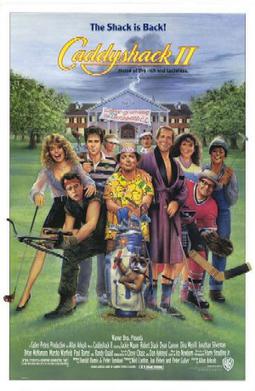
Caddyshack II (1988, directed by Allan Arkush)


Welcome back to Bushwood Country Club!  The Gopher is still stealing balls and burrowing through the course.  Ty Webb (Chevy Chase) is still the majority shareholder of the club, even though he now only plays golf inside of his mansion.  And that’s it!

Only the Gopher and Chevy Chase returned for Caddyshack II.  Ted Knight died before the movie went into production.  Bill Murray didn’t want to recreate his role from the first movie.  Rodney Dangerfield was involved in developing the movie but then dropped out after two million had already been spent in pre-production.  Chevy Chase was paid seven figures to return and he later called it one of the biggest mistakes of his career.  Only the Gopher didn’t complain.

With hardly anyone from the first film willing to come back for a second round, Caddyshack II features comedian Jackie Mason as Jack Hartounian, a real estate developer whose daughter, Kate (Jessica Lundy), wants to be a part of the WASPy Bushwood social set.  When Chandler Young (Robert Stack) keeps the plain-spoken Jack from being given a membership, Jack teams up with his old friend Ty and buys Bushwood.  He turns Bushwood into an amusement park called Jackie’s Wacky Golf.  Kate tells Jack that he’s ruined everything and turned Bushwood into Coney Island.  Chandler hires survivalist Tom Everett (Dan Aykroyd) to kill Jack and then agrees to play Jack in a round of golf.  The winner wins Bushwood.

A bust with both audiences and critics, Caddyshack II is one of the worst sequels ever made.  Why would you do a sequel to Caddyshack that features almost nothing that made the first film so entertaining?  Jackie Mason was a great comedian and writer but he wasn’t much of an actor and he makes a poor replacement for Rodney Dangerfield.  The film really loses me when Chandler Young literally pays money to have Jackie murdered.  It’s just a step too far.  Not even Ted Knight tried to kill Rodney Dangerfield and Dangerfield was a lot more obnoxious than Jackie Mason ever was.  Not even the dancing Gopher can generate much laughs and Kate’s right.  Jackie’s Wacky Golf really is a terrible place.

There are some interesting actors and actresses in the supporting cast.  The lovely Dyan Cannon plays Jack’s love interest and is one of the few good things about the movie, despite having no chemistry with Mason.  Randy Quaid gives a manic performance as Jack’s lawyer, a role that was originally meant for Sam Kinison.  Jonathan Silverman is the good caddy who falls for Jack’s daughter while Chynna Phillips is Chandler’s snobby daughter who befriends Kate and tells her she should change her last name to Hart.  Dan Aykroyd delivers all of his lines in a high-pitched voice that isn’t funny but which becomes very annoying.

The slobs win again.  The snobs are defeated and the Gopher dances with noticeably less enthusiasm.  There has never been a Caddyshack 3.

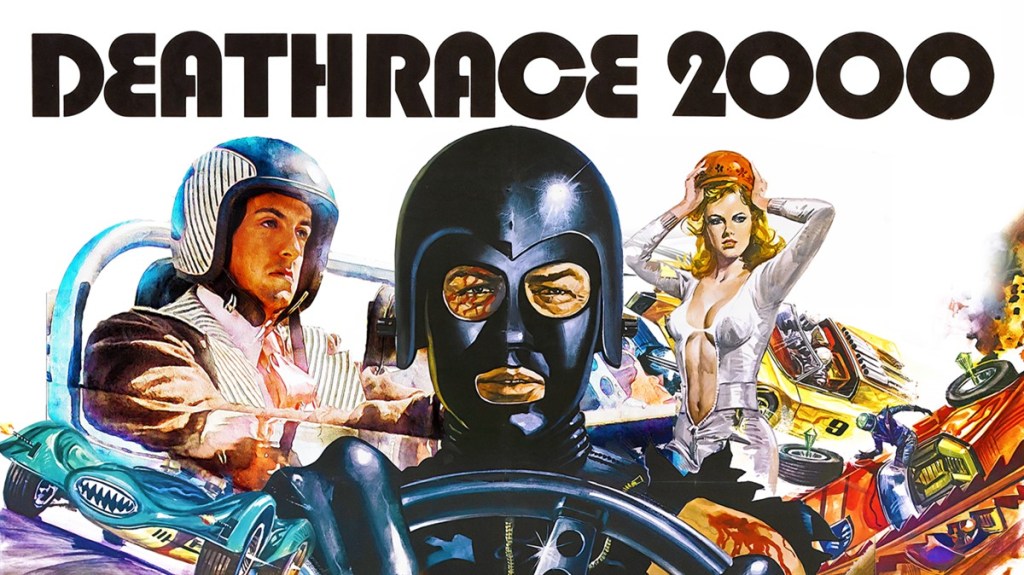
#MondayMuggers – Why DEATH RACE 2000?


Every Monday night at 9:00 Central Time, my wife Sierra and I host a “Live Movie Tweet” event on X using the hashtag #MondayMuggers. We rotate movie picks each week, and our tastes are quite different. Tonight, Monday December 2nd, we’re watching DEATH RACE 2000 starring David Carradine, Sylvester Stallone, Simone Griffith, Mary Woronov, Roberta Collins, and Martin Kove.

So why did I pick DEATH RACE 2000, you might ask? It’s pretty simple. I think it will be a fun movie to watch with a group. Unlike most of my choices, which are movies I’ve seen many times, I’ve only seen DEATH RACE 2000 one time before and it’s been awhile. I’m looking forward to seeing it again myself. I like that it’s a B-movie from legendary producer Roger Corman. That’s usually a good thing. I like that it’s directed by Paul Bartel. Bartel’s EATING RAOUL was one of those movies that helped me appreciate black comedy when I was growing up. I really like the cast, especially David Carradine and Sylvester Stallone. And finally, I like that it’s 80 minutes long. In today’s world where every film feels the need to be between 2 and 3 hours, I’ve grown to really appreciate movies clocking in at 90 minutes or less! 

It’s on Amazon Prime and Tubi. Join us if you’d like!

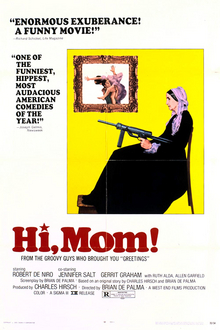
Film Review: Hi, Mom! (dir by Brian De Palma)


Released in 1970, Hi, Mom!, tells the story of Jon Rubin (played by a 26 year-old Robert De Niro).  The somewhat spacey and kind of creepy Jon has just returned to New York City from Vietnam.  After moving into a run-down apartment building and meeting the building’s superintendent (Charles Durning), Jon is hired to direct a pornographic film by producer Joe Banner (Allen Garfield).  Jon’s idea to simply point his camera at his building and to film his neighbors as they go about their day.  As quickly becomes apparent, Jon is mostly just looking for an excuse to watch and film Judy Bishop (Jennifer Salt).

Also living in the building is Gerrit Wood (Gerrit Graham), who is first seen triumphantly putting posters of Che Guevara and Malcolm X up in his apartment.  Gerrit is a freshly-minted political radical and the leader of a group of performance artists who put on a show called Be Black, Baby, in which the white audience members are forced to wear blackface and are then chased, attacked, and assaulted by black actors wearing whiteface.  (Gerrit himself is white.)  Jon is hired to play the police officer who beats and arrests the members of the audience at the end of the performance.  Of course, eventually, the real police show up….

An attempt at an episodic counter-culture comedy, Hi, Mom is definitely a product of the time in which it was made, both in its style and its thematic content.  Today, it’s best-known for being one of Brian De Palma’s early independent films and for featuring Robert De Niro in one of his first starring roles.  De Palma and De Niro aren’t exactly the first names that come to mind when one thinks about comedy and Hi, Mom shows that there’s a good reason for that.  As both a screenwriter who felt he had something important to say and a young director who was obviously eager to show off everything that he could do with a camera, Brian De Palma simply cannot get out of his own way.  Scenes are needlessly sped up.  Scenes are pointlessly slowed down.  The musical cues are obvious.  The dialogue is often so broad that it comes across as being cartoonish.  One gets the feeling that De Palma didn’t trust the audience to get the jokes so he went overboard to make sure everyone knew when to react.  All of the pointless camera trickery serves the same purpose that a laugh track would on an old sitcom.  Interestingly enough, the only sequence that really works as satire is the Be Black, Baby sequence and that’s because De Palma directs it in a semi-documentary fashion.  De Palma gets out of his own way and allow the sequence to develop a natural rhythm.  (Of course, seen today, the scene will bring to mind the upper class white liberals who pay money to have an activist lecture them about their privilege while having their friends over for dinner.)

As for Robert De Niro, he gives a typically nervy performance, one that feels like a dry run for his later work in Mean Streets, Taxi Driver, and King of Comedy.  Despite the reputation of those films, there are some genuinely funny moments to be found in all of them.  Most of them, like the classic Taxi Driver conversation between De Niro’s Travis and Peter Boyle’s Wizard, are funny because of how people react to De Niro’s obviously unhinged characters.  Both Taxi Driver and King of Comedy got mileage out of having normal people try to deal with De Niro’s unstable characters.  In Hi, Mom, everyone is equally wacky and, as such, De Niro doesn’t really have anyone to play off.  No one is really reacting to anything, De Niro-included.  (There is some spark to his scenes with Charles Durning and Allen Garfield but even those scenes seem to drag on forever.)

On the plus side, Hi, Mom! is was shot on the actual streets of New York City, guerilla-style.  (A “Re-Elect Mayor Lindsay” sign in the background confirms that the film was made on location in 1969.)  When De Palma isn’t getting in his own way with all of his fancy camera tricks, he manages to capture so memorably bleak images of New York City.  Hi, Mom! presents New York as being a dirty, crime-ridden, and menacing city but it also captures the odd grandeur of urban decay.  At its best, Hi, Mom! captures the love/hate relationship that many seem to have New York City.  The city feels both alive and dangerous at the same time.  Hi, Mom! is too uneven to work as a sustained satire but, as a documentary about New York at the end of the turbulent 60s, it’s worth watching.

I should mention that this was not the first time that De Palma and De Niro teamed up.  Indeed, De Niro was De Palma’s muse even before he met Martin Scorsese.  Hi, Mom! was a loose sequel to an earlier De Palma/De Niro film called Greetings.  (Like many of De Palma’s future films, both Greetings and Hi, Mom! were originally rated X but later re-rated R.)  De Palma and De Niro, of course, would both go onto have long Hollywood careers.  (They would later reunite for The Untouchables, a big-budget spectacle of a film that’s about as far from the grungy Hi, Mom! as one can get.)  De Palma’s career has had its ups and downs but, as of late, many of his films have been positively reevaluated.  As for De Niro, he can finally kind of play comedy.  That said, I’d rather watch Hi, Mom than Dirty Grandpa.

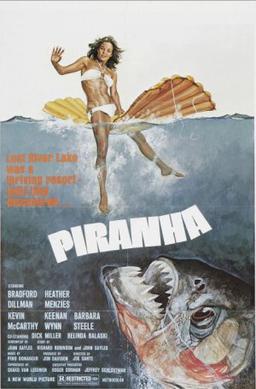
Horror Film Review: Piranha (1978, dir by Joe Dante)


At the height of the Vietnam War, the U.S. Government came up with a plan that could have changed the course of the war.

What if the government developed gigantic, super-fast, occasionally jumpy piranha?  And what if they set those killer fish loose in the rivers of Vietnam?  Would those fish swim through North Vietnam and take out the VC?  Sadly, the war ended before the government got a chance to test out Operation Razorteeth.  With the war over, the government was stuck with a bunch of killer fish.  Scientist Robert Hoak (Kevin McCarthy) ignored all orders to destroy his mutant fish because they were his life’s work.  (Awwwwwwwww!)  He kept an eye on them and did everything he could to prevent them from getting into the nearby river.

Unfortunately, Dr. Hoak’s best wasn’t good enough.  Because the piranha have gotten loose and now they’re making their way down to the river!  They start out eating skinny dipping teenagers, fisherman, and Keenan Wynn.  (They’re good enough not to eat Wynn’s adorable dog, which I appreciated.)  Further down the river, there’s a summer camp and a water park!  It’s definitely not safe to get back in the water but sadly, that’s what several people insist on doing throughout this film.  Even when the water is full of blood, people will jump in.  (It’s easy to be judgmental but it is a pretty river.  I don’t swim but I honestly wouldn’t mind living near a river that looked that nice.  Instead, I have to make due with a creek.)

Floating down the river on a raft and trying to warn everyone is the unlikely team of Maggie (Heather Menzies) and Paul (Bradford Dillman).  Maggie is a detective who has come to town to track down the two teenage skinny dippers who were eaten at the start of the film.  Paul is a drunk.  Well, technically, Paul is a wilderness guide and he does spend the entire movie wearing the type of plaid shirt that would only be worn by someone who goes camping every weekend but really, Paul’s main personality trait seems to be that he enjoys his booze.  Paul’s daughter is away at the summer camp.  Yes, that’s the same summer camp that’s about to be visited by a school of piranha.  AGCK!

Produced by Roger Corman and obviously designed to capitalize on the monster success of Jaws, Piranha was an early directorial credit for Joe Dante.  Dante would later go on to direct films like The Howling and GremlinsPiranha was also an early screenwriting credit for the novelist John Sayles, who would use his paycheck to launch his own directing career.  As a director, Sayles specializes in politically-themed ensemble pieces, which is something you might not guess while watching Piranha.  (Piranha does have an anti-military subplot but then again, it’s a film from the 70s so of course it does.)  Like the best of Corman’s film, Piranha works because it sticks to the basics and it delivers exactly what it promises.  Piranha promises killer fish biting away at anyone dumb enough to get in the water and that’s what it gives us.  As an added bonus, we also get some occasionally witty dialogue and Joe Dante’s energetic, self-aware direction.

As is typical with the films of both Corman and Dante, the cast is full of familiar faces.  Along with Kevin McCarthy as the mad scientist and Keenan Wynn as the eccentric fisherman, Dick Miller shows up as the waterpark owner.  Richard Deacon, who made a career of playing bosses and neighbors on various sitcoms in the 50s and 60s, plays the father of a missing teenager.  Director Paul Bartel plays the head of the summer camp, who may be a jerk but who still heroically jumps in the water to save several campers.  (Bartel’s moment of heroism is one of Piranha’s best scenes and, significantly, it’s played without irony.  You’ll want to cheer for the guy.)  Finally, the great Barbara Steele plays the government scientist who shows up to clean up Operation Razorteeth.

Piranha is simple but entertaining.   Dante’s direction is energetic and, despite the film’s self-referential tone, the killer fish are just savage enough to be scary.  It’s a film that tell us not to get back in the water but which understands that the temptation might just be too strong.

The TSL’s Horror Grindhouse: Chopping Mall (dir by Jim Wynorski)


This 1986 film tells the story of what happens when one local mall decides that it’s had enough of thievery and vandalism.

First off, automatic locks and shutters are installed.  What that means is that, at a certain hour, anyone who is inside the mall is going to be trapped there until the morning.  Secondly, three robots are used as a security force.  They’re called Protectors and they roll around, looking for thieves and keeping people safe.  Don’t worry about getting mistaken for a thief, of course.  As long as you’ve got a badge, the protector will just say, “Thank you and have a good day.”

It all seems perfect but …. what if the robots malfunction?  What if they ignore the badges and just start killing anyone unlucky enough to be trapped in the mall for the night?  Surely, that could never happen, right?

Of course, it does happen.  Thanks to a freak electrical storm, the Protectors come to life and set out to keep the mall safe from intruders.  First, they kill the technicians that are supposed to keeping a watch over them.  Then, they kill a janitor named Walter Paisley (played, of course, by Dick Miller).  Then, they set off after the six attractive people who were having a sleep-over in one of the stores.

So, what did I learn from Chopping Mall?

Well, I was tempted to say that I learned not to shoplift but actually, no one in the movie gets in trouble for shoplifting.  I guess the main thing I learned is not to walk around the mall in my underwear because that definitely seems to be something that will cause the Protectors to blow up your head.

I also learned that, if you’re tapped in the mall with a bunch of killer robots, the best place to go is the sporting goods store because that store not only has a lot of automatic rifles but also an unlimited supply of ammunition.  Of course, I already learned that from Dawn of the Dead but it’s always good to be reminded….

Anyway, Chopping Mall is a lot of fun.  It’s undeniably dated.  Just the fact that everyone’s life revolves around a mall tells you just how dated it is.  I guess if they made the film now, it would have to take place at an Ikea store or maybe an Amazon warehouse.  But the fact that the film is dated is a part of what makes it so much fun to watch.  Seriously, it’s amazing all of the stuff that apparently used to go on at the local mall in the 80s.

Despite the fact that they have a bad habit of killing people, the Protectors are actually kind of cute.  If nothing else, they’re unfailingly polite.  You have to love the fact that they’ll wish you a nice day even after they’ve killed you.  Surprisingly enough, the humans are just as likable as the Protectors.  For a film about killer robots, Chopping Mall is surprisingly well-acted by a likable cast.  Russell Todd, who was the best-looking man to ever be killed by Jason Voorhees, is in this film and he’s as broodingly handsome here as he was in Friday the 13th Part II.

Chopping Mall is a good mix of humor and thrills and robots and exploding heads and Dick Miller.  This is 80s mall horror at its best!

Film Review: Hamlet (dir by Michael Almereyda)


What if Hamlet was a hipster douchebag?

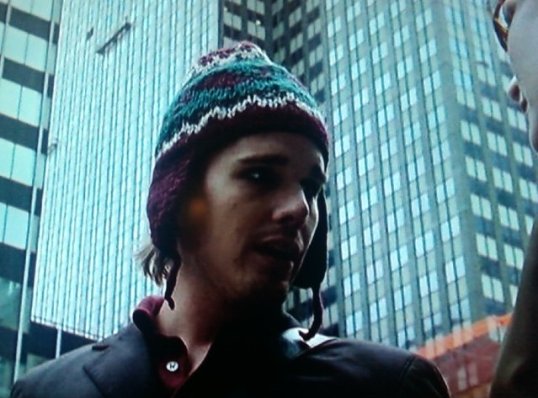
That appears to be the question at the heart of the 2000 film adaptation of William Shakespeare’s most famous play.  In this adaptation, a young Ethan Hawke plays a Hamlet who is no longer a melancholy prince but who is instead a film student with a petulant attitude.

As you probably already guessed, this is one of those modern day adaptations of Shakespeare.  Denmark is now a Manhattan-based corporation.  Elsinore is a hotel.  Hamlet ponders life while wandering around a Blockbuster and, at one point, the ghost of his father stands in front of a Pepsi machine.  While Shakespeare’s dialogue remains unchanged, everyone delivers their lives while wearing modern clothing.  It’s one of those things that would seem rather brave and experimental if not for the fact that modern day versions of Shakespeare have gone from being daring to being a cliché.

At the film’s start, the former CEO of the Denmark Corporation has mysteriously died and his brother, Claudius (Kyle MacLachlan), has not only taken over the company but he’s also married the widow, Gertrude (Diane Venora).  Hamlet comes home from film school, convinced that there has been a murder and his suspicions are eventually confirmed by the ghost of his father (Sam Shepard).  Meanwhile, poor Ophelia (Julia Stiles) takes pictures of flowers while her brother, Laertes (Liev Schreiber), glowers in the background.  Polonius (Bill Murray) offers up pointless advice while Fortinbras (Casey Affleck) is reimagined as a corporate investor and Rosencrantz (Steve Zahn) wears a hockey jersey.  Hamlet spends a lot of time filming himself talking and the Mousetrap is no longer a player but instead an incredibly over-the-top short film that will probably remind you of the killer video from The Ring.

I guess a huge part of this film’s appeal was meant to be that it featured a lot of people who you wouldn’t necessarily think of as being Shakespearean actors. Some of them did a surprisingly good job.  For instance, Kyle MacLachlan was wonderully villainous as Claudius and Steve Zahn was the perfect Rosencrantz.  Others, like Diane Venora and Liev Schreiber, were adequate without being particularly interesting.  But then you get to Bill Murray as Polonius and you start to realize that quirkiness can only take things so far.  Murray does a pretty good job handling Shakespeare’s dialogue but that doesn’t change the fact that he’s totally miscast as the misguided and foolish Polonius.  One could easily imagine Murray in the role of Osiric.  Though it may initially seem a stretch, one could even imagine him playing Claudius.  But he’s simply not right for the role of Polonius.  Murray’s screen presence is just too naturally snarky for him to be convincing as a character who alternates between being a “tedious, old fool” and an obsequious ass kisser.

Considering that he spends a large deal of the movie wearing a snow cap while wandering around downtown Manhattan, Ethan Hawke does a surprisingly good job as Hamlet.  Or, I should say, he does a good job as this film’s version of Hamlet.  Here, Hamlet is neither the indecisive avenger nor the Oedipal madman of previous adaptations.  Instead, he’s portrayed as being rather petulant and self-absorbed, which doesn’t necessarily go against anything that one might find within Shakespeare’s original text.  Hawke’s not necessarily a likable Hamlet but his interpretation is still a credible one.

At one point, while Hamlet thinks about revenge, we see that he’s watching Laurence Olivier’s version of Hamlet on television.  There’s Olivier talking to Yorick’s skull while Hawke watches.  It’s a scene that is somehow both annoying and amusing at the same time.  On the one hand, it feels rather cutesy and more than a little pretentious.  At the same time, it’s so over-the-top in its pretension that you can’t help but kind of smile at the sight of it.  To me, that scene epitomizes the film as a whole.  It’s incredibly silly but it’s so unapologetic that it’s easy to forgive.

The TSL’s Horror Grindhouse: Killer Party (dir by William Fruet)


The 1986 film Killer Party is one of those late 80s slasher films that somehow has developed a cult following.  Up until recently, there was a fairly active fansite devoted to the history of Killer Party and Killer Party still regularly shows up on TCM Underground.

So, apparently, Killer Party has fans.

I’m just not sure why.

Some of it, I suppose, could have to do with the first ten minutes of the film, which are genuinely clever.  It starts out with a young woman being menaced at a drive-in theater and, just when you’ve gotten invested in her story and have started to wonder whether or not she’ll survive the entire movie, it is suddenly revealed that we’ve actually been watching a movie-within-a-movie.  And that movie-within-a-movie then turns out to be part of an incredibly silly music video, featuring a band that is so 80s that you find yourself expecting them to stop performing so they can do a line of coke and play the stock market.  At one point, the band even performs while standing on the drive-in’s concession stand.

It’s all marvelously silly and kind of clever.  The problem is that the rest of the film never lives up to those ten minutes.  In fact, you spend the rest of the movie wishing you were still watching that movie about the girl trapped at the drive-in.

I also suppose that some of the film’s cult reputation has to do with the fact that Paul Bartel has a small supporting role.  Bartel plays the same basic role that he played in almost every horror film in which he appeared.  He’s a pompous professor who says a few dismissive lines and is then promptly killed off.  Maybe it’s the Bartel factor that has led to this film developing a cult following.

Who knows?

Killer Party is essentially four movies in one.  The first movie is that part that I’ve already talked about.  The opening is clever but it only lasts for ten minutes.

After the opening, the film turns into a rather standard college comedy.  Three girls want to join the wildest sorority on campus but it won’t be easy!  Everyone on this campus is obsessed with playing pranks.  And by pranks, I mean stuff like locking a bunch of people outside while they’re naked in a hot tub and then dumping a bunch of bees on them.  Of course, that prank gets filmed and the footage is later shown at a meeting of stuffy old people.  That’ll teach those uptight members of the World War II generation!  You may have made the world safe for democracy but that was like a really, really long time ago!  So there!  It’s time for a new generation, one that will make the world safe for pranks!

During this part of the film, there are only a few hints that we’re watching a horror movie.  For instance, the sorority wants to have a party in an abandoned frat house.  Their housemother goes by the frat house and kneels in front of a grave.  She speaks to someone named Alan and tells him that it’s time to move on.  Then she promptly gets killed and no one ever seems to notice.

The comedy part of the movie segues into a remarkably bloodless slasher movie.  The cast assembles at the forbidden house.  They have a party.  Someone in a diving mask shows up and kills off the majority of the cast in 20 minutes.  Almost everyone dies off-screen so there’s really not even any suspense as far as that goes.

Then, during the last few minutes of the film, the slasher film suddenly turns into a demonic possession film and that seems like that should be brilliant turn of events but it just doesn’t work in Killer Party.  Usually, I love movies that are kind of messy but Killer Party is a rather bland and listless affair.  If you’re going to combine a campus comedy with a slasher film and a demonic possession film, you owe it to your audience to really go totally over the top and embrace the ludicrousness of it all.  Instead, Killer Party rolls out at a languid and rather dull pace.

I would not accept an invitation to Killer Party.


Film Review: Basquiat (dir by Julian Schnabel)


Basquiat.  I love this movie.

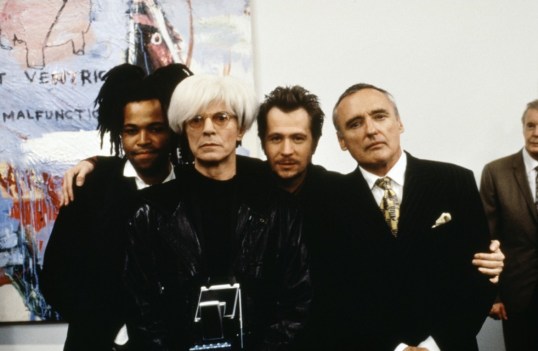
I Shot Andy Warhol was not the only 1996 film to feature Andy Warhol as a character.  He was also a prominent supporting character in Basquiat.  In this film, he’s played by David Bowie and Bowie gives a far different performance than Jared Harris did in I Shot Andy Warhol.  Whereas Harris played Andy as a detached voyeur, Bowie’s performance is far more sympathetic.  (Of course, it should be noted that Harris and Bowie were playing Andy Warhol at very different points in the artist’s life.  Harris played the younger, pre-shooting Warhol.  Bowie played the older, post-shooting Warhol.)

Then again, it’s not just Andy Warhol who is portrayed more positively in Basquiat than in I Shot Andy Warhol.  The entire New York art scene is portrayed far more positively in Basquiat.  Whereas I Shot Andy Warhol was a film about an outsider who was destined to forever remain an outsider, Basquiat is a film about an outsider who becomes an insider.  On top of that, Basquiat was directed by a fellow insider, painter Julian Schnabel.

The film itself is a biopic of Jean-Michel Basquiat (very well played by Jeffrey Wright), the graffiti artist who, in the 1980s, briefly became one of the superstars of the New York art scene.  However, it’s less of a conventional biopic and more of a meditation on what it means to be an artist.  Throughout the film, Basquiat looks up to the New York skyline and sees a surfer riding a wave across the sky.  The image itself is never explicitly explained.  We never learn why, specifically, Basquiat visualizes a surfer.  But then again, that’s what makes the surfer a perfect symbol of Basquiat’s artistic sensibility and talent.  It’s a reminder that, while we can appreciate an artist’s work, only the artist can truly understand what that work is saying.  All attempts to try to explain or categorize art are as pointless as trying to understand why that surfer is in the sky.  Ultimately, the why is not as important as the simple fact that the surfer is there.

The film follows Basquiat as he goes from living on the streets to being a protegé of Andy Warhol’s and, until he overdosed on heroin, one of the shining lights of the New York art scene.  Along the way, Basquiat struggles to maintain a balance between art and the business.  In one of the key scenes of the film, an empty-headed suburbanite (Tatum O’Neal) looks at Basquiat’s work and whines that there’s too much green.  She just can’t handle all of that green.

Basquiat’s friendship with Andy Warhol provides this film with a heart.  When Bowie first appears — having lunch with a German art dealer played by Dennis Hopper — one’s natural instinct is to assume that Bowie as Warhol is stunt casting.  However, Bowie quickly proves that instinct to be wrong.  As opposed to many of the actors who have played Andy Warhol over the years, Bowie gives an actual performance.  Instead of resorting to caricature, Bowie plays Warhol as being mildly bemused by both his fame and the world in general.

Basquiat also develops a close friendship with another artist.  Gary Oldman may be playing a character named Albert Milo but it’s obvious from the moment that he first appears that he’s playing the film’s director, Julian Schnabel.  If there was any doubt, Schnabel’s studio stands in for Milo’s studio.  When Milo shows off his work, he’s showing off Schnabel’s work.  When Albert Milo introduced Basquiat to his parents, the nice old couple is played by Julian Schnabel’s actual parents.  It’s perhaps not surprising that Albert Milo is presented as being one of the most important and popular artists in New York City.  In a film full of bitchy characters, Albert Milo is unique in that literally everyone likes and respects him.  And yet Gary Oldman gives such a good and heartfelt performance that you can’t hold it against the character that he happens to be perfect.  There’s a small but touching scene in which Albert Milo and his daughter share a dance in front of one of Schnabel’s gigantic canvases.  Of course, Milo’s daughter is played by Julian Schnabel’s daughter.

The entire cast is full of familiar actors.  Willem DaFoe appears as a sculptor.  Christopher Walken plays a hilariously vapid interviewer.  Courtney Love plays a groupie.  Benicio Del Toro plays Basquiat’s best friend.  Parker Posey shows up as gallery owner Mary Boone.  Michael Wincott plays Rene Ricard, the somewhat infamous art critic who was among the first to celebrate the work of both Basquiat and Schnabel.  For once, the use of familiar actors does not sabotage the effectiveness of the film.  If anything, it helps to explain why Basquiat was so determined to make it.  There’s a magical scene where a then-unknown Basquiat peeks through a gallery window and sees Andy Warhol, Albert Milo, and Bruno Bischofberger.  However, the film’s audience sees David Bowie, Gary Oldman, and Dennis Hopper.  What both Basquiat and the audience have in common is that they’re both seeing bigger-than-life stars.

Basquiat is an often magical and poignant film and I absolutely love it.

Back to School #22: Rock ‘n’ Roll High School (dir by Allan Arkush)


Originally, when I started this series of Back to School reviews, I was planning on reviewing Grease.  After all, everyone has seen that film.  It’s on TV all the time.  (Looking in your direction, AMC.)  It’s a musical, which is a genre that I love but one which I also rarely seem to review.  The movie features a good performance from Stockard Channing.  It also has a lot of dancing and you know how much I love that.  And speaking of love, a lot of people seem to absolutely love Grease.

But, the more I thought about it, the more I realized that while others may love Grease, I don’t.  Oddly enough, I always seem to fool myself into thinking that it’s a fun movie but then I make the mistake of watching it whenever it pops up on AMC and every time, I am surprised to discover just how boring Grease really is.  The majority of the cast play their roles as if they’re still on a Broadway stage and projecting to the back of the house.  Olivia Newton-John is miscast.  John Travolta appears to be acting on auto pilot.  Both the songs and even Stockard Channing are never as good as I remembered.  Worst of all, the dance numbers are so ineptly staged and filmed that, half-the-time, you can’t even see what anyone’s doing with their feet.

While I certainly don’t have any problem writing a negative review (and check out my thoughts on Avatar if you doubt me), I wanted to end the 70s on a positive note.  So, instead of telling you that Grease isn’t good as many people seem to think, I want to recommend another film that, like Grease, features a lot of singing and dancing but which also happens to be a lot of more fun.

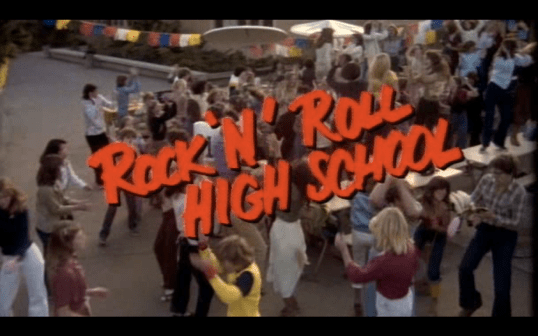
That film, of course, is the 1979 cult classic Rock ‘n’ Roll High School.

screen-shot-2010-04-27-at-1-34-11-am

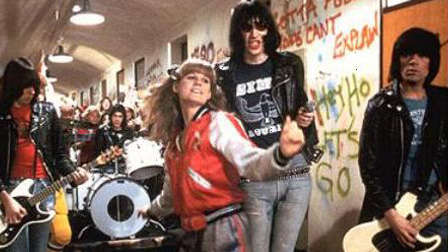
Things are amiss at Vince Lombardi High School.  The students are so obsessed with rock and roll (and the music of the Ramones, in particular) that they have caused several principals to quit.  The hallways are a disorganized mess.  Student Riff Randall (P.J. Soles) spends all of her time having fantasies about the way that Joey Ramone eats pizza.  A strange students named Eaglebauer (Clint Howard) runs a shadowy company known as Eaglebauer Enterprises out of a smoke-filled boy’s restroom.  (He’s even got an administrative assistant to schedule meetings for him.)  Handsome jock Tom Roberts (Vincent Van Patten) can’t get a date, largely because he’s obsessed with Riff who is obsessed with the Ramones.  Little does Tom realize that Riff’s best friend, the sweet and intelligent Kate Rambeau (Dey Young), has a crush on him.

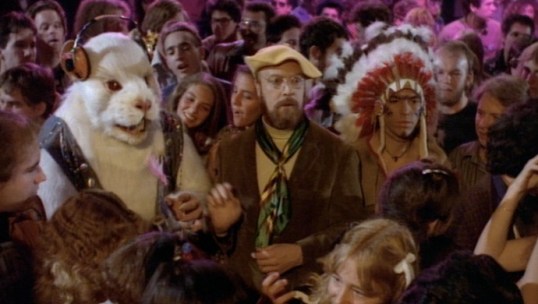
The school board hires a new principal to bring some peace to the high school.  Ms. Togar (Mary Woronov) is a strict and mentally unbalanced disciplinarian who, with the help of two apparently subhuman hall monitors, is determined to suppress any sort of fun, rebellion, or free thought.  Togar hates loud music, mostly because it causes white mice to spontaneously explode.  (When, late in the film, a human-sized white mouse — or he could have just been a very strange man wearing a white mouse costume, the film is ambiguous on this point — attempts to enter a Ramones concert, he’s turned away for his own good.  Until, of course, he reveals that he’s brought along headphones for his own protection…)

rat


In the end, it all comes down to this: Togar and her allies want to burn records.  Riff and the Ramones want to stop her.  And maybe blow up the school.  (David from Massacre at Central High would have been a fan of the Ramones.)

Rock ‘n’ Roll High School is an intentionally over-the-top film that both celebrates youthful rebellion while satirizing traditional high school films.  The jokes (which are a good combination of the silly and the genuinely clever) come non-stop, the actors all bring a lot of energy to their roles, and the entire film is just a lot of fun. As played by P.J. Soles, Riff Randall really is the ideal best friend and I imagine that a lot of boys in 1979 probably walked out of the theater with a huge crush on both P.J. Soles and Dey Young.  And finally, Mary Woronov gives a wonderfully demented performance as Ms. Togar.

rock-n-roll-high-school-1979


Rock ‘n’ Roll High School seems like the perfect film to end the 70s with.  Tomorrow, Back to School continues with the 80s!  So, if you’ve never seen Rock ‘n’ Roll High School before, watch it below!

http://www.youtube.com/watch?v=gKUHFI1dnKo