Horror Film Review: The Norliss Tapes (dir by Dan Curtis)


1973’s The Norliss Tapes begins with a disappearance.

David Norliss (Roy Thinnes), a California-based journalist, has vanished.  Before he disappeared, he had started work on a book that would have detailed his own adventures investigating the paranormal.  Though Norliss vanishes, he leaves behind several audiotapes in which he discusses some of the frightening things that he has seen.  Searching for clue about Norliss’s disappearance, his editor, Sanford T. Evans (Don Porter), sits down and listens to the tapes.

(Incidentally, Sanford T. Evans is a wonderful name for an editor.  It’s a name that just says, “My father knew Hemingway and I went to the University of Pennsylvania as a legacy.’)

As Evans listens to each tape, we watch the story unfold from Norliss’s point of view.  In this film, we watch as Norliss investigates an incident in which Ellen Sterns Cort (Angie Dickinson) claims that she was recently attacked by her dead husband, James Cort (Nicki Dimitri).  James was an artist who, in his final days, became obsessed with the occult and fell under the influence of the Mademoiselle Jeckiel (Vonetta McGee), a mysterious woman who claimed to appreciate James’s art and who gave him a scarab ring that he insisted on being buried with.

Norliss interviews Ellen and investigates her story.  He’s far more sympathetic to the idea of James having returned from the dead than the local sheriff (Claude Akins) is.  Of course, the sheriff has problems of his own.  Dead bodies keep turning up in his county, their skin gray and their bodies drained of blood.  Hmmm …. I wonder if that could have anything to do with James Cort and his scarab ring….

The Norliss Tapes is a pretty simple film.  Norliss shows up and then basically waits around until James Cort makes an appearance.  The film only runs 72 minutes and it’s very much a pilot for a television series that never went into production,  Apparently, each episode would have featured Stanford listening to a different tape and hearing about David Norliss and a weekly guest star dealing with some sort of supernatural occurrence.  Director Dan Curtis was also responsible for the cult television series, Kolchak: The Night Stalker, and The Norliss Tapes feels very much like a dry run for that show.  The main difference is that Roy Thinnes’s David Norliss is nowhere near as nervous as Darren McGavin’s Carl Kolchak.

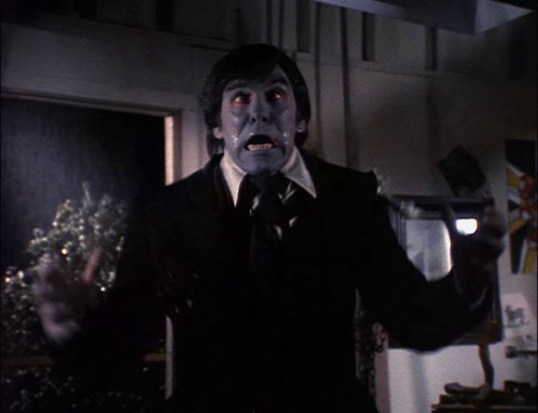
That said, the exact details for what’s going on with James Cort are almost ludicrously complicated.  It turns out that James Cort is not only trying to cheat death but he’s also helping an ancient Egyptian deity invade our world.  It’s best to ignore the nonsense about the Egyptian Gods and instead just focus on how creepy the undead James Cort is.  With his hulking frame, his gray skin, and his nearly glowing eyes, Cort is a truly frightening monster and he’s certainly the most impressive thing about this movie.  What makes Cort such an effective villain is how angry he seems to be.  Whenever he’s on screen, he’s either bursting through a door or chasing someone.  He’s pure nightmare fuel.

The Norliss Tapes never became a series but it did do well in Europe, where it was released in theaters.  The Norliss Tapes still has a cult following, not bad for a failed pilot.  Who knows what other adventures David Norliss could have had?

14 Days of Paranoia #3: The Lincoln Conspiracy (dir by James L. Conway)


When it comes to conspiracy theories involving presidential assassinations, the theories surrounding JFK may get all the attention but it’s the theories surrounding the death of Abraham Lincoln are usually far more plausible.

Unless, of course, it’s the theories that are pushed in the 1977 docudrama, The Lincoln Conspiracy.

A mix of documentary-style narration and really cheap-looking historical reenactments, The Lincoln Conspiracy essentially indicts almost everyone who was alive in 1865 as being a part of either the conspiracy or the subsequent cover-up.  Really, it’s remarkable how many historical figures are implicated in this film.

With the Civil War coming to a close, President Lincoln (John Anderson) hopes to pursue a generous reconstruction policy for the former Confederate States.  Secretary of War Edwin Stanton (Robert Middleton), Senator Ben Wade (Dick Callinan), and a host of other are all opposed to this plan, both because they want vengeance and they also want to make as much money as possible off of the Southern cotton fields.  They come up with a plan to impeach Lincoln but, in order to draw up the articles, they have to make sure that Lincoln is not seen for a few days.  When Col. Lafayette Baker (John Dehner) discovers that an actor named John Wilkes Booth (Bradford Dillman) is planning on kidnapping Lincoln, Stanton and his conspirators decide to give Booth their unofficial support.  However, when the plan changes at the last minute and Stanton decides that it would actually be a bad idea to kidnap Lincoln, an angry Booth decides to just kill Lincoln, Andrew Johnson, and William Seward.

Booth succeeds in shooting Lincoln and making his escape.  The other members of Booth’s group all fail in their assignments.  Andrew Johnson becomes president.  Though grievously wounded, William Seward survives.  Booth flees to Canada and …. oh, you thought Booth died?  No, that was just a look alike who was shot by a bizarre soldier named Boston Corbett.  By allowing everyone to believe that Booth was killed, Stanton is able to cover up any role he and his allies played in inspiring the assassination.  Unfortunately, Col. Baker keeps a diary and it seems like he might be planning on revealing the truth but he dies mysteriously before he can.

(And, to give the film some credit, Col. Baker’s sudden death at 41 was an odd one.  And, though it’s not really explored in the film, Boston Corbett, the man who shoot Booth, really was a weirdo who was described by contemporaries as being a religious fanatic who castrated himself and claimed to hear the voice of God.)

It’s a big conspiracy theory that is presented in The Lincoln Conspiracy.  In fact, it’s a bit too big to really be taken seriously.  The film pretty much accuses everyone in Washington of having a part in the assassination.  The film itself has the cheap look of a community theater production and the use of Dr. Samuel Mudd as a narrator only adds to the film’s silliness.  If you’re a fan of gigantic and thoroughly implausible conspiracy theories, as I am, the film is entertaining in its way.  If nothing else, Bradford Dillman certainly looks like how most people probably imagine John Wilkes Booth to have looked.  Otherwise, The Lincoln Conspiracy is far-fetched and not at all realistic, which is why I assume that a lot of people in 1977 probably believed every word of it.

Previous entries in 2025’s 14 Days Of Paranoia:

  1. The Fourth Wall (1969)
  2. Extreme Justice (1993)

Horror on the Lens: The Norliss Tapes (dir by Dan Curtis)


The Norliss Tapes (1973, dir by Dan Curtis)

Today’s Horror on the Lens is The Norliss Tapes, a 1973 made-for-TV movie that was also a pilot for a television series that, unfortunately, was never put into production.

Reporter David Norliss (Roy Thinnes) has disappeared.  His friend and publisher, Stanford Evans (Don Porter), listens to the tapes that Norliss recorded before vanishing. (Stanford Evans, it must be said, is a great name for an editor.)  Each tape details yet another paranormal investigation.  (Presumably, had the series been picked up, each tape would have been a different episode.)  The first tape tells how Norliss investigated the mysterious death of an artist who apparently returned from the grave.

For a made-for-TV movie, The Norliss Tapes is pretty good.  It’s full of atmosphere and features a genuinely menaching yellow-eyed zombie monster. The film was directed by Dan Curtis, who was responsible for several made-for-TV horror films and who also created the deathless TV show, Dark Shadows. Curtis also directed a few feature films. Burnt Offerings, for instance, will be forever beloved for its scene of annoying little Lee Montgomery getting crushed by a chimney. If you ever get a chance to listen to the director’s commentary that Dan Curtis recorded for the Burnt Offerings DVD release, you must do so. Curtis comes across as the crankiest man on the planet and it’s actually kind of fascinating to listen to. His irritation when Karen Black keeps asking him if he knows the name of the actor who played the ghostly chauffeur is truly an amazing thing to here. (For the record, the actor’s name was Anthony James, he also had important supporting roles in two best picture winners — In The Heat of the Night and Unforgiven — and yes, he was one of the best things about Burnt Offerings. Karen Black knew what she was talking about.)

But back to The Norliss Tapes!

Admittedly, this is not the first Halloween in which I’ve shared The Norliss Tapes with our readers. Back in both 2015 and 2021, The Norliss Tapes was one of our “horrors on the lens.” Unfortunately, there’s only so many good quality, public domain horror films available on YouTube so, occasionally, a movie is going to show up more than once over the years. But, as long as it’s good film, who cares?

Enjoy The Norliss Tapes!

Horror on the Lens: Track of the Moon Beast (dir by Richard Ashe)


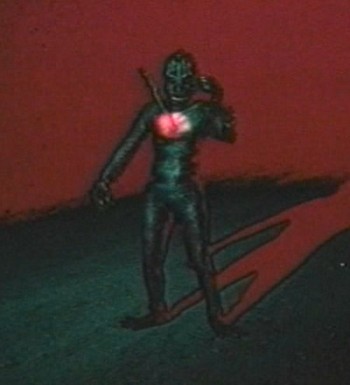
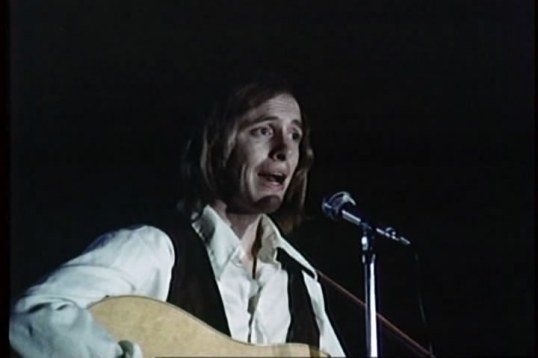
When it comes to bad movies from the 70s, you have to love a movie like 1976’s Track of the Moonbeast.  This film takes place in New Mexico and tells the story of Paul (Chase Cordel), a slow-talking mineralogist who gets a chunk of moon rock lodged into his brain.  As a result, he turns into a gigantic lizard and goes around killing people.  His only hope appears to be his old friend, the stoic Profession Johnny Longbow (Gregorio Sala), who knows all sorts of indian lore.  He also knows how to make stew and early on in the film, he gives a world-weary monologue about what ingredients he puts in his stew.  (Onions, mostly).  Anyway, this is an awful, awful film that’s full of bad acting, bad special effects, and dumb dialogue.  It’s also a lot of fun and it features the guy pictured below singing a song called California Lady that totally got stuck in my head.  I loved Track of the Moon Beast.

Enjoy!

Back to School Part II #8: Hollywood High (dir by Patrick Wright)


517prRI0TEL

If I may, for a second, quote the theme song from Degrassi, the greatest television show ever:

Whatever it takes…

I know I can make it through!

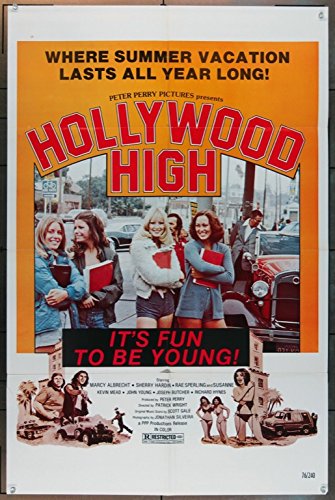
That song was running through my head as I watched the 1977 “comedy,” Hollywood High.  At times, I didn’t know if I’d be able to make it through.  Hollywood High was not only bad but it was boring as well!  This is one of those films where every line of dialogue is followed by a minute or so of awkward silence as the cast struggles to remember who speaks next.  I’ve often written of the importance of ensemble chemistry.  Well, Hollywood High is a perfect example of what happens when a cast doesn’t have any chemistry at all.  They’re all playing friends and lovers but you get the feeling that none of them knew each other before film started and no one saw each other after it ended.

Whatever it takes…

I know I can make it through!

It’s a comedy but nothing funny ever happens.  As far as plot goes, it’s about four interchangeable girls who go to Hollywood High School and who spend most of their time on the beach, getting naked while some of the most generic west coast music imaginable plays in the background.  One of the girls (it’s never clear which) has a super cool boyfriend named Fenzie.  Fenzie wears a leather jacket and starts every sentence with, “Heeeeeeeey!” and he also says stuff like, “The Fenzie needs a beer!” No, his name is not Fonzie.  It’s FENZIE!

Whatever it takes…

I know I can make it through!

At one point, the four girls are driving down the highway in their red roadster.  (And you better believe that there’s a song on the soundtrack called “Red Roadster.”)

“We need gas!” one of them says.

“We need oil!” another one replies.

“We need a lube job!” one points out.

“We need Big Dick!” the driver announces.

Well, of course … oh wait.  It turns out that Big Dick is an auto mechanic.  He’s also a dwarf!  When he first shows up on screen, one of the girls says, “Oh, I see.  That’s funny.”

Whatever it takes…

I know I can make it through!

Anyway, Big Dick tries to cheat film star June East (Marla Winters).  The girls all love June East so one of them has sex with Big Dick so that June won’t have to pay her bill.  June is so impressed that she says, “Why don’t you come down and see me sometime?”  You know what that means!  It’s orgy time at June East’s mansion.  The girls are shocked to discover that June’s lover is the flamboyant teacher (played by an actor named Hy Pyke) who they previously assumed was gay!

Whatever it takes…

The girls then look straight at the camera.

“This,” one of them says.

“Is,” another one adds.

“The,” the third chimes in.

“End!”  the fourth one says with a smile.

…I know I can make it through!

And somehow, I did make it through!  Finally, this movie ended!  I breathed a huge sigh of relief and then I wrote this review.  And, in case I haven’t made it clear, Hollywood High is one of the worst movies ever made.  It didn’t even work as a time capsule because it left me hating the 70s with such a passion that I’m probably going to have to rewatch Saturday Night Fever, Dazed and Confused, Boogie Nights, and American Hustle to remind myself why I was ever fascinated by the decade in the first place!

I made it through Hollywood High.  And now, let us never speak of it again…