Lisa Reviews An Oscar Nominee: On Golden Pond (dir by Mark Rydell)


(With the Oscars scheduled to be awarded on March 4th, I have decided to review at least one Oscar-nominated film a day.  These films could be nominees or they could be winners.  They could be from this year’s Oscars or they could be a previous year’s nominee!  We’ll see how things play out.  Today, I take a look at the 1981 best picture nominee, On Golden Pond!)
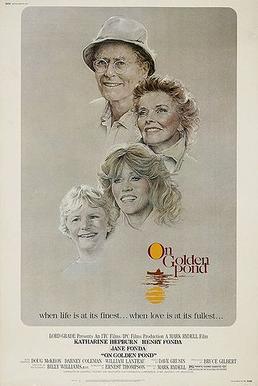
On Golden Pond takes place in a cottage that’s located on a lake called Golden Pond.  Hence, the title.  As far as title’s go, it’s not a bad one.  It’s a film about an elderly couple who spends every summer in that cottage.  They’re in their golden years so I guess it makes sense that they would feel an affinity for Golden Pond.

That said, I think that an even better title for the film would be Everything Annoys Norman.

Norman Thayer, Jr. (Henry Fonda) is a cantankerous old man.  He’s 79 and not particularly looking forward to celebrating his 80th birthday.  He’s a retired college professor.  His wife claims that the last time Norma was really happy was when Franklin Roosevelt was elected president.  Norman likes to fish and still brags about the time he caught a legendary trout named Walter.

What Norman doesn’t like is having to deal with the world.  When he stops to get gas, he loudly complains that, “in his day,” gas only cost eighty-five cents.  When he’s told that there’s another “middle-aged” couple on the lake, he says that, unless he’s going to live to be 150, he’s not middle-aged.  He gets frustrated because his memory isn’t as good as it used to be.  When he goes out for a walk in the woods, he forgets where the path is and he has to return to the house.  Sometimes, he calls people by the wrong name.  At one point, he struggles to use a landline phone.  (I can only imagine how annoyed Norman would be if he was alive today.)  Norman doesn’t like to deal with anyone other than his wife.

Ethel (Katharine Hepburn) is Norman’s wife.  She loves him.  When she hears Norman referred to as being “a son of a bitch,” she replies, “That son of a bitch is my husband.”  Ethel is used to Norman and his ways.  As she puts it, she understands that he’s like a “lion” who has to roar just to remind himself that he still can.  Ethel is … well, basically, she’s Katharine Hepburn.

Ethel has invited their daughter, Chelsea (Jane Fonda), to celebrate Norman’s birthday with them.  Norman and Chelsea have a strained relationship.  It’s implied that Norman was an emotionally distant and overly critical father and that Chelsea has never been able to forgive him.  When she shows up with her new boyfriend, Bill Ray (Dabney Coleman) and his 13 year-old son, Billy Ray (Doug McKeon), Norman barely bothers to acknowledge her.  With Bill and Chelsea planning on vacation in Europe, they ask if Billy can stay at the cottage with Norman and Ethel.  Ethel agrees.  Norman acquiesces.

On Golden Pond is a film that I wanted to like more than I actually did.  After all, the film features two classic actors, Henry Fonda and Katharine Hepburn, appearing in their only film together.  (Both Henry Fonda and Hepburn won Oscars for their work here.)  Henry Fonda gives a good performance as a strong-willed man who is struggling to deal with his own mortality.  As for Hepburn, it’s not a great performance, largely because Ethel is a thinly written role, but she’s Katharine Hepburn so it doesn’t matter.  But almost everything about the film — from the tasteful music to the pretty but not overwhelming cinematography — feels more like something you’d expect to find in a television production instead of a feature film.  On Golden Pond was based on a play and, with almost all of the action set in that cottage, it really doesn’t escape its theatrical origins.  That said, it’s a sweet movie.  The love between Norman and Ethel feels real.  If nothing else, the film gave the great Henry Fonda his only Oscar.

On Golden Pond was nominated for Best Picture but lost to Chariots of Fire.

Lisa Reviews An Oscar Nominee: Working Girl (dir by Mike Nichols)


(With the Oscars scheduled to be awarded on March 4th, I have decided to review at least one Oscar-nominated film a day.  These films could be nominees or they could be winners.  They could be from this year’s Oscars or they could be a previous year’s nominee!  We’ll see how things play out.  Today, I take a look at the 1988 best picture nominee, Working Girl!)

Welcome to the 80s!

Yes, Working Girl is definitely a film of its time.  It’s a film that’s obsessed with big things: big dreams, big offices, big money, and big hair.  It’s a movie where the heroes talk about hostile takeovers and where everyone’s dream is to eventually to be an executive on Wall Street.  You know all of those people who claim that The Big Short is the greatest movie ever made?  I can guarantee that the majority of them would totally hate every character in Working Girl.  Working Girl is such a film of the past that it even features Alec Baldwin doing something other than bellowing at people.  In fact, Baldwin’s actually sexy in Working Girl.  It was strange to see him in this film and realize that he was the same actor who currently spends all of his time picking fights on twitter and defending James Toback.

Of course, Alec Baldwin has a relatively small role in Working Girl.  He plays Mick Dugan, the type of blue-collar guy who gives his girlfriend lingerie for her birthday (“I just wish you would get me something that I could wear outside,” she says as she tries it on) and who then proceeds to cheat on her while she’s off at work.  From the minute we first meet Tess McGill (Melanie Griffith), we know that she deserves better than Mick.

Tess is a professional administrative assistant.  She’s just turned 30 but she’s not ready to give up her dreams and settle for a life of fighting off coke-snorting executives and coming home to some guy like Mick.  (Speaking of early performances from infamous actors, one of the coke-snorting executives is played by Kevin Spacey.)  Tess has got a bachelor’s degree in Business.  As she puts it, she has a “mind for business and a bod for sin.”

She’s also got a new boss, an up-and-coming executive named Katharine Parker (Sigourney Weaver).  It turns out that Katherine is 29 years old.  (“I’ve never worked for someone younger than me before,” Tess says as Katherine gives her a condescending smile.)  Katharine encourages Tess to think of her as being a mentor.  If Tess has any ideas for investments, she should feel free to bring them to Katharine.  Of course, when Tess does so, Katharine claims that her bosses shot the idea down.  It’s only after Katharine breaks her leg in a skiing accident and is laid up in Europe that Tess discovers that Katharine has actually been stealing her ideas and not giving her any credit for them.

What is Tess to do?  Well, she does what any of us would do.  She passes herself off as an executive and presents her idea to Jack Trainer (Harrison Ford) herself.  Jack is impressed with the idea but he’s even more impressed with Tess.  Of course, complicating things is that Jack was once in a relationship with Katharine and Katharine still thinks that she’s going to eventually marry Jack.  And, of course, there’s the fact that Tess is lying about actually being an executive…

Working Girl is a frequently amusing film, elevated by performances of Melanie Griffith and, in the role of Tess’s best friend, Joan Cusack.  Add to that, Harrison Ford is remarkable non-grouchy as Jack Trainer and Sigourney Weaver appears to be having the time of her life playing a villain.  Even as I laughed at some of the lines, here was a part of me that wished that the film had a bit more bite.  At times, Working Girl tries too hard to have it both ways, both satirizing and celebrating Wall Street culture.  In the end, the film works best as a piece of wish-fulfillment.  It’s a film that says that not only can you win success and Harrison Ford but you can get your bitchy boss fired too.

Despite being a rather slight (if likable) film, Working Girl was nominated for Best Picture of 1988.  However, it lost to Rain Man.

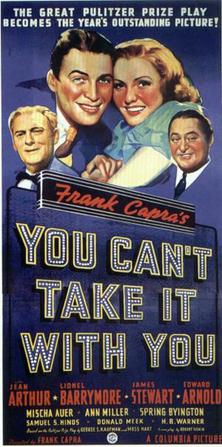
Lisa Reviews An Oscar Winner: You Can’t Take It With You (dir by Frank Capra)


(With the Oscars scheduled to be awarded on March 4th, I have decided to review at least one Oscar-nominated film a day.  These films could be nominees or they could be winners.  They could be from this year’s Oscars or they could be a previous year’s nominee!  We’ll see how things play out.  Today, I take a look at the 1938 best picture winner, You Can’t Take It With You!)

“You can’t take it with you.”

If there’s any one belief that defines the worldview of Martin Vanderhof (Lionel Barrymore), it’s this.  It doesn’t matter how much money you make in your life.  It doesn’t matter how successful you are at business or anything else.  The fact of the matter is that, when your time is up, you won’t be able to take any of that stuff with you.  Instead, Grandpa Vanderhof (as he’s called by his large family) believes that the most important thing to do during your lifetime is to make friends and pursue what you’re truly interested in.

Vanderhof has another belief, one that particularly appealed to be me.  He has never paid income tax.  He doesn’t see the point of giving money to the government when he doesn’t feel that they’ll make good use of it.  When an outraged IRS agent (Charles Lane) stops by Vanderhof’s sprawling house and demands that Vanderhof pay his taxes, Vanderhof refuses.  When the IRS man argues that the income tax is necessary to pay for the Presidency, the Congress, and the Supreme Court, Vanderhof offers to give him five dollars.  “Hell yeah!” I shouted at the TV.  With an attitude like that, Vanderhof should have moved down here to Texas.  We would have elected him governor.

Grandpa Vanderhof is the head of a large and cheerfully eccentric family, all of whom live together under the same roof.  Penny (Spring Byington) writes novels because, years ago, a typewriter was accidentally delivered to the house.  Her husband, Paul (Samuel S. Hinds), has a basement full of fireworks.  Essie (Ann Miller) loves to dance and spends almost the entire movie twirling from room to room.  Her husband, Ed (Dub Taylor), is a xylophone player.

Of course, it’s not just family living in the Vanderhof House.  There’s also Potap Kolenkhov (Mischa Auer), a Russian who is “teaching” Essie how to dance.  There’s Rheba the maid (Lillian Yarbo) and Donald (Eddie Anderson) the handyman.  Actually, the house appears to be open to just about anyone who wants to stay.

And then there’s Penny’s daughter, Alice (Jean Arthur).  Alice is the most “normal” member of the family.  She has just become engaged to Tony Kirby (James Stewart) and she is still trying to figure out how to introduce Tony’s stuffy parents (Edward Arnold and Mary Forbes) to her eccentric family.  What she and Tony don’t know is that Mr. Kirby is currently trying to buy up all the houses that are near a competitor’s factory.  Only one homeowner has refused to sell.  The name of that homeowner?  Martin “Grandpa” Vanderhof.

It all leads, of course, to one chaotic dinner party, one lively night in jail, and a huge fireworks display.  It also leads to true love, which is nice.  Jimmy Stewart and Jean Arthur are even more adorable here than they were in Mr. Smith Goes To Washington.

Based on a Pulitzer-winning play by George S. Kaufman, You Can’t Take It With You was the second comedy to win the Oscar for Best Picture.  The first comedy to win was 1934’s It Happened One Night.  It’s probably not coincidence that both of these films were directed by Frank Capra.

Seen today, You Can’t Take It With You seems a bit slight for an Oscar winner.  Grandpa Vanerhof is a lovable eccentric.  Tony’s father is a stuffy businessman.  Hmmm … I wonder whose philosophy is going to be victorious at the end of the movie?  Still, predictability aside, it’s a delightfully enjoyable film.  While it never quite escape its stage origins, it features wonderful performances from all the usual members of the Capra stock company.  James Stewart and Jean Arthur are a charming couple while Lionel Barrymore gives a performance that is so warmly likable that it’s hard to imagine that, just 9 years later, he would be so perfectly cast as the heartless Mr. Potter in It’s A Wonderful Life.  Of course, my favorite member of the member was Essie, mostly because I also like to dance from room to room.  While it’s hard to justify awarding it Best Picture over The Adventures of Robin Hood and Grand Illusion, You Can’t Take It With You is still a wonderfully fun movie.

It’ll make you smile and laugh.  Who can’t appreciate that?


Lisa Reviews An Oscar Nominee: Dodsworth (dir by William Wyler)


(With the Oscars scheduled to be awarded on March 4th, I have decided to review at least one Oscar-nominated film a day.  These films could be nominees or they could be winners.  They could be from this year’s Oscars or they could be a previous year’s nominee!  We’ll see how things play out.  Today, I take a look at the 1936 best picture nominee, Dodsworth!)

Dodsworth is the type of film that makes me thankful for both TCM and my own obsession with Oscar history.

Based on a Sidney Howard-penned stage adaptation of a Sinclair Lewis novel, Dodsworth tells the story of an American couple abroad and how their travels change them as both individuals and as a couple.  Sam Dodsworth (Walter Huston) is a wealthy man living in the middle of the United States.  20 years ago, he founded Dodsworth Motors and now, he’s finally reached the point where he can sell his company and retire.  Sam doesn’t have any big plans, not yet anyway.  Mostly, he just wants to visit Europe with his wife, Fran (Ruth Chatterton).  They’ve never been.

Walter Huston is perfectly cast as Sam Dodsworth.  When we first meet Sam, we’re not really sure whether we’re going to like him or not.  He seems to be a decent human being but he also seems to be rather resistant to change.  He’s a self-made man.  He’s smart but he’s not well-educated.  He’s honest but he’s stubborn.  He’s rich but he’s hardly sophisticated.  He says that he wants to experience new things but we can’t help but wonder how he’s going to react when he actually has the opportunity.

The cracks in Sam and Fran’s marriage become obvious as soon as they board a luxury liner heading for England.  Sam meets another traveler, Edith (Mary Astor).  Edith is divorced and lives in Italy, two things that make her very exotic to a proud product of middle America like Sam Dodsworth.  Edith and Sam immediately hit it off but there’s no way that Sam would ever consider having an affair.  Meanwhile, Fran finds herself attracted to a series of different Europeans, played by David Niven, Paul Lukas, and Gregory Gaye.  While Fran loves Europe, Sam finds himself yearning to return to the small town world that he knows best.

For a film that was released 82 years ago, Dodsworth remains a remarkably watchable and involving film.  Along with featuring brilliant lead performances from Walter Huston, Ruth Chatterton, and Mary Astor, Dodsworth touches on universal themes that remains as relevant as today as when the film was first released.  Though neither Sam nor Fran would probably recognize the term, their trip to Europe leads to an existential crisis that will be familiar to anyone who has ever looked at their life and wondered, “Is this all there is?”  At the start of the film, both characters believe that they’ve found perfection in their marriage, their family, and their money.  By the end of the movie, both of them realize just how wrong they were.

If not for my love of Oscar history, I never would have seen Dodsworth listed among the films nominated for best picture of 1936.  And, if not for TCM, I wouldn’t have had the opportunity to DVR Dodsworth this morning and then watch it earlier tonight.  That’s why it pays to know your history and to take chances on films of which you previously may not have heard.

Dodsworth was nominated for 7 Academy Awards but it only won the Oscar for Best Art Direction.  It lost Best Picture to a far less memorable film, The Great Ziegfield.

Lisa Reviews An Oscar Nominee: Shanghai Express (dir by Josef von Sternberg)


(With the Oscars scheduled to be awarded on March 4th, I have decided to review at least one Oscar-nominated film a day.  These films could be nominees or they could be winners.  They could be from this year’s Oscars or they could be a previous year’s nominee!  We’ll see how things play out.  Today, I take a look at the 1932 best picture nominee, Shanghai Express!)

Welcome to China, circa 1931.  The country is beautiful, mysterious, and dangerous.  Civil War has broken out and living in China means being caught between two equally brutal forces, the government and the Communists.  Captain Doc Harvey (Clive Brook) is scheduled to ride the so-called Shangai Express, the train that will take him from Beiping to Shanghai.  The Governor-General is ill and Doc Harvey is the only man in China who operate on him.

For Doc, it’s a matter of duty.  However, soon after boarding, he discovers that he is traveling with the infamous Shanghai Lily (Marlene Dietrich).  Though Doc has never heard of her, everyone assures him that Shanghai Lily is one of the greatest courtesans in China.   When Doc does finally meet her, he’s shocked to discover that Shanghai Lily is his former lover, Magdalen.  Did his decision to break up with her lead to Magdalen becoming a courtesan?

“It took more than one man to change my name to Shanghai Lily,” she replies.

However, Doc and Lily aren’t the only two people with their own personal drama taking place on the train.  The train is full of passengers, all of whom have their secrets.  Some of the secrets are minor.  One woman spends most of the trip trying to keep anyone from discovering that she’s smuggled her dog onto the train.  Other secrets are major.  It is suspected that one of the passengers might be working for the rebels.  And then there’s people like Sam Salt (Eugene Pallette), who is addicted to gambling and Eric (Gustav von Syffertitz), the opium dealer.  Looking over it all is a Christian missionary (Lawrence Grant) who considers both Lily and her companion, Hui Fey (Anna May Wong), to be fallen women.

It’s not an easy journey, no matter how nice and romantic the train may be.  If the express isn’t being stopped by government soldiers, it’s being hijacked by a warlord who not only wants to stop Doc from performing the operation but who also wants to take Lily back to his palace…

Shanghai Express is pre-code drama at its best.  Director Josef von Sternberg delivers an ornate mix of opulence and melodrama, never shying away from the story’s more flamboyant possibilities.  Marlene Dietrich, appearing in her fourth film for von Sternberg, gives a strong and unapologetic performance as Shanghai Lily.  Just as Lily never apologizes for who she is, the film both refuses to judge her and condemns anyone who would try.  The film’s sympathy is purely with Dietrich and Wong as they do what they must to survive in a world dominated by men who are either judgmental, brutish, or weak.  (Within just a few years, the Hays Code would make it impossible for a film like Shanghai Express to be made by an American studio.)  With one very important exception, the entire cast is strong, with Warner Oland and Eugene Pallette especially turning in strong support.  The only exception is Clive Brook, who comes across as being a bit too dull to have ever won the the heart of Shanghai Lily.

Shanghai Express is not the best von Sternberg/Dietrich collaboration.  That would be the brilliantly insane Scarlet Empress.  However, it’s still a wonderfully entertaining melodrama.  It was nominated for best picture but lost to another entertaining melodrama, Grand Hotel.

Lisa Reviews An Oscar Nominee: Kitty Foyle (dir by Sam Wood)


(With the Oscars scheduled to be awarded on March 4th, I have decided to review at least one Oscar-nominated film a day.  These films could be nominees or they could be winners.  They could be from this year’s Oscars or they could be a previous year’s nominee!  We’ll see how things play out.  Today, I take a look at the 1940 best picture nominee, Kitty Foyle!)

Kitty Foyle opens with a title card informing us that, before the film can tell us the story of Kitty Foyle, it is necessary to remind audiences of how Kitty Foyle — and so many other “white-collar” girls — arrived in their present (which is to say, 1940) situation.

We then get a strange little montage of life at the turn of the century.  A woman meets a man.  The man marries the woman.  They’re a happily married couple.  The man goes to work.  The woman takes care of the house.  The man comes home.  Everything’s perfect.  Then suddenly — oh my God, it’s the suffragettes!  They’re holding rallies!  They’re parading around with signs!  They’re demanding the right to vote!  They’re demanding prohibition!  Suddenly, women are expected to be independent and to have careers…

Which leads us to New York in the 1940s, where a bunch of women in an elevator discuss how difficult it is to find a good husband, especially now that they’re all busy working as salespeople and administrative assistants.  Apparently, this is the price that we all had to pay for the right to vote.  On the one hand, the women who cast their first votes in 1920 elected Warren G. Harding and spared the nation from another four years of Wilsonianism.  On the other hand, it’s now difficult to find a husband.

Fortunately, Kitty Foyle (Ginger Rogers) doesn’t have that problem.  She has a wonderful suitor, a man who has just asked her to marry him.  His name is Dr. Mark Eisen (James Craig).  He may not have a lot of money but he’s handsome, he’s considerate, and he spends all of his time providing medical care to the poor and indigent.  When Mark asks her to marry him, he asks her if she’s sure that she’s over that man from Philadelphia.  Kitty says that she is.

Of course, as soon as Kitty returns home, that man from Philadelphia is waiting for her.  Wyn Stafford VI (Dennis Morgan) is handsome, rich, and totally in love with Kitty.  Of course, he’s also married to his second wife.  (The identity of his first wife isn’t revealed until late in the film but you’ll be able to guess who she is.)  Wyn is in love with Kitty and he wants her to run away to South America with him.  Kitty says yes.

However, as Kitty is packing to leave, her reflection in the mirror starts talking to her.  It turns out to be a pretty judgmental mirror.  The rest of the film is an extended flashback, showing us how Kitty was raised by her single father (Ernest Cossart), how she first moved to New York, and how she met and fell in love with both Wyn and Mark.  Will she run off and live in wealthy sin with Wyn?  Or will she stay in New York and marry honest, hard-working Mark?

The main problem with Kitty Foyle is that there really isn’t much suspense as far as the film’s central dilemma is concerned.   Mark is a living saint who heals children.  Wyn is a heel who wants to abandon his wife and son so that he and Kitty can live in South America.  About the only thing that Wyn has going for him is that he’s got a better sense of humor than Mark but, in 1940, that wasn’t necessarily considered to be a good thing.  There’s really no question about who Kitty is going to pick and, in fact, the answer is so obvious that you kind of lose respect for Kitty when it takes her so long to make up her mind.  It’s like being told you could either marry a Nobel Peace Prize winner or someone who embezzles from a charity and replying, “Let me think about it…”

Of course, the main focus of Kitty Foyle is less on the love triangle and more on Ginger Rogers’s performance as Kitty.  This was one of Ginger’s first films after she stopped making films with Fred Astaire and it’s obvious that the film’s main theme was that Ginger Rogers could do more than just dance with Fred.  In Kitty Foyle, she gets to make jokes.  She gets to cry.  She gets to fall in love.  She gets a huge dramatic scene in which she mourns the loss of a child.  She does it all and yes, she does it very well.  Still, Kitty Foyle is never as much fun as the movies that she made with Fred.

Ginger Rogers won the Oscar for Best Actress for her performance in Kitty Foyle, beating out Katharine Hepburn, Joan Fontaine, Bette Davis, and Martha Scott.  Kitty Foyle was nominated for Best Picture but lost to Hitchcock’s Rebecca.

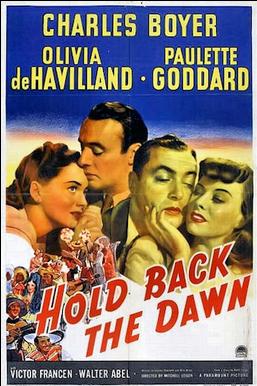
Lisa Reviews An Oscar Nominee: Hold Back the Dawn (dir by Mitchell Leisen)


(With the Oscars scheduled to be awarded on March 4th, I have decided to review at least one Oscar-nominated film a day.  These films could be nominees or they could be winners.  They could be from this year’s Oscars or they could be a previous year’s nominee!  We’ll see how things play out.  Today, I take a look at the 1941 best picture nominee, Hold Back the Dawn!)

Hold Back The Dawn is a historically important film for many reasons.

First off, this was the last film to be written by Billy Wilder before he launched his own legendary directorial career and, with its mix of sharp comedy and tearful melodrama, Hold Back The Dawn definitely feels like a Wilder film.  Wilder, himself, claimed that he was never happy with the way his script was adapted.  For instance, Wilder wrote a scene in which Charles Boyer, playing a Romanian who is stranded in a Mexican border town, was meant to deliver a monologue to a cockroach.  Boyer felt that the scene was ridiculous and the film’s director, Mitchell Leisen, never filmed it.  Wilder was so incensed that he declared that he would never again allow any of his scripts to be filmed by anyone other than himself.

Hold Back The Dawn also played a part in one of the most legendary feuds in Hollywood history, though there are some who claim that it was more the product of an overzealous pr agent’s imagination than anything else.  For her role as the shy school teacher with whom Boyer falls in love, Olivia de Havilland was nominated for Best Actress and was considered to be one of the front-runners for the reward.  (If nothing else, it was felt that giving her the Oscar would make up for not giving it to her when she was nominated for Gone With The Wind.)  However, that same year, Joan Fontaine was nominated for her role in Hitchock’s Suspicion and many felt that, after losing the previous year for her performance in Rebecca, Fontaine was owed an Oscar as well.  An Oscar night, Joan Fontaine beat Olivia de Havilland.  What complicated matters it that, beyond issues of professional jealousy, de Havilland and Fontaine were sisters.  For years, there were stories that de Havilland had never gotten over losing her Oscar to Fontaine and that, as a result, the two sisters had little to do with each other.  (The truth, as is always the case with siblings, appears to have been a lot more complicated.  de Havilland herself said it was less about the Oscars and more about just not having much in common with her sister.)

Beyond all that, however, Hold Back The Dawn is a charming dramedy that holds up remarkably well.  Boyer is Georges Iscoveu, a Romanian gigolo who has spent eight years living in a Mexican hotel, waiting to be allowed to enter the U.S.  Olivia de Havilland is Emmy Brown, an unmarried teacher who has nearly given up on ever finding love.  At first, Georges just wants to trick Emmy into marrying him so that he can legally enter the United States.  However, he soon finds himself truly falling in love with her.  Unfortunately, his partner-in-crime — Anita (Paulette Goddard) — is also in love with Georges and is not at all prepared to lose him to Emmy.  I know it all sounds very melodramatic but Wilder frames his story with a meeting between Georges and a Hollywood producer, a move the assures us that Hold Back The Dawn is content to be pure entertainment and we really should just sit back, not get too caught up on the specifics of the plot, and enjoy ourselves.  Charles Boyer is all befuddled charm as Georges while de Havilland is both poignantly likable as Emmy.  For me, as good as they are, the best performance came from Paulette Goddard, who is sharp-tongued and wonderfully cynical as Anita.  All three performers are helped by a wonderful script.  Even if Boyer never does talk to a cockroach, Wilder’s dialogue is still sharp and witty.  This is a film that is as much fun to listen to as it is to look at.

Hold Back The Dawn was nominated for best picture but lost to How Green Was My Valley.

This tribute Olivia de Havilland in Hold Back The Dawn was put together by Monique Classique for Olivia’s 100th birthday.

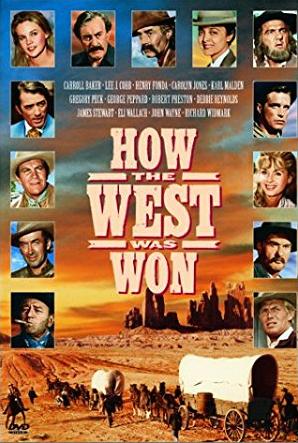
Lisa Reviews An Oscar Nominee: How The West Was Won (dir by Henry Hathaway, George Marshall, John Ford, and Richard Thorpe)


(With the Oscars scheduled to be awarded on March 4th, I have decided to review at least one Oscar-nominated film a day.  These films could be nominees or they could be winners.  They could be from this year’s Oscars or they could be a previous year’s nominee!  We’ll see how things play out.  Today, I take a look at the 1963 best picture nominee, How The West Was Won!)

How was the west won?

According to this film, the west was won by the brave men and women who set out in search of a better life.  Some of them were mountain men.  Some of them worked for the railroads.  Some of them rode in wagons.  Some of them gambled.  Some of them sang songs.  Some shot guns.  Some died in the Civil War.  The thing they all had in common was that they won the west and everyone had a familiar face.  How The West Was Won is the history of the west, told through the eyes of a collection of character actors and aging stars from Hollywood’s Golden Age.

In many ways, How The West Was Won was the Avatar of the early 60s.  It was a big, long, epic film that was designed to make viewers feel as if they were in the middle of the action.  Avatar used 3D while How The West Was Won used Cinerama.  Each scene was shot with three synchronized cameras and, when the film was projected onto a curved Cinerama screen, it was meant to create a truly immersive experience.  The film is full of tracking shots and, while watching it on TCM last night, I tried to imagine what it must have been like to see it in 1963 and to feel as if I was plunging straight into the world of the old west.  The film’s visuals were undoubtedly diminished by being viewed on a flat screen and yet, there were still a few breath-taking shots of the western landscape.

The other thing that How The West Was Won had in common with Avatar was a predictable storyline and some truly unfortunate dialogue.  I can understand why How The West Was Won was awarded two technical Oscars (for editing and sound) but, somehow, it also picked up the award for Best Writing, Screenplay or Story.  How The West Was Won is made up of five different parts, each one of which feels like a condensed version of a typical western B-movie.  There’s the mountain man helping the settlers get down the river story.  There’s the Civil War story.  There’s the railroad story and the outlaw story and, of course, the gold rush story.  None of it’s particularly original and the film is so poorly paced that some sections of the film feel rushed while others seem to go on forever.

Some of the film’s uneven consistency was undoubtedly due to the fact that it was directed by four different directors.  Henry Hathaway handled three sections while John Ford took care of the Civil War, George Marshall deal with the coming of the railroad, and an uncredited Richard Thorpe apparently shot a bunch of minor connecting scenes.

And yet, it’s hard not to like How The West Was Won.  Like a lot of the epic Hollywood films of the late 50s and early 60s, it has its own goofy charm.  The film is just so eager to please and remind the audience that they’re watching a story that could only be told on the big screen.  Every minute of the film feels like a raised middle finger to the threat of television.  “You’re not going to see this on your little idiot box!” the film seems to shout at every moment.  “Think you’re going to get Cinerama on NBC!?  THINK AGAIN!”

Then there’s the huge cast.  As opposed to Avatar, the cast of How The West Was Won is actually fun to watch.   Admittedly, a lot of them are either miscast or appear to simply be taking advantage of a quick payday but still, it’s interesting to see just how many iconic actors wander through this film.

For instance, the film starts and, within minutes, you’re like, “Hey!  That’s Jimmy Stewart playing a mountain man who is only supposed to be in his 20s!”

There’s Debbie Reynolds as a showgirl who inherits a gold claim!

Is that Gregory Peck as a cynical gambler?  And there’s Henry Fonda as a world-weary buffalo hunter!  And Richard Widmark as a tyrannical railroad employee and Lee J. Cobb as a town marshal and Eli Wallach as an outlaw!

See that stern-faced settler over there?  It’s Karl Malden!

What’s that?  The Civil War’s broken out?  Don’t worry, General John Wayne is here to save the day.  And there’s George Peppard fighting for the Union and Russ Tamblyn fighting for the Confederacy!  And there’s Agnes Moorehead and Thelma Ritter and Robert Preston and … wait a minute?  Is that Spencer Tracy providing narration?

When Eli Wallach’s gang shows up, keep an eye out for a 36 year-old Harry Dean Stanton.  And, earlier, when Walter Brennan’s family of river pirates menaces Karl Malden, be sure to look for an evil-looking pirate who, for about twenty seconds, stares straight at the camera.  When you see him, be sure to say, “Hey, it’s Lee Van Cleef!”

How The West Was Won is a big, long, thoroughly silly movie but, if you’re a fan of classic film stars, it’s worth watching.  It was a huge box office success and picked up 8 Oscar nominations.  It lost best picture to Tom Jones.

(By the way, in my ideal fantasy world, From Russia With Love secured a 1963 U.S. release, as opposed to having to wait until 1964, and became the first spy thriller to win the Oscar for Best Picture.)

Lisa Reviews An Oscar Nominee: The Emigrants (dir by Jan Troell)


(With the Oscars scheduled to be awarded on March 4th, I have decided to review at least one Oscar-nominated film a day.  These films could be nominees or they could be winners.  They could be from this year’s Oscars or they could be a previous year’s nominee!  We’ll see how things play out.  Today, I take a look at the 1972 best picture nominee, The Emigrants!)

Since I’m currently dealing with either a really bad cold or the onset of the flu (let’s hope that it’s the former), I decided that Monday would be the perfect night to stay up extremely late and watch a 190-minute Swedish movie.

The Emigrants was released in Sweden in 1971 and it received an Oscar nomination for Best Foreign Language Film.  Then, it was released in the United States in 1972 and it managed to receive four more Oscar nominations, including one for Best Picture.  The Emigrants was the third foreign language film to be nominated for Best Picture, the first film to be nominated in multiple years, and also the first Swedish film to contend for the Academy’s top prize.  (The following year, Ingmar Bergman’s Cries and Whispers would also become the second Swedish film nominated for Best Picture.)  At the same time that The Emigrants was nominated for Best Picture, its sequel, The New Land, was nominated for Best Foreign Language Film.  1972 was an interesting year.

The Emigrants opens in 1844, in Sweden.  Karl Oskar (Max Von Sydow) has married Kristina (Liv Ullmann).  Like his father before him, Karl Oskar is a farmer.  It’s an exhausting life.  There is never enough food to eat.  The weather is perpetually gloomy.  The harvest is always disappointing.  As poor farmers, Karl Oskar and his family face constant prejudice.  In Sweden, the only thing more corrupt than the government is the church.  After one of his daughters starves to death, what choice does Karl Oskar and his family have other than to escape to America?

As Karl Oskar’s brother, Robert (Eddie Axberg), explains, the best rice comes from the Carolinas.  The best farmland is in America.  In America, anyone can become rich.  Anyone can walk up to the President and talk to him without running the risk of being imprisoned or executed.  (In 1844, ordinary citizens could stop by the White House and make an appointment to see the President.  This, of course, would change decades later, after a disgruntled office seeker shot President Garfield.)  In America, Robert says excitedly, no one works more than 14 hours a day!  Even slaves can own land and make their own money!

The Emigrants deals with their Karl Oskar and his family’s voyage to America.  Karl Oskar and Kristina do not travel alone.  Kristina’s uncle (Allan Edwall) is with them and hopes that, in America, he will be allowed to freely practice his religious beliefs.  A former prostitute, Ulrika (Monica Zetterlund), is also with them, hoping a new land will mean a better life for both herself and her daughter.  Even Robert’s best friend, Arvid (Pierre Lindstedt), going with them.  It’s not an easy journey.  Not everyone survives the voyage to North America but those that do soon find themselves in a young and untouched country where anything seems to be possible.

Swedish cinema has a reputation for being dark and brooding but those are two words that definitely do not apply to The Emigrants, which is about as positive a portrait of America as you could ever hope to see.  Regardless of whatever tragedy may occur during the journey, this movie leaves no doubt that the journey was more than worth it.  It unfolds at a pace that is perhaps a bit too leisurely but, at the same time, it’s also an achingly pretty movie with shots that bring to mind the best of Terrence Malick.  In fact, there are times when the film is almost too pretty.  It’s possible to get so caught up in looking at all the beauty around Karl Oskar and Kristina that you lose track of the story.  Max Von Sydow and Liv Ullmann are both achingly pretty as well and, even more importantly, they’re believable as a married couple who are often equally in love and equally annoyed with each other.

It was interesting to go from watching The Grapes of Wrath to watching The Emigrants.  If The Grapes of Wrath was an American nightmare, The Emigrants is about as pure a celebration of the American Dream as you’re going to find.  It lost the Oscar for Best Picture to a far different film about the immigrant experience in America, The Godfather.

Lisa Reviews An Oscar Nominee: The Grapes of Wrath (dir by John Ford)


(With the Oscars scheduled to be awarded on March 4th, I have decided to review at least one Oscar-nominated film a day.  These films could be nominees or they could be winners.  They could be from this year’s Oscars or they could be a previous year’s nominee!  We’ll see how things play out.  Today, I take a look at the 1940 best picture nominee, The Grapes of Wrath!)

How dark can one mainstream Hollywood film from 1940 possibly be?

Watch The Grapes of Wrath to find out.

Based on the novel by John Steinbeck and directed by John Ford, The Grapes of Wrath tells the story of the Joad family and their efforts to neither get sent to prison nor starve to death during the Great Depression.  When they lose their farm in Oklahoma, they head for California.  Pa Joad (Russell Simpson) has a flyer that says someone is looking for men and women to work as pickers out west.  The 12 members of the Joad Family load all of their possessions into a dilapidated old truck and they hit the road.  It quickly becomes apparent that they’re not the only family basing all of their hopes on the vague promises offered up by that flyer.  No matter how much Pa may claim different, it’s obvious that California is not going to be the promised land and that not all the members of the family are going to survive the trip.

Tom Joad (Henry Fonda) is the oldest of the Joad sons.  He’s just been released from prison and he’s killed in the past.  Having been in prison during the start of the Great Depression, Tom doesn’t realize how bad things truly are until he arrives home and sees someone he grew up with using a tractor to knock down a house.  (It’s just business, of course.  The owners of the house can’t pay their bills so the house gets destroyed.)  The film’s story is largely told through Tom’s eyes and Henry Fonda gives a sympathetic performance, one the gets the audience to empathize with and relate to a character who is a total outsider.

As for the rest of the Joad Family, Ma (Jane Darwell) is the glue who holds them together and who refuses to allow them to surrender to despair.  (And yet even Ma is forced to make some tough choices when the starving children of one work camp ask her to share her family’s meal with them.)  Rosasharan (Dorris Bowdon) is pregnant while Grandpa (Charley Grapewin) is too sickly for the trip but doesn’t have anywhere else to go.  And then there’s Casy (John Carradine), the former preacher turned labor organizer.  Casy is not blood-related but he soon becomes a member of the family.

The Joads have a healthy distrust of the police and other authority figures and that turns out to be a good thing because there aren’t many good cops to be found between Oklahoma and California.  Instead, the police merely serve to protect the rich from the poor.  Whenever the workers talk about forming a union and demanding more than 5 cents per box for their hard work, the police are there to break heads and arrest any troublemakers on trumped up charges.  Whenever a town decides that they don’t want any “Okies” entering the town and “stealing” jobs, the police are there to block the roads.

The Grapes of Wrath provides a portrait of the rough edges of America, the places and the people who were being ignored in 1940 and who are still too often ignored today.  John Ford may not be the first director that comes to mind when you think of “film noir” but that’s exactly what The Grapes of Wrath feels like.  During the night scenes, desperate faces emerge from the darkness while menacing figures lurk in the shadows.  When the sun does rise, the black-and-white images are so harsh that you almost wish the moon would return.  The same western landscape that Ford celebrated in his westerns emerges as a wasteland in The Grapes of Wrath.  The American frontier is full of distrust, anger, greed, and ultimately starvation.  (Reportedly, the film was often shown in the Soviet Union as a portrait of the failure of America and capitalism.  However, it was discovered that Soviet citizens were amazed that, in America, even a family as poor as the Joads could still afford a car.  The Grapes of Wrath was promptly banned after that.)  John Ford is often thought of as being a sentimental director but there’s little beauty or hope to be found in the images of The Grapes of Wrath.  (Just compare the way The Grapes of Wrath treats poverty to the way Ford portrayed it in How Green Was My Valley.)  Instead, the film’s only hint of optimism comes from the unbreakable familial bond that holds the Joads together.

As dark as it may be, the film is nowhere near as pessimistic as the original novel.  The novel ends with a stillborn baby and a stranger starving to death in a barn.  The film doesn’t go quite that far and, in fact, offers up some deus ex machina in the form of a sympathetic government bureaucrat.  (Apparently, authority figures weren’t bad as long as they worked for the federal government.)  That the book is darker than the movie is not surprising.  John Steinbeck was a socialist while John Ford was a Republican with a weakness for FDR.  That said, even though the film does end on a more hopeful note than the novel, you still never quite buy that things are ever going to get better for anyone in the movie.  You want things to get better but, deep down, you know it’s not going to happen.  Tom says that he’s going to fight for a better world and Fonda’s delivers the line with such passion that you want him to succeed even if you know he probably won’t.  Ma Joad says the people will never be defeated and, again, you briefly believe her even if there’s not much evidence to back her up.

Even when viewed today, The Grapes of Wrath is still a powerful film and I can only guess what it must have been like to see the film in 1940, when the Great Depression was still going on and people like the Joads were still making the journey to California.  Not surprisingly, it was nominated for best picture of 1940, though it lost to Alfred Hitchcock’s Rebecca.