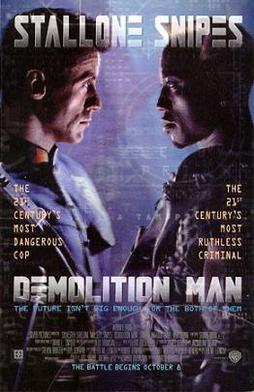
Demolition Man (1993, directed by Marco Brambilla)


File written by Adobe Photoshop¨ 4.0

In the near future, law-breakers and other destructive types are not put in prison but are instead cryogenically frozen and left in suspended animation until they’ve served out their sentences.  The most fearsome criminal in the world, Simon Phoenix (Wesley Snipes) has been frozen but so has his nemesis, Detective John Spartan (Sylvester Stallone).

In the far future, Los Angeles is a part of a megalopolis named San Angeles.  Envisioned and watched over by a seemingly benign dictator named Cocteau (Nigel Hawthorne), San Angeles is a wannabe utopia where cursing leads to an automatic fine and all of the restaurants are Taco Bell.  When he’s thawed out for a parole hearing, the suddenly super-powered Phoenix makes his escape.  The police, no longer knowing how to deal with violence, make the reluctant decision to thaw out John Spartan.  Assigned to work with the enthusiastic Lenina Huxley (Sandra Bullock), Spartan must navigate this strange future to defeat Phoenix.

For some reason, Demolition Man never seems to get the respect that it deserves.  Made at a time when both the Rambo and the Rocky franchises appeared to be over, Demolition Man features one of Stallone’s most appealing performances as he deals with a society where just saying a bad word can cause a scandal.  Just as Spartan proves that his brand of destructive police work still has its place in the future, Stallone proved that he could still carry an action movie in 1993.  There’s a lot of knowing humor to Stallone’s performance.  After a series of failed comedies in the 80s, Demolition Man was the movie that proved that Stallone could be intentionally funny.  Stallone is also surrounded by one of his strongest supporting casts.  Wesley Snipes attacks his villainous role with gusto while Denis Leary breaks out his stand-up routine as Edgar Friendly, the leader of San Angeles’s rebels.  This is also the film that led to Sandra Bullock getting cast in Speed and she’s so incredibly adorable here that even Stallone breaks out into a smile while acting opposite her

(In 1993, you couldn’t turn on television without seeing Sandra Bullock saying, “All restaurants are Taco Bell.”)

Demolition Man is an action film and it lives up to its name, with all the demolition that a viewer could want.  Even more so, It’s also a satire, of both Stallone’s previous films and what was then known as “political correctness.”  Demolition Man’s portrayal of a sterile society where everyone had been programmed to be docile and inoffensive wasn’t that far off from what a lot of politicians were then promoting for America at large.  Luckily, John Spartan was around to put an end to that.  The end result is one of Sylvester Stallone’s most memorable films.
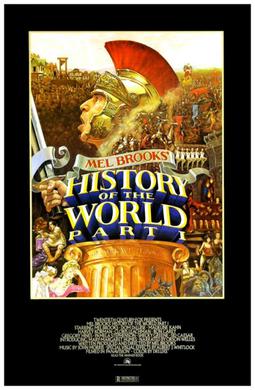
The History of the World, Part I (1981, directed by Mel Brooks)


Overlong, wildly uneven, gimmicky too a fault, and often laugh out loud funny with a mix of jokes that range from the crude to the sublimely clever to the surprisingly sentimental, The History of the World, Part I is the ultimate Mel Brooks films.

Narrated by Orson Welles and featuring five historical stories and a collection of coming attractions, The History of the World Part I follows man from his caveman origins to the French Revolution and the thread that ties it all together is that humanity always screws up but still finds a way to survive.  Moses (Mel Brooks) might drop and break one of the three tablets listing the 15 Commandments but he’s still able to present the other ten.  Stand-up philosopher Comicus (Mel Brooks) might make the mistake of poking fun at the weight of Emperor Nero (Dom DeLuise) but he still makes his escape with Josephus (Gregory Hines), Swiftus (Ron Carey), and Miriam the Vestal Virgin (Mary-Margaret Humes) and ends up serving as the waiter at the Last Supper.  (“Jesus!”)  The Spanish Inquisition may have been a catastrophe but it also gave Torquemada (Mel Brooks) a chance to show off his performance skills.  The French Revolution may have been a bloodbath but the future still held promise.  Ask for a miracle and he’ll show up as a white horse named Miracle, no matter what era of history you’re living in.

The humor is very Mel Brooks.  During the Roman Empire sequence, Madeline Kahn plays Empress Nympho.  Jackie Mason, Harvey Korman, Cloris Leachman, Spike Milligan, Jan Murray, Sammy Shores, Shecky Greene, Sid Caesar, Henny Youngman, and Hugh Hefner all make cameo appearances.  Carl Reiner is the voice of God.  John Hurt plays Jesus.  The film ends with the promise of a sequel that will feature “Jews in Space.”  Not every joke lands.  The entire caveman sequence feels forced.  But when the film works — like during The Inquisition production number — it’s hard not get caught up in its anything-goes style.  The entire Roman Empire sequence is probably more historically accurate than the typical Hollywood Roman epic.  That’s especially true of Dom DeLuise’s naughty performance as Emperor Nero.

Mel Brooks is 99 years old today and he says that he has at least one more film to give us, a sequel to Spaceballs.  I’m looking forward to it!  I’m also looking forward to rewatching and enjoying all of the films that he’s already given us.  The History of the World, Part I may not have initially enjoyed the critical acclaim of his earlier films but, in all of its anarchistic glory, it’s still pure Mel Brooks.

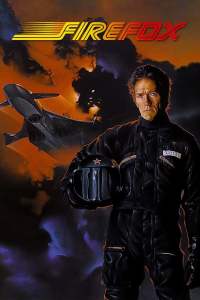
Firefox (dir. by Clint Eastwood)


You’d think someone with a face as chiseled as Clint Eastwood’s, he wouldn’t fit in well in the spy game. You’d recognize him almost anywhere in a line up. However, being able to direct your own films means you can still be the best person for a role. There is no finer example of this than with 1982’s Firefox, my submission for the Eastwood birthday celebration on the Shattered Lens. It’s not the strongest spy film, but it plays it’s hand very well, getting in and delivering the short jabs to set the tale and then finishing with an action packed combo in the film’s third act. 1990’s The Hunt for Red October may be more famous film about smuggling a vehicle from Russia to America, but Firefox did it first (Okay, From Russia With Love may have beaten them both, but we’re talking planes and subs, not a cipher box).

I remember first noticing Firefox while driving by the smaller of two movie theatres at the Green Acres Mall over in Valley Stream with my parents. Not every film hit the Sunrise Multipex, so the little Odeon (at least I think it was called an Odeon) held other films. My family caught Predator, Aliens, and Nine Months there to name a few. When I finally saw the movie, I didn’t care for it (to my credit, I was like 10 or 12), but loved the flying sequences. As an adult, the film makes more sense and deserves a watch despite a few tiny flaws here and there. Firefox marks Eastwood’s first production credit, despite The Malpaso Company having made films way before then.

Based on the 1977 novel by Craig Thomas, Firefox focuses on Mitchell Gant (Eastwood), one of the best pilots in the United States Air Force. Despite having some PTSD, Gant is sent on a mission in the height of the Cold War. His job is to sneak in and steal the Mig-31, Codename: Firefox, an experimental aircraft capable of speeds of Mach 5, extreme stealth and a special thought based firing system. He has all the necessary credentials. He can speak the language, has a good build and can fly the plane. After receiving a brief from his superiors (including Freddie Jones, who was in just about everything in the Early 1980s – Dune, Krull, Firestarter, Lifeforce), he’s dropped into Russia for his mission. Can Gant get the plane without getting in trouble? Unlike Top Gun, which used a fictional aircraft in the MiG-28, there was an actual MiG 31 in existence (or introduced to the world) at the time of filming Firefox, known as the “Foxhound”. The real MiG 31 and the films’ one are different. It was just a coincidence, but I know my Dad would point that out if he watched it.

What I loved the most about Firefox is that Gant’s character has to assume multiple roles/characters in order to blend in with the crowd and keep the KGB off of his tail. While we’re all aboard for seeing the plane in action, the real adventure is getting there and the characters that help along the way. One wrong turn, one wrong move could mean the different between success and failure, and it does get pretty tense in places. There’s one particular scene in a shower where I was like “Uhm, get up, get going, they’re on to you!”, but the pacing of the film is pretty good. As a director, Eastwood keeps the film moving without lingering too long in any one scene unless it’s truly necessary. This, along with some quick cuts and getting the most of the cast’s performances, allows the film to make some good use of the 2 hour and 16 minute runtime.

Firefox has a supporting cast that also helps to move the story along. Outside of Freddie Jones, we also have Kenneth Colley (Admiral Piett from The Empire Strikes Back & Return of the Jedi) as the Russian Colonel on Gant’s tail. Warren Clark’s (A Clockwork Orange) gruff character helps Gant to navigate through the city. Both Nigel Hawthorne (Demolition Man) and Ronald Lacey (Raiders of the Lost Ark) play scientists loyal to Gant’s mission. Wulf Kahler (also from Raiders of the Lost Ark) is on hand as a Russian military advisor. Alan Tivern, who played R.K. Maroon in Who Framed Roger Rabbit? is also in this, as is Toy Story’s John Ratzenberger.

One other element I enjoyed was how they resolved the actual flight sequences. Since Gant is in a fighter plane alone, there really isn’t any need to have any communication. The movie uses the black box in the plane both as a recording device for Gant’s actions, and a way for Eastwood to help narrate his intentions through the course of the third act. It helps to fill what would have normally been a near silent sequence (save for the evasive maneuvering). The flight sequences were developed by Star Wars alumni John Dykstra along with Johnathan Erland, who used a special blue screen effect that allowed reflective objects to move in front of lighter backgrounds or matte photography using UV light. It was pretty innovative at the time, even if it may look a little cartoony now.

Maurice Jarre (who I swore was Australian because of his work on the Mad Max films up until a first time watch of Lawrence of Arabia in 2024) scored Firefox, giving the film a mix between dark synths and patriotic tunes. The music definitely sets the tone leading up to the third act, though

Overall, Firefox is a good watch if you’re looking for a bit of late night espionage. As an actor, Eastwood’s Gant plays a mix of the everyman and spy (knowing when to hush, when to move and when to knock someone out) so well that I could easily imagine this as a recurring role for him, if he wanted to go that route. The film’s supporting cast is where it truly shines, as the contacts Gant makes during his mission are key to his success.

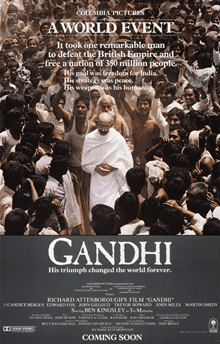
Lisa Reviews An Oscar Winner: Gandhi (dir by Richard Attenborough)


Gandhi-poster

I just finished watching the 1982 best picture winner Gandhi on TCM.  This is going to be a tough movie to review.

Why?

Well, first off, there’s the subject matter.  Gandhi is an epic biopic of Mohandas Gandhi (played, very well, by Ben Kingsley).  It starts with Gandhi as a 23 year-old attorney in South Africa who, after getting tossed out of a first class train compartment because of the color of his skin, leads a non-violent protest for the rights of all Indians in South Africa.  He gets arrested several times and, at one point, is threatened by Daniel Day-Lewis, making his screen debut as a young racist.  However, eventually, Gandhi’s protest draws international attention and pressure.  South Africa finally changes the law to give Indians a few rights.

Gandhi then returns to his native India, where he leads a similar campaign of non-violence in support of the fight for India’s independence from the British Empire.  For every violent act on the part of the British, Gandhi responds with humility and nonviolence.  After World War II, India gains its independence and Gandhi becomes the leader of the nation.  When India threatens to collapse as a result of violence between Hindus and Muslims, Gandhi fasts and announces that he will allow himself to starve to death unless the violence ends.  Gandhi brings peace to his country and is admired the world over.  And then, like almost all great leaders, he’s assassinated.

Gandhi tells the story of a great leader but that doesn’t necessarily make it a great movie.  In order to really examine Gandhi as a film, you have to be willing to accept that criticizing the movie is not the same as criticizing what (or who) the movie is about.

As I watched Gandhi, my main impression was that it was an extremely long movie.  Reportedly, Gandhi was a passion project for director Richard Attenborough.  An admirer of Gandhi’s and a lifelong equality activist, Attenborough spent over 20 years trying to raise the money to bring Gandhi’s life to the big screen.  Once he finally did, it appears that Attenbrough didn’t want to leave out a single detail.  Gandhi runs three and a half hours and, because certain scenes drag, it feels ever longer.

My other thought, as I watched Gandhi, was that it had to be one of the least cinematic films that I’ve ever seen.  Bless Attenborough for the nobility of his intentions but there’s not a single interesting visual to be found in the entire film.  I imagine that, even in 1982, Gandhi felt like a very old-fashioned movie.  In the end, it feels more like something you would see on PBS than in a theater.

The film is full of familiar faces, which works in some cases and doesn’t in others.  For instance, Gandhi’s British opponents are played by a virtual army of familiar character actors.  Every few minutes, someone like John Gielgud, Edward Fox, Trevor Howard, John Mills, or Nigel Hawthorne will pop up and wonder why Gandhi always has to be so troublesome.  The British character actors all do a pretty good job and contribute to the film without allowing their familiar faces to become a distraction.

But then, a few American actors show up.  Martin Sheen plays a reporter who interview Gandhi.  Candice Bergen shows up as a famous photographer.  And, unlike their British equivalents, neither Sheen nor Bergen really seem to fit into the film.  Both of them end up overacting.  (Sheen, in particular, delivers every line as if he’s scared that we’re going to forget that we’re watching a movie about an important figure in history.)  They both become distractions.

I guess the best thing that you can say about Gandhi, as a film, is that it features Ben Kingsley in the leading role.  He gives a wonderfully subtle performance as Gandhi, making him human even when the film insists on portraying him as a saint.  He won an Oscar for his performance in Gandhi and he deserved one.

As for Gandhi‘s award for best picture … well, let’s consider the films that it beat: E.T., Tootsie, The Verdict, and Missing.  And then, consider some of the films from 1982 that weren’t even nominated: Blade Runner, Burden of Dreams, Class of 1984, Fast Times At Ridgemont High, My Favorite Year, Poltergeist, Tenebrae, Vice Squad, Fanny and Alexander…

When you look at the competition, it’s clear that the Academy’s main motive in honoring Gandhi the film was to honor Gandhi the man.  In the end, Gandhi is a good example of a film that, good intentions aside, did not deserve its Oscar.

http://www.youtube.com/watch?v=6oWqlb_TlLQ