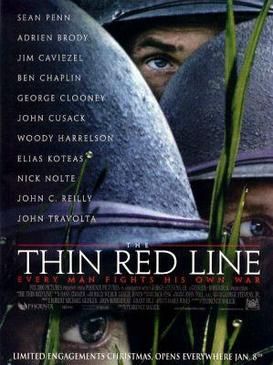
Based on a novel by James Jones (and technically, a sequel of sorts to From Here To Eternity), 1998’s The Thin Red Line is one of those Best Picture nominees that people seem to either love or hate.
Those who love it point out that the film is visually stunning and that director Terrence Malick takes a unique approach to portraying both the Battle of Guadalcanal and war in general. Whereas Steven Spielberg’s Saving Private Ryan told a rather traditional story about the tragedy of war (albeit with much more blood than previous World War II films), The Thin Red Line used the war as a way to consider the innocence of nature and the corrupting influence of mankind. “It’s all about property,” one shell-shocked soldier shouts in the middle of a battle and later, as soldiers die in the tall green grass of the film’s island setting, a baby bird hatches out of an egg. Malick’s film may have been an adaptation of James Jones’s novel but its concerns were all pure Malick, right down to the philosophical voice-overs that were heard throughout the film.
Those who dislike the film point out that it moves at a very deliberate pace and that we don’t really learn much about the characters that the film follows. In fact, with everyone wearing helmets and running through the overgrown grass, it’s often difficult to tell who is who. (One gets the feeling that deliberate on Malick’s point.) They complain that the story is difficult to follow. They point out that the parade of star cameos can be distracting. And they also complain that infantrymen who are constantly having to look out for enemy snipers would not necessarily be having an inner debate about the spirituality of nature.
I will agree that the cameos can be distracting. John Cusack, for example, pops up out of nowhere, plays a major role for a few minutes, and then vanishes from the film. The sight of John Travolta playing an admiral is also a bit distracting, if just because Travolta’s mustache makes him look a bit goofy. George Clooney appears towards the end of the film and delivers a somewhat patronizing lecture to the men under his command. Though his role was apparently meant to be much larger, Adrien Brody ends up two lines of dialogue and eleven minutes of screentime in the film’s final cut.
That said, The Thin Red Line works for me. The film is not meant to be a traditional war film and it’s not necessarily meant to be a realistic recreation of the Battle of Guadalcanal. Instead, it’s a film that plays out like a dream and, when viewed a dream, the philosophical voice overs and the scenes of eerie beauty all make sense. Like the majority of Malick’s films, The Thin Red Line is ultimately a visual poem. The plot is far less important than how the film is put together. It’s a film that immerses you in its world. Even the seeming randomness of the film’s battles and deaths fits together in a definite patten. It’s a Malick film. It’s not for everyone but those who are attuned to Malick’s wavelength will appreciate it even if they don’t understand it.
And while Malick does definitely put an emphasis on the visuals, he still gets some good performances out of his cast. Nick Nolte is chilling as the frustrated officer who has no hesitation about ordering his men to go on a suicide mission. Elias Koteas is genuinely moving as the captain whose military career is ultimately sabotaged by his kind nature. Sean Penn is surprisingly convincing as a cynical sergeant while Jim Caviezel (playing the closest thing the film has to a main character) gets a head start on humanizing messianic characters by playing the most philosophical of the soldiers. Ben Chaplin spends most of his time worrying about his wife back home and his fantasies give us a glimpse of what’s going on in America while its soldiers fight and die overseas.
The Thin Red Line was the first of Terrence Malick’s films to be nominated for Best Picture and it was one of three World War II films to be nominated that year. However, it lost to Shakespeare In Love.
Well, it’s nearly February so I guess it’s time for me to start listing my picks for the best and the worst of 2020.
It’s pretty much a tradition here at the Shattered Lens that I always end up running behind as far as posting these lists are concerned. I always think that I’m going to have everything ready to go during the first week of January but then I realize that there’s still a host of movies that I need to see before I can, in good conscience, post any sort of list. In fact, as I sit here writing this post, I’m watching some films that could very well make it onto my best of 2020 list.
Of course, the list below is not my best of 2020 list. Instead, below, you’ll find my picks for the 16 worst films of 2020. Why 16 films? Because Lisa doesn’t do odd numbers!
It probably won’t be a surprise you to see some of these films on the list. For instance, I don’t think anyone will be shocked to see The Grudge or After We Collided mentioned. However, I imagine that some people will be surprised to see The Trial of the Chicago 7 on the list. What can I say? The more I thought about it, the more it represented everything that I dislike about mainstream Hollywood filmmaking. The fact that it’s probably going to be a major Oscar contender made it even more important to list it. I’m sure there’s a lot of critics, for instance, who wish they had found room for Green Bookwhen they were compiling their 2018 lists.
In the end, of course, this list is my opinion. You’re free to agree or disagree. That’s the wonderful thing about having an opinion.
16. John Henry (dir by Will Forbes) — I actually feel kind of bad for listing this silly B-movie as one of the worst of 2020 but it was just so slowly paced and thematically muddled that I really didn’t have a choice.
15. The Binge (dir by Jeremy Garelick) — Doing The Purge with drugs and alcohol as opposed to murder is actually a pretty cool idea so this movie has no excuse for being so dull. There is one fun dance number that livens things up, which is why The Binge is listed at number 15 as opposed to number 3.
13. Valley Girl (dir by Rachel Lee Goldenberg) — This remake was a boring jukebox musical that featured 30 year-old high school students and unimaginative use of a host of 80s songs. (A girl at the beach says that she just wants to have fun. Can you guess what song the cast started singing?)
12. Ava (dir by Tate Taylor) — Jessica Chastain’s an assassin and …. *yawn.* Tate Taylor was exactly the wrong director to be expected to do anything interesting with this story.
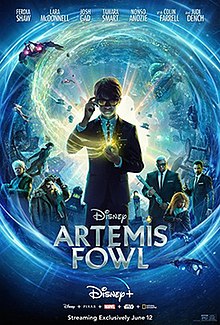
9. Artemis Fowl (dir by Kenneth Branagh) — This was a confusing movie that mixed the least interesting parts of the Harry Potter franchise with the least interesting bits of the Marvel Cinematic Universe.
6. After We Collided (dir by Roger Kumble) — This was marginally better than the first Afterbut that’s not saying much. The total lack of chemistry between the two romantic leads makes it difficult to care about whether or not they ever end up together. The cloying cameo from writer Anna Todd (“What have you written?” “Oh, this and that,”) almost made me throw a shoe at my TV.
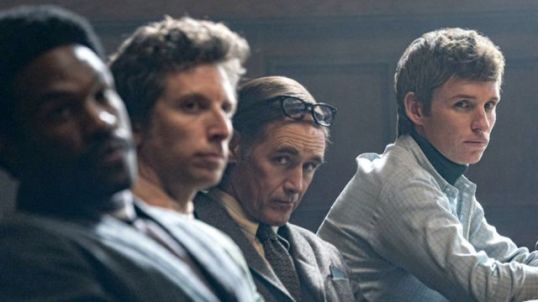
5. The Trial of the Chicago 7 (dir by Aaron Sorkin) — I liked Joseph Gordon-Levitt’s performance and the scene where Bobby Seale gets gagged in court was powerful and disturbing. Otherwise, this movie represented Hollywood at its most vapid.
2. The Last Thing He Wanted (dir by Dee Rees) — This was the first bad film that I saw in 2020 and it’s remained here, near the bottom of the list, for 12 months. This movie was a muddle mess that thought it had more to say than it did. It did feature a good performance from Willem DaFoe, which saved it from being the worst film of the year. Instead, that honor goes to….
1. Let Them All Talk (dir by Steven Soderbergh) — This mind-numbingly dull film from Steven Soderbergh seems to be determined to troll everyone who has ever said that they’d watch Meryl Streep in anything.
Last year, I was one of the few people willing to defend The Haunting of Sharon Tate, which I felt was an effective film despite its rather icky premise. I thought that the film managed to maintain a compelling atmosphere of dread and I also thought that, though somewhat miscast, Hilary Duff gave a good performance in the lead role. Finally, I felt that, despite the exploitative nature of the film, the film was firmly on the side of Sharon Tate and the other victims of the Manson Family. Though the title may have been offensive, the film itself was better than it had any right to be.
I really can’t say the same for The Murder of Nicole Brown Simpson, which is from the same production team as The Haunting of Sharon Tate and which imagines the final days in the life of another famous homicide victim. Mena Suvari stars as Nicole Brown Simpson, the ex-wife of football player OJ Simpson (played, in a hyperactive manner, by Gene Freeman). The film follows Nicole as she deals not only with her abusive ex-husband but also with shady friends like Faye Resnick (Taryn Manning) and slightly less-disreputable friends like Kris Jenner (Agnes Bruckner).
In the film, Nicole also has a short-lived affair with a handsome but unstable drifter named Glen Rogers (Nick Stahl). In real life, Glen Rogers is currently incarcerated in Florida, where he awaits execution for a series of murders. Rogers has confessed to killing people all across the country, though there’s some doubt as to whether or not Rogers was being honest when he did so. (Rogers later recanted the confession.) Rogers’s brother has claimed that Glen confessed to murdering Nicole Simpson and Adam Goldman, saying that he was actually hired to do so by OJ Simpson. (Technically, Glen Rogers said that Simpson hired him to steal some jewelry but also gave him permission to kill Nicole if he felt that it was necessary.) The film presents Rogers’s story as being fact, complete with a scene of OJ meeting with Glen shortly before the murders occur.
Other than making the case that Glen Rogers murdered Nicole and Ron, the majority of the film is just Mena Suvari walking around Los Angeles and talking to her friends about how she has a feeling that something terrible is going to happen. Whereas The Haunting of Sharon Tate was willing to challenge the audience’s expectations by, at least briefly, changing history and presenting an alternate version of what could have happened that day in 1969, The Murder of Nicole Brown Simpson is pretty much a grim march towards death, with each scene bringing the audience closer and close to the night of the actual murderers. If the film actually presented Nicole as being a fully-realized character as opposed to just a doomed victim, the story’s fatalistic atmosphere would work on an existential level but since the film doesn’t seem to care about who Nicole was before she died, it all just feels very sleazy.
Towards the end of the film, there’s an odd scene where an unseen force suddenly starts to violently throw Nicole across her bedroom, sending her against the walls and, at one point, pinning her to the ceiling. It’s a weird scene because it comes out of nowhere and it’s never explained whether it really happened or if Nicole was imagining being attacked. It doesn’t belong in this film and yet, it’s also the only moment when this film feels in any way unpredictable. Is the film trying to suggest that death, as a paranormal entity, was stalking her even before the night of her murder or was the scene just tossed in to liven up what is otherwise a rather slowly paced movie? Who knows? Again, if the film had really explored the issue of whether or not fate is predetermined and inevitable, it would have made for a far more interesting story than the rush job that this film appears to have been.
Mena Suvari and Nick Stahl are two actors who probably deserve better than this. Stahl is especially effective as the creepy but handsome Glen Rogers. Visually, the film is full of Hollywood glamour and ominous shadows. It’s not a bad-looking film, at all. Technically, The Murder of Nicole Brown Simpson is well-made but, at the same time, it’s all just so astoundingly pointless. The memory of Nicole Simpson deserved better.
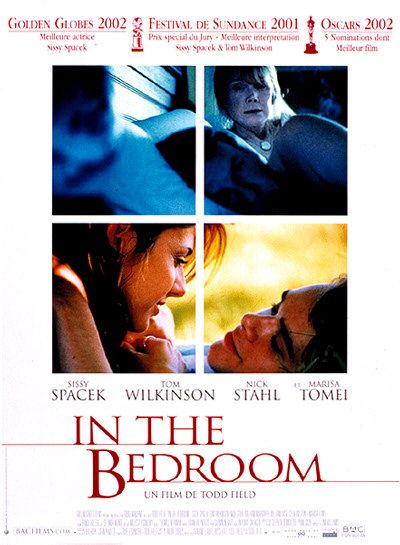
If some enterprising young filmmaker were to try to remake Ordinary People as a film noir, he would probably be wasting his time because director Todd Field already beat him to it with the 2001 best picture nominee In The Bedroom.
In the Bedroom takes place in a small town in Maine, the type of idyllic location where almost everyone is a fisherman and, in one way or another, everyone’s future is dependent on the whims of the rich and powerful Strout family. Dr. Matt Fowler (Tom Wilkinson) and his wife Ruth (Sissy Spacek) seem to have the perfect life: a happy marriage and a smart and likable son, Frank Fowler (Nick Stahl). Frank has just graduated from college and appears to have a great future ahead of him except for one thing. He’s fallen in love with Natalie Strout (Marisa Tomei), the ex-wife of the abusive Richard Strout (William Mapother). When Frank announces that he’s thinking about not going to grad school but instead staying in town so he can work as a fisherman and marry Natalie, Ruth is horrified that her son is throwing his life away. However, Matt argues that Frank is just going through a phase.
The violent and unstable Richard is determined to win Natalie back. When Frank attempts to protect Natalie during one of Richard’s rampages, Richard kills Frank by shooting him in the eye. Richard is arrested for the murder but, largely as a result of his family’s influence, he is only convicted of accidental manslaughter and gets off with probation. Matt and Ruth are left to both work through their grief and guilt and to eventually seek their own violent vengeance on Richard Strout.
In the Bedroom is probably one of the darkest films that I’ve ever seen in my entire life. Not only is the film thematically dark but a good deal of it takes place at night and Todd Field fills the screens with shadows. In the Bedroom is full of scenes of characters just staring at each other, struggling to find the right words to express their feelings and, far too often, simply giving up and saying nothing. Field makes good use of the frequent silence though. When Matt and Ruth yell at each other in the kitchen of their home, it’s both shocking and poignant because it stands in such sharp contrast to their usual silence. Later. when Matt confronts Richard, the frequent pauses in their strained conversation serves to make the scene all the more ominous and creepy.
However, despite being one of the saddest films ever made, In The Bedroom is worth watching just for the performances of the cast. You probably know that Tom Wilkinson, Sissy Spacek, and Marisa Tomei are all great so instead, I’m going to focus on the two members of the cast who did not receive Oscar nominations. William Mapother does a really good job playing an unlikable character. The dangerous yet dorky vibe that made him so menacing when he played Ethan Rohm on Lost is fully present and put to good use here. Finally, Nick Stahl gives a wonderful performance as poor, doomed Frank. With limited screen time, Stahl makes Frank into such a believable and sympathetic character that his death becomes a tragedy that the audience feels as well.
Sadly, Nick Stahl has recently been in the new more for his personal troubles than his film careers. Films like In The Bedroom and Bully show why Nick deserves a chance to make a comeback.
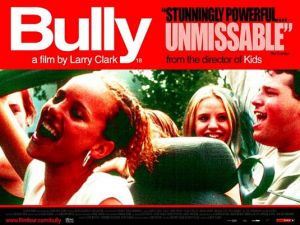
Bullying has been in the news a lot lately. The fact that some people are bullies is hardly a new development, it’s just that now people are actually paying attention to the possible consequences of cruelty. Tragically, it appears it takes people killing themselves for the rest of the world to consider that “Hey, maybe concentrated, socially accepted sadism isn’t a harmless thing.” With so many people finally admitting what they had to have known was true all along, now seems like a good time to reconsider Larry Clark’s controversial and much-maligned 2001 film, Bully.
I can still remember the night, five years ago, that I first saw Bully. I was at a party with a group of friends. Nine of us ended up in a random bedroom, drinking, smoking, and going through all the closets and dressers. I might add, we found some very interesting things while searching. Anyway, someone eventually turned on the TV and there was Bully, playing on one of the movie stations. Since we knew Bully was supposed to be a very explicit, very controversial movie, we left the TV playing and hung out in a stranger’s bedroom for two more hours. There was, obviously, a lot going on in that room and I have to admit that I only paid attention to bits and pieces of the movie. But what I saw stuck with me enough that the next chance I got, I bought the movie on DVD so I could actually devote my full attention to it. In the years since, Bully is not a film that I revisit frequently because, to be honest, it’s the type of movie that makes you take a shower after watching it. It’s also an unusually powerful and disturbing film that sticks with you for a long time after it ends. It’s not a film that I would recommend anyone watch a hundred times. But it’s definitely worth viewing at least once (or maybe even four times if you’re like me).
The bully of the title is 20 year-old Bobby Kent (played by Nick Stahl). Bobby’s “best friend” is passive, blank-faced Marty Puccio (Brad Renfro). Despite being physically stronger, Marty allows himself to be totally dominated by Bobby. Marty accepts Bobby’s constant insults and physical abuse with the meek acceptance of a battered spouse. Bobby, who is on the verge of starting college and presumably making a life for himself that high school dropout Marty could never dream of, even forces Marty to moonlight as a male stripper and to take part in making cheap, gay-themed porn videos. (Bobby insists that he’s not gay himself and, like most guys in denial, goes out of his way to act as much like an insensitive asshole as possible as if to scream to the world, “I’m straight!” despite all the evidence to the contrary.)
As the film begins, Ali (Bijou Philips) and her friend Lisa Marie Connelly (Rachel Miner) step into sandwich shop where both Bobby and Marty work. (Bobby, of course, is the boss.) Apparently, they are appropriately impressed by the sight of Bobby slamming Marty’s head against a refrigerator because soon, all four of them are going out on a double date. While Ali’s content to just give Bobby a blow job, the far more insecure Lisa decides that Marty is the love of her life and starts a relationship with him that the ever-passive Marty simple accepts. However, what Lisa has failed to take into account, is that Marty is already in a relationship and Bobby isn’t ready to just let go. Bobby expresses this by walking in on Marty and Lisa while they’re having sex, beating Marty up, and then (unlike everything else in this movie, this is never explicitly shown) raping Lisa. After this, Lisa discovers that she’s pregnant but she doesn’t know if the baby’s father is the man she claims to love or the man who raped her.
(One thing that surprised me, that night I first watched Bully out of the corner of my eye while me and my friends searched through a stranger’s lingerie, was just how little sympathy most of my friends had for Lisa. While I wasn’t surprised that the majority of guys in the room seemed to feel that Lisa was somehow to blame for disrupting all that precious male bonding, it was the reaction of some of the other girls that truly caught my off guard. While none of them went as far as to say that Lisa deserved to be raped by Bobby, quite a few of them took the attitude that she either brought it on herself or she was lying. Unlike the boys, these girls also felt the need to make several snide remarks about Rachel Miner’s physical appearance. At the time, their attitude really bothered me and I have to admit that I wasn’t as close to any of them afterward.)
(Of course, we Lisa Maries have to stick together…)
Despite having raped his girlfriend, Bobby still considers himself to be Marty’s best friend and Marty — again like an addicted spouse — proves himself to be incapable to simply cut off all ties with Bobby even as the abuse gets worse and Bobby grows increasingly unstable. In one of the film’s more controversial scenes, Bobby and Ali are about to have sex when Bobby decides that the only thing the scene is missing is a gay porn video playing in the background. Ali finds the idea to be disgusting and insinuates that Bobby must be gay. Bobby responds by raping Ali.
Finally, Lisa tells Marty and Ali that they have little choice but to murder Bobby. While this starts out as a somewhat innocent suggestion of the “I wish he was dead,” kind, Lisa soon begins to insist that Bobby must die. Ali recruits her friend Heather (Kelli Garner) and an ex-boyfriend named Donny (a truly scary Michael Pitt) into the conspiracy. (Heather and Donny both agree that Bobby must die though neither one has ever met him.) Lisa, meanwhile, brings in her cousin, video-game geek Derek. Finally, and most fatefully, they decide to get some pointers from the neighborhood hitman (Leo Fitzpatrick).
That’s right. The neighborhood hitman. He’s actually a pretty familiar figure in the suburbs. He’s the 17 year-old white boy who tries to stare out at the world with hateful eyes. He brags to you about how he’s a member of a gang. He tries to rap and speaks in dialogue lifted from Grand Theft Auto. In short, he’s the guy that everyone laughs at whenever he’s not around. His lies should be obvious to anyone with a brain which is exactly why Lisa, Marty, and Ali all assume that he’s an actual hitman. The Hitman agrees to direct their murder and help them kill a person who (like almost everyone else now involved in the conspiracy) he has never actually met.
It all climaxes in one of the most disturbingly graphic and harrowing murder scenes I’ve ever seen, one that manages to snap the audience back into reality after the (needed) comic relief of Fitzpatrick’s absurd wannabe gangster. As he’s repeatedly attacked by this group of made up of bumbling strangers and his “best” friend, Bobby proves himself to be not quite as powerful a figure as everyone had assumed. Instead, he’s revealed as a pathetic, frightened teenager who begs Marty to forgive him (for “whatever I did”) even as Marty savagely stabs him to death.
Unlike the standard rape-revenge flick (and have no doubt, that’s what Bully essentially is), the film’s climatic act of violence doesn’t provide any sort of satisfaction or wish-fulfillment empowerment. Instead, it just sets up the chain of events that leads to the film’s inevitable and disturbing conclusion.
When it first came out, Bully was controversial because of its explicit sex and violence. As a director, Clark employs his customary documentary approach while, at the same time, allowing his camera to frequently linger over the frequently naked bodies of his cast. More than one reviewer has referred to Clark as “a dirty old man” while reviewing this film. (More on that in a minute.) What those critics often seem to fail to notice is that, as explicit as the movie is, some of the most powerful and disturbing elements (like Bobby’s repressed homosexuality) are never explicitly stated.
After seeing this movie a few more times, the thing that gets me is that — in the end — the film’s nominal villains — Bobby and Lisa — are also the only two compelling characters in the entire movie. While all the other characters are essentially passive, Bobby and Lisa are the only ones actually capable of instigating any type of action. As such, they become — almost by default — the heroes of the movie. On repeat viewings, it’s apparent that Bobby and Lisa are really two sides of the same coin. The film’s title could refer to either one of them. They are both insecure, unhappy with who they are, and both of them seem to find a personal redemption by dominating Marty. One of the great ironies of the film is that Bobby and Lisa are essentially fighting a war for the soul of a guy who is eventually revealed to be empty inside. For his part, Marty simply shifts his “forbidden” relationship with Bobby over to Lisa, a relationship that is just as exploitive and destructive as his friendship with Bobby but which is also more socially acceptable because it’s so heterosexual in nature that he’s even knocked up his girlfriend. When Marty finally does kill Bobby, he’s not only killing a bully but he’s attempting to kill of his own doubts about his sexual identity. It’s his way of letting the world know that he’s a “real” man. As for the other characters — Ali, Donny, Heather, and even the swaggering hitman — they are all defined by their utter shallowness. While its clear that none of them are murderous on their own, it also becomes clear that none of them have enough of an individual identity to resist the Bobbys and Lisas of the world.
Despite playing shallow characters, nobody in the cast gives a shallow performance. Down to the smallest role, the actors are all believable in their roles. Whether it’s Michael Pitt’s blank-faced aggression or Leo Fitzpatrick’s comedic swagger, all of the actors inhabit these characters and give performances that are disturbingly authentic. The late Brad Renfro gave one of his best performances as Marty, just hinting at the anger boiling below the abused surface. However, the film belongs to Miner and Stahl. Stahl displays a sordid charm that makes his character likable if never sympathetic while Miner manages to do something even more difficult. She makes Lisa into a character who is sympathetic yet never quite likable. When Bully first came out, critics spent so much time fixating on the fact that Miner’s frequently naked on the film that they forgot to mention that she also proves herself to be an excellent actress.
As I stated, Bully is not a universally beloved film. Most of the reviews out there are negative with a few of the more self-righteous critics accusing the film of being “pornographic” as if the whole thing was filled with close-up money shots of Brad Renfro ejaculating on Rachel Miner’s ass. Strangely enough, you can find hundreds of critics complaining that Clark filmed full frontal nudity but next to none complaining that Clark filmed a brutal and realistic murder scene.
The two most frequent criticisms of Bully are that 1) it plays fast and loose with the true story that it’s based on and 2) that the film is exploitive.
Both criticisms are valid but the first one is the only one that would really bother me. I have to admit that I don’t really know much about the real life murder of Bobby Kent. I just know the version presented in this movie and in the Jim Schultze book that the movie was based on. Of course, everyone arrested and convicted for Kent’s murder has been quick to claim that the movie makes them look more guilty than they actually are. That’s to be expected. However, the main difference between the film and the reality — for me — was that, in reality, victim Bobby Kent did not look a thing like Nick Stahl. Whereas Stahl is clearly no physical match for any of the characters in the film (and hence, it’s easier to feel sorry for him when everyone attacks him at once), pictures of the real-life Bobby Kent reveal an intimidating, muscular, young man who few people would probably ever chose to mess with. Stahl’s Bobby is a bully because everyone else in the film is too passive to stand up to him. The real Bobby could probably get away with being a bully because he literally looked like he could rip another man’s arm off.
The other criticism is that this movie — with its combination of tits and blood — is essentially just an “exploitation” film. Well, it is. But as I’ve explained elsewhere, just because a film is exploitive, that doesn’t mean that it’s not a good movie. Art and exploitation, more often than not, are clandestine lovers and not bitter enemies. Yes, all of the characters — male and female — do spend a good deal of time showing off their bodies but then again, what else would these otherwise empty characters do? Their surface appearance is really all they have. Yes, the camera does linger over all the exposed flesh but then again, so do most people. If anything, critics attempted to punish Clark for openly acknowledging that majority of his audience is waiting to either see Bijou Phillips’ twat or Nick Stahl’s dick. Yes, Bully is exploitation but it’s exploitation in the best grindhouse tradition. It’s a film that’s honest specifically because it is so sordid and exploitive.
When all is said and done, Bully is the epitome of a movie that is too sordid to ever be corrupted.









 Through the Shattered Lens