Cleaning Out the DVR #17: Film Noir Festival 3


gary loggins's avatarcracked rear viewer

To take my mind off the sciatic nerve pain I was suffering last week, I immersed myself on the dark world of film noir. The following quartet of films represent some of the genre’s best, filled with murder, femme fatales, psychopaths, and sleazy living. Good times!!

I’ll begin chronologically with BOOMERANG (20th Century-Fox 1947), director Elia Kazan’s true-life tale of a drifter (an excellent Arthur Kennedy ) falsely accused of murdering a priest in cold blood, and the doubting DA (Dana Andrews ) who fights an uphill battle against political corruption to exonerate him. Filmed on location in Stamford, CT and using many local residents as extras and bit parts, the literate script by Richard Murphy (CRY OF THE CITY, PANIC IN THE STREETS, COMPULSION) takes a realistic look behind the scenes at an American mid-sized city, shedding light into it’s darker corners.

Andrews is solid as the honest…

View original post 1,048 more words

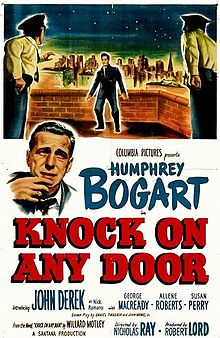
A Movie A Day #189: Knock On Any Door (1949, directed by Nicholas Ray)


Knock On Any Door opens with the murder of a policeman in New York City. Nick Romano (John Derek) is arrested for the crime. Nick is a troubled young man who has grown up in the slums and is fond of saying that his goal is to “Live fast, die young, and leave a good-looking corpse.” Now on trial for his very life, Nick reaches out to lawyer Andrew Morton (Humphrey Bogart), who once unsuccessfully defended Nick’s father in a similar criminal trial. At first, Morton wants nothing to do with Nick but he changes his mind, partially out of guilt over Nick’s father and partially because Morton himself came from the same slums that produced Nick. Even as the district attorney (George Macready) goes for blood, Morton argues that Nick isn’t a menace but instead a victim of a society that left him with little choice but to become a criminal.

Knock Any Door is heavy-handed but, for fans of Humphrey Bogart and Nicholas Ray, this is an essential film. Bogart produced this film himself and the subject matter was very important to him.  Bogart, the classic tough guy with a heart of gold, gives one of his best performances, delivering his closing statement with such conviction that it is impossible not to be moved.  Though Ray’s direction is often heavy-handed and the courtroom scenes are sometimes too stagey, Knock On Any Door sees him exploring the same themes that he would later explore in Rebel Without a Cause and with the empathy that made that later film a classic.

Never Nominated: 16 Directors Who Have Never Received An Oscar Nomination


It’s a sad fact of life that not everyone who deserves an Oscar gets one.  For instance, Alfred Hitchcock received five nominations for best director but never won once.

That said, at least Hitchcock was nominated!  Some of our greatest directors have never even been nominated!  This list below is hardly exclusive but still, these 16 directors have somehow never been nominated.  Ten of them could still be nominated in the future.  Sadly, for six, the opportunity has forever passed.

  1. Dario Argento

Sadly, Dario Argento will probably never be nominated for best director.  None of his films — even the early, acclaimed work — were typical Oscar films.  But, consider this: Argento is one of the most influential directors of all time.  Regardless of what might be said about some of Argento’s more recent films, his earlier films are classics of their genre.  Deep Red, Suspiria, Inferno, Tenebrae — his work on any of these films would have been worthy of a nomination.

2. Andrea Arnold

This British director is responsible for two of the best films of the past ten years — Fish Tank and American Honey.  She deserved a nomination for both of them (and a win for American Honey).  Hopefully, she will be recognized in the future.

3. Tim Burton

I’m not the world’s biggest Tim Burton fan but he has a fan base that will follow him almost anywhere.  It seems like every year, we hear that Burton has finally made the film that will win him some Oscar recognition.  Remember Big Eyes?  As I said, I’m not a huge Burton fan but, if I was to nominate him, it would probably be for his work on Sweeney Todd.

4. John Carpenter

Carpenter deserved all sorts of nominations for his work in the 70s and the 80s.  Being the rebel that he is, Carpenter will probably never get the Oscar recognition that he deserves.  (He did win an Academy Award for Best Live Action Short.)

5. David Cronenberg

It’s hard to believe that this Canadian director has never been nominated.  While it’s obvious that the Academy would never recognize Cronenberg’s earlier work (even if he did deserve some recognition for that exploding head in Scanners), it still seems like he’s destined to be nominated eventually.

6. Terry Gilliam

Much like Tim Burton, Gilliam sadly seems to be destined to be one of those directors who will have to be content with a devoted fan base.  Sadly, as of late, Gilliam’s become better known for the film projects that were canceled than the ones that were actually produced.  I would have nominated him for Brazil.

7. Werner Herzog

How has Werner Herzog gone his entire career without receiving at least one nomination for Best Director!?  I would nominate him for the chance to hear the acceptance speech alone.

8. Christopher Nolan

Christopher Nolan is another director who I’m shocked to realize has never been nominated.  He certainly deserved a nomination for Inception.  Maybe, just maybe, he’ll finally get some recognition for Dunkirk.

9. Lars Von Trier

With his controversial aesthetic and his talent for offending the masses, Lars Von Trier will never be nominated, no matter how much he might deserve it.

10. Joe Wright

Personally, I think that Joe Wright is responsible for two of the best films of the past ten years, Hanna and Anna Karenina.  Unfortunately, both were left out of their respective best picture races.  Even when Atonement was nominated for best picture, Wright did not receive a corresponding nomination.  Fortunately, with Darkest Hour, Wright will have another chance this year.

Best Director Joe Wright

And here are six directors who are no longer with us.  Sadly, these six will never have a chance to receive their first Oscar nomination:

  1. Mario Bava

Much like Dario Argento, there was never really any chance that the Academy would actually honor Mario Bava.  That’s a shame because Bava truly was one of the greatest directors of all time.  Check out Black Sabbath and Shock for proof.

2. Stanley Donen

It’s hard to believe that Donen wasn’t even nominated for Singin’ In The Rain.

3. John Frankenheimer 

It’s also hard to believe that Frankenheimer never received a nomination.  While he directed his share of bad films, he also directed Seven Days in May, The Manchurian Candidate, Seconds, and Ronin.

4. John Hughes

Not even for The Breakfast Club or Ferris Bueller’s Day Off!  Hughes may have been snubbed by the Academy but his films practically invented an entire genre.

5. Michael Powell and Emeric Pressburger

This directing team was a major influence on Martin Scorsese.  Black Narcissus remains one of the most visually stunning films of all time.  The Red Shoes was nominated for best picture but Powell/Pressburger were snubbed.

6. Nicholas Ray

Everyone knows that Ray directed Rebel Without a Cause.  Personally, I think his work on Bigger than Life was even more worthy of a nomination.

Double Dynamite: Robert Mitchum and Jane Russell in MACAO (RKO 1952)


gary loggins's avatarcracked rear viewer

macao1

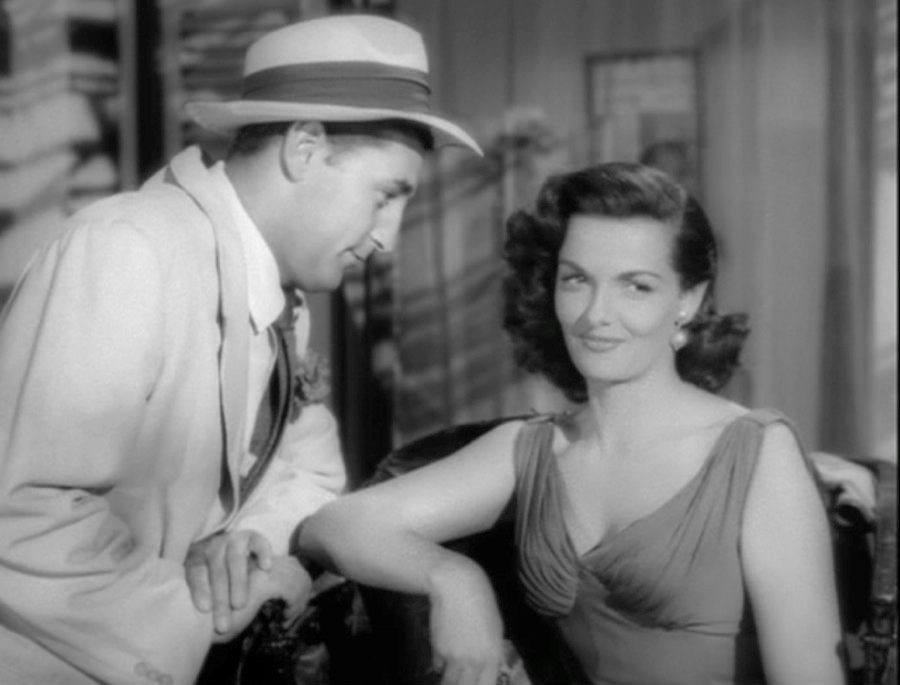
Even though 1951’s HIS KIND OF WOMAN lost money (mainly due to studio boss Howard Hughes’ meddling), Robert Mitchum and Jane Russell were reteamed the following year in MACAO. The film was actually sitting on the RKO shelf, having been completed in 1950. Once again, the autocratic Hughes wasn’t pleased with the original version, and fired credited director Josef von Sternberg, replacing him with Nicholas Ray. Mitchum himself even contributed to rewriting some scenes. The result is an entertaining noir that, while not quite as good as HIS KIND OF WOMAN, still manages to hold your interest.

macao3

On a boat from Hong Kong, drifter Nick Cochran (Mitchum) meets grifter Julie Benson (Russell), who lifts his wallet. The pair also meet Lawrence C. Trumble (William Bendix), a salesman specializing in “nylons, pearl buttons, coconut oil, and fertilizer”.  The three are headed to Macao, “The Monte Carlo of the Orient” (actually the RKO backlot), for various reasons…

View original post 265 more words

Cleaning Out the DVR Pt 7: Film Noir Festival


Now that Lisa’s finished cleaning out her DVR, it’s time once again for me to clean mine, featuring five fabulous films noir:

gary loggins's avatarcracked rear viewer

prev

I first got my DVR service from DirecTV just in time for last year’s TCM Summer of Darkness series, and there’s still a ton of films I haven’t gotten around to viewing… until now! So without further ado, let’s dive right into the fog-shrouded world of film noir:

dvr7.1

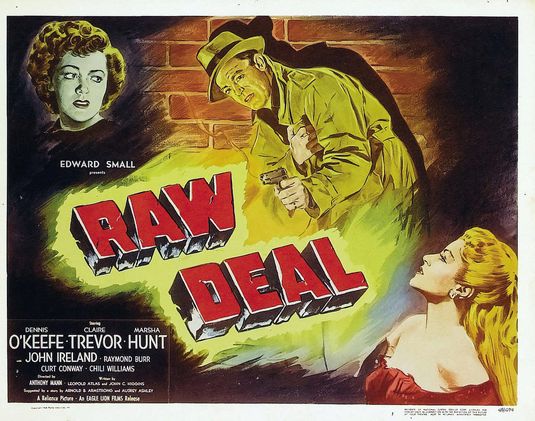
RAW DEAL (Eagle-Lion 1948, D: Anthony Mann)

This tough-talking film seems to cram every film noir trope in the book into its 79 minutes. Gangster Dennis O’Keefe busts out of prison with the help of his moll ( Claire Trevor ), kidnaps social worker Marsha Hunt, and goes after the sadistic crime boss (Raymond Burr) who owes him fifty grand. Director Mann and DP John Alton make this flawed but effective ultra-low budget film work, with help from a great cast. Burr’s nasty, fire-obsessed kingpin is scary, and John Ireland as his torpedo has a great fight scene with O’Keefe. The flaming finale is well staged…

View original post 614 more words

Back to School #4: Rebel Without A Cause (dir by Nicholas Ray)


You may have heard of this one.

Traditionally, films about teenagers tend to age terribly.  The language, the clothes, the attitudes, and even the humor; it’s all usually out-of-date within five years or so.  One need only watch something like A Summer Place to both see how dated a film can become and to see how one generation’s idol can appear rather ludicrous to future generations.  (And yes, I am talking about Troy Donahue…)  What makes Rebel Without A Cause unique is that it’s a movie about teenagers that was released way back in 1955 and yet, nearly 60 years later, it still feels fresh and relatable.

Of course, it helps that the title character is played by James Dean who, to put it lightly, was no Troy Donahue.

Rebel Without A Cause tells the story of three alienated teenagers trying to survive in the suburbs of Los Angeles.  (“…and they all came from good homes!” the film’s poster informs us.)  Plato (Sal Mineo) is a painfully sensitive 15 year-old who has been abandoned by his parents and is being raised by the family’s maid.  (Since this movie was made in 1955, the fact that Plato is gay is obvious but never explicitly stated.)  Judy (Natalie Wood) is the girlfriend of Buzz (Corey Allen) and is acting out because she feels that’s the only way she can can get her father to pay attention to her.  And then there’s Jim Stark (James Dean), whose family has just moved to Los Angeles and who is constantly in the middle of the fights between his overbearing mother (Ann Doran) and his weak-willed father (Jim Backus).

Rebel Without A Cause 2

During Jim’s first day at high school, he not only manages to make an enemy when Buzz spots him attempting to flirt with Judy but he also gets to go on a field trip to the Griffith Observatory, where the students are told that the entire universe is going to end eventually.  After the field trip, Buzz challenges Jim to a knife fight.  Jim agrees only after the rest of Buzz’s gang (including a young Dennis Hopper) accuse him of being “chicken.”  However, after a security guard breaks up the fight, Buzz challenges Jim to a “chicken run.”

(People in the 50s were obsessed with chickens.)

That night, Jim and Buzz both drive stolen cars towards the edge of a cliff.  The first driver to jump out of his car loses.  Before they start their engines, Buzz smiles and tells Jim, “I like you.”  Yay!  Jim’s finally made a friend!  Uh-oh, Buzz just drove over the cliff and his car exploded!  Well, so much for that friendship.  Now, with Buzz’s gang swearing revenge and their parents incapable of understand what happened, Jim, Judy, and Plato are on the run.  They end up hiding out in an abandoned house and find a brief moment of happiness before the gang and the police show up to ruin everything.

NW-nataliewood-rebel-love

The challenge of reviewing Rebel Without A Cause is trying to find a new way to say what everybody already knows.  Rebel Without A Cause is a great film that’s distinguished by Nicholas Ray’s sensitive direction and James Dean’s iconic performance in the lead role.  Whenever I see Rebel Without A Cause, I’m always struck by just how much unexpected nuance there is Dean’s interpretation of Jim Stark.  We always think of James Dean as being the epitome of cool and I think we tend to forget that, at least in the beginning of the film, Jim is anything but that.  Instead, he’s awkward and shy.  His attempts to flirt with Judy lead to her calling him “a real yo-yo.”  As much as he tried to fit in with the rest of his classmates, he’s a permanent outsider.  (Just consider what happens with his infamous “moooo” during the presentation at the observatory.)  He has a lot to say but he doesn’t know how to say it and every time that he tries to express what he’s feeling, he’s ignored by adults who don’t have the patience to listen.  Dean brings such a raw intensity to these scenes that I always find myself wanting to reach out and hug him and tell him that everything’s going to be okay, even though I know that it’s not.  Even today, it’s still easy to see why every teenager in the 50s either wanted to be or to be with Jim Stark.

Also, whenever I watch the film, I’m reminded of how much I relate to the character of Judy.  I think that’s because, when I was 16, I might as well have been Judy.  Natalie Wood’s performance might not be as showy as James Dean’s but it’s equally effective.

Of course, one reason why Rebel Without A Cause has become iconic is because James Dean died shortly after filming ended.  (In fact, some of his scenes had to be redubbed by Dennis Hopper, who reportedly could do an exact imitation of Dean’s voice.)  It’s interesting to wonder what would have become of James Dean if he had lived.  Would he have continued to be one of our best actors or would he have eventually been forgotten or forced to appear on television?  Personally, I like to think that James Dean would have remained a great actor but he would have been too much of an iconoclast to remain in Hollywood.  Eventually, in my alternative universe, James Dean moved to Europe and teamed up with Klaus Kinski to star in a series of spaghetti westerns.  And they were great.

As for Rebel Without A Cause, it remains a great movie nearly 60 years after it was first made.  And really, what more needs to be said?

Rebel


Embracing the Melodrama #14: Bigger Than Life (dir by Nicholas Ray)


Bigger Than Life 2

Today, we continue to embrace the melodrama by taking a look at Nicholas Ray’s 1956 Hell-In-The-Suburbs masterpiece, Bigger Than Life.  Unfortunately for some of you, this review is going to contain minor spoilers because there’s no way you can talk about Bigger Than Life without talking about that ending.

Bigger Than Life is a film about deception.

English teacher Ed Avery (James Mason, who not only gives a brilliant lead performance but produced the film as well) pretends to be happy with his safe and dull life but it only takes a few minutes of looking at his strained smile and listening to him wearily  make perfunctory conversation to realize that Ed is a deeply disappointed man.  He decorates his house with travel posters for locations that he’s never visited and spends too much time thinking about when he played football in high school, the one time in life when he truly stood out from the crowd.

Ed doesn’t want his wife Louise (Barbara Rush) to know that they’re in financial trouble so he gets a job working as a taxi dispatcher without telling her.  While Louise fears that he’s actually having an affair, Ed spends his time coming up with excuses for why he can never come straight home from school.

Ed doesn’t want either Lou or his son Richie (Christopher Olsen) to know that he’s been feeling pain and dizziness.  It’s only after he faints at home that he finally agrees to go to the hospital.

The doctors who inform Ed that he has a life threatening condition don’t want Ed to know how dangerous the medicine that they’ve prescribed for him can truly be.  They tell him that cortisone can save his life but they don’t tell him about the side effects.  It’s up to his friend Wally (Walter Matthau) to research the drug and, by the time he does, it’s already too late.

Ed doesn’t want anyone to know that he’s becoming a drug addict.  However, as he takes more and more of the pills, his personality starts to change.  The once meek Ed is now demanding perfect service at stores and restaurants.  At a PTA meeting, Ed has no problem announcing that most of his students are stupid.  (“You should make that young man principal!” one parent shouts, apparently relieved to hear that a teacher thinks of little of his children as he does.)  At home, Ed pushes his son to become a football great and announces that he no longer loves his wife.

Richie doesn’t want his father to know that he now hates him.  Lou doesn’t want her husband to know how much she is growing to fear him.

Ed doesn’t want Richie to know that, after reading the biblical story of Abraham and Isaac, Ed has decided that he has to murder his son.  When Lou points out that God kept Abraham from killing Isaac, Ed replies, “God was wrong.”

And finally, the film itself deceives you into thinking that it has a happy ending with Lou and Richie hugging a now recovered Ed.  Everyone laughs and the happy music swells but there’s prominent shadow cast on the wall close to the family, a reminder that the darkness that Ed has unleashed on his family will not be so easily contained or forgotten.

bigger than life

Bigger Than Life is famous for being one of those films that flopped when it was originally released, just to eventually be rediscovered and acclaimed decades later when it was released as part of the Criterion Collection.  It’s easy to understand why the film flopped because the power of Bigger Than Life is almost entirely to be found in the film’s subtext.  On the surface, Bigger Than Life is a typical social problem film.  In this case, that problem would appear to be drug abuse.

However, as you watch the film, it becomes obvious that, for director Nicholas Ray, the real problem is the conformist and repressed society that the Avery family finds themselves living in.  When Ed’s personality changes, all he is really doing is achieving an extreme version of the ideal suburban existence.  The suburban ideal is that the man should be the king of his castle.  Ed becomes a king but he’s one of those kings who would behead his subjects on a whim.  In telling this tale of American exceptionalism gone mad, Nicholas Ray uses the techniques of European expressionism, using skewed camera angles and creating a world that is full of shadows.  Even before Ed takes his first pill, his world is a dark and threatening one.

By the end of the film, Ed may be off the drugs and he may be recovering but, as Nicholas Ray makes clear, the real problem remains.

Bigger Than Life

Here’s Your Chance To Tell Lisa Marie What To Watch!


So, guess what I did this morning?  That’s right — I put on a blindfold, a stumbled over to my ever-growing Blu-ray, DVD, and even VHS collection and I randomly selected 12 films!

Why did I do this?

I did it so you, the beloved readers of Through the Shattered Lens, could once again have a chance to tell me what to do.  At the end of this post, you’ll find a poll.  Hopefully, between now and next Monday (that’s March 24th), a few of you will take the time to vote for which of these 12 films I should watch and review.  I will then watch the winner on Tuesday and post my review on Wednesday night.  In short, I’m putting the power to dominate in your hands.  Just remember: with great power comes great … well, you know how it goes.

Here are the 12 films that I randomly selected this morning:

The Baader Meinhof Complex (2008) — This German film was nominated for Best Foreign Language Film.  It tells the true life story of the left-wing German terrorist group, The RAF.

The Cat’s Meow (2001) — From director Peter Bogdonavich, this film speculates about the events that led to the shooting of silent film director Thomas H. Ince.  Starring Kirsten Dunst as Marion Davies, Edward Herrmann as William Randolph Hearst, and Eddie Izzard as Charlie Chaplin.

Heavenly Creatures (1994) — The close relationship between two teenage girls (Melanie Lynesky and Kate Winslet) leads to both a vibrant fantasy world and real-life murder.  Directed by Peter Jackson.

In A Lonely Place (1950) — In this film noir from director Nicholas Ray, Humphrey Bogart plays a screenwriter who may (or may not) be a murderer.

Liquid Sky (1983) — In this low-budget, independent science fiction film, an alien lands in New York and soon several members of the city’s underground art scene are vaporized.  Not surprisingly, it all has to do with heroin.

Made in Britain (1983) — A very young Tim Roth makes his debut in this British film.  Roth plays Trevor, a Neo-Nazi who — despite being intelligent and charismatic — also seems to be intent on destroying himself and everything that he sees.

Much Ado About Nothing (2013) — In between The Avengers and Agents of SHIELD, Joss Whedon found the time to direct this adaptation of Shakespeare’s play.

Peyton Place (1957) — In this Oscar-nominated film, the sordid secrets of an outwardly idyllic New England town are exposed.

Pretty Poison (1968) — Having just been released from a mental institution, Dennis (Anthony Perkins) finds himself involved with teenager Sue Anne (Tuesday Weld), who — despite her wholesome appearance — is actually psychotic.

Troll 2 (1990) — A family moves to Nilbog, a small town that is populated by vegetarian goblins.  This movie is widely considered to be one of the worst ever made.

Walkabout (1971) — In this visually stunning Nicolas Roeg film, a teenage girl and her younger brother find themselves stranded and left for dead in the Australian outback.  They try to survive with the help of an Aborigine.

Zabriskie Point (1970) — In this 1970 film, the great Italian director Michelangelo Antonioni takes a look at the 60s counter-culture.  Airplanes are stolen, buildings explode, and orgies magically materialize in the middle of the desert.

The poll will be open until Monday, March 24th.

Happy voting!