October Positivity: The List (dir by Gary Wheeler)


2007’s The List opens during the dying days of the American Civil War.

A group of wealthy plantation owners form a secret society.  They pool together their fortunes and they each sign onto a list.  Over the years, whenever a member of the Society passes away, their eldest male descendant replaces them on the List and also has access to the fortune that that the Society secretly holds.

In 2007, directionless attorney Renny Jacobsen (Chuck Carrington) is shocked when his father dies and leaves him next to no money.  As Renny tells us over and over again, he really could have used some of his father’s fortune.  However, his father does leave him a key the leads to Renny uncovering a tape that explains everything that he needs to know about the Society.  All Renny has to do is sign his name to the List.

The Society is now run by Desmond Larochette (Malcolm McDowell) and we know that he’s evil because his name is Desmond Larochette and he’s played by Malcolm McDowell.  Larochette seems to be more than happy to allow Renny to join the Society but he’s not quite as happy that another member of the group died and only left behind a female heir, Jo Johnston (Hilarie Burton).  The members of the Society are faced with quite a quandary.  Should they allow a woman to join their society?  And, if not, what should they do now that she know about the Society’s existence?

When Jo goes to the mansion for the Society’s meeting, she spots a portrait of a gray-haired gentleman and asks who he is.  Gus Eicholtz (Pat Hingle) explains that the painting is of John C. Calhoun, who served as Vice President under Andrew Jackson.  “He looks angry,” Jo says and honestly, that was a piece of historical and artistic criticism that was so simple-minded that Jo really should have been disqualified from joining the Society at that very moment.

First off, how are you going to join a Southern secret society if you don’t know how John C. Calhoun is?  Secondly, the portrait in question is actually a pretty famous one.  George Alexander Haley painted it while Calhoun was Secretary of State.  Even if you don’t know who John C. Calhoun is, chances are that you’ve seen the painting.  Finally, there’s the claim that “He looks angry.”  The painting was completed in 1845.  Everyone looked angry in 1840s!  Even the noted bon vivant Henry Clay looked angry in his 1848 State Department portrait.  (And Clay actually had his picture taken for his official portrait.  Imagine how furious he would look if someone had painted him?)

Anyway, Renny joins the society but Jo does not,  But then Renny discovers that it’s not as easy to get his hands on the money as he thought and he spends the entire movie complaining about it.  That’s pretty much it.  There is some suggestion that Desmond might have demonic powers, but it’s not really explored.  Another heir dies mysteriously and it seems like Jo is being targeted as well.  Again, it’s not really clear why.  In the end, Renny puts God before the money but it kind of comes out of nowhere.  It’s a muddled story and, by the end of the film, it’s still a struggle to figure out what it all meant.  At the very least, Malcolm McDowell seemed to be having fun, playing an evil character and speaking in an almost indecipherable accent.

October True Crime: Into Thin Air (dir by Roger Young)


Originally broadcast in 1985, Into Thin Air is a made-for-TV movie that is based on a true story.  It’s film that brings to life the horror of every family’s nightmare.  Brian Walker (Tate Donavon) is an intelligent, soft-spoken, and somewhat naive college student in Ottawa.  He’s been accepted into a summer writing program in Colorado.  As he gets in the van that he will be driving to Colorado, he promises his mother, Joan (Ellen Burstyn), that he’ll call her when he reaches Nebraska and again when he reaches Colorado.

Brian drives away and that’s the last time that Joan ever sees her son.  Brian calls from Nebraska and talks to his brother, Stephen (Sam Robards).  Joan arrives home just as Stephen is saying goodbye.  Brian never calls from Colorado.  He has vanished, seemingly into thin air.

Joan, Stephen, and Joan’s ex-husband, Larry (played the great character actor Nicholas Pryor) travel to America to search for him.  At one point, Stephen thinks that he’s spotted Brian’s van on the road and chase after it, just to discover that it’s a different van.  Joan talks to cops in Nebraska and Colorado and discovers that different jurisdictions don’t work together or share information.  As the days pass, Joan keeps hoping that Brian is somehow still alive….

I was about ten minutes into this film when I started sobbing.  I pretty much cried through the entire film.  Some of that was because I knew that they were never going to see Brian again.  Some of that was because of the powerful, heartfelt performances of Ellen Burstyn, Nicholas Pryor, and Sam Robards.  Most of it was because this film did such a good job of capturing the feeling of hopelessness and the dread that comes with not knowing what has happened to someone who you love.  I found myself crying for Brian’s lost potential.  He was a writer and he was engaging in a time-honored writing tradition.  He was taking a road trip and he was discovering the world.  He deserved better than whatever happened to him.  He deserved see his novel sitting in a bookstore.  Instead, he ran into the wrong people.

It’s the little details that really got to me.  Stephen flies into a rage when he sees his younger brother wearing one of Brain’s sweaters.  Joan momentarily gets her hopes up when she discovers that Brian reported some lost traveler’s checks, just to have that hope shot down when she’s told that the bank can’t reveal where Brian called them from unless Brian himself gives permission.  When the van eventually turn up in Maine, it’s been totally trashed by whoever took it from Brian.

Eventually, Joan hires a private detective and Robert Prosky is well-cast as Jim Conway, a seemingly cynical ex-cop who dedicates himself to trying to provide closure for the Walkers.  The scene where he finally discovers what happened to Brian is one of the strongest in the film and one of the most upsetting.  So many people could have saved Brian if they only had the courage to speak up.

Into Thin Air is a powerful film.  No one should ever be forgotten.

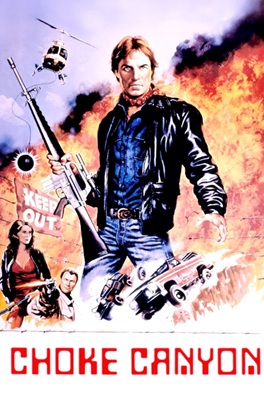
Choke Canyon (1986, directed by Chuck Bail)


Evil businessman John Pilgrim (Nicholas Pryor) and his assistant Brooke Alistair (Lance Henriksen) want to turn Utah’s Choke Canyon into a dumping ground for toxic waste.  The only problem is that Dr. David Lowell (Stephen Collins), a cowboy scientist, has signed a 99-year lease and is using the canyon as a place to conduct experiments that are designed to turn the soundwaves from Halley’s Comet into an alternative energy source.  Pilgrim sends pilot Oliver Parkside (Bo Svenson) to get Lowell out of the canyon by any means necessary.  However, Pilgrim’s rebellious daughter, Vanessa (Janet Julian), has also gone to the canyon because she finds Dr. Lowell to be intriguing.  Lowell’s reaction is to kidnap Vanessa and hold her hostage but, of course, they fall in love while trying to fly a giant ball of toxic waste out of the canyon.

Directed by the legendary stuntman Charles Bail, Choke Canyon is at its best when it focuses on Parkisde using his plane to chase Lowell’s helicopter.  Some of the aerial sequences are really exciting, even if they don’t make much sense.  (Surely, someone as powerful and rich as John Pilgrim could have afforded to send more than three guys and a cropduster to take care of Lowell.)  Stephen Collins, years before his career would collapse after he admitted to inappropriately touching three minor-aged girls, is as personable and bland here as he was in the first Star Trek movie.  The idea of a cowboy scientist is interesting but Collins really didn’t have the screen presence to pull it off.  It doesn’t help that Collins was having to act opposite a certifiable badass like Bo Svenson.  This is one of the rare movies where I wanted the bad guys to win because they were just so much cooler than the hero.

Some of the stunts are impressive, as they should be with Chuck Bail behind the camera.  Stephen Collins is boring and Janet Julian feels miscast.  (She would give a much better performance as Christopher Walken’s lawyer and girlfriend in King of New York.)  I don’t understand how a power source based on Halley’s Comet would work.  It might have worked for a few months in 1986 but what are they going to for energy until 2061 rolls around?

Scenes That I Love: Robert Downey, Jr in Less Than Zero


Today, the Shattered Lens wishes a happy birthday to Oscar-winner Robert Downey, Jr.

This scene that I love comes from 1987’s Less Than Zero.  It features Downey as the self-destructive drug addict, Julian.  Downey has said that this role wasn’t too far from his real life at the time.  Julian’s father is played by the great character actor, Nicholas Pryor.

Happy birthday to Robert Downey, Jr!  I’m thankful that, unlike Julian, he got a second chance.

Film Review: Executive Decision (dir by Stuart Baird)


In 1996’s Executive Decision, terrorists hijack an airplane.  Their leader, Nagi Hassan (David Suchet) demands that the U.S. government not only give him and his men safe passage but that they also release Hassan’s commander, Jaffa (Andreas Katsulas).

In Washington D.C., it is decide to use a stealth plane to transport Col. Austin Travis (Steven Seagal) and his men into the passenger plane.  Accompanying them will be Dr. David Grant (Kurt Russell), a consultant for U.S. Intelligence.  Dr. Grant is the world’s leading expert on Hassan, even though neither he nor anyone else is even sure what Hassan looks like.  Travis distrusts Grant because he’s a civilian and also because he holds Grant responsible for a botched raid on a Russian safehouse in Italy.  Dr. Grant is going to have to prove himself to Col. Travis because Travis doesn’t have any time for people who can’t get the job done.  And Travis is determined to get on that plane and save all those passengers.

In other words, Travis is a typical Steven Seagal character and, for the first fourth of this movie, Seagal gives a typical Steven Seagal performance.  He delivers his line in his trademark intimidating whisper, he glares at everyone else in the film, and essentially comes across as being a total douchebag who can still handle himself in a fight..  However, when it’s time to board the airplane through a docking tunnel, something goes wrong.  Everyone — even nervous engineer Dennis Cahill (Oliver Platt) is able to slip through the stealth plane’s docking tunnel and get into the hijacked airplane cargo hold without being detected.  But the two planes are hit by severe turbulence.  Suddenly, it becomes apparent the one man is going to have to sacrifice his life and close the hatch before the docking tunnel decompresses.

David, already in the cargo hold, looks down at Austin in the tunnel.  “We’re not going to make it!”

“You are!” Austin replies before slamming the hatch shut and getting sucked out of the tunnel.  (There’s your Oscar Cheers Moment of 1996!)  After all that build-up, Steven Seagal exits the film early and now, it’s up to Kurt Russell and what’s left of Austin Travis’s men to somehow stop the terrorists.  Not only do they have to stop Hassan but they also have to do it before the Air Force — which has no way of knowing whether or not any of their men were able to get on the plane before the tunnel fell apart — shoots down the airliner.

(If the airplane looks familiar, that’s because Lost used the same stock footage whenever it flashed back to the plane crash that started the show.)

It’s actually a rather brilliant twist.  When this film came out, Seagal was still a film star.  He played characters who always got the job done and who were basically infallible.  He wasn’t a very good actor but he did manage to perfect an intimidating stare and that stare carried him through a lot of movies.  No one would have expected Seagal to die within the first 30 minutes of one of his movies and when Col. Travis, who the film has gone out of its way to portray as being the consummate warrior, is suddenly killed, there really is a moment where you find yourself wondering, “What are they going to do now?”  In just a matter of minutes, Executive Decision goes from being a predictable Steven Seagal action film to a genuinely exciting and clever Kurt Russell thriller.  For once, Russell is not playing a man of action.  He’s an analyst, a thinker.  And, to the film’s credit, he uses his mind more than his brawn to battle Hassan’s terrorists.  With excellent support from Halle Berry (as a flight attendant who discreetly helps out David and the soldiers), Oliver Platt, B.D. Wong, Whip Hubley,  David Suchet, Joe Morton, and even John Leguizamo (as Travis’s second-in-command), Executive Decision reveals itself to be an exciting and ultimately rewarding thrill ride.

And to think, all it took was sacrificing Steven Seagal.

Airplane! (1980, directed by David Zucker, Jim Abrahams, and Jerry Zucker)


Airplane!, which may be the funniest movie ever made, has made me laugh every time that I’ve watched it.  And I’ve watched it a lot!

Whenever I’m getting ready to travel for my day job, I watch Airplane!  Whenever I’m going to Baltimore or West Virginia for the holidays, I watch Airplane!  Whenever I’m in a bad mood and I need something lighten me up, I watch Airplane!  Whenever I’m in a good mood and I want to be in an even better mood, I watch Airplane!

I can’t remember how old I was when I first saw Airplane! but I know I wasn’t yet ten.  While a lot of the humor went over my head at that young age, it did not matter because I laughed at all the sight gags, like the heart hopping around on the doctor’s desk and the line of passengers waiting to “calm down” the hysterical woman.  I laughed when Ted Stryker (Robert Hays) and Elaine (Julie Haggerty) got covered in seaweed while making out on the beach.  I laughed at the people dying while listening to Ted’s story, even though I didn’t fully understand that it was because of Ted boring them to death.  I loved it when Kareem Abdul-Jabbar got annoyed with the kid in the cockpit, even though young me really didn’t know who Kareem was other than he was a basketball player.  Otto the autopilot was the coolest character around.  Stephen Stucker’s Johnny made me laugh with his nonstop energy.  “Excuse me, stewardess, I speak Jive.”  “And don’t call me Shirley.”  “It looks like I picked the wrong time to stop sniffing glue.”  Every time I heard them, I laughed at all of those lines.  I didn’t have to understand why Lloyd Bridges was suddenly upside down.  I just knew it was funny.

As I got older and rewatched the film, I started to pick up on the humor that earlier went over my head.  I traveled to Turkey when I was twelve and our tour guide spent an hour telling us that Midnight Express was not a fair representation of her country.  After that, I suddenly understood why Captain Oveur (Peter Graves) wanted to know if Joey had ever been to a Turkish prison.  I came to appreciate Julie Hagerty and Lorna Patterson as the two flight attendants.  Airplane! still made me laugh but I came to understand that it was also a love story.  What adolescent boy watching Airplane! didn’t want to be Robert Hays, not only landing the plane but also getting kiss Julie Hagerty at the end of the movie?

And then, as I learned more about the movies, I realized that Airplane! was a pitch perfect parody of the disaster genre and I came to understand the brilliance of casting actors like Lloyd Bridges, Robert Stack, Peter Graves, and especially Leslie Nielsen in this film.  From the first time I saw the movie, Nielsen always made me laugh because he had the best lines and he delivered them with deadpan perfection.  But, as I got older, I came to understand that Nielsen was doing more than just saying funny things.  He was sending up his entire career.  I’m a part of the generation who grew up laughing at Leslie Nielsen the comedy superstar and it’s always strange for me to see him in one of his older, serious roles.  I have Airplane! to thank for that.

There’s so much to say about Airplane!  I could write a thousand words just talking about my favorite jokes and one-liners or how much I enjoyed Stryker’s flashbacks.  It’s my favorite movie and one that still makes me laugh even though I know all of the jokes by heart.  (I’ve always thought Howard Jarvis waiting for Stryker to return to the taxi was one of the best, though underrated, jokes in the movie.)  Airplane! is close to 50 years old and it’s still just as funny today as when I first saw it.

In fact, I think I’ll go watch it right now!

Scenes That I Love: Robert Downey, Jr. and Nicholas Pryor in Less Than Zero


Today, the Shattered Lens wishes a happy birthday to actor and now-Oscar winner Robert Downey, Jr!

Today’s scene that I love comes from 1987’s Less Than Zero.  Long before he played Iron Man, Downey played Julian, a young, self-destructive drug addict in Los Angeles.  In this scene, Julian talks to his father, played by the great character actor, Nicholas Pryor.

Downey has said that playing Julian was not a huge stretch for him as he was dealing with his own growing drug addiction while making Less Than Zero.  (Considering how heavy-handed the film was in its anti-drug message, it’s interesting that both Downey and Andrew McCarthy have talked about first experimenting with cocaine while making the film.)  It’s been quite a turn-around for Downey, who went from being a poster boy for self-destruction to a beloved pop cultural icon.  Just last month, Downey won an Oscar for his performance in Oppenheimer.  He deserved every minute of the applause he received.

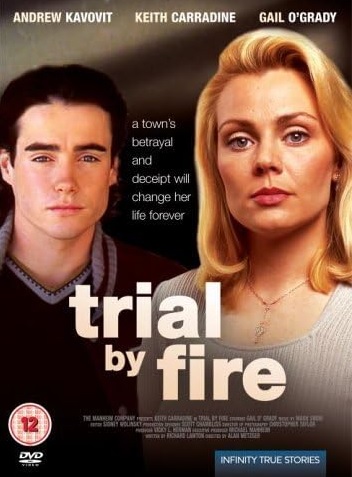
Retro Television Reviews: Trial By Fire (dir by Alan Metzger)


Welcome to Retro Television Reviews, a feature where we review some of our favorite and least favorite shows of the past!  On Sundays, I will be reviewing the made-for-television movies that used to be a primetime mainstay.  Today’s film is 1995’s Trial By Fire!  It  can be viewed on YouTube!

Trial By Fire opens with an absolutely heart-breaking scene, in which a teenager named Kip Bouchmeyer (Andrew Kavovit) enters his bedroom, closes and locks the door (and, in the process, locks out his dog, who sits out in the hallway sadly), and then proceeds to shoot himself.

The upper class community in which Kip lived is stunned by his suicide but they are soon also scandalized by reports that Kip had been having an affair with one of his teachers, Paulette Gill (Gail O’Grady).  Paulette denies the rumors but soon, Kip’s friends are coming forward and saying that Kip not only told them about the affair but that some of them spied on Kip while he was with her.  Paulette continues to deny the accusations but still loses her teaching license.  Paulette is put on trial, accused of seducing Kip and setting off the chain of events that led to his death.  The only people who seem to be willing to believe Paulette’s side of the story are Paulette’s husband, Roger (Michael Bowen), and her attorney, Owen Turner (Keith Carradine).

Indeed, it doesn’t take long for Owen to discover that there are several inconsistencies in the stories that the other students are spreading about Paulette and how she behaved as a teacher.  Owen starts to suspect that Kip’s friends met after Kip’s suicide and concocted the story of Kip and Paulette’s affair on their own.  But why would they do that and, more importantly, can Owen convince anyone else?

There have been a lot of movies made about teachers seducing and carrying on affairs with students.  (I wrote about one of them, Murder in New Hampshire, just a few weeks ago.) There have been far less films made about teachers who are falsely accused.  Interestingly enough, Trial By Fire is based on a true story.  Paulette Gill was a real teacher and, just as in the movie, she really was accused of contributing to the death of one of her students.  Because it’s based on a true story, Trial By Fire doesn’t answer every question that was raised by the case.  Though the film leaves no doubt that Paulette was innocent of seducing Kip, the film leaves it to the viewer to decide whether she was the victim of an actual conspiracy or if a bunch of teenagers just had an overactive imagination.  The film also leaves it to the viewer to decide as to whether or not Paulette allowed herself to get too close to her students, even if she didn’t actually have an affair with Kip.  It could be argued that Paulette allowed herself to care too much about Kip and was rather naïve in not realizing how easily gossip can spread in a high school.  But I think it could also be argued that it’s better to care too much than to not care at all.

It’s a good movie, though a rather sad one.  (The image of that dog sitting outside of Kip’s bedroom left me depressed for a full day.)  The cast, which is full of TV regulars, does a good job with their characters.  I especially liked Keith Carradine’s performance as the tough but fair-minded attorney.  Trial By Fire takes a familiar subject and gives it an unexpected spin, leaving the audience to consider what their own complicity would have been if they had found themselves in the same situation.

Retro Television Reviews: Dark Angel (dir by Robert Iscove)


Welcome to Retro Television Reviews, a feature where we review some of our favorite and least favorite shows of the past!  On Sundays, I will be reviewing the made-for-television movies that used to be a primetime mainstay.  Today’s film is 1996’s Dark Angel!  It  can be viewed on YouTube!

Eric Roberts is Walter D’Arcangelo!

Walter was raised in the Louisiana foster system and eventually a series of Catholic orphanages.  With a last name like D’Arcangenlo, it’s hard not to feel that Walter was destined to eventually become an eccentric homicide detective who does things his way and that’s exactly what happened.  After starting his career in Baton Rouge, Walter has recently transferred to New Orleans.  He arrives just in time to help investigate a series of gruesome murders, the victims of which are all women who cheated on their husbands.  Walter even starts to get phone calls from someone who claims to be the murderer.

Unfortunately, for Walter, he’s somehow become a suspect in the murders.  The rest of the homicide division doesn’t quite know what to make of the somewhat nervy Walter.  When they discover that he went missing for several months while working in Baton Rouge, that makes him even more suspicious in the eyes of his new colleagues.  Even while she personally is falling for him, Detective Anna St. Cyr (Ashley Crow) investigates Walter’s past and discovers that Walter does indeed have a link to the murders but not in a way that anyone was expecting.

Dark Angel was clearly intended to be a pilot for a weekly detective show.  I imagine that Detective D’Arcangelo would have spent every week investigating a different murder in New Orleans.  The show is full of moments that don’t have much to do with the case but which seem to have been included to make viewers say, “Wow, Eric Roberts is a really interesting guy!  I wish he was starring in TV series that I could watch every Tuesday night!”  Roberts does give a pretty good performance as Walter, hinting that, even if he isn’t a killer, the detective is still someone who could snap at any minute.  Roberts plays Walter as if Walter himself is a little bit scared of the darkness that’s lurking inside of him.  Walter’s an interesting character, though one gets the feeling that the demands of a weekly show would have led to the character becoming a bit less enigmatic if Dark Angel had been turned into a series.

The film takes place in New Orleans and it’s somewhat shameless about indulging in every “Big Easy” cliché possible.  Yes, Walter listens to jazz.  Yes, there are scenes of rain and shots where the steamy humidity seems to be rising from the French Quarter.  Yes, Walter visits a voodoo priestess and yes, there’s even a scene set during Mardi Gras.  Though there’s nothing unexpected about the show’s portrayal of New Orleans, the pilot does do a good job of capturing the city’s unique atmosphere.  Eric Roberts and New Orleans feel like a perfect match,

Of course, Dark Angel did not become a series.  Still, the pilot is entertaining and Eric Roberts gives another memorable performance.  Dark Angel is a enjoyably macabre diversion.

Previous Eric Roberts Films That We Have Reviewed:

  1. Star 80 (1983)
  2. Blood Red (1989)
  3. The Ambulance (1990)
  4. The Lost Capone (1990)
  5. Love, Cheat, & Steal (1993)
  6. Love Is A Gun (1994)
  7. Sensation (1994)
  8. Doctor Who (1996)
  9. Most Wanted (1997)
  10. Mr. Brightside (2004)
  11. Six: The Mark Unleased (2004)
  12. Hey You (2006)
  13. In The Blink of an Eye (2009)
  14. The Expendables (2010) 
  15. Sharktopus (2010)
  16. Deadline (2012)
  17. Miss Atomic Bomb (2012)
  18. Lovelace (2013)
  19. Self-Storage (2013)
  20. This Is Our Time (2013)
  21. Inherent Vice (2014)
  22. Road to the Open (2014)
  23. Rumors of War (2014)
  24. A Fatal Obsession (2015)
  25. Stalked By My Doctor (2015)
  26. Joker’s Poltergeist (2016)
  27. Stalked By My Doctor: The Return (2016)
  28. The Wrong Roommate (2016)
  29. Stalked By My Doctor: Patient’s Revenge (2018)
  30. Monster Island (2019)
  31. Seven Deadly Sins (2019)
  32. Stalked By My Doctor: A Sleepwalker’s Nightmare (2019)
  33. The Wrong Mommy (2019)
  34. Free Lunch Express (2020)
  35. Her Deadly Groom (2020)
  36. Top Gunner (2020)
  37. Just What The Doctor Ordered (2021)
  38. Killer Advice (2021)
  39. The Poltergeist Diaries (2021)
  40. My Dinner With Eric (2022)

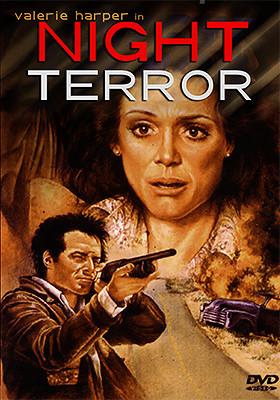
Horror On The Lens: Night Terror (dir by E.W. Swackhamer)


Today’s horror on the lens is a surprisingly violent and grim made-for-TV movie from 1977, Night Terror! 

In Night Terror, Valerie Harper plays a woman trying to drive to Denver, overnight.  Unfortunately, she catches the attention of The Killer (played by Richard Romanus), a mute psychopath who spends his time driving up and down the highway, killing random people.  This is a pretty well-done and suspenseful made-for-television movie, featuring good performances from both Harper and Romanus.  I wrote a more in-depth review of the film back in May so give it a read after you watch the movie.

(Or before you watch the movie.  I’m not going to tell you how to do things.)

Drive carefully!

https://www.youtube.com/watch?v=hahgGBOHLSg