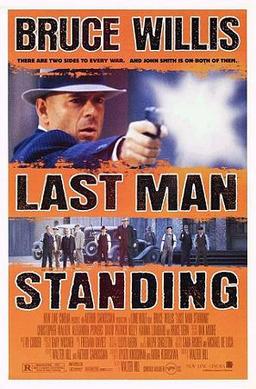
Last Man Standing (1996, directed by Walter Hill)


During the 1920s, at the height of prohibition, a mysterious man named John Smith (Bruce Willis) arrives in the dusty town of Jericho.  Jericho sits on the border, between Texas and Mexico, and it is the site of a gang war.  The Italian mob, led by Fred Strozzi (Ned Eisenberg) and Giorgio Carmote (Michael Imperioli), is trying to move in on the Irish mob, led by Doyle (David Patrick Kelly) and his fearsome gunman, Hickey (Christopher Walken).  After the members of the Irish mob destroy his car and leave him stranded in town, Smith offers his services as a gunman to the Italians.  Strozzi hires him but it turns out that Smith has his own agenda and soon, he is manipulating both gangs against each other.

Last Man Standing was Walter Hill’s remake of Yojimbo, with Bruce Willis playing an Americanized version of Toshiro Minfune’s wandering ronin.  (Hill does the right thing and gives Kurosawa credit for the film’s story.)  Now, it should be understood that this is in no way a realistic film.  It makes no sense for two Chicago-style gangs to be fighting over a ghost town in Texas.  Even when it came to smuggling in liquor during the prohibition era, most of it came over the Canadian border rather than the Texas border.  But Walter Hill has always been more about filming the legend than worrying about realism.  He’s the ultimate stylist, creating movies the come together to create an American mythology.  Last Man Standing is a work of pure style, a combination western/gangster movie that pays tribute to the ultimate samurai film.  Gangsters meeting in the desert while tumbleweed rolls past may not make sense but Hill knows a good visual when he sees one and he makes it work.  The plot is taken from Yojimbo.  The western setting is taken from A Fistful of Dollars.  And the gangsters are pure Americana.

Willis, back in his action star heyday, is quick with a gun and a quip and he gets a few scenes that show that, while he may be bad, he’s not as bad as the gangsters in charge of the town.  Hill surrounds Willis with a cast of great character actors, including Bruce Dern as the cowardly sheriff and William Sanderson as the owner of the hotel.  Though he might not be as well-known as some members of the cast, I especially liked Ken Jenkins as the Texas Ranger who informs Willis that he has ten days to finish up his business before the Rangers come to town and kill whoever is still standing.  And then you’ve got Walken, in one of his best villainous roles.  Hickey doesn’t show up until pretty late in the movie but we’ve spent so much time hearing about him that we already know he’s the most dangerous man in Texas and Walken gives a performance that lives up to the hype.

Unappreciated when it was first released, Last Man Standing has stood the test of time as one of Walter Hill’s best.

Retro Television Review: Miami Vice 2.14 “Yankee Dollar”


Welcome to Retro Television Reviews, a feature where we review some of our favorite and least favorite shows of the past!  On Mondays, I will be reviewing Miami Vice, which ran on NBC from 1984 to 1989.  The entire show can be purchased on Prime!

This week, Sonny’s latest girlfriend gets involved in the drug trade.

Episode 2.14 “Yankee Dollar”

(Dir by Aaron Lipstadt, originally aired on January 17th, 1986)

It’s another night in Miami.  Sonny Crockett is looking forward to driving out to the airport and picking up his latest girlfriend, a flight attendant named Sarah (Audrey Matson).  For two years, Sarah has been working the Miami to Bogota to Paris and back route.  She doesn’t make a lot of money but, as is typical for this show, she lives in a small but very nicely furnished house.

Unfortunately, Sarah dies shortly after Sonny picks her up.  She goes into cardiac arrest, the result of a balloon of cocaine bursting inside of her.  It turns out that Sarah was working as a drug mule, all so she could make a quick five grand and buy a used BMW.

Seriously, what are the chances that Sonny Crockett’s girlfriend would turn out to be a drug smuggler?  Maybe she thought she was dating Sonny Burnett.  Or maybe, like so many others on this show, she allowed her desire for the finer things in life — like a BMW — to lead her astray.  This is one of the major themes of Miami Vice.  In a society where conspicuous consumption rules, people will do anything to appear richer than they actually are.

When Sonny and Rico arrest Sarah’s brother, Tim (Clayton Rohner), they discover that he works for a wealthy businessman named Charlie Glide (Ned Eisenberg).  Everyone knows that Charlie Glide (a great name, by the way) is involved in the drug trade but no one has ever been able to pin anything on him.  In the past, Charlie avoided cocaine but he’s now looking to branch out.  Sonny and Rico go undercover to try to bring Charlie down.

Of course, it doesn’t work.  Charlie is smart enough to figure out that Sonny and Rico are trying to set him up.  Even after Crockett and Tubbs drag him down to the police station and Charlie makes a deal for immunity in return for setting up two other drug dealers (Anne Carlisle and Pepe Serna), he still tries to double cross the cops.  And even though the double cross doesn’t quite work, Charlie remains smug in his knowledge that he has immunity.

Except, of course, he doesn’t have immunity from all crimes.  Earlier in the episode, Charlie’s executive assistant, Max Rogo (Austin Pendleton), used Charlie’s gun to execute Tim.  Even though Crockett and Tubbs know that Max is the one who pulled the trigger and that Max is the one who decided to kill Tim, they still arrest Charlie for the murder.  (Max was apparently killed in an earlier shootout so it’s not like he’s around to tell the truth.)  “You changed the rules!” Charlie shouts as he’s dragged away.

This episode is Miami Vice at its most cynical.  Crockett and Tubbs can’t get Charlie for the crime he committed so, instead, they set him up for a crime he didn’t commit.  They did change the rules in that they decided they no longer have to follow them.  The episode is full of characters so desperate for money that they’ll do just about anything, even smuggling a lethal drug in their body.  Crockett can only watch helplessly as Sarah dies and, even as Charlie is taken away, there’s never any doubt that he’ll be replaced by someone else, the drug trade will continue, and more people will die just because they wanted to be able to afford a few extra things.  Crockett and Tubbs are fighting a war that can never be won.  Whatever victories they get ultimately feel hollow.  Arresting Charlie won’t bring Sarah back and it won’t stop more innocent people from dying.  Ned Eisenberg was wonderfully smug as Charlie Glide and Austin Pendleton was appropriately creepy as the always-smiling Max Rogo.  This was a good episode, one that challenged the traditional cop show narrative.  How long can one fight a losing war?

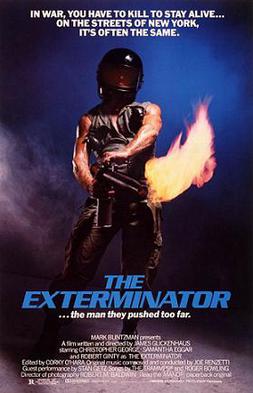
The TSL Grindhouse: The Exterminator (dir by James Glickenhaus)


First released in 1980, The Exterminator begins during the Vietnam War.

Two soldiers, John Eastland (Robert Ginty) and Michael Jefferson (future Cannon Film mainstay Steve James) have been captured by the Viet Cong and can only watch as a third soldier is beheaded by his captors.  (The graphic beheading, in which the camera lingers on the head slowly sliding off the neck, is an early warning of what this film has in store for its audience.)  Jefferson manages to free himself from his bonds and kills most of the enemy soldiers.  After Jefferson frees him, Eastland fires a bullet into the still twitching body of the VC commander.

The film jumps forward to 1980.  Living in New York City, Jefferson and Eastland are still best friends and co-workers at a warehouse.  For a second time, Jefferson saves Eastland’s life when the latter is attacked by a gang calling themselves the Ghetto Ghouls.  When the Ghouls get their revenge by tracking down Jefferson and piecing his spine with a meat hook, Eastland gets his revenge by killing …. well, just about everyone that he meets.

Though The Exterminator was obviously inspired by Death Wish, a big difference between the two films is that Eastland doesn’t waste any time before starting his anti-crime crusade.  In the original Death Wish, Paul Kersey (played by Charles Bronson) starts out as a self-described “bleeding heart” liberal who was a conscientious objector during the Korean War.  Even after his wife and daughter are attacked (and his wife killed) by Jeff Goldblum, Kersey doesn’t immediately pick up a gun and start shooting muggers.  Indeed, it’s not until the film is nearly halfway over that Kersey begins his mission and, in one of the film’s more memorable moments, he reacts to his first act of violence by throwing up afterwards.  While one could hardly call Death Wish an especially nuanced film, it does at least try to suggest that Kersey’s transformation into a vigiliante was a gradual process.

The Exterminator, on the other hand, goes straight from Eastland informing Jefferson’s wife about the attack to Eastland threatening a tied-up Ghetto Ghoul with a flame thrower.  When did Eastland kidnap the Ghetto Ghoul?  Why does Eastland have a flame thrower?  Where exactly has Eastland tied up the Ghetto Ghoul?  None of this is explained and the film’s abruptness gives it an almost dream-like feel.  The film plays out like the fantasy of everyone who has ever been mugged or otherwise harassed.  Magically, Eastland suddenly has the skills and the resources to outsmart not just the criminals but also the police who have been assigned to stop him.  Even the CIA is assigned to take down Eastland because his anti-crime crusade is inspiring people to wonder why the President hasn’t been able to reduce crime.  The film plays out like the type of daydreams that Travis Bickle had when he wasn’t driving his taxi.

Eastland is ruthless in his kills but fortunately, everyone he kills is really, really bad.  The Ghetto Ghouls clubhouse is decorated with a poster of Che Guevara but Che’s revolutionary rhetoric isn’t worth much when the Exterminator’s after you.  A mob boss makes the mistake of not telling Eastland about the Doberman that’s guarding his mansion so into the meat grinder he goes.  New Jersey loses a state senator when Eastland discovers him torturing an underage male prostitute.  The film was shot on location in New York City and the camera lingers over every grimy corner of the city.  A scene where Eastland walks through Times Square takes on a cinéma-vérité feel as people jump out at him and try to entice him to take part in everything the city has to offer.  If Death Wish suggested that Paul Kersey’s actions were saving New York, The Exterminator suggests that we should just let John Eastland burn the whole place down.

With his youthful face, Robert Ginty looks more like a mild-mannered seminarian than a hardened veteran of both Vietnam and the mean streets of New York but, ultimately, that works to the film’s advantage.  If anything, it explains why everyone who meets him trends to underestimate what he’s capable of doing.  B-movie vet Christopher George overacts in his usual amusing way as he plays the detective who has been assigned to catch The Exterminator.  Samantha Eggar plays a doctor who starts dating George for no discernible reason.  The scenes featuring George and Eggar often seems as if they belong in a different film but they do provide some relief from the rather grim and gruesome scenes of The Exterminator killing almost everyone who he meets.

The Exterminator was controversial when it was originally released and it still retains the power to shock.  It’s easy to laugh at some of the film’s more melodramatic moments but there were still more than a few scenes that I watched with my hands over my eyes.  The film’s hard edge grabs your attention from the start and the idea of the CIA sending assassins to take out a neighborhood vigilante is so over the top and ridiculous that it’s kind of hard not to appreciate it.  That the film totally buys into its paranoid worldview (“Washington will be pleased.”) makes the whole thing far more compelling than it should be.

As ludicrous as it all is, The Exterminator is a film that defies you to look away.

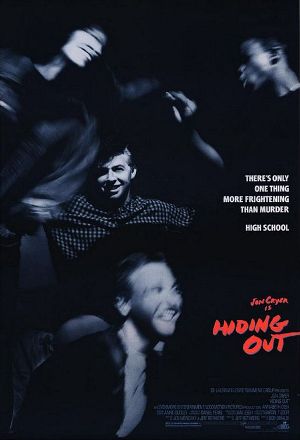
A Movie A Day #342: Hiding Out (1987, directed by Bob Giraldi)


Andrew Morenski (Jon Cryer) is a stockbroker in the 1980s.  What could be better than handling large amount of money during the decade of excess, right?  The only problem is that Andrew and two of his colleagues have gotten involved with Mafia.  And now, the Mafia wants them all dead.  On the run from both the FBI and the Mob, Andrew tries to change his appearance.  He shaves off his beard.  He gives himself a bad dye job.  No sooner has Andrew traded clothes with a homeless person than he is mistaken for a high school student.
What better place could there be for Andrew to hide than a high school?  Despite being 29 years old, Andrew fits right in and soon becomes one of the most popular students at the school.  Andrew not only gets a girlfriend (Annabeth Gish) but he is even nominated to run for student body president.  As Andrew discovers, the mob may be ruthless but they’re nothing compared to the student council.

Hiding Out may begin like a violent action thriller but it quickly reveals itself to be yet another John Hughes-influenced high school movie.  Andrew starts out as a sleazy stockbroker but, by the end of the movie, he has transformed himself into Ferris Bueller.  After spending his teenage years as a self-described “short, horny, hopeless dork,” Andrew is finally getting his chance to be cool.  (“Well, I’m not short,” Andrew says.)  The best scenes are the ones where Andrew occasionally forgets that he’s just supposed to be an apathetic teenager, like when he gets into a fierce argument with his history teacher over whether Richard Nixon should have been forced out of office or when he meets his girlfriend’s father and ends up giving him stock advice.  There’s no denying that the plot is frequently dumb and features some massive plot holes but, largely due to Jon Cryer’s likable and energetic performance, Hiding Out is also a breezy and enjoyable movie.

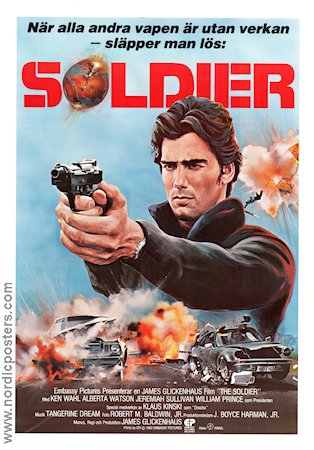
A Movie A Day #331: The Soldier (1982, directed by James Glickenhaus)


The Soldier is really only remembered for one scene.  The Soldier (Ken Wahl) is being chased, on skis, across the Austrian Alps by two KGB agents, who are also on skis.  The Soldier is in Austria to track down a KGB agent named Dracha (Klaus Kinski, who only has a few minutes of screen time and who is rumored to have turned down a role in Raiders of the Lost Ark so he could appear in this movie).  The Russians want the Soldier dead because they’re evil commies.  While being chased, the Soldier goes over a ski slope and, while in the air, executes a perfect 360° turn while firing a machine gun at the men behind him.  It’s pretty fucking cool.

The Soldier, who name is never revealed, works for the CIA.  He leads a team of special agents.  None of them get a name either, though one of them is played by the great Steve James.  When a shipment of Plutonium is hijacked so that it can be used it to contaminate half of the world’s supply of oil, The Soldier is assigned to figure out who is behind it.  Because terrorists are demanding that Israel withdraw from the West Bank, Mossad assigns an agent (Alberta Watson) to help out The Soldier.  She gets a name, Susan Goodman.  She sleeps with The Soldier because, she puts it, the world is about to end anyway.

The Soldier was obviously meant to be an American James Bond but Ken Wahl did not really have the screen charisma necessary to launch a franchise.  He is convincing in the action scenes but when he has to deliver his lines, he is as stiff as a board.  Fortunately, the majority of the movie is made up of action scenes.  From the minute this briskly paced movie starts, people are either getting shot or blown up.  Imagine a James Bond film where, instead of tricking the bad guys into explaining their plan, Bond just shot anyone who looked at him funny.  That’s The Soldier, a film that is mindless but entertaining.

Ken Wahl may have been stiff and Klaus Kinski may have been wasted but there are still some interesting faces in the cast.  Keep an eye out for William Prince as the President, Ron Harper as the director of the CIA, Zeljko Ivanek as a bombmaker, Jeffrey Jones as the assistant U.S. Secretary of Defense, and George Straight performing in a redneck bar.  Best of all, one of the Soldier’s men is played by Steve James, who will be recognized by any Cannon Films aficionado.

Surprisingly, The Solider is not a Cannon film.  It certainly feels like one.