I will hold my incredible taste and not my complete lack of social contacts to “blame” for having never before heard of the supposed pop sensation Justin Bieber. But I remember NSync, the Backstreet Boys, and similar disasters: These unforgivable icons who severed unscrupulously from the first rule of popstar trash ethics. (If you suck horribly as a musician, you must compensate with nice tits.) It would appear however, as recently discovered by ambient artist Shamantis, that this Bieber fellow has had you all fooled. Those vile record producers took his 35 minute Sigur Rós-esque ambient masterpiece U Smile and sped it up into some five minute trashy pop single.
Or maybe the moral of Shamantis’s experiment is that sound is all relative. The worst garbage on the market can speak in tongues. The complete version of U Smile 800% slower can be found and downloaded below. An abbreviated youtube version follows:
When the infamous epic Caligula was first released back in 1979, a disco version of Caligula’s love theme — We Are One — was also released as a promotional gimmick. If you’ve sat through the behind-the-scenes footage on the Caligula Imperial Edition DVD, this song has probably been forever branded on your brain.
And that’s not necessarily a bad thing.
This song is so over-the-top, so blatantly exploitive, so insidiously catchy, and so totally inappropriate for the film it was written for that it simply cannot be ignored. To me, this song represents everything that makes the Grindhouse great.
(As well, I hope whoever was playing bass got paid extra…)
While we’re on the subject, I’m also going to include the opening credits of Caligula because I’ve always liked the use of Profokiev’s Romeo and Juliet.
(I also love the fact that the screenplay is credited as being adapted from a script by Gore Vidal yet no one is given credit for doing the adapting, the editing is credited to “the production,” and director Tinto Brass is credited with “principal photography.”)
Last Monday, I made a change. I moved from my small, cozy apartment (with its paper-thin walls and bedroom window that I could never quite get to shut all the way) to a big, two-story house that I’ll be sharing with my sister and BFF, Erin Nicole. As excited and happy as I am having made this move, it also meant that, last week, I spent less time than usual obsessing over grindhouse exploitation and pop culture.
In other words, I’ve got to make up for some lost time.
I’d like to begin by highlighting one of my favorite songs, perhaps my favorite song of all time. Siouxsie Sioux may have been first known as simply a groupie for the Sex Pistols (Way back when, Bill Grundy’s lame attempts to hit on her led to the televised profanity that inspired the infamous “Filth and the Fury” headline) but she later proved herself to be a brilliant and intriguing artist in her own right. As the vocalist for Siouxsie and the Banshees, Siouxsie was (and is) one of the most important figures of the post-punk era.
Proving once again that I was simply born several years too late, I didn’t get a chance to appreciate the Banshees until they had already ceased to exist as an active group. In 2004, having just recently seen 24 Hour Party People, I was obsessed with all things punk and all things new wave. While everyone else was discovering the Black-Eyed Peas or trying to maintain a sense of ironic detachment while buying the latest from Ashlee Simpson, I was devoting my time to Joy Division, New Order, The Slits, the Talking Heads, Patti Smith, the New York Dolls, and Public Image, Ltd. I haunted the used book and music stores of north Texas and, like an archeologist, I would chip away at all of the boring, modern sediment in hopes of discovering something wonderful hidden underneath it all. Without a doubt, my greatest discovery was Siouxsie and the Banshees.
I discovered a CD entitled The Best of Siouxsie and the Bansheesat Recycled Books in Denton, Texas and it quickly became one of my most prized possessions. Over the years, my life has taken a lot of twists and turns but there has always been one constant — whenever I’ve needed them, Siouxsie and the Banshees have been playing on my CD player.
My favorite song off that CD is Kiss Them For Me, a song first released in 1991. The song, which admittedly does have more of a “pop” feel to it than other Banshee songs, is Siouxsie’s tribute to another frequently misunderstood icon, Jayne Mansfield. Like Mansfield, the song is unapologetically over-the-top and wonderfully self-aware. It’s a song that pays tribute to a legend by being legendary itself.
(It’s also the song that I had playing nonstop while my sister and I were unpacking our things this week.)
The song’s lyrics refer both obliquely and explicitly to Mansfield’s decapitation in a 1967 car accident. (Mansfield’s daughter — Mariska Hargitay — survived the accident and is currently the star of Law and Order: SVU.)
It glittered and it gleamed
For the arriving beauty queen
A ring and a car
Now you’re the prettiest by far
No party she’d not attend
No invitation she wouldn’t send
Transfixed by the inner sound
Of your promise to be found
“nothing or no-one will ever
Make me let you down”
Kiss them for me — I may be delayed
Kiss them for me — if I am delayed
It’s divoon, oh it’s serene
In the fountains pink champagne
Someone carving their devotion
In the heart shaped pool of fame
“nothing or no-one will ever
Make me let you down”
Kiss them for me — I may be delayed
Kiss them for me — I may find myself delayed
On the road to new orleans
A spray of stars hit the screen
As the 10th impact shimmered
The forbidden candles beamed
Kiss them for me — I may be delayed
Kiss them for me — I may find myself delayed
Recently, I’ve been reading Clinton Heylin’s history of punk rock, Babylon’s Burning: From Punk To Grunge. Not surprisingly, one of the main characters in this book is John Lydon (a.k.a. Johnny Rotten). Along with detailing Lydon’s time as the lead singer for the Sex Pistols, the book also examines Lydon’s subsequent career as the frontman for Public Image, Ltd. The book also inspired me to track down and listen to one of PIL’s earliest efforts, a song that was originally called Death Disco (though it was also released under the name Swan Lake for reasons that become obvious once you listen to the song).
Death Disco was written after and in response to the death of Lydon’s mother. Though the song is now over 30 years old, it remains a powerful and cathartic cry of pain and loss.
As an added bonus, here’s two interviews with Lydon, one from the late 70s that was recorded shortly before he formed Public Image, Ltd. (and in which he looks so incredibly young and, dare I say it, rather adorable in his bratty way) and one from 2007 in which he discusses the meaning of life.
As I sit here frustrated by my attempts to write about how great a movie Winter’s Bone is and feeling depressed for the usual sordid, personal reasons, I realize that I’m still in a Flight of the Conchords type of mood.
Here’s Bret and Jermaine performing my all-time favorite Conchords song, Hurt Feelings.
One of my favorite songs from 2009 was the Spaceship Martini’s Running Out Of Empty. The song was written for Lymelife, a flawed but still oddly effective little movie that featured excellent performances from Rory Culkin, Emma Roberts, Alec Baldwin, and especially Timothy Hutton.
Running Out Of Empty is used to score the film’s final scenes and it brings the perfect melancholy touch to the entire movie. I could devote a lot of space to everything that didn’t work in Lymelife but it does have an absolutely perfect ending and this song and its use in the film has a lot to do with that perfection.
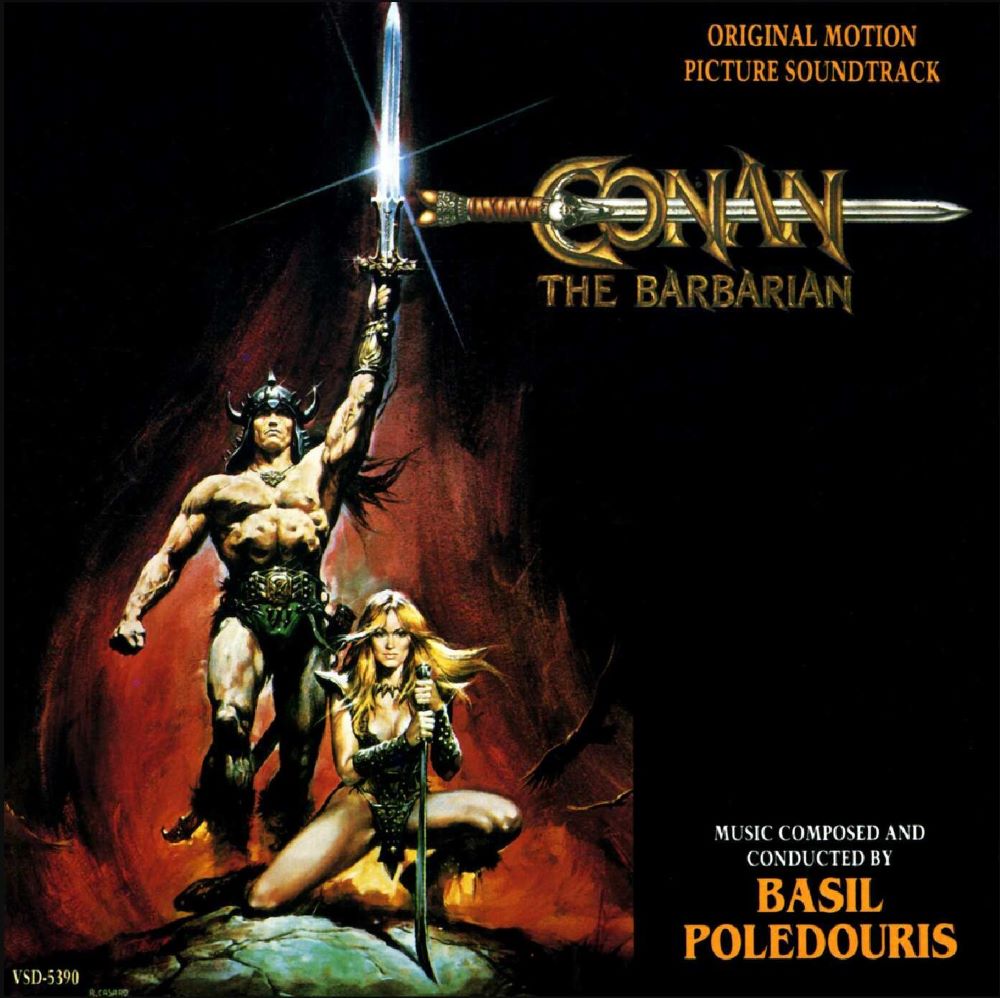
In 1982, maverick director John Milius wrote and directed a sword-and-sorcery epic based on Robert E. Howard’s pulp hero, Conan the Cimmerian. While Milius made several changes to the original character and his adventures to create a more accessible fantasy experience, Conan the Barbarian became a tremendous success and ushered in the Age of Schwarzenegger. With his charismatic leading man and a script filled with action and exotic locales, Milius now needed someone to compose a score worthy of the film’s mythic scale. His ultimate choice—composer Basil Poledouris—proved inspired.
Poledouris took an unconventional approach to scoring Conan the Barbarian. Rather than merely providing musical background to accompany scenes, he treated the score like an opera. Drawing from the influence of Richard Wagner and Carl Orff—particularly Orff’s Carmina Burana, which heavily inspired tracks like “Riddle of Steel/Riders of Doom” and “Battle of the Mounds”—Poledouris crafted a composition that could stand on its own as an operatic masterpiece. His use of leitmotifs to introduce and define characters echoed Wagner’s Ring Cycle. In “Riddle of Steel/Riders of Doom”, the intertwining themes of Conan and his nemesis Thulsa Doom are marked by pounding drums, crashing brass, and triumphant horns—a motif that returns with heightened intensity in “Battle of the Mounds.”
Another brilliant motif appears in the film’s introspective section—a more lyrical, meditative theme where Poledouris trades the martial power of drums and brass for a lighter, more emotional palette. This motif runs through a trio of tracks: “Theology/Civilization”, “The Wifeing”, and “The Leaving/The Search.” The first is a playful and airy piece that transitions seamlessly into the intimate and mournful middle section, culminating in a final movement that fuses both moods, reflecting Conan’s inner struggle and resolution in his quest for vengeance.
Other tracks contribute distinct emotional and narrative textures. “Gift of Fury” begins as a slow dirge following the destruction of Conan’s village, then swells to a dramatic crescendo that marks the end of his innocence and his descent into bondage. “The Kitchen/The Orgy” stands out for its complex duality—starting with Doom’s militaristic motif before morphing into a sensuous, decadent, and subtly discordant theme that embodies his contrasting nature: both disciplined and depraved. This piece showcases Poledouris’ deep understanding of the film’s characters and the psychological layers behind their actions.
Poledouris’ final score perfectly complements the film’s imagery and narrative while enhancing its dramatic weight. Even separated from the visuals, the symphonic and choral elements tell the story vividly—listeners can follow the emotional arc using only the liner notes. As a standalone work, it functions like a grand symphony; merged with Milius’ visuals, it achieves something transcendent.
Conan the Barbarian not only launched Arnold Schwarzenegger’s star power but also proved that sword-and-sorcery epics could be cinematic art. Milius’ decision to entrust Poledouris with the score would influence film composers for decades, demonstrating that a film’s music need not be a mere afterthought. To this day, Poledouris’ score remains his magnum opus and a benchmark for fantasy film music. Its influence can be heard as recently as Howard Shore’s The Lord of the Rings trilogy, where Shore applied Poledouris’ Wagnerian leitmotif approach to weave his own operatic storytelling through music. Conan the Barbarian endures as a masterful collaboration between director and composer—a timeless work that will continue resonating long after its creators have passed into legend.
Below are videos of the only live concert conducted by Basil Poledouris of the Conan the Barbarian symphonic score.
Part 1: Anvil of Crom/Riddle of Steel/Riders of Doom