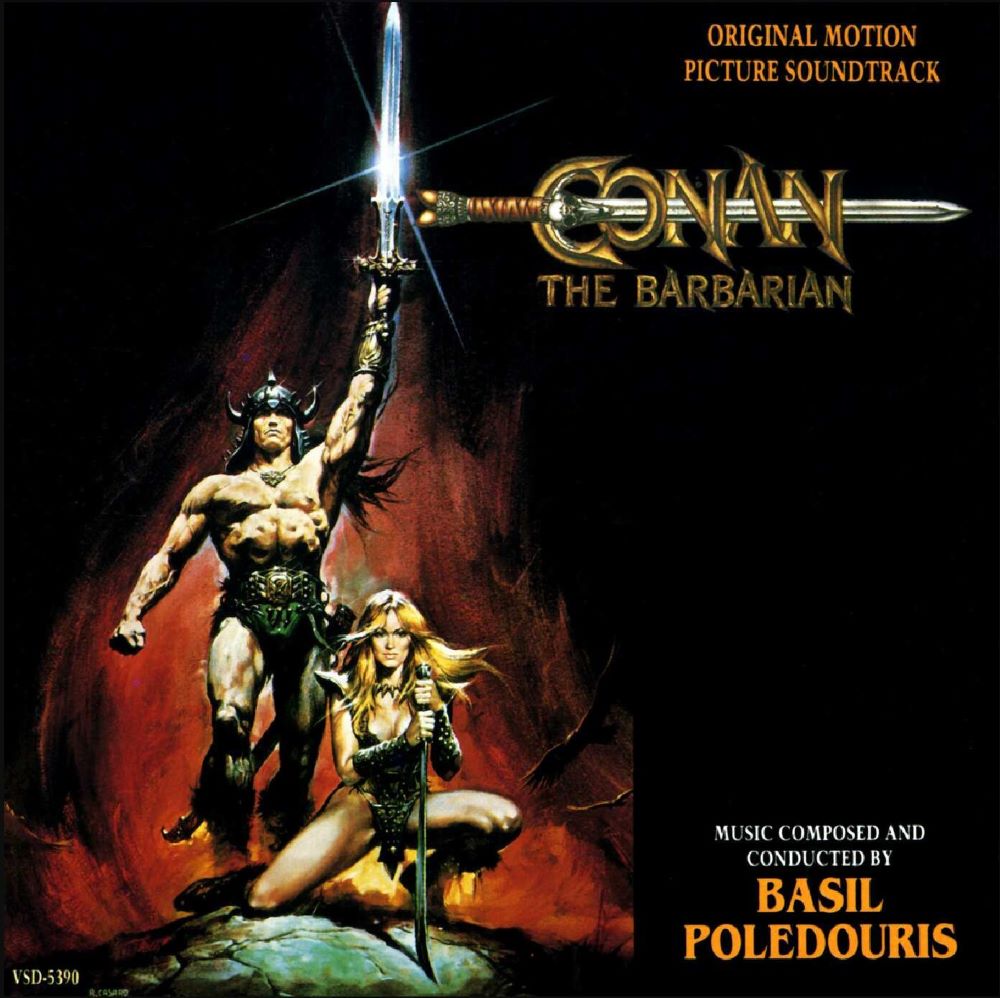
In 1982, maverick director John Milius wrote and directed a sword-and-sorcery epic based on Robert E. Howard’s pulp hero, Conan the Cimmerian. While Milius made several changes to the original character and his adventures to create a more accessible fantasy experience, Conan the Barbarian became a tremendous success and ushered in the Age of Schwarzenegger. With his charismatic leading man and a script filled with action and exotic locales, Milius now needed someone to compose a score worthy of the film’s mythic scale. His ultimate choice—composer Basil Poledouris—proved inspired.
Poledouris took an unconventional approach to scoring Conan the Barbarian. Rather than merely providing musical background to accompany scenes, he treated the score like an opera. Drawing from the influence of Richard Wagner and Carl Orff—particularly Orff’s Carmina Burana, which heavily inspired tracks like “Riddle of Steel/Riders of Doom” and “Battle of the Mounds”—Poledouris crafted a composition that could stand on its own as an operatic masterpiece. His use of leitmotifs to introduce and define characters echoed Wagner’s Ring Cycle. In “Riddle of Steel/Riders of Doom”, the intertwining themes of Conan and his nemesis Thulsa Doom are marked by pounding drums, crashing brass, and triumphant horns—a motif that returns with heightened intensity in “Battle of the Mounds.”
Another brilliant motif appears in the film’s introspective section—a more lyrical, meditative theme where Poledouris trades the martial power of drums and brass for a lighter, more emotional palette. This motif runs through a trio of tracks: “Theology/Civilization”, “The Wifeing”, and “The Leaving/The Search.” The first is a playful and airy piece that transitions seamlessly into the intimate and mournful middle section, culminating in a final movement that fuses both moods, reflecting Conan’s inner struggle and resolution in his quest for vengeance.
Other tracks contribute distinct emotional and narrative textures. “Gift of Fury” begins as a slow dirge following the destruction of Conan’s village, then swells to a dramatic crescendo that marks the end of his innocence and his descent into bondage. “The Kitchen/The Orgy” stands out for its complex duality—starting with Doom’s militaristic motif before morphing into a sensuous, decadent, and subtly discordant theme that embodies his contrasting nature: both disciplined and depraved. This piece showcases Poledouris’ deep understanding of the film’s characters and the psychological layers behind their actions.
Poledouris’ final score perfectly complements the film’s imagery and narrative while enhancing its dramatic weight. Even separated from the visuals, the symphonic and choral elements tell the story vividly—listeners can follow the emotional arc using only the liner notes. As a standalone work, it functions like a grand symphony; merged with Milius’ visuals, it achieves something transcendent.
Conan the Barbarian not only launched Arnold Schwarzenegger’s star power but also proved that sword-and-sorcery epics could be cinematic art. Milius’ decision to entrust Poledouris with the score would influence film composers for decades, demonstrating that a film’s music need not be a mere afterthought. To this day, Poledouris’ score remains his magnum opus and a benchmark for fantasy film music. Its influence can be heard as recently as Howard Shore’s The Lord of the Rings trilogy, where Shore applied Poledouris’ Wagnerian leitmotif approach to weave his own operatic storytelling through music. Conan the Barbarian endures as a masterful collaboration between director and composer—a timeless work that will continue resonating long after its creators have passed into legend.
Below are videos of the only live concert conducted by Basil Poledouris of the Conan the Barbarian symphonic score.
Part 1: Anvil of Crom/Riddle of Steel/Riders of Doom
Part 2: Gift of Fury/Atlantean Sword/Love Theme
Part 3: Funeral Pyre/Battle of the Mounds
Part 4: Orphans of Doom/The Awakening
Part 5: Anvil of Crom/Encore

