Will Randall (Jack Nicholson), the editor-in-chief of a New York Publishing house, doesn’t get much respect, not from his wife (Kate Nelligan), not from his boss (Christopher Plummer), and certainly not from Stuart Swinton (James Spader), the sleazy executive who is plotting to steal his job and destroy his marriage. But then, one night, Will runs over a black wolf on a country road. When he tries to helps it, the wolf bites him. Soon after, Will starts to feel different whenever the moon is full.
I remember that, when Wolf came out in 1994, some people said that casting Jack Nicholson as a werewolf seemed like typecasting. Nicholson apparently understood this as well so he actually downplays his usual mannerisms for the first part of the movie and gives a convincing performance as a harried executive who is worried he’s about to lose his job. It’s only after he is bitten that Will Randall starts to come alive. Not only does he develop the predator instinct necessary to survive in New York City but he also, without fear, pursues his boss’s daughter, Laura (Michelle Pfeiffer, at her most beautiful). Typecast or not, Jack Nicholson is excellent in Wolf. Equally good is James Spader as Will’s business rival, who starts to show some predator-like aspects of his own.
Director Mike Nichols was not normally a horror director and, around the midway point, his direction falters and there are times when he just seems to be going through the motions. He gets good performances from his cast but doesn’t know how to craft a good jump scare. The best parts of the movie are when Wolf uses lycanthropy as a metaphor for petty office politics, with Will “marking” his territory while talking to Stewart and showing a renewed killer instinct. Wolf works better as a social satire than as a horror movie.
Fans of Frasier will be happy to see David Hyde Pierce in a small but key role. He delivers the film’s best line. Fans of Friends may also notice David Schwimmer in a small role. He says nothing worth remembering. Their presence, though, is a reminder of just how much American culture changed in 1994. By the end of the year, both went from small roles in Wolf to co-starring in the two of the most popular sitcoms in America.
Today, the Shattered Lens wishes a happy birthday to the legendary Dustin Hoffman. This scene that I love comes from 1967’s The Graduate and it features Hoffman delivering one of the greatest lines of all time.
I noticed that today is Harrison Ford’s 83rd birthday. Like most people born in the early 1970’s, I’m a big fan of Harrison Ford. My formative years included the Star Wars movies, the Indiana Jones movies, and many other great films like BLADE RUNNER (1982) and WITNESS (1984). He would go on to make more classics like THE FUGITIVE (1993) and AIR FORCE ONE (1997) as I got older and moved into adulthood, but one of my personal favorite films starring Harrison Ford is REGARDING HENRY (1991).
In REGARDING HENRY, Harrison Ford stars as Henry Turner, a ruthless bastard, who also happens to be a hugely successful and cutthroat attorney in New York City. This horrific approach to being a human being does seem to provide plenty of money for his wife Sarah (Annette Bening) and his daughter Rachel (Mikki Allen), but you don’t get the feeling there’s that much actual love being shared between the three. Then one night, after another successful day of sticking it to the masses, Henry’s world is turned upside down when he’s shot in the head at the corner convenience store by a guy sticking up the place (John Leguizamo). The bullet to the brain doesn’t kill Henry, but it does leave him with severe brain damage and extremely impaired motor skills. This turns out to be a nice turn of events for Henry, and his family, for several reasons. First, he meets Bradley (Bill Nunn), his physical therapist and all around nice guy, who really helps him get headed back in the right direction in health, and in life, again. Second, he begins to reconnect with his wife who likes this more thoughtful, caring and affectionate version of Henry that seems to be emerging. Finally, he starts to show his daughter some much needed love and attention, rather than just wanting to ship her off to boarding school as quickly as possible. Wouldn’t you know it though, just when things are going so perfect, the sweet, innocent Henry stumbles up some very uncomfortable truths about his former life. Will these revelations upend his new life, or will he be able to move forward with a fresh start and a household filled with love?!!
There are two main reasons that I love REGARDING HENRY. The first reason is undoubtedly the feel-good story at the heart of the film. This is J.J. Abrams second writing credit and his screenplay takes Henry from being an arrogant, selfish jerk who is only interested in his own glorification, to a sweet-natured man of integrity who elevates his wife and his daughter to the prominent positions they rightfully deserve. Is this transformation grounded in reality… no, but I love movies because I want to escape reality and live vicariously through the heroes on the screen. Henry may not be a hero in the same way as Superman, Charles Bronson, or Chow Yun-Fat, but he is someone that I can relate to. I want to be a better dad. I want to be a better husband. I want to be a man of principle and integrity in the workplace. I may not always be perfect, but watching Henry navigate his life and correct past wrongs is very satisfying and uplifting to see. I love the look in the eyes of his wife and daughter as they are so proud of him. I want my family to look at me in that same way. This movie just makes me feel good. When I want realism, I’ll go visit a shrink and watch documentaries about men and women dealing with traumatic brain injuries.
The second reason I love REGARDING HENRY stems from the performances of several of the cast members. Harrison Ford is so good in the title role. His transformation from a cold hearted lawyer to a simple-minded family man is one of those things that could be really bad with the wrong actor, but I’ll gladly follow Ford through the process. He’s believable on both sides, and he has to be for the movie to work. Annette Bening is also great as his wife, Sarah. Her transformation isn’t a physical transformation, but an emotional transformation, and she’s just as convincing. The love she conveys toward Henry as he embraces his new life, followed by the way she plays the scenes when Henry uncovers some of the painful truths of their former life, are actually some of the strongest moments in the film. Finally, I want to give an extra shoutout to Bill Nunn as Bradley, possibly the greatest physical therapist on earth. If dictionaries had pictures, the word “likable” should have a picture of Bill Nunn from REGARDING HENRY. Nunn was a fine character actor, with many credits to his name, but I will never see him in a role that doesn’t take me back to his performance in this film.
Overall, I highly recommend REGARDING HENRY to any person who enjoys a well-made and well-acted feel good story. It’s not the most realistic film in the world, but it’s one that I truly love.
First released in 1971, Carnal Knowledge is the story of two friends, Jonathan (Jack Nicholson) and Sandy (Art Garfunkel).
Jonathan and Sandy meet in the late 40s, when they’re both assigned to be roommates at Amherst College. They’re both smart, handsome, and obviously from well-off families. They both believe that they have a wonderful future ahead of them and why shouldn’t they? World War II is over. America is the leader of the world and Jonathan and Sandy both appear to be future leaders of America. Sandy is shy and sensitive. When he meets Susan (Candice Bergen), he struggles to talk to her and when they date, he doesn’t know how far he should go with her. (When he tells Jonathan about getting a hand job from her, it’s obvious that Sandy didn’t previously realize such a thing was possible.) Jonathan, on the other hand, is confident and aggressive. He can be a braggart and he can be insensitive but there’s something undeniably attractive about someone who knows what he wants and is determined to get it. Soon, Susan finds herself torn between the two roommates, though Sandy is clueless that Jonathan is even interested in her.
Carnal Knowledge is divided into three separate parts, each taking place in a different decade and each shot in its own individual style. (The film was written by playwright Jules Feiffer and the script does very much feel like a three-act play.) As a character, Susan disappears after the first act but her relationship with Jonathan and Sandy haunts every bit of the second and third acts. By the end of the film, Sandy is no longer sensitive and Jonathan is no longer virile and one can’t help but feel that Susan, wherever she may be, is definitely better off without either one of them.
The second act is dominated by Jonathan’s relationship with Bobbie, played by Ann-Margaret. Bobbie is beautiful and heart-breakingly insecure. Her relationship with Jonathan starts with a dash of romance and then quickly becomes a trap for both of them. Jonathan is not ready (or mature enough) to settle down. Bobbie is desperate for him to marry her and willing to go to extremes to make that happen. The scenes where Jonathan and Bobbie fight are some of the most powerful in the film, with both Nicholson and Ann-Margaret giving the viewer raw and honest portrayals of two insecure people who are totally wrong for each other but also incapable of getting away from each other.
By the time the third act comes around, Jonathan has been reduced to paranoid ruminations about “ball-breakers” and can only get it up when he’s feeling like he’s the one in power. (Rita Moreno has a cameo as a very patient prostitute.) Meanwhile, middle-aged Sandy is dating an 18 year-old (Carol Kane) and clearly trying to live the free-spirited youth that he never had. Who is more pathetic? Jonathan, who bitterly realizes he’s never going to be young again, or Sandy, who is trying to deny the fact that he’s getting older?
CarnalKnowledge is a dark film and indeed, it sometimes feels like it’s a bit too dark for its own good. Even the worst people occasionally have a laugh. The script is full of sharp lines and the characters are interesting, even if they are for the most part unlikable. Still, there’s a staginess to the film’s narrative and director Mike Nichols never quite breaks free from it. That said, I still highly recommend this film. Not only is it a portrait of a culture-in-transition but it also features some wonderful performances, especially from Ann-Margaret and Jack Nicholson. (In most ways, Jonathan is definitely worse than Sandy but we still have more sympathy for Jonathan because Jack Nicholson is a considerably better actor than Art Garfunkel.) Ann-Margaret honestly portrays the heart-breaking insecurity that comes from being repeatedly told that you have nothing but your looks to offer. Meanwhile, Nicholson throws himself into playing the charismatic but immature Jonathan. We may not like Jonathan but we do, in the end, understand why he’s become the person that he has. It takes a certain amount of courage to play a character like Jonathan and, in this film, Nicholson shows every bit of that courage.
4 Shots From 4 Films is just what it says it is, 4 shots from 4 of our favorite films. As opposed to the reviews and recaps that we usually post, 4 Shots From 4 Films lets the visuals do the talking!
Today is Jack Nicholson’s 88th birthday!
Though he has pretty much retired from acting, Jack Nicholson remains a screen icon with a filmography that is a cinema lover’s dream. He’s worked with everyone from Roger Corman to Stanley Kubrick to Milos Forman to Martin Scorsese and, along the way, he’s become a symbol of a very American-type of rebel. Though often associated with the counter-culture, his style has always been too aggressive and idiosyncratic for him to be a believable hippie. Instead, he’s one of the last of the beats, an outsider searching for meaning in Americana.
Over the course of his career, Nicholson has won three Oscars and been nominated for a total of 12. He’s the only actor to have been nominated in every decade from the 1960s to the 2000s. He is an actor who epitomizes an era in filmmaking, actually several eras. It’s been 15 years since he last appeared in a movie but Jack Nicholson will never be forgotten.
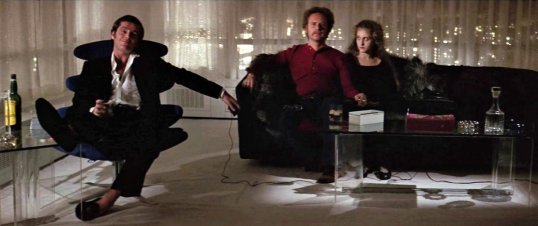
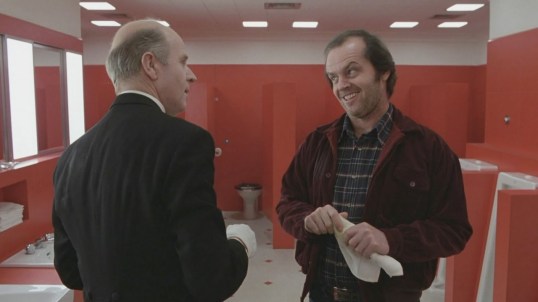
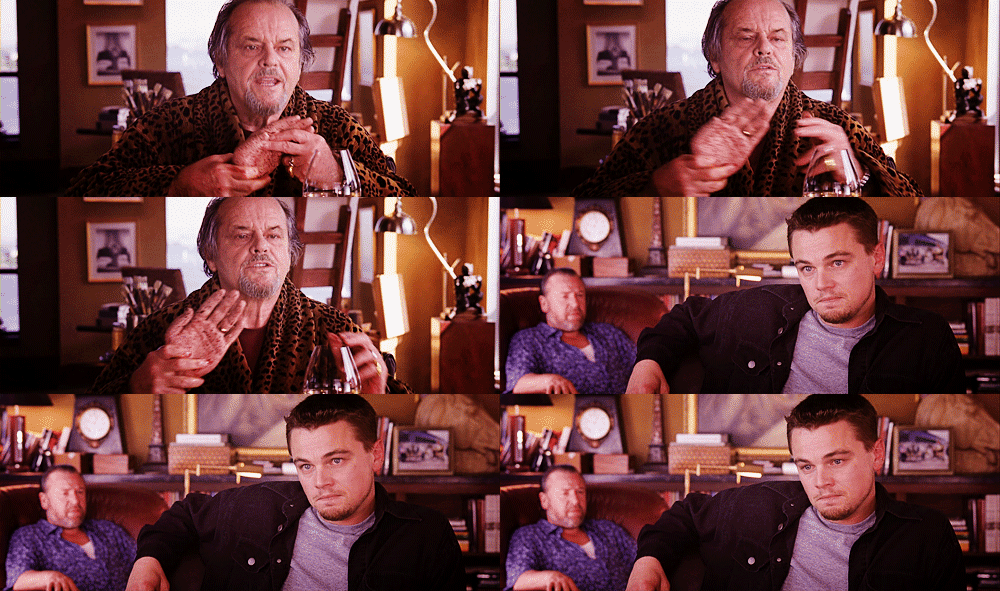
4 Shots From 4 Jack Nicholson Films
Psych-Out (1968, dir by Richard Rush, DP: Laszlo Kovacs)
Carnal Knowledge (1971, dir by Mike Nichols, DP: Giuseppe Rotunno)
The Shining (1980, dir by Stanley Kubrick, DP: John Alcott)
The Departed (2006, dir by Martin Scorsese, DP: Michael Ballhaus)
After watching 1967’s The Graduate, I defy anyone to listen to Simon and Garfunkel sing about the darkness without immediately picturing a young-looking Dustin Hoffman (he was 30 when the film was made but he was playing 22) standing on a moving airport walkway with a blank expression on his face.
If you don’t picture that, maybe you’ll picture Dustin Hoffman floating in a pool, wearing dark glasses and barely listening to his parents asking him about graduate school.
Or maybe you’ll remember him driving his car across the Golden Gate bridge. Or perhaps sitting at the bottom of his pool with a scuba mask on. Or maybe you’ll see him awkwardly standing at the desk in the lobby of a fancy hotel, trying to work up the courage to get a room. Or maybe you’ll just see him and Katharine Ross sitting at the back of that bus with a “what do we do now?” expression on their faces.
(Supposedly, that expression was not planned and was just a result of the shot running longer than expected.)
Ah, The Graduate. Based on a novel by Charles Webb, Buck Henry’s script remains one of the quotable in history. “Mrs. Robinson, you’re tying to seduce me …. aren’t you?” “Plastics.” “Elaine!” Myself, I have an odd feeling of affection for the line “Shall I get the cops? I’ll get the cops.” Perhaps that’s because the line is delivered by a young and uncredited Richard Dreyfuss, appearing in his second film and adding to the film’s general atmosphere of alienation.
Alienation is the main theme of The Graduate. As played by Hoffman, Benjamin Braddock feels alienated from everything. He was a track star. He was a top student in high school and college. Now, he’s just a college graduate with no idea what he wants to do with the rest of his life. One can argue, of course, that Braddock brings a lot of his alienation on himself. He can be a bit judgmental, even though he’s the one who is having an adulterous affair with Mrs. Robinson (Anne Bancroft) while also falling for Mrs. Robinson’s daughter, Elaine (Katharine Ross). His parents (William Daniels and Elizabeth Wilson) can be overbearing but it’s possible they have a point. Is he planning on spending the rest of his life floating in their swimming pool? Benjamin says that he just needs time to finally relax. After being pushed and pushed to be the best, he just wants time to do what he wants to do before his life becomes about plastics. When I first saw this movie, I was totally on Benjamin’s side. Now, as I’ve gotten older, I’ve started to understand where his parents were coming from. Still, it’s hard not to feel that Benjamin deserves at least a little bit of time to enjoy himself. That’s what Mr. Robinson (Murray Hamilton) thinks, at least initially.
Mrs. Robinson is the most interesting character in the film, a force of chaos who lives to disrupt the staid world around her. She’s bored with her marriage and her conventional but empty lifestyle so she has an affair with Benjamin. Later, she grows bored with Benjamin and his desire to “just talk” for once and she moves on from him. Benjamin and Elaine are both likable and you find yourself wishing the best for them but Mrs. Robinson is the character who you really remember. Mrs. Robinson grew up without losing her sense of rebellion. One doubts that Benjamin and Elaine are going to do the same.
A portrait of American suburbia and 60s alienation, The Graduate would prove to be one of the most influential social satires ever made. A box office hit, it was nominated for seven Academy Awards. It was nominated for Best Picture, Best Director (Mike Nichols), Best Actor (Dustin Hoffman), Best Actress (Anne Bancroft), Best Supporting Actress (Katharine Ross), Best Adapted Screenplay (Buck Henry and Calder Willingham), and Best Cinematography (Robert Surtees). The Simon and Garfunkel songs that set the film’s mood were, for the most part, not eligible. (Only Mrs. Robinson was written specifically for the film.) I would argue that the film deserved to be nominated for its editing as well. In the end, the film only won one Oscar, for Mike Nichols. But, regardless of what awards it won or lost, The Graduate‘s legacy lives on.
That’s a name that should be familiar to anyone who claims to be a student of film or a lover of Broadway. Originally born Mikhail Igor Peschkowsky in Berlin, Germany, the rise of the Hitler led to Nichols and his family immigrating to the United States in 1939. By that time, the seven year-old Nichols had already been completely bald for three years, the result of a bout of whooping cough. Like many who have had first-hand experience with trauma, Nichols developed an appreciation for the absurdity of life and a rather dark sense of humor. After studying to be an actor, Nichols found fame as a satirist and a comedian, performing with Elaine May. He would later go on to become not only an important theatrical director but also an important film director. With his directorial debut, Who’s Afraid of Virginia Woolf?, he helped to destroy what was left of the production code. With The Graduate, he helped to define the generation gap. With Carnal Knowledge, he explored sexual frustration and ennui. With Catch-22, he proved that even a great director can struggle to adapt an unfilmable book.
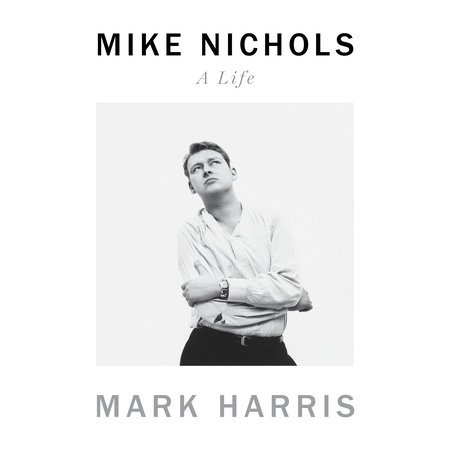
Mike Nicholas was an important director but, because his work was never quite as flashy as some of his contemporaries and because he spent as much time directing for the stage as for the movies, it always seems as if he runs the risk of being overlooked by film lovers. Luckily, Mark Harris’s biography, Mike Nichols: A Life, not only presents the details of his life and career but it also makes a convincing case that Nichols is a director who, despite all of his awards and the admiration of those who worked with him, has been a bit underrated. Harris convincingly argues that, while Nichols’s films dealt with timeless issues, they also often defined the era in which they were made. Who’s Afraid of Virginia Woolf? and The Graduate are both definitive films of the 60s. Carnal Knowledge is a film that captures the disillusionment of the early 70s, with Jack Nicholson and Art Garfunkel playing men destined to never escape their self-imposed mental prisons. Working Girl captured the greedy atmosphere of the 80s while Primary Colors epitomized America in the 90s and Closer captured the confused morality of the aughts.
To his credit, Harris doesn’t make the mistake of idealizing Nichols. Harris is just honest about the Nichols films that don’t work as he is about the ones that do. The failure of Catch-22 was as due to Nichols’s new-found cockiness as a director as it was to the unwieldy source material. On What Planet Are You From?, Nichols develops an almost instant and somewhat irrational dislike of comedian Garry Shandling, which is a bit unfortunate as Shandling was not only the star of the film but also in need of a director who would work with him to conquer his insecurities. This biography is honest about both Nichols’s strengths and his weaknesses and, as such, it becomes a fascinating look at one artist’s creative process.
It also become a look at how American culture changed from the 1960s to the first decade of the 21st Century. Nichols made his directorial debut in 1965 and directed his final film in 2007. For 42 years, Nichols recorded the cultural transformation of America, from scandalizing America by having Elizabeth Taylor and Richard Burton curse at each other to making a film about the policy decisions that would eventually contribute to 9-11 and the new America that was formed as a result of that tragedy. Mike Nichols: A Life isn’t just about Mike Nichols. It’s about how American culture, for better and worse, has developed and changed over the last century.
If you’re looking for a good and in-depth biography about a director who deserves to be rediscovered, Mike Nichols: A Life is the one to go with.
4 Shots From 4 Films is just what it says it is, 4 shots from 4 of our favorite films. As opposed to the reviews and recaps that we usually post, 4 Shots From 4 Films lets the visuals do the talking!
Today is Jack Nicholson’s 83rd birthday!
It’s been ten years since Jack Nicholson last appeared in a movie, the forgettable How Do You Know. Rumor has it that he’s basically retired from acting, though it’s said that Nicholson himself has denied it. However, whether he’s working or not, he remains a screen icon with a filmography that is a cinema lover’s dream. He’s worked with everyone from Roger Corman to Stanley Kubrick to Milos Forman to Martin Scorsese and, along the way, he’s become a symbol of a very American-type of rebel. Though often associated with the counter-culture, his style has always been too aggressive and idiosyncratic for him to be a believable hippie. Instead, he’s one of the last of the beats, an outsider searching for meaning in Americana.
Over the course of his career, Nicholson has won three Oscars and been nominated for a total of 12. He’s the only actor to have been nominated in every decade from the 1960s to the 2000s. If he ever writes his autobiography, you know that we’ll all run out and buy a copy. When the day comes that Jack Nicholson is no longer with us, it will truly be the end of an era.
Happy birthday, Jack Nicholson. May you have many happy returns!
I’ve starred in a production of Edward Albee’s play, Who’s Afraid of Virginia Woolf?
That’s right. I’ve played Martha, the heavy-drinking and dissatisfied wife of a burned-out English professor named George. Yes, I’ve played the same role for which Uta Hagen won a Tony and Elizabeth Taylor won an Oscar. Among the other actresses that have played Martha on stage: Colleen Dewhurst, Meg Tilly, Diana Rigg, and Kathleen Turner. And, of course, me.
Now, I should admit that I was only 16 when I played Martha so I was perhaps a bit too young for the role. Fortunately, my friend Erik — who played George — was only a year and a half older so he was just as miscast as I was. (It was, at one point, suggested that I should try to put some gray in my hair but I pointed out that, as a redhead, I would never have to worry about that.) On Broadway and film, Who’s Afraid of Virginia Woolf? runs for over two hours. The production in which I starred only had a running time of 13 minutes. Also, the version in which I starred did not feature the characters for Honey and Nick. I mean, who needed them when you could just watch Erik and me yell at each other for ten minutes straight.
And that’s pretty much what we did. When we told our drama teacher that we would be doing a scene from Who’s Afraid of Virginia Woolf? for our “Dramatic Duet,” I’m pretty sure that I saw her roll her eyes. I imagine that’s because she knew that both of us had a tendency towards the dramatic and that the main we picked the play was so we could compete to see who could be the first to go hoarse from yelling. She was right, of course. There was no nuance to our performance, largely because neither one of us really understood what the play was about. We just thought it was funny that some of our classmates covered their ears while we were loudly insulting and taunting each other. (For the record, I went hoarse before Erik did and I spent the next two days receiving compliments about my new sexy voice.)
Now that I’ve grown up a little, I think I have a better understanding of what Who’s Afraid of Virginia Woolf? is actually about. At the very least, I now understand that the story is about more than just two burn-outs yelling at each other while a younger couple awkwardly watches. I now understand that the game that George and Martha play over the course of the night is not a game of hate but instead a game of a very dysfunctional but also rather deep love. If anything, I now have more sympathy for George and Martha and far less for the play’s judgmental younger couple, Nick and Honey.
Of course, it helps that I’ve seen the 1966 film version of Who’s Afraid of Virginia Woolf? Directed (in his directorial debut) by Mike Nichols, Who’s Afraid of Virginia Woolf? features Elizabeth Taylor and Richard Burton as George and Martha and George Segal and Sandy Dennis and Nick and Honey. All four of them were Oscar-nominated for their roles, making Who’s Afraid of Virginia Woolf? one of the few films to see its entire cast nominated. Elizabeth Taylor and Sandy Dennis both won in in their categories but it really is Richard Burton (who lost to Paul Scofield) who dominates the film.
Burton was a performer who could be shameless in his overacting. (Just watch his performance in The Exorcist II if you need proof.) And really, one would expect that the role of George would appeal to all of his worst instincts. Instead, Burton gives a surprisingly subtle performance. He growls when you expect him to yell and he delivers the majority of his lines not with fury but instead with a resigned and rather sardonic self-loathing. He’s actually less showy than Elizabeth Taylor, who gives an overall good performance but still sometimes comes across like she’s trying too hard to convince the audience that she’s a 50 year-old drunk and not one of the world’s most glamorous film stars. Throughout the film, Burton seems to be digging down deep and exposing his true self to the audience and, watching the action unfold, you can’t take your eyes off of him. Everyone in the cast does a good job with their roles but Burton is the one who keeps the film moving. Just as George is ultimately revealed to be stronger than he originally appears, Burton also reveals himself to be a far more compelling actor than you might think if you just knew him from his lesser roles (and performances).
Admittedly, Who’s Afraid of Virginia Woolf? is not my favorite of the many films that have been nominated for best picture over the last 90 years. Even when the characters are inhabited by skilled performers, a little bit of George and Martha goes a long way. That said, this is a historically important film. The film’s language may seem tame today but it was considered to be shockingly profane in 1966. The fact that the National Legion of Decency declined to condemn the film despite the language was considered to be a major step forward in the maturation of American cinema. In fact, it can be argued that the MPAA rating system started as a way to tell audiences that a film like Who’s Afraid Of Virginia Woolf? was not morally objectionable but that it was still meant for adults.
Who’s Afraid of Virginia Woolf? received thirteen Academy Awards nominations. It was nominated in every category for which it was eligible. It won 5 awards but ultimately lost Best Picture to rather more sedate theatrical adaptation, A Man For All Seasons.
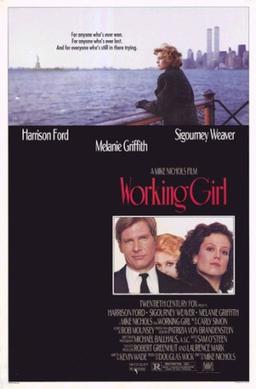
(With the Oscars scheduled to be awarded on March 4th, I have decided to review at least one Oscar-nominated film a day. These films could be nominees or they could be winners. They could be from this year’s Oscars or they could be a previous year’s nominee! We’ll see how things play out. Today, I take a look at the 1988 best picture nominee, Working Girl!)
Welcome to the 80s!
Yes, Working Girl is definitely a film of its time. It’s a film that’s obsessed with big things: big dreams, big offices, big money, and big hair. It’s a movie where the heroes talk about hostile takeovers and where everyone’s dream is to eventually to be an executive on Wall Street. You know all of those people who claim that The Big Short is the greatest movie ever made? I can guarantee that the majority of them would totally hate every character in Working Girl.Working Girl is such a film of the past that it even features Alec Baldwin doing something other than bellowing at people. In fact, Baldwin’s actually sexy in Working Girl. It was strange to see him in this film and realize that he was the same actor who currently spends all of his time picking fights on twitter and defending James Toback.
Of course, Alec Baldwin has a relatively small role in Working Girl. He plays Mick Dugan, the type of blue-collar guy who gives his girlfriend lingerie for her birthday (“I just wish you would get me something that I could wear outside,” she says as she tries it on) and who then proceeds to cheat on her while she’s off at work. From the minute we first meet Tess McGill (Melanie Griffith), we know that she deserves better than Mick.
Tess is a professional administrative assistant. She’s just turned 30 but she’s not ready to give up her dreams and settle for a life of fighting off coke-snorting executives and coming home to some guy like Mick. (Speaking of early performances from infamous actors, one of the coke-snorting executives is played by Kevin Spacey.) Tess has got a bachelor’s degree in Business. As she puts it, she has a “mind for business and a bod for sin.”
She’s also got a new boss, an up-and-coming executive named Katharine Parker (Sigourney Weaver). It turns out that Katherine is 29 years old. (“I’ve never worked for someone younger than me before,” Tess says as Katherine gives her a condescending smile.) Katharine encourages Tess to think of her as being a mentor. If Tess has any ideas for investments, she should feel free to bring them to Katharine. Of course, when Tess does so, Katharine claims that her bosses shot the idea down. It’s only after Katharine breaks her leg in a skiing accident and is laid up in Europe that Tess discovers that Katharine has actually been stealing her ideas and not giving her any credit for them.
What is Tess to do? Well, she does what any of us would do. She passes herself off as an executive and presents her idea to Jack Trainer (Harrison Ford) herself. Jack is impressed with the idea but he’s even more impressed with Tess. Of course, complicating things is that Jack was once in a relationship with Katharine and Katharine still thinks that she’s going to eventually marry Jack. And, of course, there’s the fact that Tess is lying about actually being an executive…
Working Girl is a frequently amusing film, elevated by performances of Melanie Griffith and, in the role of Tess’s best friend, Joan Cusack. Add to that, Harrison Ford is remarkable non-grouchy as Jack Trainer and Sigourney Weaver appears to be having the time of her life playing a villain. Even as I laughed at some of the lines, here was a part of me that wished that the film had a bit more bite. At times, Working Girl tries too hard to have it both ways, both satirizing and celebrating Wall Street culture. In the end, the film works best as a piece of wish-fulfillment. It’s a film that says that not only can you win success and Harrison Ford but you can get your bitchy boss fired too.
Despite being a rather slight (if likable) film, Working Girl was nominated for Best Picture of 1988. However, it lost to Rain Man.
 Will Randall (Jack Nicholson), the editor-in-chief of a New York Publishing house, doesn’t get much respect, not from his wife (Kate Nelligan), not from his boss (Christopher Plummer), and certainly not from Stuart Swinton (James Spader), the sleazy executive who is plotting to steal his job and destroy his marriage. But then, one night, Will runs over a black wolf on a country road. When he tries to helps it, the wolf bites him. Soon after, Will starts to feel different whenever the moon is full.


 Through the Shattered Lens