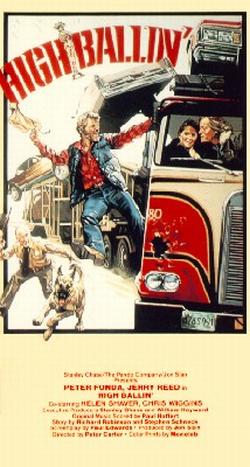
A Movie A Day #347: High-Ballin’ (1978, directed by Peter Carter)


Hey, good buddy, remember the Snowman?

The Snowman was the handle of Cledus Snow, the independent trucker who, along with his basset hound Flash, helped the Bandit escape Smokey in three different movies.  Cledus was played by the country western singer, Jerry Reed.  Interestingly, when Smokey and the Bandit was still in preproduction, the film’s producers envisioned a low-budget drive-in movie with Reed in the role of the Bandit.  When Burt Reynolds signaled that he would be interested in playing the man in the black Trans Am, Reed was instead cast as Cledus.

The box office success of Smokey and the Bandit led to several road films being rushed into production and more than a few of them starred Jerry Reed.  Several other of them starred Peter Fonda, who had already proven himself to be the king of the road with Easy Rider.  However, High-Ballin’ is the only trucker film that can claim to have starred both Jerry Reed and Peter Fonda.

In High-Ballin’, Jerry Reed may be playing “Iron Duke” Boykin but he might as well just be Cledus Snow again.  Once again, Reed is an independent trucker with a family at home and a love for the road.  (Just as he did with Smokey and the Bandit, Reed even performed High-Ballin‘s theme song.)  The local trucker’s union is putting pressure on the independent truckers and trying to intimidate them into joining.  Iron Duke has no intention of doing that.  Iron Duke has been hired to haul a load of liquor to an isolated lumber camp and he is not going to let the union or its thugs stop him.  Helping him along the way is his friend Rane (Peter Fonda) and another independent, Pickup (Helen Shaver).

High-Ballin‘ was not as bad as I was expecting it to be.  Reed, Fonda, and Shaver are likable in the lead roles and the action scenes are exciting.  Fonda may have been a notoriously inexpressive actor but he was always believable whenever he was cast as a rebel or an outsider and the friendship between him and the more expressive Reed is as believable as the friendship between Cledus and the Bandit in Reed’s previous trucking film.  Of course, the main reason you are going to watch a movie like High-Ballin’ is to see how many different ways that a car or a truck can be destroyed and this movie does not skimp on the vehicular destruction.  It’s nothing great but, as far as 70s trucking films are concerned, High-Ballin’ is better than average.

One final note: keep an eye out for Michael Ironside in an early role.

10-4, good buddy.  I’m out.
Cleaning Out The DVR: Crime + Punishment in Suburbia (dir by Rob Schmidt)


(Lisa is once again trying to clean out her DVR!  She’s got about 182 films on her DVR and she needs to get them all watched by the end of this year!  Will she make it?  Not if she’s too busy writing cutesy introductions for her reviews to actually watch the movies!  She recorded Crime + Punishment in Suburbia off of Flix on February 25th!)

Oh, dammit.

I have seen some really pretentious movies before but Crime + Punishment in Suburbia is really something else.  As you might be able to guess from the title, the film is supposedly based on the Dosteyevsky novel but it takes place not only in modern times but in suburbia as well.  Oh, and it actually has next to nothing in common with Doteyevsky novel, beyond a murder and occasional religious symbolism.  And by occasional, I mean that there’s a scene where Vincent Kartheiser wears a Jesus t-shirt.

Kartheiser plays Vincent, a teenager who I think we’re supposed to think is dark and disturbed but instead he just comes across like a weird little poser.  I mean, honestly, it takes more than just wearing black clothes to be weird.  I had a closet full of black clothes when I was eighteen and it still never brought me any closer to enlightenment.  Anyway, Vincent is a classmate of Roseanne (Monica Keena) and Roseanne is dating a handsome but dumb jock named Jimmy (James DeBello).  Roseanne’s mother is named Maggie (Ellen Barkin) and Maggie has recently married an abusive drunk named Fred (Michael Ironside).

Fred is a total jerk so Maggie goes out with her best friend, Bella (Conchata Ferrell), to a bar.  It’s at the bar that she meets Chris (Jeffrey Wright), a handsome and charming bartender.  Soon, Chris and Maggie are having an affair and when Fred finds out, he rapes his stepdaughter.  Roseanne convinces Jimmy to help her murder Fred but, after the deed is done, Roseanne finds herself struggling with her conscience.

Now, of course, in Crime & Punishment, the whole point is that the murder itself was largely random and motiveless.  The rest of the book deals with the protagonist’s attempt to come to terms with not only his crime but also with the meaninglessness of it all.  In Crime + Punishment in Suburbia, Roseanne has a good reason for killing Fred.  Fred is such a monster that there’s no real confusion as to why Roseanne did what she did.  One could argue, quite convincingly, that if she didn’t kill Fred, he would have ended up killing her.  That makes the film’s later attempt at moral ambiguity feel rather hollow and empty.

The other problem with Crime + Punishment in Suburbia is that we don’t see the story through Roseanne’s eyes.  Instead, the entire movie is narrated by Vincent.  Now, Vincent Kartheiser is not a bad actor.  Anyone who has seen Mad Men knows that.  And, in this film, he occasionally gets to flash a cute smile that makes the character a little bit bearable.  But the character he plays, Vincent, is so weird and off-putting that you have no desire to spend 100 minutes listening to him portentously talk about his existence.  Considering that Monica Keena actually gives a pretty good performance as Roseanne, the decision to tell her story through Vincent’s eyes feels all the more mistaken.

The only thing more overwrought than Vincent’s narration is Rob Schmidt’s direction.  This is one of those films that uses every narrative trick in the book to tell its story.  Look at the wild camera angles!  Look at the sudden slow motion!  Look at the freeze frame!  This is one of those movies that you watch and you just want to shout, “Calm down!” at the director.

Crime + Punishment in Suburbia is one to avoid.

A Movie A Day #195: Best Revenge (1984, directed by John Trent)


Damn … John Heard died.

I know that almost everyone knows John Heard as either the father from Home Alone or as the detective on The Sopranos or maybe even the executive in Big.  Over the course of his long career, John Heard played a lot of neglectful fathers, greedy businessmen, and corrupt politicians.  Heard was good in all of those roles but he was capable of so much more.  Though he did not get many chances to do so, he could play heroes just as well as villains.

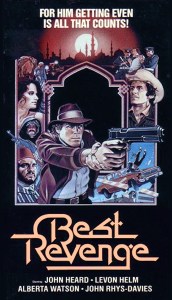
One of his best performances is also one of his least seen.  In Best Revenge, he plays Charlie.  Charlie is a laid back drug dealer, someone who would probably hate and be hated by most of the authority figures that Heard was best known for playing.  Charlie is the ultimate mellow dude, without a care in the world.  All he wants to do is play his harmonica and spend time with his girlfriend (Alberta Watson).  However, an old friend (Stephen McHattie) wants Charlie to help smuggle 500 keys of hash from Tangiers to America.  Charlie wants nothing to do with it but then he finds out that the Mafia will kill his friend unless the drugs make it across the ocean.  Charlie and his friend Bo (Levon Helm of The Band) fly over to Morocco but are betrayed.  Charlie ends up in a prison cell, from which he has to escape so that he can rescue Bo, smuggle the drugs, and get revenge on those who betrayed him.

Because of the prison aspect and the fact that Charlie wears a fedora, Best Revenge was sold as being a combination of Midnight Express and Raiders of the Lost Ark but actually it is a character study disguised as an action film.  Despite the title, Best Revenge is more interested in the real-life logistics and hassles of being an international drug dealer than in any sort of revenge.  Though it is a role far different from the ones he may be best known for, John Heard was perfectly cast as a small-time drug dealer who suddenly finds himself in over his head.  Heard gives such a good  and sympathetic performance that this film, along with his work in Cutter’s Way and Chilly Scenes of Winter, shows what a mistake was made when Heard became typecast as the bad guy.

Best Revenge was filmed in 1980 but not released until four years later.  Along with appreciating Heard’s performance, keep an eye out for Michael Ironside in an early, blink-and-you’ll-miss-it role.

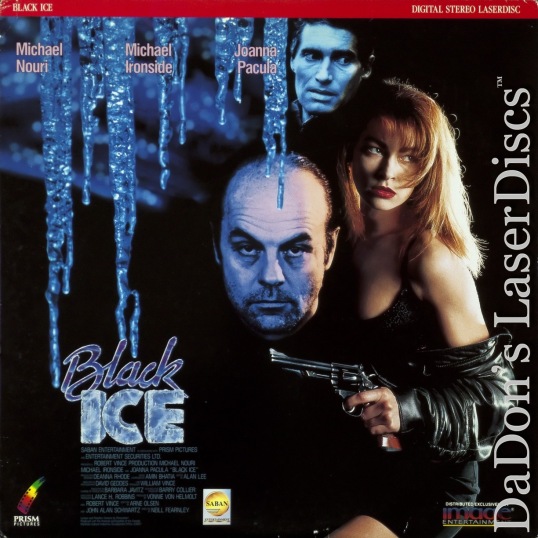
Insomnia File No. 5: Black Ice (dir by Neill Fearnley)


What’s an Insomnia File? You know how some times you just can’t get any sleep and, at about three in the morning, you’ll find yourself watching whatever you can find on cable? This feature is all about those insomnia-inspired discoveries!

Black Ice 2

If you were having trouble getting to sleep last night at 2 a.m., you could have turned over to Indieplex and watched Black Ice, a Canadian thriller from 1992.

Why is the film called Black Ice?  Well, that’s a good question.  There’s a lot of snow and ice to be seen in the film but absolutely none of it is black.  According to the imdb, this film was also released under the title A Passion for Murder.  I have to admit that I kind of like A Passion For Murder as a title, simply because it’s so generic and empty that it becomes oddly brilliant.  If you were making a parody of the type of movies that Netflix usually lists in the “steamy thriller” category,  A Passion For Murder is probably the title that you would come up with.

But, as for this film, it opens as all thrillers from the early 90s must, with a man in a suit meeting his clad-in-black-lingerie mistress in a hotel room.  The man in the suit is an up-and-coming senator.  His mistress is the mysterious Vanessa (Joanna Pacula).  When Vanessa pressures him to leave his wife, the senator gets mad and leaves.  Vanessa goes back to her apartment, where she is soon visited by the senator.  She and the senator get into a fight.  She shoves the senator into a window, which shatters and promptly kills the senator.

Meanwhile, Ben Shorr (Michael Nouri) is barely making a living as a taxi driver.  He’s an aspiring writer and, just in case we had any doubts about his intellectual bona fides, he has a pony tail and talks almost nonstop.  (Ben also owns a goldfish that he’s named Travis, as in Taxi Driver‘s Travis Bickle.)  Ben is pretty annoying and when he picks up Vanessa, you’re kind of hoping that she’ll end up killing him like she killed the senator.

But no, it turns out that Ben is supposed to be our hero.  Vanessa asks Ben to drive her from Detroit to Seattle.  And, of course, Ben agrees because … well, there wouldn’t be a movie otherwise.

It turns out that Vanessa is actually a secret agent.  She was supposed to seduce and eventually marry the senator.  Now that she’s accidentally killed him, her supervisor, Quinn, is determined to kill her.  Because this movie was made in Canada, the villainous Quinn is played by Michael Ironside.

The rest of the film is basically Quinn chasing Ben and Vanessa across the northwest.  Along the way, Vanessa and Ben fall in love.  One huge problem with Black Ice is that the audience knows everything about Vanessa before Ben does.  There are a lot of scenes of Ben trying to figure out why Quinn is pursuing Vanessa but, since we already know why, those scenes mostly feel like filler.  If  Vanessa had been as much of a mystery to the audience as she was to Ben for most of the film’s running time, Black Ice probably would have been a bit more intriguing.

As it is, Black Ice is pretty much a standard, low-budget chase film.  Michael Nouri is pretty annoying but Joanna Pacula and Michael Ironside both give good performances.  It snows throughout the entire film and there’s a few genuinely impressive shots of the three main characters running across the icy landscape.  Otherwise, Black Ice is pretty forgettable but it also doesn’t require much thought, which might make it an appropriate film to watch if you’ve got insomnia.

Black Ice

Previous Insomnia Files:

  1. Story of Mankind
  2. Stag
  3. Love Is A Gun
  4. Nina Takes A Lover

The Things You Find On Netflix: 88 (dir by April Mullen)


88

If you go over to Netflix right now, you can watch 88, the best film of the year so far.

88 opens with a close-up of Gwen (Katharine Isabelle).  Gwen is sitting in a diner and she has no idea how she got there.  All she knows is that her boyfriend Aster (Kyle Schmid) is dead and that she believes that her former employer, Cyrus (Christopher Lloyd) is responsible.  Oh, and Gwen’s hand is also covered in a bloody bandage, largely because she’s missing a finger.  When Gwen tries to leave the diner, several gumballs and a gun fall out of her bag.  The cops eating breakfast overreact.  A waitress panics.  Gwen accidentally shoots someone as she flees.

Still with no idea where she is exactly or how she got there, Gwen discovers that she has a motel room key on her.  When she goes to the motel room, she discovers that the walls are covered with newspaper clippings.  And, of course, there’s a corpse in the bathtub.  On top of that, there’s also a rather hyperactive man named Ty (Tim Doiron, who also wrote the film’s script).  Gwen claims to have never seen Ty before.  Ty, however, says that they’re friends and they’re planning on killing Cyrus together.

Meanwhile, as we watch Gwen try to figure out what’s going on, we also follow the adventures of Flamingo (again played by Katharine Isabelle).  Flamingo is a tough-talking survivor, the type of girl who, when we first meet her, is busy strangling a random motorist so that she can use his car.  Flamingo goes from motel to motel, always staying in room 88.  She obsessively drinks milk.  When she runs into Cyrus and his gang on the street, they claim to know her.  However, Flamingo has no idea who they are.

Which, of course, does not mean that she’s not willing to kill them…

88 is a masterpiece of the grindhouse imagination, an over-the-top film that not only embraces its pulpy origins but practically revels in them as well.  The film is full of wonderfully strange and crazy moments, like when Gwen and Ty visit a flamboyant gun dealer or when Flamingo casually trashes a convenience store for no reason beyond the fact that she apparently feels like doing so.  There is not a single character in 88 who is not, in some way, memorably odd.  Between Gwen’s amnesia, Flamingo’s psychotic behavior, Ty’s cheerful embrace of violence, and Cyrus’s raspy monologues, 88 presents a world that is familiar and yet uniquely its own.  When Michael Ironside shows up as a strict but good-hearted sheriff, it only makes sense that, in the world of 88, Michael Ironside would be the face of law, order, and decency.

Now, to be honest, you’ll probably figure out just how exactly Gwen and Flamingo are related long before the film actually makes it explicit.  You probably figured it out just from reading this review.  But it doesn’t matter.  Ultimately, the specifics of the twist really doesn’t matter.  This film is a celebration of pure style and pulp energy.  Katharine Isabelle is brilliant, both as Gwen and as Flamingo.  In the role of Gwen, Isabelle gives a very sympathetic performance.  You want to understand what is happening to Gwen and, even more importantly, you want her to survive.  Meanwhile, as Flamingo, Isabelle is a force of pure, destructive nature.  Finally, in the role of Cyrus, Christopher Lloyd is a sleazy marvel and even manages to bring a hint of humanity to an occasionally demonic character.

88 is one of those films that will probably never get the critical support that it deserves.  However, I think it’s one of the best of the year so far.

What Lisa Marie Watched Last Night #91: The Omega Code (dir by Robert Marcarelli)


Early this morning, after waking up and walking into a wall, I watched The Omega Code, an evangelically-themed film from 1999.

Why Was I Watching It?

Earlier this year, my friend Evelyn and I watched a film called Megiddo: The Omega Code 2.  We were both oddly amused by Megiddo so, when I saw that the first Omega Code film was going to be on one of the religious stations, I set the DVR to record it and made plans to watch it at some point in the future.

Last night, I happened to wake up around 3 in the morning.  I got out of bed, I took a few steps forward, and I walked straight into a wall.  After that, I turned on the lights and I was relieved to discover that my nose had protected the rest of my face from the wall.

So there I was at 3 in the morning with my red nose and my bruised pride and, despite my best efforts, I couldn’t get back to sleep.  What’s a girl to do, right?  So, I decided that since I was awake anyway, I would go ahead and watch The Omega Code.

What Was It About?

The world is ending.  People are starving.  Nations are going to war.  Fortunately, the President of the European Union, Stone Alexander (Michael York) has a plan to save us all.  Unfortunately, Stone Alexander also happens to be the Antichrist.

In order to get all of humanity to accept his plan, Stone recruits the world’s most famous motivational speaker (Casper Van Dien).  However, Van Dien find out about the Omega Code, a secret code that uses the bible to predict the future.  And, as Van Dien discovers, the future looks positively apocalyptic….

What Worked?

When I reviewed Megiddo: Omega Code 2, I mentioned that if you’ve got a naturally villainous name like Stone Alexander, you might as well be evil.  The same remains true of The Omega Code.  Stone Alexander is so evil and Michael York is obviously having so much fun playing him that the fun is almost contagious.

Michael Ironside plays Dominic, Stone Alexander’s henchman.  In a rather offensive moment, Alexander reveals that Dominic is both gay and a former priest and the implication (which was probably popular with the film’s target audience) is that Dominic’s villainy is the direct result of both his Catholicism and his sexuality.  But, regardless, Ironside gives a memorably menacing performance.

It’s interesting how the villains in religious films are often more compelling than the heroes…

What Did Not Work?

Though I didn’t realize it at the time, I was spoiled by getting the chance to see the 2nd Omega Code before I saw the first one.  Omega Code 2 was the epitome of a so-bad-that-it’s-good type of film but the first Omega Code was just bad.  Not even the combined villainy of Michaels York and Ironside could make The Omega Code entertaining.

(Add to that, Megiddo: Omega Code 2 featured cameos from both Franco Nero and Udo Kier, while The Omega Code featured … well, no one.)

No review of The Omega Code would be complete without mentioning that, in the lead role, Casper Van Dien gives perhaps one of the worst performances ever captured on film.  It’s oddly fascinating to watch and try to figure out how anybody could give such an incompetent performance.

As I watched the film, one question kept nagging at me.   The Omega Code makes the argument that biblical prophecy should be taken literally.  Therefore, if the bible is itself a literal document that tells you everything that you need to know  than why hide a secret code between the lines?  And, if you’re going to go through all the trouble to come up with a secret code, why use that code to then hide cryptic phrases that could literally be translated to mean anything?  It just seems a bit overly complicated.

(That, incidentally, is the same reason why I don’t have much use for anything that Dan Brown has ever written.)

“Oh my God!  Just like me!” Moments

None.  Seriously, there was not a single moment in this film to which I could relate.  Some of that may be because this film was obviously made to appeal to an evangelical audience, as opposed to a free-thinking fallen Catholic like me.

Then again, it could also be that The Omega Code just wasn’t a very good movie.

Lessons Learned

I really didn’t learn anything.  Sorry, not sorry.

omegacode

Horror Scenes I Love: Scanners (by David Cronenberg)


[SPOILERS!!!!]

I’ve already shared a favorite scene from David Cronenberg’s landmark scifi/horror film Scanners over a year ago that saw a head explode. For October’s horror-themed month I picked another great scene from this film that always stuck with me long after I’ve finished watching the film each and every time.

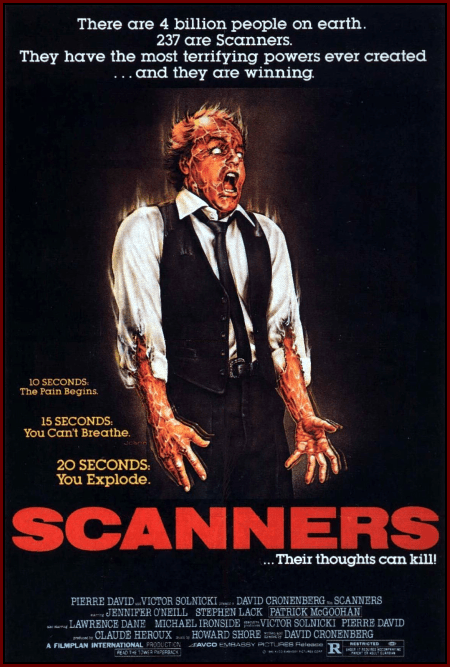
The scene I’m talking about is the climactic showdown between Good Scanner Cameron and Evil Scanner Revok. This scene was filmed before the advent of CGI-effects and Cronenberg never had the sort of big-budgets to hire the top FX make-up artists to work on his films. Yet, Cronenberg ended up creating one of the best scenes ever put on film about two people fighting each other using their minds. We never see their mental abilities shooting off psychic blasts at each other but the performance by both Michael Ironside as Revok and Stephen Lack as Cameron was so believable that it made the scene work when it could’ve turned so cheesy and disastrous in the hands of a different filmmaker and other actors.

The battle ends but we’re left to believe the good guy lost and evil triumphs. This feeling pretty much plays out right up to the final scene before fade to black and even then we’re not sure if the final reveal is true or not. Either way there’s no better way to bookend the exploding head intro than with two psychic beings duking it out mentally with blood, spontaneous combustion and creepy white eyes added in for style.

Review: X-Men: First Class (dir. by Matthew Vaughn)


The name Matthew Vaughn should be familiar with comic book fans everywhere. In 2005, Vaughn was introduced as the director to replace Bryan SInger for the third film in the X-Men franchise. The news was met with some cautious optimism. This was a filmmaker who had quite the loyal and growing following for his work on Stardust and Layer Cake. Months after he was picked my 20th Century Fox news came down that he was backing out of the project due to personal reasons and the film scrambled for a replacement which ended up being Brett Ratner. History was made that day as the beginning of the franchise’s decline began and steep plummet which recently reached it’s nadir with 2009’s Wolverine: Origins.

It’s has now been five years since X-Men: The Last Stand made it to the big-screen and now we have a new film in the franchise. X-Men: First Class has a familiar name behind the director’s seat and it looks like Matthew Vaughn stayed this time around (after directing a smaller superhero film in Kick-Ass for 2010) to craft what could become the best film in the X-Men/Wolverine film franchise. This film is a prequel/reboot of sorts (more on that later) and brings a fresh set of eyes and take on the origin story of this franchise.

X-Men: Last Stand actually begins the film exactly how the first X-Men film began with the 1944 World War II concentration camp setting where a young Erik Lensherr (later to become Magneto) finally manifests his power over magnetic fields as he watches his parents torn from his side. The first film ended that sequence once Erik was knocked out, but this time around it continues with a mysterious man named Schmidt (aka Sebastian Shaw and played with James Bond villainous-flair by Kevin Bacon) taking great interest in Erik and his ability which Erik could only use during bouts of pain and anger. The film continues this slight change in the series’ origins by switching over to Westchester County and into the expansive home of a young Charles Xavier who finds a certain young, blue-skinned shapeshifter named Raven who he invites to stay and become his friend once he realized he wasn’t the only one who was different and with abilities.

These two sequences continue to move the film forward as the we see these two “leaders in the making” adults and trying to find their place in the world of the free-swinging lifestyle and the Cold War culture of the 1960’s. Charles Xavier (played like a well-meaning cad and good-natured naivete about the world by James McAvoy) is a student working on his doctorate in Oxford on genetic theories while his “sister” Raven (Jennifer Lawrence) accompanies him. This is a Xavier who still hasn’t found the patient benevelonce of Patrick Stewart’s Professor X and uses his considerable telepathic abilities to help him pick up on beautiful coeds instead. It’s during such a scene where we see Raven show just a hint of jealousy as Xavier tries his lines and moves on a beautiful British lass. It would seem Raven’s feelings for her ‘brother” may go beyond sibling affection though Xavier doesn’t see her as anything other than a sister for him to protect.

Erik Lensherr’s time as an adult was shown as having become a life of obsession over his treatment at the hands of the Nazi’s and those of Schmidt’s as he travels the world in search of escaped Nazi war criminals. Erik takes him throughout South America as he finds the trail of Nazis hiding out in that region since the end of the war. We see this adult Erik hardened by his anger and single-minded need for revenge on Schmidt and those he worked for. He’s not above using his abilities to kill in order to get the information he requires and there’s a hint of satisfaction when he does kill those he sees as responsible for his tragic upbringing with his magnetic abilities. These two adult sequences continues the film’s theme of the ideological difference between Xavier and Erik being formed through nature and nurture as their lives moved down diverging paths from an early beginning until it convergence for a small, brief period around the time of the Cuban Missile Crisis.

The film’s second act begins with Moira McTaggart (Rose Byrne), now a covert CIA Agent, investigating a certain Col. Hendry who she suspects as having betrayed the nation to the Soviets, but instead finds out that the true nature of Hendry’s associations were much more insidious and dangerous. The iconic Hellfire Club of the comics finally make their appearance with Schmidt who actually happens to be Sebastian Shaw (whose powers grant him the ability to absorb all kinetic energy which he uses to keep himself young and can release with explosive results), Emma Frost (January Jones) who’s a telepath with the ability to turn body in a sort of diamond-form, Riptide who can create tornado-like abilities and finally the demonic-looking Azazel whose ability to teleport might give people not well-versed in the “X-Men Universe” a clue as to one-half of parents who may be responsible for Nightcrawler in the second film.

X-Men: First Class spends much of this second act like it was Ocean’s 11 as Xavier and Erik get recruited by the CIA to find other mutants and create their own mutant team to counter Sebastian Shaw’s Hellfire Club and his goal of initiating World War III between the US and the USSR and thus destroy all of humanity and leave the planet for the mutants to rule over. Yeah, it is this part of the film’s plot which may strain the suspension of disbelief for some audiences who never grew up reading the comics, but it shouldn’t. Ian Fleming’s James Bond series used scenarios just as ludicrous with villains just as Machiavellian in the form of SPECTRE so X-Men: First Class and it’s world domination plans shouldn’t be too farfetched to fans of that British superspy and his adventures.

This middle section of the film is where X-Men: First Class actually begins to lag after a strong first act. I don’t know if the sequences of the new recruits training, bonding and learning how to use their powers could’ve been written to move much faster without losing some of the character building scenes. From how this second act played it seemed to look like scenes were actually cut out to try and keep the film from being too long (it’s final cut being just a tad over two hours already upon release), but I wouldn’t be surprised if the DVD/Blu-Ray release actually has a director’s or uncut version that actually expands this middle section to really give life to it instead of having it play out like a perfunctory training montage with a dash of character beats.

The film hits it’s action-film stride with the third and final act as Xavier and Erik’s team of young mutants must now use their abilities to stop Shaw and his Hellfire Club and at the same time prevent World War III from beginning and not freaking out the humans who are still unaware of their existence as a whole. It’s this third section which we see too much of it in the trailers and tv spots that one might say we’ve seen it all before we even see the film as a whole, but it still kept back a lot from those ads to make the whole final twenty minutes of the film thrilling and action-packed.

All of this could just mean that X-Men: First Class was just your run-of-the-mill superhero action film that we get on a yearly basis come summertime, but it’s a testament to Matthew Vaughn’s direction and the strength of the script by Vaughn, longtime collaborator Jane Goldman and Thor scribes Ashley Edward Miller and Zack Stentz that the film goes beyond being just an action film with all it’s sturm und drang coupled with fancy special effects. The previous films in the series always explored important cultural and moral themes that’s always been the bread-and-butter of the X-Men stories in the comic books. We just don’t see the film explore the ideological difference between Xavier’s peaceful co-existence between humans and mutants alike, but also we get more detail on why Magneto finally comes to the conclusion that war between humans and mutants was an inevitability and why his stance doesn’t fall under the aegis of being evil, but something that anyone could understand and even support whether one was human or mutant.

The story also doesn’t just pay lip-service to the idea of how mutants view themselves and how even within the mutant community there’s a visible rift between those whose abilities are invisible to the general population and those whose abilities and genetic mutation physically manifest themselves in such ways that to many might not look to appealing. This idea really gets a major exploration in the subplot involving Raven (soon to be Mystique), Hank McCoy and, to a certain degree, Xavier and Erik. We see how those like Xavier whose abilities don’t show in a physical manner have a sort of “don’t ask, don’t show” about those like Raven when it comes to their power when in public.

Raven (played beautifully by Jennifer Lawrence) is caught between Xavier who wants her to remain incognito so as not to shock the world too soon in realizing that mutants exists and that of Erik who sees Raven’s original blue-skinned form as beauty and perfection and how she should never hide who she truly is. This tug and pull between her two mentors makes for a convincing subplot in how Raven comes to the conclusion which would take her to the side of Magneto in later films, but also highlight how the two sides in later films have so much intertwining bonds of friendship and relationship that seeing them against each other becomes a tragedy on its own. Civil wars are not just a thing of humans but those who sees themselves apart from them.

The great performances by most of the leads add to the film’s strength. McAvoy and Fassbender, at first, look to be unconvincing in terms of their appearance as the younger versions of Patrick Stewart and Ian McKellen, respectively. This becomes a non-issue once they’ve established themselves through their performances which gives new layers to the personalities of Professor X and Magneto. Many people always saw these two as the comic book version of Martin Luther King, Jr and Malcolm X, but that’s an oversimplification. The film and the performances by McAvoy and Fassbender digs deeper into both their characters’ motivations and ideologies and how their past experiences and upbringing couple with their time together as brothers-in-arms and friends show more about these two than just being mutant-proxies of MLK and Malcolm X. The other young mutants do an adequate enough job that they don’t seem lost in the film. Nicholas Hoult as the young Hank McCoy and how he plays off Lawrence’s Raven during their little subplot in the film is one stand-out that I hope gets explore even more in any follow-up sequel.

There’s a nice burgeoning young love chemistry between him and Lawrence as Beast and Raven that doesn’t seem too tacked on to create a the prerequisite love couple in any film. Their common trait of having physical mutations and how they seem to both feel apart even from their fellow mutants develop their characters in ways the previous films in the series never did. They never want to rid themselves of their mutant powers. They just want to look normal and still keep their abilities. It’s a having your cake and eat it too mentality that has some surprising results for both Raven and Hank.

X-Men: First Class has had some fans of the series put in a very difficult situation. The film definitely is a prequel to the previous films, but it also does a major time in rewriting continuity in the series. I was one of those fans and thought it would ruin the film in the context of the franchise. I’m surprised that in the end I didn’t really care and actually hope that this film actually is a reboot of the franchise. I see this film and forget the previous three as being part of it. This film was just too good and fun in it the end for continuity issues to become the major flaw that sinks it. I liken this film as similar to Christopher Nolan rebooting the Batman film franchise. That film honored the contributions to the character, but went on it’s own way to tell that character’s tale. I see Vaughn doing the same with this film. He has done something which many thought was a near-impossible task and that’s make the X-Men franchise relevant once more in a pop-culture landscape that seems to have left the franchise behind after the disastrous Wolverine: Origins of 2009.

This film delivered on the ideas that made the comic books so beloved by millions of fans for almost a half-century. It made great use of the 1960’s time and setting to tell a story of these characters beginnings as heroes and villains (though the latter shouldn’t be seen as them being truly just evil bad guys). Even the inclusion of real-world historical event like the Cuban Missile Crisis was a nice touch which gave the film a foundation in realism. Again, this film played off like a superhero, Marvel version of an Iam Fleming James Bond story. For those who are huge fans of the previous films there’s even two brief cameos of those films two favorite characters that appear in this film. They don’t come off as cheesy and unnecessary and actually come off as great additions. I won’t mention who these cameos were but the audience’s reaction to them was very vocal and very positive. I say the same should be said for X-Men: First Class as a film that resuscitates the franchise.

Scenes I Love: Scanners


While bored out of my mind this early Monday morning (no work due to the Memorial Day holiday) I do what I usually do to try and get out of it: I surf YouTube. Doing this sometimes alleviates my boredom and sometimes it doesn’t. This time around it did as I came across a scene from a film that has to be one of my all-time favorites. An all-time favorite film and scene both.

The scene I came across is one of the earliest sequences in David Cronenberg’s seminal sci-fi work, Scanners. It stars Michael Ironside in the film’s villanous role as Darryl Revok. In this scene we don’t know he’s the heavy. We suspect something to be off about him, but we can’t put a finger on it. It’s during the unfolding of this short scene that we finally realize that Revok is not what he seems to be as the unfortunate “scanner” expert next to him begins to feel the depths of Revok’s ability. A feeling that soon turns to pain and then finally the explosive result.

I think I was nine years-old when I first saw this scene and to say that it left an indelible mark on me would be an understatement. I was still too young to truly appreciate Cronenberg as a filmmaker then, but years later when I saw this again when film started to become more than just entertainment for me was when I saw just how much a genius the man was. This scene helped put me on what would turn out to be an ongoing love affair of all things Cronenberg.

Also, for those who don’t know, Michael Ironside also ends up voicing that iconic video character Sam Fisher from the Splinter Cell franchise.

Review: Scanners (dir. by David Cronenberg)


Scanners marks the emergence of David Cronenberg from low-budget horror auteur to one of the most unique voices in filmmaking of the last thirty or so years. He first came onto the scene directing such low-budget horror films such as Shivers, Rabid and The Brood. These three films were later said to have had that Cronenberg propensity to show the horror of the body-politic at its most basic. Cronenberg pretty much points out of how true horror might not be lurking on the outside, but within the the human body. Cronenberg makes the human body as forever changing and mutating against the individual person’s wants and desire of what was suppose to be the ideal. The horror that we as a people do not and will never have control over our own body was where the true horror lie.

In 1981, Cronenberg moves from the purely physical horror to one where the technology man was forever trying to create and achieve perfection would turn on the biological aspect of the human condition. This new form of techno-organic mutation was as terrifying as it was seductive in its potential to those afflicted with it. Cronenberg begins this phase in his filmmaking voice with his excellent, underappreciated and cult-classic Scanners.

The premise for Scanners had alot in common with Stephen King’s novel Firestarter in the fact that in dealt with an omnipresent and powerful organization: the CIA’s shadowy branch that dealt with experimental weapons programs for Firestarter and the ultra-powerful CONSEC multinational corporation in Scanners. These two organizations experiment on random select individuals using experimental drug treatments under the guise of helpful medications. What results from these experiments are more than what was truly expected by their handlers. In Scanners the result comes from mental abilities never seen or documented in the past. CONSEC’s experiments have yielded a unique group of individuals, 237 of them, to manifest powers of the mind that make them living weapons of mass destruction. Instead of becoming a new wonder-weapon for CONSEC to sell to their government contacts, these 237 become unstable in personality, some going as far as to develop a God-complex. Others are driven insane by these new abilities and retreat away from the rest of humanity in order to achieve a semblance of mental peace.

These two different reactions from the 237 are keenly represented by two of the main character’s in Cronenberg’s film. There’s Cameron Vale (played by Stephen Lack who had an eerie resemblance to the same named character of Stephen in Dawn of the Dead) who we first see as a vagrant who seems to be suffering from some sort of mental problem. This is farther from the truth as Dr. Paul Ruth (father of the CONSEC drug effemerol that causes the mutation and played with eccentric flair by Patrick McGoohan) soon discover that Vale’s mental problems is due to him possessing preternatural mental abilities of the highest order. Ruth’s guilt over what his experiments have done and created leads him to use Vale to counter the growing underground of those 237 who have seen their newfound abilities as a stepping stone to supplanting the normal status quo with their own in a plan of global domination that would make fans of X-Men very proud.

Leader of this underground groups of scanners (as the 237 were called) is one Darryl Revok. A scanner whose abilities rival those of Vale’s but whose mental instability for wanting to dominate the normals of the world makes him the most dangerous individual on the face of the planet. Genre veteran Michael Ironside steals the film from everyone else. His grand and classic introduction early in the film has gone down in filmmaking history as one of the most shocking scenes put on film. Ironside’s performance as the scanner with the God-complex was truly megalomaniacal and it was easy to root against him, but hard to take one’s eyes from the screen when he was on. Revok truly made for one of film history’s classic villains.

In the middle of Vale and Revok’s war for control lies Kim Obrist (played by the beautiful Jennifer O’Neill) who tries to lead those who just want to be left alone from being used by both Revok and CONSEC. O’Neill’s performance was the most grounded in reality, as much as a film about people with mental powers could be, and tries to keep the film from getting too fantastic.

This I think was what made Scanners such a great film. As ludicrous a premise as the film had to base its sotry on, there was always a sense of realism to keep everything form becoming too much like a comic book. The story paints a story that could happen in reality since similar things have occurred in the past such as the LSD testing on US military personnel during the 50’s and 60’s. Cronenberg plays on such fears of outside factors introduced by scientists looking to forever improve on what nature took eons to evolve. It’s this hubris about man’s attempt to dominate his own body which interests Cronenberg and what would happen if he did succeed in doing something nature and humanity wasn’t ready for.

Scanners marked Cronenberg’s interest in examining the effect of man’s quest for better and better technology, whether mechanical or biological, on humanity’s physical and mental existence. What he brongs forth, first with Scanners then later on with Videodrome and The Fly, was something both horrific and seductive. Who wouldn’t want to have such abilities as Vale and Revok had at their command. But by the end of Scanners the film posits the question of how much of one’s humanity must be sacrificed for such huge leaps on the evolutionary ladder. Will the resulting amalgamation of nature and technology still leave something human or just something that pretends to look like one.

Some have called Scanners a horror movie and some have called it a sci-fi thriller. It’s both those and more. It’s really hard to pin down just exactly which genre Scanners falls under since Cronenberg never tried to stay within one particular one. The film works as a thriller, as a science-fiction story, a horror flick and a philosophical exercise in examining the human condition. Cronenberg’s skill was clearly evident in keeping all these differing themes and genres from becoming out-of-place and bringing the finished product from becoming too flawed. Cronenberg’s first foray into this new phase of his filmmaking career ushered in what some have called Cronenberg at his most daring and pure. I wouldn’t argue with such an argument. Scanners is a film of great quality that would forever be used as an example of Cronenberg’s genius as a filmmaker.