The Films of 2024: Unfrosted (dir by Jerry Seinfeld)


Unfrosted is a thoroughly amiable and goofy comedy about the invention of the Pop Tart.

Taking place in an imaginary 1963, Unfrosted tells the story of the Cereal Wars.  Kellog’s and Post are competing for dominance in the kids breakfast food market, dominating the scene while the dour folks at Quaker can only shake their heads in holier-than-thou shame.  Bob Cabana (played by the film’s director, Jerry Seinfeld) is a Kellog’s exec who spends his day dealing with pompous cereal mascots (led by a hilarious Hugh Grant) and the somewhat random whims of his boss, Edsel Kellog III (Jim Gaffigan).  He dreams of someday having a lawn made out of sod and also having enough money to send his kids to a good college.  “Those colleges can cost $200 a year!” he says, at one point.

Life is good until he discovers that Post — headed up by Marjorie Post (Amy Schumer) — is developing a type of new breakfast food that could revolutionize the industry and dethrone Kellog’s as America’s top cereal company.  Bob gets Edsel’s permission to try to create something that will beat Post’s new product to the shelves.  But first, Bob has to go to NASA and convince brilliant engineer Donna “Stan” Stankowski (Melissa McCarthy) to abandon the moon project and return to Kellog’s.  “You know we’re never going to land on the moon,” Bob tells her.

Soon, the entire nation is riveted by the competition between Post and Kellog’s.  Walter Cronkite (Kyle Dunnigan) reports on every development, in between complaining about his wife and playing with silly putty.  The Russians decide to help Post, leading the world to the brink of nuclear war while President Kennedy (Bill Burr) spends his time with the Doublemint Twins.  Harry Friendly (Peter Dinklage), head of the milk syndicate, warns that kids better not stop eating cereal while Bob finds himself being menaced by a sinister milkman (Christian Slater).  A German scientist (Thomas Lennon) and Chef Boyardee (Bobby Moynihan) combine a sea monkey with a square of ravioli, leading to a new life form that lives in the Kellog’s ventilation system.  Steve Schwinn (Jack McBrayer), the bicycle guy, risks his life to test a prototype while a super computer is shipped to Vietnam and turns into Colonel Kurtz and….

Okay, you’re getting the idea.  This is a silly, joke-a-minute film that is in no way meant to be taken seriously.  It’s obvious that Seinfeld and his co-writers greatly amused themselves while writing the script and your amusement will depend on whether or not you’re on the same wavelength.  I enjoyed the film, because I love history and I love pop culture and I like random homages to other films.  Not all of the jokes landed.  There’s a lengthy Mad Men parody that, while funny, still feels several years too late.  But, for the most part, I enjoyed the amiable goofiness of it all.

Unfrosted is currently getting some savagely negative reviews but that has more to do with Seinfeld’s recent comment that the “extreme left” was ruining comedy.  Though most people would probably consider Seinfeld’s comment to be common sense (and would also realize that Seinfeld was condemning the “extreme” as opposed to liberalism in general), the online folks, many of whom were already angry over Seinfeld’s outspoken support of Israel, were scandalized and most mainstream film reviewers today never want to get on the bad side of an online mob, regardless of how annoying that mob may be.  (Even a positive review in The Hollywood Reporter contained an odd passage in which the reviewer seemed to beg forgiveness for giving a non-condemnatory review to a film made by someone on the other side.)  Of course, there are also some reviewers who are currently overpraising this film as a way to “own the libs.”  The fact that a film as silly and inoffensive as this one could suddenly find itself at the center of the culture war tends to prove Seinfeld’s point.

The important thing is that Unfrosted is amusing and, in the end, rather likable.  I enjoyed it.
Playing Catch Up With The Films of 2017: The Glass Castle (dir by Destin Daniel Cretton)


The Glass Castle, which some people expected to be an Oscar contender until they actually sat through the damn thing, is a film that nearly inspired me to throw a shoe at my television.

Seriously, I was curled up on the couch and watching the movie on TV.  On the screen, Woody Harrelson was playing an obnoxious, selfish alcoholic who resented both his daughter’s success and her boyfriend.  According to the alcoholic who was living in a trash-strewn hovel with his wife, success meant selling out and money was the root of all evil and blah blah blah.  Anyway, the drunk ended up punching his son-in-law.  The very next scene featured the son-in-law whining about getting punched and that’s when I realized that the film somehow expected us to be on the side of the drunken asshole.

I reached down and picked a shoe up from the floor.  I was just about to throw it at the television when my sister Erin reached out from behind me and grabbed my hand.

“Lisa Marie,” she said, “you are not throwing your shoe at the TV.”

“But Errrrrrrrin,” I whined, “this movie really sucks!”

“Well, then write a review about how much it sucks.  But you’re not going to throw another shoe at the TV.”

Reluctantly, I dropped the shoe.  Though I may have been annoyed at the time, I see Erin’s point.  The Glass Castle is not worth losing a shoe over.

The Glass Castle is based on a powerful memoir by Jeannette Wells.  It tells the story of how she and her siblings were raised by an alcoholic father and an artist mother.  It’s a story that’s full of adventure and pathos and everything else that you could hope for from a family memoir.  It’s also a memoir that works because Walls refuses to idealize her life.  Though she writes about how her childhood seemed like a grand adventure when she was actually living it, she’s also very honest about the fact that it really wasn’t.  Though her love for her family comes through on every page, she never shies away from the darker aspects of growing up as American vagabonds.

The film largely takes the opposite approach to the material.  As played by Woody Harrelson and Naomi Watts, Walls’s parents are portrayed as being somewhat lovable eccentrics.  Early on, when her mother’s carelessness leads to young Jeannette being burned and permanently scarred in a fire, there’s a scene where Harrelson compares it to the fire that burns inside of the entire family.  When I realized that we were supposed to be moved by this asinine comparison, I ended up rolling my eyes so hard that the world literally looked like it was upside down for five minutes.  “ARE YOU FUCKING KIDDING ME!?” I yelled at the movie.

This was followed by another scene where, at a public pool, Harrelson attempts to teach Jeanette to swim by repeatedly tossing her into the deep end and nearly drowning her.  And while the film acknowledged that this wasn’t exactly the best parenting technique, it was hard not to feel that we were supposed to think that Harrelson had a point when he said that he was preparing Jeannette to be a strong and independent person who would be able to survive being plunged into the deep end of existence.  “NO!”  I shouted at the TV, “YOU JUST NEARLY DROWNED YOUR DAUGHTER, YOU PRICK!”

(Full disclosure: My Dad once tried the same thing with me.  Fortunately, he only nearly drowned me once — as opposed to Jeannette’s father who just keeps dunking her in the deep end.  Still, it was frightening enough to not only leave me with with an obsessive fear of drowning but it also kept me from ever really learning how to swim.)

When Jeannette grows up, she’s played by Brie Larson, who does a passable Virginia accent and gives about as good a performance as anyone could, considering the script and the direction.  Her husband, David, is played by Max Greenfield.  David is a good, responsible person who doesn’t drink much and who makes a lot of money.  Jeannette’s father looks down on him for those two reasons and the film seems to expect us to do so as well.  But why?  David hasn’t done anything wrong.  He’s certainly not the one who tried to drown his own daughter or who came up with some bullshit explanation about why it was a good thing that she was allowed to burst into flame.  But, if we accept that David’s not a bad guy then we also have to accept that Jeannette’s father is being an asshole.  The film’s not sure how to handle that so instead, we’re just supposed to laugh at David because he gets the worst lines in the script.

It’s a very dishonest film.  Unlike the memoir on which it’s based, it has no interest in honestly examining what it’s like to grow up with an alcoholic.  Instead, it’s too busy giving us Woody Harrelson playing yet another redneck with a drinking problem.  Harrelson does a good enough job but fuck it.  If I want to spend time watching a drunk Woody Harrelson, I’ve got The Hunger Games on Blu-ray.

The Glass Castle ends with footage and pictures of Jeannette’s actual family and, as I watched them, it occurred to me that I would happily watch a documentary about the Walls family.  That would presumably have the honesty that is so lacking in The Glass Castle.

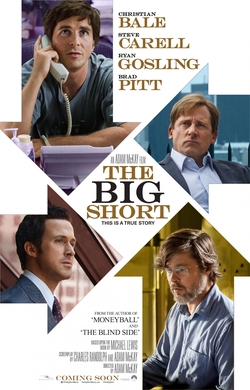
Playing Catch-Up: The Big Short (dir by Adam McKay)


The_Big_Short_teaser_poster

The Big Short is a film that is so critically acclaimed and that has been so passionately embraced by those who enjoyed it that it’s a bit intimidating to admit that it really didn’t do much for me.  (It’s even more intimidating for me to admit that I nearly included it on my list of the 16 worst films of 2015.)  It’s a big, angry movie and, even though it’s not really that good, it definitely taps into the zeitgeist.  It captures the anger, the frustration, and the fears that people (including me) are feeling right now.  It didn’t do much for me but I can understand why others have so passionately embraced it.

As for the film itself, it’s about the housing collapse and the financial crisis of 2008.  The main characters are all people who realized that the economy was about to collapse and who managed to make a profit off of the crisis.  For the most part, everyone gets at least two scenes where they get to rail about how angry they are that they’re making a profit off of other people’s misery.  However, they all still collect their money at the end of the film.

For the most part, our main characters are the type of quirky eccentrics who always tend to pop up in ensemble films like this.  They’re all played by recognizable actors and they all have an identifiable trait or two so we can keep them straight.  For instance, Christian Bale has trouble relating to people socially, plays drums, and looks like he probably has terrible body odor.  Steve Carell has a bad haircut and spends a lot of time yelling at people.  He’s also haunted by the suicide of his brother and he’s married to Marisa Tomei but she only gets to appear in two scenes and doesn’t really do much because this is a film about menfolk, dagnabit.  (I love Steve Carell but this is probably the least interesting performance that he’s ever given.)  John Magaro and Finn Wittrock are two young investors and they especially get upset when they realize that the economy is about to collapse.  Their mentor is played by Brad Pitt.  Since this is an important film, Brad Pitt plays his role with his important actor beard.

And then there’s Ryan Gosling.  Gosling plays a trader and he also narrates the film.  And really, Gosling probably gives the best performance in the film, perhaps because his character is the only one who is actually allowed to enjoy making money.  I think we’re supposed to be outraged when he brags about making money while people lose their houses but Gosling’s so charismatic and the character is so cheerful that it’s hard to dislike him.

(Of course, listening to Gosling’s narration, it’s impossible not to be reminded of The Wolf of Wall Street.  And it’s appropriate because The Big Short is kind of like The Wolf of Wall Street for people who don’t want to have to deal with ambiguity or nuance.)

The film has gotten a lot of attention for Adam McKay’s direction, which is flashy and always watchable but, at the same time, also rather shallow.  For the most part, McKay’s directorial tricks only served to remind me of other movies.  The narration, of course, made me think about The Wolf of Wall Street.  The scenes where characters look straight at the camera and say, “This isn’t the way it really happened,” only reminded me of how much more effective it was when the same thing happened in Michael Winterbottom’s 24 Hour Party People.

And then there’s the celebrity cameos.  These are the scenes where a special guest celebrity is brought on screen to explain to us how Wall Street actually works.  The first time, it’s Margot Robbie in a bubble bath and it works well because it admits the debt that The Big Short owes to Wolf of Wall Street.  (Plus, it ends with Robbie telling the viewers to “fuck off,” which is probably what I would do if a huge group of strangers interrupted my bubble bath.)  If McKay had limited himself to just doing it once, it would have been brilliant.  But McKay drags out three more celebs and, with repeated use, the technique gets less and less interesting.

But I guess it’s debatable whether any of that matters.  The Big Short taps into the way people are feeling now.  It’s a zeitgeist film.  People are rightfully angry and The Big Short is all about that anger.  A decade from now, it’ll probably be as forgotten as Gabriel Over The White House.  But for now, it’s definitely the film of the moment.