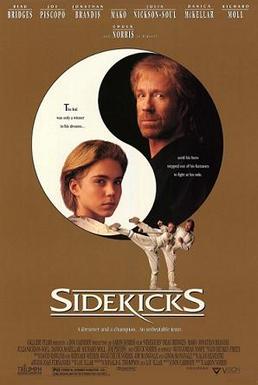
Sidekicks (1992, directed by Aaron Norris)


Barry Gabrewski (Jonathan Brandis) is a teenager living in Houston with his father (Beau Bridges).  Barry has asthma and has a hard time at school, being picked on by everyone from the school bully (John Buchanan) to the athletics coach (Richard Moll) to the clueless principal (Gerrit Graham).  Barry has only one ally and his name is Chuck Norris!  Whenever Barry is having a hard time, he imagines taking part in an exciting mission with Chuck Norris.  In his imagination, he and Chuck recreate scenes from all of Chuck’s movies even though Barry is really too young to be watching anything that violent.

Barry wants to learn karate but is turned down by an arrogant dojo owner (Joe Piscopo, channeling Martin Kove).  Barry finally finds a teacher (Mako) who uses Barry’s love of all things Chuck Norris to train him.  Barry enters the local karate tournament and wouldn’t you know it, there’s Chuck!  He’s attending as a guest and he’s hoping to see Joe Piscopo taught a lesson in humility.  When Barry and his sensei are told that they don’t have enough members for their team, Chuck volunteers to fight with them.  No one objects to the world’s most famous martial artist deciding to take part in a local, largely amateur karate tournament.  Can Barry win the tournament with the help of his hero?

Chuck Norris famously turned down a role in The Karate Kid.  Some sources say that he was offered the John Kreese role while others say that Norris was offered the sensei role that eventually become Mr. Miyagi.  Chuck has always said that his agent turned down the script and he didn’t even know it had been offered to him until years later but Sidekicks sticks so close to the Karate Kid plot that it does sometimes feel like it was made so that we could see what Karate Kid would have been like if Chuck Norris had accepted a role.  The movie follows the Karate Kid formula while lacking the edge that made Karate Kid stand out.  Karate Kid was a coming-of-age movie with a lot of karate.  Sidekicks is a blatant celebration of Chuck Norris.

Fortunately, Chuck Norris has always had the moves to back up his high self-regard and, in this film, he actually seems to be relaxed and having fun playing a version of himself.  Sidekicks is predictable and ego-driven but it has a likable energy and Chuck shows a willingness to poke fun at his earlier movies.  Whatever else you might say about Sidekicks, there were a lot of bullied kids would have loved to have had a friend like Chuck Norris.  Sidekicks is also the only place where you can see Chuck Norris fight Joe Piscopo and there’s something to be said for that.
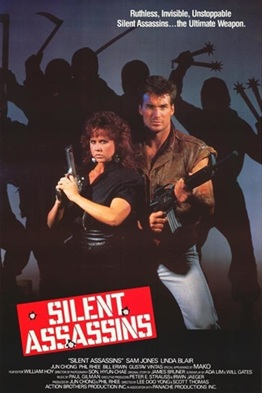
Silent Assassins (1988, directed by Lee Doo-yong and Scott Thomas)


Elite cop Sam Kettle (Sam J. Jones) just wants to get out of Los Angeles and live a peaceful life with his girlfriend, Sara (Linda Blair), but the streets have other plans.  The evil Kendrick (Gustav Vintas) has kidnapped Dr. London (Bill Erwin) and is determined to get the code for a deadly bioweapon.  For reasons that are never made clear, Kendrick has also kidnapped young Joanna (Joanna Chong).  Backing Kendrick up is the evil Miss Amy (Rebecca Ferrati).  Backing up Kettle is Joanna’s uncle, Jun Kim (Jun Chong) and Bernard (Phillip Rhee), the son of Oyama (Mako), the owner of the local dojo.  Can Sam save the world, saved the doctor and the girl, and also save his relationship with Sara?

Silent Assassins is a terrifically fun martial arts movie.  The action is well-choreographed.  The film’s plot doesn’t make a bit of sense.  The movie is full of weird throw-away dialogue, like an offended Ms. Amy announcing that she’s “a biochemist too.”  Chong shows off his moves, Rhee plays his character as a playboy having the time of life, and Jones glowers at the camera as only Sam J. Jones can.  There’s an army of loud ninjas (so much for the silent part) and Vintas is so villainous that he even carries around a red rose as some sort of strange trademark.  The movie is full of weird details and no one seems to be taking any of it too seriously.  Movies like this are why people like me always went straight for the direct-to-video releases when we went to Blockbuster back in the day.

Linda Blair is second-billed.  When Lisa and I watched this movie, she kept track of Linda’s screentime.  Linda’s onscreen for a total of ten minutes and she spends most of that time doing the worried girlfriend thing.  It’s a sad waste of Linda Blair, the one misstep of an otherwise great experience.

Film Review: Tucker: The Man and His Dream (by Francis Ford Coppola)


First released in 1988, Tucker: The Man and His Dream is a biopic about Preston Tucker.

Tucker was an engineer in Detroit who went from designing vehicles for the Army during World War II to trying to launch his own car company.  His ideas for an automobile don’t sound particularly radical today.  He wanted every car to have seat belts.  He wanted a windshield that popped out as a safety precaution.  He want brake pads and he also wanted a car that looked sleek and aerodynamic, as opposed to the old boxy cars that were being pushed out be Detroit.  He wanted a car that got good mileage and he wanted one that could be taken just about anywhere.  Unfortunately, Tucker’s dreams were cut short when he was indicted for stock fraud, a prosecution that most people agree was a frame-up on behalf of the Big Three auto makers.  Tucker was eventually acquitted but his car company went out of business.  Of the 50 cars that Tucker did produce, 48 of them were still on the road and being driven forty years later.

The film stars Jeff Bridges as Preston Tucker, Joan Allen as his wife, Christian Slater and Corin Nemec as two of his sons, Lloyd Bridges as the senator who tried to take Tucker down, Martin Landau as Tucker’s business partner, and Dean Stockwell as Howard Hughes, who shows up for a few minutes to encourage Tucker to follow his dreams regardless of how much the government tries to stop him.  One gets the feeling that the film was a personal one for director Francis Ford Coppola, a filmmaker who has pretty much spent his entire career fighting with studios while trying to bring his vision to the screen.  Tucker fought for seat belts.  Coppola fought for a mix of color and black-and-white in Rumble Fish.  Tucker stood up for his business partner.  Francis Ford Coppola stood up for Al Pacino when no one else could envision him as Michael Corleone.  As is the case with many of Coppola’s films, Tucker: The Man And His Dream is a film that Coppola spent years trying to get made.  It was the film that Coppola originally intended to be the follow-up to The Godfather, with Marlon Brando projected for the lead role of Tucker.  After watching the Tucker, it’s hard not to feel that it worked out for the best that Coppola was not able to make the film in 1973.  It’s impossible to imagine anyone other than Jeff Bridges in the role of Preston Tucker.

“Chase that tiger….chase that tiger….chase that tiger….” It’s a song that Tucker sings constantly throughout the film as the camera spins around him and how you react to Tucker: The Man And His Dream will largely depend on how tolerant you are of Coppola’s stylistic flourishes.  Coppola directs the film as a combination of Disney fairy tale and film noir.  The opening of the film, with Tucker running around in almost a manic state and excitedly telling everyone about his plans, is presented with vibrant colors and frequent smiles and an almost overwhelming air of cheerful optimism.  As the film progresses and Tucker finds himself being targeted by both the government and the other auto companies, the film gets darker and the viewer starts to notice more and more shadows in the background.  The moments of humor become less and less and there’s a heart-breaking moment where Martin Landau, in one of his best performances, reveals just how far the government will go to take down Tucker’s company.  But, in the end, Tucker refuses to surrender and Jeff Bridges’s charming smile continues to fill the viewer with hope.  The film becomes about more than just cars.  It’s a film that celebrates all of the innovators who are willing to defy the establishment.

There’s a tendency to dismiss the majority of Coppola’s post-Apocalypse Now films.  However, Tucker: The Man And His Dream is a later Coppola film that deserves to be remembered.

Retro Television Review: If Tomorrow Comes (dir by George McCowan)


Welcome to Retro Television Reviews, a feature where we review some of our favorite and least favorite shows of the past!  On Sundays, I will be reviewing the made-for-television movies that used to be a primetime mainstay.  Today’s film is 1971’s If Tomorrow Comes!  It  can be viewed on YouTube.

If Tomorrow Comes tells the story of a forbidden marriage.

In 1941, Eileen Phillips (Patty Duke) meets David Tayanaka (Frank Liu) and the two of them quickly fall in love.  David asks Eileen to marry him and Eileen says yes, even though they both know that it won’t be easy.  Eileen’s father (James Whitmore) and her brother, Harlan (Michael McGreevey), are both prejudiced against the Japanese and David’s parents (played by Mako and Buelah Quo) would both rather than David marry someone of Japanese descent.  Eileen and David decide to elope first and tell their parents afterwards.

On December 7th, Eileen sneaks out of the house and joins David at his church.  They are married by Father Miller (John McLiam), who agrees to keep their secret.  Eileen and David then drive over to the church attended by Eileen’s family but no sooner have they arrived than the local sheriff (Pat Hingle) pulls up and announces that the Japanese have bombed Pearl Harbor.  The sheriff instructs everyone to return home and to listen to their radios.  David slips his wedding ring off his finger.  Telling the parents will have to wait.

Eileen’s father and brother are convinced that every Japanese person in town, even though the majority of them were born in America and have never even been to Japan, is a subversive.  David and his family are harassed by government agents like the oily Coslow (Bert Remsen).  One morning, they discover that all of their farm animals have been killed and someone has written “REMEMBER PEARL HARBOR” with their blood.  When Franklin D. Roosevelt orders the internment of the Japanese, David’s father is among those taken away.  When Harlan continues to harass David, it eventually leads to not just one but two tragedies.

If Tomorrow Comes is a real tear-jerker, one that features a great performance from Frank Liu and a good one from Patty Duke.  Though it may seem a tad implausible that David and Eileen would get married just an hour before Japan attacked Pearl Harbor (and considering the attack occurred on a Sunday morning, I’m a little curious how they found a priest who was free to secretly marry them), the film does a good job of showing how fear can lead to otherwise good people doing terrible things.  One of the film’s strongest moments comes as David’s father is taken away to an internment camp and the Japanese prisoners try to prove their loyalty by spontaneously singing America, The Beautiful.  It’s a moment that reminds us of the danger of letting our fear destroy our humanity.

It’s a film that still feels relevant today, with its portrayal of heavy-handed government agents searching for subversives and ignoring the Constitution in order to save it.  When David visited his father at the internment camp, I thought about how, at the heigh of the COVID pandemic, it was not unusual to see people demanding that the unmasked and the unvaccinated by interned away from the rest of the world.  If Tomorrow Comes is a love story and a melodrama and tear-jerker but, above all else, it’s a warning about the destructive power of fear and prejudice.

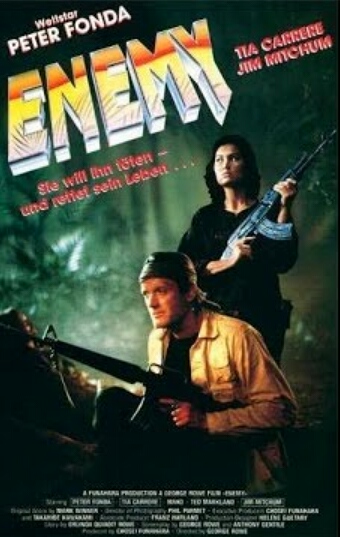
Enemy (1990, directed by George Rowe)


At the height of the Vietnam War, CIA agent Ken Andrews (Peter Fonda) disguises himself as a French journalist, slips into North Vietnam, assassinates a VC general, and then makes his escape into the jungle.  Unfortunately, the helicopter that was meant to take Ken to safety is blown up, leaving Ken stranded in the jungle with a beautiful Chinese spy named Mai Chang (Tia Carrere).

With the VC after both of them, Ken and Mai will have to set aside their initial enmity and work together to make it out of North Vietnam.  In between endless scenes of the two of them making their way through the jungle, there are battle scenes where the VC manage to shoot everything except for the two people that they’re after.

This cheap film was shot in 1988 but it sat on the shelf for two years.  The script, which attempts to be a rumination on the nature of war, feels as if it was written even earlier.  It will always be strange to me how Peter Fonda went from starring as bikers and aging hippies in films like Easy Rider and The Wild Angels to playing CIA agents and military officers in films like this one.  Peter Fonda was a stiff actor but, in this case, it works for his character, who, after all, is meant to be a man who has to keep his emotions under control.  Tia Carrere is beautiful and seems to be trying really hard to give a convincing performance despite being miscast as a grim spy.  Fonda and Carrere do have a surprising amount of chemistry together.  The romance that develops between them actually feels believable.

Enemy suffers from too much padding.  It’s a two-person show and those two people spend a lot of time walking through the jungle.  Some of the action scenes are exciting and the idea of an American spy falling in love with a Chinese spy is interesting but the ending, while action-packed, still feels like a cop out that’s designed to give Ken an easy out.  You can almost hear Ken thinking to himself, “I really dodged a bullet there.”

Music Video of the Day: Lose You Now by Lindsey Stirling and Mako (2021, dir by Lindsey Stirling and Stephen Wayne Mallett)


Today’s music video of the days comes from one of my favorite musical artists, the great Lindsey Stirling.  This otherworldly video has a wonderfully dream-like feel to it.  Lindsey has said that the video is meant to serve as a tribute to the memory of her father.

Enjoy!

Retro Television Review: Fantasy Island 4.12 “The Heroine/The Warrior”


Welcome to Retro Television Reviews, a feature where we review some of our favorite and least favorite shows of the past!  On Tuesdays, I will be reviewing the original Fantasy Island, which ran on ABC from 1977 to 1986.  Almost the entire show is currently streaming on Daily Motion.

Today, I discovered that the YouTube account that was home to every episode of Fantasy Island has been taken down.  This frustrated me.  Fantasy Island is no longer on Tubi or Prime.  In both cases, the original has been pushed to the side to make room for the reboot.  So now, Daily Motion appears to be the only platform to have every episode.  Bleh!  Daily Motion includes so many commercials that it takes forever to get through one hour-long show.

*Sigh*

That said, I’m dedicated to this show.  If I have to watch it on Daily Motion, I’ll shudder and do it.

Episode 4.12 “The Heroine/The Warrior”

(Dir by George McCowan, originally aired on January 24th, 1981)

This week, two more guests come to Fantasy Island with a desire to discover and prove who they really are.

For instance, Bob Graham (James MacArthur, who I just previously saw on The Love Boat) may seem like a rather mild-mannered fellow but he’s actually obsessed with the martial arts and his fantasy is to challenge and defeat the world’s greatest martial artist, Kwong Soo Luke (played by Mako).  Bob wants to impress his wife, Linda (Shelley Fabares).  Personally, I think it’s kind of sad that Bob thinks that beating someone up is the only way that he can impress his wife, especially since Linda seems to be pretty impressed with her husband already.  Mr. Roarke also explains to Bob that Kwong Soo Luke traditionally kills his opponents after he defeats them.  Again, you have to wonder why anyone would volunteer to go up against Kwong Soo Luke.

Anyway, this fantasy suffers from the fact that we know, from the start, that there’s no way that Bob is going to die on Fantasy Island.  But again, there’s no way that, after all of the build-up, Bob isn’t going to get his fight.  As a result, Bob’s survival and his victory are pretty much guaranteed.  It brings Bob and Linda closer together but I get the feeling that divorce is still waiting for them in the future.  “Remember that time you took me to an island and then spent the whole time fighting some guy I didn’t even know?”  Bob better get used to hearing that.

Meanwhile, when Florence Richmond (Mary Ann Mobley) steps off the plane, Tattoo immediately guesses that she must be a teacher.  Roarke explains that Florence is actually a writer, one who has had a good deal of success with a series of trashy romance novels.  However, the prim and proper Florence feels that she’s never experienced a grand romance of her own so her fantasy is to be the heroine of one of her own books.  Roarke grants her fantasy and soon, Florence is falling in love with the enigmatic and possibly duplicitous Brent Hampton (Cesare Danova) and nearly getting raped by the vile Porter Brockhill (Robert Loggia).  Florence is shocked to discover that her novels take place in a world where lust is more important than love and true romance does not exist.  Suddenly, Florence understands why her latest books were so uninspired and she leaves Fantasy Island determined to write about true romance.

This storyline featured nice performances from Mary Ann Mobley, Cesare Danova, and Robert Loggia.  For me, it was mostly interesting as an examination of a fantasy that I’m sure every writer has, the fantasy of living inside of one of their own stories.

Next week …. hopefully, someone will have been kind enough to upload the show back onto YouTube!

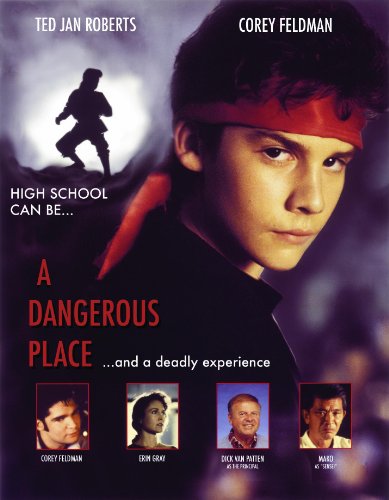
A Dangerous Place (1994, directed by Jerry P. Jacobs)


In A Dangerous Place, a young karate student avenges his brother’s death and Corey Feldman impersonates Christian Slater.

Greg (Dean Cochran) and his younger brother, Ethan (Ted Jan Roberts), are both students of a sensei (Mako) who teaches that sparing an enemy is the best way to make a friend and that true martial artists do not compete in tournaments.  Greg wants more out of karate so he starts hanging out with The Scorpions, a gang led by Taylor (Corey Feldman).  The Scorpions all belong to a dojo owned by Gavin (Marshall R. Teague), who teaches that mercy is a weakness.  When the Scorpions aren’t beating up people at the beach, they’re “scavenging.”  They break into houses and businesses, steal what they can, and claim that homeowners insurance means that they’re actually doing everyone a favor.  When one robbery goes wrong, Greg tries to stop Taylor from killing a homeowner.  Taylor fights back and the end result is Greg falling over a railing and dying.  

The Scorpions leave Greg hanging in the high school gym.  The police think that Greg committed suicide but Ethan knows that his brother would never end his own life.  Ethan knows that the Scorpions are responsible.  He leaves his old dojo and joins Gavin’s dojo.  Ethan now has an in with the Scorpions but, if Gavin and Taylor are going to trust him enough to reveal the truth about what happened to Greg, Ethan is going to have to betray his old sensei and set up a match between the two dojos.  Ethan is going to have to abandon his own peaceful principles about become as bad as the people he is trying to take down.

For a low-budget Karate Kid rip-off, A Dangerous Place is not as bad as it sounds.  Some of the fight scenes are exciting, Mako is a decent stand-in for Pat Morita, and Marshall R. Teague does a passable Martin Kove impersonation as the leader of the bad dojo.  Corey Feldman imitating Christian Slater imitating Jack Nicholson does eventually get old but, since Feldman is playing the bad guy here and we’re not supposed to like him, it actually works to the film’s advantage.  Finally, Dick Van Patten, of all people, has a small role as the high school’s principal.  Mako, Feldman, Van Patten, and karate?  A Dangerous Place is dumb but entertaining.

Film Review: Conan The Destroyer (dir by Richard Fleischer)


As you can probably tell just from looking at everything that’s been posted on the site today, I love the Oscars. That said, I realize that the Oscars aren’t for everyone. Some people find Oscar-nominated movies to be boring. Some people find the ceremony to be unbearably pompous. Every year, there’s the lament of “The truly entertaining films always get snubbed!”

Well, fear not! If you’re not into the Oscars, there are alternatives! For instance, you can go over to Prime right now and rent the 1984 film, Conan the Destroyer!

Conan The Destroyer is the sequel to the original Conan the Barbarian, with Arnold Schwarzenegger returning as Conan and Mako returning as the sorcerer who narrates the events of Conan’s life. This film is a continuation of the adventures of the barbarian who would become king, a trip to a world much different from our own, and a study of savagery vs civilization. Of course, to most viewers, Conan The Destroyer is just the film where a weird lizard monster picks up Arnold Schwarzenegger by his feet and spins him around in circles. Have you seen that meme where it’s made to appear as if Kate Winslet is spinning around a helpless Schwarzenegger? Along with Titanic, this is the film that you have to thank for it.

Conan The Destroyer picks up from where Conan the Barbarian ended. Conan is still wandering around the desert, working as a thief and a mercenary. He’s still praying to Crom and missing Valeria. He’s picked up a companion, a cowardly thief named Malak (Tracey Walter). When Conan and Malk are captured by Queen Taramis (Sarah Douglas), Taramis offers to bring Valeria back to life if Conan will escort the Queen’s niece, Jehna (Olivia D’Abo), to a temple so that she can retrieve a gem that will be used to …. you know what? I’m just going to be honest here. I have absolutely no idea what the quest is about. It’s just one of those things where Conan and his crew have to break into a castle or a temple and steal something so that a god can either be awakened or defeated. The film, to be honest, is a bit vague about how it all works but then again, the mission is less important than the journey.

It turns out that, with the exception of her insanely tall bodyguard Bombaata (Wilt Chamberlain), Jehna has never seen an actual man before and, needless to say, she is quickly fascinated by Conan. (She asks Bombaata if Conan is as handsome as he appears to be, Bombaata reluctantly agrees that he is.) However, Conan only cares for the deceased Valeria. As he leads Jehna, Malak, and Bombaata to the castle where they’ll find the gem, he picks up some other traveling companions. The wizard Akiro (Mako) joins them as does the fierce warrior Zula (Grace Jones). Of course, it turns out that Taramis has an agenda of her own and it all ends in a lot of shouting, swordplay, and muscle flexing.

If Conan the Barbarian was distinguished by the grim and girtty approach that it took to material that others would have played for camp, Conan the Destroyer takes the opposite approach. Of course, a lot of that is because director/screenwriter John Milius did not return to oversee Conan the Destroyer. Instead, Conan the Destroyer was directed by Richard Fleischer, who was one of those veteran directors who made a countless number of films in all sorts of genres but who never really developed a signature style of his own. Fleischer takes a semi-comedic approach to Conan and his quest. As opposed to the brutal warrior and conqueror who appeared in Milius’s film, the Conan in this film is a well-meaning rogue who punches out a camel and who also gets tongue-tied whenever he has too much to drink or when Jehna flirts with him. There’s little of the first film’s violence in this sequel and none of the emotional stakes.

That said, Conan the Destroyer is definitely entertaining. It’s just such a silly movie that you can’t help but enjoy it. Schwarzenegger, apparently understanding that the film is never going to make any sense, cheerfully goes through the motions and he actually does a pretty good job with some of his more comedic lines. The allies and the villains who he collects through the film are all memorably flamboyant. Sarah Douglas is especially entertaining as the over-the-top villainous. If you’re going to be evil in a film like this, you might as well go all out.

Conan The Destroyer was not nominated for an Oscars but it’s still a fun movie.

Film Review: Robocop 3 (dir by Fred Dekker)


“Oh wow, Robocop can fly!”

An odd film, Robocop 3. Released in 1993, this was the third and final film in the original Robocop franchise. While the action is still set in Detroit and Robocop is back (albeit now played by Robert John Burke) and Nancy Allen shows up long enough to get killed off, Robocop 3 feels strangely separate from the previous two Robocop films. If the first two Robocop films were dark, satirical, and over-the-top in their violence, the third film is a family friendly adventure film that reimagines Robocop as being some sort of fair housing activist.

And, on top of all that, Robocop can fly now. Admittedly, that’s because Robocop gets fitted for a jetpack that he didn’t have in the previous films but he still looks incredibly ludicrous flying through the streets of Detroit. Since the Robocop armor has always looked very bulky and very heavy, it’s hard to believe that he could fly as quickly and as smoothly as he does in this film.

There’s a new set of villains too. Rip Torn has replaced Dan O’Herilhy as the CEO. And listen, I like Rip Torn. He will always be a hero to me because he bit Norman Mailer’s ear off. But Torn is far too obviously evil in the role of the CEO. O’Herlihy smartly played the Old Man as being avuncular and amoral. You could look at him and understand how he rose to his position of prominence. Torn’s performance is a bit more cartoonish but then again, Robocop 3 is the most cartoonish of the series.

The CEO wants to tear down Old Detroit so the residents of Old Detroit are fighting back. Leading the CEO’s forces — called the Rehabbers — is Paul McDagget (John Castle), who is a complete and total madman but who, at the same time, is never quite as memorable as Kurtwood Smith or Tom Noonan. He’s really just another generic militaristic bad guy. Normally, you would expect Robocop to be on the side of the company and the police but he’s been reprogrammed by an 8 year-old hacker named Nikko (Remy Ryan). Robocop is now working with the rebels. One of the rebels is played by Stephen Root, proving once again that you never know where Stephen Root might pop up.

Robocop 3 has none of the satiric bite of the first two movies. Instead of being a symbol of authoritarianism gone beserk, Robocop becomes a generic do-gooder. The violence is toned down and, with the addition of a kid sidekick, it’s obvious that this Robocop was meant to be a safer version of the character. Unfortunately, a safe Robocop equals a boring Robocop. You watch this movie and you wonder what happened to the Robocop who shot Ronny Cox out of a window.

“My friend’s call me Murphy,” he says towards the end of the film, “You can call me Robocop.” That seemed to indicate that Robocop had quite a future ahead of him of doing the right thing and standing up to big evil corporations but Robocop 3 was such a bomb at the box office that Robocop’s further adventures would only be seen on TV. The franchise was rebooted back in 2014, in a film that my friend Mark called “Rubber Cop.” After Rubber Cop fell flat, it was announced that Robocop would be rebooted for a second time, this time with a movie that would serve as a direct sequel to the first Robocop and which would ignore the sequels and the first reboot. Personally, I think it might be time to let Robocop retire. He had a good run.