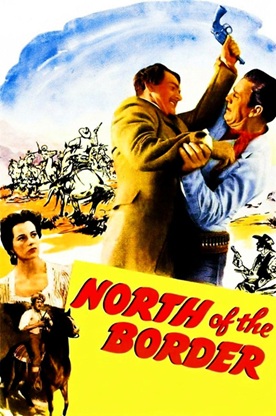
Rancher Bob “Utah” Neyes (Russell Hayden) heads into Canada to meet up with his business partner. Unfortunately, his partner has been murdered by outlaw Nails Nelson (Douglas Fowley). Mountie Jack Craig (Lyle Talbot) almost arrests Utah for the crime but he becomes convinced that Utah is innocent and Nails is guilty. Along with fur trader Ivy Jenkins (I. Stanford Jolley), Craig and Utah try to break up Nails’s fur-smuggling operation.
While I was watching it, I thought this movie seemed even more familiar than the usual Poverty Row western. I realized that’s because I had actually seen Russell Hayden and most of the rest of the cast in another movie that had a similar plot, right down taking place on the other side of the border. That other movie was called ‘Neath Canadian Skies. Both it and North of the Border are among the four Canadian western films that Robert Lippert produced in 1946, all of which starred Russell Hayden and were directed by B. Reeves Easton. Supposedly, it took 20 days to shoot all of them.
As for North of the Border, it’s only 42 minutes long and none of those minutes are wasted. There’s all of the usual horse chases and gunfights that fans want from these films. For me, the most interesting thing about the film was getting to see Lyle Talbot play something other than a boring authority figure. Also, this film features Inez Cooper, a pretty redhead who had a short career but whose beauty and personality as well-remembered by fans of Poverty Row westerns. She plays the love interest in this one and there’s no doubt that most men would give up living in Utah for her.
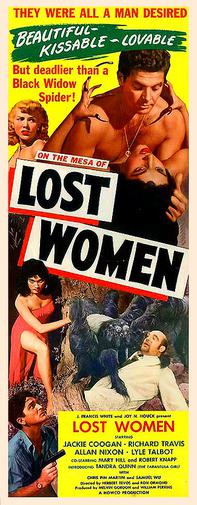
“Have you ever been kissed by a girl like this?” a disembodied voice asks at the start of 1953’s Mesa For Lost Women as a pair hands with claw-like fingernails caresses the face of someone who is later identified as being “Doc” Tucker (Allan Nixon).
Things get stranger from there. A couple is found lost and dehydrated in the Mexican desert. Grant Phillips (Robert Knapp) rambles about “super bugs” out in the desert and how they have to be destroyed. American land surveyor Frank (John Martin) assumes that Grant must be delirious but Frank’s assistant, Pepe (Chris Pin Martin), knows differently. We know that Pepe knows differently because the narrator tells us that Pepe had heard all about the monsters in the desert but Pepe keeps that information to himself….
Who is this narrator and why is he so condescending? (For the record, he’s actor Lyle Talbot, who split his career between major, Oscar-winning productions and stuff like this.) Have you ever noticed that a narrator usually just leaves you feeling even more confused by what you just watched? There’s a trailer playing right now for a film called Ella McCay that opens with Julie Kavner saying, “Hi, I’m the narrator!” and whenever I hear that line, I’m just like, “Oh, this film is going to be so bad!”
I think it’s because most narrators are added after the fact, in an attempt to give some sort of uniformity to a badly constructed movie. The narrator is there to tell us stuff that a good movie would be able to show us. For instance, in the trailer for Ella McCay, Julie Kavner tells us that “I’m nuts about her,” as a way to assure us that Ella McCay is someone worth making a movie about. Now, ideally, you wouldn’t have to have someone tell you that. You would just watch the movie and say, “Hey, Ella McCay! She deserves all the happiness in the world!” But when your trailer is a bunch of scenes of Ella McCay acting a bit immature for someone who is destined to become “governor of the state you were born and raised in,” you need that narrator to say, “No, she’s likable, I promise!”
By that same logic, Mesa of Lost Women was apparently a mash-up of several different films, none of which had a complete script. Narrator Lyle Talbot is here to tell us that, despite what we’re seeing, Mesa of Lost Women is an actual movie with an actual story as opposed to just a bunch of random scenes that were haphazardly crammed together. We get a flashback of a scientist named Masterson (Harmon Stevens) traveling to the laboratory of Dr. Aranya (Jackie Coogan) and discovering that Aranya is creating giant tarantulas and transforming human women into mind-controlled slaves with the instincts of a spider. Masterson doesn’t think that’s ethical so Aranya’s assistant, Tarantella (Tandra Quinn), gives him an injection that turns him into a simpleton. Masterson ends up in a mental hospital, though he later escapes. Meanwhile, an American businessman and his girlfriend (Mary Hill) come to Mexico and witness Tarantella dancing in a bar. Masterson shows up and shoots Tarantella and then takes everyone hostage so that he can force Grant, who we now discover is a pilot, to fly him to the mesa of lost women …. or something.
Despite the best efforts of the narrator, the film is impossible to follow. A big problem is that Dr. Aarnya’s plan never makes much sense. How is creating a giant spider and a bunch of women who think that they’re spiders going to help him conquer the world? The other problem is that the film had two directors, one of whom was an enigmatic German named Herbert Tevos who got the job by claiming to have directed Josef von Sternberg’s The Blue Angel. Tevos’s footage of Dr. Aranya, the giant tarantula, and the “lost women” was not enough to secure the film distribution so a second director, Ron Ormond, was brought in to shoot a bunch of new footage to make the film more commercial. Tevos’s film became an extended flashback in the middle of Ormond’s film and the whole thing is a big mess.
In fact, the film is such a mess that some people insist Ed Wood must have been involved. It is true that narrator Lyle Talbot also appeared in Plan 9 From Outer Space and Glen or Glenda. Plan 9‘s Mona McKinnon appears as a spider woman. So does Dolores Fuller, who was Wood’s girlfriend at the time. Wood later “borrowed” Mesa of Lost Women‘s score for Jail Bait. Mesa of Lost Women was definitely Wood-adjacent but, by all accounts, Wood didn’t actually do any work on the film. This mess of a film belongs to Tevos and Ormond.
And it is a mess. It’s a watchable mess, in much the same way that a nuclear meltdown would probably be watchable. But, nonetheless, it’s still a mess and the incoherence of the plot really does get on one’s nerves, despite the best efforts of Lyle Talbot. Talbot can’t sell the viewer on Mesa of Lost Women. Maybe he would have had better luck with Ella McCay.
Today, we pay respect to Edward D. Wood, Jr. on the date of his birth. He was born 101 years ago today.
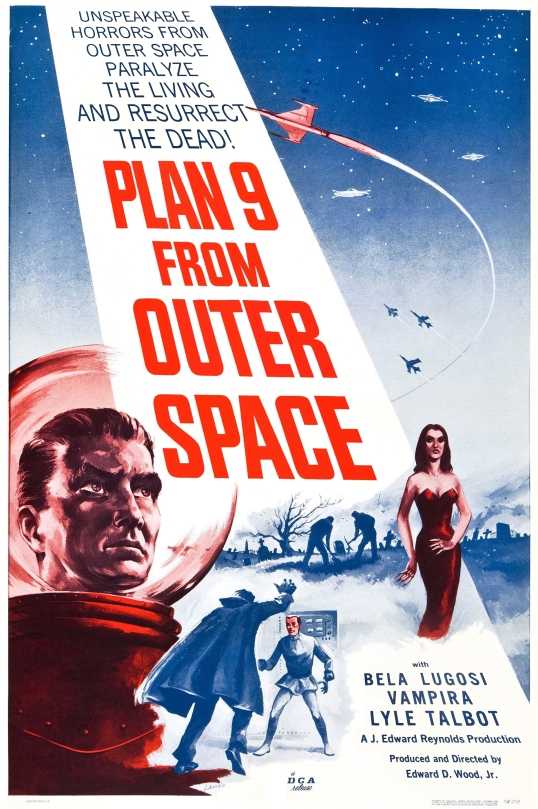
Some films need no introduction and that’s certainly the case with Wood’s 1957 masterpiece, Plan 9 From Outer Space.
Plan9 is a film like no other, a film that mixes UFOs with zombies and which ends with a rather sincere plea for world peace. When Eros the Alien explains that the Solarnite bomb could destroy the entire universe, the film’s hero, airline pilot Jeff, doesn’t point out that Eros’s logic doesn’t make sense. Instead, he just says that he’s glad that America is the one that has the bomb. “You’re stupid! Stupid minds!” Eros shouts before Jeff flattens him with one punch. Go Jeff! Don’t take any backtalk from that judgmental alien!
From Criswell’s introduction to Tor Johnson’s rise from the dead to Lyle Talbot casually standing with his hands in his pockets while a UFO explodes above him, Plan9 is a true classic of some sort.
Welcome to Retro Television Reviews, a feature where we review some of our favorite and least favorite shows of the past! On Fridays, I will be reviewing St. Elsewhere, a medical show which ran on NBC from 1982 to 1988. The show can be found on Hulu and, for purchase, on Prime!
This week, Peter White returns to the hospital.
Episode 2.18 “Equinox”
(Dir by David Anspaugh, originally aired on March 14th, 1984)
A college student (Thomas Byrd) comes in after taking a hit to the groin during a touch football game. It turns out that he might have testicular cancer and it falls to Dr. Cavanero to let him know that he will soon be down a ball.
Dr. Chandler is upset when his new girlfriend prefers to hang out with Luther. Chandler accuses Luther of “shuckin’ and jivin’.” Chandler’s girlfriend dumps him for being “mean.” In a well-acted scene, Chandler talks to Morrison about how he’s expected to act one way as a black man and another way as a black doctor.
Fiscus makes the mistake of giving Elliott Axlerod (Stephen Furst) his lucky baseball cap. Axelrod spills a urine sample on it and then accidentally sets the hat on fire while attempting to dry it. Axlerod is having a terrible day until a man dressed like Paul Revere brings his horse into the ER for treatment. It turns out that Axlerod’s father was veterinarian. Axlerod cures the horse but he still has to get Fiscus a new hat.
Finally, Dr. White returns. His charges have been reduced from attempted rape to assault. Wendy Armstrong is not happy and starts to binge eat. (And yet, as several nurses point out, she doesn’t gain a pound. We all know what that means….) When Kathy Martin sees Peter in the cafeteria, she yells that he raped her. “You’re crazy,” Peter lies.
The episode ends with Dr. Chandler going for a run outside, stopping, and screaming into the air.
This episode was a bit uneven. The Axlerod story worked because of the likability of Stephen Furst and not because the story itself was particularly clever. The Philip Chandler/Jack Morrison conversation was the highlight of the episode, though the ending with Chandler screaming into the void was a bit overdone.
As for Dr. White, I’ve reached the point where I can’t even stand to look at him and I feel foolish for having any sympathy for him earlier in the season. Hopefully, this season will end with Dr. White going to prison for life because I’m not sure how many more episodes I can handle of him wandering around the hospital with that smug look on his face.
Seriously, St. Elsewhere, take care of this guy soon….
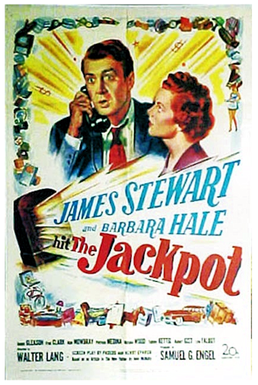
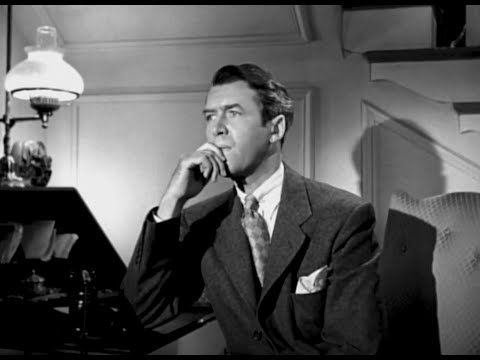
In 1950’s The Jackpot, James Stewart plays Bill Lawrence.
Bill has a job at a department store. He’s not the manager but he’s still a respected member of the staff and who knows? Maybe his boss (Fred Clark) will give him a promotion someday. He lives in a big, two-story home with his wife, Amy (Barbara Hale). He and Amy have two children, one of whom is played by a 12 year-old Natalie Wood. By all appearances, Bill is doing pretty good for himself. At one point, it’s mentioned that makes a grand total of $7,500 a year.
That definitely caught my attention. “I make more than that!” I snapped at the screen. I pulled up an inflation calculator and I discovered that $7,5000 in 1950 is the equivalent of — wait for it — $102,000 today! (Technically, I still make more than that but still, it’s six figures.)
When Bill answers a phone call from a radio station and guesses the correct answer to a trivia question, he wins $24,000-worth of prizes. (I didn’t bother to figure out how much that $24,000 would be be in 2025 dollars but we can safely assume that it would be quite a bit.) Unfortunately, a lot of the prizes end up costing more than their worth. Bill wins a side of beef , 7,500 cans of soup, and a 1,000 fruit trees but he doesn’t win anywhere to store it all. He also wins a maid, an interior designer, a pony, a swimming pool, a trip to New York, and a session with portrait painter Hilda (Patricia Medina). He also ends up with an income tax bill for $7,000. Remember, he only makes $7,500 a year. Damn the IRS!
Realizing that he’s going to have to sell the majority of his winnings, Bill loses his job when he’s caught trying to sell to the store’s customers. Needing money to pay off his tax bill, he tries to pawn a diamond ring and ends up getting arrested. With his anniversary coming up, he asks Hilda to paint a portrait of Amy from his description of her but Bill ends up spending so much time with Hilda that Amy becomes convinced that he’s having an affair.
Basically, one terrible thing after another happens to Bill, all the result of having won a contest. (The film is loosely based on a true story, with James Gleason playing a fictionalized version of the reporter who wrote the original story.) The movie’s a comedy but, as with the majority of the films that James Stewart made after World War II, there’s a sense of melancholy running through it. Even before he wins the money, Bill doesn’t seem satisfied with his life. Much like George Bailey, he’s restless and wondering if there will ever be more to his life than just his house in the suburbs and his job in the city. Also, like George, Bill learns to appreciate what he has as the result of getting what he wants and discovering that he was happier before. Few actors were as skilled at capturing ennui and dissatisfaction as Jimmy Stewart. The Jackpot is a silly comedy but it’s also an effective portrait of a middle-aged man trying to find peace with the way his life has turned out. That’s almost entirely due to Stewart’s likable but honest performance.
TheJackpot may not be one of Stewart’s most-remembered films but it’s entertaining, with the supporting cast all providing their share of laughs while Stewart provides the film with a heart. The film may be a comedy but it’s also a look at America and Americans adjusting to life in the years immediately following World War II. Suddenly, abundance is everywhere but, as Bill Lawrence, not without a price.
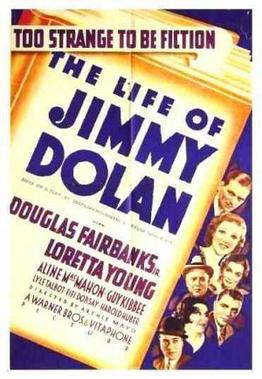
Jimmy Dolan (Douglas Fairbanks Jr.), the light heavyweight champion of the world, goes out of his way to present himself as being a wholesome boxer who loves his mom and is as saintly outside the ring as he’s fearsome inside. Instead, in private, Jimmy is a hard-drinking cynic with a corrupt manager (Lyle Talbot) and a wild girlfriend (Shirley Grey). When a reporter (George Meeker) threatens to reveal the truth, Jimmy’s manager punches him and accidentally kill him. The manager frames Jimmy for the crime and then flees with Jimmy’s girlfriend, just to suffer a fiery end in a car accident.
Everyone except for weary Inspector Phalanxer (Guy Kibbee) thinks that Jimmy is dead. Jimmy goes on the run, hitching rides on freight trains and nearly starving to death before he stumbles over a home for orphans. Peggy (Loretta Young) takes Jimmy in and gives him food and a place to live. Jimmy helps with the kids (including Mickey Rooney). When Jimmy learns that the orphanage might be shut down, he agrees to fight in a charity boxing match against the fearsome King Cobra (Sammy Stein). King Cobra is so tough that even John Wayne (playing a boxer named Smith) is scared to get in the ring with him. Jimmy risks his life and his freedom for the orphanage.
This is a good pre-code melodrama. Because this was a pre-code film, it doesn’t have to shy away from portraying Jimmy’s decadent lifestyle outside of the ring. Douglas Fairbanks, Jr. was a likable actor and easy to root for. He was athletic enough to be convincing as someone who could handle himself in a fight. When he finds himself down-and-out, he’s standing in for everyone who was struggling during the Depression. The great character actor Guy Kibbee also has some great moments as the inspector, especially towards the end of the film. Fans of John Wayne won’t see much of him here but it’s still interesting to see Wayne play a character who is frightened of something.
All in all, The Life of Jimmy Dolan is a good, pre-code boxing movie.
Today is the 100th birthday of Edward D. Wood, Jr., the director who is often referred to as being “the worst director of all time.” Personally, I’ve never really agreed with that title. Ed Wood had a long career in Hollywood and yes, he may have worked exclusively in B-movies and yes, he eventually turned to softcore and then hardcore porn to pay the bills and yes, his life ended under rather tragic circumstances. But, unlike most truly bad directors, his films are still being watched today and, again unlike most bad directors, his style is immediately recognizable. You don’t need to see his name in the credits to know when a film was directed by Ed Wood. You just have to keep an eye out for stock footage, a few familiar actors, and a lot of angora.
If anything, Ed Wood was a director whose ambitions far outweighed the money that he could usually raise for his films. On the one hand, Plan 9 From Outer Space was a film where the strings holding the flying saucers were clearly visible and where a shower curtain was used to represent the door into an airplane’s cockpit. On the other hand, it was also a very sincere plea for world peace and a lament that humans would rather blow themselves up with Solarnite than work out their differences.
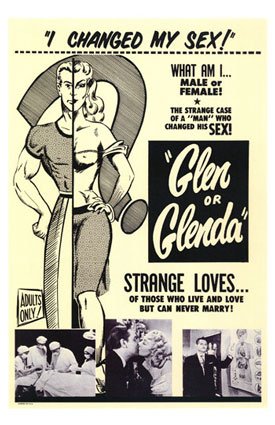
Or you take a film like 1953‘s Glen or Glenda. Ed Wood, who identified as a heterosexual and who was considered, by his friends, to be quite a womanizer (and it should be noted that young Ed Wood was strikingly handsome, though he was subsequently very badly aged by alcoholism and homelessness), also preferred to wear clothing designed for women and was open about it at a time when American culture was even more conformist-minded than usual. In Glen or Glenda, Wood plays the autobiographical role of Glen, who struggles to tell his fiancée (played by Wood’s real-life girlfriend, Delores Fuller) that he dreams of being able to wear her angora sweater. Glen’s story is told by a psychiatrist (Timothy Farrell) who is talking to a cop (veteran Hollywood character actor Lyle Talbot) who is investigating the death of a transvestite. Among other things, Glen or Glenda is known for its bad acting, stiffly delivered dialogue, and its occasional digressions about why men go bald while women do not. (It’s the tight-fitting hats, which cut-off blood flow to the head and not only cause men to lose their hair but also develop the Solarnite bomb.) But, at the same time, it’s a film in which Wood attempts to handle, with sensitivity and empathy, a subject that most films in the 50s would have either ridiculed or portrayed as being a threat to the American way of life. All of Wood’s films are sympathetic to those who are considered to be outsiders by conventional society. This is especially true of Glen or Glenda.
Of course, Glen or Glenda is also known for Bela Lugosi randomly appearing in a laboratory and shouting things like, “Pull ze string! Pull ze string!” As far as I can tell, Lugosi is supposed to be playing the creator, who is not portrayed as being a stereotypical God but instead as being a mad scientist who rants and raves in his library and his laboratory. And while it’s obvious that Bela was probably added to the film at the last minute and, more or less, allowed to do whatever the Hell he wanted, his presence adds a wonderfully bizarre touch to film’s dry style. (I would compare him to the mysterious burned man who appears at the start of David Lynch’s Eraserhead.) Whenever the film starts to get a bit too much like an educational film, Lugosi pops up and starts to literally shout at the audiences, frantically issuing a bunch of commands and nursery school rhymes that don’t really made any sense. It reminds one of H.P. Lovecraft’s insistence that the universe was created by a blind idiot God who had no idea that he was actually creating anything. The presence of Lugosi and a lengthy and increasingly surreal dream sequence in which Glen imagines himself being tormented by both his fiancée and the devil all suggest that, under different circumstances, Ed Wood could have been the American Buñuel.
Sadly, it was not to be. Ed Wood died in alcoholic poverty and was reportedly pretty miserable during the final years of his life. There was nothing pleasant about the end of Wood’s life. But, on his birthday, I think the least we can do is remove the title of “worst director” from his legacy. He was nothing of the sort.
Viewing Plan 9 From Outer Space during October is a bit of a tradition around these parts and here at the Shattered Lens, we’re all about tradition. And since the 100th anniversary of the birth of Ed Wood, Jr. is just a five days away, it just seems appropriate to watch his best-known film.
Speaking of tradition, this 1959 sci-fi/horror flick is traditionally cited as the worst film ever made but I don’t quite agree. For one thing, the film is way too low-budget to be fairly judged against other big budget fiascoes. If I have to watch a bad movie, I’ll always go for the low budget, independent feature as opposed to the big studio production. To attack Ed Wood for making a bad film is to let every other bad filmmaker off the hook. Ed Wood had his problems but he also had a lot of ambition and a lot of determination and, eventually, a lot of addictions. One thing that is often forgotten by those who mock Ed Wood is that he drank himself to death and died living in squalor. The least we can do is cut the tragic figure some slack.
Plan 9 From Outer Space is a ludicrous film but it’s also a surprisingly ambitious one and it’s got an anti-war, anti-military message so all of you folks who have hopped down the progressive rabbit hole over the past few years should have a new appreciation for this film. I mean, do you want the government to blow up a Solarnite bomb? DO YOU!?
Also, Gregory Walcott actually did a pretty good job in the lead role. He was one of the few members of the cast to have a mainstream film career after Plan 9.
Finally, Plan 9 is a tribute to one man’s determination to bring his vision to life. Ed Wood tried and refused to surrender and made a film with a message that he believed in and, for that, he deserves to be remembered.
Now, sit back, and enjoy a little Halloween tradition. Take it away, Criswell!
Viewing Plan 9 From Outer Space during October is a bit of a tradition around these parts and here at the Shattered Lens, we’re all about tradition. And since today is the 97th anniversary of the birth of Ed Wood, Jr., it just seems appropriate to watch his best-known film.
Speaking of tradition, this 1959 sci-fi/horror flick is traditionally cited as the worst film ever made but I don’t quite agree. For one thing, the film is way too low-budget to be fairly judged against other big budget fiascoes. If I have to watch a bad movie, I’ll always go for the low budget, independent feature as opposed to the big studio production. To attack Ed Wood for making a bad film is to let every other bad filmmaker off the hook. Ed Wood had his problems but he also had a lot of ambition and a lot of determination and, eventually, a lot of addictions. One thing that is often forgotten by those who mock Ed Wood is that he drank himself to death and died living in squalor. The least we can do is cut the tragic figure some slack.
Plan 9 From Outer Space is a ludicrous film but it’s also a surprisingly ambitious one and it’s got an anti-war, anti-military message so all of you folks who have hopped down the progressive rabbit hole over the past few years should have a new appreciation for this film. I mean, do you want the government to blow up a Solarnite bomb? DO YOU!?
Also, Gregory Walcott actually did a pretty good job in the lead role. He was one of the few members of the cast to have a mainstream film career after Plan 9.
Finally, Plan 9 is a tribute to one man’s determination to bring his vision to life. Ed Wood tried and refused to surrender and made a film with a message that he believed in and, for that, he deserves to be remembered.
Now, sit back, and enjoy a little Halloween tradition. Take it away, Criswell!
Today’s Horror on the Lens is the infamous 1953 film, Mesa of Lost Women. Off in the middle of the desert, Dr. Aranya (Jackie Coogan) is conducting dangerous experiments that are resulting not only in giant spiders but also a master race of superwomen who Aranya is planning to use to conquer the world or something.
Mesa of Lost Women is a bit of a disjointed film. It was originally filmed by a German director named Herbert Tevos, who claimed to be an associate of Erich Von Stroheim’s and a former collaborator of Marlene Dietrich’s. However, despite his claims of being well-connected, no one was particularly impressed with Tevos’s first cut of the film so Ron Ormond was brought in to film additional scenes, the majority of them featuring Jackie Coogan as the insane Dr. Aranya. Jackie Coogan was, at the time, still best-known for playing The Kid in the Charlie Chaplin film of the same name. After Mesa, he would go on to play Uncle Fester on the original Addams Family.
Anyway, Mesa of Lost Women is one of those B-movies that simply has to be seen and heard to be believed. (Lyle Talbot provides the narration, which is judgmental even by the standards of the 1950s.) Enjoy Mesa of Lost Women!
 Rancher Bob “Utah” Neyes (Russell Hayden) heads into Canada to meet up with his business partner. Unfortunately, his partner has been murdered by outlaw Nails Nelson (Douglas Fowley). Mountie Jack Craig (Lyle Talbot) almost arrests Utah for the crime but he becomes convinced that Utah is innocent and Nails is guilty. Along with fur trader Ivy Jenkins (I. Stanford Jolley), Craig and Utah try to break up Nails’s fur-smuggling operation.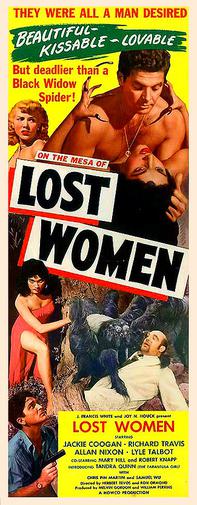


 Through the Shattered Lens