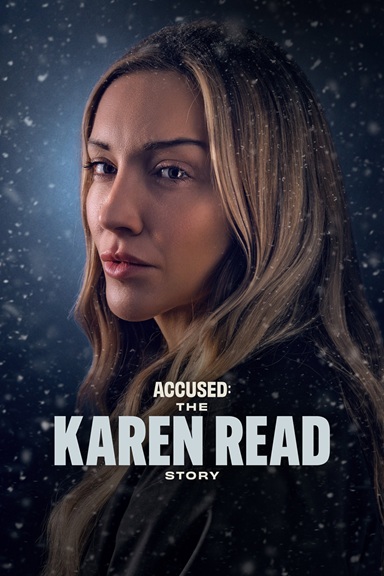
Lifetime Film Review: Accused: The Karen Read Story (dir by Linda-Lisa Hayter)


In 2022, a Boston police officer named John O’Keefe was discovered unconscious on the snow-covered front lawn of a fellow police officer.  O’Keefe was taken to the hospital, where he subsequently passed away.  It was determined that he died not from spending the night lying in the snow but instead from blunt force trauma.  O’Keefe’s girlfriend, Karen Read, was arrested and charged with the crime.  Depending on who you asked, Karen Read was either a cold-hearted murderer or the victim of a frame-up.  Because O’Keefe was himself a member of the force, it was easy make the argument that the Boston PD was so eager to arrest someone for his murder and “protect one of their own,” that they neglected to follow the evidence while making their case against Karen Read.  Of course, one could also wonder if Karen Read would have received as much support from the public if she had been someone other than an attractive professional white woman.

It took two trials but eventually, Karen Read was acquitted.  At the time, her trials dominated social media.  It was not uncommon to see the second trial referred to as being “the trial of the century.”  I think most of us understood that was hyperbole.  The Karen Read trial was not “the trial of the century” as much as it was just “the trial of the moment.”  After she was acquitted, people spent another week talking about her, the trial, and the Boston PD and then everyone moved on.  There’s always a new murder to “solve” or a new trial to debate.  In another year or so, no one will remember which side of the Karen Read debate they were on.  That will probably include me as well.

(Online sleuthing is always entertaining but ultimately rather shallow.  Those of us who have grown up consuming true crime books and movies often expect things to be more dramatic than they actually are and we tend to gloss over the fact that, while an online sleuth can bring attention to a case, it’s rare that they ever actually solve anything.  As an example, for all the attention that was given to Michelle McNamara’s quest to identify the Golden State Killer, we tend to ignore the fact that most of her theories about his identity turned out to be incorrect.)

Still, the Karen Read case was prominent enough that everyone know that Lifetime would eventually make a movie about it.  Accused: The Karen Read Story asks the question, “Did Karen Read kill John O’Keefe?” and then it answers it by saying, “Of course she didn’t!  What are you, an idiot?”  That’s not necessarily a complaint.  As annoying as I sometimes found Karen Read’s most vehement online defenders to be, I actually agreed with them about her innocence.   It’s just that, if you’re looking for a film that offers up any hint of ambiguity about the case, this is not the film for you.  The film is firmly on the side of Karen Read, to the extent that the O’Keefe family is often presented as being villains.

It’s a well-made film, though.  In the roles of Karen Read and John O’Keefe, both Katie Cassidy and Luke Humphrey give good performances.  Humphrey is especially good in the role of O’Keefe and the film doesn’t shy away from portraying the tumultuous details of his relationship with Karen Read.  (The film also deserves some credit for not turning O’Keefe into a cardboard bad boyfriend during his arguments with Read.)  Linda-Lisa Hayter’s direction captures both the cold chill  of the snowy night and the insular atmosphere of big city law enforcement.  It’s a skillful film that will be best appreciated by people who are already convinced of Karen Read’s innocence.
Lifetime Film Review: I Was Lorena Bobbitt (dir by Danishka Esterhazy)


In 1993, a woman named Lorena Bobbitt made national news when she used a kitchen knife to chop off her husband’s penis, which she then tossed into a field, where it was later found and reattached.  During Lorena’s trial, both the defense and the prosecution conceded that John Wayne Bobbitt (and what a name, right?) was an abusive and selfish husband who probably deserved a lot worse than just losing his penis for a few hours.  Lorena, meanwhile, was portrayed as being a crazed psycho, with many claiming that she was motivated not by years of abuse but instead by jealousy.  After spending months at the center of a media freakshow, Lorena was eventually found not guilty by reason of temporary insanity.  John Wayne Bobbitt was subsequently acquitted on charges that he had raped Lorena the night that she castrated him.

Subsequently, John Wayne Bobbitt held a number of jobs, was charged with more crimes, and had a brief career as an adult film actor.  Lorena attempted to stay out of the spotlight, reverted to using her birth name of Gallo, and was only briefly in the news in 1997 when she was arrested for striking her mother.

However, this previous Memorial Day, Lorena Gallo returned to the public eye as the host of I Was Lorena Bobbitt.  One of Lifetime’s “ripped from the headlines” features, the film’s format is similar to 2017’s I Am Elizabeth Smart, which featured the real Elizabeth Smart talking about her kidnapping along with dramatized scenes feature Alana Boden in the title role.  I Was Lorena Bobbitt features scenes of Lorena (played by Dani Montalvo) both before and after what the film refers to as being “the incident.”  We watch as she first meets John Wayne Bobbitt (Luke Humphrey) and how she is initially charmed by the handsome marine just to discover, after their marriage, that he’s actually a porn-addicted, abusive monster.  The real Lorena appears on-screen to provide context for what we’ve just seen.  For instance, when the movie’s Lorena gives her statement to the police, the real Lorena appears and explains that the reason why the statement was so awkward was because she was still struggling to learn how to express herself in English.  The film makes the very good and too often overlooked point that Lorena’s statement was subsequently used to paint her as being a psychopath by reporters who should have understood that not only was Lorena in shock but she was also being forced to describe a very personal experience in a language in which she wasn’t fluent.

Unfortunately, despite those few moments that do provide some valuable context to what really happened that night and afterwards, I Was Lorena Bobbitt is still a bit of a mess.  The filmmakers tell the story out of chronological order, mixing in flashbacks with flashforwards and, while I can understand why they made that narrative choice, it doesn’t really add much to the story.  In fact, it gets a bit distracting as we try to keep track of where we are in Lorena’s story.  Luke Humphrey gives a properly loathsome performance as John and Dani Montalvo gives a good performance as the young Lorena but the actual Lorena is not a particularly compelling narrator.  One gets the feeling that the film would have worked better if the real Lorena had stayed off-screen.

In the end, despite its flaws, I Was Lorena Bobbitt deserves credit for examining the real issues underneath a story that feels as if it was tailor-made to appeal to America’s tabloid sensibility.  The film shows how Lorena was gaslighted and brainwashed into believing that the abuse she suffered was her fault.  It shows how an abuser can be charming when he feels that he needs to be and it also show how Lorena was more vilified for her actions than John was for his.  It’s a film with an important message, even if the execution is sometimes lacking.