Let’s start things out with this film from 1988. I haven’t seen this film but the trailer has a certain silly charm to it and how can’t you enjoy the use of the fake lightning special effect? Plus, those finger nails screeching across the car — Agck! Freaky.
This is one of my favorite movies. Basically, a bunch of hippies take some really powerful acid in 1968 and then, eight years later, they end up having the worst flashback ever! To say that Zalman King gives an “interesting” performance as the film’s hero is a bit of an understatement.
“Jamie Lee Curtis is…Hitch.” Well, that would probably explain why she was destined to end up hitchhiking. Seriously, parents — give it some thought before you give your child any old name. Anyway, Road Games was director Richard Franklin’s follow-up to Patrick and it’s one of the better slasher films of the early 80s.
Oh my God, this looks like a bad movie. The trailer, however, is just so silly and kinda endearing in the way that it seems to desperately be saying, “No, it’s not as bad as it looks! Look — we have ice people!”
Speaking of the evil that men do, this sexploitation film from Michael and Roberta Findlay is pretty rough even by today’s standards. Don’t watch this if you’re easily offended. If you are easily offended, just remember that ten years after making this film, Michael Findlay was decapitated by a rotating helicopter blade.
On a slightly less disturbing note, here’s the trailer for Moving Violation. The film is actually a bit more odd than you might guess from just the trailer.
This is one of the most financially succesful films of all time and apparently, it extended the life of the Southern drive-in by a good decade or so. It’s actually a pretty good movie.
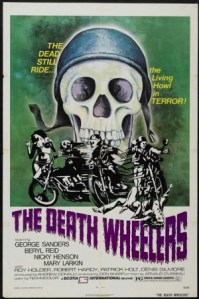
Also known as the Death Wheelers. This is one of those trailer that can pretty much speak for itself. (Though I will point out that co-star George Sanders committed suicide shortly after filming completed.)
Not surprisingly, this movie was directed by Ted V. Mikels. What makes this trailer memorable (for me) is the blandly cheerful narration. I don’t know who that is providing the narration but you hear his voice a lot as you explore the world of grindhouse trailers.
Made in the Philippines (as were many exploitation films in the 60s and 70s — I always expect to hear someone say, “Made in the Philippines — where life is cheap!” whenever I watch one of these trailers), The Twilight People is best remembered for featuring Pam Grier as the Panther Woman. I love how the trailers for Filipino exploitation films always seem to promise us that we’re in for “blood…blood…and more blood!” like some nightmarish 1950s feminine hygiene film.
“Do you think we killed niiiiiiine people for nuthin, maaaaan?” This trailer plays like one of the many “fake” grindhouse trailers that every toadsucker on Youtube is making nowadays. (And, by the way, that trend is getting increasingly obnoxious as it’s obvious that a lot of these trailers are being made by jerks who have never even seen a genuine grindhouse film.) However, Cop Killers is a real film and this is a real trailer. Every time I go down to Half-Price books, I come across the DVD for this movie. They want $9.00 for it. And every time, I end up grabbing this DVD, planning on buying it, just to then come across a movie or book that I want more. So, I haven’t seen Cop Killers yet but I’m sure that eventually, I’ll break down and get it.
Feel bad for all those cops getting killed Cop Killers? Don’t worry, the fraternity of blue meanies got their revenge in plenty of other films, including this 1978 Italian film. Convoy Busters was directed by Ruggero Deodat0 (of Cannibal Holocaust and House On The Edge of the Park fame) and is also known as Cop on Fire. (Apparently, it was retitled to take advantage of the international success of Sam Peckinpah’s Convoy.)
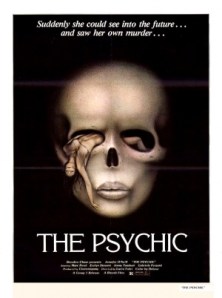
This is the (very) American trailer for Lucio Fulci’s Murder To The Tune of Seven Black Notes. This film is actually one of Fulci’s more subtle and interesting films and, considering that it’s a Fulci film without zombies or a huge amount of gore — it has a surprisingly large number of fans (including Quentin Tarantino). At the time of its release, however, it failed at the box office and so hurt Fulci’s reputation that the producers of Zombi 2 were able to hire him cheap whereas previously, they wouldn’t have been able to afford him. Hence, it can be argued that the success of Zombi 2 was directly the result of the failure of The Psychic. (That’s what we call the circle of life.)
Sometimes, believe it or not, I feel very insecure when I come on here to talk about movies because, unlike most of my fellow writers and the site’s readers, I’m actually pretty new to the world of pop culture and cult films. Up until 8 years ago, ballet was my only obsession. It was only after I lost that dream that I came to realize that I could feel that same passion for other subjects like history and writing and movies. In those 8 years, I think I’ve done a fairly good job educating myself but there’s still quite a bit that I don’t know and, at times, I’m almost overwhelmed by all the movies that I’ve read so much about but have yet to actually see. And don’t even get me started on anime because, honestly, my ignorance would simply astound you. What I know about anime — beyond Hello Kitty — is pretty much limited to what I’ve read and seen on this site. (I do know what a yandere is, however. Mostly because Arleigh explained it to me on twitter. I still don’t quite understand why my friend Mori kept using that as her own personal nickname for me back during my sophomore year of college but that’s a whole other story…)
The reason I started soul searching here is because I’m about to review a book — The Eurospy Guide by Matt Blake and David Deal — that came out in 2004 and I’m about to review it as if it came out yesterday. For all I know, everyone reading this already has a copy of The Eurospy Guide in their personal collection. You’ve probably already spent 6 years thumbing through this book and reading informative, lively reviews of obscure movies. You may already know what I’ve just discovered. Well, so be it. My education is a work in progress and The Eurospy Guide has become one of my favorite textbooks.
The Eurospy Guide is an overview of a unique genre of films that started in the mid-60s and ended with the decade. These were low-budget rip-offs — the majority of which were made in Italy, Germany, and France — of the Sean Connery-era James Bond films. These were films with titles like Code Name: Jaguar, Secret Agent Super Dragon, More Deadly Than The Male, and Death In a Red Jaguar. For the most part, they starred actors like George Nader, Richard Harrison, and Eddie Constantine who had found the stardom in exploitation cinema that the mainstream had never been willing to give to them. They featured beautiful and underappreciated actresses like Marilu Tolo and Erika Blac and exotic, over-the-top villainy from the likes of Klaus Kinski and Adolfo Celi. Many of these films — especially the Italian ones — were directed by the same men who would later make a name for themselves during the cannibal and zombie boom of the early 80s. Jess Franco did a few (but what genre hasn’t Jess Franco experimented with) and even Lucio Fulci dabbled in the genre. Their stories were frequently incoherent and, just as frequently, that brought them an undeniably surreal charm.
And then again, some of them were just films like Operation Kid Brother, starring Sean Connery’s younger brother, Neil. (Operation Kid Brother was an Italian film, naturally.)
Well, all of the films — from the good to the bad (and no, I’m not going to add the ugly) — are covered and thoroughly reviewed in The Eurospy Guide. Blake and Deal obviously not only love these films but they prove themselves to be grindhouse aficionados after my own heart. Regardless of whether they’re reviewing the sublime or the ludicrous, they approach each film with the same enthusiasm for the potential of pure cinema run amuck. It’s rare to find reviewers who are willing to pay the same respect to a film like The Devil’s Man that they would give to a sanctioned classic like The Deadly Affair.
Along with reviewing a countless number of films, Deal and Blake also include two great appendices in which they detail the review some of the film franchises that came out of the genre and provide biographies of some of the more prominent stars of the eurospy films.
The highest compliment I can pay to The Eurospy Guide is that, even with all the various films guides I own (and I own a lot), I found films reviewed and considered in this book that I haven’t found anywhere else. Everytime I open this book, I learn something that, at least to me, is new. The book was an obvious labor of love for Blake and Deal and I love the results of their labor.
Hi there! Welcome to the first edition of Lisa Marie’s Favorite Grindhouse and Exploitation Trailers for 2011. All 6 of our trailers in this edition are Italian. And, as always, most of them should be watched with caution and definitely not watched at work. (Also, I wouldn’t be surprised if Youtube yanked one or two of them offline within a week or so. So, watch while you can.)
This is actually one of Umberto Lenzi’s not that terrible movies. Which doesn’t mean it’s good. Just means that it’s not that terrible. This is the movie in which Lenzi manages to turn the Jonestown Massacre into a cannibal film. Ivan Rassimov, who looks like a Russian Charlton Heston, plays Jim Jones. Also, you might recognize the music because it ended up being used in about a 100 different Italian exploitation trailers.
One of the most misleading titles of all time as Warhol had very little to do with this film beyond lending Paul Morrissey and Joe Dallesandro. This is better known as Flesh For Frankenstien. The trailer really doesn’t do justice to the movie but I had to include it because, even if it’s not my favorite trailer, it’s a classic exploitation trailer in just the shameless way that Andy Warhol’s name is used to sell the film.
Believe it or not, this movie is actually a lot of fun. One of the stars is apparently a gay porn star but I’ve never been able to figure out who he’s playing in the film.
I had to finish out this all-Italian edition with a little Lucio Fulci. And I had to go with Murderock because it features a lot of dancing. The trailer is also memorable for revealing the identity of the killer.
So, I’m currently still working on my review of Black Swan, which I saw this weekend and loved so much that I ended up having an asthma attack at the end of it. But anyway, as we wait for me to discover articulation, why not check out 6 more of my favorite grindhouse and exploitation film trailers?
Now, this is an interesting debut film from the prolific Canadian director Bob Clark (the man who later gave the world both Black Christmas and A Christmas Story). A young soldier is killed in Viet Nam and shows up back in his hometown one night later without a soul. The allegory is pretty obvious but it’s still effectively done and crawls under your skin. This film was also one of Tom Savini’s early films. The soldier’s father is played by John Marley who later appeared in The Godfather with a horse’s head in his bed.
Director Lucio Fulci made this film around the same time he was making his more famous zombie films but it never got the same attention, despite starring David Warbeck. I love the cat — he’s so cute and he reminds me of my own cat. Plus, he’s quite effective at killing people.
Apparently, this is a nunsploitation film from Japan! That nunsploitation was a very popular genre in Italy, Spain, and Ireland makes sense when you consider that those are three of the most Catholic countries on the planet. But Japan?
The trailer for the 1971 Italian lesbian vampire film goes on for a bit too long but I think it has nice atmospheric feel to it (the same can be said of the film itself).
Since we started with a zombie film, let’s end with one as well. The Dead Pit is pretty silly but I enjoyed it and would happily star in a remake. Plus, the trailer’s line about “the thickness of the door” just amuses me on so many levels.
Here’s the latest edition of Lisa Marie’s Favorite Grindhouse and Exploitation Trailers. (I know, I know — worst intro paragraph evuh! Following the tradition of the Pieces trailer, which can be found below, I’m keeping things simple. I’ll be back to my usual complicated self next week.)
Believe it or not, this was directed by Abel Ferrara, the same man who directed Ms. 45. Fear City is one of the few Ferrara films that I haven’t seen but the trailer just oozes sleaze doesn’t it? And speaking of sleaze, maybe that’s what all the men in this film were putting in their hair. Seriously, why not call it Gel City? And how about Billy Dee Williams there, sounding like the angel of the final judgment? Shut up, Billy Dee Williams!
This is one of Lucio Fulci’s final films and you’re either going to love it or you’re going to hate it. The film is surprisingly meta for an Italian horror film not directed by Michele Soavi. This is the one where Fulci plays himself and attempts to personally answer his critics. Anyway, the reason I love this trailer is because of the cat puppet that appears at the end. It’s so cute! (Ignore the quote from Clive Barker — he’s almost as much of a whore as Stephen King.)
I imagine this is another film that’s “exactly what you think it is.” I love trailers that show off what was considered to be chic and decadent in the past. This is one is from the 70s. (Surprised?)
While the rich people were partying in London, cannibals were apparently ruling the streets of Atlanta. According to actor John Saxon, starring in Cannibal Apocalypse made him suicidal. Cannibal Apocalypse is actually a pretty good film with an anti-war subtext and it features a great supporting performance from Giovanni Lombardo Radice so seriously — shut up, John Saxon! (Actually, Saxon gives a really great performance here — of course, his character is meant to be suicidal — and he’s the main reason that Cannibal Apocalypse works.)
Much like Cannibal Apocalypse, Cannibal Man is actually an allegory of alienation that’s disguised as a horror movie. Cannibal Man is a seriously strange movie and highly recommended.
As I’m sure I’ve mentioned before, I’ve always loved to dance. Before I embraced the movies, my life was about dancing. I was going to be Prima Ballerina and my mom paid for several years of ballet class to help me reach that goal. I obsessed on it the way that I obsess, today, on Lucio Fulci and Jean Rollin. However, my brilliant career was cut short by two things — 1) I’m about as graceful as a Clydesdale and 2) I ended up tumbling down a flight of stairs when I was 17 and essentially shattering my ankle. Actually, I guess those two things might be connected. Anyway, I can’t complain because giving up my affected love of ballet allowed me to discover my very true love of film. I was never really a great dancer (though I was, and am, very enthusiastic) but I’m very good at watching movies.
However, I still love to dance and I still love movies — even mainstream movies — that feature dancing. That’s why I’m so looking forward to seeing Black Swan next month. Until then, here’s 6 of my favorite dance scenes from the movies.
Let’s start off with one of my favorite “dance” scenes of all time, my man Giovanni Lombardo Radice and Lorraine De Selle breaking it down in Ruggero Deodato’s The House On The Edge of the Park. The man in yellow is David Hess.
If anyone’s ever wondered why I was crushing on Joseph Gordon-Levitt in Inception (as opposed to Tom Hardy, Cillian Murphy, or Leonardo DiCaprio), it was largely because of this scene from (500) Days Of Summer.
Murder Rock is kinda sorta like my own personal Holy Grail — it’s a grindhouse dance movie directed by Lucio Fulci! Plus, it costars Christian Borremeo, who co-starred in The House on the Edge Of The Park and Dario Argento’s Tenebrae.
Okay, so I think Nine was definitely the worst the movie of 2009. Yes, even worse than Avatar. However, I love this scene and I love the song featured in it, Cinema Italiano. Yes, technically, it’s a really terrible song that displays an astounding ignorance of Italian cinema. If anything, the lyrics appear to be describing the French New Wave. True, the song do make reference to “neo-realism” but you get the feeling no one involved with Nine ever saw Open City or The Bicycle Thief. But the thing is do damn catchy that I still find myself singing it in the shower. Like me, Kate Hudson is obviously not much of a singer or a dancer but she’s very enthusiastic.
An Unmarried Woman was apparently very groundbreaking in 1978. Seen now, it seems like a better title for it would be An Unmarried Woman Who Can Still Afford A Penthouse Apartment In New York City. Still, the late, great Jill Clayburgh’s performance holds up well and I like the film if just because it’s still one of the few movies out there that’s willing to acknowledge that an unmarried woman can still be a sensual, happy woman. The scene below captures perfectly the exhilarating joy of just surrendering to the music and dancing. Plus, for me, this is one of those “Hey, I do that too!” scenes. In fact, my ankle is still hurting as a result of rewatching this film last Friday.
This week, I’m highlighting trailers from the year 1981. 1981 not only saw the release of Lucio Fulci’s twin classics The Beyond and The House By The Cemetary, it was also the year that my sister Melissa was born. (Happy birthday, Melissa Anne!)
You may notice that, despite citing them above, I did not include the trailer for either one of Fulci’s films in this post. I’m saving them for a future edition. Instead, let’s start with Alien Contamination and end with Christiane F. and see what waits in the middle.
I haven’t seen this film but I’ve read several favorable reviews of it. While the trailer isn’t nearly as graphic as some of the other trailers that I’ve featured in this series, I still like it. With the ominous narrator and all, it has a nice retro feel to it.
I recently ordered this Italian film off of Amazon but I have yet to sit down and watch it. The trailer, for me, is memorable just because it’s a chance to see both Harvey Keitel and Johnny Rotten (who were both quite the sexy beast back in 1981) occupying the same space.
Some people, I know, would disagree with me referring to Christiane F. as being an exploitation film. I’m sure that the film’s award-winning director — Uli Edel — would disagree with me. However, Europe’s art films were often sold as America’s grindhouse movies and, just from anecdotal evidence, that was often the case with Christiane F. Besides, I love this trailer if just for the music alone.
1) Graveyard Shift — This is a Canadian film from 1986. Ever since I first saw it on DVD last year, this has been one of my favorite vampire films. It’s an atmospheric, strangely well-acted film that is just trashy enough to remain interesting.
2) Panorama Blue — I’ve never seen this movie and apparently, it’s a lost film of some sort. The trailer can be found on one of the 42nd Street Forever compilation DVDs. Apparently, this is some sort of pornographic epic. I just enjoy the trailer even though I wouldn’t be caught dead on a roller coaster. (They’re scary!)
3) Zombi 3 — This film is credited to Lucio Fulci but he actually only directed about 60% of it before he was fired and replaced by Bruno Mattei. This trailer deserves some sort of award because it manages to make an amazingly boring film look exciting and almost fun.
4) Rolling Thunder — Another film that I’ve never seen (and another trailer that I first found on a 42nd Street compilation). This is an effectively moody trailer. As a Texan, I also like the fact that Rolling Thunder apparently not only takes place in Texas but was also actually shot there with actual Texans in the cast. And I love the ominous yet casual way that Tommy Lee Jones delivers the “I’ll get my gear,” line.
5) Angel — This is a trailer from the early 80s. This is another one of those trailers that I love because it’s just so shamelessly sordid and trashy.
6) Hitch-Hike — Okay, quick warning — this trailer is explicit. Not as explicit as many grindhouse trailers but it’s still explicit enough that some people might find it objectionable. It’s certainly not safe for work though why are you visiting this site from work anyway?
However, all that taken into account, it’s still a very good trailer for a very good movie, 1977’s Hitch-Hike. Not only is it a nicely cynical little thriller, but it features not only another iconic psycho performance from David Hess but also a brilliant lead performance from Franco Nero. I will also admit right now that if I ever got my hands on a time machine, the first thing I would do would be go back to 1977 and give Franco Nero a hummer. Seriously.
Okay, I’ve said too much. Just watch the trailer and enjoy one of Ennio Morricone’s best scores.


 Through the Shattered Lens