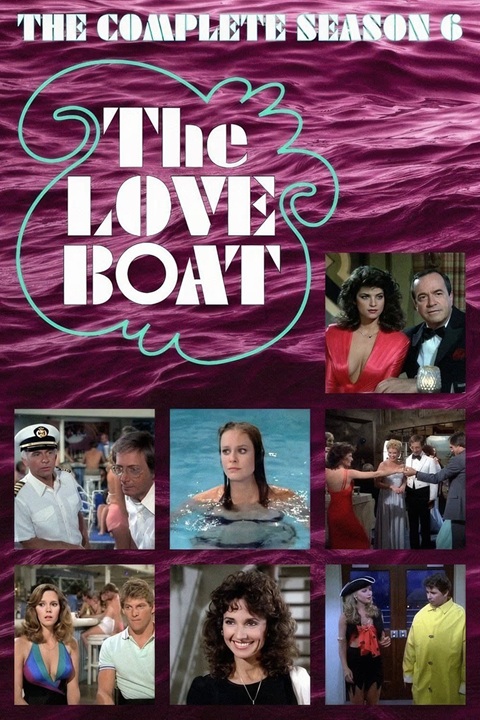
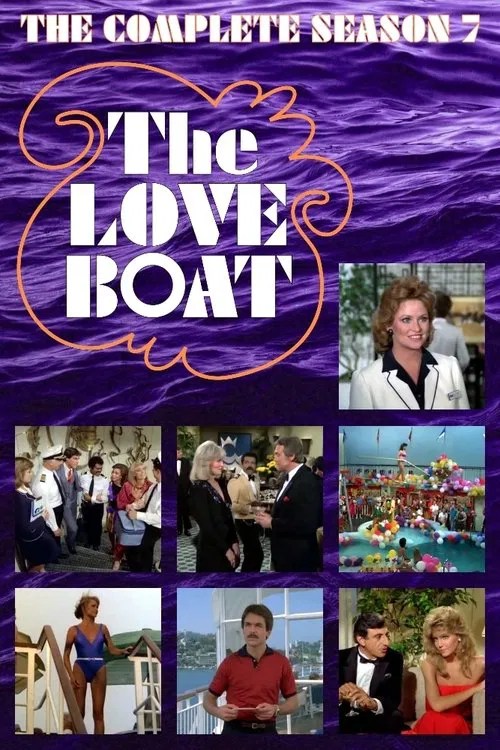
Retro Television Review: The Love Boat 6.7 and 6.8 “The Spoonmaker Diamond/Papa Doc/The Role Model/Julie’s Tycoon”


Welcome to Retro Television Reviews, a feature where we review some of our favorite and least favorite shows of the past!  On Wednesdays, I will be reviewing the original Love Boat, which aired on ABC from 1977 to 1986!  The series can be streamed on Paramount Plus!
Come aboard, we’re expecting you….

Episodes 6.7 and 6.8 “The Spoonmaker Diamond/Papa Doc/The Role Model/Julie’s Tycoon”

(Dir by Robert Scheerer, originally aired on November 13th, 1982)

The Love Boat is going to Greece and Turkey!

Well, actually, it’s the Love Boat crew that is going to Greece and Turkey.  They’ve been asked to temporarily take over another ship and, of course, Captain Stubing said yes.  This is one of those two-hour Love Boat episodes where the action was actually shot on location and on a real cruise ship.  As such, it’s more of a travelogue that anything.  We get to see the sights of both Greece and Turkey and no one makes any jokes about Midnight Express.

The majority of the storylines revolve around the Spoonmaker Diamond, a very valuable diamond that has been stolen by someone on the ship.  Was the diamond stolen by Emmett and Ellen Stokes (Harvey Korman and Nancy Dussault)?  Was the diamond stolen by Mark Hayward (Mike Connors)?  That’s what Inspector Sadu (Jamie Farr) is trying to figure out!  Of course, regardless of who stole it, it ultimately ends up in the unknowing possession of travel agent Dana Pierce (Polly Bergen).  Will Mark steal the diamond or will he fall in love with Dana?  Why can’t he do both?  This was an odd story because you had the goofiness of Harvey Korman and Jamie Farr and then you had the grouchy intensity of Mike Connors.  Connors seemed to be under the impression that he was appearing on a hard-boiled crime show as opposed to an enjoyably silly comedy about a cruise ship.

Meanwhile, Sabrina Drake (Jan Smithers) is a young heiress who is traveling with her mother, Amanda (Alexis Smith).  Amanda is not happy when she sees that tabloid reporter Joe Novak (Kiel Martin) is also on the cruise.  She’ll probably be even less happy when she discovers that Amanda is 1) secretly seeing Joe and 2) is pregnant.  When Doc finds out that Sabrina is pregnant, he offers to marry her.  Why not?  He’s known her for two days and he’s in love.  Fortunately, Joe talks to Amanda and wins Amanda’s blessing for his relationship with Sabrina.  Doc remains single.

Speaking of marriage, Greek tycoon Gregori Pananopolis (Lorenzo Lamas) asks Julie to marry him.  Julie is stunned and says she needs some time to think it over.  She tells Captain Stubing that she’s not sure if she’s ready to get married.  Uhmm …. Julie, this like the third or fourth guy who had asked you to marry him on this show.  You’ve nearly gotten married twice.  It’s odd how the show always acts as if marriage proposals aren’t a recurring theme when it comes to Julie.  Fortunately, Julie stays single because we all know she’s destined to eventually marry Doc.  Or Gopher, maybe.

Fashion photographer Cliff Jacobs (David Hedison) runs into his ex-wife, model Monica Brandon (Linda Evans).  He lies about having landed a job with a magazine in order to get her to pose for him.  He also takes some pictures of Vicki posing amongst the ruins of Greece.  Later, a magazine contacts him and offers to make Vicki into a star but he and Monica decide not to tell Vicki because they don’t want her to have to deal with pressure of being a model.  Hey Cliff and Monica, that’s really not your decision to make.  I’m sure being a model would be no less detrimental to Vicki than spending her entire youth on a cruise ship with people who are several decades older than her.

As I said at the start of the review, this episode worked best as a travelogue.  None of the stories were particularly intriguing but the scenery was lovely.  Even Turkey looked like a nice place to visit!

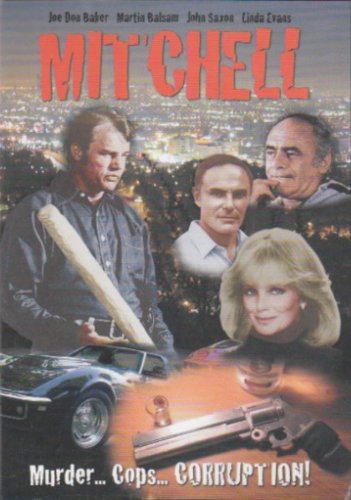
The TSL Grindhouse: Mitchell (dir by Andrew V. McLaglen)


I come here to defend Mitchell.

First released in 1975, Mitchell does not have a great reputation.  It’s often described as being one of the worst of the 70s cop films and Joe Don Baker’s performance in the lead role is often held up to ridicule.  A lot of that is due to the fact that Mitchell was featured on an episode of Mystery Science Theatre 3000.  Last year, for my birthday, my friend Pat McCurry actually hosted a showing of the MST 3K version of Mitchell.  I laughed all the way through it.  It was a funny show and most of the jokes uttered by Joel and the Bots landed.  That said, I wish they hadn’t been so hard on Joe Don Baker.  Baker was an outstanding character actor, one whose good ol’ boy persona sometimes kept people from realizing just how fiercely talented he actually was.

Here’s the thing with Mitchell.  Just because a film is snarkable, that doesn’t mean that it’s a bad film.  Just because there are moments in a film that inspire you to talk back to the screen, that doesn’t make it a bad film.  Some of the most enjoyable films that I’ve ever watched were enjoyable specifically because they were made to inspire the audience to talk back to the characters.  Whatever flaws you may want to find in Mitchell, it’s an entertaining film.  The plot may be impossible to follow but who cares?  When you’ve got Joe Don Baker, John Saxon, and Martin Balsam all in the same film, does the plot really matter?

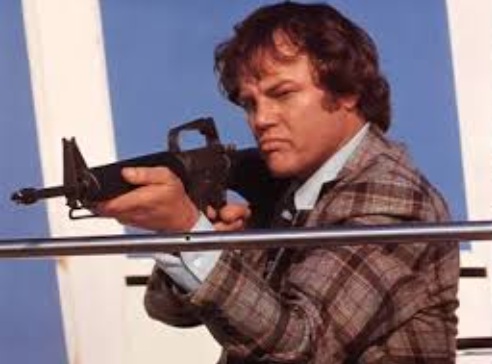
This is a film that you watch for the personalities involved.  Balsam plays a wannabe drug lord who always seems to be somewhat annoyed.  Someone once describes Bernie Sanders as always coming across as if he was about send his meal back to the kitchen because it was too cold and that’s a perfect description of Balsam’s performance in Mitchell.  John Saxon plays a sleazy rich guy who murders a burglar and then tries to cover up his crime.  Saxon is calm, cool, collected, and completely confident that his wealth will get him out of anything.  And then you’ve got Joe Don Baker as Mitchell, wearing an ugly plaid suit, drinking beer the way that I drink Diet Coke, and continually pretending to be dumber than he actually is.  There’s an interesting subtext to these three characters and how they interact.  Saxon and Balsam play criminals who are both rich and who both think they can get away with anything because they’ve got money.  Mitchell is a complete and total slob, a guy with a cheap apartment, a cheap suit, and absolutely no refinement at all.  Mitchell uses his good old boy persona to get the bad guys to continually underestimate him.  He ultimately turns out to be smarter and actually more ruthless than any of them.

Joe Don Baker throws himself into the role of Mitchell and there’ actually a lot of intentional humor to be found in his performance.  Baker doesn’t play Mitchell as being a supercop.  Instead, he plays Mitchell as being a blue collar guy who gets absolutely no respect.  Even when he’s on a stakeout, a random kid starts arguing with him.  (Mitchell loses the argument.)  Mitchell’s a jerk who busts his hooker girlfriend (Linda Evans) for having weed on her but he’s also the only one who could stop Balsam from doing whatever it is that Balsam thinks he’s trying to do.  (Again, don’t spend too much time trying to understand the plot.)  Mitchell’s super power is that he’s a slob who doesn’t give up.  To paraphrase Road House‘s Dalton, he plays dumb until it’s time not to be dumb.

As I said, it’s an entertaining film.  Where else are you going to see a not particularly high-speed chase between two station wagons?  Where else are you going to see John Saxon in a dune buggy or Joe Don Baker in a helicopter or Martin Balsam as the captain of a yacht?  Where else are you going to see a film that features its hero saying, “Yep, that’s grass,” before arresting his lover?  Mitchell is fun and entertaining and I’ll always defend both the movie and its star.

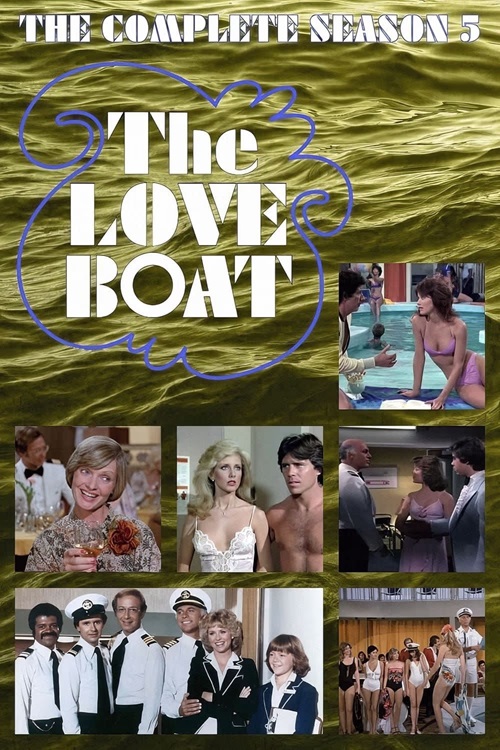
Retro Television Review: The Love Boat 5.8 and 5.9 “Farnsworth’s Fling/Three in a Bed/I Remember Helen/Merrill, Melanie & Melanesia/Gopher Farnsworth Smith”


Welcome to Retro Television Reviews, a feature where we review some of our favorite and least favorite shows of the past!  On Wednesdays, I will be reviewing the original Love Boat, which aired on ABC from 1977 to 1986!  The series can be streamed on Paramount Plus!

This week, we have a two-hour special!

Episodes 5.8 and 5.9 “Farnsworth’s Fling/Three in a Bed/I Remember Helen/Merrill, Melanie & Melanesia/Gopher Farnsworth Smith”

(Dir by Richard Kinon, originally aired on November 21st, 1981)

The Love Boat crew is back in Australia, sailing from Sydney to Fiji and back again.  The Captain remembers his time in the Navy and a lost love who he met while serving in the South Pacific.  Julie remembers her love affair with Tony and how he left her at the altar after he discovered that he was dying.  Anthony Andrews, who played Tony, is listed as being a guest star on this episode but he only appears in archival footage.  Tony, we learn, has died but his brother, David (Brendon Lunney), assures Julie that her letters to him provided him with much comfort during his final days.

(David only appears for a minute or two, when Julie visits the animal preserve where Tony worked.  Still, in that minute, he and Julie have so much chemistry that I found myself hoping that David would spontaneously propose to her.)

As for the cruise, the majority of the cabins are populated by the relatives of William Otis Farnsworth (Lloyd Bridges).  Farnsworth is one of the richest men in the world and he’s taking a cruise with his entire family because he wants to see who is truly worthy of inheriting his fortune.  The ship is full of people looking to get rich, including:

  1. Jenny (Moran Fairchild) and Bud Boyer (Grant Goodeve), who are hoping that William will not discover that they’ve recently gotten divorced,
  2. Hazel (Patti MacLeod) and Frank Fransworth (Russell Newman), who hope that Hazel imitating William’s deceased wife will cause William to mention them favorably in his will,
  3. Marcia (Jessica Walter), who was married to William’s brother and who has basically hired gold digger Jessica Halberson (Linda Evans) to seduce and marry William, and
  4. Burl “Gopher” Smith, who thinks that he might be distantly related to William and who, with Isaac’s encouragement, tries to get close to William.  Gopher even calls his mother (Ethel Merman) to find out if he’s a relative.  She’s not much help.

Not interested in the money is William’s niece, Eloise (Beth Howland).  Eloise, who is William’s administrative assistant, finds herself falling in love with William’s valet, country boy Wayne Burton (Jim Nabors).  Words cannot begin to express just how annoying Jim Nabors is in this episode.  “Surprise surprise surpise!” Wayne says when he shows up on the boat.  “Golly!” Wayne says when a conscience-stricken Jessica tries to break up with William.  I found myself covering my ears whenever Nabors appeared on screen.

The main problem here is that none of these people are remotely likable.  Not even William Farnsworth is likable.  He’s meant to be likable but really, he comes across as being a judgmental jerk.  When Jessica tries to leave the ship and fly back to Sidney, William reacts by buying every single plane ticket on the island.  Jessica can’t leave but hey …. neither can anyone else!

Far more likable was Melanie (Margaret Laurence), the daughter of the Captain’s former lover, Madeleine.  Melanie is a dead-ringer for her mother and the Captain falls in love with her.  Melanie also falls in love with him.  She proposes marriage.  Awwww!  But then she realizes marrying the Captain would mean abandoning her job as a teacher so she calls the wedding off.  So now, both the Captain and Julie have had their heart broken in Australia.  At least they now have something to bond over.

For a two-hour episode, there really wasn’t much plot to this episode.  It was largely a travelogue.  There were a lot of kangaroos and koala bears and they were certainly cute.  The scenery was lovely.  Otherwise, this was a cruise full of rather unlikable people.  Australia deserved better.

Film Review: Swan Song (dir by Todd Stephens)


Once upon a time, Pat Pitsenbarger (Udo Kier) was one of the most important citizens of Sandusky, Ohio.  He was the town’s leading hairdresser.  He was the man who the wealthy trusted with their appearance.  When he wasn’t cutting hair, he performed drag as Ms. Pat and when he wasn’t cutting or performing, he built a nice home with his partner.  He often remembers the two of them working in the garden.

All of that is in the past, though.  Pat’s partner died years ago and Pat was reminded of his place in the community when some of his wealthiest clients didn’t even bother to come to the funeral.  Pat lost his business.  He lost his home.  He’s spent the past decade or so living in a nursing home.  Pat may be the best-groomed and best-spoken resident of the nursing home but he’s still definitely a man who is waiting for death.

One day, a lawyer shows up at the home and informs Pat that one of his most faithful clients, Rita Parker Sloan (played by Linda Evans), has died.  Rita had one last request.  She wanted Pat to do her hair and makeup for the funeral.  At first, Pat is hesitant.  His memories of Rita are not particularly pleasant.  But finally, he decides to do it.  He escapes from the nursing home and starts to walk to the funeral home.  To do Rita’s makeup, he’s going to need supplies, some of which haven’t even been existed since the 80s.  Unfortunately, he has no money and, as he soon discovers, his old home no longer exists either.  The world has changed.

As quickly becomes clear, there’s more to Pat’s journey than just wanting a final chance to do Rita’s hair.  As he walks through the town, he tries to reconnect with his past, just to discover that much of his past has been torn down.  His old beauty shop is under different management.  His old house has been torn down.  Few people seem to remember or recognize him.  One of the few people who does remember Pat is his former protégé, Dee Dee (Jennifer Coolidge), who now basically hates his guts.  Meanwhile, Rita waits in the funeral home, her hair and makeup a mess.

Released last year, Swan Song is an imperfect but ultimately touching movie.  The shadow of death hangs over almost every scene.  It’s not just that Pat is doing one last favor for the deceased Rita.  Nor is it just that Pat is haunted by memories of his dead partner.  (The scene where Pat visits his grave is one of the most effective in the movie, thanks to Kier’s heartfelt performance.)  It’s the fact that Pat himself knows that he’s getting older and he only has a certain amount of time left.  His walk across Sandusky is not just about traveling to the funeral home.  It’s also his final chance to see the world, remember the past, and experience how things have changed (or not changed as the case may be).  The journey is about Pat coming to terms with his anger, his sadness, and his past.  It’s also about Pat’s desire to go out the same way that he’s always lived, on his own terms.

As I said, it’s not a perfect film.  There are a few scenes that threaten to get a bit mawkish.  But even the most overwritten scenes are saved by the brilliant lead performance of Udo Kier, who gives a wonderfully complex performance as Pat.  Since the 70s, Kier has been a mainstay in European exploitation cinema.  He stared in Flesh For Frankenstein and Blood For Dracula.  He had key supporting roles in two Dario Argento films.  He appeared in art films, horror films, dramas, comedies, and thrillers.  He’s appeared in blockbusters and small indie films.  At times, it can seem like Kier is one of those actors who basically accepts anything that’s offered to him, regardless of whether the material is worthy of his talents or not.  Kier has appeared in good films and bad and, perhaps because he’s been such a ubiquitous cinematic presence, he’s often been unfairly taken for granted as an actor.  In Swan Song, Udo Kier gives one of his best performances as the sometimes brutally snarky but ultimately kind-hearted Pat Pitsenbarger.  If for no other reason, watch this movie to appreciate the often underrated talent of Udo Kier.  A lesser actor would have turned Pat into a cliché.  Udo Kier transforms Pat into a complex and rather heart-breaking character.

Swan Song is currently streaming on Hulu.

Tom Horn (1980, directed by William Wiard)


Today would have been Steve McQueen’s 90th birthday.

Sadly, McQueen died in 1980 at the absurdly young age of 50.  In life, McQueen never got as much respect as he deserved as an actor but in death, he’s been rediscovered as not just an icon of cool but also as an underrated actor who, much like Clint Eastwood, could say a lot without uttering a word.  (Be sure to read Marshall Terrill’s biography of McQueen.)  When Steve McQueen (as played by Damian Lewis) showed up in Once Upon A Time In Hollywood, it seemed appropriate.  McQueen and Tarantino both seem made for each other, even if McQueen died long before Tarantino even wrote his first screenplay.

McQueen made two films shortly before he died, The Hunter and Tom Horn. Unfortunately, neither one of them was a hit with audiences or critics.  The Hunter, which was McQueen’s last film, is a forgettable movie that features McQueen as a bounty hunter who can’t drive.  Tom Horn, however, was an underrated western that features one of McQueen’s best performances.

In Tom Horn, McQueen plays the title character, a legendary frontier scout who is known for the role he played in the capture of Geronimo.  When the film opens, Tom Horn has seen better days.  With the frontier changing and the old west being replaced by the modern age, Horn has been reduced to being almost a vagrant, wandering from town to town in search of work.  When the film begins, Horn has found employment as a “stock detective.”  He’s employed by the local cattlemen to keep rustlers from stealing their stock.  Horn uses the same violent methods that he’s always used, gunning down rustlers and often doing so in public.  What Horn doesn’t realize is that times have changed and the methods that previously made him a legend are now making him a pariah.  When the cattlemen realize that the townspeople are turning against them because of Horn’s activities, they conspire to take out Horn themselves.

Tom Horn is based on a true story.  In 1903, Tom Horn was hung for shooting a 15 year-old boy.  While it is agreed that Horn killed many men over the course of his life, he was undoubtedly framed for the murder for which he was executed.  While sitting in his jail cell, waiting to be executed, Horn wrote the autobiography upon which this movie is based.  The movie makes the argument that Horn was executed because he was a reminder of what the West used to be like.  In order to prove that they were now ready to be members of civilized society, the cattleman had to sacrifice Horn in the most public way possible.

The film does a good job of capturing the final days of the old west and Steve McQueen does an even better job of playing a man who doesn’t realize that his time has come to a close.  Horn often seems to be the only man who doesn’t understand that the time of outlaws and the gunslingers is coming to a close and that leaves him defenseless when he’s put on trial.  Even after found guilty, Horn remains confident that he will somehow escape the hangman’s noose.  Tragically, it’s not until time is up that Horn truly comes to understand that the world has changed and civilization no longer has place for men like him.  The same people who used to depend on men like Tom Horn now just want to forget that he ever existed.  McQueen took a long break between making The Towering Inferno and Tom Horn and dropped out of the public eye.  The only film he made during that period was a barely released version of Enemy of the People.  When McQueen made Tom Horn, he was also a man out of time and he brings a sense of resignation and loss to the role that he might not have been capable of doing earlier in his career.

Sadly, it was while filming Tom Horn that McQueen first started to show symptoms of the cancer that would eventually kill him.  Tom Horn was released in 1980 and never got the attention that it deserved.  It’s a minor western classic and features Steve McQueen at his best.


Mitchell (1976, directed by Andrew V. McLaglen)


Mitchell (played by Joe Don Baker and don’t you forget it) is a detective who rubs everyone the wrong way because he’s a huge slob.  In order to keep Mitchell from investigating a murder committed by a mobbed-up lawyer named Walter Deaney (John Saxon), Mitchell’s superiors order him to conduct surveillance on businessman James Arthur Cummings (Martin Balsam).  Cummings is in the export/import game, which can only mean that he’s looking to smuggle heroin in the United States.  Mitchell balks at having to spend hours sitting in a car and watching a house but he finally agree to do it just so he can show up his superiors.  “I’m going to get Deaney and Cummings!” he says.

In order to get Mitchell off of his back, Deaney sends him a prostitute named Greta (Linda Evans).  Mitchell doesn’t have any problem having sex with Greta but he does have a problem with her smoking grass.  After spending two nights with her, he hauls her off to jail for possession because the only intoxicant that Mitchell needs is Schlitz beer.

Eventually, both Deaney and Cummings get tired to being harrassed by this slob so they team up to kill him.  This leads to both a dune buggy accident that has to be seen to be believed and an exciting helicopter chase.

Mitchell is best-known for having been featured on an episode of Mystery Science Theater 3000.  Everyone remembers Joel and the bots making savage fun of Joe Don Baker and commenting on the plot’s incoherence.  What is less well-known is that the version that was shown on MST 3K was a heavily edited version that was missing some key scenes.  Earlier today, I watched the unedited version of Mitchell.  It’s still pretty bad but the plot does make slightly more sense.  In the unedited version, we actually learn why John Saxon just vanishes from the movie and we also see the end result of Mitchell’s final confrontation with Cummings, instead of just cutting away.  Even more importantly, in the unedited version, we discover that Mitchell spends the entire movie being threatened, abused, and insulted.  It makes it easier to understand why he’s in such a terrible mood throughout the entire film.  The unedited version of Mitchell is not much better than the edited version but it is a tougher and more violent film in every way.

Mitchell is usually described as being a take on Dirty Harry but it’s actually more of a French Connection rip-off.  The slovenly Mitchell has more in common with the erratic Popeye Doyle than with the cool and collected Harry Callahan.  Unfortunately, Mitchell doesn’t have any scenes that can compare to the chase scene from The French Connection nor does it have that film’s gritty, semi-documentary tone.  Whereas Doyle and Callahan got results through being smart along with being tough (Dirty Harry, for instance, goes out of its way to show that Callahan is dogged investigator and not just a trigger-happy cop), Mitchell just annoys people until they try to kill him.

For all the shit that Joe Don Baker has taken for starring in Mitchell, his performance is not that bad.  He’s convincing as a borderline fascist cop who doesn’t get much sleep and who doesn’t trust anyone.  It’s just that Mitchell, as written, is never a likable hero.  Instead, he’s the type of hero who busts his girlfriend because she has a tiny amount of grass in her purse.  Of the villains, John Saxon is believably sleazy as Deaney but Martin Balsam sleep walks through his role as Cummings and, even in the unedited version, his plan never makes much sense.  Balsam and Saxon should switched roles.

Finally, no review of Mitchell would be complete with including the lyrics of the haunting Mitchell theme song, sung by Hoyt Axton:

“My my my my Mitchell
What do your Mama say?
What would she do
if she knew you
were fallin’ round and carryin’ on that way…
Crackin’ some heads, jumpin’ in and out of beds
and hangin’ round the criminal scene…
Do you think you are some kind of a star like the guys on the movie screen…

Well oh my my my Mitchell
What would your captain say?
If he knew you was hangin’ round
Eatin’ with the crooks and shootin’ up the town
Know you been out there, roundin’ up the syndicate
succeedin’ where the others have failed
Oh my my my Mitchell
You shoot ’em just to get ’em in jail
When they take a look in the record book, they’ll find you got a lot of class…

The whole shebang, arrestin’ painted ladies for a little grass
Oh my my my Mitchell!”

“Mitchell!”

The cover of the unedited Mitchell DVD features Joe Don Baker from Walking Tall, Linda Evans from Dynasty, and a publicity still of John Saxon. Martin Balsam, however, does appear to have been taken from the film.

Fun in the Sun: BEACH BLANKET BINGO (AIP 1965)


gary loggins's avatarcracked rear viewer

You’d think by the fourth entry in American-International’s ‘Beach Party’ series, 1965’s BEACH BLANKET BINGO, the formula would be wearing a bit thin. Frankie and Annette are still trying to make each other jealous, Eric Von Zipper and his Rats are still comic menaces, and the gang’s into yet another new kick (skydiving this time around). But thanks to a top-notch supporting cast of characters, a sweet subplot involving a mermaid, and the genius of comedy legend Buster Keaton , BEACH BLANKET BINGO is loads of fun!

Aspiring singer Sugar Kane skydives from a plan into the middle of the ocean and is “rescued” by surfer Frankie. But not really… it’s all been a publicity stunt by her PR agent ‘Bullets’. Sugar is played by lovely Linda Evans, right before she landed on TV’s THE BIG VALLEY, and ‘Bullets’ is none other than the fantastically sarcastic Paul Lynde. But wait… Eric Von Zipper…

View original post 453 more words