Retro Television Review: Fantasy Island 6.13 “Midnight Waltz/Let Them Eat Cake”


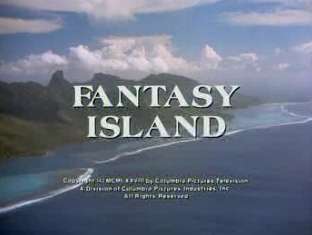
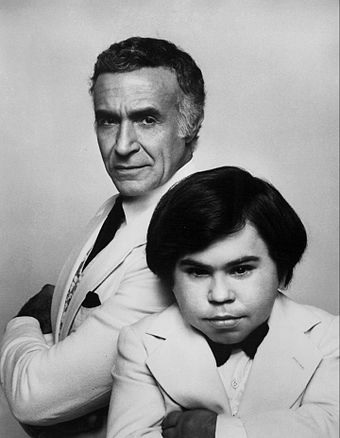
Welcome to Retro Television Reviews, a feature where we review some of our favorite and least favorite shows of the past!  On Tuesdays, I will be reviewing the original Fantasy Island, which ran on ABC from 1977 to 1984.  Unfortunately, the show has been removed from most streaming sites.  Fortunately, I’ve got nearly every episode on my DVR.

This week, Roarke is in the director’s chair!

Episode 6.13 “Midnight Waltz/Let Them Eat Cake”

(Dir by Ricardo Montalban, originally aired on February 12th, 1983)

Adele Anthony (Adrienne Barbeau) is a hard-working waitress whose fantasy is to be a queen for the weekend.  Mr. Roarke asks her if there’s a country that she would like to rule over.  Adele shrugs and says that she’s always liked France.  Mr. Roarke has her shoot an arrow and suddenly, Adele Anthony is …. MARIE ANTOINETTE!

Yes, the same Marie Antoinette who was beheaded during the French Revolution.

Like, seriously, Mr. Roarke ….. she couldn’t have been any other queen?  I’m not really sure why Mr. Roarke decided to do this to Adele, who is probably about a saintly a guest as has ever visited Fantasy Island.  Occasionally, Roarke will use the fantasies to teach someone a lesson but Adele really hasn’t done anything to justify being beheaded.

Fortunately, Adele isn’t beheaded.  It turns out that Marie Antoinette was saved from the guillotine by Francois (Patrick Wayne), a leader of the revolution who was shocked to discover that the Queen was not as heartless as he had been led to believe and that she had actually been framed by her husband, Louis (James Coco) and Louis’s mistress, Baroness La Rue (Cathryn Damon).  Indeed, all Marie Antoinette did was suggest that the cake that the royals were going to have for desert should be given to the citizens, along with a lot of other food.  Louis spread the story that Marie Antoinette had said, “Let them eat cake.”

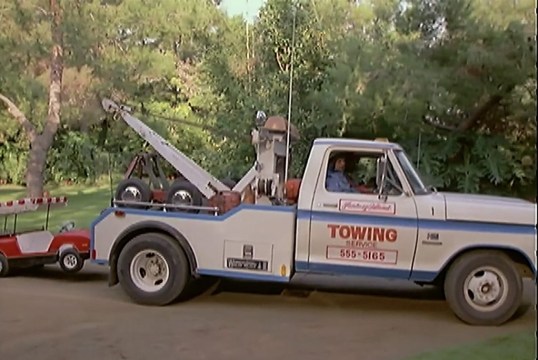
So, Marie Antoinette (and Adele) survives!  Meanwhile, Louis is dragged off to be beheaded.  Except, it turns out that Louis was just having a fantasy as well.  Louis is actually Mr. Willaker, who runs the Fantasy Island car towing service.  In lieu of paying him for his services, Roarke gave him a fantasy in which he was beheaded.  The episode ends with Willaker towing away Tattoo’s car.

Meanwhile, John Cook (Lew Ayres) is a widower who wants to have one last dance with his wife, Carol (played, in ghost form, by Rosemary DeCamp).  However, John meets and falls in love with Martha Wilson (Jane Wyatt) and instead dances with her.  Carol approves, saying that she doesn’t want John to spend the rest of his days in mourning.  It’s a pretty simple fantasy but you know what?  It still brought tears to my eyes and I still smiled at the end of it.  A lot of that is due to the Lew Ayres, one of the great actors of Golden Age Hollywood.  Ayres gives such a sincere and downright sweet performance that it’s impossible not to get swept up in his fantasy.

This was a good episode.  I’m still not sure that Adele needed to become Marie Antoinette but the last dance fantasy made up for a lot.  It was just so sweet!  This was the second (and last) episode of the series to be directed by Ricardo Montalban and he did a great job.

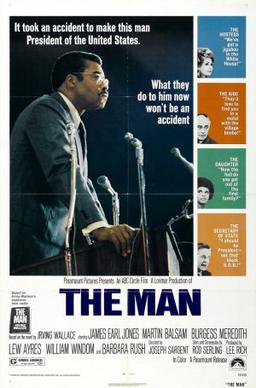
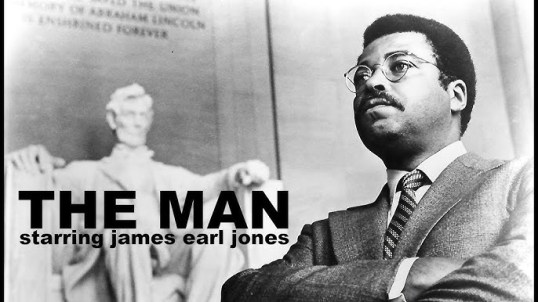
Starring James Earl Jones: The Man (dir by Joseph Sargent)


In 1972’s The Man, James Earl Jones stares as Douglass Dilman.

Dilman is a black college professor and a U.S. Senator.  To his friends, he’s a symbol of progress.  To his enemies, he’s a sell-out who is viewed as being improperly radical.  The U.S. Senate, eager to prove that it’s not a racist institution, has elected Dilman as the President Pro Tempore.  He is now fourth in line for the presidency but that doesn’t concern racist senators like Senator Watson (Burgess Meredith).  A lot would have to happen before Dilman would ever become President.

Needless to say, a lot does happen.

The President and the third-in-line Speaker of the House are attending a conference at a historic building in Frankfort when the roof collapses on them.  We don’t actually see this happen.  We just hear the people in the White House talk about how it’s happened.  We also don’t really learn many details about why the roof collapsed.  Someone nonchalantly says, “It’s an old building.”  Myself, I spent the entire movie waiting for some sort of big revelation of a conspiracy behind the roof collapse but it didn’t happen.  Apparently, in 1972, the Secret Service just let the President go anywhere without checking the place out first.  That said, it’s not a good thing when a serious movie opens with a dramatic plot development that, at the very least, draws a chuckle from the audience.  Seriously, we lost our President because a roof fell on him?  How is America ever going to live that down>

Vice President Noah Calvin (Lew Ayres) is wheeled into the White House cabinet room.  This was not the first time that a Ayres played a Vice President called upon to succeed the President.  Unlike in Advice and Consent, the Vice President announced that he cannot accept the honor of being sworn in because he’s too sick.  (Since when does the Vice President have the option to refuse to do his Constitutional duty?)  With Calvin putting the country ahead of his own ambition, Senator Watson announces that Secretary of State Eaton (William Windom) will be the new President.  No, Eaton says, Dilman will be the new president.  But once Dilman screws up and is either impeached or resigns, fifth-in-line Eaton will be sworn in.

Except …. it wouldn’t work that way.  Excuse me while I put my history/political nerd hat on….

First off, Calvin is apparently still Vice President so if Dilman did step down, Calvin would once again be the successor.  What if Calvin refused a second time?  As soon as the Speaker of the House died, the House of Representatives would elect a new Speaker and that person would be third-in-line.  And, as soon as Dilman became President, the Senate would elect a new President Pro Tempore and that person would be fourth-in-line.  In other words, Eaton is no closer to being President than he was before.

My reason for going  into all of this is to illustrate that The Man is a film about American politics that doesn’t really seem to know much about American politics.  That said, it does feature the great James Earl Jones as Douglass Dilman and Jones gives such a good and thoughtful performance that it almost doesn’t matter that no one else in the film seems to be taking it all that seriously.  Jones plays Dilman as being a careful and cautious man, one who understands that he occupies a huge place in history (Barack Obama was only 11 years old when this film came out) but whose main concern is just doing a good job as President.  Dilman finds himself in the middle.  On one side, he has advisors warning him not to scare America by being too radical.  On the other side, his activist daughter (Janet MacLachlan) brands Dilman a sell-out.  When a black student named Robert Wheeler  (Georg Stanford Brown) is arrested for assassinating a South African government official, Dilman’s first instinct is to believe Wheeler’s been framed but, as the film progresses, doubts start to develop and Dilman must decide whether or not to risk an international incident.  It’s an interesting story, well-played by James Earl Jones and Georg Stanford Brown.

It was originally mean to be a made-for-TV movie but, in order to capitalize on the excitement on the 1972 presidential election, it was released into theaters.  As a result, the film often has the cheap look of a made-for-TV movie and quite a few members of the cast give performances that feel more appropriate for television than the big screen,  (Some members of the cast, like Burgess Meredith, just overact with ferocious abandon.)  In the end, The Man is mostly of interest from a historical point of view.  (In 1972, the idea of a black man being elected President seemed so unrealistic that the movie actually had to drop the roof on 50% of the government just to get Dilman into the Oval Office.)  James Earl Jones, who would have turned 94 today, is the main reason to watch.

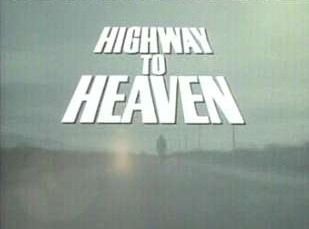
Late Night Retro Television Review: Highway to Heaven 2.22 “Sail Away”


Welcome to Late Night Retro Television Reviews, a feature where we review some of our favorite and least favorite shows of the past!  On Thursdays, I will be reviewing Highway to Heaven, which aired on NBC from 1984 to 1989.  The entire show is currently streaming on Freevee and several other services!

This week, Jonathan helps a novelist get in touch with his long-passed muse.  He also helps him repair his relationship with his grandson before it’s time to move on.

Episode 2.22 “Sail Away”

(Dir by Michael Landon, originally aired on April 2nd, 1986)

Two novelists travel to a remote island.

Frank Worton (Lew Ayres) grew up on the island and was inspired to write a series of paperback romances based on his love for a girl named Jenna.  Sadly, Jenna died when Frank was a teenager and his books were his way of trying to get continue their relationship, if just in his imagination.

Todd Worton (David Einser) is Frank’s grandson.  Todd writes 3,000 words a day and is very strict about his routine.  He’s never written anything as successful as his grandfather’s pulpy romances and he feels that his grandfather has never respected his work.  What Todd doesn’t realize is that Frank feels the same way about him.

When they travel to the Island, Frank starts to act strangely.  He moves into the abandoned house where Jenna lived and claims that it still looks the same as it did when he was a young man.  At one point, he thinks that he sees Jenna walking along the beach.  Is he going senile or is he being haunted by a ghost?

Or is he being prepared for death?  Jonathan and Mark are running a ferry service, taking people to and from the Island.  (I can understand Jonathan knowing how to do all of this, as he’s an angel.  But how does Mark casually go from job to job?  That man’s resume must be a mess at this point.)  Just as he did with Eli Wallach a few episodes ago, Jonathan is preparing Frank to move on.  By the end of the episode, Frank is boarding a sailboat and heading off with his beloved Jenna.  But not before Todd reads the last novel that Frank wrote about Jenna and Frank reads the novel that Todd wrote about him.  The two finally make peace and Jonathan, in voice-over, tells us that both books became best sellers.

Awwww!  What a sweet episode.  This episode is largely a showcase for Lew Ayres and he definitely delivers, giving a heartfelt performance as a man haunted by his past.  If you don’t cry when he gets on that boat, you don’t have a heart and you might want to get that checked out.  You need a heart to live or so they tell me.

In the end, this is an episode that will make you want to sail away.  And while Highway to Heaven has never exactly been known as a subtle show (and I imagine that was by design), I am somewhat impressed at the restraint it must have taken to not include Styx’s Come Sail Away on the soundtrack.

Retro Television Review: The Love Boat 4.12 “Doc’s Dismissal/A Frugal Pair/The Girl Next Door”


Welcome to Retro Television Reviews, a feature where we review some of our favorite and least favorite shows of the past!  On Wednesdays, I will be reviewing the original Love Boat, which aired on ABC from 1977 to 1986!  The series can be streamed on Paramount Plus!

This week, Doc’s in trouble!

Episode 4.12 “Doc’s Dismissal/A Frugal Pair/The Girl Next Door”

(Dir by Richard Kinon, originally aired on January 3rd, 1981)

Carl (Lew Ayres) and his wife, Violet (Janet Gaynor), board the boat in a good mood.  Carl has just retired from the post office and they’re about to celebrate their 50th wedding anniversary.  Awwwww!  Carl and Violet are the sweetest couple ever, frequently referring to each other by pet names.  They’re also very frugal.  Violet brings her own tea bag on board.  Carl turns down a bottle of champagne.  They are a nice old couple who know the value of pinching a penny.

But, on the morning of their anniversary, Violet tells Carl a secret and everything changes.  It turns out that Violet has been buying stock for years.  She based her purchases on whatever pet name Carl used for her that day.  If the name started with a G, she bought General Motors.  If it started with an S, she bought Standard Oil.  Once, Carl used a name that started with a “Z,” and she bought stock in Xerox.  She explains that she didn’t know how Xerox was spelled at the time.  (So, how did she buy the stock?)  Anyway, the important thing is that Carl and Violet are rich and they have been for several decades.

Carl is upset by this news.  If he had known he was rich, he wouldn’t have spent years at the post office!  I see his point though, to be honest, they’re not that rich.  The total stock portfolio is only worth $200,000.  Still, Carl and Violet stop speaking to each other.  Julie, Isaac, and Gopher jump into action and throw them an anniversary party, which causes Carl and Violet to remember how much they love each other.

Meanwhile, Charley Cole (Sal Viscuso) tells Pam Madison (Lynda Goodfriend) that he’s with the CIA so that she’ll let him stay in her cabin so that he can spy on his girlfriend (Denise DuBarry) and the guy (Stephen Shortridge) with whom she is cheating.  Got all that?  This storyline was incredibly dumb but it was saved by the frantic performance of Sal Viscuso, who managed to make even the lamest of lines seem funny.

Finally, Sally (Jessica Walter) boards the ship with her lout of a husband, Hank (Alex Cord).  Hank is the type of jerk who looks at other women while his wife is sitting right next to him.  Complaining of a headache, Sally goes to Doc Bricker’s cabin for some aspirin.  Doc, who has witnessed Hank’s bad behavior, is sympathetic to Sally.  Later, Sally tries to make Hank jealous by saying that Doc hit on her when she went to see him.

Angered, Hank calls the captain and accuses Doc of sexually harassing his wife.  The Captain is forced to suspend Doc from his duties until an investigation can be launched.  The crew is shocked.  Doc would never hit on a patient, they all say.  Except, of course, Doc does exactly that every single episode!  Seriously, Doc is a walking HR nightmare.  (Fortunately, for Doc, he was played by the always likable Bernie Kopell.)  When the captain makes it clear that Doc could be fired and lose his medical license, Sally admits that he never hit on her.  Doc keeps his job and somehow, all of this fixes Sally and Hank’s marriage.  Later, Gopher and Isaac joke about how Doc got in trouble for the one time he “didn’t hit on a passenger.”  Gopher and Isaac aren’t blind to what’s happening.

This was a surprisingly effective episode.  Lew Ayres and Janet Gaynor were adorable and Jessica Walter’s intense, method performance as a desperately unhappy wife provided a good change-of-pace from all of the usual Love Boat goofiness.  Even with all of the CIA nonsense, this was an entertaining cruise.

Late Night Retro Television Review: Highway to Heaven 1.23 “The Right Thing”


Welcome to Late Night Retro Television Reviews, a feature where we review some of our favorite and least favorite shows of the past!  On Thursdays, I will be reviewing Highway to Heaven, which aired on NBC from 1984 to 1989.  The entire show is currently streaming on Freevee and several other services!

This week, Jonathan encourages an elderly man not to give up.

Episode 1.23 “The Right Thing”

(Dir by Victor French, originally aired on March 27th, 1985)

Elderly Harry Haynes (Lew Ayres) lives with his son (Michael Durrell), his daughter-in-law (Marcia Rodd), and his grandson, Matt (Matthew Labyorteaux).  When Harry wets the bed one too many times, his daughter-in-law demands that he be moved to a nursing home.  (I suppose it’s a sign of the time that, too modern ears, that may sound like the set up for a tasteless joke but it’s actually how the episode begins and Lew Ayres does such a good job portraying Harry’s shame and panic that your heart just breaks for him.)  Harry isn’t happy about going to the nursing home and he’s on the verge of giving up on life.  Fortunately, the new orderly is Jonathan Smith and Harry is the week’s mission.  Jonathan isn’t just in the nursing home to pass out magazines and books.  He’s also there to encourage Harry not to give up hope.

This episode is the epitome of what most people would probably come up with if they were asked to describe a typical episode of Highway to Heaven.  It’s sentimental, emotional, and so achingly sincere that it’s hard not to get caught up in it, regardless of how heavy-handed and occasionally simplistic the storytelling may be.  With Jonathan’s encouragement, Harry starts to run with his grandson.  Harry and Matt enters a grandparent/grandson relay race together.  Harry’s son says that, if Harry wins, he’ll be allowed to move back home.  Harry does win  but it turns out that no one told his daughter-in-law about the deal.  To the show’s credit, Harry’s daughter-in-law is not monster.  She’s just exhausted from having to take care of the house, her teenage son, and an elderly man.  Harry realizes that it wouldn’t be fair to her for him to move back in so, instead, he announces that he’s going to travel and see as much of the world as he can in the time he has left.

There was nothing subtle about the plot of this episode but Lew Ayres gives a sensitive and honest performance as Harry and Matthew Labyorteaux matches him as Harry’s grandson.  (Lew Ayres was an excellent actor whose career began in the early days of Hollywood.  He starred in the Oscar-winning All Quiet on The Western Front but his own pacifist beliefs led to him being temporarily blacklisted when he registered as a conscientious objector.  He later made a comeback, appearing in films like Johnny Belinda and Advise and Consent but never receiving an Oscar nomination, due to the controversy over his beliefs.)  This is a sweet episode, even if it is perhaps a bit simplistic with its message that old age can be held off by simply not giving up.  Sad to say but aging is going to get us all eventually.

Retro Television Review: Fantasy Island 2.21 “Yesterday’s Love/Fountain of Youth”


Welcome to Retro Television Reviews, a feature where we review some of our favorite and least favorite shows of the past!  On Tuesdays, I will be reviewing the original Fantasy Island, which ran on ABC from 1977 to 1986.  The entire show is currently streaming on Tubi!

Smiles, everyone, smiles!  It’s time to take a trip to Fantasy Island!

Episode 2.21 “Yesterday’s Love/Fountain of Youth”

(Dir by George McCowan, originally aired on March 17th, 1979)

Tattoo has the hiccups so Mr. Roarke pops a brown paper bag beside his head and scares the Hell out of him. Tattoo loses his hiccups and Roarke get the joy of tormenting his assistant.

As for the fantasies, they both involve youth and aging.

Charles (Craig Stevens) and Peggy Atwood (Eleanor Parker) met in 1944, when he was in the Navy and she was a member of the USO.  Now, over thirty-years later, Charles wants to open a bait shop and Peggy wants to get a divorce.  Their children pay for Charles and Peggy to take a trip to Fantasy Island, where Mr. Roarke has recreated the period in which they first met.  He’s also invited all of their old friends to come celebrate Peggy and Charles’s anniversary.  Unfortunately, one of those friends is the totally arrogant Brick Howard (Guy Madison), to whom Peggy was engaged before meeting Charles.  It quickly becomes apparent that Brick wants a second chance and that, unlike Charles, Brick has bigger plans than spending his retirement selling fishing bait.

Will Peggy leave her husband for Brick Howard?  Or will she decide that running a bait shop sounds like a great way to spend her twilight years?  You’ll have to watch the show to find out …. or you can read the next paragraph.

Of course, Peggy stays with Charles!  It wouldn’t be Fantasy Island if the ending wasn’t a happy one.  Add to that, when has anyone named Brick Howard not turned out to be a cad?  As you can guess, this fantasy was a bit predictable but the cast of veteran actors were all likable and they gave it their all.  This fantasy was simple but pleasant.

As for the other fantasy, world-famous explorer Jeff Bailey (Dennis Cole) needs money so Mr. Roarke arranges for him to be hired by aging millionaire J.J. Pettigrew (Lew Ayres).  J.J. has heard rumors that the fabled Fountain of Youth can be found on an island near Fantasy Island.  He offers to pay Bailey a million dollars if he can find it.  Of course, Bailey does find the Fountain but he also discovers that the Fountain is guarded by a fierce tribe of headhunters.  The headhunters have no intention of allowing anyone else to have any of the water’s fountain.  The headhunters may be intimidating but they also believe that a polaroid camera can steal their soul.  Bailey threatens to take all of their pictures at one point and tells them that J.J. possesses “white man magic.”  Seen today, it’s a bit awkward to watch.  To be honest, I imagine it was a bit awkward in 1979 as well.

Using his canteen, Bailey steals some of the water from the fountain but, while he and his girlfriend (Mary Louise Weller) are fleeing the natives, he loses the canteen.  J.J. has a heart attack and appears to be dead but, at the end of the episode, Roarke announces that J.J. is expected to survive and he’s written Bailey a check for a million dollars.  Bailey found the fountain and that was their agreement.  So, I guess that all worked out.

Overall, this episode was uneven.  The anniversary story was sweet but predictable.  The headhunter story was sometimes cingey but still enjoyably campy.  This was pretty much a standard episode of Fantasy Island.  Still, I can’t help but wonder why J.J. didn’t just buy an eternal youth fantasy instead of hiring Bailey to search for the fountain.  I guess that question is destined to be forever unanswered.

Next week’s episode is all about comedians and prisoners!


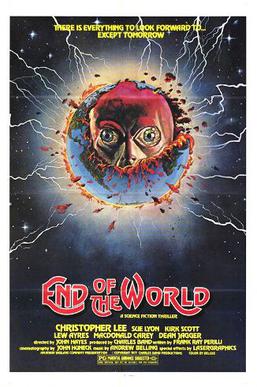
The TSL’s Horror Grindhouse: End of the World (dir by Charles Band)


http://www.youtube.com/watch?v=jXmvGqlp8NY

The 1977 film End of the World has got a great opening scene.  An obviously distraught priest (played by none other than Christopher Lee!) steps into an isolated diner.  He tells the counterman that he needs to use the phone.  The counterman says, “Sure, father.”  And then suddenly, everything in the dinner starts blowing up.  The phone, the coffee, the pinball machine, everything explodes.  The counterman ends up trying to unsuccessfully throw himself through a window.  The priest, looking rather confused, steps outside of the diner and he runs into …. his exact double!  Christopher Lee meets Christopher Lee!

Again, that’s a great opening and it’s really not a surprise that the rest of the film can’t live up to it.  Once the two Christopher Lees disappear into the darkness, the focus of the story shifts to a scientist named Andrew (Kirk Scott) and his wife, Sylvia (Sue Lyon, who years previously played Lolita).  Andrew spends a lot of time sitting in front of a boxy computer and staring at the screen.  He’s picking up strange transmissions from space and he’s trying to translate them.  Andrew goes home.  He and his wife got a party.  Andrew sits in front of the computer a while longer.  Andrew goes home.  Andrew goes to work.  Andrew keeps staring at the computer….

“Wait,” you’re saying at this point, “isn’t this is a Christopher Lee movie?”

Yes, it is.  Christopher Lee is indeed top-billed and he’s hardly in the movie at all.  I’d like to think that, when asked why by an intrepid reporter why he agreed to star in End of the World, Lee laughed and replied, “For the money, of course.”  But, according to Lee’s autobiography, he did the film because he was told that he would be appearing with a cast of distinguished actors like Jose Ferrer, Dean Jagger, and John Carradine.  Now, Dean Jagger does have a small cameo in the film but Ferrer and Carradine are nowhere to be seen.  Either they left the production or someone lied to Sir Christopher!

Anyway, back to the plot.  Eventually, Andrew figures out that the space transmissions are predicting natural disasters.  We don’t actually see any of these disasters because, after all, this is the end of the world on a very low budget.  But we are assured that the disasters are happening.  Andrew and Sylvia discover that the transmissions are coming from a convent in the middle of the desert.  Andrew and Sylvia go to investigate and they discover that the nuns are….

ALIENS!

Now, this is actually a pretty good twist and there are some vaguely humorous scenes of the the nuns working in a space lab.  It turns out that the nuns (and one of the Christopher Lees) are stranded on this planet because their spaceship broke down.  They don’t really like Earth, considering it to be an ugly and polluted place.  They’re planning on ending the world but they need to leave before the whole place blows up.  They demand that Andrew help them fix their transporter and they’re going to hold Sylvia hostage until he does so….

It’s all a bit silly but, as you’re watching the film, you can’t help but wish that it had been even sillier.  I mean, alien nuns and Father Christopher Lee?  That sounds like the makings of a certain type of classic!  But, unfortunately, the film never fully embraces the full potential of its absurdity.  It takes forever for Andrew and Sylvia to actually reach that convent and even the alien nuns become rather passé after a few minutes.  Christopher Lee is fun to watch as always and his character’s irritation with being stuck on Earth was obviously mirrored by Lee’s irritation with being in the film.  And, despite all else, let’s give credit where credit it is due — the title lives up to its promise.  The world may end in a pile of stock footage but an end is an end.

Anyway, this one is pretty much for Christopher Lee completists only.  Watch the opening and then fast forward to the end.

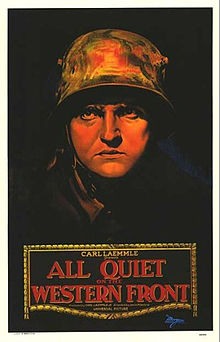
Lisa Reviews an Oscar Winner: All Quiet On The Western Front (dir by Lewis Milestone)


all_quiet_on_the_western_front_1930_film_poster
“When it comes to dying for your country, it’s better not to die at all!”

— Paul Baumer (Lew Ayres) in All Quiet On The Western Front (1930)

Tonight, I watched the third film to ever win the Oscar for Best Picture, the 1930 anti-war epic, All Quiet On The Western Front.

All Quiet On The Western Front opens in a German classroom during World War I.  Quotes from Homer and Virgil, all exalting heroism, are written on the blackboard.  The professor, a man named Kantorek (Arnold Lacy), tells his all-male class that “the fatherland” needs them.  (It’s all very patriarchal, needless to say.)  This, he tells them, is a time of war.  This is a time for heroes.  This is a time to fight and maybe die for your country.  He beseeches his students to enlist in the army.  The first to stand and say that he will fight is Paul Baumer (Lew Ayres).  Soon, almost every other student is standing with Paul and cheering the war.  Only one student remains seated.  Paul and the others quickly turn on that seated student, pressuring him to join them in the army.  That seated student finally agrees to enlist, even though he doesn’t want to.  Such is the power of peer pressure.

A year later, a visibly hardened Paul returns to his old school.  He’s on furlough.  He’s been serving in a combat zone, spending his days and nights in a trench and trying not to die.  He’s been wounded but he hasn’t been killed.  He can still walk.  He can still speak.  He hasn’t gone insane.  He is one of the few members of his class to still be alive.  (That student who didn’t want to enlist?  Long dead.)  When Kantorek asks Paul to speak to his new class, Paul looks at the fresh-faced students — all of whom have just listened to Kantorek describe the glories of war — and Paul tells them that serving in the army has not been an adventure.  It has not made him a hero.  The only glory of war is surviving.  “When it comes to dying for one’s country, it’s better not to die at all!”  Kantorek is horrified by Paul’s words but he needn’t have worried.  The students refuse to listen to Paul, shouting him down and accusing him of cowardice and treason.

(This scene is even more disturbing today, considering that we live in a time when accusations of treason and calls for vengeance are rather cavalierly tossed around by almost everyone with a twitter account.)

What happened between those two days in the classroom is that Paul saw combat.  He spent nights underground while shells exploded over his head.  He watched as all of his friends died, one by one.  One harrowing night, spent in a trench with a French soldier who was slowly dying because of Paul stabbing him, nearly drove Paul insane.  In the end, not even his friend and mentor, Kat (Louis Wolheim), would survive.  From the first sound of bombs exploding to the film’s haunting final scene, the shadow of death hangs over every minute of All Quiet On The Western Front.  By the end of it all, all that Paul has learned is that men like Kantorek and the buffoonish Corporal Himmelstoss (John Wray) have no idea what real combat is actually like.

All Quiet On The Western Front may be 87 years old but it’s still an incredibly powerful film.  There are certain scenes in this pre-code film that, after you watch them, you have to remind yourself that this film was made in 1929.  I’m not just talking about a swimming scene that contains a split second of nudity or a few lines of dialogue that probably wouldn’t have made it past the censors once the production code started to be enforced.  Instead, I’m talking about scenes like the one where a bomb goes off just as a soldier attempts to climb through some barbed wire.  When the smoke clear, only his hands remains.  And then there’s the sequence where the camera rapidly pans by soldier after soldier falling dead as they rush the trenches.  Or the scene where Paul literally watches as one of his friends, delirious and out-of-his-mind, suddenly dies.  Or the montage where a pair of fancy boots is traded from one doomed soldier to another, with each soldier smiling at his new boots before, seconds later, laying dead in the mud.  Or the harrowing scene where Paul tries to keep a French soldier from dying.

All Quiet On The Western Front remains a powerful film.  It’s perhaps not a surprise that, when it briefly played in Germany, the Nazis released live mice in the theaters to try to keep away audiences.  (Both the film and the book on which it was based were later banned by the Nazi government.)  Sadly, we’ll never get to see All Quiet On The Western Front the way that it was originally meant to be seen.  A huge hit in 1930, All Quiet On The Western Front was rereleased several times but, with each rerelease, the film was often edited to appease whatever the current political climate may have been.  Over the years, much footage was lost.  The original version of All Quiet On The Western Front was 156 minutes long.  The version that is available today is 131 minutes long.  But even so, it remains a harrowing and powerful antiwar statement.

With all due respect to both Wings and Broadway Melody, All Quiet On The Western Front was the first truly great film to win the Oscar for Best Picture.  Sadly, it remains just as relevant today as when it was first released.

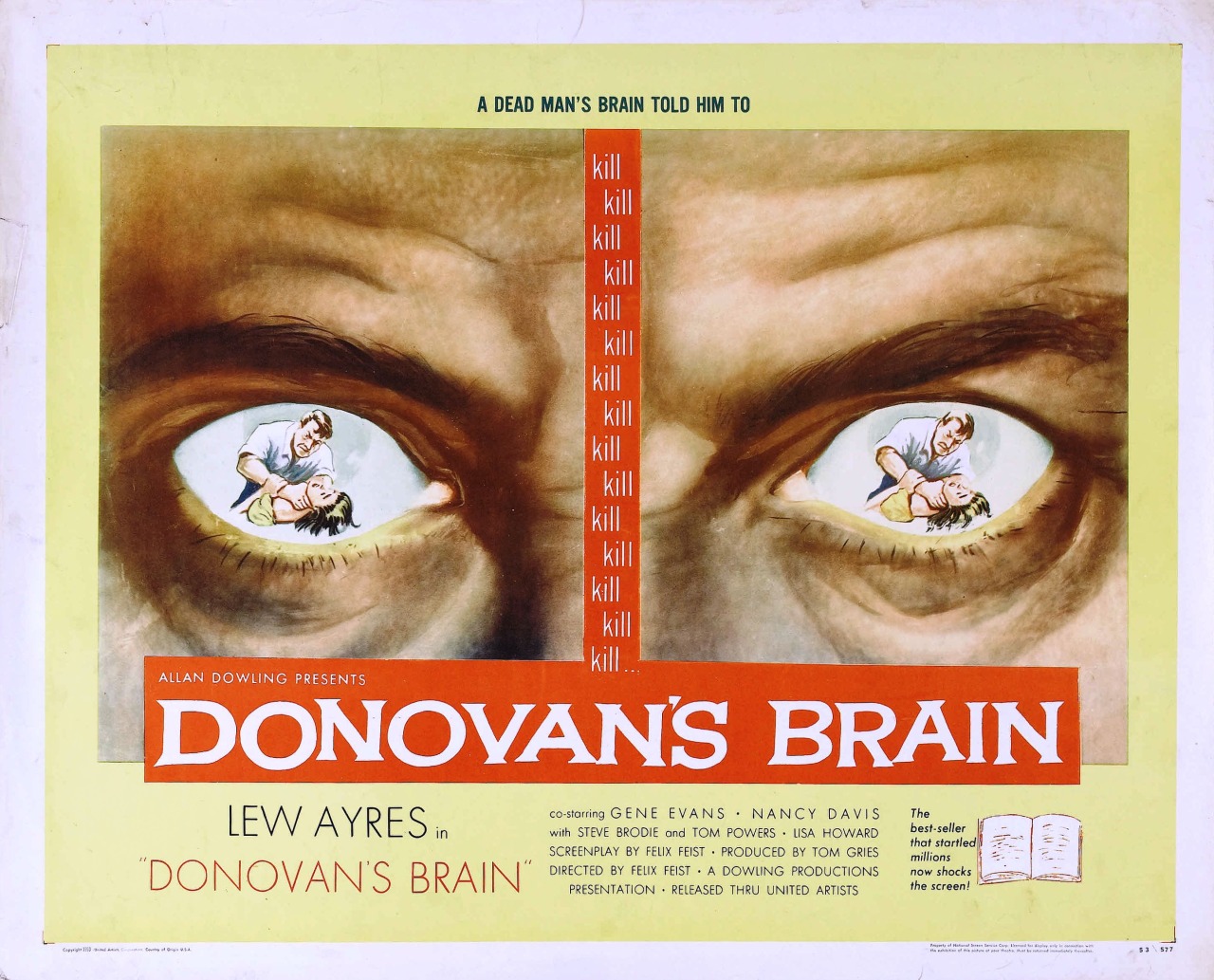
Halloween Havoc!: DONOVAN’S BRAIN (United Artists 1953)


gary loggins's avatarcracked rear viewer

donovan1

No, this is not a movie about the mind of the 60’s Scottish folk singer responsible for “Sunshine Superman” and “Mellow Yellow”. DONOVAN’S BRAIN is a sci-fi/horror hybrid based on the 1942 novel by Curt Siodmak, responsible for THE WOLF MAN and other Universal monster hits. It was first made as a 1944  Republic Pictures effort titled THE LADY AND THE MONSTER with Erich Von Stroheim (why Universal didn’t buy the rights is a mystery to me). This is one of those rare cases where the remake is better than the original!

donovan22

The story concerns Dr. Pat Cory, a scientist experimenting with keeping the brain of a monkey alive without a body. After several failures, Cory and his assistant, alcoholic Dr. Frank Schratt, have finally succeeded. A nearby plane crash leaves three dead, and multi-millionaire Warren H. Donovan in critical condition. Donovan dies on the table, but his brain is still registering…

View original post 466 more words

The Fabulous Forties #16: Dr. Kildare’s Strange Case (dir by Harold S. Bucquet)


Dr._Kildare's_Strange_Case_FilmPoster

The 16th film in Mill Creek’s Fabulous Forties box set was 1940’s Dr. Kildare’s Strange Case.  It’s about a doctor who investigates a medical case and wow, is it ever a strange case.

Apparently, there was a whole series of Dr. Kildare films that were released in the 30s and 40s.  I guess the films were the cinematic equivalent of a TV show like Grey’s Anatomy or ER or Children’s Hospital or… well, every medical show that’s ever shown up on TV since the beginning of time.  Dr. James Kildare (Lew Ayres) is a passionate young doctor who may break the rules but he gets results!  His mentor is Dr. Gillipsie.  Gillipsie is played by Lionel Barrymore and since the character is cranky and confined to a wheelchair, it was impossible for me to watch him without thinking about Mr. Potter from It’s A Wonderful Life.  Whenever Kildare went to him for advise, I kept expecting Gillipsie to glare at him and say, “You once called me a warped old man…”

Anyway, Dr. Kildare works in a hospital and, when he’s not silently judging everyone else that he works with, he’s busy silently judging the wealthy Dr. Lane (Sheppard Strudwick), a brain surgeon whose patients keep dying.  Kildare and Lane are also both in love with the same nurse, Mary Lamont (Laraine Day).  Mary wants to marry Kildare but Kildare would rather be poor and single than compromise his medical principles.  Lane, on the other hand, sends her a box full of silk stockings.  Plus, he’s rich!

Seriously, how is this even a competition?  Forget Kildare and marry Lane!

Except, as I mentioned earlier, all of Lane’s patients keep dying.  Is Lane incompetent or, as Kildare suggests, is it possible that brain surgery is just really, really hard?  I imagine it was even harder in 1940, when this movie was being made.  While Kildare and Lane are operating on brains, Dr. Gillipsie is still using leeches to suck sickness out of the poorer patients.

(You don’t actually see it happen in the movie but Gillipsie comes across as being a leech man.)

Anyway, eventually, Kildare has to cure a schizophrenic and it turns out that he can do this by putting the man into an insulin coma.  As is explained in great detail, forcibly putting a patient in a coma will cause that patient’s mind to go back to a reset point.  It’s kind of like how Windows sets up a restore point before doing a major update.

And that therapy sounds so crazy that you just know it had to be based in an actual practice.  I checked with Wikipedia and I was not shocked to discover that apparently Insulin Shock Therapy used to be a thing!

Anyway, Kildare’s gets into a lot of trouble for putting his patient into a coma and attempting to erase a huge part of his mind.  Will Kildare’s results vindicate his methods or will Gillipsie have to use leeches to suck the crazy out of the patient’s brain?

Watch the film to find out!  Or don’t.  Dr. Kildare’s Strange Case was directed by Harold S. Bucquet, who did a pretty good job with The Adventures of Tartu.  His direction here is flat and uninspired, which only serves to make this entire film feel like an old TV show.  I’m tempted to recommend the movie just because of the scene where it’s explained that insulin shock therapy causes patients to devolve so that they can re-evolve but otherwise, Dr. Kildare’s Strange Case is forgettable.

If you want to see it, you can watch it below!

http://www.youtube.com/watch?v=8UPFyrlNiGM

Or you can just watch this classic episode of Children’s Hospital!

http://www.youtube.com/watch?v=dpBjqgVaEbk