Quick Horror Review: John Carpenter’s The Fog


I have something of a tradition with John Carpenter’s The Fog. Every year, I try to watch the film on the date and time where the story starts – April 20th, at around 11:55pm. It’s not the scariest of stories, but it does have a spooky atmosphere that lends itself well to Halloween – or any late quiet night. I love this movie.

The Fog marked the first film that John Carpenter worked on after Halloween, collaborating with the late Debra Hill, who also produced the movie. She’d go on to also produce both Escape From New York and Escape from L.A for Carpenter. While it didn’t really have the impact of Halloween, it held up until Escape from New York came out the following year.

Here’s the story:

In the town of Antonio Bay, an old captain (John Houseman) explains to some children about the ill-fated Elizabeth Dane (what a beautiful name, I might add), a ship that belonged a rich of crew of lepers led by someone named Blake. The heads of the town conspired to steal the gold by setting up the ship to crash against the docks. It works out for the Conspirators, as they are “aided by a unearthy fog” that blinds the Leper ship’s navigators. and the gold they collect helps to form the great town the kids play in to this day.

What they don’t realize is that vengeance is coming in the form of that very same fog, as the ghost of the Lepers have come to claim the lives of the six conspirators…or their direct descendants.

As a kid, I had a problem with that. You mean because my great great grandparents messed up somewhere ages ago, I have to get killed for it? I remember thinking that it really wasn’t fair, but I’m kind of diverging from the topic here. The story gives you four points of view. You have Nick (Tom Atkins, sans his signature mustache) and a hitchhiker he picks up played by then scream queen Jamie Lee Curtis. You have Curtis mother, Janet Leigh, who’s character is working on the anniversary party for the town and her assistant, Sandy, played by Nancy Loomis (who appeared in the first three Halloween films). The third comes from Adrienne Barbeau’s character, Stevie Wayne, who works for the local radio station. Her character acts as the warning voice for the town and she starts to notice that something’s going on when her son gives her a piece of Driftwood that later echoes Blake’s warning. The final viewpoint comes from Father Malone (Hal Holbrook), who discovers Blake’s diary and learns the truth about what happened 100 years ago. His character helps to piece the mystery together, somewhat.

Carpenter and Hill gathered many of their friends, who went on to work on other films for this. Tommy Lee Wallace went on to direct Halloween III: Season of the Witch (and coincidentally did the voice of the Silver Shamrock ad-man in the commercial) and Vampires: Los Muertos. Wallace’s name was given to Carpenter fan favorite Buck Flower. Nick Castle’s name was given to Tom Atkins character. Makeup Wizard Rob Bottin (who also played Blake in the film) went on to do some of the effects in The Thing.

The makeup effects in this film were okay. The lighting and fog did more to obscure than to actually help one see what was doing the attacking, but it really worked for some of the shadowing in the film. If the movie has any drawbacks, it’s that there’s a really low body count to the film. In essence, there are only 6 people the ghosts are after, so these are only the ones they actually get. It would have been interesting if there were a few random deaths, or more individuals in danger, but I supposed it worked out well for the time period.

The Fog is a nice film to catch late at night. You won’t find it at the upper rankings of top horror films, but it’s one to try, at least. Don’t even bother with the Remake for this one. It’s not even work talking about.
Thoughts on the Battlefield 3 Beta


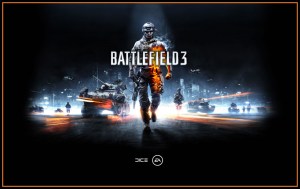
I received an email from Electronic Arts this week, letting me know that the Beta for Battlefield 3 was available to play about 48 hours from the main release. Everyone should be able to play it today, and from what I can tell, it’s well worth it for Battlefield Fans. This is just a quick synopsis of playing the game.

I feel like someone out there has been paying attention to the shortcomings of the Bad Company games, and it looks like it’s coming across nicely.

So far, the Beta works off of one huge map. As always, the battle is broken down into three areas within this map. The first of these is a large park. The second moves into a subway system and the third expands out to a city square. It almost feels larger than what was available in Bad Company 2, but is roughly the same size. It seems that a number of changes were implemented, particularly in the explosions in the game. A lot of changes have been implemented, particularly in some of the movements of your character. You now have the ability to go prone and vault over low obstacles. Going Prone has already proven effective in a number of game sessions as fireteams now lie in wait near the foliage close to the demolition targets. It’s become much harder to be able to see anyone when making your way into a situation. That’s a very nice touch, considering that in the past, the most one could do was kneel.

The game still works off of the Class system from previous BF games, but the graphics have been updated considerably. While it may not be very noticeable in the first part of the battle, once you reach the subway, it’s nice to see how large the world you’re in is and what you can do with it. When you throw down a package, it’s a very large box, compared to the small ones in Bad Company Two.

The guns in the game are interesting. The opening gun for the Assault Class remains the M16, but the Specialist class has the M4 as a starting rifle. Additionally, playthroughs on this map will allow you to unlock various attachments such as scopes and new weapons. Though I haven’t seen it first hand, the game explains that laser attachments and flashlights will actually blind a person when shined at them. The guns (the shotgun in particular) appear to be a little overpowered, though that could be my playing a little too much Gears of War before starting BF3. It’s tactical, as always.

One thing I would like to see (unless I missed it) was Night Vision. There is one area of the game, where it’s almost completely dark and is really almost impossible to see anything. You have to pause and look for where the shots are come from and just fire in that general direction. It would be nice to see, if it’s there.

Overall, Battlefield 3 is really shaping up to look like an intense game. I’m eager to see what other maps they’ll have in store later on.

Quick Review: Drive (dir. by Nicolas Winding Refn)


Here at the Shattered Lens, we’ve been eagerly awaiting Nicolas Winding Refn’s Drive, which has picked up some major buzz over the last few months. So note that this will not be the only review you’ll see for the film. As the other reviews come in, I’ll update this paragraph to link to them.

Addendum: 

Leonth3duke has added his Drive Review, which examines the film from a lens closer to the director’s point of view and remains spoiler free. Definitely worth reading!

Arleigh has also added his Drive Review – which compares the film to both Michael Mann and David Cronenberg’s styles.

*  *   *   *  *

I was so excited by Drive that I treated my extended family to it (just in case the film went sour, it would be easy to apologize). This is going to be a quick review, because I’m going to ramble.

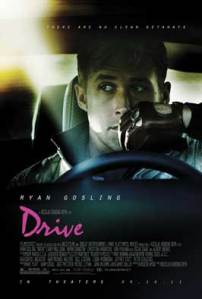
To quickly sum it up, Drive is a beautiful, artistic film that hits all the right buttons when it comes to the crimes it showcases. It occasionally explodes between quiet reflection and ultra violent action. Even the music was sweet. It’s just a shame though that all that coolness is wrapped up in dialogue and scenes where the pacing……moves……as……………slow…………..as………………this. Honestly, the book this was adapted from felt like it must have been about 50 pages, at best.

Drive is the tale of Driver (Ryan Gosling), a stuntman for the movies by day, and a Wheelman by night. His partner, Shannon (a nice performance by Breaking Bad’s Bryan Cranston) gets involved with a mobster (Albert Brooks) on a business venture. After getting caught up in a heist that goes awry, Driver has to try to protect himself along with the woman and child he’s recently befriended.

Drive has a fantastic sequence before we actually see the opening credits. Everything about that opening is downright sharp and creative. I haven’t seen that cool an opening to a film in quite a while. What a way to hook the audience in.

Overall, the film feels great and unique, but it suffers from one problem that I’ve only seen a few people actually mention. It feels like there’s this pause between every statement between Driver and Irene (Carey Mulligan). Imagine having one character say “Hello”, and then having someone pause the movie for a few minutes before picking it up from there. Drive ended up doing this quite a bit.  I can understand if Driver is a soft spoken, man of action,  but there were moments where I wanted to shake both Gosling and Mulligan to communicate more. I’m not saying they had to move in a particular direction, but they had a lot of patience waiting for replies from each other.  There were other scenes where I felt Refn should have considered adding just a few cuts to the film to increase the speed of the film. The slow pace keeps it from becoming The Transporter, but most of this movie felt like that 3rd act in Heat after the robbery (or the multiple endings in Return of the King) to me. The film felt more like it was in love with itself than anything.

I understand that Drive is an independent film, and with independent filmmaking, there’s a bit more freedom to do things artistically instead of having movie marketers breathe down your throat. While I may lack the film appreciation skills to effectively grasp the artistic impact of Drive on screen, I can say that as a dialog or story driven piece, the movie suffers that one hiccup. Others may see the movie differently than I did.

Pacing aside, Drive is easily worth seeing, and is in some ways similar to some of Michael Mann’s films like Thief and the aforementioned Heat. Ryan Gosling was cool, but knowing that you’re not going to get the kind of emotion from his character compared to maybe Blue Valentine helps to brace you. Working from Mann’s concept of movies, you could relate Driver to a Neil McCauley. In Heat, DeNiro’s McCauley took action when he needed to. If someone forced his hand, the response was harsh. Driver felt like he had something of the same approach, which I really did like.

Visually speaking, I loved it, but it just has areas where Refn appears to be in love with a shot so much that he lingers longer than he needs to. If you never told me who directed this, I might assume it was David Lynch.  The driving scenes themselves are done very well, and the action is also explosive, breaking the silence in the film a number of times. The silence is so strong that something as simple as a gunshot caused most of the audience to jump, which I found interesting.

The other performances in Drive are interesting, especially Albert Brooks and Oscar Issac, particularly. I didn’t even recognize him in this film, compared to his bad guy role in Sucker Punch. Christina Hendricks, though nice to see, didn’t really do too much here.

So with Drive, you can go see it. I may see it again myself. I’m not saying you shouldn’t, but if you yawn somewhere down the line, don’t say I didn’t warn you.

One other thing I had to add here. The Marketing for this film a few months ago (including the original trailer) is closer to the impact of the actual film than some of the marketing that’s being done now. Most of the recent posters and tv ads push Drive as something of an action piece. I would consider it more of a Drama with action occasionally spliced in.

Quick Movie Review: The Warrior’s Way (dir. by Sngmoo Lee)


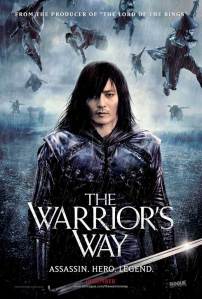
I’ll admit that I didn’t give The Warrior’s Way that much thought when we picked it up from the rental store the other day. At first glance, it didn’t seem to have much of an identity to it. Was it trying to be something serious like a House of Flying Daggers or something more humorous like Kung Fu Hustle? I guess one could say that it’s really a little of both and although the movie may be a little too strange for it’s own good, it was really worth going through the first hour or so just to get to the last 30 minutes. The film really picks up steam from there going forward.

In the film, Yang (Jang Dong Gun) becomes the Greatest Swordsman in the World after defeating the original Greatest Swordsman ever. After doing so, he’s given an order to kill a family by his clan. Managing to kill everyone but a young baby named April, Yang decides to let it live and to take care of it, giving the movie a Lone Wolf and Cub / Shogun Assassin feel.

And basically, what the film boils down to is Yang trying to leave behind the life he had in order to protect the baby he’s found. He finds himself in a Wild West town and meets a number of individuals who help him hide his identity. In return, he helps them gain the courage to find themselves. Kate Bosworth’s character, Lynne, is a knife thrower with a bit of talent, but without any focus. Geoffrey Rush is something of a drunkard, but in watching what Yang is doing in the town, he sets aside his drinking ways in place of sniper rifle. Both actors are okay in their roles, but I found myself wondering why they went with these, honestly.

One of the standouts of this film (if one could say there’s a standout, because the movie really could be better than what it was) was Danny Houston. Despite some of the bad movies he’s been in (X-Men Origins: Wolverine instantly comes to mind), he carries his characters with this really weird style – his voice has this sense of authority, much like a Liev Schreiber – his villain is the classic evil cowboy, which normally would do him a lot of justice. Here, he does okay in his scenes, but doesn’t really have a whole lot to work with.

Yang is also being pursued by his former master, Saddest Flute, named after the sound one’s throat makes when it’s cut. Saddest Flute and his ninjas manage to make their way to the town, which culminates in a really cool battle which is one part Rango, one part Ninja Scroll and even a little like Samurai Jack. And all of that really needs to be seen, all 25 to 30 minutes of it, even if it happens to be just as a clip.

Overall, The Warrior’s Way is the kind of movie you end up watching if you’re planning to take a nap on a Sunday afternoon or if you really like cinema of this type. It’s not worth taking the whole ride for, but it ends with such a bang that one may not consider it a total loss.

Quick Movie Review: Arachnophobia (dir. by Frank Marshall)


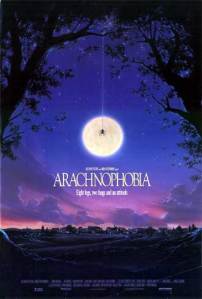
When I was a kid, my grandmother used to keep this clear shower curtain of a large black web, complete with a big red spider on it. It scared me so bad that I was actually more willing to brave the darkness of the basement bathroom than to have to deal with that monstrosity in the well-lit one. Between that, my brother’s EC comics and the original “The Fly” with Vincent Price, it’s how I developed Arachnophobia. It’s a fight or flight reflex that occurs when anything spider related appears. It seems fitting that as I’m writing this from a location that’s full of Black Widows, Arachnophobia is the topic for this review.

Arachnophobia marked the first directing attempt by Frank Marshall, long time producer of many of Steven Spielberg’s films. The film turned out to be a success when released, and manages to feature one the greatest Human vs. Tarantula battles ever filmed.

Although the film has some horror elements, it’s kind of hard to classify Arachnophobia as an actual horror film, despite the deaths that are in the film. There are some humorous moments (particularly from John Goodman), and the scares don’t come too often. For anyone who’s bothered by spiders, though, there are a number of jumpy moments that occur without being excessively gory. The story is a little misleading. It starts in Venezuela, South America, where a deadly tarantula manages to sneak its way on board a trip back to California. You’d think that from here, the Tarantula would end up finding another Tarantula, and thus pull a Kingdom of the Spiders with a whole town full of spiders. The writers, however, end up making a mistake in having a Tarantula mate with a common house spider, thus breeding dozens of other smaller spiders.

That’s like a Tiger trying to mate with a house cat. I’m not exactly sure if that’s even possible, but I’m getting off track. This actually ends up helping the story because now the town has to deal with all of these smaller spiders that are easy to hide around. I always considered that to be pretty effective.

Jeff Daniels character, Dr. Ross Jennings suffers from Arachnophobia in the worst way. Moving to the town of Canaima with his family, he trades the big city for a more relaxed, rural setting. Of course, it’s a happy ideal situation until various deaths start happening around town. Eventually, he and the authorities come to realize just how bad things really are. John Goodman’s character was an interesting touch as a funny exterminator, but really wasn’t used as much as he could have in this film. Then again, when he does tend to steal the scenes he’s in. Arachnophobia has a number of other supporting actors, but the film mainly belongs to Daniels, Goodman and the the spiders.

Chris Walas, who won an Oscar for his effects and make up work in The Fly helped to create some of the more mechanical spiders and close-ups when necessary. While you can tell where you’re dealing with real tarantulas and their synthetic counterparts, he did a great job in getting the fear factor out there, especially during the final standoff of the film. Without giving much away, the last 20 minutes of the movie are brilliant in that the final battle is much more than the simple “find it and squash it” scenario from Kingdom of the Spiders. It’s almost a violent chess match.

Arachnophobia is a treat. It may not be the best film about spiders in general, but if you do suffer from the condition or know someone who does, it definitely worth seeing, just to jump and squirm now and then. It’s much better than knowing there are real Black Widows to contend with.

Movie Review: Darkman (dir. by Sam Raimi)


As I haven’t been to the movies lately, I’m working on reviews of older films I’ve seen.

A long time ago, just after Tim Burton’s Batman and before Spielberg’s Jurassic Park, Sam Raimi came up with the idea of making his own superhero movie. Supposedly, he had tried to get a hold of both Batman and The Shadow (which eventually went on to Highlander’s Russell Mulcahy), but wasn’t able to. As a result, Darkman was created. I never mind watching it or recommending it, as long as the viewer realizes they’re not shooting for Oscar Winning material here.

Darkman was a strange film. It wasn’t really marketed very well, evidenced in the simple “Who is Darkman?” posters that I remembered seeing on the sides of buses. I don’t recall there being any kind of commercials for the movie. While the movie did alright (and even spawned 2 sequels), I never thought of it as a great success. It still is, despite its flaws, a good film. Well, for someone at 15, it was good.

In Darkman, Peyton Westlake (Liam Neeson) is a gifted scientist that has just about everything. He has a great girlfriend in Julie (Frances McDormand), who’s doing well in her job and he’s on the verge of a major breakthrough in developing a new synthetic skin. If he could only solve the problem where the skin apparently decays in light after 99 minutes. Soon after realizing the flaw in his project, he is attacked a group of criminals (lead by Larry Drake in a great role), burned with his own chemicals and his lab is set ablaze. Left for dead, he’s found and brought to a hospital. They’re able to confirm that he’ll live, but he’s also horribly scarred, has no sensation in his nerves (meaning he feels no pain), and will need skin grafts for the rest of this life. The result of all this trauma is also a bit of mental damage. Westlake breaks free of the hospital, resurrects his lab, and decides to get revenge for what was done to him. The synthetic skin technique now allows him to assume the appearance of anyone he chooses (as long as he has a picture of them, of course). He can wear a disguise for up to 99 minutes in direct sunlight, else his face begins to melt.

One thing I like about some of Sam Raimi’s films is that they’re just strange in some ways. Not Cronenberg strange (that’s just creepy sometimes), but they tend to have some weird elements. He likes to throw things into the camera, whether it’s someone’s face or an object. He’s also into these extreme zoom shots where he’ll have the camera low and bring it racing towards it’s subject. At the time the movie came out, my parents gave me a Camcorder. I did a lot of similar shots, chasing the cats around the house with the camera hovering a few inches off of the floor. I’ll admit it, it was pretty effective here.

Some of the acting was okay in Darkman. I particularly liked Larry Drake at the time because he seemed so different from the character he played on L.A. Law at the time, but everyone else here seemed like they were playing up their roles and in some cases, taking themselves far more seriously than they should have. Some scenes didn’t even make sense to me and felt like filler. I get that Westlake was just a little bonkers, but the whole “See the Dancing Freak” song and dance routine kind of left me with a “What the hell?” expression. Frances McDormand seemed to almost whine on cue (though I guess if I had a love one come back from the dead, I’d be a little shocked too). Colin Friels’ villain caused my family to collectively snicker and groan when at one part, he exclaims “Because I built it!!! I built it all!!” It was just all very strange. M. Night Shyamalan did something similar with The Happening, but for me, this really worked better in Darkman’s favor. Since the acting is so campy, the movie never really tries to make itself out to be Dark Knight / Captain America piece.

If you’re looking at it logically, there’s really no way that Westlake should have been able to pull off half of the disguises he used. You’ve height and weight to consider, and last I checked, Liam Neeson and Larry Drake really had two different body types. Where’d he get all the extra bulk, one has to wonder? Extra clothing, perhaps?

If Darkman has anything going for it, it’s the music. At the time, Danny Elfman was riding the high he had off of movies like Batman, Midnight Run, Dick Tracy and Nightbreed. While Edward Scissorhands remains the strongest score he had that year, Darkman has a number of nice action cues mixed with some somber tones. It helps to carry the film, somewhat.

Overall, Darkman was an interesting look at Sam Raimi’s approach to a superhero. It may have also been one of the key factors in securing the directing duties on the Spider-Man movies in the early 2000’s, which was far superior to this film. If nothing else, it’s worth a laugh or two.

Quick Review: Fright Night (dir. by Craig Gillespie)


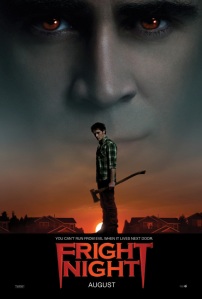
I want to say great things about Craig Gillespie’s remake of Fright Night. I want to say that it was worth seeing and it was full of awesome moments. I also wanted to be able to write this review without making so many comparisons to the 1985 Original by Tom Holland. Not that the original was a masterpiece by any means, but I dozed off (just a little) on this film.

If there’s only one reason I could give for recommending Fright Night, it would be to get a taste of what Vampires should be. Don’t read me wrong on this. I own all four Twilight books in hardcover, read them repeatedly, and have seen the three films that came out in the theatre. It’s just nice to see a vampire movie that shows vampires more as predatory creatures than sparkling A&F models.  There’s an edge to this film that’s pretty fun in a lot of ways. Both Colin Farrell and David Tennant have great roles here and even Anton Yelchin holds his own, but there’s a weird breakdown that happens. Fright Night is a good film, as long as you don’t try to make any kind of direct comparisons to the source material.

The story focuses on Charlie Brewster (Yelchin), a teenager – the story being in Vegas this time –  who discovers he has a vampire named Jerry Dandrige (Farrell) living next door to him. When the vampire confronts Charlie, Charlie is forced to seek out help in the form of Peter Vincent (Tennant) to defeat him. While there were a few scenes that really stood out for me and I found myself smiling more often than rolling my eyes, the pacing of this was off. Other audiences may find that the movie moved well. I felt like they were just throwing things to say “Well, wouldn’t it be cool if they did this, and then that.”

The two problems I had with Fright Night were it’s pacing and Chris Mintz-Plasse. Chris is fun to watch at the start, and I’d love to see him do more, but someone really has to give him something where he’s not playing the “token geek”.  While I liked the movie overall, there’s a lot of verbal exposition in the beginning of the film, as Charlie doesn’t so much discover the truth about Jerry, but is pretty much told the entire scenario he’s in about 15 minutes into the start. I had a problem with that. Again, depending on the audience, the movie may move just fine.

Fright Night is one of those films could be a love it or hate it. I’m of the audience that will probably catch it again when it’s out on video, but it doesn’t feel like anything you really have to rush to the theatre for.

Scene I Love: Sunshine (dir. by Danny Boyle)


The scene in Danny Boyle’s “Sunshine” where the crew reaches Mercury is one of my favorites. It may not be as powerful as Kaneda’s Death, but this is one of those moments I can watch and smile at. There are no words, but visually, It’s an awesome moment of reflection in the scheme of things. John Murphy and Underworld’s music add a nice touch to this.

Quick Review: Winnie the Pooh (dir. by Stephen J. Anderson & Don Hall)


With Harry Potter and the Deathly Hallows Part 2 running at full steam, and Captain America: The First Avenger opening this weekend, Winnie the Pooh still remains an option for younger kids who may not be ready for these two films (at least until The Smurfs is released). There’s really very little in the way of negative comments that I can give to Winnie the Pooh, expect perhaps that running at just 69 minutes, it’s very short. It’s for kids.

Working off the original story by A.A. Milne, Winnie the Pooh re-introduces us to the title character, along with his friends from the Hundred Acre Wood – Tigger, Rabbit, Piglet,  Kanga and her son Roo, Owl, and Eeyore. They are the treasured toys of Christopher Robin, who has an active imagination.

One of the cute elements of this story, narrated by John Cleese is how everyone breaks the fourth wall and occasionally has interactions with the paragraphs of the story. Stepping on a few words here, using a few as a ladder, it came across as being quite worthy of a few smiles.

I used to watch “The New Adventures of Winnie the Pooh” on Saturday Mornings, and it was a treat to return to these characters. For the movie, we are given the “Busy Backson” story, where Eeyore has lost his tail and the team come up with ideas on new and interesting ones for him. Each character has their own way of figuring this out. Of course, Pooh has something of a difficult time with his constantly rumbling tummy, but he manages to help in his own way. In their search, Owl misreads a note left behind by Christopher Robin stating that he’ll be busy, but will be back soon. This conjures up the great and terrible “Backson” in everyone’s imagination, responsible for everything from stealing your left socks to making your milk spoil. The team decides to set a trap for the Backson, with wild results. The scenes with the Backson maybe a little frightening to the youngest of viewers, but it’s not that bad. We’re not dealing with Heffalumps or Woozles here.

In the end, as always, everything turns out well. I liked that Friendship was the big factor here. All of Eyeore’s friends tried to help him find his tail, and Pooh even puts his honey chasing ways on hold (as best he can, anyway) to aid his friend. Those familiar with the animated series will instantly recognize Jim Cummings as the voice of both Winnie the Pooh and Tigger. I would have liked to have seen Peter Cullen come back as Eyeore, but he was pretty busy voicing Optimus Prime while the movie was being made. All of the other voice actors are new, including late night tv host Craig Ferguson as Owl. The kids won’t even care.

Musically, there are a few interesting songs. Actress / Singer Zooey Deschanel lends her voice to the title song, along with a few others. Most of the other songs are sung by the cast themselves, and the kids may find themselves singing along (at least I could hear singing in my audience, anyway). The film moves fast, extremely fast. By the time the antsy factor kicks in, the movie’s done, which makes that a treat by itself.

Overall, Winnie the Pooh may not have the magnificence of say a Kung Fu Panda 2 or How to Train Your Dragon, but for very young viewers, it should do just the trick.

Movie Review: Captain America – The First Avenger (dir. by Joe Johnston)


This won’t be the only review for Captain America: The First Avenger here on the Shattered Lens. This may very well be considered an editorial on the film, depending on whether I can stay on topic (I gush a lot in this one). Once they see it, both Arleigh and Lisa Marie will probably make their own posts. Either way, you’ll have more than one perspective on the film.

Addendum: Arleigh’s review is up.

Many years ago, Marvel Comics decided that with all of it’s key franchises spaced around various film production companies, they’d create a series of films that would culminate to one big “Team Up” story. That team is known as The Avengers and it’s members (for the sake of the films, anyway) are Iron Man, Thor, The Incredible Hulk, The Scarlett Witch, Hawkeye and Captain America. The project really went into high gear when Marvel Studios was born and Disney purchased Marvel.

I didn’t have a lot of hope for Captain America: The First Avenger. I know very little about the character save for the comics my older brother used to read. He was an army guy given something to make him super and he had a really cool shield that he’d throw and have return to him.. That was basically the bulk of my knowledge. When taken into account the announcement that Joe Johnston was directing the film, after his somewhat disappointing turn in The Wolfman and that Chris Evans was playing the role, I was certain the film was going to fail. I mean, wasn’t he just playing the Human Torch in The Fantastic Four?

Now, you need to understand that hearing Joe Johnston’s name attached to this left a mixture of feelings. I absolutely love The Rocketeer (1991) and period pieces in general. He was able to give it a nice ‘30s feel, right down to the old war serials that used to be shown before films. Hell, even the poster to that film was something grand. My little brother had a Rocketeer toy and I used to film home movies with it, holding the character just in front of the camera and running around the house as if it were flying. Unfortunately, it didn’t quite work out as well for Johnston or Disney then – but that’s another story.

As for Captain America, the movie floored me. The story isn’t as complex as say, The Dark Knight or as full of itself as Green Lantern, but it’s hands down the best story in the whole Avengers arc that Marvel’s worked on. From my viewpoint, only Iron Man comes close to competing with this film.

The premise of the story is pretty straightforward. Steve Rogers (Chris Evans) is a frail man with just about every problem you can think of. He’s short, he’s asthmatic, and he can’t do a pull up to save his life. Yet, as his parents were in the Army, he felt it was right that he do his part. Every time he tries to enlist, however, he’s told he can’t. This doesn’t sway him from the belief that he can do it, it just forces him to find other ways in. When a scientist overhears Steve’s reasoning behind wanting to join, he gives him a big chance to become the first of many Super Soldiers. The process does indeed work, but a mishap leaves Steve as the only Super Soldier the Allies have, and thus, Captain America is born.

Now, I’m kind of summarizing things there as the story’s just a little bigger than that, but it really needs to be noted just how great a job Chris Evans did in this. He portrays Steve Rogers as one of the most noble characters I’ve seen since Superman. The character never loses that drive or passion, and it came across so well that on reflection, I can’t recall ever thinking once about the Human Torch (something I fully expected to do here). I found myself really wanting this character to succeed, which is more than I could say about Hal Jordan in Green Lantern despite loving the comic. Evans truly was the right person for this film, in my opinion. Again, die hard Captain America fans that have grown up with the character may disagree.

Captain America also has a rich supporting cast. Hayley Atwell, coming over off a great role in the Starz Miniseries The Pillars of the Earth plays Peggy Carter, a tough as nails Army Officer that helps to motivate Rogers toward the path he’s destined to take. Atwell is beautiful, demure at times and responsive at others, every bit as she was when playing Alienna. Also from Pillars of the Earth is Anatole Taubman as one of Johan Schmidtt’s (Hugo Weaving’s) Officers. Tommy Lee Jones’ Colonel has some of the funnier lines in the film. Weaving does a great job as always at playing the villian. There’s really very little I can say on that other than the make up job they gave Weaving’s Red Skull was nice, right down to the visible seams just under his ears. Sebastian Stan has a good role in Rogers’ best friend, Bucky, but I think he could have used a little more. Even Natalie Dormer (Cassanova, The Tudors) and Amanda Righetti (Friday the 13th) have cameos. If the film has two supporting anchors other than Atwell, it would be Stanley Tucci (Easy A) and Dominic Cooper (The Devil’s Double). As Abraham Erskine and Howard Stark, respectively, they both almost steal the show from Evans. They both have a few key moments in the film.

If Captain America suffers from any problems, it may be that it gets from Point A to Point B a little quicker than I’d have liked it to. Some of the pacing is done in Montages, which is okay for showing the audience that the Captain is making progress, but I would have liked to have seen another mission or two before the finale. The buildup to Steve Rogers becoming the Captain is fast, and everything else moves pretty quickly from there on in. The last battle sequence could have been stronger – I’m reminded of the tank sequence in Indiana Jones and the Last Crusade – but considering the era in which the story was told, I wasn’t really expecting lightsabers or anything along those lines. It wasn’t bad, but it was over sooner than I expected. I should also point out that it really does help to have seen the other Avenger related movies. It’s not really a requirement, but the larger puzzle really comes into view on seeing this film.

Visually, the film is great. Johnston really catches that sense of old New York, though it may not be as nuanced as Jackson’s in King Kong. The colors are a little muted in some places, but I’m thinking that’s part of the tone that was set. There’s even a musical number that’s somewhat cute. The 3D effects in this are okay for some scenes. The end credits in particular were nice, but over all it’s really nothing to write home about. I’m still of the notion that 3D should really be restricted to animated features.

Overall, Captain America was a fun film in the vein of Joe Johnston’s earlier film, The Rocketeer and is easily the best of the Marvel Studios Avenger prequels. I’ll be heading back to see it again on Sunday.

And remember, when the movie is done, don’t leave. After the credits comes something definitely worth seeing (at least the yelling and cheers from my audience seemed to deem it so).