Retro Television Reviews: Fantasy Island 3.14 “Lookalikes/The Winemaker”


Welcome to Retro Television Reviews, a feature where we review some of our favorite and least favorite shows of the past!  On Tuesdays, I will be reviewing the original Fantasy Island, which ran on ABC from 1977 to 1986.  Almost entire show is currently streaming is on Youtube!

This week, Tattoo goes rogue!

Episode 3.14 “Lookalikes/The Winemaker”

(Dir by Lawrence Dobkin, originally aired on December 22nd, 1979)

“Ah.  So you thought you would handle her teeny, weeny fantasy your teeny weeny yourself,” Roarke says to Tattoo as they watch a nun depart from the plane and step onto Fantasy Island.

On the one hand, after the past few episodes, I guess we should be glad that Roarke is actually talking to Tattoo again.  But, as the comment shows, it’s pretty obvious that Roarke still despises his assistant and Tattoo doesn’t have much respect for Roarke’s authority.

As for the fantasy, it involves Sister Veronica (Celeste Holm), a wine-making nun who wants to enter her wine in the Fantasy Island Wine Tasting Contest and hopefully win enough money to save her orphanage.  At first, Roarke is a bit annoyed that Tattoo promised Sister Veronica a fantasy that Roarke is not sure that he can make come true.  (Of course, after three seasons, we know that Roarke can do just about anything so, to be honest, Roarke’s objection mostly seems to be about having to do anything to help out Tattoo.)  When Roarke tastes Veronica’s wine, he is pleasantly surprised.  It’s quite good, he says.  However, when he and Tattoo taste the wine a second time, they discover that it’s actually quite bad!

At first, Tattoo tries to substitute a different wine for Sister Veronica’s but Roarke catches him and tells him that the integrity of Fantasy Island cannot be compromised.  However, greedy winemaker Armand Fernandel (Ross Martin) decides do to the same thing, switching the label of a bottle of his wine with the label of a bottle of Sister Veronica’s.  As a result, Veronica wins the competition but has the win taken away when the judge (Jonathan Harris) discovers that the labels were switched.  (Armand doesn’t get the win either, having been disqualifies for cheating.)  So, it looks like Veronica’s fantasy is a bust….

….except, amazingly, oil has been discovered on the grounds of the orphanage.  Yay!  Everything works out and Tattoo is able to keep his promise to Sister Veronica.

As for the other fantasy, it features Ken Berry as Harry Simpson, an Idaho salesman who is convinced he has an exact double and who wants to live the double’s life for a weekend.  It’s an oddly specific fantasy but somehow, Roarke pulls it off.  (But if Roarke could find Harry’s double and allow Harry to live the double’s life, why couldn’t he fix a wine tasting competition?)  It turns out that Harry’s double is a high-living gambler.  Harry is excited to live his life until he discovers that his double is in trouble with a gangster (Michael V. Gazzo) and that he owes all of his gambling success to a 12 year-old card reader named Jimmy (Johnny Timko).  In order to adopt Jimmy and give him a normal childhood, Harry has to win a game of blackjack on his own.  Once again, it’s time to head down to the Fantasy Island casino!  Mr. Roarke, of course, will not allow Jimmy to help Harry because the casino has a strict 18 and over age requirement.  It’s strange how sometimes, Mr. Roarke is in charge of the casino and how other times, Roarke claims to have absolutely no power over the casino.  Personally, I suspect the casino is a money laundering scheme.

This was an enjoyably silly episode, featuring guest stars who appeared to be having a good time.  Celeste Holm is convincingly saintly as Sister Veronica while Ross Martin is enjoyably cartoonish as the greedy Armand.  Ken Berry is so totally cast against type as a gambler that it actually kind of works.  This episode managed to strike a balance between over-the-top silliness and melodrama and, as such, it was an entertaining weekend on the Island.

Retro Television Reviews: Fantasy Island 3.8 “The Handyman/Tattoo’s Romance”


Welcome to Retro Television Reviews, a feature where we review some of our favorite and least favorite shows of the past!  On Tuesdays, I will be reviewing the original Fantasy Island, which ran on ABC from 1977 to 1986.  Almost entire show is currently streaming is on Youtube!

This week, on Fantasy Island, Tattoo falls in love!

Episode 3.8 “The Handyman/Tattoo’s Romance”

(Dir by Lawrence Dobkin, originally aired on November 10th, 1979)

Following the death of his wife last week, Mr. Roarke is once again back to being his usual cranky, Tattoo-hating self.  And this week, Mr. Roarke has a special reason to be annoyed with his assistant.  Tattoo has gone rogue!

As Mr. Roarke explains it, he has rejected the fantasy of Donna May Calloway (Audrey Landers) twice.  Donna May says that she wants to be a country-western superstar but Mr. Roarke doesn’t feel that she has the talent and he also feel that Donna May is being pushed into it by her aunt, Ellie Simpson (Carolyn Jones).  Ellie had to give up her own musical dreams when she was younger and now she’s forced them onto Donna May.  However, Tattoo takes it upon himself to bring Donna May to the Island and to get her an audition with country-western producer, Colonel Hank Sutton (Richard Paul).  Mr. Roarke correctly perceives that Tattoo is being blinded by his own crush on Donna May.

Col. Sutton is not impressed with Donna May’s audition.  (It doesn’t help that Ellie pressures Donna May to sing a corny song about losing her boyfriend to her best friend.)  Still, Ellie is convinced that Tattoo can somehow talk Col. Sutton into giving Donna May another chance.  Ellie tells Donna May to use Tattoo’s attraction towards her for own purposes.  Though reluctant, Donna May starts to flirt with Tattoo.

Tattoo may be in love but Mr. Roarke is enraged.  He confronts Ellie and Donna May in their cabin and tells them that he will not allow them to manipulate Tattoo.  (Much as with last week, Ricardo Montalban is obviously energized by having the chance to play Mr. Roarke as being something other than just an enigmatic host.)  Ellie goes to Tattoo and lies, claiming that Mr. Roarke told them that Tattoo is not good enough for Donna May.  What a bitch!

This leads to — and I’m not joking here — a sincerely touching scene between Mr. Roarke and Tattoo.  Tattoo tells Mr. Roarke what Ellie said.  Mr. Roarke replies that what worries him more than Ellie saying that is the thought that Tattoo might believe it.  Tattoo says that he doesn’t but that he loves Donna May and that he’s going to leave Fantasy Island to be with her.  By most accounts (including their own), Ricardo Montalban and Herve Villechaize did not get along on the set but you’d never guess it from this wonderfully performed scene.  Both of them deliver their lines with such sincerity and emotional vulnerability that it’s impossible not to be moved by their friendship.

Mr. Roarke confronts Donna May and Ellie in the Fantasy Island recording studio.  (Yes, Fantasy Island has its own recording studio.)  Donna May is stricken with guilt when she hears that Tattoo is giving up Fantasy Island for her.  She tells Ellie that she’s going to live her own life from now on.  After Ellie leaves in a huff, Donna May says that she must find Tattoo and apologize to him.

Suddenly, Tattoo reveals that he’s been in the recording the booth the whole time.  “Apologize to the boss, first,” Tattoo orders, revealing that his first allegiance will always be to Mr. Roarke.  Donna May and Tattoo then sing a country song together.  No, I’m not making that up.  It’s weird but kind of sweet.

As for the other fantasy, it’s far less interesting.  Holly Ryan (Future Congressman Sonny Bono, who was a bit of a regular on both this show and The Love Boat) is an accountant who witnessed a murder committed by a gangster named Spider Sloat (Joey Forman).  Holly’s fantasy is to hide out from Spider and, when Spider and his men suddenly show up on the Island, Holly ends up doing just that at an orphanage run by Emily Perkins (Shelley Fabares).  Holly falls in love with Emily, takes care of the orphans, and puts on a dress when Spider comes looking for him.  It’s a thoroughly lightweight fantasy that largely serves to remind us that no one nicknamed Spider can be convincingly intimidating.

As silly as the second fantasy may be, the first fantasy makes up for it.  Much as with last week’s episode, both Ricardo Montalban and Herve Villechaize give such strong performances that this silly little show actually brought a tear to my mismatched eyes.

Will next week be as good?  We’ll find out!

Retro Television Reviews: Fantasy Island 2.17 “The Stripper/The Boxer”


Welcome to Retro Television Reviews, a feature where we review some of our favorite and least favorite shows of the past!  On Tuesdays, I will be reviewing the original Fantasy Island, which ran on ABC from 1977 to 1986.  The entire show is currently streaming on Tubi!

Smiles, everyone, smiles!  This week, we’ve got stripping and boxing!

Episode 2.17 “The Stripper/The Boxer”

(Dir by Lawrence Dobkin, originally aired on February 10th, 1979)

This week, Tattoo is wearing a monocle because his cousin Igor has discovered that they are descended from royalty.  Roarke is not impressed.  Indeed, he seems to be genuinely angered by Tattoo’s suggestion that he’s somehow better than him.

As for the fantasies, first off the plane is Maureen Banning (Laraine Stephens).  Maureen is a runaway heiress.  Her father doesn’t want her to marry a poet named Barnaby (William Beckley) so she has snuck off to Fantasy Island so that she can get married over the weekend.  Unfortunately, her father’s private detectives have followed her to the island.  In a panic, Maureen hops onto the first bus that she sees.  It turns out the bus is the tour bus for a burlesque show and the show’s manager, Russ McCoy (Michael Callan), has a fantasy that concerns bringing the show to Broadway.  Maureen is mistaken for a famous burlesque dancer.  Fortunately, Sheba Palumbo (Mamie Van Doren) and Betty (Beverly Powers) are avid tabloid readers and they immediately recognize Maureen as the runaway heiress.  They agree to teach her how to dance so that she can stay on the island and marry Barnaby.  Except, of course, Maureen is now starting to feel more attracted to Russ….

This fantasy was okay.  I enjoyed the dancing and I also enjoyed thinking about how much Gary Loggins would have enjoyed watching his favorite actress, Mamie Van Doren, teach Maureen all the moves.  I think the main problem with this fantasy is that, even after she ran way, Maureen never seemed to be in control of her own fate.  The appeal of dancing on stage, whether you’re an old school burlesque performer or a modern-day stripper, is that it gives you all the power but, for Maureen, it just seemed like something to do until she finally got around to getting married.

The other fantasy involves Billy Blake (Ben Murphy), a boxer who only has three years to live.  He wants a chance to fight the other leading leading championship contender.  Even though the fight will be unofficial, Billy just wants a chance to show that, if not for his fatal disease, he could have been a champ.  Of course, if he takes too many hits to the head, Billy could die in the ring.  Billy is okay with that until he discovers that his former high school girlfriend, Jennie Collins (Maureen McCormick), is working on the Island.  Billy’s trainer (Forrest Tucker) tells Jennie to stay away from Billy and Jennie is ashamed of all of the “things” she did when she ran off to Hollywood to try to become a star.  (Like starring on The Brady Bunch Hour, perhaps….)  But, in the end, Billy realizes that his real fantasy is to spend his last remaining years with Jennie.  Personally, I found myself wondering why Billy didn’t consider a fantasy where he was cured of his terminal but unnamed disease.  Then he could both be champion and spend the rest of his life with Jennie.

There weren’t many surprises with this fantasy but Ben Murphy and Maureen McCormick were an undeniably cute couple.  I hope they had many good times before Billy’s agonizing and tragic death.

Next week …. John Saxon comes to Fantasy Island!

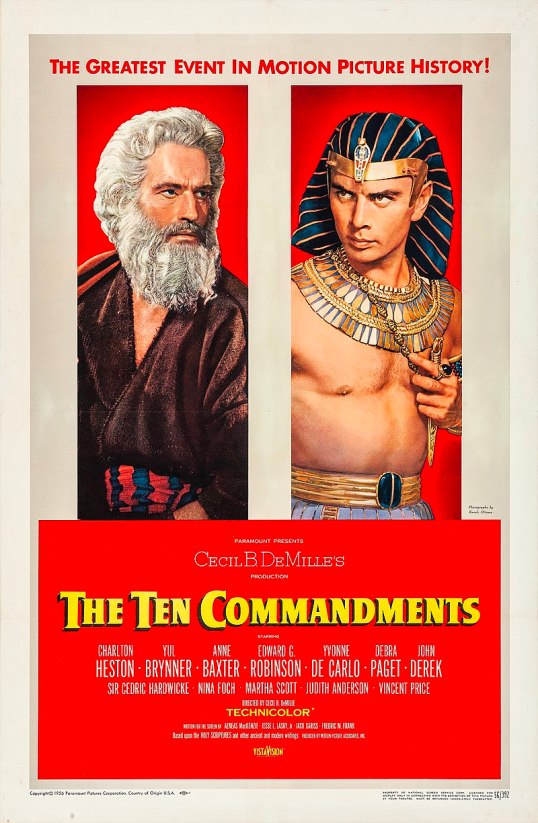
Film Review: The Ten Commandments (dir by Cecil B. DeMille)


Though you may not know it if you’ve only seen the film during one of its annual showings on television, the 1956 religious epic, The Ten Commandments, originally opened with director Cecil B. DeMille standing on a stage.  Speaking directly to the audience, DeMille explains that, though the film they’re about to see me take some dramatic license with the story of Moses, it still based on not just the Bible but also the accounts of Philo, Josephus and Eusebius.  He also tells us that The Ten Commandments is more than just an adaptation of the Book of Exodus.  Instead, it’s a film about every man’s desire to be free.

Demille concludes with: “The story will take 3 hours and 29 minutes to unfold.  There will be an intermission. Thank you for your attention.”

To be honest, it’s kind of a sweet moment.  Cecil B. DeMille is a name that is so associated with (occasionally overblown) epic filmmaking that it’s easy to forget that DeMille was one of the most important names in the artistic development of American cinema.  He was there from the beginning and, unlike a lot of other filmmakers, he was equally successful in both the silent and the sound era.  Say what you will about his films, DeMille was a showman and he handles the introduction like a pro.  At the same time, there’s a real sincerity to DeMille’s tone.  After you listen to him, you’d almost feel guilty if you didn’t sit through all 3 hours and 29 minutes of his film.

That sincerity extends throughout the entire film.  Yes, The Ten Commandments is a big, long epic and some members of its all-star cast are more convincing in their roles than others.  And yes, the film can seem a bit campy to modern viewers.  (In fact, it wouldn’t surprise me if it seemed a bit campy to viewers in 1956 as well.)  Yes, The Ten Commandments does feature Anne Baxter saying, “Oh Moses!  You sweet adorable fool!”  But it doesn’t matter.  Even the most ludicrous of dialogue just seem right.  The film is just so sincere that it’s difficult not to enjoy it.

In the Book of Exodus, Moses is described as having a speech impediment and even tries to use it as an excuse to get out of going to Egypt.  That’s actually one of the reasons why Moses brought Aaron with him to Egypt, so that Aaron could speak for him.  In the movie, Moses is played by Charlton Heston, who comes across as if he’s never felt a moment of insecurity over the course of his entire life.  But no matter.  Heston may not by the Moses of Exodus but he’s the perfect Moses for the DeMille version.  When Heston says that Egypt will be visited by plagues until his adopted brother Ramses (Yul Brynner) agrees to allow the Jews to leave Egypt, you believe every word.  (Aaron, incidentally, is played by the legendary John Carradine.  He doesn’t get too much other than respectfully stand a few feet behind Charlton Heston but still: John Carradine!)

And really, anyone who dismisses The Ten Commandments out-of-hand should go back and, at the very least, watch the scene where the Angel of Death descends upon Egypt.  The scene where Moses and his family shelter in place while the screams of distraught mothers echo throughout the city is chilling.  Ramses may spend most of the film as a petulant villain but you almost feel sorry for him when you see him mourning over his dead son.  When he sets off after Moses, it’s not just because he’s doing what villains do.  He’s seeking vengeance for the loss of his first born.  For that brief moment, Ramses goes form being a melodramatic bad guy to being someone with whom the viewer can empathize.  Brynner, with his burning intensity, gives a great performance as Ramses.

As I said before, this film has what, in 1956, would have been considered an all-star cast.  Watching the names as they show up during the opening credits — Cedrick Hardwicke!  Yvonne DeCarlo!  Woody Strode!  Debra Paget! — is like stepping into a TCM fever dream.  Some of the performers give better performance than others.  And yet, even the worst performer feels as if they just naturally belong in the world that DeMille has created.  John Derek may seem rather smarmy as Joshua but his callowness provides a good contrast to the upright sincerity of Heston’s performance as Moses.  Edward G. Robinson’s cries of, “Where is your God now!?” may have provided endless fodder for impersonators but just try to imagine the film without him.  Even Vincent Price is in this thing!  He doesn’t have his famous mustache but, as soon as you hear his voice and see that famous glare, you know that it’s him.

Of course, when you’re growing up and The Ten Commandments is on TV every year, you mostly just want to see the scene where Moses parts the Red Sea.  The Ten Commandments was nominated for seven Oscars but it only won one, for its special effects.  (The prize for Best Picture went to another epic, Around The World In 80 Days.)  Today, the film’s special effects may no longer amaze viewers but there’s still something rather charming about the Red Sea parting and then crashing in on the Egyptian army.  The scene where the Earth opens up and swallows those who worshiped the Golden Calf remains impressive, if just because all of the extras really look terrified that they might die.  And while the Pillar of Fire may look a bit cartoonish to modern eyes, that’s a huge part of the film’s appeal.

The Ten Commandments is a big, long, sometimes silly, sometimes effective, and always entertaining epic.  It’s a grand spectacle and one that I usually watch every year when it shows up on television.  I missed this year’s showing but, fortunately, I own it on DVD.  It’s a sincere epic and a difficult one not to like.


30 Days of Noir #17: Loan Shark (dir by Seymour Friedman)


The 1952 film, Loan Shark, opens with a familiar film noir situation.

A man walks down a dark city street.  Judging from the way that the man keeps looking over his shoulder, he’s obviously nervous about something.  Suddenly, we hear two sets of footsteps approaching him and it quickly becomes apparent that the man has good reason to be so nervous.  The man is being pursued by two gangsters.  (We know that they’re gangsters because of the suits and the fedoras.)  The gangsters toss the man in an alley and proceed to beat the Hell out of him.

The local tire factory has a problem.  Though its employees are highly valued, they’re not highly paid.  In order to make ends meet, many of them have resorted to gambling.  Plant foreman Charlie Thompson (Russell Johnson) always seems to have the latest tip on a sure thing.  Interestingly enough, the tips never seem to pan out and, as a result, the workers are forced to go to the local loan shark, Lou Donelli (Paul Stewart).  Lou always loans them the money but he charges exorbitant interest and, when the workers can’t pay back the loans, he sends his thugs to beat them up.  The factory’s management knows that they have to do something to take this loan shark out of commission.

Now, what would you do if you were a part of management?  Would you go to the police and maybe see if they could arrange to put a trained undercover cop in your factory?  Or would you hire an ex-con and tell him to just take care of it on his own?

The ex-con in question is Joe Gargen (George Raft).  He’s just been released from prison, though the film is quick to point out that Joe didn’t really do anything that bad.  He just hit a guy who was being obnoxious.  The guy fell back and hit his head and, as a result, Joe was charged with assault with a deadly weapon.  (As Joe explains it, he’s a former boxer and, as a result, his fists are legally considered to be deadly weapons.)  When Joe is first offered the clandestine job at the tire factory, he turns it down.  As he explains it, he’s not looking to get in any more trouble with anyone.  But then when the loan sharks kill his brother-in-law, Joe reconsiders.

Soon, Joe is working at the tire plant.  (If you’ve ever wanted to see, in meticulous detail, how a tire is made, this is the film to watch.)  After Charlie gives him a bad tip on a horse, Joe finds himself in debt to Donelli.  However, when Joe manages to beat up the thugs that Donelli sends to collect, Joe finds himself with another job offer.  Soon, Joe is working for the loan sharks!  Because he can’t reveal that he’s undercover, everyone — from the administrative assistant (Dorothy Hunt) who he once took dancing to his own sister (Helen Westcott) — is disgusted by Joe’s actions.  Joe finds himself a pariah but he’s still determined to discover the identity of Donelli’s boss.

With it’s combination of the mob and exploited blue collar workers (not to mention it’s use of an ex-boxer as its protagonist), Loan Shark lightly treads on the ground that would later be covered, in a far more exacting manner, by On The Waterfront.  Unfortunately, Loan Shark suffers a bit from the miscasting of George Raft in the lead role.  Raft was a charismatic actor but, when he made Loan Shark, he was 51 and looked about 9 years older.  When Raft shares what is meant to be a romantic dance with Dorothy Hart, he looks more like a proud father dancing with his daughter at a wedding reception than anything else.  Loan Shark is one of those films that calls out for a younger actor, a William Holden or maybe a John Garfield.  That said, Raft was a genuine tough guy and, despite his advanced age, he still looked like he could go a few rounds.

That said, Loan Shark is a tough and shadow-filled film, one that features some genuinely exciting fight scenes.  Miscast or not, when George Raft throws a punch, you believe it.

Lisa Cleans Out Her DVR: The Silver Chalice (dir by Victor Saville)


If you ever needed proof that everyone has to start somewhere, look no further than the 1954 biblical epic, The Silver Chalice.

The Silver Chalice features the film debut of Paul Newman, who later proved himself to be a legitimately great actor.  It’s true that, unlike a lot of actors, Newman made his debut in a starring role.  He never had to humiliate himself with any one-line roles or walk-on bits.  No, Paul got to humiliate himself with a starring role.

Paul Newman was 29 years old when he played Basil, a former slave turned sculptor.  Not only did Newman bear a disconcerting resemblance to Ben Savage (of Boy Meets World fame) but he gave a performance that was so bad that it’s kind of a shock that he ever worked again.  Basil is a passionate artist, one who survived being betrayed by his adopted family and slavery.  Newman comes across like a nice, young man from Iowa.  Usually, Newman looks miserable but occasionally, he flashes a somewhat weak smile.  When Basil gets mad, Newman speaks in a squeaky voice.  When Basil is feeling reverent, Newman furrows his brow like a hungover Russell Brand staring straight into the sun.

“But me and Topanga are soul mates…”

Then again, I’m not sure that any actor could have given a good performance as Basil.  The Silver Chalice has a terrible script, one that was written by Lesser Samuels.  (I’ll avoid the obvious joke about whether or not The Silver Chalice would have been better if written by Greater Samuels.)  Apparently, before Newman was cast, the producers pursued James Dean for the role.  I’m sure we all would have enjoyed seeing Dean slouch his way through the film but I doubt that even he could have done much with The Silver Chalice.

The Silver Chalice is based on a novel, which perhaps explains why there’s so many characters and so many unnecessary subplots.  Basil follows a path that will be familiar to anyone who has seen a 1950s biblical epic.  He’s a young Greek who is adopted into a noble Roman family.  When his kindly stepfather dies, Basil’s stepsiblings sell him into slavery.  It’s not an easy life but Basil is a talented sculptor so Joseph of Arimathea commissions him to make a silver chalice for the Holy Grail.  Basil goes from poor to rich to poor again to rich again to ultimately saved by grace.  He even gets to do the same walking towards Heaven thing that Richard Burton did at the end of The Robe.

Meanwhile, Simon Magus (Jack Palance) is wowing the citizenry with his magic tricks and claiming to be the risen Messiah.  Simon’s assistant just happens to be Helena, who knew Basil when he was younger.  Young Helena is played by dark-haired Natalie Wood.  Grown-up Helena is played by blonde Virgina Mayo.  They were both good actresses but there’s seriously no way that Natalie Wood would have ever grown up to be Virginia Mayo.

Jack Palance pretty much steals the movie, mostly because he gets to wear the silliest costumes:

Poor Paul Newman has to settle for a tunic and a miniskirt, while Jack Palance gets to wear this:

Personally, I’ve always enjoyed the story of Simon Magus.  He tried to show off by flying over the Roman Forum so St. Peter said a prayer and Simon promptly plunged to his death.  Take that, you Gnostic!

Another interesting thing about The Silver Chalice is that the sets are very deliberately fake.  I don’t mean that they look cheap.  I mean, much as in the style of German Expressionism, the sets are specifically designed to remind you that you’re watching a movie.

For instance, look at the wall behind Palance:

Look at this pleasure palace:

Look at Rome at night:

The sets are extremely dream-like and yet everything else about the film is extremely slow and conventional.  One wonders if director Victor Saville was trying to make an art film, though there’s nothing else in his long filmography that would suggest that Saville was anything other than a workmanlike director.  In fact, most biblical epics of the time took a lot of pride in looking as expensive and “accurate” as possible.  Major studios in the 1950s were not known for artistic experimentation, especially when it came to Biblical epics.  It’s hard to know what to make of The Silver Chalice‘s artistic flourishes, which is why it’s easier to just focus on what a terrible performance Paul Newman gives.

That’s certainly what Paul did!  In 1966, when The Silver Chalice finally premiered on TV, Newman took out a newspaper ad in which he apologized for his performance and then asked people not watch.  Apparently, he also used to show the movie during parties on the condition that his guests mock the film while watching it.

I don’t really blame him.  It’s an amazingly dull film and Newman looks absolutely miserable in nearly every other scene.  However, because it did star Paul Newman, The Silver Chalice will always have a life on TCM.

Speaking of TCM, they last broadcast this film on February 24th as part of their 31 Days of Oscar.  (It was nominated for both its sets and its score.)  That is when I recorded it.  And, after watching it yesterday, I was more than happy to erase it.

The Fabulous Forties #12: D.O.A. (dir by Rudolph Mate)


DOA1950

The 12th film contained in Mill Creek’s Fabulous Forties box set is the classic film noir D.O.A.  Before I get into reviewing this film, there’s an oddity that I feel the need to point out.  According to the back of the Fabulous Forties box, D.O.A. was released in 1949.  However, according to Wikipedia, imdb, and almost every other source out there, D.O.A. was released in 1950.  In short, it’s debatable whether or not D.O.A. actually belongs in the Fabulous Forties box set but it really doesn’t matter.  D.O.A. is a classic and, along with Night of the Living Dead, it is undoubtedly one of the best B-movies to ever slip into the public domain.

D.O.A. opens with a lengthy tracking shot, following a man named Frank Bigelow (Edmond O’Brien) as he walks through the hallways of a San Francisco police station.  Frank walks with a slow, halting movement and it’s obvious that he is not a healthy man.  When he finally steps into a detective’s office, Frank announces that he’s come to the station to report a murder — his own.

Frank is a small-town accountant who came to San Francisco for a vacation.  After a long night of drinking, Frank woke up feeling ill.  When he went to a doctor, he was informed of two things.  Number one, he was in overall good health.  Number two, he only had a few days to live.  Sometime during the previous night, Frank was poisoned with a “luminous toxin.”  There was no antidote.

The rest of the film follows Frank as he attempts to figure out who poisoned him and why.  It’s an intriguing mystery and I’m not going to ruin it by going into too many details.  Over the course of his investigation, the increasingly desperate Frank comes across a gangster named Majak (Luther Adler).  This leads to a lengthy scene in which Majak’s psychotic henchman, Chester (Neville Brand), repeatedly punches Frank in the stomach.  It’s a scene that, even in our far more desensitized times, made me cringe.  I can only imagine how audiences in 1950 reacted.

(There’s also a shoot-out at a drug store that can stand alongside almost any modern-day action sequence.  Regardless of whether the film was made in 1949 or 1950, it still feels like a movie that could have just as easily been made in 2016.)

But really, the mystery is secondary.  Instead, D.O.A. is truly about Frank and how he deals with the knowledge that he is going to die.  Before being poisoned, Frank is the epitome of complacent, middle-class suburbia.  He’s engaged to Paula (Pamela Britton) but he’s in no hurry to marry her.  He’s got all the time in the world.  When Frank goes to San Francisco, he epitomizes the bourgeoisie on vacation.  He goes to the 1940s equivalent of a hipster nightclub, not because he’s actually interested in what the scene is all about but because he’s a tourist looking for a story to tell the folks back home.  When he checks into his hotel, he leers at every passing woman with a casual sexism that would not be out-of-place on an old episode of Mad Men.  Frank is floating through life, confident in his own complacency.

It’s only after he’s poisoned that Frank actually starts to live.  He goes from being passive to being aggressive.  Knowing that he’s going to die, he no longer has anything to lose.  Only with death approaching does Frank actually start to live.  Frank’s realization that he waited to long to live makes his final line all the more poignant.

D.O.A. is a classic!  Watch it below, you won’t be sorry!

Embracing the Melodrama Part II #23: The Defiant Ones (dir by Stanley Kramer)


Defiant_Ones_poster

Stanley Kramer is one of those old school filmmakers who directed several films that were acclaimed when they were originally released but who tends to be dismissed by contemporary film critics.  Kramer specialized in making films about social issues and he deserves to be applauded for attempting to look at issues that Hollywood, at that time, would have preferred to ignore.  However, as Mark Harris points out in his excellent book Pictures At A Revolution, Kramer started out as a producer and, even after he started directing, he never lost his producer sensibility.  As a result, a Kramer film would typically address issues that were guaranteed to generate a lot of free publicity but, at the same time, Kramer would never run the risk of truly alienating his audience by digging too deeply into those issues.  As a result, Kramer’s films have come to represent a very safe and middlebrow version of 50s and early 60s style liberalism.

Now, I have previously reviewed 4 Stanley Kramer films on this site and I have to admit that I was somewhat dismissive of most of them.  I felt that Ship of Fools was shallow.  I thought that Guess Who’s Coming To Dinner collapsed under the combined weight of a self-satisfied script and Kramer’s refusal to let Sidney Poitier’s character be anything other than idealized perfection.  R.P.M. is a guilty pleasure, specifically because Kramer was so out-of-touch with the film’s subject matter.  I did give Judgment at Nuremberg a good review, describing it as one of Kramer’s rare films that still holds up today.

And now, I’m going to give another Kramer film a good review.

Kramer’s 1958 film The Defiant Ones features a classic Kramer situation.  White Joker (Tony Curtis) and black Noah (Sidney Poitier) are both prisoners in the deep south.  Joker is an unrepentant and violent racist while Noah … well, Noah is Sidney Poitier.  He’s determined, he’s not afraid to speak his mind, and most of all, he’s dignified.  That’s not meant to be a complaint about Poitier’s performance in The Defiant Ones.  In the role of Noah, Poitier has a great screen presence and it’s impossible not to root for him.  Whereas Curtis tends to chew up every piece of scenery that he gets nears (and, again, that’s not really a complaint because Curtis’s overacting is totally appropriate for his character), Poitier keeps the film grounded.

When the prison bus that is transporting them crashes, Joker and Noah are able to escape.  Fleeing on foot, they make their way through the wilderness and attempt to hide from the police.  As quickly becomes obvious, Joker and Noah hate each other but, because the sheriff had a sense of humor, they have also been chained together.  In other words, they’re stuck with each other and, in order to survive, they’re going to have to learn to coexist.

No, it’s not exactly subtle but it works.

As a filmmaker, Kramer was never known for being visually inventive and, as a result, his films often had to resort to heavy-handed monologues to make their point.  But, in The Defiant Ones, the chains act as a great visual symbol for race relations in America.  Joker and Noah literally can’t escape from each other and they have to work together if they’re going to survive.  The chains make that obvious and, as a result, this is the rare Kramer film where nobody has to give a big speech to get across Kramer’s message.  As a result, The Defiant Ones preaches without ever getting preachy.

Though the film is dominated by Poitier and Curtis, it also features some excellent supporting work.  Lon Chaney, Jr, for instance, has a great cameo as world-weary man who helps the two convicts in their flight.  Cara Williams is surprisingly poignant as a lonely, unnamed woman who tries to both protect Joker and get rid of Noah.  And finally, there’s Theodore Bikel, playing the role of Sheriff Max Muller.  Max is the most surprising character in the film, the head of a posse that’s set out to recapture Noah and Joker.  As opposed to most of his men, Max is a humane and caring man who struggles to control the more bloodthirsty men who are serving under him.

Message films tend to get dated rather quickly but The Defiant Ones holds up surprisingly well.

http://www.youtube.com/watch?v=tkzgmgLl8qA