Trash Film Guru Vs. The Summer Blockbusters : “Man Of Steel”


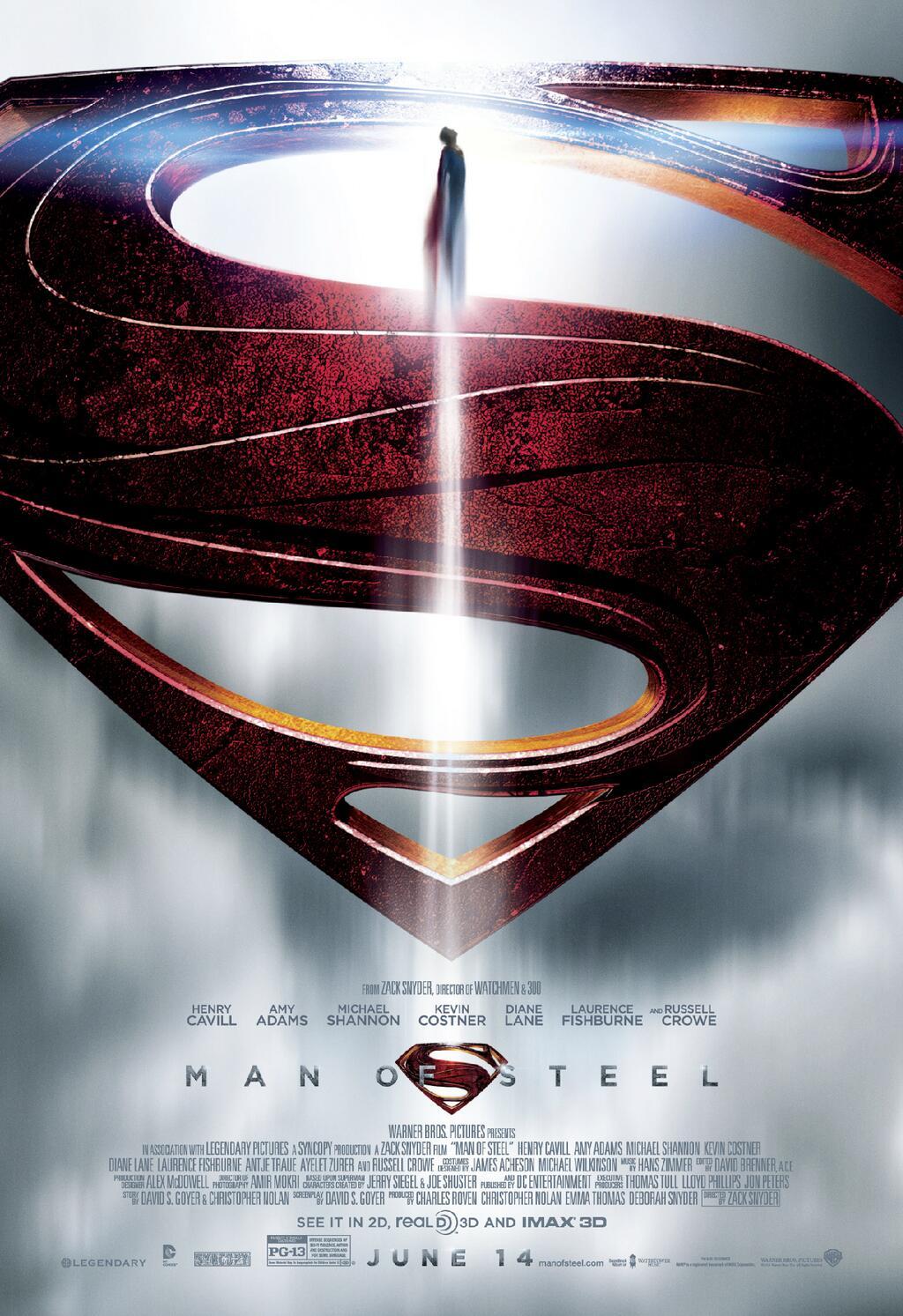
New Man of Steel Poster

I know that, in this day and age, we as a society seem to get off on tearing down our myths and legends and “humanizing” them, but seriously — when did Superman develop a split personality?

Before you jump to any conclusions based on that admitted “gotcha” of an opening line, allow me to state for the record that I didn’t actively dislike Zack Snyder’s Man Of Steel, it’s just that it spends its first half or so rather half-heartedly trying to portray its title character in more human terms than we’ve seen in previous iterations before finally throwing all that out the window and deciding that it actually wants to tell a story about a God who walks (and flies) among us, and the film definitely suffers as a result of this abrupt shift in tone.

But first the “plus” side of the ledger : Man Of Steel is pretty much the most awesome visual spectacle the movies have ever produced. I’m no fan of CGI as a general rule, but damn if every single effects shot in this flick isn’t enough to take your breath away, particularly the sequences on Superman’s home planet of Krypton, which Snyder and his WETA-employed staff depict in a markedly new and exciting “biotech on steroids” fashion. When the action goes earthbound, the optical awesomeness continues, never fear, so if spectacle is what you’re after, you’ll walk away from this well pleased indeed.

Pitch-perfect (with one notable exception which we’ll get to in a moment) casting doesn’t hurt matters any, either — Henry Cavill makes an immediate impression in both his Superman and Clark Kent personas; Russell Crowe is suitably above it all as his Kryptonian father, Jor-El; Kevin Costner and Diane Lane are almost too spot-on for words as his adopted human parents; Laurence Fishburne’s Perry White is old-school newspaper vet all the way (even with the pierced ear); and the always-underrated Michael Shannon oozes psychotic menace as lead villain General Zod. Watching all these people at work is a genuine joy.

Granted, the script — by Dark Knight veteran David S. Goyer (from a story co-plotted with the head honcho of this whole enterprise, Christopher Nolan) — doesn’t do any of them any favors dialogue-wise (apparently Kryptonians have evolved beyond good, old-fashioned conversation and speak entirely in grandiose pronouncements — but it’s not like the mere humans in this film are any less prone to dull, dry, wooden,  faux-poetic waxings themselves), but the players by and large manage to rise above the material they’ve been handed.

I say “by and large” (and here comes that exception I talked about a moment ago) because, sadly, one has been dealt such a losing hand that I’m not sure what she could really have done about it — I’m speaking, of course, about Amy Adams’ Lois Lane. Goyer does some brave and interesting things in terms of shaking up the established Clark-Lois backstory ( let’s just say she won’t be sneaking glimpses of him at sly angles when his glasses are off to see how much he might or might not look like Superman), but the cold, emotionally distant nature of this particular big-budget beast means that the whole love story angle falls pretty flat. By the time Goyer, Nolan, and Snyder decide they want to play the Nietzchean uberman card for all it’s worth, the independent, confident journalist we meet at the outset is reduced to becoming more awestruck than she is lovestruck, and rather than being “Superman’s girlfriend” she comes off more as his disciple. Who just so happens to kiss him. I mentioned the abrupt tonal shift in the film at the outset of this review, and poor Lois definitely suffers the brunt of it.

The messianic poses Cavill is forced into during all the flight and battle sequences get pretty old pretty fast as well, it’s gotta be said, and with no real transition period in the way the story is structured between its “simple farm boy from Kansas”  and its “demi-god here to save us all from the evil forces originating from his own homeworld” (that he inadvertently brought here himself, but hey, let’s not dwell on that) segments, well — let’s just say not much thought apparently went into how jarringly that would all play out. Hans Zimmer’s typically percussive, insistent musical score only augments the problem, and while there’s no way anybody was gonna have fans forgetting about John Williams, a “stripped-down,” “less over the top” orchestral accompaniment really doesn’t work when you’re trying to portray Superman as a fucking deity.

Superman purists, for their part,  may also find themselves semi-outraged by more than the snakeskin-fetish-wear take on his costume. There’s no Jimmy Olsen here, no Lex Luthor (although the “Lexcorp” logo appears here and there on props throughout — as do the logos for Sears, 7-11, and an unending and highly annoying litany of corporate sponsors), and “Metropolis” is never mentioned by name even though the entire final act takes place there. So be ready for at least some “nerd-rage” on the internet. Still, if those were the only things that bugged me about Man Of Steel, I’d be feeling a little bit better about it as a whole right about now. Not that I’m all that pissed or disappointed —-just, well, kinda perplexed.

I can’t say that Man Of Steel isn’t a fun movie to watch, because it is — hell, it’s an absolute visual marvel, and if you want to shut your brain off and just be taken along for a wild adventure ride, you’re not gonna do much better this (or any other) summer  Still —my mind kept drifting back to the famous first-encounter-between-Supes-and-Lois scene in Richard Donner’s Superman : The Movie (still the gold standard for all superhero flicks as far as I’m concerned) : when Lois asks him “who are you?,” and he replies, simply and with a smile, “a friend,” that told us all we needed to know right there. Sure, he was faster than a speeding bullet, more powerful than a locomotive, and able to leap tall buildings in a single bound, but at the end of the day , Superman as envisioned by Richard Donner, Mario Puzo, and Christopher Reeve was one of us.

By contrast, Superman a la Snyder, Nolan, Goyer and Cavill is above us. He’s not here to help humanity, but to redeem it. He’s not our hero anymore, he’s our savior — whether we want one or not.

Film Review: Man of Steel (dir. by Zack Snyder)


New%20Man%20of%20Steel%20PosterHere the short of it, for anyone looking to make a decision based on what’s being written here (spoiler free part): 

Man of Steel is a great film, though has it’s flaws. The film is a coming of age story of an individual who knows what he’s capable of, but in fearing the world’s reaction to his existence, keeps it at bay until he can discover who and what he is. Where Marvel celebrates the removal of the Masked Hero (with Iron Man), DC looks towards giving the audience a reason why Superman has to be Clark Kent, which I thought worked very well. Carried by some fantastic casting, the film manages to raise the stakes for Superman (and the damage level of anywhere there’s a fight – I’m talking Dragonball Z levels of damage) in a way that up until now really wasn’t depicted well. Rather than taking the lazy route of Superman Returns (which just took Superman II’s ending and ran with it, saying that III and IV just didn’t happen), Man of Steel tries to re-invent things a little, which works on some levels, but not on all.

The faults of the film lie in the same problems that plagued the entire Dark Knight Trilogy. There’s a scene or two that ends without “closing the loop” and work within a bubble of action – a catastrophe occurs for one or two people, but before you can wonder how everyone else in the area fared, you’re left to believe “Well, let’s just assume they’re all okay and everything was fixed.” It’s the same as the Joker throwing Rachel Dawes out of a window and leaving the audience to believe that the Joker’s crew just left the way they came with no fuss or muss. The film also suffers from the physical fight issues of “Batman Begins”. It all moves so fast that in some cases, you’re left with this shaky-cam feel. It almost warrants a second viewing just to try to see the punches / kicks you may have missed the first time around. And the last act has a lot of that. This is the thing that may hurt the film with older movie goers. Imagine having something you’ve grown up with for who knows how long displayed at a speed so fast, it moves like a video game? That could be jarring.

And for those of you want to read more (it may get just a little – very little – on the spoilery side here): 

I’ll start with this. I’m not a huge fan of Superman overall. Although I’ve seen all of the previous film (many of them at the movies), I’ve always thought of Superman as a seriously overpowered character. With the pieces of his own planet being the only thing that could hurt him, what were the chances anyone could find that stuff? For this, I found the Marvel characters more interesting and relatable. How many stories can you really write about the Hulk, or Namor / Aquaman for that matter? That’s where I put Superman in the scheme of things.

That said, Zack Snyder’s Man of Steel did manage to invoke an emotion in me that I’ve never felt for the character in all these years – Sadness. It was like watching a Bond film and actually worry about Bond, imagine that. You figure this guy has all these powers, he can frickin fly, dammit. He has heat vision, x-ray vision and freezing breath. One could choose, with all that power to just dominate humanity. It’s Clark’s parents – all of them – that give him the power of choice. To decide as he grows to become who he wants to be and how to use those abilities.  That has to be pretty difficult. One scene hit home for me, involving Clark learning an ability. It’s short, but reflects the isolation of someone who is considered very different from those around him.

I loved Man of Steel. It’s does have its issues, but for me it’s such a step in a better direction for the Superman franchise. That isn’t to say that the films before it were terrible or horrid (save for Quest of Peace, which was utter crap), but Man of Steel brings so much more action and love for the character overall. Where Superman Returns was more of a drama with slices of action, perhaps Man of Steel is best consider a reversal.

When it comes to the story – penned by Christopher Nolan and David Goyer, and with Goyer doing the screenplay – I liked where it went. It didn’t try to recreate anything from the first two movies, nor did it sway so far away from it that you wondered what it was all for (Amazing Spider Man, with its thousands of radioactive spiders that could make any scientist Spider-Man with a well timed bite). The origin parts are delivered piecemeal though flashbacks, which allowed the whole story to flow pretty evenly. It’s when the movie gets into the third act – the “Hero has to face said Event” sequence that Goyer loves so much that it starts turning right back into the Batman Begins train sequence. At least the level of the event is big enough so that only Superman could really deal with it, but personally, I’ll admit that I wanted a bit more for what was done.

Casting wise, I don’t think they could have done much better than this. Henry Cavill, who I remember from 2002’s The Count of Monte Cristo and Showtime’s The Tudors, is damn near perfect as the Man of Steel, though he has so much seriousness to him that you wanted to say…”Hey, Hakuna Matata, dude. It’ll all work out. Just lighten up a little.” There’s very little playing around here.  Then again, given the way the character was written this time around, he doens’t have all that much to laugh about, I suppose.

Amy Adams really isn’t the Lois Lane I expected. She’s not written in the style of the intrepid reporter that has to get herself in trouble, but still manages to find herself facing problems in the pursuit of a good story. She wasn’t bad at all, really, but one smart thing the story does is forces her to have to be in the mix of this in less of a spectator role and more of a participant. That I enjoyed.

I gave Michael Shannon a lot of flak for his performance in last year’s Premium Rush, but I owe him an apology. All that craziness in that film is just gone here, his General Zod is subdued and even. I also enjoyed that they gave him something more to work with other than “Dominate the creatures of this planet because we hate the son of Jor-El”. His Villain has a fully plausible reason for what he’s doing, so much so that you could almost empathize with it. He’s not very different from Magneto against the X-Men in that fashion, and I felt it added quite a deal to this story. Don’t get me wrong. Terrence Stamp was great, and his “Kneel Before Zod” was always cool, but the premise in Superman II was a little odd. I figure they’d get bored with us kneeling after a while and just leave the planet once discovering our love for reality tv (Pawn Stars for me).

Someone pointed out online that both of Kal-El’s parents were Robin Hood. Both Russell Crowe and Kevin Costner do indeed play Clark’s fathers and both are used better in this than in previous versions. Each character has a view in what Clark can be become, and both individuals seem to be right, but between the two I thought Costner fared better. One thing about Crowe, he’s given quite a bit to do in this film, which surprised me. I did really didn’t expect to see much of him in this.

Diane Lane is a sweet Martha Kent. While I love Lane in her movies, I don’t know. I kind of feel anyone could have played that. She performs the role well, though. Laurence Fishburne makes for a good Perry White, channelling his character from Hannibal, as does Christopher Meloni as a Military General. I really want to see more from Meloni, actually. The scene stealer, by far (and future Hottie of the Day, if I can find enough pictures of her) is Pandorum’s Antje Traue as Zod’s henchwoman, Faora. Every scene she’s in makes her to be that Darth Maul /   Hellboy kind of supporting baddie, providing as much of a challenge to Superman as Zod. And for the time she has on screen, Ayelet Zurer sells it totally as Lara, siding with her husband to send their child away for a chance at a better life. That can’t be an easy decision for anyone or anything, but I could at least feel she was bothered by it.

Personally, I didn’t want another origin tale. The way I view it, some of these characters are so burned into our minds that we really don’t need to know the back story. However, Man of Steel does provide an origin tale that seems to make sense with the way things are today. We don’t trust what we don’t understand and unless we can catalog and easily reference it to something comparable, we usually consider it something bad. As this story tells it, Superman may or may not have the luxury to openly say “Hey, I’m Kal-El, from Krypton, let me walk among you.” as easily as Tony Stark could proclaim he was Iron Man.

As for the DC Cinematic Universe, if this is the first film that’s going to lay the groundwork, it’s a nice start. It doesn’t leave any breadcrumbs for audience expectation for a Justice League movie, but if  DC is smart, they’ll get whatever the next movie they want to do started right after this. That’s the hope, anyway.

With a new direction in tone also comes a new score. Hans Zimmer knocks the soundtrack out of the ballpark with this one. Bringing together nearly 12 drum legends for percussion (including Sheila E. And Jason Bonham), Zimmer creates a theme for the hero that will undoubtedly be reused in sports venues for years to come. It’s uplifting in places and creepy in others. Some themes borrow a little bit from his own Angels & Demons, but this is something Zimmer is known for. Having listened to the score for most of the week, I’m already humming it off and on.

And what about the kids? The kids should be fine seeing this. There’s a childbirth sequence in the very beginning that may require some explaining to the littlest of viewers, and there’s violence all over the place, but all it’s worth, there’s not a whole lot of blood and very little gore. Nothing anyone who plays Call of Duty on the regular couldn’t handle.

Oh, one more thing. The 3D is good here, particularly in the flight sequences, but you’re not really missing anything if you happen to catch it in 2D. Note that there isn’t anything after the credits with this film.

Trailer: Man of Steel – “Fate of Your Planet”


ManofSteel

Leading up to this film I was still hesitant to embrace it after the underwhelming Superman Returns. I think the more fun and energetic Marvel Studios fare has spoiled me to the the more dour (though still entertaining) take on the DC main heroes (though the Green Lantern one was neighter serious, fun or enjoyable).

The trailers and teasers already released for Man of Steel has focused a lot on the existential question about who or what Superman is and his role on Earth. Some of the teasers and trailers even try to ape the Terence Malick visual-style with the close-ups of waving wheatfields and background narration asking deep questions. But this latest trailer now switches gear and focuses on the villain of the film and more action.

I’m not hugging this film 100%, but this latest trailer has me closer to embracing it.

Will Man of Steel be too dour a la Christopher Nolan or two much a visual overload by way of Zack Snyder or will the two differing storytelling styles be able to meld into a perfect balance to finally give Superman his day in the sun once again.

Man of Steel is set for a June 14, 2013 release date.

Trailer: Man of Steel (3rd Official)


ManofSteel

We’re now just two months away from one of this year’s biggest and most-anticipated films. It’s also one of the biggest gamble for Warner Bros. Pictures in light of the success that Marvel/Disney had with their Marvel Cinematic Universe.

Man of Steel looks to reboot that Superman film franchise after the lackluster Superman Returns of a few years back. Gone are Bryan Singer and in comes Zack Snyder in the director’s chair with Christopher Nolan (himself reviving the Batman franchise from the depths) overlording over it all. It’s a recipe that smells success, yet there’s still some nagging doubt about whether it’s going to rule the summer and become the stepping stone to what Warner Brothers hopes will be their return shot at Marvel/Disney: a Justice League film.

The first trailer for Man of Steel had quite the Malickesque look to it. From the subtle music in the background to existential narration about the nature of Superman. Then that was followed up a couple months later by a more action-packed trailer that had the hallmarks of Snyder as a visual artist of onscreen mayhem. Now we have a third trailer (hopefully a final one) that seems to be an amalgam of the first two that tries to explore the nature of Superman in regards to his adopted planet and then some action that shows Man of Steel won’t be a two and half hours of Zack Snyder channeling his inner Terence Malick.

Man of Steel is set for a June 14, 2013 release date.

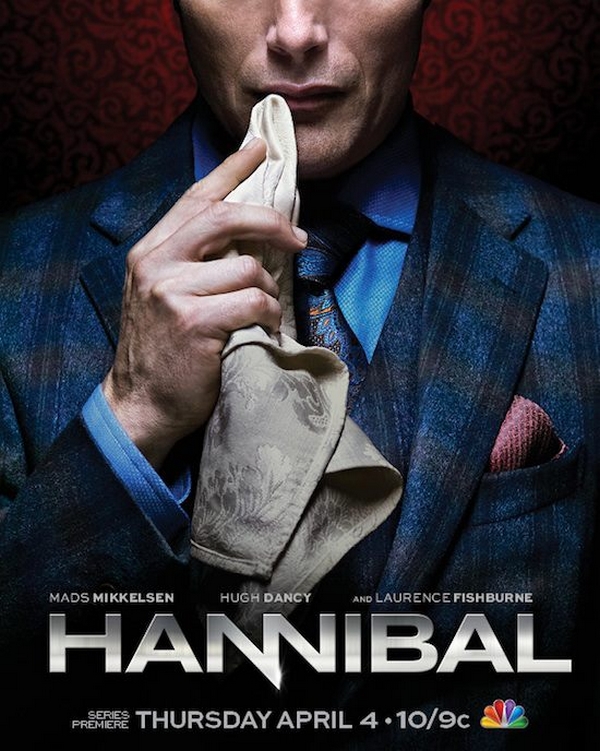
Trash TV Guru : “Hannibal,” Episode 1 : “Aperitif”


hannibal_nbc

Okay, here’s the deal — if you follow my “writing” (am I being too generous already?) either here on TTSL, on my own site,  http://trashfilmguru.wordpress.com, or on other places where my “byline” (again with the generosity!) occasionally appears such as dailygrindhouse.com, geekyuniverse.com, or what have you, it’s probably become apparent to you by this point that I don’t talk TV that much. Movies? Sure, all the time. Comics? Yeah, what the hell, I opine on those plenty, as well. But TV? This is, to my knowledge, a first. A new frontier. A new era. A new beginning. A bold, vast, wide-open, new horizon.

Okay, now I know I’m being far too generous. And grandiose. So I’ll cut it the fuck out right now.

Seriously, though, there’s a reason I don’t talk TV that much — I don’t watch TV that much. Alright, fair enough — I more or less never miss a Wolves or Wild game, so what I mean to say is that I don’t watch series TV that much. It’s just not my bag. Even with DVR and cable on demand, both of which negate the need to be in front of your screen at a set time every week,  it’s fair to say that continuing, serialized television just ain’t my thang for the most part. I’m a die-hard Doctor Who fan and have been since age, I dunno, six or seven, but my absolute, long-standing love for that show precludes me from saying what I really think about its current, depressing, lowest-common-denominator iteration too publicly. And I watch The Walking Dead and Bates Motel but Arleigh and Lisa Marie, respectively, have got those bases covered around these parts already. I’d been kind of wanting to dip my toes into the metaphorical waters of TV criticism on this site for awhile now, but there just didn’t seem much to be much point.

Then, I heard that the network suits at NBC had become either adventurous or desperate enough to green-light a series based around Hannibal Lecter, and furthermore that said new series was actually good, so I figured here’s my chance. Fair enough, the new show, simply (and unimaginatively) called Hannibal, shared a title with Ridley Scott’s genuinely atrocious entry into the Lecter cinematic canon, but why hold that against it? Especially since the territory it was going to mine, the backstory set before both the very best (Michael Mann’s Manhunter) and very worst (Brett Rattner’s Red Dragon) of the cannibal shrink’s celluloid exploits, seemed ripe for mining. Plus, rumor had it that the first episode was going to be directed by David Slade, who gave us 30 Days Of Night  and Hard Candy, two films I absolutely loved (we won’t hold the Twilight flick he did against him).

So, I figured, here it was — a show I could get in on the ground floor of and review every week for the edification of you, dear Through The Shattered Lens reader, whoever you are.

hannibal2

Confession time — I still missed the first episode anyway, despite my best intentions. The Wild were playing that night, so sue me. But I dutifully watched it on Comcast On Demand the next evening, and went in with pretty high hopes. It seemed that pretty much everyone liked this thing, from the most cynical corners of the internet to the most pompous and self-important to the most populist to, frankly, the dumbest (Entertainment Weekly, for instance, raved about it). Yup, everybody seemed to be in agreement — TV is bad bad for you, except for Hannibal.

So, yeah — maybe my expectations were too high. Maybe I just don’t “get” how series TV works. Maybe I stupidly wanted it to look and feel like Manhunter on, probably, a fraction of that film’s budget. And maybe — just maybe — I don’t know what the fuck I’m talking about, but I thought that episode one of Hannibal, titled (again rather unimaginatively) “Aperitif,” sucked.

The setup, developed/dumbed down for television by series semi-creator Bryan Fuller (Thomas Harris should still get the lion’s share of the credit in my book) probably should work (and maybe on paper it does) — FBI special agent Will Graham, here played by Hugh Dancy (he of the bloodied glasses in the photo below) is paired with noted psychoanalyst Dr. Hannibal Lecter , here played by Mads Mikkelsen (he of the refined table manners pictured above) by Bureau big-shot Jack Crawford, here played by Laurence Fishburne (he  of the admittedly rather uptight appearance pictured far below). Yup, Graham and Lecter are, for all intents and purposes, partners.

Cool, right? And let’s just for the time being leave aside the fact that Dancy is no William Petersen circa the mid-1980s and that Mikkelsen is no Bryan Cox (still the best screen Lecter, I don’t care what anybody says) or Anthony Hopkins. This is TV, we gotta set our sights lower. But even making allowances for all of that, this was still a thoroughly lifeless, clinical, dull affair. Mikkelsen’s Lecter is closer to the version seen (by those who actually did bother to see it) in Hannibal Rising, which I guess makes sense given that he’s still in the early stages of his cannibalistic career here, and by that I don’t just mean that his vaguely eastern European accent is still present. I mean he’s not the older, accomplished, seen-it-and-done-it-all super-genius criminal of the Cox and Hopkins variety — he’s still, for lack of a better way of putting it, nothing but a pompous ass who happens to eat people. Which I guess makes him more interesting than a pompous ass who doesn’t eat people, but only marginally so.

Hannibal - Season 1

As far as Dancy’s interpretation of Graham goes, he probably does a better job in the role than Ed Norton did in Red Dragon, but the ultra-trendy twists Fuller gives the character — placing him somewhere in the autistic disorder spectrum, making him single so he can apparently spark up a love interest a few episodes down the line with co-star Caroline Dhavernas — are both unnecessary and, frankly, kinda patronizing. A lot of people seem to love the the way that this show has Graham mentally “re-live” the murders he’s investigating (all of which in this opening episode supposedly take place in my home state of Minnesota — probably by way of either rural California or Vancouver) by re-casting himself in the role of the killer, but I found it to be pretty gimmicky, to be honest, and already thoroughly predictable by the second time the conceit was employed.  I’ll take William Petersen’s anguished-and-angry version of the character from Manhunter any day of the week, even if I did promise not to hold the series to the same standards as the films.

And, since I opened that door anyway — one thing that both Michael Mann and Jonathan Demme understood about Hannibal Lecter that, frankly and depressingly, no one else has seemed to be able to figure out is that, underneath his civilized and erudite trappings, this is essentially a blackly comic character.  The greatest flaw of Hannibal the TV series — even greater than the lame-as-hell, wrapped-up-way-too-quickly-and-conveniently murder “mystery” here in episode one — is  its insistence on continuing the humorless, morose trend previously established by Ridley Scott, Brett Rattner, and whoever the hell it was who directed Hannibal Rising. Fuller and Slade just plain don’t seem to get this guy at anything beyond the most surface level, and that’s a shame, because apparently we’re in for 12 more weeks of this shallow, thoroughly unsatisfying interpretation of the character.

Serie 'CSI'

Or, should I say, you are. My days as an armchair TV critic are over (at least for now). Hannibal had a few good things going for it, I suppose — particularly Laurence Fishburne’s spot-on take on Jack Crawford and the nifty little scene where Lecter feeds human meat to Graham (unbeknownst to him, of course) — but not enough to get me to tune in for more.  I’m going back to what I know best. CSI with a cannibal just doesn’t do it for me. Now, Cannibal Holocaust on the other hand —

Quick Review: Contagion (dir. by Steven Soderbergh)


Note that this isn’t the only review for Contagion.

Arleigh has an in-depth review of the film, which is also available to see, whereas this is more of a summary. As it’s for the same film, I’ve used the same tags that were in Arleigh’s post.

Before I start, I have to say that I haven’t had a theatre be so quiet during a film since I went to see Mirrors, and that was because there was no one there. My showing for Contagion was packed, but no one made a sound throughout the film. I coughed twice (because I had to), and you wouldn’t believe how many heads turned in my general direction. If nothing else, it shows that the movie had some impact to the audience, and that’s always (okay, usually) interesting to see. By the time the movie is over, you will probably pay attention to how many times you touch your face or the objects around you.

If there’s one thing I can give director Steven Soderbergh, it’s that he has a great ability to work with ensemble casts. He did a great job in getting everyone to work together on the Oceans Eleven remake and sequels. He also walked away with a Best Director Oscar for Traffic. His films have the ability to avoid having his stars chew up enough screen time that they appear to be an actual center character. Catherine Zeta-Jones’ had a character who’s story was just as strong as Benecio Del Toro’s.

On this, Contagion is no different. In essence, it’s almost like watching cameos in a miniseries.

Although the film is peppered with various actors, no one person can be considered the main character of the film. Soderbergh is able to get them all to play their roles well. He and Scott Z. Burns – one of the writers on The Bourne Ultimatum and a collaborator with Soderbergh – give us a number of perspectives for this story and damn, the whole thing is very tight overall. The movie has very little wasted space.

Like the story itself, the movie moves at a great pace, opening with Elizabeth Emhoff (Gwenyth Paltrow) on her second day after exposure to the virus after returning from a trip to Hong Kong. This eventually escalates to other infections reported in other areas around the world. In an effort to contain and understand what they’re dealing with, the Center for Disease Control starts an investigation. Lead by Dr. Ellis Cheever (Lawrence Fishburne), he sends Dr. Erin Mears (Kate Winslet) to Minnesota to determine the scale of the problem.

In addition to the CDC’s efforts, the World Health Organization also gets involved, sending their own field agent to Hong Kong, played by Marion Cotillard. Both doctors come up with information that appear to be helpful for the overall investigation in various ways.

The other two angles in the film are through a conspiracy theory blogger / investigative reporter played by Jude Law and Mitch Emhoff (Matt Damon), who has to deal with the impact of his wife’s sickness. Enrico Colantoni, Brian Cranston, Sanaa Lathan, Elliot Gould and Jennifer Ehle round out the cast. It should be noted that Ehle is the daughter of Kenneth Branaugh’s Hamlet actress Rosemary Harris, who looks remarkably like her mother. That’s just something that caught my eye.

In terms of the Kid Factor, I would be hesitant to take kids to see this unless they had a pretty clear handle on death or getting sick. Teens and adults could probably handle the film, but anyone under than that may freak out a little. Mind you, there’s very little gore in this film. When I think about it, there’s not even a whole lot of blood. There is some violence though as the story escalates and humanity goes wild, but it’s not that far a cry from many zombie movies. It’s up to the parents discretion on whether their kids should see this.

I should also point out that the music in this film is also very good. Cliff Martinez, who also worked on the score for Drive (also out this month) did an impressive job with an electronic score that sits in the background of the film, but also fits the pacing of the film well. It’s worth giving it a listen if at all possible. This quick review was actually written to the Contagion score.

Contagion is definitely worth seeing, easily recommended, but if you happen to be particular about germs, note that this may not be the most comfortable film to watch. Don’t be shocked if you end up hugging yourself while watching this in the theatre. With Soderbergh moving away from film directing to pursue other interests, Contagion is a nice final bow to his career.

Review: Contagion (dir. by Steven Soderbergh)


In a world where almost every season news media both traditional and on-line warn the population of what could be an outbreak of a new super-virus that could cause a new pandemic similar to the Spanish Flu of 1918. This was a pandemic which occurred before transcontinental travel was the norm and the virus still managed to kill 1% of the world’s population. Now, it’s 2011 and with warnings of swine flu, bird flu, Ebola, SARS and any number of infectious diseases still in the public’s consciousness we get a new film from filmmaker Steven Soderbergh which seriously explores a world discovering a new deadly disease and how the world responds and deals with the crisis.

Contagion begins with a simple “Day 2” caption as we see one Beth Emhoff (Gwyneth Paltrow) awaiting her flight to board in O’Hare at Chicago. There’s a bit of character building about this character who we see as already in the early stages of what looks to be the flu. From there Soderbergh does an interesting bit where he lets the camera linger for just a split second longer whenever Beth touches something. Soderbergh does this many times that the audience will soon get used to it and forget the significance of the act. We see Beth get a ride home from a colleague back to her home where she’s welcomed home by her husband Mitch and her young son Clark who runs to her and gives her a big hug.

The story really hits the ground running as Beth and soon those she has come into contact with begin to show similar symptoms and quickly die. The CDC and it’s head administrator, Dr. Ellis Cheever (Laurence Fishburne), soon begin to see a pattern to the deaths and the similarity to their symptoms. We soon see another aspect of the story begin with the arrival of Dr. Erin Mears whose job is to investigate the circumstance which seems to be leading into a cluster case starting with Beth and the area she lives in.

The third aspect of this film throws in internet news blogger Alan Krumwiede (Jude Law) who begins to suspect that several deaths around the world looks to be interconnected in someway and that the government, the CDC and the WHO (World Health Organization) are trying to hide these disturbing facts from the general public. Krumwiede becomes the purveyor of unfiltered news which seems to do more harm than good as more and more people begin to believe his conspiracy theories about what looks to be a growing global pandemic cause by an unknown virus every expert brought in to help cannot seem to figure out.

Let me just first say that to call Contagion a thriller in the traditional sense would be flimsy at best. Soderbergh and the film’s writer, Scott Z. Burns, have made a thriller but in a sense that it skews heavily on using realism and an almost docudrama style to push the film’s narrative. The thriller aspect comes from the notion that this film’s plot is not far off from actually becoming a real event. There’s no usage of dramatic tropes from past disaster and apocalyptic films to manipulate the audience. The film as a thriller would be quite mundane when stacked up against films like Outbreak and The Andromeda Strain. It’s the realness of the story, the events taking place on the screen which gives the film it’s dramatic heft.

We begin to see what Soderbergh is trying to accomplish with this film. How transcontinental travel which took weeks during the 1918 Spanish Flu pandemic now can spread a highly infectious disease in a manner of less than a day’s plane flight over one ocean. The film shows in disturbing detail just how easily we as a people can spread a disease just by doing the most innocuous thing like absently touching one’s face many times a minute then transferring whatever we had to any surface we touch. Contagion definitely will add to the paranoia of those who already have an unhealthy habit of disinfecting everything before they even touch it.

The film doesn’t just touch upon the medical side of solving the growing crisis, but also explores how the governmental response and sociological reaction to the epidemic. For the former we see how protocols and the need to slowly disseminate information to the public only adds to the public’s mistrust of the very agencies created to help them in case of such an event. Soderbergh doesn’t condemn or praise these agencies for their bureaucracy. We see the reason why places like the CDC take their time to finally inform the public as we get the unfiltered and manipulative news blog side of the news media in the form of Krumwiede’s blog. While he does dare to ask the questions other more traditional news organizations fail to ask he also becomes too enamored with how many people read his blog that he’s willing to manipulate the news itself in order to gain more followers.

Contagion hits the second half of the film with the world in full crisis mode and the film taking on a more apocalyptic tone. We see streets in San Francisco full of garbage bags as agencies who used to pick them up have either gone on strike or have stopped their daily runs in fear of infection. Then there are the riots at pharmacies and stores as interstate commerce grounds to a halt and no new supplies of goods and sundries make it to stores. Society itself begin to devolve as everyone and every group start to look after their own and begin to turn on others for the dwindling supplies.

It’s here in the second half that we see the film take on some of the more traditional aspects of a thriller, but even here Soderbergh doesn’t seem to want to linger on the more sensational side of the story. He continues, for good or ill, on the narrative style he began with and that’s to see the epidemic from beginning to conclusion in as clinical a manner as possible. It’s for this reason that at times the more intimate and personal side of the film’s story involving the Emhoff family seemed like it was from a different film. The Emhoff’s end up becoming the heart of the film, but it’s this emotional center that never seemed to fit with the sterile and cold narrative style Soderbergh chose to tell the film’s story.

The performances by the star-studded cast was quite good, but no one person really stood out. If I had to choose one it would have to be Kate Winslet’s Dr. Mears who goes out into the field early in the crisis investigating the early stages of the epidemic. We see her frustration at having to deal with local governmental agencies who fear the hit a quarantine would put on local economies (as if people dying in droves wouldn’t be a bigger hit) and the very danger of contracting the disease itself since having no knowledge of how it works she must use means of protection that may or may not protect her. While her story-arc in the film was just one of several it was her’s which really showed a major impact at how impersonal can be and how no one is truly safe.

Contagion is a film that tells a story about the possibility of such an event occurring and does it well, if not in a very clinical way, but it also shows just how unprepared we truly are when it comes to the smallest of creatures who sees us as nothing more than living forms of intercontinental travel. It’s exploration of such a global crisis in all it’s aspects (medical, research, governmental, media and sociological) makes it seem more like a docudrama more at home in the Discovery Channel, The Science Channel and the like instead of a cinema multiplex. It’s all due to Soderbergh’s storytelling skills that he’s able to pull off such a non-traditional thriller and make people more afraid about their surroundings coming out of the film than they were going into it. It’s not one of Soderbergh’s best films, but it’s a strong offering from him and one of the better films to come out in 2011.

Trailer: Contagion (Official)


If there’s one type of genre film I always will end up watching (sometimes to my regret if they turn out to be awful) it will be the apocalyptic-themed film. It doesn’t matter if the apocalypse about to hammer down on the planet in the film is nuclear war, some cosmic event, zombies, the Rapture, etc. As long as the world is in the brink of snuffing out I will watch it.

To find out last year that Steven Soderbergh was going to make his next big project just such an apocalyptic film was exciting. He was to take the worldwide, multi-subplot storyline and a huge cast like he did with Traffic and substitute an lethal pandemic virus for the drug war. It’s cast was to include Matt Damon, Marion Cotillard, Kate Winslet, Gwyneth Paltrow, Laurence Fishburne, John Hawkes and Jude Law to name a few. The film was going to be filmed around the world to truly give it that international feel to it.

Contagion will have a release date of September 16, 2011 and if any film really could benefit from a really great viral marketing it would be this.