Retro Television Review: Miami Vice 5.6 “Line of Fire”


Welcome to Retro Television Reviews, a feature where we review some of our favorite and least favorite shows of the past!  On Mondays, I will be reviewing Miami Vice, which ran on NBC from 1984 to 1989.  The entire show can be purchased on Prime!

This week, Crockett and Tubbs are assigned to protect a witness.

Episode 5.6 “Line Of Fire”

(Dir by Richard Compton, originally aired on December 16th, 1988)

Carlos Cantero (Aharon Ipalé) is on trial for murdering Ian Sims, one of Crockett’s confidential informants.  Crockett is the number one witness against him, which is a problem because Crockett just spent the last few months under the impression that he was Sonny Burnett, one of Miami’s biggest drug dealers.  Cantero’s defense attorney dismantles Crockett’s testimony by pointing out that Crockett had a “psychotic breakdown.”

(And you know what?  The attorney is actually very correct about that.  Crockett acts shocked when his mental health history is brought up but why wouldn’t it be?)

Luckily, there is an eyewitness to the murder of Ian Sims.  The FBI asks Crockett and Tubbs to keep an eye on Keith (Justin Lazard), a heavy metal fan who is willing to testify against Cantero.

I have to admit that I nearly gave up on this episode because my first impression of Keith was that he was the most annoying character to ever appear on a television show.  However, I’m glad that I didn’t because this episode actually introduced a very clever twist.  Keith is not actually Keith.  Instead, he’s DEA agent Joey Hardin, who has been assigned to pretend to be Keith to keep Cantero from going after the real Keith.  It turns out that FBI Agent Bates (Kevyn Major Howard, the “Do you believe in Jesus?” guy from Death Wish II) is crooked and he’s giving information to Cantero.

Unfortunately, Crockett doesn’t find out the truth until Joey has already been shot multiple times by Bates.  (Tubbs and Crockett proceed to gun down Bates.)  Joey nearly dies while the prosecutor chortles about how all of this is actually going to help him get a conviction.  It turns out that the prosecutor doesn’t know what he’s talking about.  The real Keith is now too terrified to testify against Cantero, leading to Cantero going free.  Joey does recover from being shot but, at the end of this episode, it’s hard not to feel that it was all for nothing.

This is one cynical episode!  But that’s okay.  Miami Vice was always at its best when it was being cynical and this episode is a throwback to old school Vice, back when the emphasis was on how no one could trust anyone and the government was often its own worst enemy.  Miami Vice was definitely a left-wing show but occasionally, it did reveal a libertarian streak.  That was certainly the case with this episode, in which the war on drugs is portrayed as being unwinnable because the government is naturally incompetent.  Young idealists like Joey Hardin are sent off to battle and are ultimately abandoned once they’re no longer needed.

This was a good episode.  I’m still having a hard time buying that Crockett could just go back to being a cop after being Miami’s top drug lord but whatever.  It’s the final season.  I’ll suspend my disbelief a little.

DEATH WISH II – Bronson wears a beanie!


I’m on Day 2 of my discussion of Charles Bronson’s DEATH WISH series in chronological order. This series has brought me countless hours of entertainment over the last 40 years, so enjoy and let me know your thoughts!

Charles Bronson returns as vigilante Paul Kersey in DEATH WISH II. In this installment, Kersey is trying to get his life back on track in Los Angeles with his daughter Carol, who’s still traumatized from the events of the first film, and with his new lady friend Geri Nichols (Jill Ireland). One day when he takes these two out for a fun day of shopping and ice cream, Kersey runs afoul of a group of young thugs who take his wallet. They use the wallet to find Kersey’s address, stand outside his house and make a plan like they’re diagramming a back yard football play, and then break in and rape his housekeeper. They set up shop to wait on Kersey to come home. When Kersey and his daughter finally arrive, the thugs knock out Kersey and kidnap his daughter. They take her back to their warehouse / hideout, where they rape her and she then falls to her death trying to escape. After this series of horrific events, Paul Kersey again turns vigilante to hunt down and kill every person responsible. 

DEATH WISH II (1982) came along at a time in Charles Bronson’s career when he needed a box office hit. His prior three movies, DEATH HUNT, BORDERLINE & CABOBLANCO, had barely made a dent at the box office. Around the same time that Bronson needed a hit, the infamous Cannon Films, recently purchased by cousins Menahem Golan & Yoram Globus, was also looking to make a big splash in the American movie market. Cannon decided that a sequel to DEATH WISH was just what they needed, and with a big paycheck, they were able to convince Bronson to come along for the ride. Director Michael Winner was also hired to direct. The resulting film was a big success, earning back eight times its production budget at the box office alone. Its success also started a relationship between Bronson & Cannon Films that lasted for a total of eight films all the way to the end of the 1980’s. 

Now that we’ve discussed how important DEATH WISH II was to extending Charles Bronson’s leading man career and providing Cannon Films a needed hit, let’s talk about the movie itself. I’m just going to say upfront that it’s my least favorite of the DEATH WISH series. Even though it presents itself as a serious film, it’s more of an exploitative retread of the 70’s classic than a realistic continuation of the Kersey character. And the first thirty minutes is hard to watch. Not content with just allowing Kersey to lose a beloved family member, Winner has crafted two graphic rape and murder sequences. These scenes are rough. While they do make sure we want to see Paul Kersey get his revenge, they leave a bad taste in our mouth that doesn’t go away as the creeps are being dispatched one by one. Vincent Gardenia returns as Frank Ochoa, the New York detective who investigated the original vigilante killings in DEATH WISH. Gardenia was so good in the original, but he’s not given much to do here. Jill Ireland doesn’t really add much either as his new lady friend. 

This is a Charles Bronson film though, so there are definitely some things about DEATH WISH II that I really do like. First, I think Bronson looks like a total badass in his beanie that he wears when he’s hunting down the creeps on the mean streets of LA. It’s a classic 80’s Bronson look. Second, Kersey has some cool sayings as he dispatches the bad guys. The “Do you believe in Jesus” exchange is the best example. Third, it’s fun seeing a young Laurence Fishburne show up as one of the creeps, extending the franchise’s ability to cast future big stars as horrific rapists. Jeff Goldblum had that distinction in DEATH WISH. And finally, Led Zeppelin guitarist Jimmy Page composed the music for DEATH WISH II. It’s a memorable soundtrack that’s different than just about anything I’ve ever heard. It’s the most unique thing about the entire movie! 

The bottom line is that I would watch Charles Bronson read a phone book, so I will always find something to enjoy about his films. Well, maybe every one but LOLA. DEATH WISH II isn’t as fun as most Bronson movies, even if it does have some good moments. I’m glad DEATH WISH 3 went a completely different direction with Kersey’s character.

BONUS: Robert “Bobby” Lyons had a part in DEATH WISH II. On our THIS WEEK IN CHARLES BRONSON PODCAST, my partner Eric Todd and I interviewed Bobby about his time on DEATH WISH II and a whole bunch of other topics. He has some interesting stories to tell about working with Charles Bronson, as well as clashing on the DEATH WISH II set with Michael Winner. Give it a listen if you get a chance!

Cleaning Out the DVR: Scared Straight! Another Story (dir by Richard Michaels)


Who is ready to be scared straight … again!?

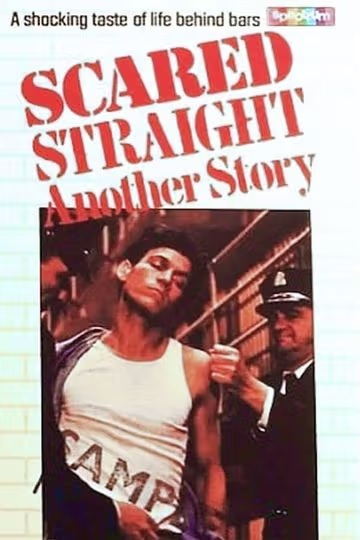
Scared Straight!  Another Story is a made-for-television movie from 1980.  As you can tell by the name, the movie was inspired by the documentary Scared Straight! and the addition of Another Story to the title would lead one to suspect that this was actually a follow-up or continuation to that documentary and I guess it kind of is.  A group of teenagers, all of whom have been in trouble with the law, are sent to a prison where they are finger-printed, forced to stay in a cell, and then yelled at by a bunch of prisoners who assure them that they don’t have what it takes to survive in prison.  Then, just as in the documentary, the teenagers leave the prison.  Some of them continue to get in trouble and some of them are scared straight.  As for the prisoners, they remain imprisoned.

The main difference is that, instead of featuring real prisoners and real delinquents, Scared Straight! Another Story is a dramatization.  As a result, the prisoners are saying the same thing that they said in the first Scared Straight! but now the prisoners themselves are played by actors who will be familiar to anyone who has watched enough old TV shows.  The prisoners may be yelling about how much life sucks but the viewer knows that they are all actors and, as a result, Scared Straight!  Another Story lacks the rough authenticity of the first film.  (It also doesn’t help that most of the profanity from the original documentary has been replaced with softer expressions of disgust.)  The film again makes the argument that the Scared Straight program can turn someone’s life around but it’s not as effective because, again, the troubled teens are all actors.  The viewer knows that they’re actors.  Their lives have already been turned around.

Surprisingly, the scenes of the prisoners yelling are the least effective parts of this film.  Instead, Scared Straight!  Another Story works best when it is exploring everyone’s life before and after the trip to the prison.  Stan Shaw, in particular, is effective as a prisoner who is inspired to take part in the program after he comes across the body of an inmate who has been driven to suicide.  Also well-cast is Terri Nunn, playing Lucy, the girlfriend of a small-time drug dealer.  Both she and her boyfriend are scared straight but it turns out to be too little too late as her boyfriend is eventually sent to jail for the crimes that he committed before the program.  (There’s an interesting scene, one that I wish had been explored in greater detail, where Lucy’s father observes the scared straight program and, instead of understanding that prison is a terrible place to send a kid, reacts by saying that the prisoners are all getting what they deserve.)  Finally, Cliff De Young, who has played a lot of corrupt government agents and out-of-touch teachers over the course of his career, gets a sympathetic role as Paul, the idealistic juvenile probation officer who sends three of his clients to the program.  The program works for two of them while the other eventually ends up joining the inmates who previously tried to warn him.  If nothing else, the film deserves some credit for admitting that the Scared Straight program isn’t going to magically reform everyone who attends.

Despite some good performances, Scared Straight! Another Story lacks the rough edged authenticity of the documentary.  It’s just not as effective when you know that everyone, including the prisoners, could go home at the end of the day.  Today, this is one of those films that is mostly interesting as a historical artifact.  Apparently, there really was a time when anything could inspire a TV movie.

Missed Opportunities: Alien Nation (1988, directed by Graham Baker)


Alien Nation starts out with an intriguing premise but sadly doesn’t do enough with it.

In 1988, a spaceship lands in Mojave Desert.  Inside are 300,000 humanoid aliens, known as the Newcomers.  Intended to serve as intergalactic slaves, the Newcomers are now stuck on Earth.  (Of course, in the view of many humans, it’s Earth that’s stuck with them.)  Three years later, the Newcomers have settled in Los Angeles and they have adopted human names.  Some of them, like businessman William Harcourt (Terrence Stamp), have become successful and have been accepted by the human establishment.  The majority remain second-class citizens, facing discrimination and feeling alone in a world that doesn’t seem to want them.

Detective Matthew Sykes (James Caan) does not like the Newcomers but, after his partner is killed by one of the aliens, he ends up working with one.  Sam Francisco (Mandy Patinkin) is the first Newcomer to have been promoted to the rank of detective and is eager to prove himself.  Sykes renames him George and enlists him to investigate a series of recent Newcomer deaths.  Sykes’s real goal is to use Francisco’s Newcomer connections to investigate the death of his partner.  What the two of them discover is that the deaths are linked to a drug called Jabroka, which has no effect on human but was previously used to keep the Newcomers enslaved.

Alien Nation starts out with an intriguing premise.  I love the early scenes of Sykes driving down the streets of Los Angeles and seeing Newcomer prostitutes, Newcomer families, and even a Newcomer dance studio.  There is a lot promise in those scenes and they capture the feeling of a familiar world that has been irrevocably changed.  Both Caan and Patinkin give good performances and the alien makeup is still impressive.  Unfortunately, once Sykes and George start their investigation, the movie becomes a standard-issue police movie with a plot that could easily have been lifted from a Lethal Weapon rip-off.  So many interesting ideas are left unexplored, making Alien Nation an intriguing missed opportunity.  (There was later a television series based on the movie, which explored the Newcomer culture in greater detail.)

Alien Nation still has a strong cult following and I wouldn’t be surprised if it influenced District 9.  In 2016, it was announced that Jeff Nichols would be writing and directing a remake.  Nichols seems like the ideal director for a film like this and this is the rare case of a remake that I’m actually looking forward to.

Bronson’s Back!: Death Wish II (1982, directed by Michael Winner)


To quote John McClane, “How can the same shit happen to the same guy twice?”
It has been eight years since Paul Kersey (Charles Bronson) lost his wife and single-handedly cleaned up New York City.  The first Death Wish ended with Paul in Chicago, preparing to gun down a new group of criminals.  I guess Chicago didn’t take because, at the start of Death Wish II, Paul is in Los Angeles and he’s working as an architect again.  He has a new girlfriend, a bleeding heart liberal reporter named Geri (Jill Ireland, Bronson’s real-life wife) who is against the death penalty and who has no idea that Paul used to be New York’s most notorious vigilante.  Having finally been released from the mental institution, Carol (Robin Sherwood) is living with her father but is now mute.

Crime rates are soaring in Los Angeles and why not?  The legal system is more concerned with the rights of the criminals than the victims and Paul has retired from patrolling the streets.  But when a group of cartoonish thugs rape and kill his housekeeper and cause his daughter to fall out of a window while trying to escape them, Paul picks up his gun and sets out for revenge.

Death Wish II was not the first sequel to Death Wish.  Brian Garfield, the author of the novel on which Death Wish was based, never intended for Paul to be seen as a hero and was disgusted by what he saw as being the film’s glorification of violence.  As “penance,” he wrote a sequel called Death Sentence, in which Paul discovered that he had inspired an even more dangerous vigilante.  When Menahem Golan and Yoram Globus bought the rights to produce a second Death Wish film, they decided not to use Garfield’s sequel and instead went with a story that was co-written by Golan.

It’s the same basic story as the first film.  Again, Paul is a mild-mannered architect who is a liberal during the day and a gun-toting reactionary at night.  Again, it’s a home invasion and a death in the family that sets Paul off.  Again, Paul gets help from sympathetic citizens who don’t care that the police commissioner (Anthony Franciosa) wants him off the streets.  Jeff Goldblum played a rapist with a switch blade in the first film.  This time, it’s Laurence Fishburne who fills the role.  (Fishburne also carries a radio, which he eventually learns cannot be used to block bullets.)  Even Detective Ochoa (Vincent Gardenia) returns, coming down to Los Angeles to see if Paul has returned to his old ways.

The main difference between the first two Death Wish films is that Death Wish II is a Cannon film, which means that it is even less concerned with reality than the first film.  In Death Wish II, the criminals are more flamboyant, the violence is more graphic, and Paul is even more of a relentless avenger than in the first film.  In the first Death Wish, Paul threw up after fighting a mugger.  In the second Death Wish, he sees that one of the men who raped his daughter is wearing a cross, leading to the following exchange:

“Do you believe in Jesus?”

“Yes, I do.”

“Well, you’re going to meet him.”

BLAM!

Death Wish II is the best known of the Death Wish sequels.  It made the most money and, when I was a kid, it used to show on TV constantly.  The commercials always featured the “You believe in Jesus?” exchange and, every morning after we saw those commercials, all the kids at school would walk up to each other and say, “You believe in Jesus?  Well, you’re going to meet him.”  It drove the teachers crazy.

Overall, Death Wish II is a lousy film.  Michael Winner, who was always more concerned with getting people into the theaters than anything else, directs in a sledgehammer manner that makes his work on the first film look subtle.  He obscenely lingers over every rape and murder, leaving no doubt that he is more interested in titillating the audience than getting them to share Paul’s outrage.  The script is also weak, with Geri so poorly written that she actually gets more upset about Paul going out at night than she does when she learns that Paul’s daughter has died.  When Paul sets out to track down the gang, his method is to merely wander around Los Angeles until he stumbles across them.  It doesn’t take long for Paul to start taking them out but no one in the gang ever seems to be upset or worried that someone is obviously stalking and killing them.

There are a few good things about the film.  Charles Bronson was always a better actor than he was given credit for and it’s always fun to watch Paul try to balance his normal daily routine with his violent night life.  Whenever Geri demands to know if he’s been shooting people, Paul looks at her like he is personally offended that she could possibly think such a thing.  Also, the criminals themselves are all so cartoonishly evil that there’s never any question that Paul is doing the world a favor by gunning them down.  For many otherwise sensible viewers, a movie like Death Wish II may be bad but it is also cathartic.  It offers up a simple solution to a complex issue.  In real life, a city full of Paul Kerseys would lead to innocent people getting killed for no good reason.  But in the world of Death Wish II, no one out after nightfall is innocent so there’s no need to worry about shooting the wrong person.

Finally, the film’s score was written by the legendary Jimmy Page.  The studio wanted Isaac Hayes to do the score but Winner asked his neighbor, Page.  Page took the film, retreated into his studio, and returned with a bluesy score that would turn out to be the best thing about the movie.  The soundtrack was the only one of Page’s solo projects to be released on Led Zeppelin’s record label, Swan Song Records.

Tomorrow, Bronson returns with Death Wish 3!

A Movie A Day #208: War Party (1988, directed by Franc Roddam)


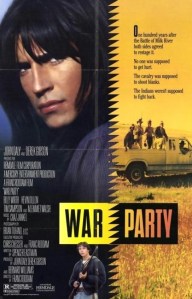
On the hundredth year anniversary of a battle between the U.S. Calvary and the Blackfeet Indians, the residents of small Montana town decide to reenact the battle and hopefully bring in some tourist dollars.  The white mayor (Bill McKinny) and the sheriff (Jerry Hardin) both think that it is a great idea.  Even the local Indian leader, Ben Cowkiller (Dennis Banks, in real-life a founder and leader of the American Indian Movement), thinks that it will be a worthwhile for the Indians to participate.  The Calvary’s guns will be full of blanks.  The Indians will play dead.  However, as the result of a bar brawl the previous night, one of the local rednecks, Calvin Morrisey (Kevyn Major Howard), shows up with a gun full of bullets.  After he shoots one of the Indians, Calvin ends up with a tomahawk buried in his head.  Three Indian teenagers, Warren (Tim Sampson), Skitty (Kevin Dillon), and Sonny (Billy Wirth), flee into the wilderness.  Thirsty for revenge, a white posse heads off in pursuit.

War Party is an underrated and surprisingly violent movie.   Franc Roddam brings the same sensitivity to his portrayal of alienated Indians that he brought to portraying alienated Mods in Quadrophenia.  Though, at first, Kevin Dillon seems miscast as an Indian, he, Wirth, and Sampson all give good performances, as does Dennis Banks.  The movie is often stolen by M. Emmett Walsh and Rodney A. Grant, playing renowned trackers who are brought in to help the posse chase down the three youths.  That Grant’s character is a member of the Crow adds a whole extra layer of meaning to his role. Even though the setup often feels contrived and heavy-handed and anyone watching should be able to easily guess how the movie is going to end, War Party still packs a punch.