In The Alto Knights, I’m pretty sure that Robert De Niro sets the record for saying “What’s the mater with you!?” the most times in one movie.
I don’t know for sure, of course. While I was watching the movie last night, I didn’t keep an exact count and, for that, shame on me. That said, when you consider that The Alto Knights features Robert De Niro playing not just one but two old school Italian gangsters, you can be sure that there were a lot of scenes of either Vito Genovese (Robert De Niro) or Frank Costello (De Niro, again) demanding to know what was the matter. When Genovese watches Costello testifying in front of a Congressional hearing, the “What’s the matter with you!?” count truly goes haywire.
The Alto Knights was directed by Barry Levinson, who has directed some great films. It tells the relatively true story of the rivalry between Costello and Genovese. Both Costello and Genovese were present when the modern Mafia was first created. The diplomatic and negotiation-minded Costello was known as the “Prime Minister of the Underworld.” Genovese was a much more violent gangster and he became one of the most powerful members of the New York Mafia by basically killing anyone who stood in his way. Costello and Genovese started out as weary friends before coming mortal enemies. Costello retired from the rackets after Genovese ordered one of his men to shoot Costello in the head. Meanwhile, Genovese ended up involving the Mafia in the drug trade and died in prison. In the film, Costello narrates their story. There’s a lot of shots of an elderly Costello sitting in what appears to be a park as he speaks directly to the camera. Interestingly enough, Gottitried to do the same thing, with Travolta’s John Gotti speaking directly to the audience while standing in front of the Brooklyn Bridge.
The Alto Knights pretty much features all of the usual Mafia tropes. All the usual points are hit. Albert Anastasia (played by Michael Rispoli) is assassinated while getting a haircut and some viewers will remember that, before De Niro played the man who ordered Anastasia’s assassination, he also played the man who claimed to have shot Anastasia in The Irishman. Personally, I love Mafia films but The Alto Knights felt a bit too recycled to be truly effective. Barry Levison does the usual thing of dropping real-life newspaper headlines and photographs into the middle of the film and it doesn’t so much add verisimilitude as much as it just reminds one of David DeCoteau’s film about Bonnie and Clyde.
The film’s main selling point is that it features Robert De Niro playing two gangsters but there’s really not much gained from casting De Niro in both roles. We get a few scenes of De Niro acting opposite of himself and it’s hard not to notice that Genovese’s reactions often don’t seem to match whatever it is that Costello’s saying. As an actor, De Niro has the ability to be believable as both the cerebral Costello and the hot-headed Genovese but ultimately, the double casting just feels like a distraction. Watching De Niro acting opposite himself, I found myself thinking how much more entertaining it would have been if Joe Pesci, Al Pacino, Harvey Keitel, or even John Travolta had played Genovese. To be honest, if Levinson really had any courage, he would have given the role to James Woods and given us the Once Upon A Time In America/Casino reunion that we all deserve.
The film did win me over a bit towards the end with a recreation of the Apalachin meeting. That was when Genovese invited every mob boss in the country to come to a meeting in upstate New York, just for the feds to suddenly show up and send everyone scattering. For most of the film, it was hard not to feel that Barry Levinson was past his prime as a director but he actually did a good job with the Apalachin scenes. I genuinely laughed when Genovese got into a pointless argument with his driver. I loved the way the film captured the real-life absurdity of a bunch of mob bosses fleeing into the woods, all of their bravado suddenly dissipating as they scrambled into the wilderness. If the entire film had just been about the Apalachin meeting, this review would probably be a lot of different. As it is, one good sequence can’t save the film as a whole.
I’m going to guess that there’s quite a backstory to the production of the film …. well, I’m really not even sure what to call the film.
The version that I just watched on Tubi was called 69 parts and it clocked in at a little over 90 minutes. It’s the story of gangsters, cops, and one hapless law student in 1979 New York. Jack (Ryan O’Callaghan) needs money to go to law school. His best friend, gambling addict Gino (Johnny Solo), arranges for Jack to get a loan from his uncle, Dennis (Aidan Redmond). However, Gino swears that he can double the loan if Jack goes with him to the tracks. Unfortunately, Gino’s hot tip turns out to be a bust so now Jack is broke and can’t pay back the money. So, Dennis forced Jack to marry Dennis’s mistress so that she can get her green card but then Dennis gets jealous and decides to kill Jack but then he discovers that Jack is the son of an imprisoned criminal associate (Eric Roberts). It’s all a bit too complicated for its own good and the use of multiple narrators, many of whom sound exactly alike, doesn’t make the film any easier to follow.
Tubi claims that 69 Parts was released in 2022. However, on the IMDb, there’s a film called 79 Parts, which is listed as being a few minutes shorter than 69 Parts but it has the exact same cast and the exact same plot. This version was released in 2016, six years before 69 Parts. And then there’s 79 Parts: The Directors Cut, which clocks in at over two hours and which was released in 2019. In short, there appears to be multiple versions of this film and really, I have to be a little bit impressed by the determination necessary to keep re-editing, re-titling, and re-releasing the film.
As for the film itself, the version I saw was a bit too busy and difficult to follow but I appreciated the work that went into recreating the 70s. That obviously take some effort. Aidan Redmond was properly avuncular and menacing as Dennis but Jack was such a wimpy character that it was difficult to really care about him. As for Eric Roberts, he appears for about five minutes and is even less impressed with Jack than I was. Maybe Eric gets to do more in the director’s cut.
Previous Eric Roberts Films That We Have Reviewed:
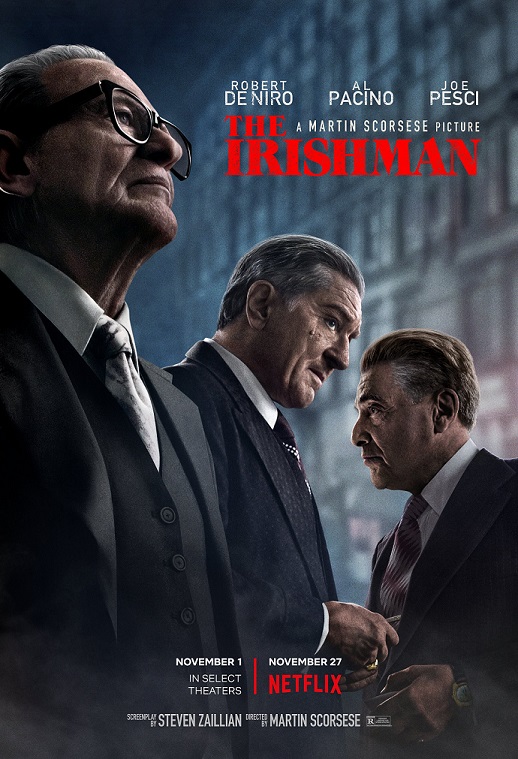
Released by Netflix in 2019 and clocking in at close to 4 hours, the Martin Scorsese-directed Best Picture nominee, The Irishman, is a film about many different things.
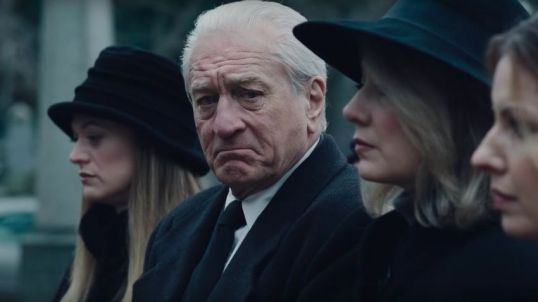
At its simplest, it’s a film about a very old man named Frank Shearan (played by Robert De Niro). Frank is an Irish-American from Philadelphia. Frank is a veteran of World War II and a former truck driver who was briefly a fairly important figure in the Teamsters union. He did a few years in prison. At the start of the film, though, he’s just another elderly man living in a retirement community. All of his friends are dead. His wife passed away years ago. His children never comes to visit. In fact, the only people interested in talking to Frank are the FBI but Frank doesn’t have much to say to them. That’s not to say that Frank isn’t talkative. For the first time in his life, he wants to talk to people but there’s no one left to talk to. The only people who listen are those who are required to do so. A nurse politely nods along as as he tells her about his old friend Jimmy Hoffa. (She’s never heard of him.) A priest listens to the story of Frank’s life and offers him absolution. At times, Frank looks straight at Scorsese’s camera and appears to be talking straight to the audience. Frank has a lot of interesting stories but who knows how truthful he’s being or if his memory can be trusted.
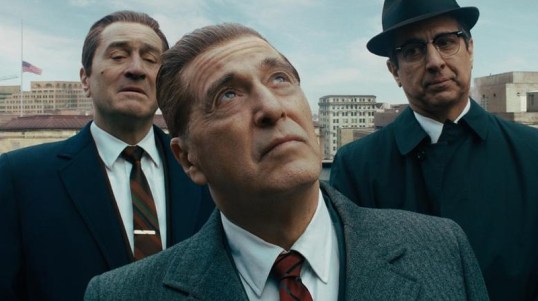
The Irishman, though, is not just the story of Frank. It is also a secret history of America during the latter half of the 20th Century. Frank may look old and harmless in that nursing home but, to hear him tell it, he was once acquainted with some of the most powerful men in America. He went from executing Italian POWs during World War II to executing hits for the Mafia in post-war America. Along the way, he became close to crime bosses like Skinny Razor (Bobby Cannavale), Angelo Bruno (Harvey Keitel) and Russell Bufalino (Joe Pesci), men who may not have been household names but who still wielded a lot of power. These are men who, Frank flatly states, fixed the presidential election of 1960 and who later quite possibly killed the man they had elected president. Frank also became a close associate of Jimmy Hoffa (Al Pacino), the labor leader who was reputed to have mob connections and who disappeared in 1975.
The Irishman is also a tribute to the modern gangster film, featuring role for nearly every living actor associated with the genre. De Niro, Pacino, Pesci, Keitel, Bobby Cannavale, Domenick Lombardozzi, Gary Basaraba, they’ve all played their share of gangsters in films and television show that were both good and bad. Having them all appear in one film together serves to remind the viewer of just how much of America’s popular entertainment has revolved around stories of organized crime. Even as the old school Mafia has declined as a real-world power, it’s become a permanent part of pop culture. Everyone loves a gangster, except for the people who actually have to deal with them on a daily basis.
Not surprisingly, considering the stars and the director, it’s a film full of smart, detailed performances. When the film was originally released, Pacino and Pesci got the lion’s share of the praise and they certainly deserved it. Pacino gets the best lines and brings some unexpected wit to his performance as Jimmy Hoffa. Pesci, meanwhile, finally gets to play a gangster who is not psychotic and shows that he can be just as compelling when he’s not raising his voice as when he is. Still, some of my favorite performances came from actors who one wouldn’t necessarily associate with a Scorsese gangster film. I liked the nervous humor that Ray Romano brought to the role of a corrupt union lawyer. I liked the seething resentment that Stephen Graham brought to the role of Jimmy Hoffa’s main rival in the union. (The scene where Graham and Pacino argue over who is more owed an apology for all of their past disagreements is both funny and, due to the people involved, somewhat frightening.) Jesse Plemons is poignantly dumb in his brief role as Hoffa’s stepson. Louis Cancelmi doesn’t get a lot of screen time but he steals every scene in which he appears as a paranoid hitman. (Cancelmi plays a character named Sally Bugs, proving that not everyone in the Mafia gets a cool nickname.)
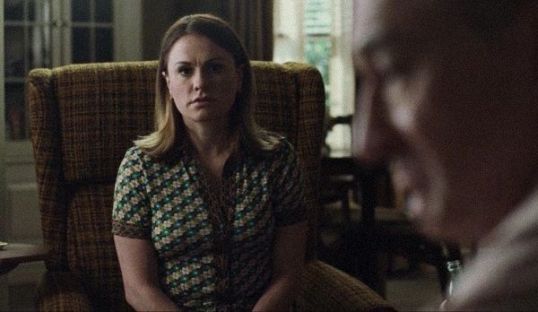
And then there’s Anna Paquin, who provides the film with its moral center. When the film was first released, many Twitter critics complained that Paquin, who played Frank’s daughter Peggy, only a had a handful of lines. It was one of the stupidest controversies of 2019, which is saying something when you consider how much time Film Twitter devotes to generating stupid controversies. Peggy doesn’t say much because she’s decided that she doesn’t want to be a part of her father’s life. From the moment that she first sees Frank beating up a store owner, Peggy knows that her father and his associates are violent men. She not only fears them but she resents the damage that Frank does to not only her family but to the families as other as well. The only one of her father’s associates who she likes is Jimmy Hoffa, because Hoffa cares about helping others. When Hoffa disappears, Peggy makes a decision to disappear from Frank’s life and Paquin’s withering stare says more than any lengthy monologue could. Peggy doesn’t say much because she knows that her words would be wasted on a man who she knows is a liar. The scene where she silently walks away from her now elderly father tells us everything we need to know about the emotional consequences of the life that Frank has chosen to live. Regardless of how many lines she did or didn’t have, Paquin gave one of the best performances of 2019.
Famously (or, depending on which critics you read, infamously), de-aging technology was used so that De Niro, Pacino, Pesci, and Keitel could play both the younger and the older version of their characters. At first, it can be a bit jarring. The de-aging works fine with Pesci and Keitel, both of whom are already supposed to be middle-aged when they first meet Frank. (Admittedly, Keitel only has a few minutes of screen time.) With De Niro and Pacino, it’s a bit less successful. Even when they’re playing younger versions of themselves, De Niro and Pacino still move and stand like old men. Fortunately, in the case of Pacino, his natural movie star charisma wins out over his obvious age. In the end, we believe that he’s Hoffa because we want to believe that all of our important historical figures were as interesting and entertaining as Al Pacino is in The Irishman.
And yet, ultimately, even the awkward de-aging works to the film’s advantage because it reminds us that we’re not necessarily seeing what happened. Instead, we’re seeing what Frank says happened. We’re seeing his memories, or at least what he claims to remember. It makes sense that, when Frank thinks about himself as a young truck driver in 1956, he would picture himself not as he was but instead as just a slightly less weathered version of who he would eventually become. Throughout the film, there are hints that Frank’s memory should not be trusted. Some of his stories are incredibly detailed while others — like when he transports weapons for the failed invasion of the Bay of Pigs — are a bit more vaguely presented. Is Frank lying or is he misremembering or are we just expecting too much detail from a man who is now essentially waiting to die? The film leaves that up for us to determine.
The Irishman is Scorsese at his most reflective. Compared to Goodfellas and Casino, The Irishman is certainly one of Scorsese’s less “flashy” films. But, on repeat viewings, it becomes cleat that The Irishman is the perfect conclusion to the gangster trilogy that began with Goodfellas and continued with Casino. All three of these films deal with someone who rises up the ranks in the mob while remaining, as a result of their ethnicity, an outsider. (Henry Hill and Frank Shearan are both Irish. Ace Rothstein was Jewish.) All three of them are briefly on top of the world and all three of them are left wondering how they’re going to continue their lives after their days at the top are over. In Goodfellas, Henry Hill makes no secret of his disgust at having to live in the bland anonymity of the suburbs. In Casino, Ace Rothstein ends the film with a mournful acceptance the fact that he will never return to his beloved Vegas. (“And that’s that.”) In The Irishman, Frank finally realizes that he has comes to the end of it all, alone and with nothing but death in his future. All three of them made their decisions and, in the end, all three of them are left to deal with the consequences. The trilogy goes from Henry’s anger to Ace’s depression to Frank’s acceptance.
It may seem strange to describe a film like The Irishman as being underrated, seeing as how it was nominated for 10 Oscars and got a Criterion release in record time. And yet, when the film first came out, there was a vague sense of disappointment to found in even some of the positive reviews. It was a Scorsese film that was so eagerly awaited and arrived with so much hype that there was no way it could live up to some of the expectations that had been set for it. (And, of course, there’s also a whole set of people who were predestined to dislike the film precisely because it was a Scorsese film and it was so anticipated.) It’s a long film and, while Netflix should be praised for allowing Scorsese the freedom to make his epic, it’s also not a film that should be viewed in bits and pieces on a tiny screen. The Irishman is a film that should be watched in one sitting and it’s definitely a film that most viewers should watch more than once. It takes more than one viewing to truly grasp the the world that Scorsese has recreated.
The Irishman was nominated for Best Picture. It lost to a worthy competitor, Parasite. Still, regardless of who took him the Oscars, The Irishman is a film that will live forever.
Well, the year is coming to a close and I’ve got close to 50 films that I still need to review before I get around to making out my “Best of 2014” list. (That’s not even counting the films that I still have left to see. December is going to be a busy month.) With that in mind, here are late reviews of 6 films that I saw earlier this year and had yet to get around to reviewing.
1) 300: Rise of an Empire (dir by Noam Munro)
Last night, I watched 300: Rise of an Empire for the second time and I still couldn’t figure out what exactly is going on for most of the film. I know that there’s a lot of fighting and a lot of bare-chested men yelling and, whenever anyone swings a sword, they suddenly start moving in slow motion and dark blood spurts across the screen like Jackson Pollock decorating a previously blank canvas. The style of 300 has been co-opted by so many other films that 300: Rise of an Empire feels more like an imitation than a continuation.
At the same time, I’m resisting the temptation to be too critical of 300: Rise of the Empire for two reasons. First off, this movie wasn’t really made to appeal to me. Instead, this is a total guy film and, much as I have every right to love Winter’s Tale, guys have every right to love their 300 movies. Secondly, 300: Rise of an Empire features Eva Green as a warrior and she totally kicks ass.
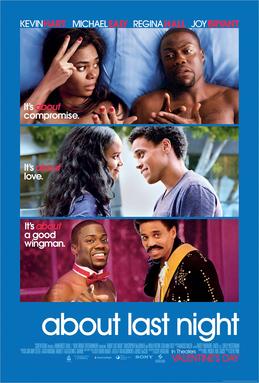
2) About Last Night (dir by Steve Pink)
Obviously, I made a big mistake this Valentine’s Day by insisting that my boyfriend take me to see Endless Love. (I still stand by my desire to see Winter’s Tale.) I say this because I recently watched this year’s other big Valentine’s Day release, About Last Night, and I discovered that it’s a funny and, in its way, rather sweet romantic comedy.
About Last Night tells the story of two couples, Danny (Michael Ealy) and Debbie (Joy Bryant) and Bernie (Kevin Hart) and Joan (Regina Hall). All four of the actors have a very real chemistry, with Hart and Hall bringing the laughs and Ealy and Bryant bringing the tears. The film itself is ultimately predictable but very likable.
3) Adult World (dir by Scott Coffey)
In Adult World, Emma Roberts plays Amy Anderson, an aspiring author and recent college graduate. Despite her own overwhelming faith in her own abilities, Amy struggles to find a job outside of college. She is finally reduced to working at Adult World, a small adult bookstore. Working at the store, she befriends the far more down-to-earth Alex (Evan Peters) and eventually discovers that one of her customers is also her idol, poet Rat Billings (John Cusack). Amy proceeds to force her way into Rat’s life, volunteering to work as his assistant and declaring herself to be his protegé. However, it turns out that Rat is far less altruistic than Amy originally thought (and with a name like Rat, are you surprised?).
Adult World is a flawed film but I still really enjoyed it. The story has a few problems and the film never really takes full narrative advantage of Adult World as a setting but the entire film is so well-acted that you’re willing to forgive its flaws. Cusack gives a surprisingly playful performance while Evan Peters is adorable in a Jesse Eisenberg-type of way. Emma Roberts shows a lot of courage, playing a character who is both infuriating and relatable.
4) Jersey Boys (dir by Clint Eastwood)
Clint Eastwood’s upcoming American Sniper has been getting so much attention as a potential Oscar contender that it’s easy to forget that, at the beginning of the year, everyone was expecting Jersey Boys to be Eastwood’s Oscar contender. In fact, it’s easy to forget about Jersey Boys all together. It’s just one of those films that, despite its best efforts, fails to make much of an impression.
Jersey Boys is based on one of the Broadway musicals that tourists always brag about seeing. It tells the true story of how four kids from the “neighborhood” became the Four Seasons and recorded songs that have since gone on to appear on thousands of film soundtracks. The period detail is a lot of fun, Christopher Walken, who has a small role as a local gangster, is always entertaining to watch, and the music sounds great but Eastwood’s direction is so old-fashioned and dramatically inert that you don’t really take much away from it.
Hopefully, American Sniper will be the work of the Eastwood who made Mystic River and not the Eastwood who did Jersey Boys.
5) Ride Along (dir by Tim Story)
School security guard Ben Barber (Kevin Hart) wants to marry Angela (Tiki Sumpter) but Angela’s tough cop brother James (Ice Cube) doesn’t approve. In order to prove himself worth, Ben goes on a ride along with James and the results are just as generic as you might expect. Probably the only really funny part of the film was the way that Hart delivered the line, “You’re white! You don’t fight!” but we all saw that in the commercial so who cares?
On the plus side, Ice Cube has a lot of screen presence and is well-cast as James. As for Kevin Hart — well, he should probably be thankful that About Last Night came out a month after Ride Along.
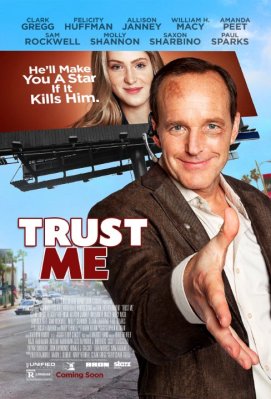
6) Trust Me (dir by Clark Gregg)
In Trust Me, Clark Gregg both directs and stars. He plays Howard, a fast-talking but ultimately kind-hearted talent agent who mostly represents children. After losing some of his most popular clients to rival agent Aldo (a hilariously sleazy Sam Rockwell), Howard meets Lydia (Saxon Sharbino), a 13 year-old actress. Soon, Howard is representing Lydia and trying to land her a starring role in a major production. Howard also finds the time to tentatively date his next door neighbor (Amanda Peet). However, there’s more to Howard than meets the eye. He is haunted by the death of one of his previous clients and his guilt leads him to become especially protective of Lydia. When Howard concludes that Lydia is being sexually abused by her crude father (Paul Sparks), he attempts to protect her from both him and the Hollywood system that’s threatening to corrupt her. It all leads to an oddly tragic conclusion…
I say “oddly tragic” because Trust Me is, in many ways, an odd film. As a director, Gregg gets good performances from his cast but he never manages to find a consistent tone. The film starts as a Hollywood satire and then it becomes a romantic comedy and then it turns into a legal drama before then becoming an all-0ut attack on the way the entertainment industry treats child actors and then finally, it settles on being a tragedy. As a result, Trust Me is undeniably a bit of a mess.
And yet, it’s a compelling mess and the film itself is so heart-felt that you can’t help but forgive its flaws. If nothing else, it proves that Clark Gregg is capable of more than just being Marvel’s Agent Coulson.




 Through the Shattered Lens