Retro Television Review: Veronica’s Video 1.1 “Pilot”


Welcome to Retro Television Reviews, a feature where we review some of our favorite and least favorite shows of the past!  On Thursdays, I will be reviewing Veronica’s Video, which was produced by UPN in 1998.  The entire show is currently streaming on YouTube!

I sacrificed my eyesight to review this show.

Episode 1.1 “Pilot”

(Dir by Don Scardino, originally aired on …. well, we’ll get to that.)

Aspiring filmmaker Gary Gluckin (Matt Champagne) needs a day job so he walks into a trashy, nearly deserted video store and tells the owner, Nick (Cobin Bernsen), that he wants to work for him.  Nick is an angry man who chain smokes and rolls around in a wheelchair because his wife ran him over while she was leaving him.  Nick is also Gary’s father.

Nick is only willing to hire on a Gary probationary basis and he explains that Gary will be competing for a full time job with Chandra (Shishir Kurup), a Sikh who is an expert on Indian films.  Gary and Nick make fun of Chandra’s ethnicity, religion, and name.  Chandra, meanwhile, enforces a strict policy of only allowing 21 year-olds into the porn section of the video store.  He kicks out a 51 year-old.  That’s the type of show this was.

Occasionally dropping by the video store is Mary Sue Henderson (Julie Benz) who works for her grandmother and who wears an Alice In Wonderland costume that Gary is constantly looking down.  Mary Sue is always bright and cheerful.  When she talks to Gary, Gary goes all mush-mouthed because Gary is a loser.  Gary also thinks that he may have seen Mary Sue’s picture on the cover of one of the porn videos that is in the store.

Nick eventually tortures Gary by forcing him to stand outside in 116-degree heat.  At one point, Greg gets beaten up by someone who is played by Greg Grunberg.  Frustrated, Gary announces that he doesn’t need the job and he’ll just move in with his mother.  Nick replies that Gary’s mother wants nothing to do with him.  Wow, what a fun comedy.

This is, without a doubt, one of the worst shows that I’ve ever watched.  This show was so bad that the pilot didn’t even get a pity showing.  UPN, which was famous for being the home for terrible and misguided shows, didn’t even want to mess with this thing.  Why is this show so bad?  The humor is not particularly funny, the laugh track in intrusive, and the video store itself is so dirty and ugly that it’s hard to believe that it has ever had a customer.  Corbin Bernsen, being a veteran actor, at least manages to suggest that there’s a heart underneath Nick’s rough exterior.  The rest of the cast is just bland.

I should also admit that I watched this on YouTube and the upload was one of the worst that I’ve ever seen.  I’m surprised I still have my eyesight after being confronted with this:

And this:
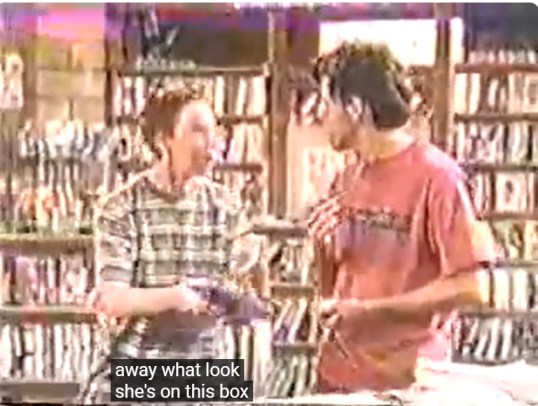
I had 20/60 eyesight when I started this show.  I’m worried about what it is now.

Anyway, needless to say, only one episode of Veronica’s Video was produced.  And that episode probably should have been left in a landfill somewhere, rather than uploaded to YouTube.
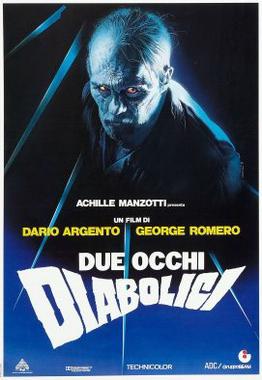
The Film of Dario Argento: Two Evil Eyes


In 1990, long-time friends George Romero and Dario Argento collaborated on Two Evil Eyes, anthology film that was based on the writings of Edgar Allan Poe.  An Italian-American co-production, Two Evil Eyes featured two stories.  The first was directed by George Romero, while the second was directed by Argento.

The Facts In The Case of Mr. Valdemar

(Dir by George Romero)

The first story is Romero’s, a modernized version of The Facts In The Case of M. Valdemar.

Jessica Valdemar (Adrienne Barbeau) is the 40 year-old wife of 65 year-old, Ernest Valdemar (Bingo O’Malley).  Jessica only married Ernest for her money and, now that he’s on his death bed, she and her lover, Dr. Robert Hoffman (Ramy Zada), have hypnotized to him to do and say whatever they tell him to say and do.  Even though Ernest is essentially comatose, the hypnosis allows them to force Ernest to sign his name to legal documents and to tell his suspicious attorney (E.G. Marshall) that he indeed wants to leave all of his money to Jessica.

When Ernest dies while under the influence of hypnosis, Jessica and Robert attempt hide his body in the basement.  But is Ernest really dead?  Jessica is convinced that she hears groaning from the basement and she wonders if the hypnosis has somehow left Ernest in limbo, between life and death.  Robert thinks that Jessica is being foolish but it turns out that she’s not.  After much paranoia and betrayal, one conspirator is dead and the other is a part of the living dead.

Usually, I like Romero’s work but this one didn’t work for me.  From the flat cinematography to the shallow performances, this film felt more like an episode of a television show than anything else.  Perhaps if it had been a stand-alone film, Romero could have found a way to make the material a bit more cinematic.  (The story’s final shot, of blood dripping on a hundred dollar bill, is the film’s strongest moment and the part that feels the most Romeroesque.)  But as a shortened chapter of an anthology film, it fell flat.

The Black Cat

(Dir by Dario Argento)

The Dario Argento segment is based on several different Poe stories.  While the majority of the story is taken from The Black Cat, it also contains elements of Annabel Lee, Telltale Heat, The Pit and the Pendulum, and Buried Alive.  Though this segment doesn’t really work, it’s obvious that Argento is a fan of Poe’s work and, for other Poe fans, there’s a lot of fun to be found in all of the Poe references that Argento sneaks into his story.

Harvey Keitel stars as Rod Usher, a crime scene photographer who loves his work a bit too much.  He’s excited about the fact that his book of photography is about to be published.  He’s less happy about the fact that his girlfriend, Annabel (Madeleine Potter), has adopted a black cat that is constantly glaring at Rod.  Rod is eventually driven mad by both the cat’s apparent hatred of him and the fact that the cat itself keeps showing up no matter how far he goes to get rid of it.  (This film features violence against a cat, which I hated.  But it also featured a cat getting revenge and I appreciated that.)  Eventually, Rod’s paranoia leads to violence and murder.

Look, this is a film about a guy who has an obsessive hatred of a cat.  Obviously, this is not a film that I’m going to enjoy because I love cats.  That said, I can still judge the film on its merits, even if it’s not for me on a personal level.  While Argento is able to build up a good deal of tension and suspense in this film, the overall film doesn’t work because Harvey Keitel, supremely talented actor that he is, was totally the wrong choice for Rod Usher.  Keitel, who reportedly did not get along with Argento during filming, gave a self-indulgent performance that featured a lot of bellowing.  It’s as if Keitel is trying to compete with the constantly moving camera.  The problem is that a star of a film like this has to be the director and Keitel’s histrionics take the viewer right out of the story.

Considering all of the talent involved, Two Evil Eyes is a disappointment.

The (Reviewed) Films of Dario Argento:

  1. The Bird With The Crystal Plumage
  2. Cat O’Nine Tales
  3. Four Flies on Grey Velvet
  4. Deep Red
  5. Suspiria
  6. Inferno
  7. Tenebrae
  8. Phenomena
  9. Opera

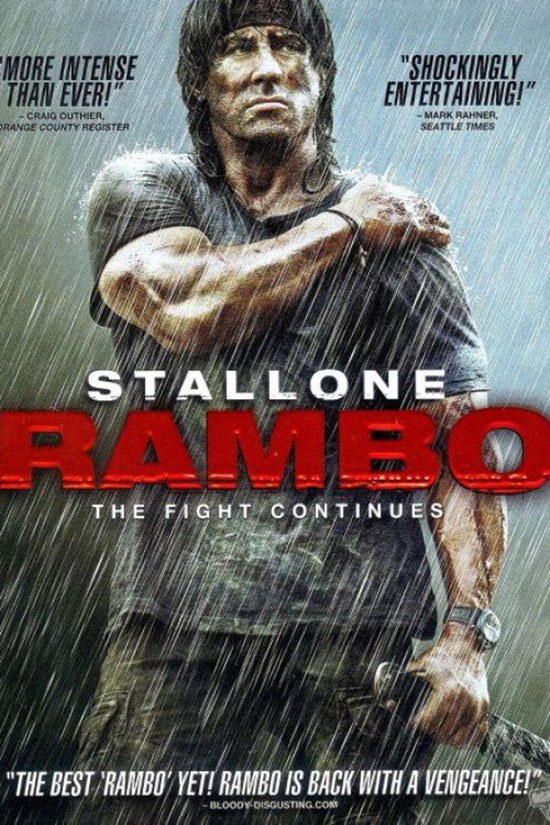
Rambo (2008, directed by Sylvester Stallone)


When a group of Christian missionaries needs someone to guide them into Burma so that they can provide medical supply to the oppressed Karen people, they approach John Rambo (Sylvester Stallone).  The missionaries think that Rambo is just an American living in Thailand who makes a meager living as a snake catcher and a boat guide.  Because we’ve seen the previous Rambo films, we know that John Rambo is actually a Vietnam vet who, after destroying the town of Hope, Washington, was recruited by the government to rescue POWs in Vietnam and fight the Russians in Afghanistan.

At first, Rambo tells the missionaries that it’s foolish for them to go anywhere near Burma and that he wants nothing to do with them.  It’s only when Sarah Miller (Julie Benz) asks him personally that Rambo agrees to ferry the missionaries up the Salween River.  Rambo isn’t doing it for the missionaries.  He’s doing it to protect Sarah.

Unfortunately, on the way to the village, Rambo is forced to kill a group of pirates and he is rejected by the pacifist missionaries and, after he drops them off at the village, they order him to leave.  However, after the village is attacked and Sarah is taken prisoner by the Burmese military, Rambo returns.  This time, he’s with a group of younger mercenaries who, like the missionaries before them, don’t know what Rambo is capable of doing.  Rambo soon proves that he might not be as young as used to be but he’s still just as deadly.

During the final 11 minutes of this movie, Rambo kills over a hundred people but fortunately, they’re all bad.  It’s excessively violent and gory and it’s also totally awesome.  When you go to see a Rambo movie, you’re not expecting to see Shakespeare.  You’re expecting to see Rambo blow away the bad guys and, on that front, this film definitely delivers.  Even more than the previous films in the series, Rambo is up front about what happens when someone gets shot by a machine gun or blown up by a bomb.  It’s not pretty picture.  The violence is so gruesome that Rambo could almost pass for an antiwar film if the people that Rambo blows up weren’t all portrayed as being almost cartoonishly evil.

Rambo is also upfront about what that type of violence would do to a man’s psyche.  This film features one of Stallone’s best performances.  Eschewing the comic book heroism of the 2nd and 3rd films in the franchise, Rambo reminds us that, when first introduced in First Blood, John Rambo was portrayed as being a seriously damaged and bitter man, someone who hated what the war had done to him and who felt that he no longer had a home in the normal world.  Stallone was 62 when he starred in Rambo and he surrendered enough of his vanity to actually allow himself to look and sometimes act his age.  In this film, Rambo may start out as bitter but he finally accepts that his pain doesn’t have to define his life.  “Live for nothing or die for something,” Rambo says, a line that has subsequently been picked up by the real life Karen National Liberation Army in Burma.

Of the four sequels to the original First Blood, Rambo is the best.  It has the biggest action sequences, the best Stallone performance, and it alerted people to very real atrocities being carried out against the Karen people.  Coming out shortly after Rocky Balboa, Rambo was one of the films that reminded audiences that Sylvester Stallone still had it.  Rambo was a box office success and, 11 years after its release, it was followed by Last Blood.  I’ll be reviewing that one tomorrow.

Lifetime Film Review: V.C. Andrews’ Heaven (dir by Paul Shapiro)


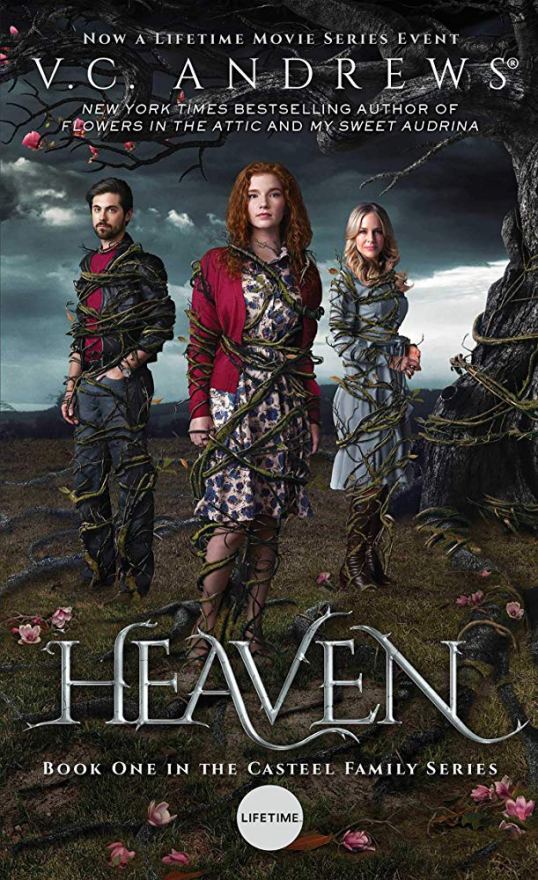
So, let’s say that you’re an alcoholic, backwoods hillbilly living in West Virginia.  Everyone in town hates you and your family because, years ago, your father sold a bad batch of moonshine to the mayor’s son.  You’ve got more children than you know what to do with and your wife has just run out on you because she’s blames you for losing her latest baby.  You ain’t got no money and you don’t understand that ain’t no word used by proper folks.  What do you do to make ends meet?

Well, if you’re Luke Casteel (Chris William Martin), you sell your children.  You sell the twins to a couple who can’t have children.  You sell your son to a farmer in Virginia.  You sell one of your daughters to the pervy local priest.  And you keep your oldest daughter, Heaven (Annalise Basso), so that she can clean the house and do the laundry.

Of course, Heaven’s not very happy about this arrangement.  She’s way smarter than the average Casteel and she’s got a crush on a boy at school named Logan Stonewall (James Rittinger).  Everyone keeps telling Logan to stay away from the Casteels and it’s certainly not going to help the family’s reputation once it gets out that Luke’s been selling off his children.

Luke has always resented Heaven, mostly because she’s the daughter of Angel, the only woman that Luke ever truly loved.  Angel was from a rich family in Boston but they disowned her when she married Luke.  Unfortunately, Angel then died giving birth to Heaven.  If that’s not bad enough, Heaven has now grown up to look exactly like her mother which leads to Luke getting drunk and trying to climb into bed with her….

AGCK!

Realizing that Heaven won’t be safe as long as she’s living with him, Luke decides to quit drinking and get his shit together.  JUST KIDDING!  Instead, he decides to sell her too.  He sells her to Kitty (Julie Benz) and Cal (Chris McNally).  Kitty is emotionally unpredictable and alternates between being extremely supportive and extremely cruel.  (She’s also obsessed with keeping her house spotless and really who can blame her?  A house should be clean because you never know who might come by.)  Cal is a sexually frustrated writer who smiles every time that he’s alone with Heaven.

Can you guess what happens?

Heaven is based on a book by V.C. Andrews, the first part of the five-volume Casteel Saga.  A few years ago, Lifetime had a lot of success when they adapted Flowers In the Attic and its sequels so it only makes sense that they would eventually bring the Casteel Saga to screen.  Heaven has everything that you would expect from both V.C. Andrews and Lifetime — melodrama, over the top dialogue, sex, dysfunctional families, and one victimized girl searching for her destiny.

At first, when I started watching Heaven, the film itself seemed to a bit silly.  I mean, I took one look at Casteels mountain shack and I started laughing because it was seriously the nicest shack that I’ve ever seen in my life.  (On Lifetime, even poor hillbillies live in a big house.)  It was also hard not to be amused about how, every few minutes, some primly-dressed townsperson would pop up and say something like, “Logan Stonewall!  You get away from those Casteels!”  As the film went on, though, it became obvious that the film itself had a very self-aware sensibility.  It understood that it was an over-the-top, frequently ludicrous melodrama so, instead of trying to trick us into believing it to be anything else, it instead embraced the melodramatic label and everything that it implied.  This is not a film that’s mean to be taken seriously.  Instead, for the first hour or so, it’s a bit of a self-aware parody.  It’s like Winter’s Bone directed by Paul Feig.

The second half of the film, which finds Heaven living with Kitty and Cal, has a bit more of an edge to it, largely due to Julie Benz’s wonderfully unhinged performance as Kitty.  Benz brings a jolt of real menace to both the role and the film itself.  That’s a good thing because winking at the audience and letting them know that you’re in on the joke can only take you so far.  Julie Benz shows up and basically announces, “Yes, this may be an overheated adaptation of a V.C. Andrews novel but don’t even think about letting your guard down!”

All in all, it makes for an entertaining Lifetime film.  While it may not be a powerful as Flowers in the Attic, it still holds your attention and Annalise Basso gives a good and sympathetic performance as Heaven.  Myself, I related to Heaven because we both have red hair.  Seriously, it’s not always being a redhead.

Heaven was followed by Dark Angel, which I’ll be reviewing later today.

Quickie Review: Punisher: War Zone (dir. by Lexi Alexander)


If there was ever a Marvel Comics character who was perfectly suited to star in a grindhouse film it would be Frank Castle aka The Punisher. He’s a character who takes the term anti-hero past its limits and who makes other film vigilantes seem like sissy, choir boys. In December 2008 Lionsgate released a sort of reboot of The Punisher by Jonathan Hensleigh and starring Thomas Jane in the titular role. This time around the role of Frank Castle goes to Ray Stevenson (The Other Guys, Thor, Kill the Irishman) with German-filmmaker Lexi Alexander taking on the director’s reins.

Punisher: War Zone takes much of the characters in the film from story-arcs found in the Marvel Knight’s Punisher MAX series which took the character and his stories into a darker realm of violence. This latest film definitely owes much of it’s darker and more violent tone from that comic book line while at the same time creating a look which brings to mind the garish and over-the-top grindhouse action films of the early 80’s. The film quickly establishes who the Punisher is and what motivates him to take on and kill (heavy emphasis on kill) the criminal underworld of the city. In an opening sequence that probably out-violences every other film released in 2008, the Punisher wipes out a gathering of mobsters in every bloody way as possible. Blood and gore flows and splatters a-plenty in the first 10-15 minutes of this film.

There’s a semblance of a story which involves Castle mistakenly killing an undercover FBI agent which causes him a momentary crisis of conscience, but it really doesn’t last too long as there are more criminals to kill, main and blow up. If there’s one thing the Punisher knows how to do best it’s those three things. Ray Stevenson in the title role doesn’t get to emote much, but does a great job in showing the characters ice-cold ruthlessness paired with a sort of dead-man walking persona which rings true to how the Punisher has been written up of late. His Frank Castle is dead inside and only when he’s the Punisher does he even show any sort of life (even if it’s the barest hint). His foil this time around brings one of the Punisher’s earliest arch-enemies in the disfigured mobster (caused by the Punisher) Jigsaw (played with over-the-top campy relish by Dominic West). Where Castle is deadly serious to the point of morbidity his opposite was all garish with a liberal dose of crazy.

Punisher: War Zone really dispenses with any complexities to it’s plot and just finds reasons and excuses for the Punisher to go on another killing spree against criminals that for some it might not be enough. As a lover of grindhouse and exploitation films what this film offers was enough and really goes a long way in entertaining in such an 80’s fashion. It’s a film that revels in its violent absurdities and campy storytelling. Even the acting by all in the film passes the line of campy and into a sort of Looney Tunes level which makes the extreme violence and gore of the killings more cartoonish than realistic. This was a film that celebrated it’s grindhouse roots from the actors, the filmmakers all the way down to it’s cinematographer and art directors. It’s disposable entertainment and it knows it so doesn’t bother to try and hide that fact and just tries to entertain in every manner possible and then some.

Scenes I Love: Rambo


Watching Ninja Assassin made me think about how much film and special effects technology has advanced to the point that the ways people can die in a film really is only limited by the imagination of the filmmakers involved. My new choice for “Scenes I Love” may make me come across as some gorehound, violence-loving neanderthal (the first two are actually correct but the third is false since I’m homo sapiens), but I love this scene I have chosen because it’s so over-the-top yet holds many truths to the events happening therein.

Rambo was Sylvester Stallone’s attempt to restart the Rambo franchise and to a certain extent he does so. The film was better than the third one and in terms of storytelling was equal to the second one and just a tad short of the original film. It’s a film one will not write to the Academy about, but Stallone brings back the franchise to what made it popular in the first place. He brought the character of John Rambo back to being the self-destructive, self-loathing, war-scarred veteran who just wants to be left alone to live his miserable life, but always gets dragged into one good-intentioned crusade after another.

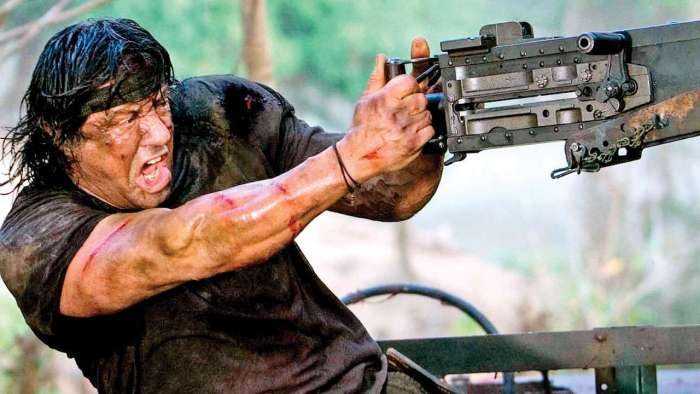
This scene happens right at the very end and one could say it’s the film’s climactic eruption of testosterone. Rambo literally explodes Burmese soldiers’ bodies through his effective use of a .50 caliber heavy machine gun (and those who think the gun’s effect on people’s bodies was over-the-top…those people would be wrong. That is exactly what a .50 caliber round does to a body. It doesn’t do a body good) and some help from the people he’s trying to rescue. It’s hard not cheer Rambo in this scene after watching these very same soldiers massacre an entire Burmese village, raping captured young women and bayonet little kids before throwing them into a hut’s raging fire.

This scene also shows why the Rambo films have been labeled as nothing but mindless violence trying to make itself to be something profound (he is killing the bad people and trying to save those who are defenseless). I always though this franchise was just about one very angry guy who may or may not be right in the head, but who definitely has a weird sense of right and wrong. Not to mention very good at killing massive amounts of people in very messy ways.

There’s a part halfway in this scene where the higher-than-though leader of the Christian missionary group (who had earlier in the film lectured Rambo for being too violent in saving his and his people’s lives) played by Paul Schulze sees the carnage happening all around him and decides to go all caveman on one soldier who killed one of his congregation. A part of me actually smirked at this part. I knew that no matter how well-intentioned, principled and civilized a man thinks he is there’s something primal deep down inside that wants to commit violence.

10 Things To Be Thankful For In 2010


It’s the Thanksgiving season, that time when bloggers everywhere come up with lists of things that they are thankful for.  Here’s just 10 of the many things that I’ve been thankful for in 2010.

1) The fifth season of Dexter

I have to be honest.  I’ve been a fan of Dexter since the show’s 1st season but I wasn’t sure if the show would be able to survive after the fourth season ended with Rita (Julie Benz) dead in a bloody bathtub.  However, season 5 has been a triumph.  Yes, a little too much time has been devoted to the domestic troubles of LaGuerta and Batista (Lauren Velez and the always intriguing David Zayas) but Michael C. Hall (as Dexter) and Jennifer Carpenter (as Deb) have done some of their best work this season.  Even better, this season has featured two brilliant performances from guest stars Peter Weller and, especially, Julia Stiles (who really deserves her own spin-off).  Still, you have to wonder if any murder has ever actually been solved in Miami…

2) Noomi Rapace as Lisbeth Salander. 

In three films — The Girl With The Dragon Tattoo, The Girl Who Played With Fire, and The Girl Who Kicked The Hornet’s Nest, Rapace created one of the first truly iconic film characters of the 21st century and that’s an accomplishment that will stand regardless of any attempts by the Hollywood mainstream to steal her accomplishment through any unnecessary remakes. 

3) Lost

As more time has passed, the more I’ve come to admit just how dissatisfied I was with how the creators of Lost decided to end their show.  Still, that doesn’t change the fact that, for several years, I scheduled my life around when the next episode of Lost was going to air.  I may not be thankful for a series finale that left way too many questions unanswered (why couldn’t children be born on the island?  What was the sickness?) but even the final season featured some of the show’s best moments.

4) The Walking Dead

I’m not a huge fan of Frank Darabont (sorry, but The Shawshank Redemption sucks) but I’m happy to say that he didn’t fuck up The Walking Dead.

5) Kathryn Bigelow broke the glass ceiling.

I’m still not a huge fan of The Hurt Locker but I am definitely a fan of Kathryn Bigelow.  As bad as this year’s Oscar ceremony was, it was worth watching just to see Bigelow become the first woman to ever win an Oscar for best director.  In many ways, it almost felt like a fantasy come to life — not only did Bigelow win a historic victory but she did it by beating her ex, James Cameron (who, to judge from his films, has never met a woman to whom he wouldn’t condescend).  The fact that she then gave one of the only genuine acceptance speeches of the entire ceremony was a wonderful bonus.

6) Blue Valentine was rated NC-17.

The upcoming film Blue Valentine (which I have yet to see) was reportedly given an NC-17 rating on account of scenes featuring Ryan Gosling and Michelle Williams having sex.  That the film would feature characters played Gosling and Williams having sex makes sense when you consider that the movie is specifically about their marriage.  However, despite this, Blue Valentine was rated NC-17 while films like The Expendables, A Nightmare on Elm Street, the Saw films — in which thousands of people are graphically killed and tortured on-screen — are given an R rating as a matter of routine.  If Blue Valentine had been about Ryan Gosling murdering Michelle Williams (as opposed to fucking her), the film probably would have an R rating and would be considered appropriate viewing in malls across America.  I’m thankful for this rating because it serves as a reminder that it’s okay to show a woman being humiliated, tortured, or killed just as long as you don’t show her actually enjoying an orgasm.

7) Exit Through The Gift Shop

The rest of you mainstreamers can talk about how much you love the Social Network for the rest of eternity, if you want.  Exit Through The Gift Shop is still the best movie of 2010.

8 ) Lisa Marie finally figured out how to work her DVR.

Yes, yes, I know.  DVR has been around like forever and it’s all old news and I’m sure there’s something even better than DVR that everyone but me is raving about and using right now but — look, shut up, okay?  Yes, I’ve had DVR forever but I just figured out how to actually make it work a few months ago.  And I love it!  Now, if I want to sit down in the living room at 3 in the morning and watch old episodes of Project Runway, there’s no way anyone can stop me.

9) Joseph Gordon-Levitt floating through a dream hallway in Inception

Inception was a film full of excellent set pieces and memorable images but whenever I think about the movie, I will always see Joseph Gordon-Levitt floating through that hallway in a suit and looking rather adorable as he does it.

10) Cthulhu on South Park

Well, of course.

That’s just ten things I’m thankful for and I didn’t even start to talk about Scott Caan on Hawaii 5-0, James Franco in 127 Hours, or movies like Fish Tank, Winter’s Bone, and Never Let Me Go.  What are you thankful for?  Leave a comment, let the world know.  The best comment wins a renewed sense of peace and a happy new year.  (Please note that this is not a legally binding document.)