This is one of my favorite episode of The Twilight Zone. I originally shared it two years ago but it has subsequently been taken off of YouTube. At first, that upset me but then I realized that it gave me the perfect excuse to share it again!
In The Howling Man, American wanderer Dave Ellington (H.M. Wynant) comes across a castle. There’s a man (Robin Hughes) being held prisoner in the castle. Brother Jerome (the great John Carradine) explains that the man is the devil. The man says that Brother Jerome is crazy. Dave Ellington has to decide who to believe.
This well-acted, dream-like episode was written by Charles Beaumont and directed by Douglas Heyes. It originally aired on November 4th, 1960.
Hi there and welcome to October! This is our favorite time of the year here at the Shattered Lens because October is horror month. For the past three years, we have celebrated every October by reviewing and showing some of our favorite horror movies, shows, books, and music. That’s a tradition that I’m looking forward to helping to continue this year.
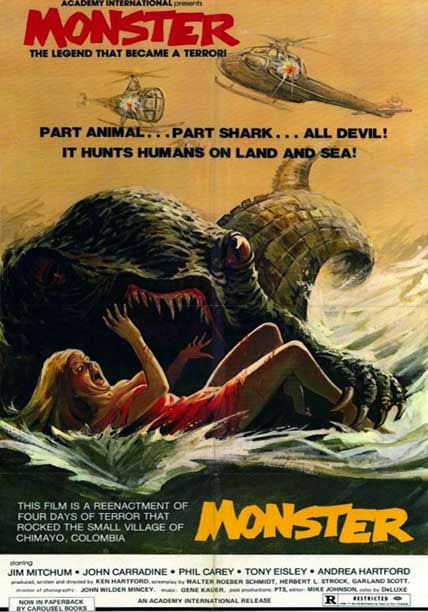
So, let’s start things off with a little indie film from 1980. This film was released under several names, including Monster. However, I prefer the title under which it has been included in several Mill Creek box sets: Monstroid: It Came From The Lake!
Monstroid tells the story of what happens when a monster emerges from a lake and starts killing people in Columbia. Superstitious villagers blame a local woman whom they believe to be a witch. Even though the town priest (and no horror fan should be surprised to discover that the priest is played by John Carradine) claims that he can exorcise the evil spirits that have possessed her, the villagers would rather burn her at the stake. Meanwhile, the local Big Evil Corporation has sent in Travis (James Mitchum) to take care of the monster!
And what a monster! Listen, there’s a lot of negative things that I could say about this low-budget film but the monster is simply adorable and must be seen by anyone who appreciates the rubber monsters that populated horror films in the days before CGI.
Plus, how can you resist a film that features not only Robert Mitchum’s son but John Carradine as well?
What’s an Insomnia File? You know how some times you just can’t get any sleep and, at about three in the morning, you’ll find yourself watching whatever you can find on cable? This feature is all about those insomnia-inspired discoveries!
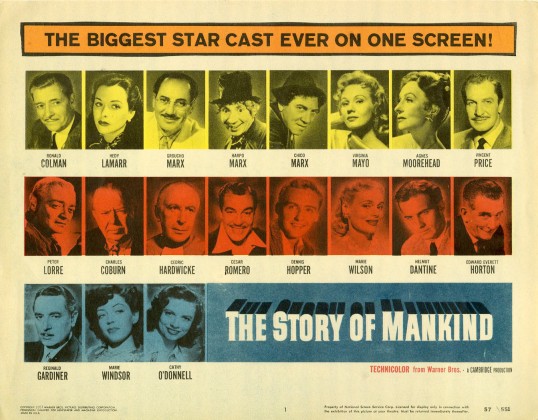
If, last night, you were suffering from insomnia at 3 in the morning, you could have turned on TCM and watched the 1957 faux epic, The Story of Mankind.
I call The Story of Mankind a faux epic because it’s an outwardly big film that turns out to be remarkably small on closer inspection. First off, it claims to the tell the story of Mankind but it only has a running time of 100 minutes so, as you can imagine, a lot of the story gets left out. (I was annoyed that neither my favorite social reformer, Victoria C. Woodhull, nor my favorite president, Rutherford B. Hayes, made an appearance.) It’s a film that follow Vincent Price and Ronald Colman as they stroll through history but it turns out that “history” is largely made up of stock footage taken from other movies. The film’s cast is full of actors who will be familiar to lovers of classic cinema and yet, few of them really have more than a few minutes of screen time. In fact, it only takes a little bit of research on the imdb to discover that most of the film’s cast was made up of performers who were on the verge of ending their careers.
The Story of Mankind opens with two angels noticing that mankind has apparently invented the “Super H-Bomb,” ten years ahead of schedule. It appears that mankind is on the verge of destroying itself and soon, both Heaven and Hell will be full of new arrivals. One of the angels exclaims that there’s already a housing shortage!
A celestial court, overseen by a stern judge (Cedric Hardwicke) is convened in outer space. The court must decide whether to intervene and prevent mankind from destroying itself. Speaking on behalf on humanity is the Spirit of Man. The Spirit of Man is played by Ronald Colman. This was Colman’s final film. In his heyday, he was such a popular star that he was Margaret Mitchell’s first choice to play Rhett Butler in Gone With The Wind. However, in The Story of Mankind, Colman comes across as being a bit bored with it all and you start to get worried that he might not be the best attorney that mankind could have hired.
Even more worrisome, as far as the future of mankind is concerned, is that the prosecutor, Mr. Scratch, is being played by Vincent Price. Making his case with his trademark theatrics and delivering every snaky line with a self-satisfied yet likable smirk on his face, Vincent Price is so much fun to watch that it was impossible not to agree with him. Destroy mankind, Mr. Scratch? Sure, why not? Mankind had a good run, after all…
In order to make their cases, Mr. Scratch and the Spirit of Man take a tour through history. Mr. Scratch reminds us of villains like the Egyptian pharaoh Khufu (John Carradine) and the Roman Emperor Nero (Peter Lorre, of course). He shows how Joan of Arc (Hedy Lamarr) was burned at the stake. The Spirit of Man argues that, despite all of that, man is still capable of doing good things, like inventing the printing press.
And really, the whole point of the film is to see who is playing which historical figure. The film features a huge cast of classic film actors. If you watch TCM on a semi-regular basis, you’ll recognize a good deal of the cast. The fun comes from seeing who tried to give a memorable performance and who just showed up to collect a paycheck. For instance, a very young Dennis Hopper gives a bizarre method interpretation of Napoleon and it’s one of those things that simply has to be seen.
And then the Marx Brothers show up!
They don’t share any scenes together, unfortunately. But three of them are present! (No, Zeppo does not make an appearance but I imagine that’s just because Jim Ameche was already cast in the role of Alexander Graham Bell.) Chico is a monk who tells Christopher Columbus not to waste his time looking for a quicker way to reach India. Harpo Marx is Sir Isaac Newton, who plays a harp and discovers gravity when a hundred apples smash down on his head. And Groucho Marx plays Peter Miniut, tricking a Native American chief into selling Manhattan Island while leering at the chief’s daughter.
And the good thing about the Marx Brothers is that their presence makes a strong argument that humanity deserves another chance. A world that produced the Marx Brothers can’t be all bad, right?
Anyway, Story of Mankind is one of those films that seems like it would be a good cure for insomnia but then you start watching it and it’s just such a weird movie that you simply have to watch it all the way to the end. It’s not a good movie but it is flamboyantly bad and, as a result, everyone should see it at least once.
Edward L. Cahn (1899-1963) was one of those unsung Hollywood minions who had long careers. Beginning as an editor in the waning days of the silent era, Cahn steadily worked his way up to director, helming 26 of MGM’s later Our Gang shorts. Moving from the majors to the seedy world of low-budget filmmaking, Cahn’s feature film output found him at poverty stricken studios like PRC and for a number of years American International Pictures. He worked mainly in the science-fiction realm, but labored on everything from teen delinquency pics (DRAGSTRIP GIRL) to war dramas (SUICIDE BATTALION) to westerns (FLESH AND THE SPUR) and noir (WHEN THE CLOCK STRIKES). Cahn’s features were interesting. Not very good mind you, but interesting.
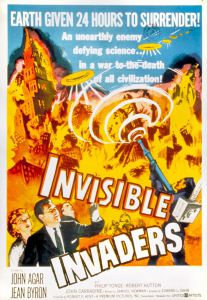
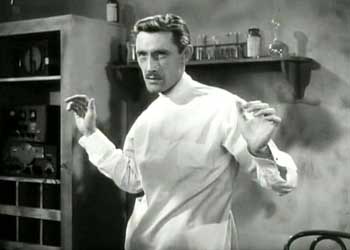
INVISIBLE INVADERS is a interesting one, in a car wreck sort of way. Atomic radiation from mankind’s nuclear testing has filtered into outer space. The late Dr. Karol Noyman’s corpse (veteran boogieman John Carradine) has been reanimated by an invisible alien from the moon (!) and sent to give his former colleague Dr. Penner a warning: all nations on Earth must surrender or the aliens will take over dead bodies and annihilate the world! Penner’s daughter Phyllis and associate Dr. Lamont are supportive, but the press has a field day scoffing at the old scientist. When the alien zombies go on a destructive, stock footage filled rampage, they start taking the old duffer seriously.
Army Major Bruce Jay is sent to whisk Penner and company to a secret atomic lab. There, the scientists work diligently to figure out a way to stop the zombie invasion. It’s learned that by disrupting the alien’s molecular structure with high pitched sound waves, they leave their host bodies and die. Building a sonic ray gun (and how they built it so fast is beyond me), they successfully knock off a horde of the marauding monsters. Our heroes have the zombie cure and save the world from certain death.
Whew! I laughed out loud at some of the ridiculous situations presented in INVISIBLE INVADERS. The phony special effects and shoddy props would make Ed Wood proud. The cast tries, but are defeated by the ludicrous dialogue forced on them. John Agar (Maj.Jay) starred in way too many of these Grade Z schlockfests to mention here. Agar is clearly trying to emulate his former co-star John Wayne in this one, but falls far short of the mark. Pretty Jean Byron (Phyllis) had much more success as the mom in the mid-60s sitcom THE PATTY DUKE SHOW. Robert Hutton (Lamont) was a Hollywood also-ran who’s career never took off. He later starred in another low-budget masterpiece, 1967’s THEY CAME FROM OUTER SPACE (which I’ll get around to reviewing sooner or later). And Carradine is totally wasted in a role he could play in his sleep…and in this turkey. it looks like he did!
Despite it all, I still liked INVISIBLE INVADERS. As a connoisseur of bad movies, I thought it was fun in a dopey kind of way. If you’re a fan of stuff like PLAN 9 FROM OUTER SPACE, TEENAGERS FROM OUTER SPACE, BEAST OF YUCCA FLATS, or a die-hard John Agar fan, you’ll enjoy INVISIBLE INVADERS. I did (guess there’s just no accounting for good taste!)
Last night, the Late Night Movie Crew and I watched the 1943 film, Revenge of the Zombies.
Revenge of the Zombies deals with the mysterious Dr. von Aldermann (John Carradine), who has a house on the Louisiana bayous and who is involved in weird, 1940s-style scientific experiments. As is evident from his name (but not particularly from Carradine’s disinterested performance), von Aldermann is from Germany and his experiments are designed to create an army of zombies who will destroy American from within for the benefit for the Third Reich. This is a pretty big deal and von Aldermann isn’t particularly subtle about his schemes but, as the film’s begins, nobody has figured out what’s going on.
I guess you can get away with anything on the bayous.
Von Aldermann’s wife Lila (Veda Ann Borg) has recently died but, thanks to the mad scientist, she’s still walking around Louisiana and leading an army of zombies. Lila’s brother (Robert Lowery) shows up with a private investigator (Mauritz Hugo) and yet another mad scientist (Barry Macollum) and they eventually figure out that something weird is happening. With the help of von Aldermann’s secretary (Gale Storm), they try to thwart von Aldermann’s plans and keep the world safe for democracy.
There are a few good points about Revenge of the Zombies. For one thing, the film is only 61 minutes long so the suffering is short. As with any low-budget John Carradine horror film, Revenge of the Zombies is fun to watch with a group of snarky friends. Historically, this film is significant for being one of the first zombie movies. It’s always interesting to see how non-threatening zombies were in the days before George Romero and The Walking Dead.
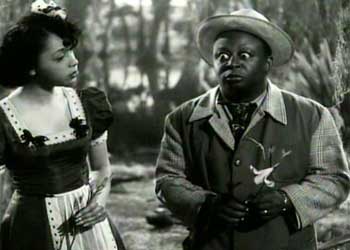
And then there’s the character of Jeff (Mantan Moreland), who is a chauffeur and who provides most of the film’s comic relief. It’s always difficult for contemporary audiences to deal with the racial attitudes displayed in the films and literature of the past. On the one hand, Jeff is written as a complete and total stereotype and, as you listen to his dialogue, you’re painfully aware of the fact that the goal was to get audiences to laugh at him as opposed to with him. On the other hand, Moreland is literally the only actor in the film who actually gives a good performance. Even when delivering the most cringe-worthy of dialogue, Moreland does so with a conviction and commitment that holds your interest. As you watch Revenge of the Zombies, you really don’t care what happens to most of the bland and interchangeable characters. But you really do want Jeff to survive.
And, ultimately, you do take some comfort in that. Moreland was given a role that, as written, was very demeaning but, in the end, Jeff is the only character that you care about.
As for the rest of Revenge of the Zombies, it’s short, it’s pretty bad but it’s not terrible, and you can watch it below!
“When the legend become fact, print the legend.” — Maxwell Scott (Carleton Young) in The Man Who Shot Liberty Valance (1962)
Though I understand and respect their importance in the history of both American and Italian cinema, I have never really been a huge fan of westerns. Maybe its all the testosterone (“A man’s got to do what a man’s got to do…”) or maybe it’s all the dust but westerns have just never really been my thing.
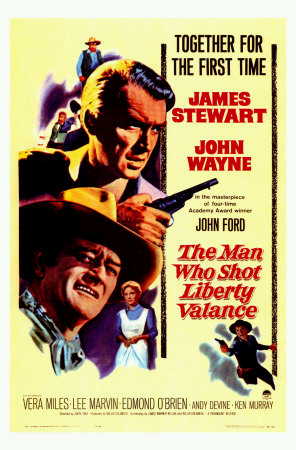
However, I will always make an exception for The Man Who Shot Liberty Valance, which is not just a great western but a great film period.
But you already knew that. It’s a little bit intimidating to review a film that everyone already knows is great. I even opened this review with the exact same quote that everyone uses to open their reviews of The Man Who Shot Liberty Valance. To a certain extent, I feel like I should have found a quote that everyone hasn’t already heard a thousand times but then again, it’s a great quote from a great film and sometimes, there’s nothing wrong with agreeing with the critical consensus.
The Man Who Shot Liberty Valance opens with a train stopping in the small western town of Shinbone. The residents of the town — including newspaper editor Maxwell Scott (Carleton Young) — are shocked when Sen. Rance Stoddard (James Stewart) and his wife Hallie (Vera Miles) get off the train. Sen. Stoddard is considered to be a front-runner to become the next Vice President of the United States. Scott is even more shocked to discover why the Stoddards are in town. They’ve come to Shinbone to attend the funeral of an obscure rancher named Tom Doniphon (played, in flashback, by John Wayne).
Sitting in the funeral home with Doniphon’s coffin (and having reprimanded the local mortician for attempting to steal Tom’s boots), Rance tells Scott why he’s come to pay respect to Tom Doniphon. We see, in flashback, how Rance first came to Shinbone 25 years ago, an idealistic lawyer who — unlike most of the men in the west — refused to carry a gun. We see how Rance was robbed and assaulted by local outlaw Liberty Valance (a wonderfully intimidating and bullying Lee Marvin), we discover how Rance first met Hallie while working as a dishwasher and how he eventually taught her how to read, and we also see how he first met Tom Doniphon, the only man in town strong enough to intimidate Liberty Valance.
At first, Rance and Doniphon had an uneasy friendship, epitomized by the condescending way Doniphon would call Rance “pilgrim.” Doniphon was in love with Hallie and, when he attempted to teach Rance how to defend himself, he was largely did so for Hallie. Rance, meanwhile, was determined to bring law and society to the west.
And, eventually, Rance did just that. When Shinbone elected two delegates to the statehood convention in the territory’s capitol, Rance attempted to nominate Doniphon for the position but Doniphon refused it and nominated Rance instead, explaining that Rance understood “the law.” When Liberty Valance attempted to claim the other delegate spot, Rance and Doniphon worked together to make sure that it instead went to newspaper editor Dutton Peabody (Edmond O’Brien). And when Liberty Valance attempted to gun Rance down in the street, Rance shot him.
Or did he?
That’s the question that’s at the heart of The Man Who Shot Liberty Valance. However, as a film, The Man Who Shot Liberty Valance is far less interested in gunfights than it is in politics. Perhaps the most important scene in the film is not when Rance and Liberty meet out on that dark street. Instead, it’s the scene at the statehood convention where the reformers (represented by Rance) and the cattlemen (represented by John Carradine) battle over who will be the territory’s delegate to Washington. Between John Carradine orating, the horses riding in and out of the hall, Edmond O’Brien drinking, James Stewart looking humble, and John Wayne glowering in the background, this is one of the best political scenes ever put on film.
When Rance first arrives in the west, there is no political system in place. With the exception of the ineffectual town marshal (Andy Devine), there is no law. The peace is kept by men like Tom Doniphon and, oddly enough, by Liberty Valance as well. (Whether he realizes it or not, Shinbone’s fear of Liberty has caused the town to form into a community.) What little official law there is doesn’t matter because the majority of the Shinbone’s citizens can’t read.
When Rance arrives, he brings both education and the law. He makes Shinbone into a town that no longer needs Liberty Valance but, at the same time, it no longer need Tom Doniphon either. Hence, it’s Rance Stoddard who goes from dishwasher to U.S. Senator while Tom Doniphon dies forgotten. Rance represents progress and unfortunately, progress often means losing the good along with the bad things of the past.
(It’s no coincidence that when Rance and Hallie return to Shinbone, the first person that they see is the former town marshal, who no longer wears a star and who, we’re told, hasn’t for years. Time has passed by.)
It’s a bittersweet and beautiful film, one that features four great performances from Stewart, Wayne, Marvin, and Vera Miles. Personally, I like to think that maybe Sen. Stoddard had a daughter who married a man named Smith and maybe they had a son named Jefferson who later made his way to the Senate as well.
Down here in Dallas, we have a county commissioner named John Wiley Price. Even if you don’t live in Texas, you might have heard about him. A few years ago, Price stormed out of a commissioners meeting while shouting, “All of you are white! Go the Hell!” It was a popular YouTube video for a while and attracted all of the usual type of comments that you see online. It even made the national news.
Nobody down here in Dallas was surprised by Price’s outburst. To us, that was just John Wiley being John Wiley. For that matter, nobody was particularly surprised when it was reported that he was being investigated by the FBI. Everyone always took it for granted that John Wiley Price was taking bribes and receiving kickbacks. That’s just the way that things are done down here in Dallas, by politicians both white and black. (Of course, most of the white politicians who do it don’t get publicly investigated by the FBI.)
Now, if you ask the majority of people in Dallas county what they think about John Wiley Price and they’ll probably say something negative. I’ll admit that I would probably be among them. But the thing is — John Wiley Price’s constituents love him. John Wiley Price was first elected to the commissioner’s court before I was even born and, as long as he’s on the ballot, he will be reelected. Even if Price is convicted on corruption charges, he will still be reelected.
I can still remember the night that it was announced that John Wiley Price was on the verge of being arrested by the FBI. All across his district, emergency meetings were held in churches and ministers stood behind the pulpit and, while the TV cameras rolled, they called upon everyone to pray for John Wiley Price. In Price’s district, he’s known as “our man downtown,” the idea being that John Wiley Price is standing up to the rich and white Dallas establishment and, if he makes some money for himself in the process, so be it. As long as he’s doing right for the people who elected him, who cares how he does it?
And, as much as we may want to judge the John Wiley Prices of the world, the fact that of the matter is that he’s a part of a long American political tradition. That political tradition is also the driving force behind today’s final entry in Shattered Politics.
First released in 1958 and directed by John Ford, The Last Hurrah tells the story of Frank Skeffington (Spencer Tracy), the mayor of an unnamed city in New England that’s obviously meant to be Boston. Skeffington is the flamboyant head of a large and powerful (but, as the film makes clear, aging) Irish-American political machine. He’s preparing to run for his fifth term for mayor, a campaign that he says will be his last.
Whether Frank Skeffington is a good mayor or not depends on who you ask. The poor and the disenfranchised love him. Skeffington, after all, is the son of Irish immigrants. He was born poor. His mother worked as a maid and was even fired by a member of the wealthy and influential Force family. They know that Skeffington has had to cut corners and that he’s gone out of his way to reward his cronies but they also know that Skeffington is on their side. Though the phrase is never used in the film, Skeffington is “their man downtown.”
Meanwhile, the wealthy and the upper class see Frank Skeffington as being a crook, a man who has run a corrupt administration and who uses class warfare to keep the city divided against itself and to make himself and his cronies rich. Newspaper editor Amos Force (John Carradine) has thrown his considerable influence between Skeffington’s opponent, a wealthy but dull man named Kevin McCluskey.
Reporter Adam Caulfield (Jeffrey Hunter) is in an interesting position. On the one hand, he is Skeffington’s nephew. On the other hand, as a journalist, he works for Amos Force. Skeffington invites Adam to follow and record his final campaign for posterity.
It’s interesting to compare The Last Hurrah to films like The Boss or All The King’s Men. Whereas those two films came down squarely on the sides of the reformers, The Last Hurrah is firmly on the side of Frank Skeffington. It presents Skeffington as being a sentimental figure, the type of old-fashioned, populist politician who won office by going out and meeting the people face-to-face and personally giving them a reason to vote for him. As Skeffington himself points out, he’s the type of politician that will soon be made obsolete by television and modern campaigning.
And it’s impossible not to enjoy The Last Hurrah‘s refusal to pass judgment on its lead character. It helps, of course, that Spencer Tracy plays Skeffington with a twinkle in his eye while all of his opponents are played by villainous and aristocratic character actors like John Carradine and Basil Rathbone. Yes, the film says, Skeffington may have been corrupt but at least he wasn’t boring!
Finally, I enjoyed the film because all of the “good” guys were Irish Catholic and all of the bad guys most definitely were not.
So, with that last hurrah, we conclude Shattered Politics for today. We’ll be back tomorrow, when we’ll start to get into the 1960s.
Tonight’s offering of Horror on TV is another episode of The Twilight Zone.
In The Howling Man, H.M. Wynant plays a rational man who, during a walk across Europe, finds himself in an isolated monastery. Wynant discovers a bearded prisoner (played by Robin Hughes) who explains that he’s being held prisoner because he was caught kissing his girlfriend in public. However, Brother Jerome (played by the legendary John Carradine) claims that Hughes is the devil himself! It’s left up to Wynant whether to set the man free or to leave him imprisoned…
Written by Charles Beaumont and directed by Douglas Heyes, The Howling Man is a favorite of mine. Not only does the show establish and maintain an atmosphere of palpable menace but it also features a brilliant ending.
So, last night, we finally got a proper storm here in Texas and wow, was I happy! Quite frankly, it’s not October unless you’ve got thunder, lightening, and howling wind. Of course, I also ended up getting caught out in the middle of it all and ended up getting soaked just from running from my car to the front door of my house. Seriously, it’s amazing how quickly your life can turn into a wet t-shirt contest. (Once I got inside, I did what anyone would do and jumped on twitter so I could tell everyone I was soaked. “OMG, I’m so wet!” I tweeted, with the most innocent of intentions.) Anyway, as I dried off, I watched The Boogeymanoff of Fearnet. No, I’m not talking about The Boogeyman that starred the oldest son from Seventh Heaven. No, The Boogeyman I watched is a genuinely weird little artifact from 1980 and it was directed by the infamous Ulli Lommel.
A hybrid of Halloween, the Exorcist, and probably every other horror film that had been released up to 1980, The Boogeyman opens up with siblings Willy and Lacey spying on their mother having sex with her creepy boyfriend who is wearing a nylon stocking over his face. So, naturally, Willy grabs a butcher knife and stabs the man to death. This act of violence is reflected in the bedroom mirror and, not surprisingly, this leads to the dead boyfriend’s evil spirit getting trapped in the mirror. Or maybe it’s just the evil of the act itself. Or maybe it’s … well, there’s a lot of possibilities and it’s hard not to consider them all because the film considers none of them, beyond the fact that the dead boyfriend is still in the mirror (which, let’s give credit where credit is due, is actually a pretty neat idea for a horror film).
Anyway, we jump forward 20 years and now, the brother and sister have grown up. They both live on a farm with their judgmental, self-righteous, ballet-hating aunt and uncle. (Okay, I’m projecting a little here because I have relatives who remind me of both of these characters and I always hated having to spend any time with them over the summer because I always knew they’d be all like, “Look at us, we’re farm folk, we’re better than you and who needs books or ballet when you got foul-smelling chickens and cows that’ll kick you in the face just because they feel like it…” Seriously.) Willy (now played by Nicholas Love) has been mute since the day he brutally butchered his mother’s boyfriend and oddly enough, no one seems to be disturbed by the fact that he’s a murderer. (“He’s a good boy,” his uncle says at one point, “I just wish he could talk.”) Lacey (played by Suzanna Love) is married to Jake Scully (Ron James) and they have a son. Judging from the uniform he’s wearing when he’s first introduced, Jake is apparently some sort of law enforcement guy. He’s also a total and complete chauvinistic toadsucker who (though it’s never acknowledged in the film) is pretty much responsible for every terrible thing that’s about to happen.
Lacey is suffering from intense nightmares (the nightmare sequence, by the way, is one of the film’s genuinely disturbing moments) and she keeps waking everyone up at night with her screams. Well, of course, Jake can’t have this because they’re farm folk, after all! So, Jake has to act like a man about it and chastises Lacey for not suppressing her feelings. When that doesn’t work, he drags her off to a therapist. This would seem like a good idea except for the fact that the only therapist in their little rural community appears to be John Carradine. Carradine grimaces through his three scenes, tells Lacey that she should go back to her childhood home and see that it’s just a normal house despite its history of brutal murder, and then leaves to collect his paycheck.
Lacey says she doesn’t want to go back to the house where the most Hellish thing ever occurred. Jake tells her that she’s being silly and that she’s going to go relive the worst event of her life whether she wants to or not. Seriously, Jake sucks.
So, Jake drags Lacey back to her childhood home. The house is now inhabited by two teenage sisters and their obnoxious little brother who spends his time running around and screaming, “Boogeyman!” at random. He’s kind of a brat but don’t worry — he eventually yells “Boogeyman!” one too many times and ends up getting his neck crushed by a falling window. That scene, by the way, genuinely shocked me because you just don’t expect to see little kids dispatched so graphically. But he really kinda deserved it, if just to keep him from growing up to be like Jake.
But before the little boy gets killed, we get to watch Lacey and Jake wander through the house. It turns out that, even though the house has changed owners, the exact same mirror is still hanging in the bedroom. Lacey looks at the mirror, sees her mother’s dead boyfriend’s reflection, and proceeds to shatter the mirror into a hundred pieces. Jake replies that she’s being silly and proceeds to put almost all the broken shards of the evil mirror into a paper bag so he can take them back to the farm with him. Why? Well, because he’s Jake so anything he does must be right…
Of course, by bringing the mirror to the farm (and then deciding to put it back together — really, Jake?), Jake has also brought the evil spirit of the dead boyfriend with him as well. Once again, Jake sucks. Though, in his defense, Lacey was having nightmares and Willy nearly strangled a neighbor girl, before John Carradine even suggested going to the house. And mom’s dead boyfriend liked to wear a stocking over his head but was he really evil? After all, he’s the one who ended up getting stabbed to death…well, regardless, now people start dying and eventually a priest has to come up to the house and try to remember the final scene of the Exorcist. So, thanks a lot, Jake!
The Boogeyman is one of those odd films that always seems to pop up on TV and hidden away in various DVD horror compilations. Through no fault of my own, I’ve actually seen it a handful of times and every time, I’ve discovered something else that doesn’t really work. The last time I watched it, I found myself concentrating on just how unconvincing all the actors (with the exception of Suzanna and Nicholas Love) were.* Slowly but surely, I found myself growing obsessed with actor Ron James, who played Lacey’s husband with all the style and charisma of a cardboard cut-out. (Of course, it doesn’t help that James was playing a character who, to put it charitably, is kind of a sexist pig. “C’mon, Lacey, cheer up!” he says as he forces her to visit the house where the most traumatic event of her childhood occurred.) Whenever the movie hit one of its many slow spots, I asked myself, “I wonder if Ron James gave up during the first day of shooting or the second?”
And yet, oddly, this is a film that’s stuck with me. The film has an effectively Southern gothic atmosphere to it and even the stiff performances and unnatural dialogue help to give the film a certain dream-like atmosphere. I know quite a few people who argue that Ulli Lommel is the worst director of all time** but he actually comes up with some effectively surreal and disturbing images. The sight of the dead boyfriend, with a nylon stocking pulled down of her face, suddenly staring at Lacey from the mirror is genuinely frightening, as is Lacey’s nightmare in which she’s bound and gagged by a knife-wielding assailant. The idea of mirrors storing everything that they witness is an intriguing one and there’s a nicely surreal sequence in which poor, mute Willy paints over every reflective surface he can find. Whether by intentional design or not, these flashes of genuine fright and oddness are all the more effective because they’re surrounded by such mundane material. The end result is a film that’s either brilliant or terrible depending on which point you actually start watching it.
————————–
* Actually, the Loves were pretty bad too.
**By the way, the worst director of all time is Rod “Straw Dogs” Lurie.
Last night, as I struggled to get some sleep, I ended up turning on the television to HBO and watching a truly infamous film — 1970’s Myra Breckenridge. Based on a novel by Gore Vidal (a writer that I generally have little use for), Myra Breckinridge is infamous for being one of two X-rated film released by 20th Century Fox in 1970. (The other one was Russ Meyer’s Beyond The Valley of the Dolls.)
Why Was I Watching It?
Because I’ve read a lot of books devoted to “the worst films ever made.” And all of them mention 1970’s Myra Breckinridge as being one of the worst ever made. And having seen the film, I can say that they’re right.
What’s It About?
Well, that’s a good question. Okay, there’s a bisexual film critic named Myron Breckinridge (played by an actual film critic named Red Reed). Myron gets a sex change operation from a pot-smoking doctor played by John Carradine. “It won’t grow back,” Carradine warns him.
Next thing you know, Myron is Myra and is now being played by Raquel Welch. Pretending to be Myron’s window, Myra goes to the acting school that is run by Myron’s uncle Buck (John Huston) and ends up falling in love with an acting student (played, pretty badly in her film debut, by Farrah Fawcett). Unfortunately, Fawcett’s in love with a cowboy from Oklahoma so Myra ends up anally raping the cowboy with a big dildo.
Oh, and a 70 year-old Mae West in the film for some reason. She plays a talent agent.
It all sounds a lot more interesting than it actually is.
What Worked?
Nothing. Just in case I’m not being clear, allow me to clarify: Nothing. Seriously, this may indeed be the worst movie I have ever actually sat through. What’s said is that it didn’t even work on a “so-bad-its-good” level. I love trashy film but Myra Breckinridge isn’t really interesting enough to be trashy. It’s just an amazingly boring film that thinks it’s about sex.
I’ve also read some who have claimed that this film, bad as it is, has a certain camp appeal. And, if you’ve never actually seen a campy film, you might think that Myra Breckinridge is camp. However, camp is not boring. Myra Breckinridge is.
Actually, there is one scene that has an odd, “you’ve-got-to-see-this-crap” appeal to it and here it is. Mae West sings “Hard to Handle.”
What Doesn’t Work:
The entire freaking film. Seriously. I mean, I don’t even know where to begin or what specifically to point out because, if you simply take this film’s failings on a problem-by-problem basis, it creates the false impression that the film is somewhat watchable.
Okay, here’s a few things that I simply will not be able to live with myself if I don’t take a few moments to be a bitch about:
1) There’s a lot of bad movies that are distinguished by interesting or, at the very least, watchable performances. It’s as if the actors realize that they’re going to go down with the ship unless they bring something new to the film. (Meanwhile, so-called great films feature some of the worst performances this side of Avatar…) Unfortunately, Myra Breckinridge is not one of those films. The cast alternates beyond going insanely overboard (like John Huston and Rex Reed) to delivering their lines with a dull contempt that seems to be directed as much at us as at themselves (like Raquel Welch.)
By the way, Raquel Welch is actually one of my favorite of the old school film stars. For me, she’s a bit of a role model, a strong Latina who never felt the need to apologize for being both a sex symbol and an intelligent, succesful woman. But Welch really does give a pretty bad performance here. Then again, I would argue that she gives the material exactly the amount of effort it deserves.
2) As bad as the cast is, no one is as terrible as Mae West. The 70 year-old West came out of retirement to play her role here. Anyway, it’s hard to understand why she’s in this film. At one point, when she meets a 6’7 actor, she says she’s only concerned with the seven inches. Now, imagine this being said by your great-great-great-grandma and you have some idea what it’s like to watch her performance here.
3) This film was made in 1970 and it attempts to be all counter-cultural by having “hippies” wandering around in the background. As well, we get a lot of hard-hitting political satire. By that, I mean that various fat men in cowboy hats pop up and complain about “smut” and “nudity” in the movies. I guess the audience is supposed to go, “Oh my God, they’re talking about movies like this!” It’s for this reason that I think that Myra Breckinridge is actually secretly meant to be a piece of right-wing propaganda.
4) Finally, for no real reason, clips from old 20th Century Fox films are littered throughout the film, popping up randomly to…well, I was going to say “comment on the action,” but few of them manage to do that. Basically, it works like this: you see Raquel Welch anally raping a man with a dildo. And then you see a clip of Stan Laurel for a few seconds. Then, you’re back to Raquel anally raping the man. Suddenly, there’s a clip of Claudette Colbert smiling. Suddenly, Raquel’s back and she’s still anally raping the man. And by the way, I’m not just making this up so I’ll have an example. This is what actually happens in the film.
5) And again, allow me to clarify that this film — which features Raquel Welch using a dildo to anally rape a man — is still one of the most boring things ever made.
6) “Okay,” you’re saying, “if you hated it so much then why did you sit through the entire freaking movie, Lisa?” I did it because, once I start watching a movie, I can’t stop watching until it ends. That’s my addiction. That’s my curse. That’s a duty that I’ve proudly accepted as a film lover. And not even Myra Breckenridge is going to keep me from doing my duty.
“Oh my God! Just like me!” Moments:
Yes, I know that this is where I traditionally offer up some sort of teasingly vague comment about my first year at college or where I admit that I’m scared of dogs, heights, swimming, and the area directly behind the television. And you would be justified in thinking that a film that claims to celebrate sexual freedom and bisexuality would give me the perfect excuse to be all sorts of TMI.
But you know what? There were absolutely no “Oh my God! Just like me!” TMI moments in Myra Breckenridge because there was not one single moment that, in any way, rang true or seemed to possess any sort of insight about…well, about anything. For an X-rated film that was specifically about sexuality, Myra Breckinridge left me as dry as the Sahara.
So, sorry — for the first time, I can say that I watched something that had absolutely no “OMG! Just like me!” moments.




 Through the Shattered Lens