There’s one rule in life that should never be forgotten.
Any movie that opens with Susan Lucci casting a hex that causes a man’s head to explode is going to be worth watching.
That’s certainly the case with Invitation to Hell, a 1984 made-for-TV movie that was directed by Wes Craven and which casts Lucci as Jessica Jones, an insurance agent who lives and works in an upper class suburb in Southern California. Jessica not only sells insurance but she also runs the ultra-exclusive Steaming Springs Country Club! Anyone who is anyone in town is a member of Steaming Springs! That include Matt Winslow (Robert Urich) and his family. Matt soon comes to suspect that something strange might be happening at the club. Fortunately, Matt’s spacesuit comes with a flame thrower, a laser, and a built-in computer that can determine whether or not someone is actually a human being. (Wearing the space helmet means viewing the world like you’re the Terminator.) Soon, it’s science vs. magic as Matt dons the suit and tries to rescue his family from country club living!
Totally ludicrous and a lot of fun, this is a film that has a little bit for everyone — familiar television actors, flamethrowers, space suits, demonic possession, exploding cars, and even a little bit of social satire as the film suggests that living in the suburbs is a terror even without weird country clubs and chic spell casters.
In the 1976 film StayHungry, Jeff Bridges plays Craig Blake.
When we first meet Craig, he doesn’t have much of a personality, though we still like him because he’s played by Jeff Bridges. Living in Alabama, he’s a young rich kid who, after the death of his parents, divides his time between his nearly empty mansion and his country club. Craig suffers from a good deal of ennui and seems to spend a lot of time writing letters to his uncle in which he promises that he’s going to eventually get his life together. Craig eventually gets a job at a real estate firm that is managed by Jabo (Joe Spinell). We know that the real estate firm is shady because Joe Spinell works there.
Craig is assigned to handle the purchase of a small gym so that he can eventually close the place and allow it to be torn down to make room for an office building. However, Craig soon falls for the gang of colorful eccentrics whose lives revolve around the gym and bodybuilder Joe Santo (Arnold Schwarzenegger, who gets an “introducing” credit, even though this was his fourth film). The friendly Franklin (Robert Englund) is Santo’s “grease” man. Anita (Helena Kallianiotes) is tough and can kick anyone’s ass. The receptionist, Mary Tate (Sally Field), is a free spirit with whom Craig soon falls in love. In fact, the only less than likable person at the gym is the former owner, Thor Erickson (R.G. Armstrong), a heavy-drinking perv who has a hole in the floor of his office that he uses to peek down at the women’s locker room.
There’s not much of a plot here. Instead, the film plays out in a rather laid back manner, with Santo befriending Craig and showing him the joy of embracing life. Arnold Schwarzenegger actually won an award (well, a Golden Globe) for his performance here and it must be said that he’s very good as the gentle and easy-going Santo. Because he’s huge and he’s Schwarzenegger, we expect him to be intimidating. Instead, he’s a soft-spoken guy who is quick to smile and who doesn’t even get upset when he finds out that Mary Tate and Craig are now involved. There’s even a surprising scene where Joe Santo picks up a fiddle and starts playing with a bluegrass band. Schwarzenegger is so likable here that it’s easy to wonder where his career might have gone if he hadn’t become an action star. Even early in his career (and when he was still speaking with a very thick accent), Schwarzenegger shows off a natural comic timing. He’s fun to watch.
In fact, he’s so much fun that the rest of the film suffers whenever he’s not onscreen. The cast is full of talented people but the film’s loose, plotless structure keeps us from truly getting too invested in any of them. (Santo is training for Mr. Universe so at least he gets an actual storyline.) Sally Field and Jeff Bridges are cute together but their romance is never quite as enchanting as it seems like it should be. The main problem with the film is that, when it ends, one still feels like Craig will eventually get bored with the gym and return back to his mansion and his country club. One doesn’t get the feeling that Craig has been changed so much as Craig just seems to be slumming for the heck of it.
There are charming moments in StayHungry. I’m a Southern girl so I can attest that the film captured the feel of the South better than most films. If you’re a Schwarzenegger fan, you have to see this film because it really does feature Arnie at his most charming and natural. Unfortunately, despite all that, the film itself never really comes together.
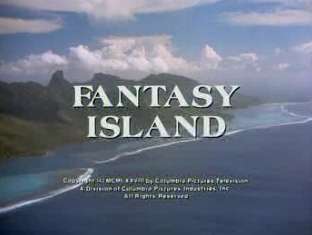
Welcome to Retro Television Reviews, a feature where we review some of our favorite and least favorite shows of the past! On Tuesdays, I will be reviewing the original Fantasy Island, which ran on ABC from 1977 to 1984. Unfortunately, the show has been removed from most streaming sites. Fortunately, I’ve got nearly every episode on my DVR.
This week, three nurses are brought to the Island by one grateful benefactor.
Episode 7.3 “Nurses Night Out”
(Dir by Philip Leacock, originally aired on October 22nd, 1983)
Wealthy George Galloway (Peter Graves) has recently been discharged from the hospital and he wants to give a present to the three nurses that took care of him. He pays for all of them to come to Fantasy Island and experience a fantasy.
Christine Donavon (Joanna Cassidy) wants the capable but abrasive Dr. Mark Reed (Monte Markham) to experience what it’s like to be a patient so that he might understand what it’s like having to deal with the uncertainty of being in a hospital. However, Christine comes to discover that Dr. Reed isn’t that bad and Dr. Reed comes to realize that perhaps he could be a bit kinder. Love is in the air!
Tracy Freemont (Pat Klous) wants to hook up with quarterback Crash McGowan (Brodie Greer, who I’m also currently watching as Officer Barizca on CHiPs). Crash was a patient at the hospital and Tracy was his night nurse. Crash likes Tracy but, as he explains it to Mr. Roarke, he’s currently under a lot of pressure to win football game and, as a result, he’s impotent. Maybe Crash should just ask for a fantasy where he’s not impotent for the weekend. Fear not, things work out. Love is in the air!
At first, Alice Green (Eleanor Parker) just wants to spend her time on the Island doing nothing. That’s her fantasy. Lawrence may think that an odd fantasy but I actually understand Alice’s point. She’s on vacation. Why should she have to do anything? However, when Alice discovers that George is her benefactor, she decides she does have a fantasy. She wants to tell George that she loves him. George’s fantasy is for Alice to love him. Hey, that works out! The only problem is that George only has three months to live! Love is in the air …. but for how long!?
This episode wasn’t that bad, especially when compared to the previous two episodes. I like Peter Graves and I liked the three nurses and I was happy that they all ultimately found love on the Island. Admittedly, Tracy and Christine’s fantasies didn’t do much for me. But the Peter Graves/Eleanor Parker fantasy was nicely done and I appreciated the fact that the show didn’t come up with some miracle cure for George’s terminal illness. Instead, with the gentle encouragement of Mr. Roarke, George and Alice decided to make the best of the time they had left. Good work, Mr. Roarke!
Tattoo is very much missed but this was still a good trip to the Island.
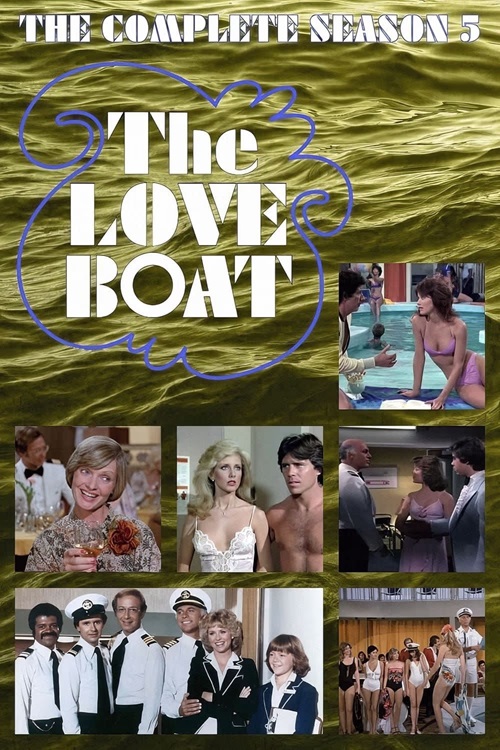
Welcome to Retro Television Reviews, a feature where we review some of our favorite and least favorite shows of the past! On Wednesdays, I will be reviewing the original Love Boat, which aired on ABC from 1977 to 1986! The series can be streamed on Paramount Plus!
This week, Gopher thinks that he recognizes a passenger!
Episode 5.15 “I Don’t Play Anymore/Gopher’s Roommate/Crazy For You”
(Dir by Bob Sweeney, originally aired on January 23rd, 1982)
When Rachel (Mackenzie Phillips) boards the ship, Gopher is sure that they’ve met before. Rachel tells Gopher that he must be mistaken and, in fact, she goes out of her way to avoid him. Since no one on this ship has ever stopped to consider that getting the cruise line sued would be bad for their career, Gopher continues to follow Rachel around. Rachel finally tells Gopher the truth.
She does know him.
In fact, they were once quite close.
In college, Rachel was Gopher’s roommate and she played for the football team. However, after graduating college, she had gender-affirmation surgery and now, she goes by the name of Rachel. Gopher is stunned and I know what you’re probably thinking. You’re probably looking at the 1982 air date and assuming that the whole storyline becomes consumed with gay panic as Gopher grapples with having been attracted to his former roommate. (Doc also hits on her but then again, Doc hits on anyone.) Well, believe it or not, The Love Boat handles this storyline with a surprising amount of sensitivity. Yes, Gopher is stunned at first. But he soon comes to respect and support Rachel’s decision, even if he doesn’t fully understand it. Physically, the rather slight Mackenzie Phillips is not particularly believable as a former football player but still, both she and Fred Grandy gave good performance in the story. This week was a case of The Love Boat really taking me by surprise.
Meanwhile, psychiatrist Lisa Lessing (Joanna Cassidy) boards the boat to observe David Jackson (Dick Shawn), an exec who is asking for worker’s compensation because he claims to be mentally ill. Lisa (hey!) is on board to check on David’s sanity. Lisa comes to believe that David is not faking but — surprise! — David actually is faking and now he feels bad because he and Lisa have fallen in love. Lisa decides to pretend to be crazy too. Uhmmm, okay.
Pianist Paul Krakauer (James MacArthur) has retired from playing because of the crippling arthritis in his hands. When he meets Irene (Donna Pescow), a maid on the ship, he falls in love and decides to give one last performance so that he can make a quick $25,000 and give it to Irene so she can get an operation to fix her ankle. Turns out that Doc has some ‘medicine” that allows Paul to play the piano but it takes several hours to take it effect so Paul misses a date that he previously set up with Irene. Irene is ready to dump David until she finds out why he stood her up.
So, this episode had one surprisingly sensitive and two kind of bland storylines. (The pianist storyline was ultimately saved by Donna Pescow’s performance as Irene.) And I’ve got a massive headache and a cold. Bleh. That said, this was actually an above-average cruise, featuring some good performances on the part of the passengers and the cruise. This week’s trip on The Love Boat was worth it.
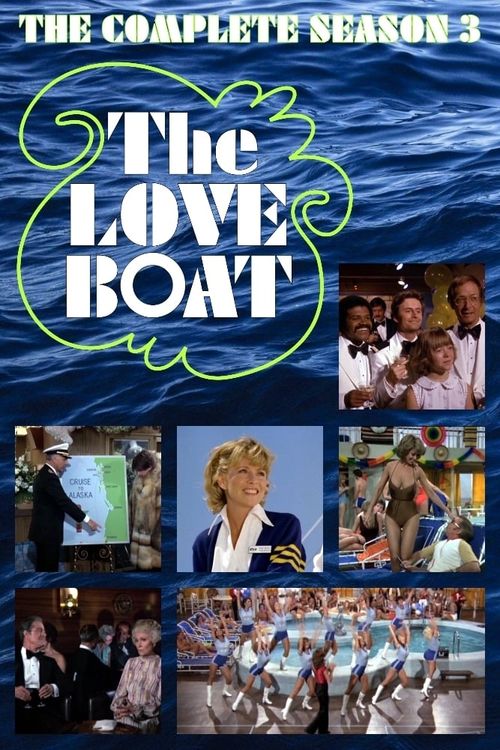
Welcome to Retro Television Reviews, a feature where we review some of our favorite and least favorite shows of the past! On Wednesdays, I will be reviewing the original Love Boat, which aired on ABC from 1977 to 1986! The series can be streamed on Paramount Plus!
This week, Gopher sings!
Episode 3.6 “Gopher’s Greatest Hits/The Vacation/One Rose A Day”
(Dir by Alan Rafkin, originally aired on October 13th, 1979)
What a pleasant cruise this turned out to be!
Two sisters, Joan (Joanna Cassidy) and Olivia (Jaye P. Morgan), are apparently regulars on the boat. They sail so often that Captain Stubing literally jumps for joy when he sees that they are once again on the ship. Joan and Olivia always take the cruise together and usually, they have a wild time. But this year, Olivia is shocked when Joan shows up with her husband, Byron (Conrad Janis)! Byron is a bit uptight and not at all happy when he starts to hear stories about how wild his wife and sister-in-law have gotten in the past. He assumes that Joan has cheated on him. She hasn’t but Olivia has cheated on her husband. In the end, Olivia continues to have fun and Joan decides that it’s time to settle down. This story suffered a bit because Byron came across as being insufferably self-righteous but Joanna Cassidy and Jaye P. Morgan were believable as sisters. As someone who has enjoyed a wild vacation or two with her sisters, I could relate.
Meanwhile, Janet Latham (Martha Scott) is taking her first vacation since the death of her husband. Her florist, Henry (Don Ameche), is also on the cruise. Every day, during their marriage, Janet’s husband would have Henry deliver a single white rose to Janet. After her husband died, Henry continued to deliver the roses to Janet. He allowed Janet to believe that her husband had arranged for her to continue to receive the daily roses but it turns out that Henry has been delivering them on his own because he’s fallen in love with her. Janet does fall in love with Henry on the ship, though she fears that she’s betraying her husband’s memory. Fortunately, by the end of the cruise, she’s ready to take another shot on love. This story worked wonderfully, largely due to the sincere and heartfelt performances of Martha Scott and Don Ameche. There was a tremendous amount of sincerity to their love story and it was impossible not to smile at the sight of them leaving the cruise together.
Finally, Julie has a problem! The singer that she scheduled to perform in the Acapulco Lounge gets the mumps and has to cancel at the last minute. Julie has to find a replacement. Fortunately, it turns out that Gopher has a great singing voice. He performs at the Lounge, wearing a pink tuxedo and acting like a drunk brat packer. The audiences loves him. The captain, once skeptical, applauds. Gopher thinks that they love his singing but actually, they all think that he’s parodying a bad lounge act. When the captain congratulates Gopher for being a brilliant comedian, the crestfallen Gopher says that he’s only going to sing in the shower from now on. So, Julie arranges for a fake shower to be placed in the middle of the Acapulco Lounge so that Gopher can sing Danny Boy while Isaac holds a watering can over his head. Again, the captain loves it. This was undoubtedly a goofy storyline but goofiness was Fred Grandy’s strong suit and it’s hard not to smile at his over-the-top interpretation of Mack the Knife.
This was a good episode that really showed how much fun The Love Boat could be at its best. From the sentimental Don Ameche/Martha Scott storyline to Fred Grandy dancing around the pool, this was an entertaining cruise.
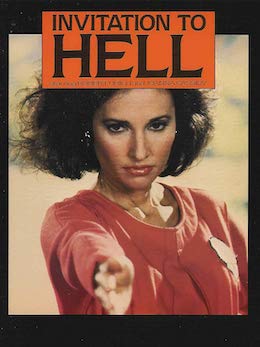
Welcome to Retro Television Reviews, a feature where we review some of our favorite and least favorite shows of the past! On Sundays, I will be reviewing the made-for-television movies that used to be a primetime mainstay. Today’s film is 1984’s Invitation to Hell. It can be viewed on YouTube!
There’s one rule in life that should never be forgotten.
Any movie that opens with Susan Lucci casting a hex that causes a man’s head to explode is going to be worth watching.
That’s certainly the case with Invitation to Hell, a 1984 made-for-TV movie that casts Lucci as Jessica Jones, an insurance agent who lives and works in an upper class suburb in Southern California. Jessica not only sells insurance but she also runs the ultra-exclusive Steaming Springs Country Club! Anyone who is anyone in town is a member of Steaming Springs! Of course, joining Steaming Springs requires going through a strange ceremony in which you walk into a mist-filled room. Jessica says that the room is called “the Spring” and that it contains everything that someone would need to be happy. However, one need only consider that the film is called Invitation to Hell to guess that Jessica might not be completely honest.
Matt Winslow (Robert Urich) and his family have just moved into the suburbs. Matt’s an engineer whose job involves designing a state-of-the-art space suit. Matt is a little bit annoyed when Jessica starts pressuring him and his family to join the country club. He’s even more perturbed when his wife (Joanna Cassidy), upon returning from the mist-filled room, starts acting and dressing just like Jessica. Matt soon comes to suspect that something strange might be happening, especially after his own daughter attacks him! Fortunately, Matt’s spacesuit comes with a flame thrower, a laser, and a built-in computer that can determine whether or not someone is actually a human being. (Wearing the space helmet means viewing the world like you’re the Terminator.) Soon, it’s science vs. magic as Matt dons the suit and tries to rescue his family from country club living!
Invitation to Hell is totally ludicrous but also a lot of fun. Robert Urich is properly stolid as the hero while the film itself is, not surprisingly, stolen by Susan Lucci. Lucci is totally and wonderfully over-the-top as Jessica, playing the role with the same cheerfully unapologetic intensity that made her a daytime television star. This is a film that has a little bit for everyone — familiar television actors, flamethrowers, space suits, demonic possession, exploding cars, and even a little bit of social satire as the film suggests that living in the suburbs is a terror even without weird country clubs and chic spell casters.
Interestingly enough, this made-for-television film was directed by none other than Wes Craven! The same year that this film was broadcast, Craven directed a little film called A Nightmare on Elm Street. While Invitation to Hell might not be in the same league as that classic shocker, it’s still an enjoyably campy horror flick.
Today’s horror on the lens is a made-for-tv movie directed by Wes Craven.
First televised in 1984, Invitation to Hell is a wonderfully over-the-top depiction of what happens when an engineer (Robert Urich) sells out and goes to work for a big evil corporation. Long story short, Satan (in the form of Susan Lucci) takes over his family. Admittedly, this film does start slowly but, in the end, it’s a lot of fun.
I can’t quite remember how I found out about 1988’s Who Framed Roger Rabbit. Growing up, most of my movie news came from four major sources – Entertainment Tonight, Siskel & Ebert, the occasional movie poster you’d see at a bus stop or cinema. If you were really lucky, the production company would sometimes create a “Behind the Scenes”/”Making of” showcase a little after the movie premiered. If possible, I would read the billing block of a poster to see if I could recognize anyone familiar, Just seeing Amblin Entertainment meant you’d have Steven Spielberg, Kathleen Kennedy and Frank Marshall involved. Nothing new there. I knew Robert Zemeckis and Alan Silvestri from Romancing the Stone and Back to the Future. Movies have had mixes of animation and live action – Bedrooms & Broomsticks, Mary Poppins, etc., but the big buzz here was the film planned to somehow involve both the Disney and Warner Bros. animation studios. It was an alien concept for me, because they couldn’t be more different from each other. Historically, animation on the WB side of things were edgy and almost dared to be even raunchy if they could get away with it. Disney, on the other hand, was pristine and extremely kid friendly. Bugs Bunny and Mickey Mouse? Daffy Duck vs. Donald Duck, all on the same screen? It was the 1980’s equivalent of asking Marvel (which ironically, is owned by Disney now) and DC (which the WB has owned for decades) to write a single Justice League / Avengers crossover story.
At the time, Steven Spielberg was already well known for blockbusters like the Indiana Jones films and E.T., but did he really have enough clout to bring two major companies together like that? It blew my 13 year old mind and I became completely obsessed.
Around the time Who Framed Roger Rabbit came out, I picked up anything I could find about it. I had Alan Silvestri’s soundtrack, a poster, a stuffed Roger doll, and the video game when it came out. I even read Gary Wolf’s novel. I begged my parents to let me see it, and it was one of the rare times where my Mom took my sis and I to the movies instead of my dad (the major movie buff, who took us to see Robocop twice the year before). I think she went in part to shut me up, and to give herself a break from my nearly 2 year old brother. It remains one of the two best movie related memories I have of her.
In the world of Who Framed Roger Rabbit, humans and cartoons share the same space in Los Angeles. Cartoons live in Toontown, owned by Marvin Acme (Stubby Kaye). It’s the story of Eddie Valiant (Bob Hoskins – Hook, Mermaids), a Los Angeles Private Eye with a bit of a grudge against toons. For a quick buck, Valiant is hired by R.K. Maroon (Alan Tilvern – Firefox, Little Shop of Horrors) to snoop on Acme. Valiant’s work puts him in the path of Roger Rabbit (Charles Fleischer, Back to the Future Part II), after Eddie takes some racy pictures of Acme playing patty cake with Roger’s wife, Jessica (Kathleen Turner, Romancing the Stone). Roger angrily swears they’re still a happy couple and that Acme somehow coerced her before running off into the night. The next morning, Eddie is informed that the Marvin Acme’s been killed overnight. To make things worse, Acme’s Will is missing, leaving the fate of Toontown up in the air. All of the evidence points to Roger, but Roger asks for Eddie’s assistance in clearing his name. Can Eddie save Roger before Judge Doom (Christopher Lloyd, Back to the Future) and his pack of weasels get their hands on him?
The production for the film required jumping over a number of hurdles. Zemeckis, himself a cartoon fan, wanted to bring some of the Warner Bros. characters along with Disney characters. Even better, he also wanted to add some of Tex Avery’s classic style to the film. Similar to what he did with Ready Player One, Spielberg negotiated with some of the studios, and while he couldn’t get everyone, he did manage to get Disney, WB and a few others to commit. With this in place, they had to somehow merge animation with live-action in a way that made it look like the cartoons were interacting with their environment.
This would require one really huge magic trick, made up from an assortment of parts.
Since it was around 1986-1987, there really was no CG, yet.. James Cameron made 6 stuntmen in Alien suits look like 600 through the use of Oscar Winning Editing, and the technology that gave us the paradigm shifting dinosaurs of Jurassic Park wouldn’t occur for another 3 or 4 years. For Who Framed Roger Rabbit, the approach was a mix of robotics, puppetry, sleight of hand gadgetry, and a lot of imagination.
The art was handled by Richard Williams and his team, who would go on to win a Special Achievement Oscar for his contribution to the film. They had to draw every cell/frame by hand, on paper and then have them inked. These would then go to Industrial Light & Magic, who would add shadow, highlights and special effects To make things harder, the artists had to work around Zemeckis’ filming style and figure out how to fit the characters into each scene.
Take Jessica Rabbit’s performance of “Why Don’t You Do Right?”, sung by Amy Irving (Carrie, The Fury). At first glance, it seems a really easy shot. Girl steps on the stage, performs and leaves, right? However, there are so many things happening here on an effects level that I still don’t fully understand how they did it after all these years. ILM handled the lighting, from the sparkles in the dress, the use of the handkerchief and the great moment where Jessica blocks the spotlight in her walk from Acme to Valiant. I had to later explain to my mom that the “Wow” I whispered in the theatre during that scene had little or nothing to do with puberty. It was because I hadn’t seen anything like that before with a cartoon, and I’d hate the Academy forever if the movie didn’t win an Oscar for that.
Having cartoons on screen is one thing, but making it feel like they were interacting with people is another. Hoskins was the anchor that tied most of it all together. Having to work with nearly nothing – not even a green screen – and perform the physical actions required of the role was quite a feat compared to what some actors do with the motion capture rooms and digital walls we use today. Near lifesize models of Roger were created to help Hoskins handle some of the physical “grab and move” sequences, and actor Charles Fleischer actually spent time dressed as Roger on set (but off camera, of course) to feed his side of the conversation to Hoskins when filming a scene.
Puppeteers were brought on for moments were toon characters needed to hold objects, such as guns or knives. There is a moment of the movie where you can see one of the holes for the guns that the weasels, but it’s a pretty minute hiccup with all of the great work that was done. For the car sequences with Benny the Cab (also Fleischer), they used a special mini-car with a driver in the back. The car and driver were painted over (still, frame for frame) by the animators.
And ff course, it wouldn’t be a Zemeckis film without Alan Silvestri at the helm, musically speaking. Silvestri’s score for was a mix of detective noir and cartoony antics, which made for a perfect fit for the film. Overall, Who Framed Roger Rabbit is one of those films I cherished growing up, and it’s almost impossible for me to avoid recommending it.
I think I was nine or ten years old when I first saw Club Paradise on HBO. I remember thinking it was pretty funny.
I recently rewatched Club Paradise and I discovered that ten year old me had terrible taste in movies.
Robin Williams plays Jack Moniker, a Chicago fireman who gets blown out of a building while rescuing a dog. Living off of his disability payments, he retires to the island of St. Nicholas, which is basically Jamaica but with less weed. Jack and reggae musician Ernest Reed (Jimmy Cliff) open up their own Club Med-style resort, Club Paradise. Jack doesn’t know much about the resort business but he does know how to put together a good brochure. Almost the entire cast of SCTV shows up at Club Paradise, looking for a tropical vacation. Things quickly go wrong because Jack doesn’t know how to run a resort and there’s also an evil developer (played by Brian Doyle-Murray) who wants Club Paradise to fail so that he can get the land.
Club Paradise has got a huge and impressive cast, the majority of whom probably signed on because they were looking forward to a paid Caribbean vacation. Peter O’Toole plays the British-appointed governor of St. Nicholas. Twiggy plays Jack’s girlfriend. Joanna Cassidy plays a reporter and Adolph Caesar is cast in the role of St. Nicolas’s corrupt prime minister. Because the film was directed by Harold Ramis, it is full of Ramis’s co-stars from SCTV. Andrea Martin tries to get her husband to enjoy the islands as much as she’s enjoying them. Joe Flaherty is the crazed pilot who flies people to the resort. Rick Moranis and Eugene Levy play two nerdy friends who are both named Barry and who are only interested in scoring weed, getting laid, and working on their tan. Rick Moranis and Eugene Levy playing nerds? It’s a shock, I know.
There’s enough funny people in Club Paradise to ensure that there are a few isolated laughs. Not surprisingly, the movie comes to life whenever Moranis and Levy are onscreen. (If I had to guess, I imagine they were the reason why ten year-old me liked this movie so much.) Needless to say, Jimmy Cliff also provides a killer soundtrack. But Club Paradise ultimately doesn’t work because the script is too disjointed and it feels more like an uneven collection of skits than an actual film. It’s impossible to tell whether we’re supposed to think of Club Paradise as being the worst resort ever or if we’re supposed to be worried that the bad guys will shut it down. For a movie like this, you need a strong central presence to hold things together. Unfortunately, Robin Williams’s style of comedy is too aggressive for the role of Jack. The role was originally written for Bill Murray and it shows. Most of Jack’s lines sound like things you would expect Bill Murray to say in his trademark laid back fashion and it is easy to imagine Murray redeeming some of Club Paradise‘s weaker scenes simply by attitude alone. Instead, Robin Williams is so frantic that you never buy he could be happy living a laid back life on a Caribbean island. As played by Williams, Jack often comes across as being unreasonably angry at everyone staying at Club Paradise and it’s hard to care whether or not he manages to save his resort or not.
Club Paradise was a bomb at the box office. Harry Shearer, who was originally credited with working on the screenplay, hated the movie so much that he requested his name be removed from the credits. (Instead, credit is given to Edward Roboto.) As a result of the film’s failure, it would be 7 years before Harold Ramis would get to direct another movie. Fortunately, that movie was Groundhog Day and this time, Ramis was able to get Bill Murray.
Artie Logan (Charlie Schlatter) is a wannabe James Dean who keeps getting kicked out of school because he is such a rebel. His father, a judge, gives Artie one more chance. Artie can either enroll at Fairfield College or he can go to jail. Artie chooses Fairfield, where he meets and falls for the beautiful and popular Tally Fuller (Josie Bissett). However, no sooner does Artie show up for their first date than someone sets Tally on fire and crashes through a window. Artie is the number one suspect but Detective P.J. Decker (Christopher Walken) still gives him 24 hours to solve the murder and clear his name. Artie investigates and discovers that Tally was not the innocent, all-American girl that everyone thought she was. This leads to a nudity-filled flashback that explains why All-American Murder was an HBO mainstay in the 90s. It also leads to other people being murdered by snakes and hand grenades.
Despite some bloody murders and the presence of Walken and Joanna Cassidy in potentially interesting supporting roles, All-American Murder fails because it asks us to accept Charlie Schlatter as being a charismatic rebel. When Joanna Cassidy tells him that he’s a “renegade,” not even she sounds like she believes it. The murder mystery is intriguing but Artie is so obnoxious that you want him to go to prison whether he’s guilty or not.
All-American Murder was directed by Anson Williams, who is best known for playing Potsie on Happy Days. The Fonz could have framed Ralph Malph for this murder in half the time that it takes Artie to solve it.

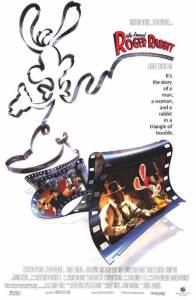 I can’t quite remember how I found out about 1988’s Who Framed Roger Rabbit. Growing up, most of my movie news came from four major sources – Entertainment Tonight, Siskel & Ebert, the occasional movie poster you’d see at a bus stop or cinema. If you were really lucky, the production company would sometimes create a “Behind the Scenes”/”Making of” showcase a little after the movie premiered. If possible, I would read the billing block of a poster to see if I could recognize anyone familiar, Just seeing Amblin Entertainment meant you’d have Steven Spielberg, Kathleen Kennedy and Frank Marshall involved. Nothing new there. I knew Robert Zemeckis and Alan Silvestri from Romancing the Stone and Back to the Future. Movies have had mixes of animation and live action – Bedrooms & Broomsticks, Mary Poppins, etc., but the big buzz here was the film planned to somehow involve both the Disney and Warner Bros. animation studios. It was an alien concept for me, because they couldn’t be more different from each other. Historically, animation on the WB side of things were edgy and almost dared to be even raunchy if they could get away with it. Disney, on the other hand, was pristine and extremely kid friendly. Bugs Bunny and Mickey Mouse? Daffy Duck vs. Donald Duck, all on the same screen? It was the 1980’s equivalent of asking Marvel (which ironically, is owned by Disney now) and DC (which the WB has owned for decades) to write a single Justice League / Avengers crossover story.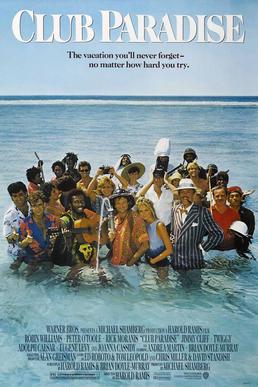

 Through the Shattered Lens