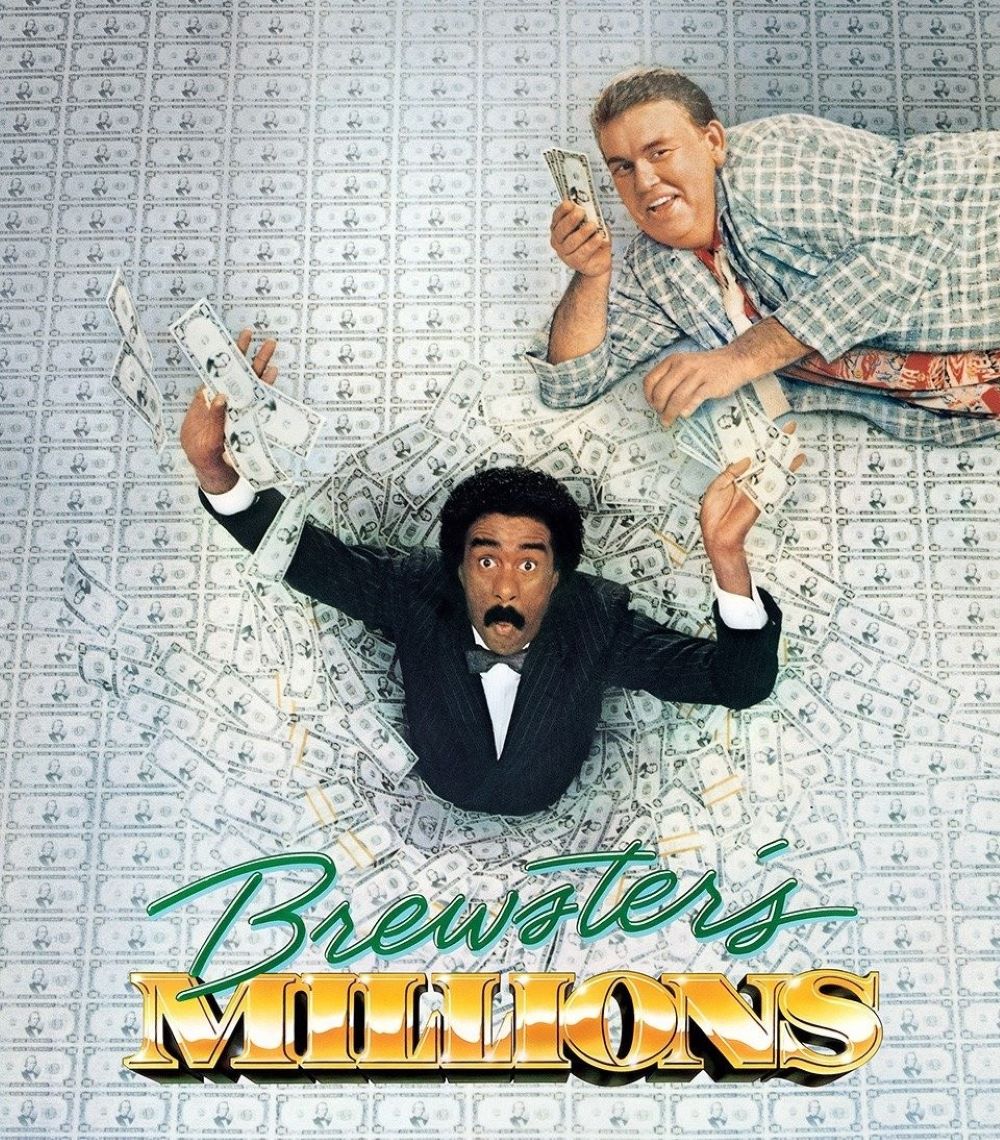
Guilty Pleasure No. 92: Brewster’s Millions (dir. by Walter Hill)


Walter Hill’s Brewster’s Millions (1985) isn’t a perfect movie by any stretch, but it’s the kind of film that sneaks up on you. It may not be sharp enough to qualify as great satire or consistent enough to hit every comedic note, but it has an undeniable charm that pulls you in regardless. It’s loud, uneven, and often ridiculous, yet few comedies from the 1980s are as weirdly entertaining when they’re firing on all cylinders. For many movie fans, it’s that quintessential “guilty pleasure”—a film you know has problems, but that somehow feels impossible to turn off once it starts. And in many ways, that’s exactly where Brewster’s Millions finds its lasting appeal.

The setup alone is too fun to resist. Richard Pryor stars as Montgomery Brewster, a minor league baseball pitcher who unexpectedly inherits the opportunity of a lifetime—to claim a $300 million fortune from a distant relative. The catch? Before he can get it, he has to spend $30 million in 30 days under a bizarre set of conditions that make financial ruin easier said than done. He can’t give the money away, can’t destroy it, can’t buy assets or investments that retain value, and can’t tell anyone why he’s doing it. Fail, and he gets nothing. Succeed, and he becomes one of the richest men alive. It’s the sort of gleefully absurd premise that could only have come from Hollywood in the 1980s, and it’s immediately clear that the film wants audiences to sit back, grab some popcorn, and watch Pryor tear through cash in increasingly funny and desperate ways.

Richard Pryor is, without doubt, the heart and soul of the movie. He imbues Montgomery Brewster with equal parts manic energy and human frustration, giving the character a real emotional arc beneath all the comic spectacle. Pryor’s talent for blending humor with exasperation makes Brewster’s predicament believable, even when it’s insane. Watching him scramble to lose money while the world keeps rewarding him is strangely satisfying. Pryor understood how to play ordinary men caught in extraordinary circumstances, and that quality grounds the film when it could have easily spiraled into total silliness. In scenes where he loses his patience with accountants, schemes wild spending sprees, or watches his good intentions backfire, Pryor’s comic timing keeps the chaos enjoyable.

John Candy adds another layer of charm as Brewster’s best friend and teammate, Spike Nolan. Candy brings warmth, loyalty, and that unmistakable good-heartedness that made him one of the decade’s most beloved comedic actors. The chemistry between Pryor and Candy keeps the film buoyant even through its weaker stretches. Their friendship defines the film’s tone—it’s loose, goofy, and full of bro-ish camaraderie. Without Candy’s infectious energy, the movie’s more hollow comedic beats might have hit the floor with a thud. Together, they create a dynamic that feels real, even inside a premise that’s totally absurd.

As a director, Walter Hill feels like an odd fit for this kind of broad comedy, but that’s part of what makes Brewster’s Millions interesting. Hill, better known for tough, kinetic action films like The Warriors and 48 Hrs., approaches this farce with a surprising amount of structure and visual precision. The film looks slicker and sharper than most comedies of its kind, which gives the excess on-screen an unintentionally epic flair. Hill’s direction keeps the story moving, and though he’s not naturally a comedic filmmaker, his grounded style adds a peculiar edge to all the craziness. It’s chaos with discipline—an aesthetic that somehow works in the movie’s favor.

Still, Brewster’s Millions can’t quite escape its shortcomings. The pacing is uneven, especially in the middle, where the film loses some steam as Brewster cycles through increasingly repetitive spending gimmicks. The story flirts with satire but rarely commits, brushing up against deeper commentary on wealth, politics, and capitalism before retreating to the comfort of broad comedy. The “Vote None of the Above” subplot, where Brewster’s money-wasting political campaign taps into voter cynicism, is one of the smartest parts of the film—but it’s introduced and resolved too quickly to leave a mark. And while the movie is full of lively energy, not every gag lands; a few supporting performances veer into caricature, and some jokes feel very much of their time.

Yet these flaws are partly what make Brewster’s Millions such a delightful guilty pleasure. It’s the cinematic equivalent of junk food—high on calories, low on nutritional value, but deeply enjoyable all the same. Pryor’s constant exasperation, the sheer absurdity of trying to “waste” money legally, and the exaggerated set pieces (like the overblown parties or his failed attempts to lose at gambling) make for irresistible entertainment. Even when the humor dips into predictable territory, the concept keeps pulling you back in. There’s a giddy satisfaction in watching Brewster try—and fail—to lose money, especially because the universe just won’t let him.

The romance subplot with Lonette McKee’s character, Angela Drake, adds just enough heart to balance the absurdity. McKee gives a grounded, intelligent performance that prevents the love story from feeling tacked on, even if it never fully takes center stage. Her presence keeps Brewster tethered to some kind of reality, and the moral through-line—learning that not everything valuable can be bought—lands gently rather than preachily. It’s not profound, but it fits the breezy tone perfectly.

As a comedy of excess, Brewster’s Millions is very much a product of its time. The slick suits, the gaudy parties, the blind faith in wealth, and the Reagan-era optimism about money’s moral neutrality all ooze from every frame. That time-capsule quality is part of its modern appeal. Watching it today, you can’t help but smile at how on-the-nose it feels—a movie from the “greed is good” decade that accidentally ends up mocking the very mindset it sprang from. It’s self-aware only in flashes, but those flashes are enough to make you recognize the movie’s satirical edge hiding beneath its loud surface.

In the end, that’s what makes Brewster’s Millions endure as a lovable guilty pleasure. It has flaws you can’t ignore—uneven pacing, scattershot tone, underdeveloped ideas—but none of them outweigh its charm. Pryor’s comic genius makes even the weakest joke land better than it should. Candy’s warmth keeps the film light. And Hill’s straightforward direction infuses the lunacy with just enough realism to make it believable. The result is a movie that’s too silly to take seriously but too fun to dismiss. You watch it, laugh at its audacity, shake your head at the logic gaps, and yet somehow come away smiling.

Brewster’s Millions may not be a comedy classic, but it’s easy to see why people keep revisiting it. It’s comfort food cinema—lighthearted, clumsy, and endlessly watchable. And like all the best guilty pleasures, it doesn’t need to be perfect to make you happy. Sometimes, seeing Richard Pryor outsmart the meaning of money for two hours is more than enough.

Previous Guilty Pleasures

  1. Half-Baked
  2. Save The Last Dance
  3. Every Rose Has Its Thorns
  4. The Jeremy Kyle Show
  5. Invasion USA
  6. The Golden Child
  7. Final Destination 2
  8. Paparazzi
  9. The Principal
  10. The Substitute
  11. Terror In The Family
  12. Pandorum
  13. Lambada
  14. Fear
  15. Cocktail
  16. Keep Off The Grass
  17. Girls, Girls, Girls
  18. Class
  19. Tart
  20. King Kong vs. Godzilla
  21. Hawk the Slayer
  22. Battle Beyond the Stars
  23. Meridian
  24. Walk of Shame
  25. From Justin To Kelly
  26. Project Greenlight
  27. Sex Decoy: Love Stings
  28. Swimfan
  29. On the Line
  30. Wolfen
  31. Hail Caesar!
  32. It’s So Cold In The D
  33. In the Mix
  34. Healed By Grace
  35. Valley of the Dolls
  36. The Legend of Billie Jean
  37. Death Wish
  38. Shipping Wars
  39. Ghost Whisperer
  40. Parking Wars
  41. The Dead Are After Me
  42. Harper’s Island
  43. The Resurrection of Gavin Stone
  44. Paranormal State
  45. Utopia
  46. Bar Rescue
  47. The Powers of Matthew Star
  48. Spiker
  49. Heavenly Bodies
  50. Maid in Manhattan
  51. Rage and Honor
  52. Saved By The Bell 3. 21 “No Hope With Dope”
  53. Happy Gilmore
  54. Solarbabies
  55. The Dawn of Correction
  56. Once You Understand
  57. The Voyeurs 
  58. Robot Jox
  59. Teen Wolf
  60. The Running Man
  61. Double Dragon
  62. Backtrack
  63. Julie and Jack
  64. Karate Warrior
  65. Invaders From Mars
  66. Cloverfield
  67. Aerobicide 
  68. Blood Harvest
  69. Shocking Dark
  70. Face The Truth
  71. Submerged
  72. The Canyons
  73. Days of Thunder
  74. Van Helsing
  75. The Night Comes for Us
  76. Code of Silence
  77. Captain Ron
  78. Armageddon
  79. Kate’s Secret
  80. Point Break
  81. The Replacements
  82. The Shadow
  83. Meteor
  84. Last Action Hero
  85. Attack of the Killer Tomatoes
  86. The Horror at 37,000 Feet
  87. The ‘Burbs
  88. Lifeforce
  89. Highschool of the Dead
  90. Ice Station Zebra
  91. No One Lives

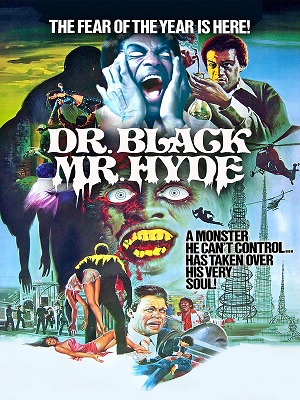
The TSL Horror Grindhouse: Dr. Black, Mr. Hyde (dir by William Crain)


1976’s Dr. Black, My Hyde tells the story of Dr. Henry Pride (Bernie Casey).

Dr. Pride is a respected doctor, the head of a free clinic in the Watts district of Los Angeles.  He has a big house.  He has a fancy car.  With Dr. Billie Worth (Rosalind Cash), he is researching a serum that will help people with cirrhosis to regenerate the tissue of their liver.  Of course, Dr. Pride wasn’t always rich.  In his own words, he and his mother grew up in the guest house of a brothel.  But now that he is rich and successful, some people claim that he’s lost touch with his community.  As a prostitute named Linda (Marie O’Henry) tells him, “You talk white, you think white, you probably drive a white car.”

In a scene that is designed to bring to mind the horrors of the Tuskegee syphilis experiments, Dr. Pride considers the ethics of injecting his serum into his patients without warning them that there might be consequences.  Billie warns him that what he’s thinking about doing would be not only unethical but illegal.  Dr. Pride questions whether ethics matter when dealing with something that could potentially save lives in the future.  After Dr. Pride injects an elderly black woman with the serum, she turns into a white-skinned monster who attempts to strangle a nurse before promptly dying.  Despite this, Dr. Pride continues to develop the serum and eventually, he tries it on himself.

Under the effects of the serum, Dr. Pride becomes a white-skinned madman.  (Bernie Casey wears a white makeup whenever he plays this film’s version of Mr. Hyde.)  Under the influence of the serum, Pride rampages through Watts, killing prostitutes and pimps before transforming back into the Dr. Pride.  The police are investigating the murders but they’re searching for a white man.  Meanwhile, Dr. Pride continues to obsess on trying to work out the kinks of her serum.  He wants Linda to be his latest test subject.

Dr. Black, Mr. Hyde is a blaxploitation take on Dr. Jekyll and Mr. Hyde and, as with many blaxploitation films, the subtext is frequently more interesting than what actually happens on screen.  Dr. Pride, after continually being accused of acting white, takes his serum and soon literally becomes white and sets out to kill the prostitutes and the pimps who remind him of his life before he became a doctor.  And while it’s easy to see this as an example of the serum turning a good man into an evil monster (the classic Jekyll and Hyde formula), it’s also true that, even before his transformation, Dr. Pride views his patients as being potential test subjects.  For all of his talk about helping people, Dr. Pride maintains his distance from the members of his own community.  Is the serum turning Dr. Pride into a monster or is it just revealing who Dr. Pride truly wishes to be?  Given the film was directed by William Crain, who also did Blacula and who, unlike a lot of Blaxploitation directors, actually was black, it’s easy to believe that the subtext was intentional.

Of course, subtext aside, Dr. Black, Mr. Hyde is a cheap-looking and haphazardly edited film.  Much of the acting is amateurish but Bernie Casey gives a strong performance as both the repressed black doctor and his violent, white alter ego.  Cheapness aside, Dr. Black, Mr. Hyde is a frequently intriguing film.

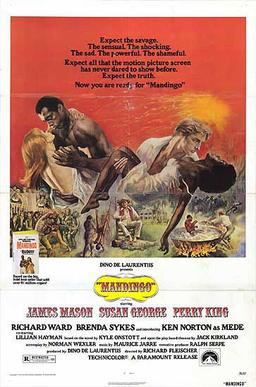
Embracing the Melodrama Part II #54: Mandingo (dir by Richard Fleischer)


Mandingo_movie_posterUp until last night, I was under the impression that James Mason never gave a single bad performance over the course of his long career.  Oh sure, I knew that Mason had probably appeared in his share of bad films.  But I figured he was one of those actors who was always better than his material.  Just watch Lolita, The Verdict, Julius Caesar, Odd Man Out, Bigger Than Life, or Murder By Decree and you’ll see that James Mason was a great actor.

But then, last night, I finally got around to watching the 1975 film, Mandingo.

I’ve actually owned Mandingo on DVD for a few years.  I bought it on a whim, the result of having seen it listed as one of the worst films of all time in several different reference guides.  But I have to admit that I did not have any great desire to actually sit through the film.  Instead, it was one of those films that you buy just so your very ownership of it can be a conversation piece.

(“Oh my God, Lisa, what’s this?”  “Oh, that little old thing?  That’s my copy of Mandingo…”)

However, when I decided to do Embracing the Melodrama, Part II, I realized that this would be the perfect time to actually watch and review Mandingo.

Mandingo deals with life on a sordid plantation in pre-Civil War Alabama.  Warren Maxwell (James Mason) owns the plantation and he spends most of his time sweating and complaining about his rheumatism.  When a Satanic slave trader named Brownlee (Paul Benedict) suggests that Warren can cure his rheumatism by always resting his feet on the backs of two little slave children, Warren proceeds to do just that.  Seriously, this is a 127 minute film and, nearly every time that Mason appears on screen, he’s got his feet propped up on the children.

Warren’s got a son named Hammond (Perry King).  Hammond walks with a limp, the result of a childhood pony accident.  Warren expects Hammond to sire an heir to Maxwell family legacy but Hammond is only comfortable having sex with slaves.  Finally, during a business trip with his decadent friend Charles (Ben Masters), Hammond meets and marries Blanche (Susan George).  Blanche assures Hammond that she’s a virgin and, on their wedding night, she asks Hammond how to have sex.  “We take off our clothes…” Hammond begins.

However, the morning after, Hammond is convinced that Blanche lied about being virgin because she enjoyed having sex.  Once they return to the plantation, Hammond refuses to touch Blanche and instead ends up falling in love with a slave named Ellen (Brenda Sykes).  When Ellen gets pregnant, Blanche beats her until she miscarries.

And meanwhile, James Mason keeps popping up with two little kids resting underneath his feet…

But that’s not all!  Hammond has purchased a slave named Mede (Ken Norton).  Mede is a boxer and wins Hammond a lot of money.  In order to “toughen up” his skin, Mede is also forced to bathe in a cauldron of very hot water.  “Shuck down those pants!” Hammond shouts before Mede gets in the cauldron.

Blanche, who is now an alcoholic, gets her revenge on Hammond by having sex with the the legendarily endowed Mede.  Soon, Blanche is pregnant and Hammond and Warren are both excited.  Then the baby is born and all Hell breaks loose.

And, meanwhile, James Mason rests his feet on the back of two little kids…

Mandingo is one of those films that you watch in wide-eyed amazement, shocked that not only was this movie made but it was also apparently made by a major film studio and directed by a professional director.  (Before he directed Mandingo, Richard Fleischer directed everything from 20,000 Leagues Under The Sea to Doctor Dolittle to Soylent Green.)  I know that some would argue that Mandingo used the conventions of exploitation cinema to expose the sickening inhumanity of American slavery but let’s be honest here.  Mandingo is not Django Unchained.  Instead, it’s a slow-moving soap opera that is occasionally redeemed by some over-the-top dialogue and histrionic performances.

And it’s also proof that James Mason was capable of giving a bad performance.  According to the imdb, James Mason described Mandingo as a film that he did solely for the paycheck.  From his terrible Southern accent to the way that he always seems to be trying to hide his face from the camera, Mason gives perhaps one of the worst performances ever given by a legitimately great actor.

But really, can you blame him?

Lisa Reviews An Oscar Nominee: Bound for Glory (dir by Hal Ashby)


Bound_for_glory_Poster

One of my favorite online film reviewers is Mitch Lovell of the Video Vacuum.  The thing I like about Mitch is that he doesn’t worry about how many Oscars a film has been nominated for or whether or not a film’s politics are currently in fashion.  Unlike a lot of online reviewers, he doesn’t worry about whether or not he’s going against the “accepted” views of the critical establishment.  Instead, he’ll watch a film and tell you exactly how he felt about it.

For example, Mitch Lovell’s review of the otherwise critically acclaimed 1976 best picture nominee Bound for Glory can be summed up in three words: “boring as fuck.”  Every other online review that I’ve found for Bound for Glory offers up polite but rarely inspiring praise for this rather lengthy film about the folk singer Woody Guthrie.  Most of those reviews do acknowledge that the film moves at its own pace but we are told that we will be rewarded for being patient.  If the review was written after 2010, you can be sure that the reviewer will be sure to say that Bound for Glory reminds us of why labor unions are still important and need to be protected from the Tea Party.  (The idea apparently being that, if a film has the right politics, it doesn’t have to actually be all that interesting.)  It’s all rather predictable and that’s why we’re lucky to have reviewers like Mitch Lovell around.  Whether you agree with him or not, it’s good to have a reviewer who will go against the conventional wisdom.

I recently watched Bound for Glory as a part of TCM’s 31 Days of Oscars and, to a large extent, I have to agree with Mitch Lovell’s review.  This is a movie that is not only long but which moves slowly as well.  It’s not that the film has a deliberate pace.  It’s just slow!  (If you want to see a film that makes good use of a deliberate pace, check out Barry Lyndon.)  David Carradine plays Woody Guthrie, a sign painter who, during the Great Depression, abandons his family in Texas and, by hopping trains, makes his way to California.  He works with fruit pickers.  He tries to convince his fellow workers to form a union.  He gets beat up a lot.

And he plays his guitar.

If there’s anything that remains consistent about Bound for Glory, it’s that Woody is always playing his guitar and that every time he starts to play, something terrible either has happened or does happen.  There’s a huge dust storm.  Woody plays his guitar.  A fight breaks out at a union meeting.  Woody plays his guitar.  A bunch of hoboes on a train get beat up.  Woody plays his guitar.  Woody shows up at a textile mill and starts to play his guitar.  He gets beaten up by a bunch of thugs.  Woody impresses Pauline (Gail Strickland) by playing his guitar and soon, he’s cheating on his wife.  Woody partners up with another folk singer, Ozark Blue (Ronny Cox), and they get their own radio show where Woody plays guitar.  Woody promptly gets fired.

It quickly became apparent to me that Woody Guthrie’s guitar was cursed.  Whenever he played it, poor people ended up getting oppressed.

In many ways, Bound for Glory is a prototypical example of what it means to be an acclaimed-at-its-time-but-subsequently-forgotten best picture nominee.  It’s a big epic film that tells a fictionalized account of a real person’s life story.  Woody Guthrie is best known for writing This Land Is Your Land, which is a song that I mostly associate with pretentious super bowl commercials.  As Bound for Glory details, Woody was also a union organizer and political activist but what’s odd is that the film keeps the exact details of what he believed rather vague.  We’re given the general idea of what Woody believed but we’re not given any specifics.  As a result, Woody just comes across like another part-time social protestor as opposed to being a true political thinker (much less a revolutionary).

On a positive note, Bound for Glory is impressive to look at.  The film’s cinematographer was the famous Haskell Wexler (who also directed Medium Cool, a film that was as upfront about its politics as Bound for Glory is vague) and Wexler captures some hauntingly beautiful images of the American wilderness.  The scene where a gigantic wall of dust crashes down onto a small Texas town is especially memorable.

Otherwise, though, Bound for Glory is pretty much a snoozefest.  It was nominated for best picture of 1976 and, when you compare it to fellow nominees like All The President’s Men, Network, Taxi Driver, and even RockyBound for Glory does feel a bit out of place.

Then when you consider some of the other films that came out in ’76 — Carrie,  Face to FaceThe Front, God Told Me To, Logan’s Run, The Man Who Fell To Earth, Marathon Man, The Omen, The Outlaw Josey Wales, Lipstick, Robin and Marian, The Sailor Who Fell From Grace With The Sea, and The Town That Dreaded Sundown — the nomination of Bound for Glory feels like even more of a mistake.

Oh well.

Occasionally, the Academy gets it wrong.

Shocking, I know.