The TSL Horror Grindhouse: Fear City (dir by Abel Ferrara)


Welcome to Manhattan in the mid-80s!

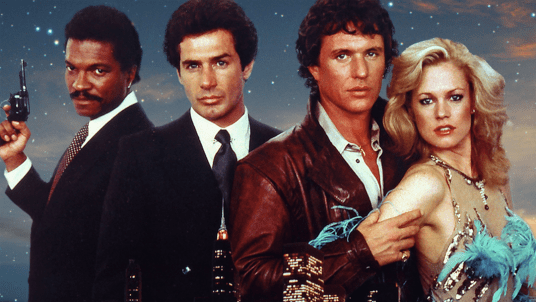
While self-righteous vice cop Al Wheeler (Billy Dee Williams) patrols the streets with the fury of an Old Testament prophet, men flock to seedy bars to watch women like Loretta (Melanie Griffith) dance and strip.  Mobsters like Carmine (Rossano Brazzi) control the streets while club owners like Mike (Michael V. Gazzo) and Frank (Joe Santos) try to do business and make enough money to keep things open.  Bookers like Nicky Parzeno (Jack Scalia) and Lou Goldstein (Jan Murray) compete to see who can place their girls in the most clubs.  Nicky’s best friend and business partner, Matt Rossi (Tom Berenger), is haunted by his violent past as a boxer and his failed relationship with the drug-addicted Loretta.

Meanwhile, a nameless man (John Foster) practices nude tai chai in his warehouse apartment and writes feverishly in his journals.  At night, he stalks the streets with a blade in his hand.  He targets strippers, attacking them as they try to get home from the club.  Honey (Ola Ray) is attacked on a subway platform.  Loretta’s girlfriend, Leila (Rae Dawn Chong), is attacked on the streets.  Obsessed with Loretta’s safety, Matt struggles with his own inner demons as he prepares for a final confrontation with the killer….

1985’s Fear City is another one of director Abel Ferrara’s heavily stylized fever dreams.  In typical Ferrara fashion, the plot is so sordid that one might be tempted to think that the film is meant to be a self-parody and the dialogue mixes profane insults with bizarrely philosophical asides.  As played by Billy Dee Williams, Al Wheeler is not just a cop who wants to clean up New York and Times Square.  Instead, he’s a seething soldier to traditional morality and one who is so intense that it’s something of a shock that he doesn’t just walk around New York shooting people for jaywalking.  Meanwhile, Tom Berenger’s Matt is a hulking brute who is haunted by the time he killed a man in the ring.  He knows what he’s capable of and it scares him but, in order to save Loretta and his business, he’s going to have to become that deadly boxer once again.  “I hate Matt Rossi because he’s arrogant,” Al Wheeler says through gritted teeth.  Meanwhile, Matt deals with his own issues by trashing his office and then leaving the mess for someone else to clean up.  I’m not sure what that was supposed to accomplish but it’s apparently something that Matt just has to do.

Abel Ferrara directed this film five years before King of New York and, in some ways, Fear City feels like a dry run for King of New York.  Both films are highly stylized and both present New York as being a neon-lit Hell where the rich and the poor come together in mutual self-loathing and where the criminals often have more of a code of honor than the cops who are trying to stop them.  Of course, King of New York had Christopher Walken’s magnetic performance as Frank White holding the film and its many storylines together.  Fear City doesn’t really have that.  Billy Dee Williams, Tom Berenger, Jack Scalia, and Melanie Griffith all give strong performance but none of their characters are really quite compelling or grounded enough to keep the film from spinning off into delirious excess.

In other words, Fear City is a mess but it’s one of those over-the-top, shamelessly sordid messes that you really can’t look away from.  There’s enough philosophical dialogue to confirm that, as with King of New York, Ferrara was shooting at something more than just a typical exploitation film.  Unlike King of New York, Ferrara doesn’t quite succeed in saying anything particularly deep about the human condition in Fear City.  But that’s okay.  It’s an entertainingly sordid film.
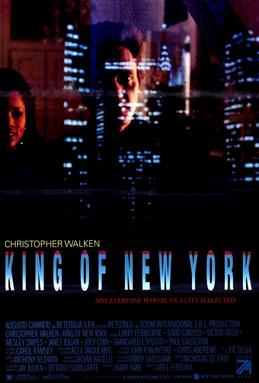
King of New York (1990, directed by Abel Ferrara)


Drug kingpin Frank White (Christopher Walken) has been released from prison and is again on the streets of New York City.  Frank might say that he’s gone straight but, as soon as he’s free, he’s  partying with his old crew (including Laurene Fishburne, Steve Buscemi, Giancarlo Esposito, and others).   While Frank’s agent (Paul Calderon) goes to all of the other city’s gangsters and explains that they can either get out of Frank’s way or die, three detectives (Victor Argo, David Caruso, and Wesley Snipes) make plans to take Frank out by any means necessary.  Meanwhile, Frank is donating money to politicians, building hospitals, and presenting himself as New York’s savior.

King of New York is the epitome of a cult film.  Directed by Abel Ferrara, the dark and violent King of New York was originally dismissed by critics and struggled to find an audience during its initial theatrical run.  (It was lumped in with and overshadowed by other 1990 gangster films like Goodfellas and Godfather Part III.)  But it was later rediscovered on both cable and home video and now it’s rightly considered to be a stone cold crime classic.  Walken gives one of his best performances as Frank White and that’s not a surprise.  The film was clearly made to give Walken a chance to show off what he could do with a lead role and Walken captures Frank’s charisma and humor without forgetting that he’s essentially a sociopath.  Walken gives a performance that feels like James Cagney updated for the end of the 80s.  What’s even more impressive is that all of the supporting characters are just as memorable as Walken’s Frank White.  From Laurence Fishburne’s flamboyant killer to David Caruso’s hotheaded cop to Paul Calderon’s slippery agent to Janet Julian’s morally compromised attorney, everyone gives a strong performance.  (I’m usually not a Caruso fan but he’s legitimately great here.)  They come together to bring the film’s world to life.  Everyone has their own reason for obsessing on Frank White and his return to power.  I’ve always especially appreciated Victor Argo as the weary, veteran detective who finds himself trapped by Caruso and Wesley Snipes’s impulsive plan to take down Frank White.  Frank White and the cops go to war and it’s sometimes hard to know whose side to be on.

Director Abel Ferrara has had a long and storied career, directing films about morally ambiguous people who are often pushed to extremes.  Personally, I think King of New York is his best film, a portrait of not just a criminal but also of a city that combines the best and the worst of human nature.  The action is exciting, the cast is superb, and Frank’s justifications for his behavior sometimes make a surprising amount of sense.  Thought there’s occasionally been speculation that it could happen, there’s never been a sequel to King of New York and it doesn’t need one.  King of New York is a film that tell you all that you need to know about Frank White and the city that he calls home.


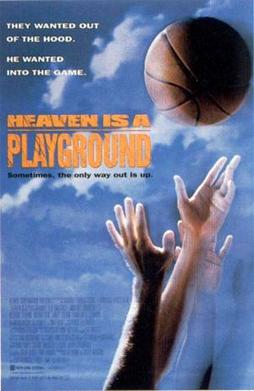
Heaven Is A Playground (1991, directed by Randall Fried)


In the projects of Chicago, Byron Harper (Michael Warren) runs a nonprofit basketball farming system and helps black kids, many of whom would have no other prospects other than a live of poverty or crime, to find a home in college basketball programs.  Byron is passionate about what he does but he’s also a stern taskmaster and not quick to forgive.  When one of his best players, Casey (Nigel Miguel), developed a drinking problem, Byron kicked him off his team.  Byron’s main concern is his stepson, Truth (Victor Love).  Truth is a great basketball player but also has an addiction to cocaine and an attitude problem.

For reasons that are never made clear, white lawyer Zack Telander (D.B. Sweeney) shows up on the court and says he wants to play one-on-one with Byron.  Everyone assumes that Zack is a drug dealer and they tell him to get lost.  But when one of the players is shot, Zack is the only person at the court who has a car.  Zack rushes the player to the hospital and he wins Byron’s trust.  Byron needs Zack to look over a professional contract that is being offered to Truth by sleazy sports agent David Racine (Richard Jordan).

For reasons that are again never made clear, Byron tells Zack to coach some of the more troubled players on the court, including Casey.  At first, Zack isn’t much of a coach but eventually, he gets the players to trust him and start playing like a team.  He also tries to get burned-out Matthew Lockhart (Bo Kimble) to start playing the game again.

Heaven Is A Playground is a mess of a movie that doesn’t really seem to be sure what it wants to say about basketball, the projects, or race relations.  The main problem is that a lot of the decisions made by Byron and Zack don’t make any sort of logical sense.  Moments of broad comedy are mixed with moments of high drama and it makes for an unconvincing and overly melodramatic sports movie.

Heaven Is A Playground had a long pre-production phase.  At one point, a young Michael Jordan agreed to play the role of Matthew Lockhart.  By the time the film actually went into production, Jordan was a superstar and had neither the time (nor, probably, the desire) to co-star in a low-budget sports movie.  After the movie flopped, director Randall Fried sued Jordan for breach-of-contract, claiming that he caused the film’s box office failure by refusing to appear in it and, as a result, Fried’s directorial career stalled.  In the suit, Fried claimed that he was on the verge of being “the next Steven Spielberg” until Jordan refused to do his film.  The jury found Jordan not liable and awarded him $50,000.

(Trying to sue Michael Jordan was a terrible idea in 1998 and it’s probably still a terrible idea today.  People love Jordan!)

Personally, I have to say that Mike made the right decision.

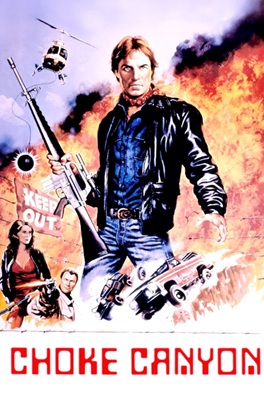
Choke Canyon (1986, directed by Chuck Bail)


Evil businessman John Pilgrim (Nicholas Pryor) and his assistant Brooke Alistair (Lance Henriksen) want to turn Utah’s Choke Canyon into a dumping ground for toxic waste.  The only problem is that Dr. David Lowell (Stephen Collins), a cowboy scientist, has signed a 99-year lease and is using the canyon as a place to conduct experiments that are designed to turn the soundwaves from Halley’s Comet into an alternative energy source.  Pilgrim sends pilot Oliver Parkside (Bo Svenson) to get Lowell out of the canyon by any means necessary.  However, Pilgrim’s rebellious daughter, Vanessa (Janet Julian), has also gone to the canyon because she finds Dr. Lowell to be intriguing.  Lowell’s reaction is to kidnap Vanessa and hold her hostage but, of course, they fall in love while trying to fly a giant ball of toxic waste out of the canyon.

Directed by the legendary stuntman Charles Bail, Choke Canyon is at its best when it focuses on Parkisde using his plane to chase Lowell’s helicopter.  Some of the aerial sequences are really exciting, even if they don’t make much sense.  (Surely, someone as powerful and rich as John Pilgrim could have afforded to send more than three guys and a cropduster to take care of Lowell.)  Stephen Collins, years before his career would collapse after he admitted to inappropriately touching three minor-aged girls, is as personable and bland here as he was in the first Star Trek movie.  The idea of a cowboy scientist is interesting but Collins really didn’t have the screen presence to pull it off.  It doesn’t help that Collins was having to act opposite a certifiable badass like Bo Svenson.  This is one of the rare movies where I wanted the bad guys to win because they were just so much cooler than the hero.

Some of the stunts are impressive, as they should be with Chuck Bail behind the camera.  Stephen Collins is boring and Janet Julian feels miscast.  (She would give a much better performance as Christopher Walken’s lawyer and girlfriend in King of New York.)  I don’t understand how a power source based on Halley’s Comet would work.  It might have worked for a few months in 1986 but what are they going to for energy until 2061 rolls around?

Smokey Bites The Dust (1981, directed by Charles B. Griffith)


Sheriff Hugh “Smokey” Turner (Walter Barnes) of Cyco County, Arkansas is determined to capture teenage car thief and prankster, Roscoe Wilton (Jimmy McNichol).  Roscoe is determined to disrupt the high school homecoming dance by abducting the homecoming queen, Peggy Sue (Janet Julian).  Peggy Sue is, at first, determined to escape from Roscoe but changes her mind as they flee from her father, who just happens to be Sheriff Turner.

From producer Roger Corman, Smokey Bites The Dust is an 88-minute car chase film where the most spectacular getaways and crashes are lifted from other Roger Corman productions.  Eagle-eyed viewers will spot footage from Eat My Dust, Grand Theft Auto, and Moving Violations.  In order to explain why the cars keep changing from scene to scene, the chase moves from county-to-county where both Roscoe and Sherriff Turner inevitably end up ditching (or crashing) their old car and then stealing a new vehicle to continue the pursuit.

That’s not much of a plot so the run time is padded out with several subplots.  A local moonshiner tries to sell his special brew to a group of Arabs.  Peggy Sue’s boyfriend, Kenny (William Forsyth, in one of his first films), joins in the chase.  Dick Miller flies around in a helicopter and also gets involved in the chase.  None of it makes any sense and none of it is particularly amusing but Roger Corman undoubtedly made a lot of money pushing this thing into Southern drive-ins and letting people assume it was some sort of a sequel to Smokey and the Bandit.

Most of the acting is pretty bad.  When it comes to being an incompetent sheriff, Walter Barnes is no Jackie Gleason.  Jimmy McNichol comes across as being seriously disturbed.  Of the main cast, Janet Julian is alone in giving an appealing and naturalistic performance as Peggy Sue.  While Julian (who has since retired from acting) never became the star she deserved to be, she is remembered for her later turn as Christopher Walken’s lawyer and girlfriend in 1990’s King of New York.

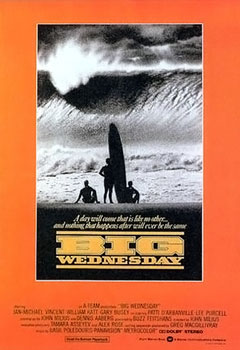
A Movie A Day #165: Big Wednesday (1978, directed by John Milius)


If there is a male bonding hall of fame, Big Wednesday has to be front and center.
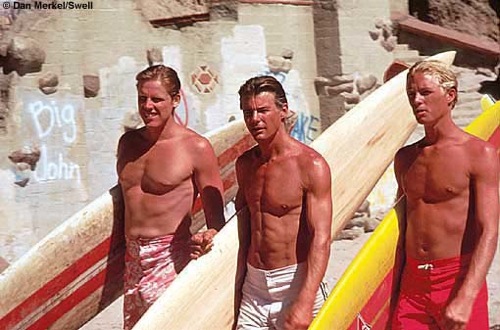
This episodic movie follows three legendary surfers over twelve years of change and turmoil.  Jack Barlowe (William Katt) is the straight arrow who keeps the peace.  Leroy “The Masochist” Smith (Gary Busey) is the wild man.  Matt Johnson (Jan-Michael Vincent) is the best surfer of them all but he resents both his fame and the expectation that he should be some sort of role model for the younger kids on the beach.  From 1962 until 1974, the three of them learn about love and responsibility while dealing with cultural turmoil (including, of course, the Vietnam War) and waiting for that one legendary wave.

After writing the screenplays for Dirty Harry and Apocalypse Now and directing The Wind and The Lion and Dillinger, John Milius finally got to make his dream project.  Big Wednesday was based on Milius’s own youth as a California surfer and he has said that all three of the main characters were based on different aspects of his own personality.  Expectations for Big Wednesday were so high that Milius’s friends, George Lucas and Steven Spielberg, exchanged percentages points for Star Wars and Close Encounters of  The Third Kind for a point of Big Wednesday.  The deal turned out to be worth millions to Milius but nothing to Lucas and Spielberg because Big Wednesday was a notorious box office flop.  Warner Bros. sold the film as a raunchy comedy, leaving audiences surprised to discover that Big Wednesday was actually, in Milius’s words, a “coming-of-age story with Arthurian overtones.”

I can understand why Big Wednesday may not be for everyone but it is one of my favorite movies.  It is one of the ultimate guy films.  Some of the dialogue and the narration may be overwrought but so are most guys, especially when they’re the same age as the surfers in Big Wednesday.  We all like to imagine that we are heroes in some sort of epic adventure.  The surfing footage is amazing but it is not necessary to be a surfer to relate to the film’s coming-of-age story or its celebration of the enduring bonds of friendship.  Katt, Vincent, and Busey all give great performances.  Considering their later careers, it is good that Big Wednesday is around to remind us of what Gary Busey and Jan-Michael Vincent were capable of at their best, before their promising careers were derailed by drugs and mental illness.  Be sure to also keep an eye out for infamous 70s character actor Joe Spinell as an army psychiatrist, a pre-Nightmare on Elm Street Robert Englund, playing a fellow surfer and providing the film’s narration, and Barbara Hale, playing the patient mother of her real-life son, William Katt.

One final note: At a time when the shameful stereotype of the psycho Vietnam vet was becoming popular and unfairly tarnishing the reputation of real-life vets, Big Wednesday was unique for featuring a character who not only joins the Army but who appears to return as a better person as a result.