Retro Television Review: Miami Vice 4.7 “Missing Hours”


Welcome to Retro Television Reviews, a feature where we review some of our favorite and least favorite shows of the past!  On Mondays, I will be reviewing Miami Vice, which ran on NBC from 1984 to 1989.  The entire show can be purchased on Prime!

This week, it’s the most infamous episode of Miami Vice ever!

Episode 4.7 “Missing Hours”

(Dir by Ate De Jong, originally aired on November 13th, 1987)

This is an episode that I had been waiting for years to see.  From the moment I decided to review Miami Vice, I started to read about and hear about this seventh episode of the four season.  This was the episode was supposedly so bad that many people consider it to be the point that Miami Vice “jumped the shark.”  This is the episode were James Brown plays a white-suited singer named Lou de Long, who has going from performing songs to giving lectures about UFOs.  (James Brown is essentially playing himself, right down to the presence of I Feel Good on the soundtrack.)  This is the episode where Trudy disappears for 12 hours and then returns with no firm memories of where she was.  This is the episode where even Crockett and Tubbs see a UFO.  Even though his appearance here does not receive as much attention as much a James Brown’s, Chris Rock made his television debut as a nerdy technician named Carson who was into UFOs.  Carson mentions getting his information for “computer bulleting boards” and everyone looks at him as if he’s speaking Esperanto.

This is the episode that is frequently cited as being the worst in Miami Vice history and really, who am I to disagree?

It pains me to say that.  I really wanted to like this episode, just because it is so strange and and I’ve always been a bit of a contrarian at heart but …. no, this episode really doesn’t work.  The sad truth of the matter is that, for all of his other talents, James Brown was a lousy actor and, with the exception of Michael Talbott and Philip Michael Thomas (who both appear to be having fun), the regular cast gives performance that suggest they all knew this episode was a bad idea.  Miami Vice was at its best when it was a cynical and downbeat show about the futility of the war on drugs.  There’s really no reason for Miami Vice to ever do a science fiction-themed episode.  Somehow, this is the second such episode to air during the fourth season.

Of course, the episode’s most unforgivable sin is that it ends with Trudy waking up in bed.  Not only is that ending a cop out but it’s also pretty rude to anyone who was actually trying to follow the plot or who was actually worried about whether or not Trudy had been brainwashed by the aliens.  Perhaps if this had been a Halloween episode, all of this could have been excused but apparently, this episode aired in the middle of November.

Poor Trudy.  Seriously, Olivia Brown didn’t really get many episode built around her character.  It’s a shame that, when they gave her one, it was this one.  Next week on Miami Vice, who knows?  I’m on vacation.  We’ll see what happens!

Woman They Almost Lynched (1953, directed by Allan Dwan)


At the height of the Civil War, the small town of Border City, Missouri has declared itself to be neutral ground.  Mayor Delilah Courtney (Nina Varela) announces that anyone who enters her town looking to recruit for either the Union or the Confederacy will be arrested and will face the possibility of being hung from the noose in the middle of Main Street.

That doesn’t stop Charles Quantrill (Brian Donlevy) from coming to town.  Quantrill is a former Confederate officer who now terrorizes the Arkansas/Missouri border with his gang of thieves.  Accompanying Quantrill is his wife, Kate (Audrey Totter), who once lived in Border City and who still enjoys singing a song at the saloon.

Another new arrival is Sally Maris (Joan Leslie), who comes down from Michigan to help her no-account account, Bitterroot Bill (Reed Hadley), run his saloon.  Sally attempts to bring some order to the rowdy saloon, which makes an enemy out of Kate.  When Bill is killed in a gunfight, Sally takes over the saloon and soon, she is being challenged first to a fight and then to an actual duel by Kate.  With the disapproving Mayor Courtney watching all of the action from her office, it is obvious that one of the women is eventually going to be taken to the noose in the middle of the street but which one?

This is one of the best of the many B-westerns that Allan Dwan directed in the 1950s.  Though much of the emphasis is on the usual western action — Quantrill wants to take over a mine, there’s a Confederate spy in town, and both Frank and Jesse James appear as supporting characters — the film is really about the rivalry and eventual partnership between a group of strong-willed woman who aren’t going to let anyone tell them how to live their lives.  As tough as Kate is, Sally proves to be stronger than she looks and, in the end, they realize that they are stronger working together for a common goal than trying to tear each other down.  Audrey Totter and Joan Leslie both give sexy and tough performances as Kate and Sally.  They’re equally believable hanging out in a saloon, flirting with a cowboy, or drawing guns on each other in the middle of the street.

Along with taking a strong stand against vigilante justice, Woman They Almost Lynched features an exciting stage coach robbery, an intriguing story, and two very interesting lead characters.  It’s a western that deserves to be better known.


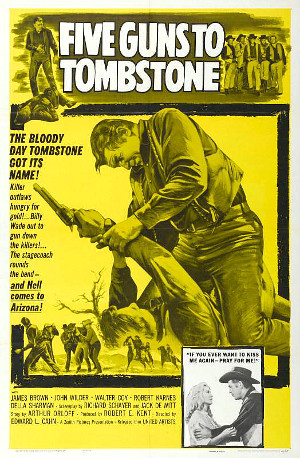
Five Guns To Tombstone (1960, directed by Edward L. Cahn)


Outlaw Matt Wade (Robert Karnes) escapes from prison and rejoins his old gang.  They ride out to Tombstone, Arizona, stopping off at the ranch of Matt’s brother, Billy Wade (James Brown).  Billy used to be an outlaw but eventually he hung up his guns, settled down, got married, and now he’s raising Matt’s teenage son, Ted (John Wilder).  Ted, who thinks that his father has just been paroled, is excited to see Matt but Billy doesn’t want Ted being led into a life of crime.  When Matt and the gang rob a bank, they frame Billy for the crime.  With the townspeople looking to lynch him and Ted drifting towards the wrong path in life, Billy has no choice but to pretend to be a part of the gang until he can dig up the evidence to clear his name.

If this sounds familiar, thank you for reading yesterday’s review of Gun Belt.  Released seven years after Gun Belt, Five Guns To Tombstone tells the exact same story as Gun Belt and, in many case, it features the exact same dialogue.  The only difference is that some of the names have been slightly changed.  The gang leader in Gun Belt was named Ike Clinton.  In this Five Guns To Tombstone, his name is Ike Garvey.  Billy Ringo becomes Billy Wade and Wyatt Earp because Marshal Sam Jennings.  Otherwise, it’s pretty much the exact same film.

Which one is the better film, Gun Belt or Five Guns To Tombstone?  Both films have plenty of two-fisted, gun-slinging action and a good cast of western character actors but I’d probably have to give the edge to Five Guns To Tombstone because John Wilder is more convincing in the role of the outlaw’s son than Tab Hunter was in Gun Belt.  Tab Hunter was young and callow and annoying but John Wilder is the type of confused kid that anyone could relate to.

Five Guns To Tombstone was one of the 9 films that Edward L. Cahn directed in 1960.  As with most of Cahn’s films, the action seems rushed but that’s appropriate for the story that Five Guns To Tombstone is telling.  (It’s also understandable.  When you’re directing 9 films a year, you don’t have the luxury of taking your time.)  Like Gun Belt, this is hardly a classic but western fans should enjoy it.

Gun Street (1961, directed by Edward L. Cahn)


During the closing days of the Old West (people ride horses and form posses but they also use hand-crank telephones), a notorious bank robber (played by Warren J. Kemmerling) escapes from prison.  Everyone fears that the outlaw is heading for his home town, where he’s sworn that he’s going to get revenge on all of the people who he blames for his imprisonment.  It’s up to Sheriff Chuck Morton (James Brown, not that James Brown) and Deputy Sam Freed (John Clarke) to alert all of the outlaw’s potential victims and to put together a posse to ride into the desert and hopefully end his reign of terror once and for all.  Complicating matters (though only slighly) is that the sheriff and the outlaw grew up together and used to be friends.

Yet another B-feature from the very active director Edward L. Cahn (he was credited with having directed 127 films, 11 in 1961 alone!), Gun Street plays out like a lesser episode of Gunsmoke.  Imagine High Noon, just without the red scare subtext and no Gary Cooper.  James Brown and John Clarke are both believable as western lawman and they have a good rapport.  Sandra Stone plays the outlaw’s sister, who now owns the local “dance hall” and, in her scenes with Brown, I thought it seemed as if the film was suggesting that she and the sheriff were once more than just friends.  Unfortunately, that’s one of many potentially intriguing subplots that the film suggests without bothering to explore.  Obviously made to be a second feature on a double bill, Gun Street is barely over an hour long, which doesn’t leave much time for anyone else in the film to make much of an impression.  The short running time also means that the film moves so quickly that certain plot points go unexplained.  Probably the most disappointing thing about Gun Street is that, after all of the build-up about how tough and dangerous this outlaw is, the film ends not with a bang but with an anti-climatic whimper.  Did they run out of money during filming?  Did Edward L. Cahn have to leave so he could go direct another film?  We may never know.

If you’re looking for a good western about one town awaiting the arrival of an outlaw, rewatch High Noon.

Rockin’ in the Film World #14: SKI PARTY (AIP 1965)


gary loggins's avatarcracked rear viewer

American-International Pictures takes the “Beach Party ” concept to the slopes in 1965’s SKI PARTY, an endearingly goofy ball of fluff headlining Frankie Avalon, Dwayne Hickman, Deborah Walley , and a pre-‘Batgirl’ Yvonne Craig . It sells itself with a sly wink to the audience that says, “We know the whole thing’s absurd, and we don’t care”! Besides the off-the-wall comedy, the film features above average musical interludes by guests Lesley Gore and the Godfather of Soul himself, James Brown.

Frankie and Dwayne play a pair of slightly overage college students (Avalon was 25, Hickman 31!) trying to woo Deborah and Yvonne. The two knuckleheads can’t figure out why they can’t get to first base, while college Romeo Aron Kincaid scores with every babe on campus. When the whole gang (including Beach movie regulars Luree Holmes, Michael Nader, Salli Sachsee , and surfing champ Mickey Dora) go on a…

View original post 491 more words

Cleaning Out The DVR #11: Going My Way (dir by Leo McCarey)


GoingmywayBing

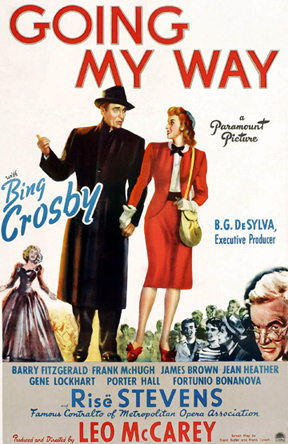
Last night, continuing my effort to watch 38 movies in 10 days (and, for the record, I have 7 days left as of today), I watched the 1944 musical-comedy-drama Going My Way.

Going My Way tells the episodic story of Father Chuck O’Malley (Bing Crosby), a priest from St. Louis who is assigned to take charge of a struggling parish in New York City.  O’Malley is meant to replace Father Fitzgibbon (Barry Fitzgerald), a stubbornly old-fashioned priest who is struggling to keep up with a changing world.  Though O’Malley is to take charge of the parish’s affairs, Fitzgibbon is to remain the pastor.  However, the compassionate O’Malley doesn’t tell Fitzgibbon about the arrangement and allows Fitzgibbon to believe that O’Malley is only meant to be his assistant.

It’s obvious from the start that Fitzgibbon and O’Malley have differing approaches.  Fitzgibbon is a traditionalist.  O’Malley, on the other hand, is a priest who sings.  He’s a priest who understands that the best way to prevent the local teens from forming a street gang is to convince them to start a choir instead.  When it appears that 18 year-old Carol (Jean Heather) is “living in sin,” it is the nonjudgmental O’Malley who convinces her to marry her boyfriend.

And, slowly but surely, Fitzgibbon and O’Malley start to appreciate each other.  O’Malley is even able to convince Fitzgibbon to play a round of golf with him, while Fitzgibbon tells O’Malley about his love for his mother in Ireland.

What’s interesting is that we learn very little about O’Malley’s past.  In many ways, he’s like a 1940s super hero or maybe a less violent and far more ethical version of one of Clint Eastwood’s western heroes.   He shows up suddenly, he fixes things, and then he moves on.  Instead of a cape or a poncho, he wears a collar.

(And, of course, he doesn’t kill anyone.  Actually, that’s probably a lousy analogy but I decided I’d give it a try anyway…)

At one point, O’Malley does run into an opera singer named  Genevieve Linden (Rise Stevens).  He and Genevieve (whose real name is Jenny) talk briefly about their past and it becomes obvious that they once had a romantic relationship.  We don’t learn the exact details but it does bring some unexpected melancholy to an otherwise cheerful film.  It reminds us of what O’Malley gave up to become a priest.

Fortunately, Genevieve is more than happy to help out with O’Malley’s choir, even arranging for them to meet with a record executive (William Frawley).  The executive doesn’t have much interest in religious music but then he hears Bing O’Malley sing Swinging On A Star.

It’s a bit strange to watch Going My Way today because it is a film that has not a hint of cynicism.  There’s no way that a contemporary, mainstream film would ever portray a priest as positively as Father O’Malley is portrayed in this film.  Indeed, it says something about the world that we live in that I instinctively cringed a little whenever O’Malley was working with the choir, largely because films like Doubt and Spotlight have encouraged me to view any film scene featuring a priest and an pre-teen boy with suspicion.  O’Malley is the ideal priest, the type of priest that those of us who were raised Catholic wish that we could have known when we were young and impressionable.  Bing Crosby does a pretty good job of playing him, too.  Watching Going My Way felt like stepping into a time machine and going to a simpler and more innocent time.

In the end, Going My Way is a slight but watchable film.  It doesn’t add up too much but, at the same time, it’s always likable.  Though the film may be about a priest, the emphasis is less on religion and more on kindness, charity, and community.  Going My Way was a huge success at the box office and even won the Oscar for best picture.

Personally, I would have given the Oscar to Double Indemnity but Going My Way is still a likable movie.

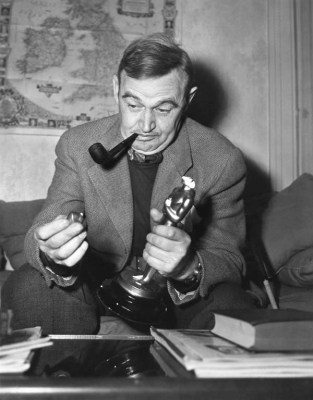
Speaking of likable, the Academy was so impressed with Barry Fitzgerald’s performance that they actually nominated it twice!  He got so many votes in both categories that Fitzgerald ended up nominated for both Best Actor and Best Supporting Actor.  Subsequently, the Academy changed the rules and decreed that a performance could only be nominated in one category.  As for Fitzgerald, he won the Oscar for best supporting actor.  He later broke the Oscar while practicing his golf swing.

Barry and Oscar

Barry and Oscar

(Don’t worry.  The Academy sent him a replacement.)

Before Woodstock: T.A.M.I. Show (1964, directed by Steve Binder)


51cR8JMSnPL

Five years before Woodstock, there was T.A.M.I. Show.

In 1964, a concert was held over two days at the Santa Monica Civic Auditorium.  Free tickets were distributed to local high school students and the best footage from the two shows was edited into one movie.  Distributed by American International Pictures, T.A.M.I. Show was one of the first concert films.

T.A.M.I. stood for Teenage Awards Music International but no awards were given out during those two days.  Instead, 12 of the most popular music acts of 1964 performed on one stage.  The Beatles may not have been there but almost every other hitmaker of the year showed up.

Among the highlights of T.A.M.I. Show was the performance of James Brown and The Famous Flames, which many consider to be one of the best musical performances ever captured on film.

http://www.youtube.com/watch?v=09qbhwcpA6A

James Brown’s performance was followed by The Rolling Stones.  Though Keith Richards once claimed that trying to follow James Brown was the biggest mistake of their careers, T.A.M.I. Show was the first time that many American teenagers actually saw the Stones perform.

Also performing: The Supremes, at the height of their popularity.

http://www.youtube.com/watch?v=u7Cn57BNVoM

The Beach Boys’ performance has become semi-legendary because, as a result of copyright issues, it was edited out of prints of T.A.M.I. Show following the initial theatrical run.

http://www.youtube.com/watch?v=yh1XVOQEMOE

For years, T.A.M.I. Show was unavailable for home viewing but finally, in 2010, Shout Factory released this landmark of movie and music history on DVD and they even included the long censored footage of the Beach Boys.  For music lovers, T.A.M.I. Show is a must-see record of the rock scene in between the start of the British invasion and the rise of the counterculture.

Scenes I Love: Saturday Night Live (feat. Eddie Murphy)


Celebrity Hot Tub

With the trailer for the James Brown biopic now out for people to watch I just thought it would be appropriate I share one of my favorite scenes from the many years of watching Saturday Night Live.

Before he became a mega superstar during the 80’s, Eddie Murphy was just part of the ever-changing cast of comedians for Saturday Night Live. One of the funniest skits had Eddie as James Brown doing the intro to his very own talk show, Celebrity Hot Tub.