James Bond Review: Casino Royale


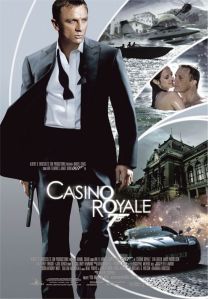
Welcome, one and all! Leading up to the North American release of the latest James Bond film, Skyfall, The Shattered Lens has taken on the task of reviewing each and every one of the twenty two James Bond films that precede it. Today’s is the penultimate review, Casino Royale, the first film of the series to star current-iteration Bond Daniel Craig. It serves as a reboot of the James Bond character, looking back to the beginning of his career, and entirely unconnected from all of the previous films in the series. The only returning actor is Dame Judi Dench, who reprises her role as M, in a more maternal overseer role looking out for a young Bond, despite his rash actions potentially causing trouble for MI6.

Our cold open this time has a black and white Bond confronting a crooked MI6 section chief – one who has been selling secrets to make money on the side. Bond kills both the section chief and his contact, which is enough to earn him his 00-status. The freshly minted 007 heads to Madagascar in pursuit of an international bomb maker. He attempts to find a way to apprehend the bomb maker alive, but is made, and is forced to pursue this man across the city. Bond eventually corners the bomb maker in an embassy building and kills him, blowing up part of the wall, and effecting his escape.

Back in England, M chides Bond for his itchy trigger finger, pointing out that while the world has one less small-time terrorist, they had hoped to get information which would let them fight international terrorism on the organisational level. Bond seems suitably chastened, but M goes further, asserting that she promoted Bond too early, that he is reckless, and a danger. Bond coldly replies that, since the 00-agent’s life is not typically a long one, she will not have to live with her mistake for long.

That’s the sort of Bond that we’re dealing with under the handling of Daniel Craig. While the character is still capable of being charming, he’s a very far cry from Sean Connery’s easy smile and one liners, or Pierce Brosnan’s especially terrible puns. This is sort of the crux of the movie; what controversy exists surrounding its qualities is heavily tied into how you respond to this new take on James Bond. Like all things 2000s, our hero is much grittier than before. Absent is all of Q’s high tech wizardry, and as I stated before, we are not even dealing with a seasoned killer in James Bond, but rather a freshly minted 00 agent. As a result of all these factors, this film has a distinctly different feel from every Bond produced before it. If you like the changes, everything is cool. If you don’t, you may still find yourself appreciating Casino Royale, which has a relatively simple plot, but spends quite a bit of effort on setting up and establishing its characters, including this new James Bond, for the audience.

The main plot of Casino Royale revolves around a high-stakes Texas Hold ‘Em tournament held at the titular casino, located in Montenegro. James Bond is assigned to win the tournament which is being staged by terrorist financier Le Chiffre (Mads Mikkelsen) to recoup the terrible losses he suffered when he used the money of his clients to short sell stock, predicting that a terrorist strike which he himself had planned would send prices into free fall. M hopes that by pushing Le Chiffre to the point of desperation, they can force him to cut a deal with MI6 – sanctuary in exchange for everything he knows about terrorists around the world. Bond is assisted in his goal by fellow MI6 agent Rene Mathis (Giancarlo Giannini) and Vesper Lynd (Eva Green), this iteration’s Bond girl, an agent from HM Treasury, who is assigned to manage Bond’s $10M buy-in, and to provide him with a $5M re-buy if she believes it would be a good investment. However, since a failure on Bond’s part would mean that Her Majesty’s Treasury was directly funding international terrorism, there is incentive to be cautious.

It takes us nearly an hour to begin to engage in the meat of the film, at the titular Casino Royale. Or, at least, this should be the meat of the film. However, the structure of Casino Royale is a little bit off. It feels like it has enough action, but it doesn’t feel properly paced, with the front half of the film (really just a series of subplots to get us to Montenegro) feels like classic “action Bond”. The scenes in the Casino could have been pulled (well, if Daniel Craig could smile, at any rate) from any other Bond film, as his history is littered with a rich litany of casino sequences. Before and after the casino sequences, however, are framing bits that involve idyllic locations, and if I may be so bold, it doesn’t exactly zoom along. The spacing between the casino sequences and the finale, in particular, made the final act feel very tacked on and a little out of place, even as deliberately intended setup for Quantum of Solace. This can also be off-putting, as it feels like there are two different movies going on here.

For the most part though, I think Casino Royale works. If you can live with a grimmer, grittier, low-talking James Bond, you may really appreciate this low-tech return to basics for our favourite 00-agent.

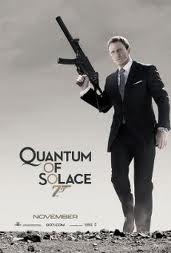
Tomorrow you’ll get a healthy dose of Quantum of Solace, but before I sign off, let me leave you with the theme from Casino Royale, one of the cooler James Bond themes in the franchise, performed by Chris Cornell.

James Bond Review: Die Another Day


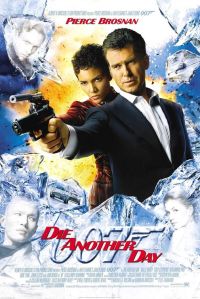
Leading up to the North American release of the latest James Bond feature film, Skyfall, The Shattered Lens is reviewing each and every James Bond film in the history of the franchise. Today’s film is the controversial Die Another Day, the twentieth film in the James Bond franchise, and the final such film to feature Pierce Brosnan in the titular role as 00-agent James Bond. Despite launching to mixed reviews – particularly overseas, where it generated significantly negative reaction in North and South Korea – it was at the time the highest grossing Bond film of all time.

Our cold open for this film has us in North Korea. There, 007 is assuming the identity of a diamond smuggler who is assisting a North Korean Colonel, Tan-Sun Moon, in laundering blood diamonds as part of an ongoing search for advanced military hardware. In order to bypass the landmines of the Korean Demilitarized Zone, the good Colonel has constructed an entire army of hover vehicles which can cross the region without triggering the mines, allowing for a land invasion of South Korea. Bond proceeds with the exchange, but is identified by Zao (Rick Yune), Colonel Moon’s right hand man. Bond triggers an explosion which badly disfigures Zao’s face, which becomes embedded with dozens of diamonds. Colonel Moon attempts to escape on a hovercraft, and Bond pursues him, eventually chasing the Colonel off the edge of a waterfall, apparently killing him. Afterward, Bond is captured by General Moon, the Colonel’s father, and is imprisoned.

After over a year of imprisonment and torture, Bond is traded during a prisoner exchange for Zao. Upon returning to MI6, M (Dame Judi Dench) tells Bond that his 00-status has been suspended. Both she and the Americans believe that Bond cracked under torture and revealed classified information, necessitating the prisoner exchange that brought him back. However, the release of Zao leaves both M and Bond extremely bitter. Determined to recapture Zao, Bond evades MI6’s security and disappears. He travels to Hong Kong, seeking a way back into North Korea, but his contact there informs him that Zao has attempted to disappear in Cuba and provides him with the necessaries to travel there instead.

After he arrives in Havana, Cuba, Bond investigates a clinic there which specializes in gene therapy that is virtually unknown in the first world. Bond’s local contact describes it as prolonging the lives of their leading citizens, and the richest folks in the West, but Bond also learns that the gene therapy would allow a person to totally restructure their appearance and assume a whole new identity. During his investigation, he meets a woman who introduces herself as Jinx (Halle Berry) who, initially unknown to Bond, is an NSA agent on a similar investigation, albeit one with presumably very different goals. Bond locates Zao inside the clinic, and a chase ensues. Although Zao ultimately manages to escape by helicopter (and Jinx in dramatic fashion by diving off the sea wall and boarding a waiting boat which drives her off), Bond recovers a pendant left behind by Zao. Upon unscrewing it, Bond discovers a cache of diamonds. Upon inspection, the diamonds are chemically identical to diamonds found in Sierra Leone, but they bear the identifying mark of a diamond mine owned by a British billionaire and thrill seeker, Gustav Graves (Toby Stephens). Bond is determined to investigate.

This forms the basis of the remaining plot. Our set pieces this time aren’t quite so varied, as much of the remaining story plays out in Iceland, where Graves’ diamond mine is situated, and where he has constructed a special ice hotel for the purpose of a technology convention. Eventually, we return to Korea, for a final showdown that seems somehow empty, despite the increasingly high stakes in terms of both explosions and technology.

The truth, ultimately, is that Die Another Day is a bit of a mess. It has a seemingly incessant procession of action sequences, but they raise the stakes primarily through CGI and improbable wizardry, in a way that threatens our suspend disbelief. I know that this is Bond, and that in 80s-early 00s Bond very much fell into the trap (who didn’t?) of ‘bigger and better’. However, this film takes things a bit too far in my estimation. Its villains aren’t quite as fun as the ones in the past two films (well, Mr. Stamper is kind of a drag I suppose), and don’t really fit the Bond mold. The story is pretty straightforward, but probably doesn’t receive quite the treatment that it deserves to get us established in it. The interactions between Bond and M are a bit too stiff, and I say that even keeping in mind tomorrow’s review piece, Casino Royale. There’s something about Die Another Day that made me think everyone involved was just going through the motions, like a sense of fatigue just hung over the proceedings. It was a bit of a bummer.

As for the women of Bond, Die Another Day actually has a lot to recommend. Breaking convention, this section is heavy with spoilers, but I’m going to risk it just this once. Don’t read on if you’re new to this film and planning to watch it!

Die Another Day continues to feature Dame Judi Dench as a pleasantly strong and uncompromising intelligence chief (I probably haven’t made enough of how much I enjoy her in the role of M in my reviews up to this point). In addition, we’re treated to Halle Berry as Jinx, an ass-kicking NSA agent who seems to do a lot of getting outmaneuvered and captured for being so adept. I didn’t care for Berry’s performance in this film, and I’d be lying if I said she stacked up well against Tomorrow Never Dies’ Michelle Yeoh as a Chinese intelligence agent. Still, compared to some of the other Bond girls, Berry is definitely a warrior. The other major female character, however, is Miranda Frost (Rosamund Pike), a frigid and beautiful MI6 agent… actually, a double agent, who betrayed Bond in the cold open. Pike’s character definitely gives off the edge of competence and deadliness that I, for one, am rooting for in female characters in any Bond movie, and she sells it well. Unfortunately, she’s not nearly as fun as Elektra King, as her motivations are completely unexplored and she just feels like an add-on to the existing plot surrounding some dangerous North Koreans.

Overall, this is probably not one of the better Bond films, though I’d argue that it doesn’t deserve the bad rap that some have given it either. It’s not a terrible film, just overwrought in a kind of Michael Bay way that undermines the characters and concepts. This is a common complaint of all four Pierce Brosnan films, especially, as well as some of the Roger Moore and Timothy Dalton efforts. However, this is the one that I most agree with that assessment of. This film really gets out of control with effects and gadgetry.

That’s it for today’s review. I leave you with the theme from Die Another Day, performed by Madonna. Tomorrow’s review will be of 2006’s Casino Royale.

James Bond Review: The World Is Not Enough


But it is such a perfect place to start.

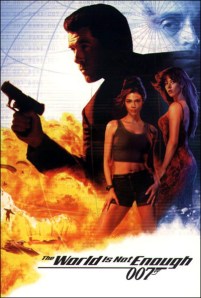
Hello everyone! As a prelude to the North American release of Skyfall, we here at The Shattered Lens have been reviewing each and every single James Bond film in the history of the franchise. Today we examine the nineteenth film in the James Bond franchise, and the third to feature Pierce Brosnan as the titular super spy, Ian Fleming’s James Bond. Its title? The unpretentious The World is Not Enough.

This time our cold open has Bond in negotiations with a Swiss banker for the return of a significant amount of money belonging to British Knight, Sir Robert King, who is a personal friend of M (Dame Judi Dench). Negotiations break down quickly, when Bond reveals that King was buying a report over which an MI6 agent was killed. The banker not only refuses to disclose information, but actually threatens Bond. Bond takes control of the situation in predictable fashion, offing the Banker’s underlings and capturing the man in question. However, before the banker can give up the name of the man who hired him, he is picked off by his own assistant – revealed to be a lovely young assassin (Maria Grazia Cucinotta), who disappears before Bond can do much in the way of response. With the police already on their way, Bond escapes out a window, and heads back to jolly old England.

When Bond returns to MI6 headquarters, Sir King takes possession of his money. However, Bond deduces seconds too late that the money has been trapped with a binary compound explosive that King inadvertently triggers, blowing up the suitcase of money, Robert King, the entire room he is present in, and a huge chunk of the wall of MI6 headquarters. Bond arrives just in time to see the same assassin outside in a speed boat, aiming a mounted gun his direction. Upon seeing Bond, she opens fire, but then quickly turns tail and flees the scene. Bond seizes a speed boat from Q and goes in pursuit. After a truly remarkable chase sequence (by sea, by land, and by air!) Bond catches up with the assassin, who commits suicide by firing into the tanks of her own hot air balloon rather than risk being taken alive. Bond falls and is heavily injured, and the assassin is killed.

Bond convalesces under the care of one Dr. Molly Warmflash (Serena Scott Thomas), but unwilling to actually wait for his wounds to heal, he “persuades” the good doctor into giving him a clean bill of health, the way only James Bond can. Medically cleared, he invites himself into a high level planning session with M where they trace the assassination of Robert King back to its likely perpetrator – a notorious Soviet terrorist, Renaud (Robert Carlyle). Recognizing the danger he represents, M sent 009 to kill Renaud. Although the agent got a shot in, and it struck Renaud in the head, the bullet miraculously failed to kill the terrorist right away. Instead, it slowly burrows through the matter of his brain, dampening and destroying his senses one by one. Dr. Warmflash speculates that while Renaud will eventually die from his wound, in the meantime he feels no pain, and is particularly dangerous as a result. Renaud had previously abducted and held hostage King’s beautiful daughter, Elektra (Sophie Marceau), for ransom. M believes that Renaud is attempting to strike against the King family again. Concerned with Elektra’s safety, she assigns 007 to personally see to her security.

Things ramble on quickly from there. Like Tomorrow Never Dies, there are no shortage of action pieces in The World is Not Enough. The film has a healthy dose of plot twists and is finely paced, never really descending into a lull. It has excellent set pieces, including a kind of cart racing down an oil pipeline, a battle in a caviar factory (which includes a notable cameo from our old friend Valentine, first introduced in Goldeneye [a fun role that is heartily embraced by actor Robbie Coltrane]), and even climactic showdown aboard a Soviet nuclear submarine Unfortunately, The World is Not Enough suffers from a couple of limitations that hold it back from being a truly great Bond film. Yes, that’s right folks, it’s time we talked about one of the more infamous Bond girls… Dr. Christmas Jones (Denise Richards).

Now, I don’t necessarily hate Denise Richards, but she’s not what I’d call a paragon of acting ability. She doesn’t bring a ton of range to a character that is already a bit on the weak side. Dr. Jones, a short-short short-dress short-skirt clad nuclear physicist, is not short on brains. She’s also athletic, and able to keep up with 007’s crazy antics for the most part. She’s also a patently unbelievable character, a stretch even for James Bond, even for latter-day Pierce Brosnan James Bond. She doesn’t ever really fit into this film, and while the movie’s plot ultimately deals with a nuclear threat (as always, I won’t spoil the film’s more important plot details!) and it seems like Dr. Jones’ expertise might be useful… mostly, she just offers some rather obvious exposition, and serves as a sexual object for one important sequence in the film’s final third. So, hooray? Compared to ass-kicking Chinese secret agent Wai Lan, the main thing that Denise Richards’ character brings to the James Bond franchise is cup size. And more easy puns on her name than you can shake a stick at.

This film is also notable for being the tragic final appearance of Desmond Llewelyn in his long time role as “Q”. Although the film … “humourously” … introduces John Cleese as Q’s successor early in the film, there were no official plans to cut Desmond Llewelyn from future Bond films, and he had not announced plans to retire. Unfortunately, Llewelyn was killed in a traffic collision shortly after the film’s premiere. R.I.P.

That having been said, I still very much like this movie. For reasons which are not entirely clear, I think I’ve seen it a dozen times or so (maybe it’s just on BBC a lot?) and nothing about it ever makes me want to turn the film off. In fact, vibrant performances by the film’s villains and an energetic Judi Dench as M (more active in this film than in … probably any other) kind of bring this one to life for me. Of course, this film definitely telegraphed a possible dive off the cliff’s edge… something which we may or may not journey through together in tomorrow’s film, the much-maligned Die Another Day.

In the meantime, let me leave you with my all-time favourite James Bond theme, presented by Garbage:

James Bond Review: Tomorrow Never Dies


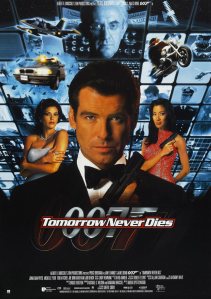
In anticipation of the North American release of the latest 007 adventure, Skyfall, we here at The Shattered Lens are systematically going through each and every film of the James Bond franchise and reviewing them for you! Today, we’ll take a look at the eighteenth film of the James Bond franchise, and the second one to star Pierce Brosnan as James Bond. It’s one of my personal favourites… Tomorrow Never Dies.

It’s the return of Pierce Brosnan as Agent 007, a cold-war relic modernized for a more discerning audience. While the Bond of old – Connery in particular – could flash his smile, make a pun, and have a girl in bed, the modern Bond is often challenged by the women in his life. As a modern viewer, I’m much more comfortable with this view of the sexes, though it would be quite a stretch to say that Bond has ‘struggles’ trying to find the affections of women. Anyway.

Our cold open takes us to the Russian border, and a so-called Terrorist bazaar. Yes, it’s more or less a marketplace of weapons, illegal technology, and mercenary services. And it’s under surveillance by MI6 and the British armed forces, led by M (Dame Judi Dench) and Admiral Roebuck (Geoffrey Palmer). MI6’s analysis is being led by the strangely memorable Charles Robinson (Colin Salmon), M’s Chief of Staff in this film, and the next two. Although his part is minor, Salmon impressed me enough in this part (the first time I can recollect seeing him; Tomorrow Never Dies was a first day viewing for my father and I when it released) that I instantly associate him any time I see him with his role in this film, not in the newer Resident Evil franchise, or in any of his other work. Robinson is in contact with an unidentified (but I’ll bet you can guess!) agent on the ground who is observing the terrorist bazaar through a telephoto lens. In addition to the formidably terrifying hardware, the as-yet-un-named agent also identifies cyber terrorist Henry Gupta (Ricky Jay) an American wanted for all kinds of technology-related crimes. Although he seems to have obtained an extremely secret, extremely valuable, American GPS code cracking machine, I’m sure he won’t turn up later.

Eager to be rid of “half the world’s terrorists” as he describes it, Admiral Roebuck first attempts to negotiate a Soviet strike using ground assets against the bazaar. When the Soviet liaison reports that casualties would be inconvenient to the electorate so close to party elections, Roebuck instead opts for a British naval strike which will dismantle the bazaar – cruise missiles launched from afar. Overriding M’s objections that the survey of the bazaar is not yet complete, Roebuck provides authorization for missile launch, and in no time, two massive cruise missiles are en route.

It’s about this time that we learn that the mysterious, unnamed, ground agent in Russia is Agent 007 – an unsmiling Pierce Brosnan. Bond has detected a pair of L-39 Albatross fighters, one of which has been outfitted with nuclear-yield weapons of Soviet origin. At best, the cruise missile attack will scatter weapons-grade plutonium over a huge area, and Admiral Roebuck immediately orders the cruise missiles to be aborted remotely. Unfortunately, the missiles are already out of range in the network of (presumably Afghani) canyons they are maneuvering down. If nuclear disaster is to be averted, it’s up to an unsmiling 007 – now revealed as M’s agent in the field.

As anyone could have predicted, Bond chooses a heroically stupid solution. He charges into the bazaar, knocking out several terrorists and seizing an automatic weapon. Clearing enemies from his area, he makes his way to the L-39 with the nuclear payload. After dispatching the pilot, Bond boards the aircraft, and barely manages to get airborne before the cruise missiles detonate behind him, wiping out most of the terrorists involved. Suspiciously, it seems that Henry Gupta survived the naval strike. I continue to remain convinced that he won’t pop up again later in the story, though. After escaping aboard his stolen aircraft, Bond’s reel man inexplicably feels the need to strangle him which will crash and kill them both while Bond is pursued by a second L-39. Eventually, Bond manages to eject his would-be strangler straight up into the other aircraft, neatly eliminating his problems, and he heads home.

In a reveal with our evil super-villain, Elliot Carver (Jonathan Pryce), we learn that he is manipulating headlines for the profit of his super powerful Viacom-esque media conglomerate. I wonder if that Gupta fellow and his stolen GPS controller will show up again?

I probably don’t need to spoil much more about the plot than that. Suffice to say that the concept behind this Bond yarn is actually a touch on the original side. It correctly anticipated the importance of mass media, its complete transformation into a corporate entity (rather than a ‘news’ entity), and some of the possible consequences. Of course, the plot of the film has also aged terribly, because the internet has changed everything about communication in a way that we would never have anticipated in the mid 90s. Still, Tomorrow Never Dies has always struck a chord with me for both the nature of its villain, and his designs upon the world. The rest of the villainous cast is somewhat less impressive, as beyond Carver, we have the eminently forgettable Mr. Stamper (Götz Otto) and the certainly-not-a-plot-point Henry Gupta to satiate our need for nemeses. Oh, and a hired assassin, but I’ll get to him in a moment. Suffice to say that Mr. Stamper is not exactly this generation’s Oddjob, and we can probably leave it there.

Once we pass the initial setup, the action of Tomorrow Never Dies doesn’t really let up. It’s very tech-heavy, the true realization of the gadet-heavy accusations that are often levied against post-Connery bond. Yes, Pierce Brosnan has a huge variety of gadgets at his disposal. Notable in this particular film is Bond’s seemingly indestructible BMW, which leads to a humourous exchange between he, a hired hitman named Dr. Kaufmann (Vincent Schiavelli), and a gaggle of minions attempting to break into the vehicle with hammers and other tools.

As usual, the women around Bond are beautiful. In this incarnation, we get a heavy dose of Paris Carver (Teri Hatcher), Elliot’s trophy wife, and a former flame of James Bond’s (to, I assume, no one’s surprise) as well as Colonel Wai Lin (Michelle Yeoh) an ass-kicking Chinese intelligence agent who is assigned to the same case as Bond. Yeoh’s character enters the film relatively late, but repeatedly proves her chops as Bond’s Chinese counterpart. She is healthily proficient with firearms and has all of the ninja skills that we would expect from any slight Asian female character in a Bond film.

The set pieces of Tomorrow Never Dies are probably also worth noting, as they range from Elliot Carver’s bizarrely fortress-like mass media headquarters (notably, also, a haven for both digital media and the printing of a newspaper), to extensive time spent in China, to Elliot Carver’s special stealth boat. The production values of the film are certainly not lacking, and unlike so many more ‘modern’ action films, Bond is not immersed in a CGI universe, but rather surrounded by practical effects that make it easy for us to fall into the story and its various locales.

Let me leave you with the theme to Tomorrow Never Dies, also oddly amongst my favourites!

James Bond Review: Goldeneye (dir. by Martin Campbell)


After License to Kill, there was darkness.

The Bond Franchise would hit the longest lull in the series history, a break of about 6 years before Goldeneye came into fruition. I remember seeing the poster for Goldeneye in a subway station and the shock of both finding out there was finally a Bond film and that they managed to pick one of my favorite Bond choices at the time in Pierce Brosnan.

Albert “Cubby” Broccoli was upset with the response of License to Kill after its release. In the process, he decided to try something new and perhaps go with a different writer / director pairing. John Glen did a number of the Bond films leading up to this, and like a change in coaching, Broccoli may have felt it wasn’t going where it should. MGM, who was in the process of dying (and let’s face it, MGM was like that for some time), were in a deal that would allow the new owners to publish the Bond movies on TV without any consent or control from EON Productions. It was basically a fight to hold on to the ownership of the entire Bond Library, from what I’m finding. I could be wrong there, but it’s how I read into it.

Additionally, Dalton was supposed to do a third Bond film, but the issues between MGM and EON lasted so long that he eventually decided to bow out. Brosnan was approached to play Bond right after Moore finished A View to A Kill, but was unable to do so due to the success of Remington Steele. It was only after License to Kill (and Dalton’s departure) that the offer came back again and this time he jumped right on it.

One of the challenges for Goldeneye was to come up with a story for Bond. With the Cold War ending around the beginning of the decade, they couldn’t use General Gogol and the other angles that worked well in previous 007 files. The story that was made was seemingly tailored to work around that. Goldeneye deals with a joint mission with James and Alex Trevelyan (Sean Bean), who is also 006. During the mission, 006 is believed killed and Bond is able to both complete the job and escape. Bond later discovers that Trevelyan is alive and is behind a plot to fire an orbital EMP that would let him rob all of the banks in London via an electronic transfer. The film concentrates on how Bond doesn’t exactly fit in, considering that so much has changed around him.

One thing that Goldeneye really failed at was the music. Instead of the traditional Orchestra like tones from John Barry, they went with The Professional’s Eric Serra. The music was a mixture of electronic sounds and beats, a major departure from everything that Bond fans up until that point knew. For a number of Bond fans, the music just didn’t work for the film in any way (or only marginally made sense). This would be later rectified in Tomorrow Never Dies and a composer change. Here’s a bit of trivia: The end song of Goldeneye, “The Experience of Love” is actually a song made for The Professional, and an instrumental version of that song can be heard in that film’s soundtrack. Not the first time that’s happened musically – A James Horner track for James Cameron’s Aliens can be heard in the movie Die Hard – but it is a first for a Bond film, as far as I can tell.

Martin Campbell took over the directing for Goldeneye. While he doesn’t have a perfect track record (see Green Lantern and The Legend of Zorro), he was able to pull an action film together. He did so well with Goldeneye that he was actually brought on to film Casino Royale, possibly because both films were different kinds of reboots.

Another notable difference in Goldeneye is the introduction of Dame Judi Dench as “M”. It marks the first time that M is played by a woman. Her candor towards James is that he is “a relic of the Cold War” and a “misogynist dinosaur”. The chemistry between Brosnan and Dench is a bit rough when compared to her work with Daniel Craig, but the change also lends to an interesting dynamic. For someone who is considered a ladies man, here 007 is having to answer to a woman. Not terrible by any means, but it’s a shake up in the scheme of things. A younger Moneypenny (Samantha Bond) is also introduced, whose attitude is similar to M’s, but not as venomous. Desmond Llewelyn returns as Q, providing Bond with a BMW, outfitted with all of the regular gear. Although an Aston Martin DB5 was used in the beginning of the movie, it’s not the same car that Bond uses for the rest of the film. Where Moore was a Lotus driver and Dalton an Aston Martin one, Brosnan would be found behind BMW’s for the span of his 007 career.

For the Bond girls, two are better than one, and for Goldeneye we were given Izabella Scorupco as Natalia Simonova, a programmer with knowledge of how to stop the Goldeneye and a witness to the attack and theft of the device. The other is Xenia Onatopp, a former Soviet helicopter pilot and assassin, played by X-Men’s Famke Janssen. Jansen’s character is a bit cliche in that she kills with her thighs, but one has to wonder if that was just a carry over from what EON had to work with in previous films.

I thought Sean Bean was a great choice for a Bond Villain. At the time, he was young and dynamic, so  his character was able to hold his own with Bond in the fighting scenes and had a great plan with what he wanted to do with Goldeneye. I wouldn’t mind seeing more Bond guys be of the actual fighting type, rather than ones who let their henchmen do it for them. Speaking of henchmen, Alan Cumming’s hacker was more funny than fearsome to me, providing a comic relief to the film. Robbie Coltrane also adds a bit of humor as a contact of Bond’s that leads him to Trevelyan.

Goldeneye is also the first Bond movie to have it’s very own console based video game, and the impact of that game as a first person console shooter was huge at the time. We leave you with Tina Turner’s theme to the movie, with the assistance of Bono and the Edge. Tomorrow, we take on Tomorrow Never Dies.

James Bond Film Review: Licence to Kill (dir. by John Glen)


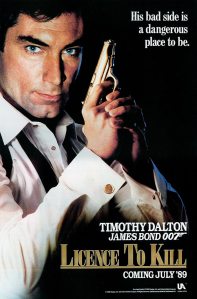
Licence to Kill, which was initially released in 1989, was the 16th “official” James Bond film.  It was also the second and the last one to feature Timothy Dalton in the role of James Bond.  This is the one where Felix Leiter gets eaten by a shark, Bond resigns from MI6, and ends up going to Central America in search of revenge.  Sad to say, it’s also one of my least favorite of the Bond films.

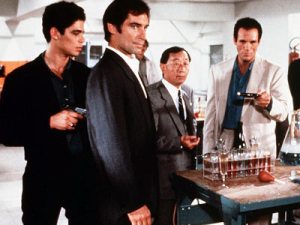
Licence to Kill starts out with Bond in Florida, attending the wedding of his best friend, Felix Leiter (played by David Hedison, who previously played the role in Live and Let Die).  However, before going to ceremony, Felix and Bond take a few minutes to arrest notorious drug lord Franz Sanchez (Robert Davi).  With the help of a crooked DEA agent (played by a wonderfully smarmy actor named Everett McGill), Sanchez escapes from custody.  Accompanied by his psychotic henchman Dario (Benecio Del Toro), Sanchez gets his revenge by killing the new Mrs. Leiter and feeding Felix to a shark.  When Bond discover the barely alive Felix, he also discovers a note that (in a scene borrowed from the novel Live and Let Die) reads, “He disagreed with something that ate him.”

Investigating on his own, Bond discovers that Sanchez’s partner in Florida is the wonderfully named Milton Krest (played by a brilliantly sleazy Anthony Zerbe).  Soon, James Bond is on a mission of vengeance that involves tracking down and killing every member of Sanchez’s organization.  However, M (Robert Brown) doesn’t like the idea of his best secret agent killing the entire population of Florida.  Bond responds by resigning from the service and heading to Central America on his own.

In typical Bond film fashion, James Bond manages to infiltrate Sanchez’s organization and Sanchez soon takes a liking to the man who has vowed to kill him.  Along the way, Bond romances both Sanchez’s abused mistress Lupe (Talisa Soto) and an ex-CIA agent named Pam Bouvier (Carey Lowell) and the viewers learn that Sanchez’s criminal enterprise not only involves drugs but also a crooked TV preacher (played by Las Vegas mainstay Wayne Newton) as well.

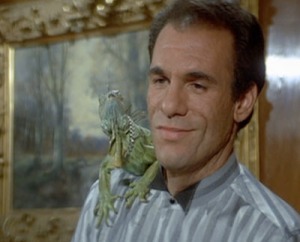
Let’s start with the positive.  Robert Davi, playing the role of Franz Sanchez, makes for a memorable villain.  Along with the silky charm and hints of madness that we’ve come to expect from Bond villains, Davi brings an almost perverse edge to the character.  Every line of dialogue that he delivers is practically dripping with decadence.  Whether he’s doting on his pet iguana, his main henchman Dario, or poor Lupe, Sanchez makes for a dangerously charismatic and compelling villain, one that feels like he would have been at home in one of Ian Fleming’s original novels.  Wisely, Davi plays his role almost as if he was playing James Bond and, as a result, the scenes that he shares with Dalton all have a crackling energy to them that is missing from the film as a whole.

In fact, almost all of the villains are compelling in this film, from Franz Sanchez all the way down to the lowliest henchman.  As played by a very young Benicio Del Toro, Dario is all smoldering intensity and arrogant swagger.  Smuggler Milton Krest is played by veteran character actor Anthony Zerbe and he gets one of the bloodiest death scenes in the history of the series.  However, I have to admit that my favorite bad guy was Sanchez’s business manager, Truman-Lodge (played by Anthony Starke).  Truman-Lodge is just so enthusiastic about the business opportunities that came along with allying oneself with evil that it’s rather infectious.

With such a memorable collection of bad guys, it’s a shame that the film didn’t provide them with any goals worthy of their evil talents.  In previous (and future) Bond films, far less interesting villains have still come up with plans to allow them to take over the world.  Even Moonraker‘s Hugo Drax was able to overcome his lack of personality and come up with a diabolical intergalactic scheme.  Meanwhile, Franz Sanchez — one of the most complex and impressive Bond villains of all time — is simply content to sell drugs and feed people to sharks.  It feels almost disrespectful to Davi’s performance that Sanchez’s goals are, ultimately, so boring.

And, in the end, I think that’s the main problem that I have with Licence to Kill.  The film feels so predictable.  There’s nothing about it that makes it comes across as a story that could only have been about James Bond.  Instead, it feels like the type of standard action/revenge film that always seems to come out every summer.  The film’s hero might be an Englishman named James Bond but he could just as easily be an American named Jake Sully.

According to Sinclair McKay’s invaluable history of the Bond franchise, The Man With The Golden Touch, Licence to Kill was specifically written to compliment Timothy Dalton’s more “realistic” interpretation of the Bond character.  As Dalton played Bond as grim and serious, Licence to Kill is a grim and serious film.  Innocents and villains alike die in bloody agony and, the few times that Dalton does smile, the expression looks so unnatural that you worry that his face is about to split in half.  Unfortunately, along with being grim and serious, Dalton’s Bond is also remote and uncharismatic and, with the exception of Robert Davi, he doesn’t have any chemistry with anyone else in the cast.  (Carey Lowell brings a lot of energy to the role of Pam but Dalton’s Bond never seems to be that into her.)  Dalton simply doesn’t make for a very compelling hero and, as a result, Licence to Kill ends up feeling like an empty collection of occasionally impressive stunts.

Licence to Kill holds a few dubious distinctions.  It was the least financially succesful of all the Bond films and it was also the last Bond film to be produced by Albert Broccoli and directed by John Glen.  It was also the last to feature Robert Brown in the role of M and, of course, it was also the last to feature Timothy Dalton in the role of James Bond.  (That’s not all that shocking when you consider just how miserable and bored Dalton seems to be in this film.)  Over the next six years, the Bond franchise would be mired in a lawsuit between Eon productions and producer Kevin McClory and when James Bond finally did return, he would do so in the form of Pierce Brosnan.

We’ll be taking a look at Goldeneye tomorrow.

James Bond Review: The Living Daylights (dir. by John Glen)


Addendum: It was brought to my attention that Maryam and Olivia d’Abo are actually cousins, rather than sisters.  This was corrected.  

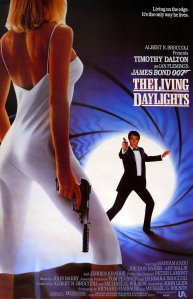
The Shattered Lens continues it’s coverage of all things Bond with 1987’s The Living Daylights. Timothy Dalton was once approached to play 007 after Connery left the franchise the first time, but being only 22 at the time, he considered himself a bit too young for the role. It was only after Roger Moore’s final role in A View to a Kill that he reconsidered and brought on as Britain’s superspy. What I liked about Dalton as Bond was that he was very cold and direct. There was nothing stylish about him, nor did he really try to be (aside for the usual Bond quip). For me, there was sense of darkness to the character. Dalton’s Bond felt like someone just a second away from doing damage to someone, but not exactly caring about how smoothly it was done. This may be partially why I’ve liked Craig so far in his films.

Below is the trailer for The Living Daylights. It makes chuckle how the word “Dangerous” gets thrown on screen every now and then.

The Living Daylights deals with a Russian plot to kill spies. General Gogol in the Roger Moore films was replaced with General Pushkin (John Rhys-Davies, Sallah from the Indy Films and Gimli from Lord of the Rings), and MI6 believes they are behind the recent deaths of agents during a training mission. Bond is asked to help eliminate a sniper for a defecting Soviet named Koskov (Jeroen Krabbe), but upon realizing that the sniper is a woman, he deliberately misses, shooting the frame of the gun and catching the sniper off guard. Bond manages to get Koskov out of Russia via a tube system, but Koskov is later kidnapped again.

We come to find that Koskov’s defection was a fake and that he’s working with an arms dealer (played by Joe Don Baker, who would later return to the Bond Franchise in Goldeneye as a different character), smuggling Opium and arms. Bond locates the sniper, who turns out to be Koskov’s girlfriend Kara (Maryam d’Abo) and poses a friend to Koskov to get closer to him. Granted, this ends up with Kara falling in love with James and we all know where that goes. d’Abo wasn’t bad as a Bond girl, but arguably her cousin, Olivia was more popular at the time.

Q Branch supplies Bond with a few fun gadgets. Back in the 80s, one fad were these keychain finders that would beep when you whistled or made a sound. 007 receives one of these with both an explosive and a smoke gas pellet inside. It’s pretty much the same setup that Connery had in From Russia With Love, placed in a more “modern day” casing (well, as modern as 25 years ago). Bond is also given an Aston Martin V8 Volante, and after all the Lotus editions in the Moore films – perhaps with the exception of the one that doubled as a sub, that one was awesome – it’s really wonderful to see the franchise return to it’s automotive roots. The car is outfitted with missiles, lasers in the hubcabs, on board skis and the all important self destruct system. As with all of Bond’s toys, he doesn’t manage to return this to Q.

From an action point of view, there isn’t a great deal in The Living Daylights. That’s a fantastic snow chase early on, and a fight on an airplane so popular that it was mimicked in the videogame Uncharted 3: Drake’s Deception. Neither of these try to be too over the top and work to great effect, but there are also a number of slow pacing moments that frankly had me wanting to fast forward through the film. I thought the sequence with the desert was drawn out just a little too much, lending to my notion that whenever a James Bond film uses the desert as a filming location, the movie just isn’t as strong in my eyes. Others, of course, may disagree. What the film does do well is establish Dalton as the new Bond. It doesn’t make fun of who he is compared to who came before in the way Her Majesty’s Secret Service did and just gives you an action sequence that says “Take it or leave it, this is who we’re running with”. I like to think it worked well. One could say it becomes the template for all of the “new 007” films

The Living Daylights notes a few changes in the Bond style. It would be the last film ever scored by long time Bond musician John Barry. The Dalton film after this, License to Kill was actually done by the late Michael Kamen (Robin Hood, Die Hard), and everything after that was either done by Eric Serra (The Professional, Goldeneye) or David Arnold (Stargate and Independence Day). A new, younger Moneypenny is introduced after Lois Maxwell’s departure, but I kind of hoped there would have been more time to see the chemistry grow there.

Overall, for a film that had to introduce a new James Bond to audiences, The Living Daylights does so with the 007 style we all know and love. It’s does downshift during the film to concentrate on the love story, but I felt Timothy Dalton’s dark and cold approach to the signature character adds a lot to the story overall.

The theme song to the film is a stand out by the band A-ha (who was popular with their song, Take On Me), and it’s orchestrated version is used heavily in the film. Tomorrow, we’ll visit License to Kill, where Bond goes rogue.

James Bond Film Review: A View to a Kill (dir by John Glen)


In the days leading up to the American premiere of Skyfall, the Shattered Lens has been revisiting the previous films in the James Bond franchise.  Today we take a look at 1985’s A View To A Kill.

Along with bring the 14th “official” Bond film, it was also the last to star Roger Moore in the role of 007.  On a personal note, it was also released the same year that I was born.  I have to say that I hope I’ve aged better than this film has.

Much like The Spy Who Loved Me, A View To A Kill opens with a ski chase between Bond and a bunch of Russians.  And while the chase itself isn’t all that exciting, it does lead to one of the better opening credits sequences of the Bond franchise.


Say what you will about A View To A Kill, it features the perfect theme song.  I first heard Duran Duran’s title song long before I saw the actual film.  After I graduated high school, I spent the summer in Italy and I can still remember hearing this song blaring from a loud speaker in Venice.  With it combination of exuberant music and incoherent lyrics, the song is the perfect soundtrack for both an American girl abroad and a mid-80s spy flick.

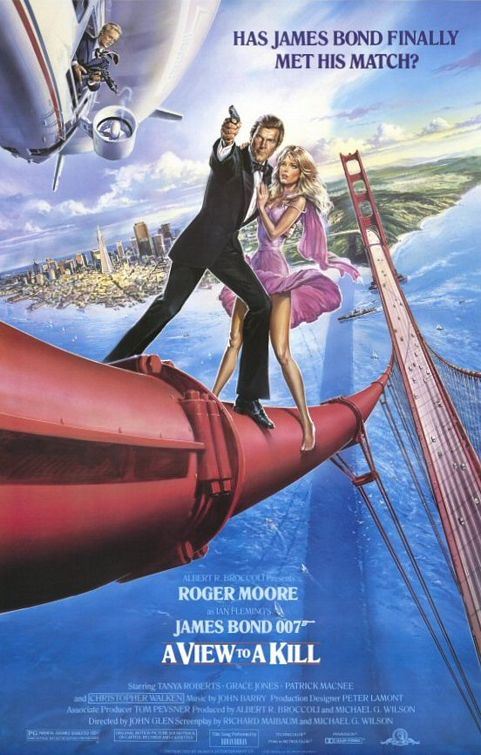
A View To A Kill finds James Bond investigating the mysterious industrialist Max Zorin (Christopher Walken).  Though Zorin is one of the world’s richest men, MI6 is suspicious of him.  Microchips manufactured by Zorin Industries are turning up in Russian submarines.  Perhaps even worse, it’s become apparent that, much like Auric Goldfinger, Zorin is a cheater.  He owns a champion racehorse but it’s rumored that the horse is somehow being given steroids.  MI6 sends Bond and racehorse trainer Sir Godfrey Tibbets (played, quite wonderfully, by Patrick Macnee) to investigate.

These scenes, in which an undercover Bond sneaks around Zorin’s estate in France, are my favorites of the film.  Moore and Macnee make for a likable team and it’s fun to watch the two veteran actors play off each other.  As well, since these scenes are more about detection than action, it’s easier to ignore the fact that Moore was 58 years old when he made A View To A Kill.

Unfortunately, the rest of the film doesn’t work as well and that’s unfortunate because A View To A Kill starts to get seriously weird as things progress.  It turns out that Zorin isn’t just a shady businessman.  No, he’s actually the product of Nazi genetic experimentation and, as a result, he’s both a genius and a complete sociopath.  What this means is that, opposed to previous Bond antagonists, Zorin spends a lot more time giggling and smiling as if even he can’t believe how evil he is.

Bond ends up following Zorin and his aide, May Day (Grace Jones), to San Francisco.  It’s there that Bond discovers that Zorin is planning on setting off a massive underground explosion, in hopes of causing an Earthquake that will totally destroy California.  This will allow Zorin to corner the world microchip market and make a lot of money but, for the most part, Zorin just seems to want to do it so that he’ll have something to talk about the next time he gets together with his fellow megalomaniacs.

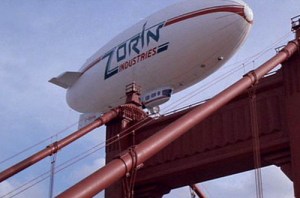
Once everyone arrives in San Francisco, James Bond ends up teaming up with geologist Stacy Sutton (played by Tanya Roberts, better known as Donna’s mother on That 70s Show).  As for Zorin, he divides his time between holding business meetings on his blimp and laughing like a maniac while gunning down random people.

Seriously, it’s an odd film.

Whenever film critics are looking over the Bond films, A View to  A Kill seems to be the Bond film that’s destined to get the least amount of respect and admittedly, this is an uneven entry in the Bond franchise.  In Sinclair McKay’s excellent look at the oo7 films, The Man With The Golden Touch, Roger Moore is quoted as having been uncomfortable with just how violent A View To A Kill eventually turned out to be and, watching the film, he definitely had a point.  It’s odd to see Moore’s light-hearted approach coupled with scenes in which Zorin gleefully kills a thousand people in a thousand seconds.  It also didn’t help that, in this film, Roger Moore looked every bit of his 58 years.  Never have I been as aware of stuntmen then when I watched A View To A Kill.  Finally, Moore and Tanya Roberts have next to no chemistry together.

With all that in mind, A View To A Kill is something of a guilty pleasure and that’s largely because of the bad guys.

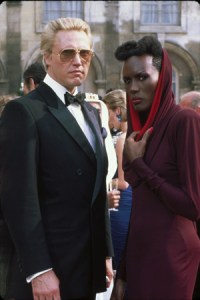
If anyone was born to play a Bond villain, it’s Christopher Walken and Max Zorin is an enjoyably over-the-top villain.  Whereas previous Bond villains were motivated primarily by greed, Zorin is the first Bond sociopath and Walken seems to be having a blast playing bad.  As opposed to the grim bad guys of the past, Zorin laughs and grins through the whole movie and Walken is a lot of fun to watch.  Regardless of whatever other flaws that the film may have, Max Zorin is rightly regarded as one of the best of the cinematic Bond villains.

As played by Grace Jones, May Day is one of the franchise’s most memorable and flamboyant villainous lackeys.   Much like Richard Kiel in The Spy Who Loved Me, Jones is such a physical presence that she dominates every scene that she’s in.  In their scenes together, Walken and Jones have the type of chemistry that’s so noticeably lacking between Moore and Roberts.

As I previously stated, A View To A Kill was Roger Moore’s final appearance as James Bond.  Before we started our look at the Bond films, I spent some time researching the history of both the franchise and the men who have played 007.  One thing that quickly became apparent was that nearly everyone agreed that Roger Moore is a nice, likable guy but that he didn’t bring much more than likability to the role of James Bond.  Having now rewatched the Bond films, I can say that Roger Moore’s performance as James Bond was and is seriously underrated.  Yes, Moore may have brought a light touch to the role but his interpretation of Bond was perfect for the films that he was starring in.  Much as it’s difficult to imagine Roger Moore in From Russia With Love, it’s just as difficult to visualize Sean Connery in The Spy Who Loved Me.  Moore’s greatest talent may have been likability but that likability kept the Bond franchise alive and Moore’s interpretation of the role deserves better than to be continually dismissed.  

With Roger Moore leaving the franchise, the role of James Bond would next be played by an actor named Timothy Dalton.  If Moore was the likable, fun Bond, Dalton was, in many ways, the complete opposite.  We’ll be taking a look at The Living Daylights tomorrow.

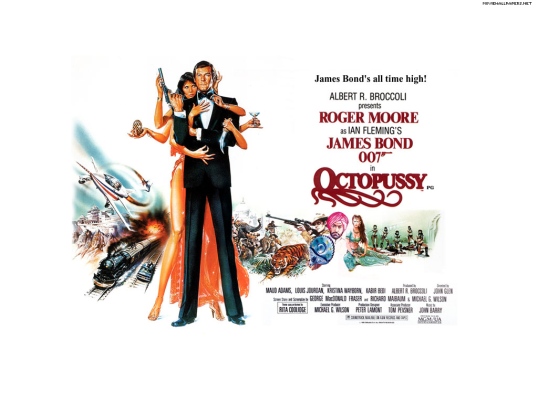
James Bond Review: Octopussy (dir. by John Glen)


We’re at the home stretch in the Roger Moore-era of Ian Fleming’s James Bond film series. During his time in the role as Britain’s super spy extraordinaire we’ve seen him put his own personal stamp on the role. It was a daunting task seeing the role had been played by Sean Connery early in the film series and had done such a great job of making the character such a cultural icon that anyone following him would forever be compared. Moore doesn’t just hold his own, but has built such a loayl following in the role that many consider his portrayal of Agent 007 as the best in the series.

His Bond when compared to Connery’s portrayal was more the witty charmer who tried to use his wits and brains to solve problematic (usually dangerous ones) situations he finds himself in. Connery’s Bond was more the physical type whose charm belied a much darker personality streak that Moore’s portrayal could never pull off no matter how the writers tried.

The Roger Moore-era also redefined the franchise as more more about action and less and less thriller with each new film. This culminates in Moore’s most action-packed film in the role with the 13th Bond film (produced by EON) in Octopussy.

The film begins with one of the more impressive opening sequences in the series as we find Bond in the middle of an undercover mission in Cuba. This intro’s stunt work with Bond piloting a mini-plane in and around Cuban airspace to escape and, at the same time, fulfill his mission remains a highlight in the series where each new film tries to raise the bar in terms of well-choreographed and very complicated action scenes.

Octopussy sees Bond traveling to India, East and West Germany to halt the nuclear and warmongering ambitions of a Soviet general who sees his country’s nuclear disarmament talks with the West as inviting defeat for the Soviet Union. We also have the theft of priceless Russian treasures like the Faberge Eggs being used to finance this general’s plan to complicate bond’s main mission. The plot for Octopussy is a reminder of the time it was filmed in. Reagan and Thatcher had a strong control of the West and their confrontational attitudes towards the Soviet Union and it’s satellite states made people believe that the world was on the brink of war. This public sentiment affected the fiction and entertainment of the time with Cold War thrillers becoming ascendant once more.

As much as the basic outline of the film’s plot looked to be impressive on the face of it the way the story unfolded was quite a hit-and-miss affair. I put some of this on the shoulders of it’s director John Glen who seemed more interested in moving the story from one action scene to the next while paying just the minimum of lip-service to the quieter scenes that occur in-between.

This being Moore’s sixth Bond film we pretty much know how his Bond operates. So, it falls to fleshing out his rivals and enemies to help create a much more interesting film beyond the extravagant action scenes. We learn about the agendas and personalities of Bond’s rivals through too much exposition info dumps. Even the title’ character of Octopussy (played by Maud Adams) we don’t get to learn much of other than a brief personal history dialogue she has with Bond the first time we meet. Of Bond’s two enemies in the film one is the warmongering General Orlov (played by Steven Berkoff) who comes off like an over-the-top caricature with a distinct speech pattern to match. The other is the exiled Afghan prince Kamal Khan who comes off a bit more fleshed out as Octopussy’s covetous partner-in-crime. Louis Jourdan as Kamal Khan plays the role with a sense of panache and joie de vivre that at times he’s able to match Moore’s Bond in the charisma department whenever the two share the screen together.

What should interest people about Octopussy are the very action scenes I spoke about earlier. From the opening sequence in Cuba to a thrilling race against time that traverses from East Germany to West Germany to stop a nuclear weapon from detonating it’s no wonder some people consider Octopussy as a favorite. I enjoyed the film for these very sequences despite missteps in the overall execution of the plot and inconsistencies in the performances of the cast. Yet, the film had the DNA to be much better and after repeated viewings one could see that in the hands of a different filmmaker and changes in the cast this sixth Moore-era Bond film had the potential to be one of the best.

Octopussy would mark the start of the franchise’s decline in the face of much more violent and action-packed action films of the 80’s. The film tried to keep up with this rising trend in action filmmaking during the 80’s. It was able to succeed in a fashion in making the series much more action-packed (though quite bloodless in comparison to what was about to come out of Hollywood in the coming years), but in doing so the film’s storyline and characters suffered that the film doesn’t hold up the test of time unlike some of the early Connery and Moore films.

On a side note, the film did have one of my favorite Bond song’s with Rita Coolidge singing “All Time High” in the intro sequence. A song title that was quite ironic considering that the film definitely didn’t hit an all time high.

James Bond Review: Never Say Never Again


With the release of the latest James Bond yarn, Skyfall, imminent, the Shattered Lens has been looking back at every single James Bond film ever created – the entire history of the franchise. Today’s selection for review is 1983’s Never Say Never Again. Unlike the overwhelming majority of the franchise, this film was not produced by EON productions, but rather by an independent studio. It is an adaptation of Ian Fleming’s Thunderball, much like the 1965 film that shares the novel’s name. It also marks the return of Sean Connery to portray the film’s lead, 00-agent James Bond, 12 years after appearing in Diamonds Are Forever.

I have to say, when I entered into reviewing this film I was certain that I had seen it before, but it took only ten minutes or so of film action before I realized that this film, somehow, had completely flown under my radar.

I have to say, it does not make a strong first impression. We don’t get a cold open with Bond, but rather launch directly into the credit sequence with what I have to admit may be the worst opening theme song of the entire franchise. I haven’t even posted it here, I’m so embarrassed by it, but I’m sure a quick youtube search will yield some results. It’s lengthy, slow, and weirdly incongruous with what proves to be a fairly action-packed Bond adventure.

The story here is sort of needlessly complicated. Addressing the long lapse between Connery appearances as bond, M (Edward Fox) notes that he has recalled James Bond to service against his will, and that after failing a routine training exercise, that Bond is in unacceptable physical condition. His first assignment? To proceed to a health spa to be placed on an exercise and dietary regimen to bleed all of the toxins out of his system, with a strong implication that Bond’s behaviour and mind-set are as much of a problem as his physical condition. While at the spa, of course, Bond becomes privy to a strange interaction between the beautiful nurse Fatima Blush (Barbara Carrera) and an accomplice with a bandaged face, one Jack Petachi (Gavan O’Herlihy). The duo spot Bond, and attempt to have him assassinated, but 007 is able to overcome the assassin and lives to fight another day.

We learn that both Blush and Petachi are agents of the infamous terrorist organization, SPECTER, headed by Ernst Stavros Blofeld (Max Von Sydow). In a convoluted plot, Jack Petachi will use a surgically implanted false eye to replicate the retinal scan of the President of the United States. Using this eye, he is able to arrange for two nuclear warheads to be placed aboard cruise missiles. Using strategically positioned transmitters, SPECTER’s agents then guide the launched missiles remotely, driving them into the sea where their agents can retrieve the nuclear weapons. With the warheads, Blofeld plans to hold the world hostage, forcing world governments into paying an annual tribute to SPECTER, or risk the annihilation of world cities in nuclear fire. Soon after, Jack Petachi is murdered by Fatima Blush, who throws a snake into his speeding vehicle, causing him to lose control and crash through a wall. She then plants a bomb in the vehicle and blows him sky high.

Responding to the crisis presented by SPECTER, M reluctantly reinstates the 00-agents, including James Bond. Bond is immediately assigned to track down the missing warheads.

From there, we’ll travel from the Bahamas, home of SPECTER agent Maximillian Largo (Klaus Maria Brandauer)’s massive yacht, Flying Saucer. Bond meets Domino Petachi, Jack Petachi’s sister, and Largo’s lover (Kim Basinger) and comes into conflict with both Fatima Blush and Largo himself. Bond will chase Largo from the Bahamas to France, into the Mediterranean, and out to the Middle East, with help from noted CIA agent Felix Leiter (Bernie Casey). The action sequences, once they get rolling in the second half of the movie, don’t really let up, and take us to an underwater finale where Domino finally kills Largo in revenge for the needless death of her brother.

For all that this film does right, I have to confess that this was definitely not my favourite James Bond film. The pacing seemed brutally uneven for much of the film, with the action sequences spaced too far apart. The film does spend a little effort winking and nodding at the earlier Connery Bond films, probably in part because Never Say Never Again was not developed by the franchise’s principle producers, EON. Although this film is a far cry from the extremely gadget and superscience-y Bond films that dot the landscape after Connery’s original departure, there is a definitively 80s quality to this film – especially in the film’s score, which at times is loud and invasive, and other times oddly subdued – which prevents it from ever fitting right in with the other Connery films.

The performances are pretty good all around. Sean Connery himself might never have taken a 12 year vacation from playing 007, the women around him are beautiful, and Brandauer is a flamboyant villain in the classic Bond style. Max Von Sydow is excellent in presenting yet another take on supervillain Ernst Blofled, though I thought he was more or less wasted in a very limited role.

If you are waxing nostalgic and just can’t live without one more trip with Connery as James Bond, you probably won’t find this film disappointing. Something about it never really struck a chord with me, however, and I came away thinking of it as a bit of a slog.

Join us tomorrow as we continue our odyssey through the history of James Bond with the slightly-silly but always-fun Octopussy. Until then, against my better judgment, I’ll leave you with the theme song to Never Say Never Again … remember what I said about the music score before you chance it though!