4 Shots From 4 Films is just what it says it is, 4 shots from 4 of our favorite films. As opposed to the reviews and recaps that we usually post, 4 Shots From 4 Films lets the visuals do the talking!
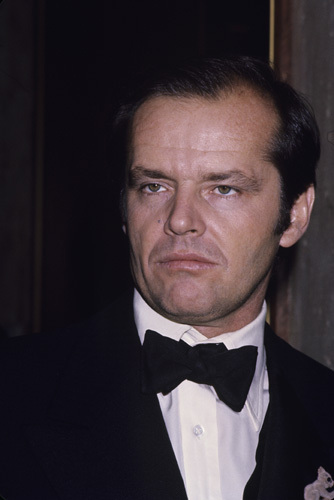
Today is Jack Nicholson’s 88th birthday!
Though he has pretty much retired from acting, Jack Nicholson remains a screen icon with a filmography that is a cinema lover’s dream. He’s worked with everyone from Roger Corman to Stanley Kubrick to Milos Forman to Martin Scorsese and, along the way, he’s become a symbol of a very American-type of rebel. Though often associated with the counter-culture, his style has always been too aggressive and idiosyncratic for him to be a believable hippie. Instead, he’s one of the last of the beats, an outsider searching for meaning in Americana.
Over the course of his career, Nicholson has won three Oscars and been nominated for a total of 12. He’s the only actor to have been nominated in every decade from the 1960s to the 2000s. He is an actor who epitomizes an era in filmmaking, actually several eras. It’s been 15 years since he last appeared in a movie but Jack Nicholson will never be forgotten.
4 Shots From 4 Jack Nicholson Films
Psych-Out (1968, dir by Richard Rush, DP: Laszlo Kovacs)
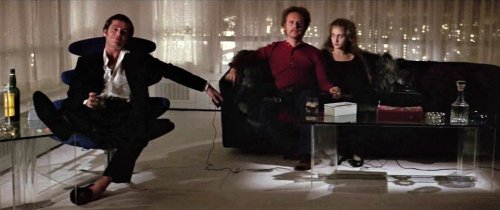
Carnal Knowledge (1971, dir by Mike Nichols, DP: Giuseppe Rotunno)
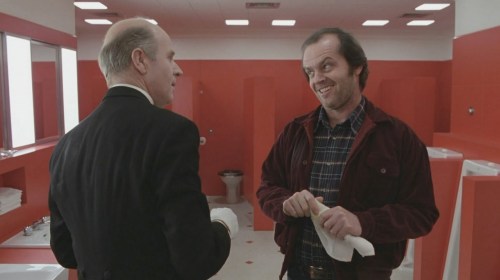
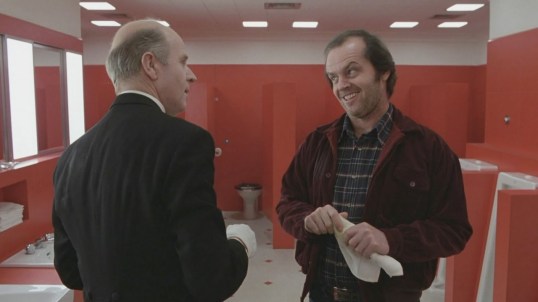
The Shining (1980, dir by Stanley Kubrick, DP: John Alcott)
The Departed (2006, dir by Martin Scorsese, DP: Michael Ballhaus)
Today would have been the 101st birthday of character actor Philip Stone. While Stone appeared in a lot of films, he’ll probably always be best-remembered for his subtly menacing turn as the ghostly Grady in 1980’s The Shining. Here he is, having a conversation with Jack Torrance (Jack Nicholson) and letting him know that he’s always been caretaker.
(Fair warning to those who may not have seen this scene before or who perhaps have forgotten about it, Grady does use a racial slur at one point. It’s a moment that’s true to his villainous character, even if it’s a bit jarring to hear today.)
In the 1981 film Reds, Warren Beatty plays Jack Reed, the radical journalist who, at the turn of the century, wrote one of the first non-fiction books about Russia’s communist revolution and then went on to work as a propagandist for the communists before becoming disillusioned with the new Russian government and then promptly dying at the age of 32.
Diane Keaton plays Louise Bryant, the feminist writer who became Reed’s lover and eventually his wife. Louise found fame as one of the first female war correspondents but then she also found infamy when she was called before a Congressional committee and accused of being a subversive.
Jack Nicholson plays Eugene O’Neill, the playwright who was a friend of both Reed and Bryant’s and who had a brief affair with Bryant while Reed was off covering labor strikes and the 1916 Democratic Convention.
Lastly, Maureen Stapleton plays Emma Goldman, the anarchist leader who was kicked out of the country after one of her stupid little dumbass followers assassinated President McKinley. (Seriously, don’t get me started on that little jerk Leon Czolgosz.)
Together …. well, I was going to say that they solve crimes but that joke is perhaps a bit too flippant for a review of Reds. Reds is a big serious film about the left-wing activists at the turn of the century, one in which the characters move from one labor riot to another and generally live the life of wealthy bohemians. Reed spends the film promoting communism, just to be terribly disillusioned when the communists actually come to power in Russia. For a history nerd like me, the film is interesting. For those who are not quite as obsessed with history, the film is extremely long and the scenes of Reed and Bryant’s domestic dramas often feel a bit predictable, especially when they’re taking place against such a large international tableaux. At its best, the film is almost a Rorschach test for how the viewer feels about political and labor activists. Do you look at Jack Reed and Louise Bryant and see two inspiring warriors for the cause or do you see two wealthy people playing at being revolutionaries?
Reds was a film that Warren Beatty spent close to 20 years trying to make, despite the fact that the heads of the Hollywood studios all told him that audiences would never show up for an epic film about a bunch of wealthy communists. (The heads of the studio turned out to be correct, as the film was critically acclaimed but hardly a success at the box office.) It was only after the success of the 1978, Beatty-directed best picture nominee Heaven Can Wait that Beatty was finally able to get financing for his dream project. He ended up directing, producing, and writing the film himself and he cast his friend Jack Nicholson as O’Neill and his then-romantic partner Diane Keaton as Louise Bryant. (Gene Hackman, Beatty’s Bonnie and Clyde co-star, shows up briefly as one of Reed’s editors.) One left-wing generation’s tribute to an early left-wing generation, Reds is fully a Warren Beatty production and, for his efforts, Beatty was honored with the Oscar for Best Director. That said, the Reds lost the award for Best Picture to another historical epic, Chariots of Fire. Chariots of Fire featured no communists and did quite well at the box office.
The film is good but a bit uneven, especially towards the end when we suddenly get scenes of Louise Bryant trudging through Finland as she attempts to make it to Russia to be reunited with Reed. The film actually works best when it features interviews with people who were actual contemporaries of Reed and Bryant and who share their own memoires of the time. In fact, the interviews work almost too well. The “witnesses,” as the film refers to them, paint such a vivid picture of the Reed, Bryant, and turn of the century America that Beatty’s attempt to cinematically recreate history often can’t compete. One can’t help but feel that Beatty perhaps should have just made a documentary instead of a narrative film.
(Interestingly enough, many of the witnesses were people who were sympathetic to Reed’s politics in at the start of the century but then moved much more to the right as the years passed. Reed’s friend and college roommate, Hamilton Fish, went on to become a prominent Republican congressman and a prominent critics of FDR.)
That said, Jack Nicholson gives a fantastic performance as Eugene O’Neill, adding some much needed cynicism to the film’s portrayal of Reed and Bryant’s idealism. Keaton and Beatty sometime both seem to be struggling to escape their own well-worn personas as Bryant and Reed but Beatty does really sell Reed’s eventually disillusionment with Russia and the scene where he finally tells off his Russian handler made me want to cheer. Fans of great character acting will want to keep an eye out for everyone from Paul Sorvino to William Daniels to Edward Herrmann to M. Emmet Walsh and IanWolfe, all popping up in small roles.
Reds is not a perfect film but, as a lover of history, I enjoyed it.
First off, we’ve got the trailer for Head, starring the Monkees! This film was co-written by Jack Nicholson.
2. The Great Rock and Roll Swindle (1980)
In the first film that Julien Temple made about the history of the Sex Pistols, Malcolm McLaren presents himself as being the genius behind the group and tries to keep viewers from noticing that Johnny Rotten refused to have anything to do with the film.
3.Stunt Rock (1978)
I know next to nothing about this film but it was directed by Brian Trenchard-Smith and that’s often a good sign.
4, Sgt. Pepper’s Lonely Hearts Club Band (1978)
Featuring Donald Pleasence singing the longest version of I Want You ever recorded!
5. The Decline of Western Civilization (1981)
From director Penelope Spheeris comes the ultimate documentary about 1980s Los Angeles punk rock.
6. The Decline of Western Civilization Part 2: The Metal Years (1988)
I’ve always felt that Barry Nelson’s performance as Ullman is one of the best parts of the early part of the film. Whereas Ullman was presented as being a stereotypical jerk in King’s novel, the film presents him as a blandly friendly bureaucrat who can talk about what happened with the previous caretaker and make it sound like the most normal thing in the world. The scene were he interviews Jack Torrance for the caretaker job is wonderfully ominous, even if it’s hard to describe why. I know that Stephen King disliked this scene because it made Jack look unbalanced from the start but, personally, I think it does a wonderful job of setting the mood.
Finally, Ullman’s office reminds me of Ben Horne’s office in Twin Peaks, right down to the somewhat campy name plate on his desk.
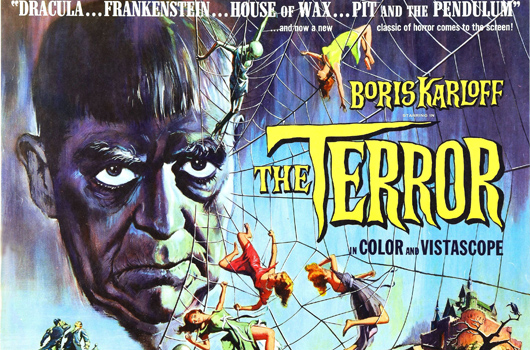
Have you ever woken up and thought to yourself, “I’d love to see a movie where a youngish Jack Nicholson played a French soldier who, while searching for a mysterious woman, comes across a castle that’s inhabited by both Dick Miller and Boris Karloff?”
Of course you have! Who hasn’t?
Well, fortunately, it’s YouTube to the rescue. In Roger Corman’s 1963 film The Terror, Jack Nicholson is the least believable 19th century French soldier ever. However, it’s still interesting to watch him before he became a cinematic icon. (Judging from his performance here and in Cry Baby Killer, Jack was not a natural-born actor.) Boris Karloff is, as usual, great and familiar Corman actor Dick Miller gets a much larger role than usual. Pay attention to the actress playing the mysterious woman. That’s Sandra Knight who, at the time of filming, was married to Jack Nicholson.
Reportedly, The Terror was one of those films that Corman made because he still had the sets from his much more acclaimed film version of The Raven. The script was never finished, the story was made up as filming moved alone, and no less than five directors shot different parts of this 81 minute movie. Among the directors: Roger Corman, Jack Hill, Monte Hellman, Francis Ford Coppola, and even Jack Nicholson himself! Perhaps not surprisingly, the final film is a total mess but it does have some historical value.
(In typical Corman fashion, scenes from The Terror were later used in the 1968 film, Targets.)
Hi! Welcome to Horrorthon! It’s a tradition around these parts that we offer up a classic (or not-so-classic) horror film for our readers to watch every day in October. As we have just lost the great Roger Corman, it seems appropriate to start things off with one of his best films.
And so, without further ado….
Enter singing.
Little Shop…Little Shop of Horrors…Little Shop…Little Shop of Terrors…
For the 2024 Horrorthon’s first plunge into the world of public domain horror films, I’d like to present you with a true classic. From 1960, it’s the original Little Shop of Horrors!
When I was 19 years old, I was in a community theater production of the musical Little Shop of Horrors. Though I think I would have made the perfect Audrey, everybody always snickered whenever I sang so I ended up as a part of “the ensemble.” Being in the ensemble basically meant that I spent a lot of time dancing and showing off lots of cleavage. And you know what? The girl who did play Audrey was screechy, off-key, and annoying and after every show, all the old people in the audience always came back stage and ignored her and went straight over to me. So there.
Anyway, during rehearsals, our director thought it would be so funny if we all watched the original film. Now, I’m sorry to say, much like just about everyone else in the cast, this was my first exposure to the original and I even had to be told that the masochistic dentist patient was being played by Jack Nicholson. However, I’m also very proud to say that — out of that entire cast — I’m the only one who understood that the zero-budget film I was watching was actually better than the big spectacle we were attempting to perform on stage. Certainly, I understood the film better than that screechy little thing that was playing Audrey.
The first Little Shop of Horrors certainly isn’t scary and there’s nobody singing about somewhere that’s green (I always tear up when I hear that song, by the way). However, it is a very, very funny film with the just the right amount of a dark streak to make it perfect Halloween viewing.
So, if you have 72 minutes to kill, check out the original and the best Little Shop of Horrors…
“Shall I ever see the rare and radiant Lenore again?” — Dr. Erasmus Craven (Vincent Prince)
“How they Hell should I know?” — Dr. Adolphus Bedlo (Peter Lorre)
This exchange comes from Roger Corman’s 1963 film, The Raven, and it pretty much epitomizes the film. Very loosely based on the poem by Edgar Allan Poe, The Raven was one of the many Poe adaptations that Corman did with Vincent Price. As opposed to the other films in Corman’s Poe cycle, The Raven was a flat-out comedy, one that parodied the other films in the cycle. Reportedly, Peter Lorre improvised his response to Vincent Price’s question about Lenore. In fact, Lorre improvised a good deal of his performance and his jokes sometimes even took Corman by surprise. As a result and despite the fact that Richard Matheson did write a script for the film, The Raven is one of those films that feels like it was made up while the camera was rolling.
The Raven is a film about three sorcerers who are always fighting and arguing with each other. Dr. Erasmus Craven (Vincent Price) spends his time mourning the late Lenore. The evil Dr. Scarabus (a frail-looking Boris Karloff) has his own castle where he lives with the ghost of the late Lenore (Hazel Court). Dr. Adolphus Bedlo (Peter Lorre) is a sarcastic ne’er-do-well who saw Lenore in Scarabus’s castle and was transformed into a talking raven as a result.
In raven form, Dr. Bedlo flies over to Craven’s castle and convinces Craven to transform him back into human form. After informing Craven that Scarabus has Lenore’s ghost in his castle, the heart-broken Craven decides to head over to Scarabus’s castle and get some answers. Accompanying the group is Craven’s daughter, Estelle (Olive Sturgess) and Bedlo’s son, Rexford (Jack Nicholson, looking somewhat lost in the role of a boring young man).
At the castle, Scarabus puts on an act of being a friendly and gracious host but the opposite soon turns out to be true. In fact, the entire castle is full of secrets and it quickly turns out that hardly anyone — with the exception of Estelle and Rexford — are who they actually claim to be. It leads to a battle in magic between Craven and Scarabus. I nearly described their battle as being “epic” but that’s probably not the right world. It’s epic by the standards of Roger Corman but actually, the big battle is just as jokey as the rest of the film.
The Raven is definitely not a film that’s meant to be taken seriously. One gets the feeling that Corman knew that the presence of Price, Karloff, and Lorre would make the film a success no matter what the film was like so he decided to have some fun with it. (Price and definitely Lorre appear to have been in on the joke while Karloff was perhaps a bit less so.) To be honest, the film’s only earnest moments come courtesy of Oliva Sturgess and Jack Nicholson but, because Nicholson is Nicholson, you watch those earnest moments waiting for Rexford to arch an eyebrow or flash that devilish grin. Unfortunately, he doesn’t. Jack is pretty boring here.
The Raven, if we’re going to be honest, is probably too jokey for its own good but it’s still hard to resist the charm of Price, Lorre, and Karloff. The film is a chance to see three horror icons acting opposite each other and, as a result, it’s a fun film for horror fans. Vincent Price breaks the fourth wall at the end of the film and it’s hard not to love it.
Today’s actor really needs no introduction. While Jack Nicholson started his career as a part of the Roger Corman stock company and appeared in the original Little Shop of Horrors while also being strongly considered for the role of Guy Woodhouse in Rosemary’s Baby, Nicholson has not appeared in many horror movies.
But the horror movie in which he did appear is such a classic that it’s made Nicholson a horror icon, even if he didn’t appear in as many horror films as a Christopher Lee or a Boris Karloff.
In this scene from 1980’s The Shining, Nicholson’s Jack Torrance has a drink with a ghost. Nicholson does a wonderful job in this scene, especially when he’s playing off the wonderfully sinister Joe Turkel.
Have you ever woken up and thought to yourself, “I’d love to see a movie where a youngish Jack Nicholson played a French soldier who, while searching for a mysterious woman, comes across a castle that’s inhabited by both Dick Miller and Boris Karloff?”
Of course you have! Who hasn’t?
Well, fortunately, it’s YouTube to the rescue. In Roger Corman’s 1963 film The Terror, Jack Nicholson is the least believable 19th century French soldier ever. However, it’s still interesting to watch him before he became a cinematic icon. (Judging from his performance here and in Cry Baby Killer, Jack was not a natural-born actor.) Boris Karloff is, as usual, great and familiar Corman actor Dick Miller gets a much larger role than usual. Pay attention to the actress playing the mysterious woman. That’s Sandra Knight who, at the time of filming, was married to Jack Nicholson.
Reportedly, The Terror was one of those films that Corman made because he still had the sets from his much more acclaimed film version of The Raven. The script was never finished, the story was made up as filming moved alone, and no less than five directors shot different parts of this 81 minute movie. Among the directors: Roger Corman, Jack Hill, Monte Hellman, Francis Ford Coppola, and even Jack Nicholson himself! Perhaps not surprisingly, the final film is a total mess but it does have some historical value.
(In typical Corman fashion, scenes from The Terror were later used in the 1968 film, Targets.)



 Through the Shattered Lens