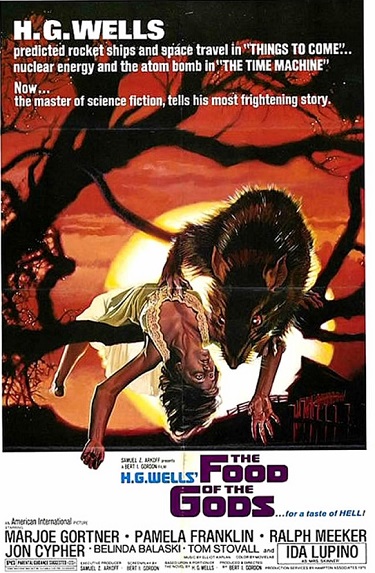
The TSL’s Horror Grindhouse: Food Of The Gods (dir by Bert I. Gordon)


Uh-oh! Something weird has bubbled up to the ground on an island near British Columbia and a farmer and his wife (played by John McLaim and Ida Lupino) foolishly decided to feed it to their farm animals! Soon, they’ve got giant chickens! And listen, that might sound like a good thing to some but I’ve spent enough time around farms to know that giant chickens are not a good thing! Seriously, normal-sized chickens are messy enough. Giant ones? I don’t even want to thinking about it.

Unfortunately, it’s not just the chickens that are eating the food. Rats are eating the food. Wasps are eating the food. All of the animals are turning into giants and now, they’re hunting humans! After his best friend is attacked and killed by giant wasp, a football player named Morgan (Marjoe Gortner) decides to investigate on his own. You would think that a football player would be busy preparing for his next game or something like that but no, not Morgan! Morgan’s determined to find out why there are giant animals off the coast of Canada.

Of course, Morgan isn’t the only one interested in the so-called Food of the Gods. There’s also Jack Bensington (Ralph Meeker), who owns a dog food company. Jack wants to sell the food. Why would Jack want to do that? Does he actually think that causing dogs to transform into giants who would undoubtedly try to kill their masters is somehow going to be good for his company’s reputation? Jack’s main motivation seems to be that he’s a businessman and, in this film’s moral universe, that automatically makes him one of the bad guys. But it seems like even an evil businessman would know better than to kill off all of his customers.

This 1976 film, which is loosely (very loosely) based on a novel by H.G. Wells, was directed by Bert I. Gordon and, if you think the plot sounds a little ludicrous …. well, it is. Nothing about the film really makes much sense but that’s kind of to expected from a Bert I. Gordon film. Gordon specialized in making films about giants destroying stuff. The films were never particularly good but Gordon obviously understood that American filmgoers love big things. Food of the Gods, as silly as it may be, apparently made a lot of money when it was first released.

Today, of course, it’s impossible to watch the film without noticing just how terrible the special effects are. Between the unconvincing use of super-imposed images and the obviously fake rats that are tossed at some of the actors, there’s not a single shot that doesn’t somehow look totally ridiculous. In fact, it’s all so silly and obviously done on the cheap that it becomes rather charming, or at least as charming as the superimposed image of giant wasp ever could possibly be. You have to admire the film’s determination to tell its story despite not having the resources to do so. As for the rest of the film, it’s dumb but it doesn’t take itself too seriously. If you’re specifically searching for a bad giant animal movie, The Food of the Gods is fun in its own goofy, nonsensical, low-budget way.

Horror Film Review: The Devil’s Rain (dir by Robert Fuest)


https://www.youtube.com/watch?v=HAfio1Qht3c

Was I the only one who was relieved that William Shatner didn’t die this week?

Seriously, when I heard that the 90 year-old Shatner was going to be taking a trip on one of the Amazon rockets, I was really worried.  First off, you’re taking a 90 year-old into space.  Secondly, you’re doing it with a rocket that people don’t really know that much about.  And third, that 90 year-old is a cultural icon and one who probably played no small role in causing people like Jeff Bezos and Elon Musk to become obsessed with conquering space in the first place.  With the exception of George Takei, everyone loves William Shatner.  (And, at this point, Takei’s constant sniping about Shatner is coming across as being just a little bit petty.  Move on, George!  People love you, too.)

As I watched Shatner land back on Earth, I found myself thinking about The Devil’s Rain, a film from 1975 that starred William Shatner as a man whose exploration of the unknown led to a far less triumphant result.   

In this film, Shatner plays Mark Preston, a youngish man who lives on ranch with his father (George Sawaya) and his mother (Ida Lupino).  For some reason, the Preston family owns a book that is full of evil magic.  Satanic high priest Jonathan Corbis (Ernest Borgnine) wants the book and when the Prestons refuse to hand it over, he makes it his mission to destroy them.  He gets things started by turning Mark’s father into a weird, waxy zombie who melts in the rain.  Not wanting the same fate to befall the rest of the family, Mark grabs the book and heads to a desert ghost town that has been taken over by Corbis and his followers.  Mark never returns.

Mark’s older brother, Tom (Tom Skerritt) then shows up in town, searching for Mark.  Accompanying him are his wife (Joan Prather) and a paranormal researcher (Eddie Albert).  Tom discovers that Corbis is transforming his followers into zombies who have no memories and who exist only to …. well, I’m not sure what the point of it all is but I guess it basically comes down to Corbis needing something evil to do.  Not only has Mark become one of his Corbis’s followers but, if you keep an eye out, you might spot a very young John Travolta in the background.  This was Travolta’s film debut.  According to the end credits, the character he plays is named Danny.  Danny Zuko, perhaps?  That would serve him right for making Sandy doubt herself.

The Devil’s Rain is one of the many low-budget movies that William Shatner did between the end of the Star Trek TV show and the start of the Star Trek movies.  It’s a bit of an disjointed film, as I think any film starring William Shatner and Tom Skerritt as brothers would have to be.  Skerritt gives a very laconic performance, playing his character as if he was the star of a Western.  Shatner, meanwhile, does that thing where he randomly emphasizes his words and gets the full drama out of every sentence and facial expression.  But, as much as Shatner overacts, you can’t help but enjoy his performance because he’s William Shatner and that’s what he does.  The same is true of Ernest Borgnine, who overacts in his role just as much as you would expect Ernest Borgnine to overact when cast as an evil cult leader.  For that matter, Eddie Albert isn’t exactly subtle as the paranormal researcher.  Don’t even get me started on Keenan Wynn, playing yet another small town sheriff.  Let’s just say that, with the exception of Tom Skerritt, the cast of The Devil’s Rain is not necessarily full of actors noted for their restraint.  That said, there’s something rather charming about everyone’s attempts to steal every scene in which they appear.

The Devil’s Rain is a deeply silly film but that doesn’t make any sense but it’s hard not to get caught up in it.  Even if the fact that this film is perhaps your only opportunity to see John Travolta melt on screen isn’t enough to make you watch, Shatner vs. Borgnine with Skerritt approaching in the distance is just too entertaining to resist!  Thankfully, Shatner survived appearing in this film and revitalized his career through a combination of Star Trek movies and Canadian tax shelter flicks.  He’s a survivor.  In fact, I guess I shouldn’t have been surprised that, even at the age of 90, Shatner has no trouble going into space.  William Shatner’s going to be around forever.

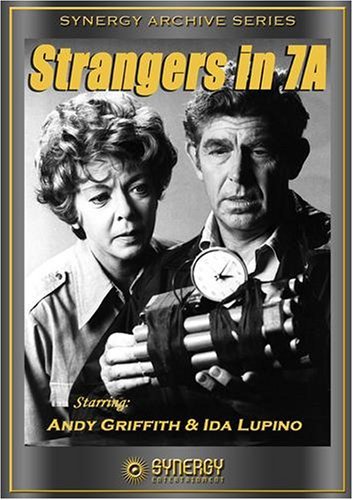
The Strangers in 7A (1972, directed by Paul Wendkos)


Artie Sawyer (Andy Griffith) is a man who no one respects.  Having recently been fired from his long-time job, he’s forced to take a job as a superintendent for an apartment building in New York.  The tenants don’t think much of him.  His wife, Iris (Ida Lupino), is getting tired of his self-pity.  The only person who seems to like Artie is Claudine (Susanne Benton).  The young and beautiful Claudine approaches Artie in a bar and, after flirting with him, reveals that she needs a place to stay.  Artie agrees to let Claudine check out Apartment 7A.  At the apartment, Claudine rolls around in the bed, dances seductively, and then reveals that she has three male friends who are going to be staying in the apartment with her.  Billy (Michael Brandon), Virgil (Tim McIntire), and Riff (James A. Watson, Jr.) all served in Vietnam together and now they need to crash at the apartment for a while.  Artie can either let them stay or they can reveal to his wife that he was at a bar, trying to pick up young women.

Led by the psychotic Billy, the three men are planning on robbing the bank next door.  When Artie, who is having doubts about whether or not it was a good idea to let four obviously unstable people live rent-free in his building, discovers their plans, he and Ida are taken hostage.  When the bank robbery goes wrong, Billy tries to use the hostages and a bomb as leverage for his escape from the police.

As far as films about bank robberies goes, The Strangers in 7A is no Dog Day Afternoon.  While it’s interesting to see the usually confident Andy Griffith play a loser, he never seems like enough of a loser that he would actually risk a job that he clearly needs just because Claudine flashed a little leg at him.  Even when he’s playing a character who is down on his luck, he’s still Andy Griffith.  Along with the lead role being miscast, the bank robbers are too generic to really be credible or threatening.  Susanne Benton is sexy as the femme fatale and Ida Lupino is sympathetic as Artie’s wife but otherwise, The Strangers in 7A is forgettable.

The Strangers in 7A was made for television.  At the time, Andy Griffith was still trying to escape being typecast as Mayberry’s amiable Sheriff Taylor.  Griffith was a convincing villain in movies like Pray For The Wildcats and Savages but he’s just not believable as a loser in this film.

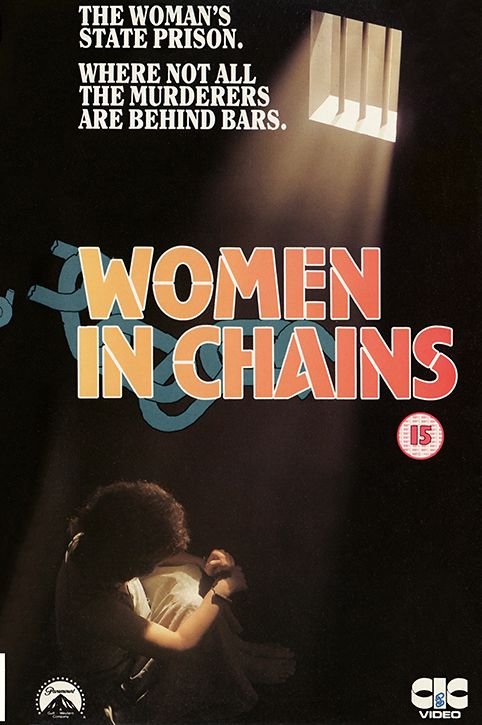
Women In Chains (1972, directed by Bernard L. Kowalksi)


Sandra Parker (Lois Nettleton) is the world’s most dedicated parole officer.  After one of her parolees is sent back to prison and then dies under mysterious circumstances, Sandra decides to investigate on her own.  For Sandra, this means changing her name to Sally Porter and arranging to be sent to prison on a phony charge.  For some reason, Sandra/Sally only tells one other person what she’s doing.  The plan is for Sandra to spend two weeks undercover and then her friend, fellow parole officer Helen (Penny Fuller), will reveal the truth to the proper authorities and get Sandra sprung from prison.  It doesn’t work out that away, as Helen is killed in the line of duty shortly after Sandra finds herself behind bars.

The prison is run by the tyrannical Claire Tyson (Ida Lupino!), a matron who is more interested in exercising power than in rehabilitation.  Claire’s main enforcer is a butch prisoner named Dee Dee (Jessica Walter!!).  As soon as she enters the prison, Sandra gets on Tyson’s bad side.  Sandra asks too many questions and makes the mistake of demanding that her fellow prisoners be treated humanely.  Sandra even demands that a prisoner be given aspirin for a migraine, which is the type insubordination that leads to a stay in solitary.  (What’s strange is that, in solitary, Sandra ends up sharing a cell with another prisoner which I would think would defeat the purpose of being in solitary.)  With Tyson openly plotting to kill her and the only person who knows where she is dead, Sandra has to figure out a way to escape the prison and reveal the truth about what goes on behind bars.

Compared to most women-in-prison films, Women in Chains is pretty tame.  This is a women-in-prison film that you could safely watch with grandma.  This one was made for early 70s television, so there’s no nudity, no strong language, and even the required prison riot is restrained.  The film asks us to believe that Sandra would not only be stupid enough to only let one person know that she was going undercover but also that a parole officer could somehow walk around the prison without running into any prisoners who she previously dealt with. Obviously, the film’s plot is not its strong point but viewers with an appreciation for camp will undoubtedly enjoy the performances of Ida Lupino and Jessica Walter.  They rule that cell block with an iron fist and are entertaining to watch.

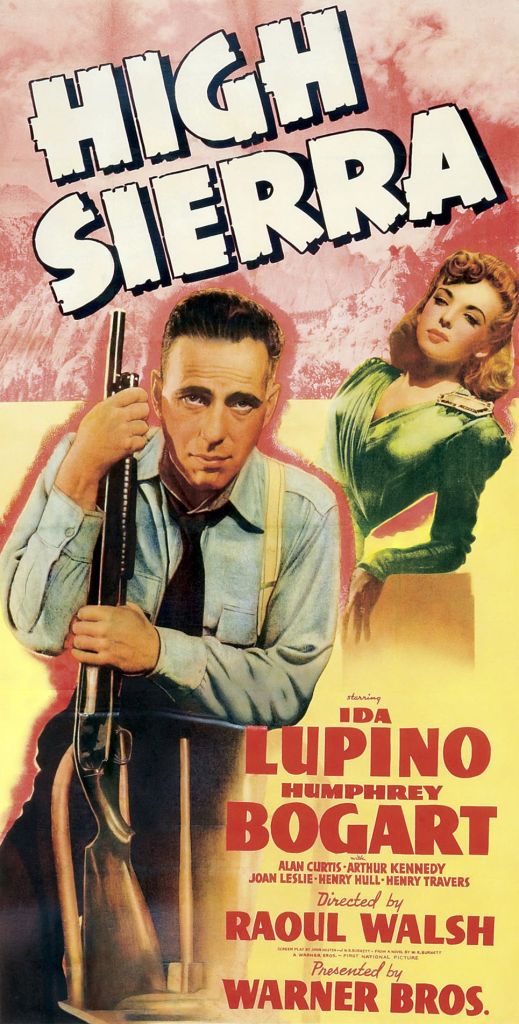
Crashing Out: Humphrey Bogart in HIGH SIERRA (Warner Brothers 1941)


gary loggins's avatarcracked rear viewer

Humphrey Bogart played yet another gangster in Raoul Walsh’s HIGH SIERRA, but this time things were different. Bogie had spent the past five years at Warner Brothers mired in supporting gangster parts and leads in ‘B’ movies, but when he read John Huston and W.R. Burnett’s screenplay, he knew this role would put him over the top. James Cagney and Paul Muni both turned it down, and George Raft was penciled in to star, until Bogie put a bug in his ear and Raft also refused it. Bogart lobbied hard for the role of Roy Earle, and his instincts were right: not only did HIGH SIERRA make him a star at last, it led to him getting the lead in his next picture THE MALTESE FALCON , the directorial debut of his good friend Huston.

Roy Earle is an old-school criminal pardoned from an Indiana prison thanks to the machinations…

View original post 698 more words

30 Days of Noir #12: The Hitch-Hiker (dir by Ida Lupino)


The intense 1953 film noir, The Hitch-Hiker, begins with news of a murderer at large.

His name is Emmett Myers (William Talman).  He’s the rough-looking man who you might occasionally see standing by the side of the road, asking for a ride with his thumb outstretched.  For me, it only takes one look at Myers’s unfriendly face and his shifty eyes to know that I would never slow down to give him a ride.  However, The Hitch-Hiker takes place in a more innocent era, at a time when everyone wanted to be of help.  Anyone who gives Emmett a ride ends up dead.  He steals their cars and then drives across country, abandoning the car only when he learns that his previous murder has been discovered.  Emmett has hitchhiked from Illinois to Southern California and he’s left a trail of dead bodies behind him.

Roy Collins (Edmond O’Brien) and Gilbert Bowen (Frank Lovejoy) don’t know who Emmett is.  They’ve missed all of the reports about Emmett’s killing spree.  They haven’t read the newspapers, all of which feature a picture of Emmett on the front page and a warning to never pick him up.  Roy and Gilbert have been too busy getting ready for a long-planned fishing trip in Baja California.  When they see Emmett hitchhiking in Mexico, they pull over and offer him a ride.

Unlike other movie hitchhikers, Emmett doesn’t waste any time before revealing who he is.  As soon as he gets in the car, he pulls a gun and tells the two men that they’re going to drive him deeper into Baja California.  He’s got a boat to catch and he says that all the two men have to do is follow orders.  Of course, both Roy and Gilbert know better.  They know that Emmett’s planning on killing them as soon as they arrive at their destination.  In fact, if Emmett learns that the police are looking for the two men, he’ll kill them sooner.  Roy and Gilbert not only have to keep Emmett from flying off the handle but they also have to keep him from discovering that both of them have been reported as being missing.

As the three men drive across California, Emmett continues to taunt his prisoners.  Repeatedly, he points out that the only reason they’re in this situation is because of their loyalty to each other.  As Emmett explains it, if the two men tried to run in opposite directions, Emmett would probably only be able to kill one of them.  If the two men both attacked him, Emmett would again probably only have time to kill one before the survivor subdued him.  Will Roy and Gilbert remains loyal to each other or will they finally embrace Emmett’s philosophy of every man for himself?

Oh, how you’ll hate Emmett Myers!  As played by William Talman, Emmett is not just a criminal but a bully as well.  The enjoyment that he gets out of taunting Roy and Gilbert will make your skin crawl.  Emmett is hardly the type of witty or charming master criminal who often shows up in movies today.  Instead, The Hitch-Hiker emphasizes that Emmett’s an idiot but, because he has the gun, he has the power.  Edmond O’Brien and Frank Lovejoy are also well-cast as the two friends who are forced to choose between survival and loyalty.

The Hitch-Hiker was one of the few films to be directed by a woman in the 1950s.  (It’s generally considered to be the only film noir to have been directed by a woman.)  Ida Lupino was not only an actress but also the only female director in the old Hollywood system and she made several hard-hitting films, the majority of which dealt with the type of issues that mainstream Hollywood was still too scared to handle.  With The Hitch-Hiker, Lupino emphasizes not only Emmett’s cruelty but also the bonds of friendship between Emmett’s two hostages.  Visually, she makes the wide open desert appears as menacing and as dangerous as any shadowy city street.  If urban noirs often suggested that threats could be hiding anywhere, The Hitch-Hiker takes the opposite approach.  The threat is in the back seat of the car and there’s literally no place to hide.

The Hitch-Hiker is an intense film that holds up well today.  Watch it below and never again make the mistake of helping out a stranger.

Cleaning Out the DVR #17: Film Noir Festival 3


gary loggins's avatarcracked rear viewer

To take my mind off the sciatic nerve pain I was suffering last week, I immersed myself on the dark world of film noir. The following quartet of films represent some of the genre’s best, filled with murder, femme fatales, psychopaths, and sleazy living. Good times!!

I’ll begin chronologically with BOOMERANG (20th Century-Fox 1947), director Elia Kazan’s true-life tale of a drifter (an excellent Arthur Kennedy ) falsely accused of murdering a priest in cold blood, and the doubting DA (Dana Andrews ) who fights an uphill battle against political corruption to exonerate him. Filmed on location in Stamford, CT and using many local residents as extras and bit parts, the literate script by Richard Murphy (CRY OF THE CITY, PANIC IN THE STREETS, COMPULSION) takes a realistic look behind the scenes at an American mid-sized city, shedding light into it’s darker corners.

Andrews is solid as the honest…

View original post 1,048 more words

Horror on TV: Thriller 2.1 “What Beckoning Ghost” (dir by Ida Lupino)


For today’s adventure into the world of televised horror, we have another episode of the Boris Karloff-hosted anthology series, Thriller!

In this episode, a concert pianist (Judith Evelyn) is haunted by visions of mysterious piano and the sound of someone playing.  Is she losing her mind, is she being set up, or is her house truly haunted?  This enjoyable episode was directed by actress Ida Lupino.

http://www.youtube.com/watch?v=ZjTltusqkCk

A Movie A Day #155: Out of the Fog (1941, directed by Anatole Litvak)


When two aging fishermen (Thomas Mitchell and John Qualen) attempt to buy a new boat, they run into a problem with local mobster, Harold Goff (John Garfield).  As Goff explains, if they do not pay him $5.00 a week, something bad could happen to their boat.  When one of the fisherman’s daughter (Ida Lupino) falls in love with Goff, she makes the mistake of letting him know that her father is planning on giving her $190 so that she can take a trip to Cuba.  When Goff demands the money for himself, the fishermen attempt to go to the police, just to be told that there is nothing that the authorities can do.  Goff tricked them into signing an “insurance” contract that allows him to demand whatever he wants.  The two fishermen are forced to consider taking drastic measures on their own.  Out of the Fog is an effective, early film noir, distinguished mostly be John Garfield’s sinister performance as Harold Goff.

Out of the Fog is also memorable as an example of how Hollywood dealt with adapting work with political content during the production code era.  Out of the Fog was based on The Gentle People, a play by Irwin Shaw.  In the play, which was staged by The Group Theater in 1939, Harold Goff was obviously meant to be a symbol of both European fascism and American capitalism.  In the play, the two fisherman had Jewish names and were meant to symbolize those being persecuted by the Third Reich and its allies.  In the transition for stage to film, Jonah Goodman became Jonah Goodwin and he was played by the very talented but definitely not Jewish Thomas Mitchell.   The play ended with Harold triumphant and apparently unstoppable.  Under the production code, all criminals had to be punished, which meant the ending had to be changed.  Out of the Fog is an effective 1940s crime thriller but, without any political subtext, it lacks the play’s bight.

One final note: while Out of the Fog had a good cast, with up and comer John Garfield squaring against old vets Thomas Mitchell and John Qualen, the original Broadway play’s cast was also distinguished.  Along with contemporary film stars Sylvia Sidney and Franchot Tone, the play’s cast was a who’s who of actors and directors who would go on to be prominent in the 1950 and 60s: Lee J. Cobb, Sam Jaffe, Karl Malden, Martin Ritt, and Elia Kazan all had roles.


Cleaning Out the DVR Pt 11: Five from the Fifties


gary loggins's avatarcracked rear viewer

dve1

The 1950’s were a time of change in movies. Television was providing stiff competition, and studios were willing to do anything to fend it off. The bigger budgeted movies tried 3D, Cinerama, wide-screen, and other optical tricks, while smaller films chose to cover unusual subject matter. The following five films represent a cross-section of nifty 50’s cinema:

dve2

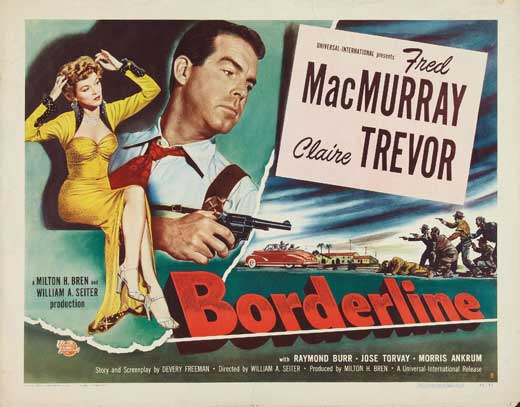
BORDERLINE (Universal-International 1950; D: William A. Seiter)

BORDERLINE is a strange film, straddling the borderline (sorry) between romantic comedy and crime drama, resulting in a rather mediocre movie. Claire Trevor plays an LAPD cop assigned to Customs who’s sent to Mexico to get the goods on drug smuggler Pete Ritchey (Raymond Burr , being his usual malevolent self). She’s tripped up by Ritchey’s rival Johnny Macklin (Fred MacMurray , channeling his inner Walter Neff), and taken along as he tries to get the dope over the border. What she doesn’t know is he’s also…

View original post 628 more words