4 Shots From 4 Films: Special Roger Corman Edition


4 (or more) Shots From 4 (or more) Films is just what it says it is, 4 (or more) shots from 4 (or more) of our favorite films. As opposed to the reviews and recaps that we usually post, 4 (or more) Shots From 4 (or more) Films lets the visuals do the talking.

Today, on the first day of Horrorthon, we remember the great film pioneer and director, Roger Corman!  It’s time for….

4 Shots From 4 Roger Corman Films

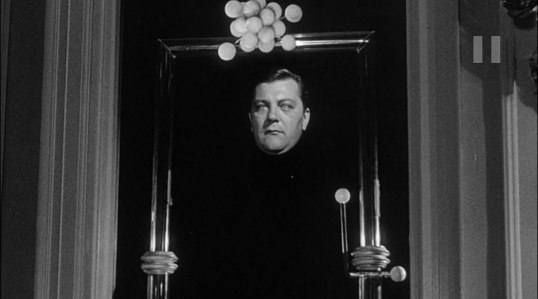
Not of this Earth (1957, dir by Roger Corman DP: John J. Mescall)

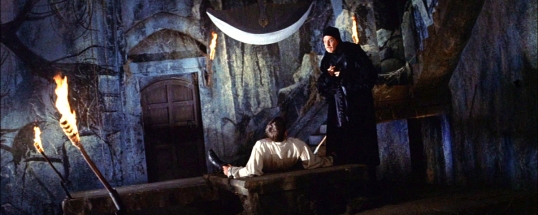
Pit and the Pendulum (1961, dir by Roger Corman, DP: Floyd Crosby)

X: The Man With The X-Ray Eyes (1963, dir by Roger Corman, DP: Floyd Crosby)

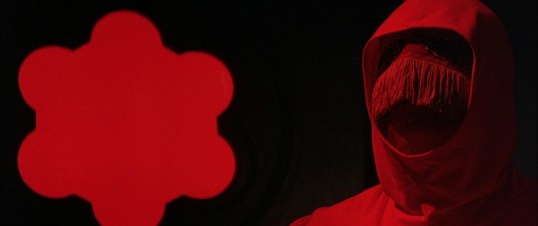
The Masque of the Red Death (1964, dir by Roger Corman, DP: Nicolas Roeg)

Horror Film Review: The Survivor (dir by David Hemmings)


The 1981 film, The Survivor, opens with a group of school children watching as a plane crashes in the distance.  Of the 301 people on the plane, 300 die.  Somehow, the only survivor is the pilot, David Keller (Robert Powell).  It’s rare for a pilot to be the sole survivor, especially in a crash as severe as the one in this film.  Even more shocking, David walks away without a scratch on him or any memory of what happened in the minutes before the crash.

Though the airline wants to keep David hidden away until after it has determined what caused the crash, David insists on helping with the investigation.  He is haunted by strange visions and the sound of screaming passengers.  He has to know if the crash was his fault or if there was a bomb on the plane.  While the tabloid press tries to take his picture, the families of the victims blame him for the crash.  “There he is,” one angry woman shouts at a funeral service that is overseen by Joseph Cotten (in his last film role), “the pilot who walked away!”

When one of the tabloid photographers gets a little bit too aggressive in his attempts to take David’s picture, he finds himself pursued by a ghostly apparition of a little girl.  The photographer is so frightened of the little girl that he stumbles in front of a train, which has to rank right up there as one of the dumbest ways that someone can die in a horror movie.  Later, the photographer’s girlfriend tries to look at one of the pictures of David and her hand is promptly chopped off by a paper cutter.  That’s not quite as bad as stumbling in front of a train.

As David tries to understand what is happening, he realizes that he’s being followed by a woman named Hobbs (Jenny Agutter).  Hobbs says that she is a medium.  She witnessed the crash and now, she’s in contract with the spirits of the dead.  At one point, David and Hobbs suddenly start trying to strangle each other.  They manage to break free of whatever has possessed them but it’s obvious that these spirits are not fooling around.  (That said, the attack begins and ends so abruptly that, for those of us watching, it inspires more confusion than fright.)

The idea behind The Survivor is an intriguing one.  The film was directed by David Hemmings, the British actor who is probably best-remembered for starring in the 60s classic, Blow Up and in Dario Argento’s classic Deep Red.  Along with co-founding Hemdale Films, Hemmings also directed a handful of movies.  Unfortunately, intriguing premise aside, The Survivor is not one of Hemmings’s better directorial efforts.  There are a few effective visuals and Jenny Agutter is well-cast as Hobbs but the film’s pace is extremely slow and Robert Powell seems to be more bored than enigmatic as the title character.  The film’s plot calls out for an all-out grindhouse approach.  Hemmings’s instead gives us a stately and rather self-important film that ultimately feels like a lesser episode of some obscure 70s anthology show.

That said, this film does feature Joseph Cotten in his final film appearance.  He only has two scenes but he brings a quiet dignity to the role of the Priest.  The film doesn’t really work but Joseph Cotten and Jenny Agutter give performances that survive the wreckage.

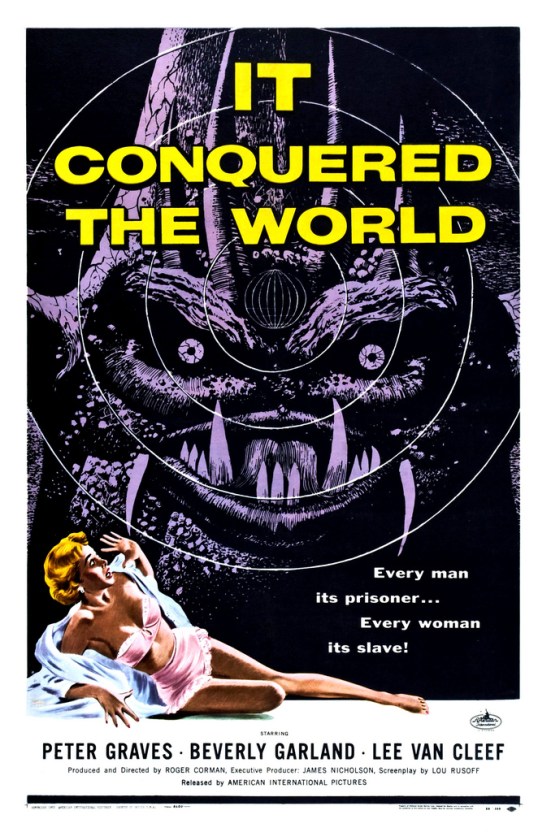
Horror Film Review: It Conquered The World (dir by Roger Corman)


“Man is a feeling creature, and because of it, the greatest in the universe….”

So says scientist Paul Nelson (Peter Graves) towards the end of 1956’s It Conquered The Universe.  Paul may be a scientist but he understands the importance of emotion and imagination and individuality.  He knows that it’ll take more than just cold logic to save humanity from destruction.

Unfortunately, Paul’s best friend, Tom Anderson (Lee Van Cleef), disagrees.  Tom worked at Los Alamos.  Tom helped to develop the atomic bomb.  Tom is convinced that humanity will destroy itself unless a greater power takes over.  Tom feels that he has discovered that greater power.  Tom has recently contacted a Venusian and invited it to come to Earth.  Upon arriving, the Venusian promptly disrupts all electrical power on Earth.  It sends out bat-like creatures that inject humans with a drug that takes control of their minds and turns them into a compliant slaves.  Paul tells Tom that robbing people of their free will is not going to save the Earth but Tom remains committed to the Venusian, even as it becomes obvious that the Venusian’s main concern is with its own survival.

It Conquered The World is very much a film of the 1950s.  Along with tapping into the era’s paranoia about nuclear war and UFOs, it also features Peter Graves delivering monologues about freedom and the inherent superiority of the human race.  When Paul confronts Tom, he not only accuses Tom of selling out the Earth but he also attacks Tom’s patriotism.  When Tom’s wife, Claire (Beverly Garland), confronts the alien and orders it to leave her plant along, she does it while wearing high heels and a tight sweater and holding a rifle.  The one female scientist (played by Karen Kadler) spends most of her screentime being menaced while wearing a white slip and there’s a platoon of bumbling but unbrainwashed soldiers hanging out in the woods.  If one looked up 1956 in the dictionary, there’s a very good chance this film would be the definition.

At the same time, the film’s story feels like a metaphor for modern times.  When the Venusian-controlled police turn authoritarian and start threatening to punish anyone who questions their orders, we’re reminded of the excesses of the COVID lockdowns.  When the editor of the town’s newspaper is shot by a policeman who says that words are no longer necessary in the new world, it’s hard not to think of all the writers, commentators, artists, and ordinary citizens who have run afoul the online cancellation brigade.  When Paul is reduced to riding a bicycle from place to place, it’s hard not to think of the environmental Luddites, with their hatred of anything that makes life more convenient.  When Tom rationalizes his activities by saying that humanity must be saved from itself, he’s expressing an opinion that is very popular among several people today.  Tom’s embrace of cold logic feels very familiar.  Of course, today, people don’t need a Venusian to order them to accept authoritarianism.  Instead, they’re more than happy to do on their own.

It Conquered The World was directed by Roger Corman.  It was his eighth film as a director and it remains one of his most entertaining.  As one might expect from a low-budget sci-fi film, It Conquered The World produces it’s share of laughs.  It’s hard not to smile at the sight of the extremely serious Peter Graves peddling his bicycle from location to location.  (It doesn’t help that Graves never takes off his suit or loosens his tie.)  And the Venusian simply has to be seen to be believed:
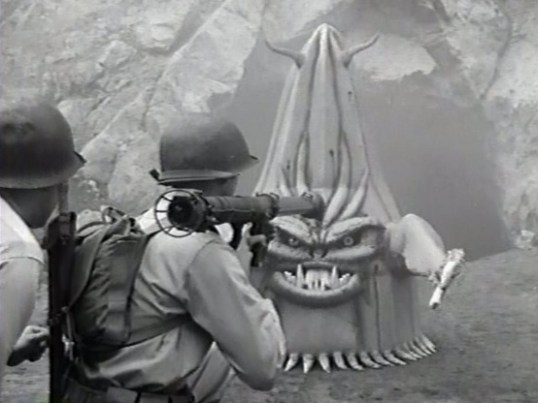
At the same time, It Conquered The World holds up well.  Lee Van Cleef and Beverly Garland both give performances that transcend the material, with Van Cleef especially doing a good job of paying a man struggling to rationalize his bad decisions.  It Conquered The World holds up today, as both a portrait of the 50s and 2024.
The Covers of Imagination


From 1951 through 1958, Imagination magazine brought stories of science fiction and horror to eager readers.  Among the writers who appeared in Imagination were Philip K. Dick, Robert Heinlien, Robert Sheckley, and John Wyndham.  Today, the magazine is well-remembered for its exciting covers, which were done by some of the best artists working in the pulps.  You can’t have art without Imagination.

Below is a sampling of The Covers of Imagination: Stories of Science and Fantasy.

1950, October, by Hannes Bok

1951, April, by Malcolm Smith

1952, May, by Malcolm Smith

1953, January, by Harold W. McCauley

1954, June, by Malcolm Smith

1954, July, by Harold W. McCauley

1954, September, by Bill Terry

1955, June, by Harold W. McCauley

1956, February, by Lloyd Rognan

1956, December, by Lloyd Rognan

1957, December, by Malcolm Smith

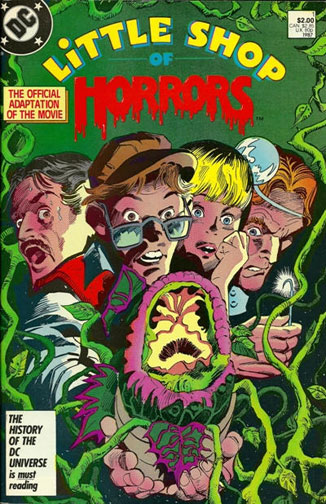
Horror on the Lens: The Little Shop of Horrors (dir by Roger Corman)


Hi!  Welcome to Horrorthon!  It’s a tradition around these parts that we offer up a classic (or not-so-classic) horror film for our readers to watch every day in October.  As we have just lost the great Roger Corman, it seems appropriate to start things off with one of his best films.

And so, without further ado….

Enter singing.

Little Shop…Little Shop of Horrors…Little Shop…Little Shop of Terrors…

For the 2024 Horrorthon’s first plunge into the world of public domain horror films, I’d like to present you with a true classic.  From 1960, it’s the original Little Shop of Horrors!

When I was 19 years old, I was in a community theater production of the musical Little Shop of Horrors.  Though I think I would have made the perfect Audrey, everybody always snickered whenever I sang so I ended up as a part of “the ensemble.”  Being in the ensemble basically meant that I spent a lot of time dancing and showing off lots of cleavage.  And you know what?  The girl who did play Audrey was screechy, off-key, and annoying and after every show, all the old people in the audience always came back stage and ignored her and went straight over to me.  So there.

Anyway, during rehearsals, our director thought it would be so funny if we all watched the original film.  Now, I’m sorry to say, much like just about everyone else in the cast, this was my first exposure to the original and I even had to be told that the masochistic dentist patient was being played by Jack Nicholson.  However, I’m also very proud to say that — out of that entire cast — I’m the only one who understood that the zero-budget film I was watching was actually better than the big spectacle we were attempting to perform on stage.  Certainly, I understood the film better than that screechy little thing that was playing Audrey.

The first Little Shop of Horrors certainly isn’t scary and there’s nobody singing about somewhere that’s green (I always tear up when I hear that song, by the way).  However, it is a very, very funny film with the just the right amount of a dark streak to make it perfect Halloween viewing.

So, if you have 72 minutes to kill, check out the original and the best Little Shop of Horrors

6 Trailers In Memory of Roger Corman


Today, for the first day of Horrorthon, we pay tribute to the legacy of the legendary Roger Corman with a special edition of Lisa Marie’s Favorite Grindhouse and Exploitation Film Trailers.

1. The Day The World Ended (1955)

Though Corman worked in almost every type of film genre imaginable, he’s probably best remembered for his science fiction and horror films.  This was one of the first of them.

2. Bucket of Blood (1959)

In Bucket of Blood, Roger Corman gave Dick Miller a starring role and also mixed comedy and horror in a way that influence many future horror directors.

3. Little Shop of Horrors (1960)

Roger Corman famously shot Little Shop of Horrors in just two days.  The end result was a mix of comedy and horror that continues to be influential to this day.  The musical is very good but I still prefer the cheerful low-budget aesthetic of the Corman original.

4. The Terror (1963)

Corman was famous for his ability to spot new talent.  His 1963 film The Terror starred a then unknown actor named Jack Nicholson.

5. The Masque of the Red Death (1964)

In the 60s, Corman was also well-known for his Edgar Allan Poe adaptations, the majority of which starred Vincent Price.  With these colorful and flamboyant films, Corman showed himself to be a pop artist at heart.

6. Frankenstein Unbound (1990)

In the 1970s, Corman retired from directing and instead focused on producing and distributing movies.  In 1990, he briefly came out of retirement and gave us his final directorial effort, Frankenstein Unbound.

6 Things To Which I Am Looking Forward In October


Welcome to October!  October is a big month here at the Shattered Lens.  It’s the month when we devote the majority of our time to the horror genre.  It’s time for our annual Horrorthon!  Last year, we had a record number of Horrorthon posts.  I’d love to that record this year but mostly. I just want this year’s Horrothon for both our writers and our readers!

Here’s what I’m looking forward to in October!

  1. Anora — Sean Baker’s latest film may not be a horror film but it’s still the October film to which I’m most looking forward to.  A hit on the festival circuit, the early word is that Anora is going to be one of this year’s major Oscar contenders.
  2. The Horror Movies On TCM — TCM never lets me down in October.  I can’t wait to binge all of the classic horror that will be aired this month.
  3. Joker: Folie a Deux — This film is one of the big question marks on the upcoming calendar.  When I first heard that the sequel to Joker would be a musical, I thought it sounded like a disastrous idea.  But the early word has been that Joaquin Phoenix and Lady Gaga both give excellent performance and that the sequel is worthy follow-up to first film.  We’ll find out in just a few more days!
  4. Terrifier 3 — Art the Clown is one of the scariest villains around.  Terrifier gave me nightmares.  Terrifier 2 was overlong but well-made.  I’ll be interested to see what happens with the third film.  If nothing else, I appreciate that the Terrifier films are unapologetic about being the type of films that they are.  It takes courage to fully embrace a genre that hasn’t always been accepted by the mainstream.
  5. Conclave — This is another film that’s expected to be an Oscar contender.  Based on what I’ve heard about the film’s plot, I’m not as enthusiastic about this film as some people are.  But I do always look forward to seeing a good Ralph Fiennes performance and the word is that he’s excellent in this film.
  6. Halloween — It’s my favorite holiday!  I can’t wait to see all the decorations, all the parties, and all the costumes!

October’s going to be a great month and those of us at TSL can’t wait to celebrate it with you!  What are you looking forward to in October?

Music Video of the Day: Ashes to Ashes by David Bowie (1980, directed by David Bowie and David Mallet)


David Bowie was one of the first artists to truly understand the potential power of a good music video and, as can be seen in this video for Ashes to Ashes, he was an early pioneer of the form.  At a time when most music videos were just performance clips, Bowie put together a narrative that offered an artistic interpretation of the song’s lyrics and themes and which invited viewers to interpret the song on their own.

The video was largely shot on two beaches in the UK, at Beachy Head and Hastings.  Interior scenes were filmed on the set of the Kenny Everett Show.  Bowie’s followers were played by the Blitz kids, who were known for frequenting the Blitz nightclub in Covent Garden.

Bowie said that the video was meant to combine the past and the future, which is why Bowie not only appears as an astronaut but also as an Edwardian clown.  The scenes with Bowie as an astronaut are, as the lyrics make clear, a reference to Major Tom.  The look of the scenes was heavily influenced by H.R. Giger’s work on Alien.

David Mallet would go on to become one of busiest directors of music videos of the 80s, directing videos for Queen, Iron Maiden, AC/DC, and others.  David Bowie would also go on to play a huge role in MTV’s history, due to both his videos and his willingness to call out that station’s initial refusal to feature videos from black artists.

Enjoy!

Another Halloween Has Come and Gone


Another Halloween has come and gone and another Horrorthon has come to a close.  We hope you have had a wonderful October and that the Thanksgiving month brings you much to be grateful for!

And remember, just because you didn’t see the Great Pumpkin this year, doesn’t mean that he won’t be there for you next October.  As always, Linus puts it best:

To all of our readers and from all of your friends at the Shattered Lens, thank you.