Horror on TV: The Twilight Zone 2.3 “The Last Rites of Jeff Myrtlebank”


The_Last_Rites_of_Jeff_Myrtlebank

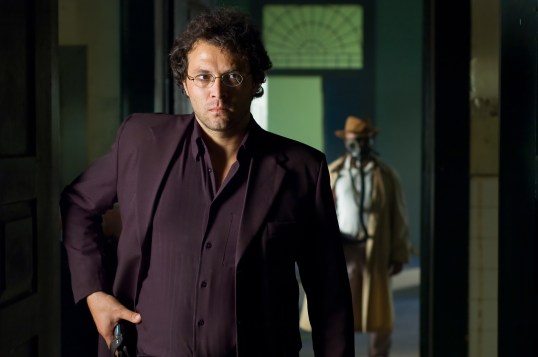
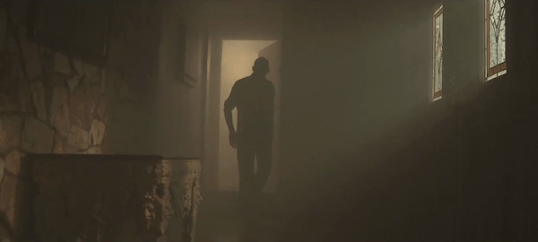
Today’s televised horror is an episode of The Twilight Zone called The Last Rites of Jeff Myrtlebank. It examines what happens when, in the middle of his funeral, Jeff Myrtlebank (played by James Best) suddenly sits up in his coffin and asks what’s going on. Jeff’s friends and family are now torn between being happy to have Jeff back and being worried as they try to figure out what exactly Jeff has come back as. I like this episode, largely because it’s a good example of country gothic and, in many ways, I’m a gothic country girl. Plus, it has a really great ending!


This episode was directed and written by Montgomery Pittman and originally aired on February 23rd, 1962.

Horror on The Lens: Robot Monster (dir by Phil Tucker)


Robot Monster

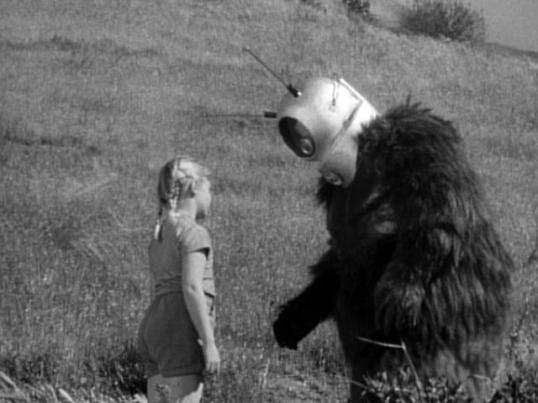
Today’s horror film is a true classic of its kind, the 1953 science fiction epic Robot Monster.

What happens with the Earth is attacked by aliens?  Well, first off, dinosaurs come back to life.  All of humanity is killed, except for one annoying family.  Finally, the fearsome Ro-Man is sent down to the planet to make sure that it’s ready for colonization.  (Or something like that.  To be honest, Ro-Man’s exact goal remains a bit vague.)

Why is Ro-Man so fearsome?  Well, he lives in a cave for one thing.  He also owns a bubble machine.  And finally, perhaps most horrifically, he’s a gorilla wearing a diver’s helmet.  However, Ro-Man is not just a one-dimensional bad guy.  No, he actually gets to have a monologue about halfway through the film in which he considers the existential issues inherent in being a gorilla wearing a diver’s helmet.

Can humanity defeat Ro-Man?  Will Ro-Man ever get his intergalactic supervisor to appreciate him?  And finally, why are the dinosaurs there?

All of those questions, and more, are cheerfully left unanswered but that’s a large part of this odd, zero-budget film’s considerable charm.  If you’ve never seen it before, you owe it to yourself to set aside an hour and two minutes in order to watch it.

You’ve never see anything like it before.

Enjoy!

Horror on TV: The Twilight Zone 2.7 “The Nick of Time”


TheTwilightZoneLogo

Along with starting each day of October with a horror film here at the Shattered Lens, we’re going to end each day with a horror-themed television show.

While I had previously caught a few episodes of the Twilight Zone during one of the annual holiday marathons on SyFy, I didn’t truly appreciate the show until I first exchanged e-mails with my friend in Australia, Mark. Among other things, Mark expressed a very eloquent appreciation for The Twilight Zone and that inspired me to watch quite a few episodes that have been uploaded to YouTube and Hulu. Along with being an essential piece of television history, the best episodes of the Twilight Zone remain watchable and entertaining 50 years after they were first broadcast.

Considering the esteemed place that the Twilight Zone continues to occupy in American culture, it seems appropriate to feature it during Horror Month here at the Shattered Lens.

We start things off with an episode that was originally broadcast on November 18th, 1960. The Nick of Time tells the story of what happens when two newlyweds stop off at a small town cafe and the superstitious husband (William Shatner) starts to play with a memorably creepy fortune telling machine. Now, I should warn you that, since this episode is not available on YouTube, I’m having to embed it from Hulu. That means that you’ll have to sit through a few commercials but it’s still a good episode.

Enjoy!

Horror On The Lens: The Hideous Sun Demon (dir by Robert Clarke and Tom Boutross)


Hideous Sun Demon

Hi there and welcome to October!  This is our favorite time of the year here at the Shattered Lens because October is horror month.  For the past three years, we have celebrated every October by reviewing and showing some of our favorite horror movies, shows, books, and music.  That’s a tradition that I’m looking forward to helping to continue this year.

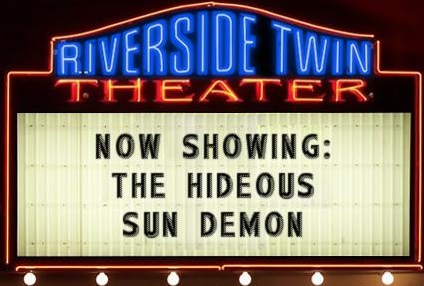
So, let’s start things off with the 1959 cult classic The Hideous Sun Demon.  In The Hideous Sun Demon, a scientist named Gil (played by Robert Clarke, who also wrote and directed) is exposed to radiation.  Perhaps not surprisingly, this does not turn out well for Gil.  Now, whenever Gil is exposed to direct sunlight, he turns into a scaly and murderous monster.  Struggling to control his new monstrous side and slowly losing his grip on his own sanity, Gil retreats to a seaside town where he spends most of his time sitting in the dark.  He only emerges from his house at night and then only so he can go down to a bar and listen to the sultry Trudy sing a song.  However, the sun always rises…

The Hideous Sun Demon may not be a great film but it’s perfect for a little Halloween fun.  Robert Clarke is sympathetic in the lead role and, while the Sun Demon might just be a man in a rubber suit, that’s all just a part of the film’s charm.

So, let’s start October by pulling down the shades, blocking out the sun, and enjoying The Hideous Sun Demon!

Horror Song of the Day: Theme from The Fog (by John Carpenter)


the-fog1

It’s that time of year again for the gang here at Through the Shattered Lens. October has become a sort of official month for the site with much of the posts and articles being related in some manner to all things horror (or close enough to it).

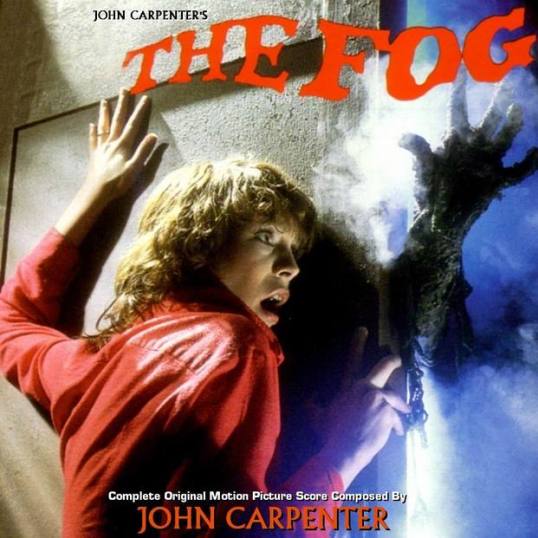
To start off 2014’s Horror Month here at Through the Shattered Lens I’ve chosen a wonderful and creepy piece of horror film music courtesy of the Master himself, John Carpenter.

It’s a great piece of atmospheric music that more than adds to the encroaching horror that is the film’s title. John Carpenter has done most of the soundtracks to his films and his use of electronic keyboards and synthesizers have become such a unique signature in all his films. The last couple years have seen a sort of revival for Carpenter’s type of electronic/synthesizer compositions. One recent film which made great use of this particular style was Jim Mickle’s Cold In July.

The theme to The Fog remains a favorite of horror fans and its influence on filmmakers today is a nice testament to well-earned classic status.

Film Review: A House Is Not A Home (dir by Christopher Ray)


Gerald-Webb-Creepy-Stairs-A-House-is-Not-A-Home-Still

I was recently lucky enough to get a chance to see a perfectly creepy haunted house movie called A House Is Not A Home.  A House Is Not A Home is one of those films that I have wanted to see ever since I first heard about it last year.  I have to admit that, usually, whenever I find myself looking forward to a movie, I sometimes dread actually watching it.  There’s nothing worse than being disappointed by a film that fails to live up to your initial expectations.  That’s why I’m happy to report that A House Is Not A Home not only lived up to those expectations but exceeded them.

A House Is Not A Home begins with a close-up of a bloodied hand.  An obviously unstable man (played, with a truly unsettling intensity, by Richard Greico) calls 911 and tells the operator that “they’re all dead” and it’s all his fault.  He then hangs up and, after shouting, “Take me!”, disappears into a bright white light.  It’s an effective scene, largely because it’s played totally straight.  You look at Greico and you have no doubt that something terrible truly has just happened and that not only was he responsible but he’s going to also be responsible for a lot more before the film reaches its conclusion.  It’s the perfect way to open up a haunted house scene, one that hints at the promise that the film itself will soon fulfill.

Sometime after the man had vanished, the house is up for sale.  Architect Ben (Gerald Webb) and his wife Linda (Diahnna Nicole Baker) are given a tour of the house by a real estate agent named Paul (Bill Cobbs).  When we first see Paul, he seems like a nice old man.  He’s friendly, he’s always smiling, and he comes across like he could probably sell snow in Canada.  But, it quickly becomes obvious that there’s something a little bit off about Paul.  By the time he finishes showing the house, you start to realize that his friendly smile seems to be more of a self-satisfied smirk.

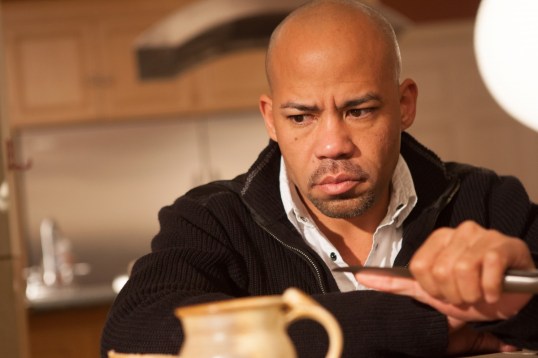
Regardless, Ben and Linda buy the house and, along with their two teenagers, Ashley and Alex (Aurora Perrineau and Melvin Gregg), move in.  From the minute that they unpack, strange things start to happen.  Ashley is woken up in the middle of the night by mysterious laughter and, regardless of how many times she tries to move them, the same scary-looking dolls keep showing up on her dresser.  (Seriously, those dolls were creepy!)  Alex feels as if he’s being watched wherever he goes.  Linda, a recovering alcoholic, starts to drink again and her attempts to give piano lessons are made difficult by the fact that the piano occasionally attacks her students.  And Ben suddenly finds himself having nightmares and deliberately cutting himself so that the blood can hynotically drip down onto the kitchen table.
A-House-is-Not-a-Home-Still-Gerald-Webb-Ben-Williams

Even more frightening?  The man from the first scene in the film keeps popping up, standing in the corner and watching.

Yes, obviously the house is haunted and eventually, even Ben is forced to admit it.  The family is forced to call in a voodoo priest, who attempts to exorcise the house.  (The priest is played by Eddie Steeples, who may be best known for playing the comedic Crabman on My Name Is Earl but  who actually gives a nicely intense and creepy performance here.  Just check out his eyes!)  If you’re a fan of the horror genre, then you’ve probably seen a lot of haunted house exorcisms but, even if it might seem like a familiar development, the exorcism scenes in A House Is Not A Home are really well-done.  If nothing else, they’re distinguished by the fact that the exorcist isn’t the typical quirky medium or self-doubting Catholic priest that most movies offer up.  For once, we’re given an exorcism that’s interesting to watch…

But does the exorcism work?  Well — does an exorcism ever work in a haunted house film?  You’ll have to watch to find out.

A House Is Not A Home is an effectively creepy movie, one that uses its low-budget to its advantage. Director Christopher Ray allows the camera to creep through the house, snaking its way through empty passages while the soundtrack is full of the sounds of restless spirits.  The end result is a film that, as opposed to relying on predictable CGI for its scares, instead creates a palpable sense of doom and dread.

The film is well-acted by the entire cast, with Bill Cobbs especially giving a wonderfully sinister performance.  (I wish I could tell you about his final appearance in the movie without it acting as a spoiler but seriously, it’s a wonderfully acted scene.)  In the role of Ben is Gerald Webb, who will be a familiar face to anyone who regularly watches the SyFy Channel.  Webb (who also earned a bit of pop cultural immortality by serving as casting director for both Sharknados) has appeared in several beloved Asylum films as characters who inevitably always seem to end up getting killed.  It was nice, in A House Is Not A Home, to get to see Webb play a leading role and prove that he’s capable of a lot more than just a good death scene.  He gives an effective, sympathetic performance here.  In fact, the entire family does.  One reason that the film works as well as it does is because you believe that these four characters actually are a family.  You care about what happens to them and, as a result, the horror is all the more effective.

Finally, two final notes about A House Is Not A Home.  At its best, the film — with its emphasis on atmosphere and its scenes of the characters discovering that the house exists on its own plane of surreal logic — can compared favorably to the works of Italian horror director Lucio Fulci.  I don’t know if that was intentional or not.  But it’s definitely a good thing!

Secondly, and perhaps a little sadly, A House Is Not A Home is one of the few “serious” films that I’ve seen recently that featured an almost entirely African-American cast.  That’s really saying something when you consider that I literally watch hundreds of films a year.  At a time when mainstream filmmaking (and the horror genre in particular) still seems to be struggling to break free from racial stereotyping, A House Is Not A Home is definitely a step in the right direction.
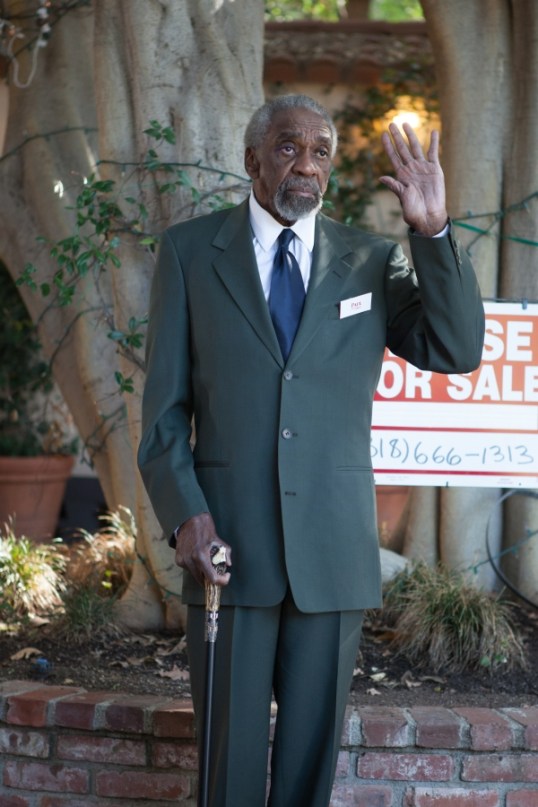
A-House-is-Not-a-Home-Still-Bill-Cobbs-Paul

Film Review: Beyond the Grave (dir by Davi de Oliveira Pinheiro)


Poster_Engl

Beyond the Grave is an intriguingly enigmatic film about the end of the world.

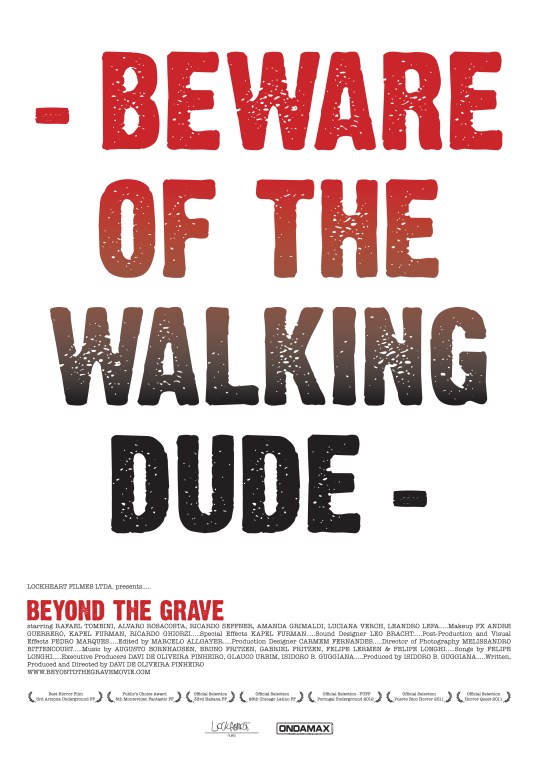
Why was the world ended?  To the film’s credit, this is left intentionally vague.  Some characters mention that the “Seven Gateways of Hell” have been opened.  (Just the term “Seven Gateways of Hell” pays wonderful homage to Lucio Fulci’s horror classics, The Beyond and City of the Living Dead.)  At one point, we spy some graffiti reading, “Beware the Walking Dude,” which, of course, brings to mind the apocalyptic fiction of Stephen King.  Occasionally, small groups of “returners” are seen aimlessly wandering up and down empty highways.  Are they zombies or are they something else?  Occasionally, on the radio, a disembodied voice is heard over a car radio.  “This is the end of the world,” the voice says, “If you are listening to this, it is already too late.”

One thing that quickly becomes obvious is that there’s very few “normal” people left alive.  One of these is a mysterious and enigmatic man known as the Officer (Rafael Tombini).  The Officer, who carries both a sword and a gun that carries only one bullet, drives a police car over the deserted landscape and dispenses his own form of justice.  Who he works for or if there’s any sort of controlling legal authority left in this world is another issue that the film leads intriguingly vague.

(I appreciated the fact that the film — much like Romero’s original Dead films and Cormac McCarthy’s The Road — only hinted at what had causes it’s world-changing cataclysm.  When it comes to end of the world, there should never be any simple answers.)

The Officer is hunting a demonic force known as the Dark Rider and, as he explains, it’s a search that he began before the world even ended.  (And, indeed, we saw in a brief flashback that the Dark Rider existed even when there was still civilization.)  Throughout the film, the Dark Rider jumps from body to body, all the while uttering, “What is near me, shall become mine.”

Working with two teenagers, the Officer searches the Dark Rider, taking time to only briefly rest at a compound.  When, about 42 minutes into the film, the Officer finally tracks the Rider down, something totally unexpected happens, something that forces the audience to reconsider everything that they had previously assumed about how the film was going to work.  I’m not going to tell you what happens.  That’s something you should discover for yourself.

Beyond the Grave is a visually stunning hybrid of a film.  It’s a western, a zombie movie, a postapocalyptic action film, and a philosophical rumination of man’s place in the universe, all wrapped up in one!  Director Davi de Oliveira Pinheiro gets the most out of the film’s bleak locations and Rafael Tombini gives an excellent lead performance as the enigmatic Officer.  Beyond the Grave is an intriguing film, both for the questions it answers and for the ones that it leaves unanswered.  It’s a film that any horror fan should see and will appreciate.

Still_02

Film Review: Deliver Us From Evil (dir by Scott Derrickson)


Deliver_Us_from_Evil_(2014_film)_posterI had high hopes for Deliver Us From Evil, largely because it was directed by Scott Derrickson who, in 2012, gave us the wonderfully atmospheric and disturbing Sinister.  Unfortunately, having now seen Deliver Us From Evil, I can only call it the anti-Sinister.  Whereas Sinister took the viewers by surprise, Deliver Us From Evil is predictable.  Whereas Sinister was full of genuinely disturbing moments, Deliver Us From Evil is full of jump scenes that are scary for a few seconds but then swiftly vanish from the memory.  Whereas Sinister was fascinating for featuring a morally ambiguous hero, Deliver Us From Evil features a hero who is so mundanely heroic that you find yourself hoping that he’ll fail just as punishment for his smug hubris.

Perhaps the only way that Deliver Us From Evil tops Sinisteris that it features none other than the King of Television Snark, Joel McHale.  As someone who loves both The Soup and Community, I’m always happy to see Joel but he’s oddly cast here, playing a muscle-bound, adrenaline junkie cop.  It’s not that Joel does a bad job.  In fact, he’s probably the most likable and compelling character in the entire film.  It’s just that you can’t look at him on screen without asking, “Joel, why are you here!?”

Anyway, Deliver Us From Evil is pretty much your standard demonic possession/cop thriller hybrid.  Mysterious murders are being committed.  The murderers speak in a weird language and, it soon turns out, all of them are linked both to the discovery of ancient tomb in Iraq and to a painting company that was started by a group of returning veterans.  It’s up to cops Ralph Sarchie (Eric Bana) and Parker (Joel McHale – why, Joel, why!?) to solve the crime.  Helping them along the way is a former drug addict priest named Mendoza (Edgar Ramirez).  If you’re guessing that the whole thing leads to a violent exorcism on a stormy night – well, you’re definitely on the right track.

Scott Derrickson does the best that he can with the material but he’s hampered by the fact that the film is based on a book that was written by the real-life Ralph Sarchie.  Perhaps as a result, the film’s Ralph is such an upright and moral hero (though he does yell at his daughter in one unpleasant moment but even that is excused as simply being evidence of how personally Ralph takes his job) that he’s also not that interesting of a character.  Eric Bana, who is actually a pretty good comedic actor, struggles to find some sort of depth to Ralph but ultimately, it’s just not there.  And since 90% of horror is psychological, Deliver Us From Evil cannot recover from revolving around such a flat protagonist.

As a result, Derrickson has little option but to fill the film with standard horror movie scenes.  The scenes, as themselves, work well enough but the story is so predictable that they don’t make much of an impact.  The end result is a film that you’ve seen a hundred times before.

The only difference, of course, is that this version features Joel McHale dancing around with a knife.

Review: The Walking Dead S4E14 “The Grove”


TheWalkingDeadS4M

“Just look at the flowers, Lizzie. Just look at the flowers.” — Carol Peletier

The Walking Dead tv series has always diverged from the comic book source to keep fans of the books guessing. Some fans of the comic books have complained about this since it would mean discarding certain subplots and characters that they love but were really non-essential to the overall story being told for the tv series version. Yet, the writers of the show, through the comic book’s creator Robert Kirkman, have mined the comic book source for material that remains important to the show’s narrative.

The latest episode, “The Grove”, takes a disturbing but very important subplot from the comics and manages to adapt it for the tv series in a way that made it one of the series’ best.

A cold opening that manages to be both quaint, idyllic and disturbing which sets the tone for the rest of the episode sees the return of the group led by Carol. It’s a group that could almost be seen as a makeshift family unit. There’s Carol the loving, yet stern mother who wants to make sure her daughters learn how to survive in this dangerous, new world while Tyreese remains te compassionate and protective father. Lizzie, Mika and Rick’s baby daughter Judith make up the children who must now adapt to this new world or perish.

First off, Judith remains the blank slate in the show. She’s the first baby born after the world went to hell and thus will have to grow up in it’s new environs and new set of morals and principles. The old civilization is gone and while people try to hold onto what made that civilization tick only those willing to adapt to this new world seem to survive. Now, Lizzie and Mika were already forming their own personalities and sets of morals when the zombie apocalypse hit. We see the two Samuels girl go in differing paths in how they cope with this new world.

While seeing these two girls’ inability to adapt to the world post-zombie apocalypse was a nice theme to explore the episode really focused on the group’s maternal unit. This latest episode was a culmination of the new Carol Peletier that season 4 unleashed on an unsuspecting audience.

This was a character that we saw as being the meek victim of spousal abuse even before the zombies arrived. Her emotional trauma would continue with the loss of her young daughter Sophia in season 2 and almost dying during break in prison security in season 3. Yet, by the time season 4 rolled around we see her become a hardened survivor who has turned the corner and decided she will not remain a victim anymore and make sure those people see as being helpless (the young children in the group) learn how to defend themselves from zombies and humans alike.

The titular grove the group stumbles upon early in the episode has an almost mystical quality to it. An idyllic locale in the middle of literal hell on earth. There’s untainted well water to be had, a pecan grove for food and even a solitary deer that seems to come by at the most opportune time for meat. Hell, the cabin even has a working gas stove (probably a propane tank fed one) and a secure enough fence of barbed wire to fend off the random zombies that may wander by. It’s almost paradise in comparison to the different place Carol, Tyreese and the girls have had to call shelter.

It is no wonder that both Tyreese and Carol entertain the idea of maybe staying at the grove and making a life for themselves with the girls instead of continuing onto the unknown potential haven that is Terminus. But one thing this show has been consistent about when it comes to it’s characters seeming to find peace and tranquility is that it will pull the rug from under them to reveal that things are not ideal and that it’s just a veneer over the ugliness and brutality this new world has turned into.

The rug gets pulled out gradually from beneath Carol’s feet as both Mika and Lizzie continue to fail in heeding her teachings about survival. Mike remains adamant about not ever wanting to hurt anyone alive (she makes some headway in killing off some zombies during the episode) which Carol sees as dangerously naive of the young girl. Lizzie on the other hand begins to reveal an even more dangerous quality which would turn tragic by episode’s end.

By this time many will have written and discussed the events involving Lizzie and Mika that would add another emotional stone on Carol’s back. It’s a sequence that’s as disturbing as anything this show has put on the air in the last four years. It’s not often that children get killed in tv shows (well except for Law and Order: SVU) and yet The Walking Dead manages to do it twice in one night and both times it’s not gratuitous or meant to be entertaining. both Mika and Lizzie’s death become a sort of crucible Carol must go through to find a sort of equilibrium between the nurturing mother she was before season 4 and the cold, pragmatic survivor she has become this season. She still remains conscious to the fact that hard decisions need to be made for the greater good and she makes it ones again when Lizzie murders her younger sister Mika. It’s a murder not done in spite or malice. Lizzie truly believes that Mika will return and remember not to attack her friends and family.

In the end, the grove ceases to be the ideal haven Carol and Tyreese saw it as in the beginning and realize it’s just another place to leave behind with bad memories. It’s become another haunted place for the next people to find and wonder what happened to the previous inhabitants and what caused them to leave behind three small graves in the flower and pecan grove.

Notes

  • Tonight’s episode was written by showrunner Scott M. Gimple and directed by Michael Satrazemis.
  • The cold opening sequence was a nice touch using The Ink Spot’s “Maybe” song that was also used in the Bethesda post-apocalyptic game, Fallout 3.
  • Mika definitely came off as being the more intelligent of the two sisters. Though as many would probably point out, just as Carol did, her inability to hurt other people who will want to hurt her will get her killed sooner or later.
  • Lizzie’s personality matches very closely that of the comic book Carol who began to see the zombies as more her friends than a danger. I’m sure Kirkman had a hand in helping Gimple round out the character of the elder Samuels girl.
  • I noticed that the pistol that Mika carried with her was a Smith & Wesson M&P 9 (full-size one even) just for the fact that I also own one so it was very recognizable.
  • The different subplots involving the scattered groups of prison survivors seem to be following an uneven timeline within this midseason narrative. The fire and smoke seen by Carol, Tyreese and the girls would mean that they’re at least a day behind Daryl and Beth.
  • Gimple must’ve been a fan of Steinbeck because tonight’s episode had a very Of Mice and Men feel to it right up to the sequence with Carol and Lizzie in the end.
  • Talking Dead Guests: Melissa McBride of The Walking Dead, Yvette Nicole Brown from Community and WWE’s CM Punk.

Season 4


Review: The Walking Dead S4E13 “Alone”


TheWalkingDeadS4M

“Why hurt yourself when you can hurt other people.” — Joe

The Walking Dead has taken on a new narrative path since it’s return after this season’s mid-season break. One of the biggest complaints that some fans and critics have had about the show has been the lack of character development for many of the roles in the show. We’re not talking about people who show up for a scene or an episode or two. It’s for those who have become regulars through the show’s many season.

Well, it looks like from the show’s writers will be trying to rectify that flaw this second half of season 4.

Since the show’s return from it’s mid-season break it’s taken on an almost zealous attempt to show the audience more of who these people truly are. Each new episode in this second half has been more about exploring each surviving character’s backstory either through some sort of flashback (like we saw tonight with the cold opening showing Bob’s lonely existence before being found by Daryl and Glenn pre-prison attack) or some of the quieter moments of exposition between characters (last week’s episode between Daryl and Beth was a prime example of this). We’ve gotten to learn more about our favorite zombie apocalypse survivors. They’ve shown themselves to be more than what the previous seasons have made us to think of them.

Tonight’s episode continued to explore the growing relationship (whether romantic or platonic) between resident badass Daryl Dixon and bright-eyed optimist Beth Greene. We see him trying to teach the younger Greene girl how to become a better with the crossbow and be a better tracker. Throughout their section of tonight’s episoode we see Daryl become more protective of young Beth Greene. The false front he’s put up in the past to avoid getting closer to people has started to come down. In past season fans and writers have looked at Daryl Dixon as someone who probably would be better off being alone instead of trying to deal with a dysfunctional “family” unit of survivors. He’s the only one who seems to be ready-made for this zombie apocalypse.

Yet, as we’ve seen in the second half of this season being alone is something that he doesn’t want to ever return to. He may remain gruff and surly, but his need to be around those who care about him and people who he wants to belong with has made him a more well-rounded badass. The way the Daryl and Beth half of the episode ended it’s going to be interesting if his need to belong with a group will cause him to forget the humanity he has found while being with Rick’s group.

The theme of being alone continues, and actually began, with the Bob, Sasha and Maggie half of tonight’s episode which was aptly titled, “Alone”. Bob’s time being alone in the wilderness was the cold opening for tonight’s episode and revealed much about the enigmatic Bob. This was all done with Bob not speaking a line of dialogue in the first few minutes. He seemed able enough to survive on his own, but the moment Glenn and Daryl arrive and offers him sanctuary back in the prison he accepts with no questions asked.

It’s a theme that runs throughout tonight’s episode. Being alone may make it easier to survive. No one to worry about. Only have to keep one person alive. But for these survivors it’s the comfort of having others looking out for you which makes it all worth the headaches and drama that comes with being involved with other people. These lone wolf survivors may be great at surviving on their own, but they also want to be doing more than just survive. They want to live and being with others. It makes them feel more human and gives them a higher purpose than just trying to survive day to day.

Some fans may not be liking this more introspective turn of The Walking Dead this second half of the season. There’s still some gruesome scees to be had, but there’s also many more quiet scenes of just characters interacting with each other minus the violence and brutality inherent in a show about the zombie apocalypse.

Notes

  • Tonight’s episode was written by Curtis Gwinn and directed by Ernest Dickerson.
  • Some great genuinely scary moments in tonight’s episode: the fog sequence with the zombies involving Bob, Maggie and Sasha was shot and directed well by veteran director Ernest Dickerson (who has directed some of the best episodes in the series). Another was Daryl finding himself stuck in a room filling up with zombies and the only way out was going through them.
  • Tonight’s episode was the strongest of this season’s second half. We just didn’t get to learn about some of the things which motivates Bob, but also what made Sasha and Maggie such good survivors. Larry Gilliard, Jr. hasn’t been given enough chances to stretch his acting skills this season, but tonight he was allowed to do just that and he passed with flying colors.
  • Beth is really thirsting for some of Daryl and was really apparent in tonight’s episode. This should make Daryl/Carol shippers not very happy at all.
  • For Dead Rising fans tonight’s episode should bring a smile to their faces as we see Maggie become an expert in zombie killing just using a street sign pole and it’s very sharp squared steel sign.
  • The episode opened and ended with the song “Blackbird Song” by Lee DeWyze.
  • Jeff Kober returns as the leader of the small band of raiders we saw in the episode “Claimed”. His return may mean he’s the big baddie for this second half as the different groups make their way to Terminus.
  • Talking Dead Guests: Sonequa Martin-Green and Lauren Cohan, Sasha and Maggie of The Walking Dead.

Season 4