
“Room for one more, honey!”
Agck!
This classic episode of the Twilight Zone originally aired on February 10th, 1961. It was written by Rod Serling, directed by Jack Smight, and stars Barbara Nichols.
“Room for one more, honey!”
Agck!
This classic episode of the Twilight Zone originally aired on February 10th, 1961. It was written by Rod Serling, directed by Jack Smight, and stars Barbara Nichols.

Originally released in 1996, Castle Freak is a film that I watched a few years ago and seriously, it totally freaked me out! Seriously, this is one truly creepy, scary, and disturbing film. I imagine that I’m not alone in having nightmares after watching Castle Freak.
Castle Freak takes place in Italy and yes, the main setting is a castle. (One the reasons why Castle Freak was so effective in freaking me out is because I have actually been to Italy and I have stepped inside castles much like the one featured in this film.) The castle belonged to a duchess who has recently passed away. The duchess’s son, Giorgio, is still alive. The duchess it seems was a bit insane and, after being abandoned by her husband, she was so angry that she had Giorgio chained up in the basement. After being trapped for years, Giorgio has reverted to a feral state, speaking in grunts and growls. Horribly disfigured, Giorgio is served a meal a day by a frightened maid. When Giorgio finally escapes (via breaking off his own thumb so he can slip out of his manacles), he is looking for revenge against humanity.
Giorgio is probably one of the most frightening monsters in cinematic history but yet, like all great monsters, he is as much a victim as a villain. One reason why the film works is that, even though you’re terrified of Giorgio, you can’t blame him for being angry. Indeed, one of the film’s strongest moments come when Giorgio sees his reflection for the first time and wails at the sight. Jonathan Fuller gives a great performance as Giorgio.
Just as Giorgio escape, the duchess’s last remaining descendants move into the castle. John Reilly (Jeffrey Combs) is a recovering alcoholic. Years ago, a drunk John had an automobile accident, which led to the death of his son and the blinding of his teenage daughter, Rebecca (Jessica Dollarhide). His wife, Susan (Barbara Crampton), cannot bring herself to forgive John for the accident.
Though neither is initially aware of the other’s existence, there’s an obvious bond between John and Giorgio. Much as the duchess never forgave Giorgio, Susan will never forgive John. Giorigio was held prisoner by chains while John was held prisoner by both his own guilt and Susan’s anger. Both of them are capable of monstrous acts with the only difference being that John has yet to totally surrender his humanity to his rage. It’s somewhat appropriate that, after John picks up a prostitute from town, it’s Giorgio who ends up killing her because Giorgio really is John’s id unleashed. And now, John’s entire family is in danger to falling victim to that id.
Castle Freak is a frightening movie, one that mixes shocking gore with other more subtle scares. Director Stuart Gordon makes good use of the castle’s ominous atmosphere and he also gets wonderful performances from his entire cast, with Jeffrey Combs as the stand-out. This is a scary and gory film that was truly made for intelligent adults.
And finally, that scene where the blind Rebecca talks about her hopes and dreams while Giorgio stands unseen beside her?
Pure nightmare fuel.
Since I just reviewed Paul Schrader’s 1982 version of Cat People, I figured that I’d show a scene from the film that I love.
In this film, Irena (Natassja Kinski) has a dream in which her brother, Paul (Malcolm McDowell) explains the curse under which they both live. This dream leads directly into the first part of the film’s best sequence, in which Alice (Annette O’Toole) suspects that she’s being followed while out jogging.
Everything about this scene — from the music to the sets to the cinematography — is horror perfection as far as I’m concerned.
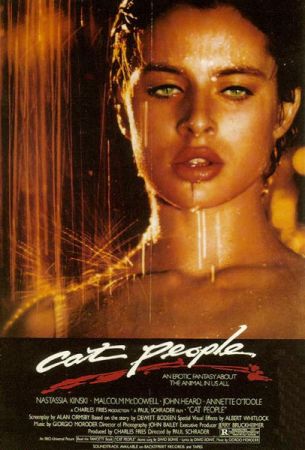
Before I get around to actually reviewing Paul Schrader’s 1982 reimagining of Cat People, I’m going to suggest that you take a few minutes to watch the film’s opening credits. Say what you will about Schrader’s Cat People, it has a great opening, one that perfectly sets up the rest of the film.
In this version of Cat People, Irena (Natassja Kinski) is a naive young woman (and virgin) who, after the death of her parents, has spent most of her previous life in foster care. Irena travels to New Orleans, where she reconnects with her older brother, Paul (Malcolm McDowell). From the minute that Irena meets her brother and his housekeeper (Ruby Dee), it’s obvious that something is off. When Paul looks at her, he does so with an unsettling intensity. At night, while Irena sleeps, Paul wanders the dark streets of New Orleans.
One morning, Irena wakes up to discover that Paul is missing. Having nothing else to do, Irena wanders around New Orleans. When she visits the zoo, she feels an immediate connection to a caged panther who stares at her with a familiar intensity. It turns out that the panther was captured the previous night, after he mysteriously appeared in a sleazy motel and mauled a prostitute.
It’s at the zoo that Irena meets zookeeper Oliver Yates (John Heard). Oliver gets Irena a job working at the zoo gift shop. where Irena is befriended by Oliver’s co-worker, Alice (Annette O’Toole). One day, Irena witnesses the panther kill another zookeeper before it then escapes from its cage.
That night, Paul suddenly shows up in Irena’s bedroom. He explains to her that they are a cursed species. Having sex causes them to turn into panthers and the only way to avoid the curse is through incest. A terrified Irena flees her brother and soon finds herself living with and falling in love with the increasingly obsessive Oliver, all the while knowing that giving herself to him physically will lead to her transformation.
From the very first second of the film. Schrader’s Cat People is an exercise in pure style. If the original Cat People was largely distinguished by its restraint, Schrader’s version is all about excess. Everything that was merely suggested in the original is made explicit in this version. As tempting as it may be to try, it’s somewhat pointless to try to compare these two versions. Though they may both be about a woman who turns into a panther when she has sex, they are two very different films.
Schrader’s Cat People walks a very fine line between moodiness and absurdity, which is perhaps why I enjoyed it. Making great use of both the sultry New Orleans setting and Giorgio Moroder’s atmospheric score, Cat People is compulsively dream-like and enjoyably over-the-top. Cat People is often described as being an example of a movie that could have only been made in the coked up 80s and truly, this is one of those films that’s so excessive that it’s becomes fascinating to watch.
(I think that often we are too quick to assume that excess is necessarily a bad thing. If you can’t be excessive when you’ve got Malcolm McDowell playing an incest-minded cat person in New Orleans, when can you be excessive?)
Schrader’s Cat People may not have much in common with the original version but the film’s best scene is the only one that is a direct recreation of a scene from the original. In fact, in recreating the scene where Alice is menaced while swimming in a public pool, Schrader actually improves on the original. Brilliantly performed by both Annette O’Toole and Natassja Kinski (whose cat-like features made her perfect for the role of Irena), it’s the only scene in the film that can truly be called scary. Starting with a tracking shock that follows Alice as she jogs, the stalking scene is practically a master class in effective horror cinema. If nothing else, you should see Cat People for that one scene.
And you should also see it for the wonderful soundtrack! Let’s end this review with David Bowie’s theme song, which you may also remember from Quentin Tarantino’s Inglourious Basterds.

Yesterday, for our Horror on The Lens, we featured It!, a British film what happens when Roddy McDowall discovers the legendary Golem.
Today, we are very proud to present another film about the Golem, one that is definitely held in higher critical regard than It! (Sorry, Roddy!) The 1920 German film The Golem: How He Came Into The World is, for lack of a better term, an origin story for the Golem, one that shows how the Golem was originally brought to life to protect the Jewish people from persecution and how it was later corrupted by a combination of the dreaded demon Astaroth and pretty human jealousy.
The Golem is also a landmark of both German Expressionism and horror cinema, a dream-like tribute to both the power of the human imagination and the strength and resilience of the Jewish people. This is one of those films that everyone should watch at least once.
And yes, it is a silent movie. So, put your favorite music on in the background and watch The Golem!
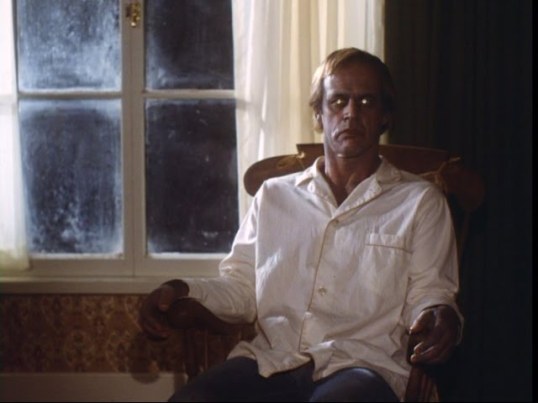
“Look at me teacher.”
Those were some of the most terrifying words I’ve ever heard growing up. It’s all because of one scene from the tv mini-series which adapted Stephen King’s vampire novel, Salem’s Lot. It was a scene in the novel that terrified me as a young boy reading King for the first time.
I’ve always been gifted (or I sometimes say cursed) with having a very overactive imagination. This is why horror has always been such a fascinating genre for me. Even where the horror is all up in one’s face with it’s gore and messy aftermath my mind’s eye would make things worst or just constantly play it on repeat in my head days after the film has ended. It’s even worst when the horror comes across less through gore and more through atmosphere and built-up dread moving towards a jump-scare or something more insidious.
This particular scene is my second favorite from the Salem’s Lot mini-series. The first one I had posted a couple years back which just barely lags behind this one for third. What made this scene so effective despite it’s tv-style production was Tobe Hooper’s direction. Despite working with the censorship inherent in broadcast tv, Hooper was able to create a palpable sense of dread as the old English teacher Matt Burke senses a presence up in one of his house’s rooms. It was the same room where one of his former students had passed away in his sleep.
As the audience we already have an idea who or what is in that second floor room. Matt Burke has an idea as well, but his morbid curiosity wins out as he decides to investigate. Yet, despite such a lack in judgement he does come armed with a crucifix in hand. The way the scene builds and builds as Burke climbs the stairs and hesitating before opening the door to the room was almost too much to bear.
The reveal of his former student, Mike Ryerson, back in the room sitting in the rocking chair as one of the undead only increases the horror of the scene. His snake-like mannerisms was a new take on the vampire behavior. It’s not the usual silk and lace bloodsucker we grew up watching. This was a vampire that behaved like a predator beguiling it’s next prey. From the way Ryerson (played by Geoffrey Lewis) hissed his words and undulated his body as he stood to face his former teacher was disturbing at the very least.
Just writing about it and seeing the scene for the umpteenth time still gives me the shakes.
In this episode of the Twilight Zone, a con man (Harry Townes) has the ability to change his face to make himself appear like anyone he wants to be. Needless to say, this ability doesn’t quite work out as well for him as he might have hoped.
This episode originally aired on January 1st, 1960.
(If the video is not showing up below — some browsers apparently have problems showing embedded videos from Hulu — you can watch the episode at http://www.hulu.com/watch/440771.)

Filmed in 1976 but not released until 1979, Savage Weekend is the story of a brave boom mic that takes a trip to upstate New York for the weekend and ends up witnessing a lot of decadent behavior and, eventually, a few gruesome murders. Sadly, the brave little boom mic apparently has no social skills because everyone pretends like they don’t see it, even though it shows up a few dozen times, always floating at the top of the screen.
It’s also the story of Otis (William Sanderson), a local redneck (I’ve never been to upstate New York but I still find it amusing how movies always portray it as being a step away from Deliverance country) who spends his time talking to his father’s gravestone. Apparently, when Otis was younger, he found out his girlfriend was cheating on him so he branded her with an H. Why an H? Because, we’re told, Otis doesn’t know how to spell whore.
Well, okay then…
Actually, if you’ve watched any number of these type of films, you’ll immediately recognize William Sanderson. Sanderson played a countless number of backwoods weirdos and he always did a pretty good job. (He also played the poignantly sympathetic J.F. Sebastian in Blade Runner.) Interestingly enough, in real life, Sanderson has a law degree.
Savage Weekend, incidentally, has a brilliant opening. After running through the woods, a woman finds herself cornered by Otis. As Otis approaches her, he gives her a strange little half-smile. It’s super creepy and scary and the rest of the film never lives up to it.
That said, Savage Weekend is an interesting film, even if it’s not a particularly good one. I’m not sure if it’s intentional or if it’s a happy byproduct of the filmmaker’s general incompetence but Savage Weekend has a truly surreal feel to it. It moves at a deliberate, almost dream-like pace. Characters appear and then vanish for lengthy periods of time. Plot points are raised and then abandoned. As a result of an inconsistent script, much is hinted at without ever being truly revealed. It makes for a very odd viewing experience.
Plotwise, it’s your standard slasher film. A group of people find themselves in an isolated location and are picked off, one-by-one, by a masked killer. Whereas most slasher films feature teenage victims, Savage Weekend is distinguished by the fact that all of the victims are adults and they’re all way too old and successful to justify continually making the type of stupid decisions necessary for a slasher movie to work. Two of them, Robert (Jim Doerr) and Jay (Devin Goldenberg), are stockbrokers. Marie (Marilyn Hamlin) is the ex-wife of the Governor of New York’s press secretary. (At one point, someone mentions that the governor was corrupt and apparently committed suicide. It’s one of those plot points that comes out of nowhere.) Meanwhile, Marie’s sister, Shirley (Caitlin O’Heany), is accompanied by her best friend, Nicky (Christopher Allport). Nicky is flamboyantly gay and, shortly after being introduced, he single-handedly beats up three rednecks and then dramatically announced, “I was raised in the Bronx!”
Since the first murder doesn’t take place until an hour into the film, we spend more time than usual getting to know our victims but none of them behave in any sort of consistent manner, which adds to the film’s dreamlike feel. Nicky clutches a barbed wire fence while watching Shirley fool around with Jay. Marie appears to be on the verge of touching herself while listening to the story about Otis branding his girlfriend. Later, a good deal of screen time is devoted to Marie and another redneck milking a cow, with the camera zooming in on the milk shooting out of the udders. While being stalked by the killer, Nicky puts on makeup while a lingerie-clad Shirley dances through the house while tango music plays on the soundtrack.
It all just feels very odd and strangely paced, as if huge chunks of the script were either not filmed or left on the editing room floor. But that oddness (along with the boom mic) is exactly what makes Savage Weekend an interesting movie.
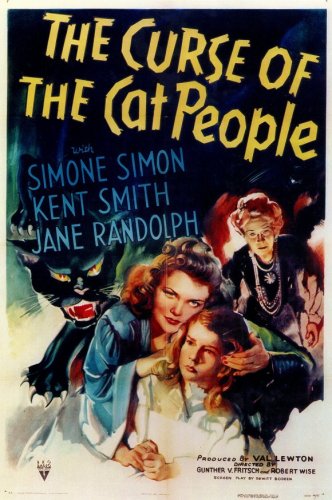
So, you can add the 1944 film The Curse of the Cat People to the list of films that made me cry.
And I know that you’re probably going to point out that it’s already a very long list and I know that some people believe that I cry at every movie that I see. (Listen, if I cried every time that I watched a movie, that would mean that not a single hour would pass without me shedding tears and … well, anyway, lets move on…) But seriously, The Curse of the Cat People is a wonderful and heartfelt film.
Technically, it’s a sequel to the original Cat People. Oliver (Kent Smith) and Alice (Jane Randolph) are married now and they have a six year-old daughter named Amy (Ann Carter). Irena (Simone Simon) does return but we’re never quite sure whether she’s a ghost or if she’s meant to be a figment of Amy’s imagination. There is no mention of Irena being cursed, though a hissing cat does make an appearance at the beginning of the film. In the original Cat People, Elizabeth Russell played a mysterious woman who asked if Irena was her sister. In The Curse of the Cat People, Russell appears in a different role but, interestingly enough, she’s still linked to the memory of Irena.
Instead, The Curse of the Cat People is about Amy. Amy is a shy girl who spends most of her time daydreaming and Ann Carter (who was 8 years old at the time) gives a very real and very authentic performance, one that is totally the opposite of the type of performance that we often expect from child actors. I was a shy child myself (I was famous for always hiding behind my mom whenever I saw a stranger approaching) and, from the minute Amy appeared, I knew exactly how she felt and what was going through her mind.
While Alice feels that Amy’s daydreaming is harmless, Oliver worries about her daughter. At one point, he says that he fears that she’ll never leave her fantasy world and that she’ll grow up to be like Irena. (Interestingly enough, this line suggests that Oliver still doesn’t believe that Irena was actually a cat person.) Amy, meanwhile, has a vision of Irena standing in the backyard and soon, the two of them are best friends.
At the same time, Amy has also become friends with Julia Farren (Julia Dean), an elderly woman who lives in the neighborhood. Just like Amy, Julia lives in a fantasy world. She treats Amy like her own daughter. Meanwhile, Julia refuses to acknowledge her true daughter, Barbara (Elizabeth Russell), accusing Barbara of being a spy and saying she is only pretending to be her daughter. Barbara grows more and more resentful of Amy and that resentment leads her to consider doing a truly terrible thing.
I guess it’s debatable whether or not The Curse of the Cat People can truly be called a horror film. While it does have elements of the horror genre, The Curse of the Cat People is ultimately both a coming-of-age story and a plea for adults to allow their children to be children. It’s all so heartfelt and so wonderfully performed by Ann Carter, Kent Smith, Jane Randolph, Elizabeth Russell, and Simone Simon that I couldn’t help but cry at the end of the film. The Curse of the Cat People is a great film to watch in October or any other month.

There’s little that is more intimidating than trying to write a review of the 1975 best picture nominee, Jaws.
I mean, seriously, what’s left to be said about this film? Jaws is one of those movies that everyone has seen and everyone loves. And, even if someone somehow hasn’t seen the film, chances are that they still know all about it. They know that it’s a movie about a giant shark that attacks Amity Island, just as the summer season is starting. They know that the town’s mayor refuses to close the beaches, because he doesn’t want to lose the tourist dollars. They know that the final half of the film is three men (Roy Scheider, Richard Dreyfuss, and Robert Shaw) floating around in a boat, searching for a shark. And they certainly know that, whenever you hear John Williams’s iconic theme music, it means that someone is about to get attacked.
Jaws is such a part of our culture that probably not a single day goes by without someone saying a variation on “we’re going to need a bigger boat.” Did you know that, on twitter, Ben Gardner’s boat has its own account? And despite getting pretty graphically dismembered about halfway through Jaws, poor little Alex Kintner has an account as well!
What’s amazing about Jaws is that, even though everyone’s seen it and it’s been parodied a few thousand times, Jaws remains incredibly effective. I still find myself cringing whenever the shark catches Alex Kintner and that geyser of blood explodes out of the ocean. I still jump whenever the shark suddenly emerges from the water and scares the Hell out of Roy Scheider. I still laugh at Richard Dreyfuss’s hyperactive performance and I instinctively cover my ears whenever I realize that Robert Shaw is about to drag his nails across that chalk board.
And then there’s that music, of course! Even after being used, misused, and imitated in countless other films, the Jaws theme still fills me with a sort of existential dread. The mechanical shark was notoriously fake-looking and was rarely seen onscreen as a result. The camera and the music stand in for the shark and it works beautifully.
The one unfortunate thing about Jaws is that it’s been so critically acclaimed and so embraced by audiences that I think people tend to forget that it is primarily a horror film. Mainstream critics tend to look down on horror as a genre so, rather than admit the obvious, they claim that Jaws is more of a thriller than a horror film. Or they talk about how it’s actually meant to be a political allegory or an environmental allegory or an examination of male bonding.
So, let’s just make this clear. No matter what the elitist critics or even Steven Spielberg himself may say, Jaws is primarily a horror film, with that relentless killer shark serving as a prototype for such future horror fiends as Michael Myers, Jason Voorhees, Freddy Krueger, and both of the Ghostface and Jigsaw Killers. (Jaws even opens with a stereotypical slasher movie death, as a nude and stoned swimmer is suddenly attacked by an unseen killer.) If not for Scheider, Shaw, and Dreyfuss floating in the endless ocean, you would never have had films — like the Blair Witch Project — about people being lost and stalked in the wilderness. And when that shark attacks and graphically rips apart its victims, how different is it from something you might find in a George Romero or Lucio Fulci zombie film?
On the basis of Jaws and Duel, I think it can be argued that, if Steven Spielberg hadn’t become America’s favorite director of crowd-pleasing, Oscar-contending blockbusters, he could have been one of our best horror directors. Sadly, Spielberg has pretty much abandoned horror and I doubt that Jaws would be as effective if it were made today. (I suspect that the temptation to resort to a cartoonish CGI shark would be too great.)
But that’s all speculation.
What matters is that Jaws remains one of the greatest films ever made.
And it’s a horror film!
 Through the Shattered Lens