In today’s horror scene I love, Peter Graves delivers one of the greatest monologues ever written. Here it is, from It Conquered The World:
In today’s horror scene I love, Peter Graves delivers one of the greatest monologues ever written. Here it is, from It Conquered The World:

First released in 1983, Hostage is an Australian film about Christine (Kerry Mack) and Walter Maresch (Ralph Schicha).
Christine is a young woman who escapes from her abusive father by going on the road with a traveling carnival. She runs the dart-throwing booth. It’s a simple life but she’s happy with it. She has friends and she has freedom. When Walter, an enigmatic German drifter, joins the carnival, there’s an immediate attraction between him and Christine. Christine sleeps with him a few times but she makes it clear that she’s not looking for anything serious or permanent. Walter announces that, if Christine doesn’t marry him, he’s going to shoot himself. Christine rolls her eyes and leaves his trailer, just to hear a gunshot as she walks away. At the hospital, Walter refuses to get treated until Christine promises to marry him.
Christine does marry Walter, both to keep him from dying and also because she’s pregnant. Walter survives his gunshot wound and turns out to be the type of husband who alternates between being wildly romantic and being coldly abusive. Walter wants to have lot of a children. He’s upset when Christine gives birth to a girl. “The next one will be a son!” he announces. Walter also spends a lot of time complaining about how weak the Australians are compared to the Germans. And, of course, there’s another huge issue with Walter.
HE’S A NAZI!
Walter is a neo-Nazi. For whatever reason, it takes Christine forever to figure this out. Walter drags to Christine to Germany and then gets mad when Christine doesn’t stand along with all of his friends while watching The Triumph of the Will. Christine opens up Walter’s keepsake box and finds a picture of his father wearing a Nazi uniform and also an iron cross. Walter’s friends are all blonde Aryan types who are constantly talking about how Germany has lost its way. And yet Christine doesn’t really seem to get that Walter is a Nazi until Walter starts talking about blowing up buildings and robbing banks.
Eventually, back in Australia, Walter and Christine rob a string of banks and the tabloids are soon describing them as being a modern-day Bonnie and Clyde. Walter is happy but Christine just wants to grab her daughter and escape from him. That proves to be easier said than done. Walter’s not just a Neo-Nazi. He’s also totally insane….
Amazingly enough, this is based on a true story. Christine wrote about her ordeal and her book was adapted into Hostage, a film that may look like a typical exploitation film but which is actually a rather engrossing drama about a naive girl who finds herself trapped with a monster. The film is full of moments that stick with you, like when a policeman comes by Christine’s trailer and manages to totally miss her signals that she’s currently being held, at gunpoint, by Walter. Kerry Mack and Ralph Schicha both give strong performances as Christine and Walter. Schicha especially deserves a lot of credit for turning Walter into a believable villain as opposed to just a caricature. One reason why Walter is so dangerous is because he’s such an idiot and Schicha does a great job of showing what happens when stupidity mixes with confidence. In one of the film’s more over-the-top moments, Walter and his friend Wolfgang drag Christine to Turkey. At first, Walter and Wolfgang are cocky but the trip becomes a violent and (literally) bloody disaster.
Hostage brings a real nightmare to life. Sadly, even after she freed herself of Walter, Christine continued to live a difficult life. She died of hypothermia in 2019.
Since we are now halfway through October, it only seems appropriate to share what may be the most famous (and perhaps the most covered) song about witchcraft, Donavon’s Season of the Witch!
This song was originally recorded in 1966 and it’s gone on to become a Halloween mainstay. One fan of the song was future director Martin Scorsese, who originally planned to borrow the song’s title for one of his own films. However, George Romero beat Scorsese out the gate with a film called Season of the Witch and Scorsese ended up renaming his film, Mean Streets.
This October, I’m going to be doing something a little bit different with my contribution to 4 Shots From 4 Films. I’m going to be taking a little chronological tour of the history of horror cinema, moving from decade to decade.
Today, we continue the 1960s!
4 Shots From 4 Horror Films

Blood and Black Lace (1964, dir by Mario Bava)

2,000 Maniacs (1964, dir by Herschell Gordon Lewis)

Repulsion (1965, dir by Roman Polanski)

Kill, Baby, Kill (1966, dir by Mario Bava)

“Man is a feeling creature, and because of it, the greatest in the universe….”
Hell yeah! You tell ’em, Peter Graves!
Today’s Horror on the Lens is 1956’s It Conquered The World. Graves plays a scientist who watches in horror as his small town and all of the people who he loves and works with are taken over by an alien. Rival scientist Lee Van Cleef thinks that the alien is going to make the world a better place but Graves understands that a world without individual freedom isn’t one that’s worth living in.
This is one of Corman’s most entertaining films, featuring not only Graves and Van Cleef but also the great Beverly Garland. Like many horror and science fiction films of the 50s, it’s subtext is one of anti-collectivism. Depending on your politics, you could view the film as either a criticism of communism or McCarthyism. Watching the film today, with its scenes of the police and the other towns people hunting anyone who fails to conform or follow orders, it’s hard not to see the excesses of the COVID era.
Of course, there’s also a very persuasive argument to be made that maybe we shouldn’t worry too much about subtext and we should just enjoy the film as a 50s B-movie that was directed with the Corman touch.
Regardless of how interpret the film, I defy anyone not to smile at the sight of ultra-serious Peter Graves riding his bicycle from one location to another.
Here, for your viewing pleasure, is It Conquered The World!
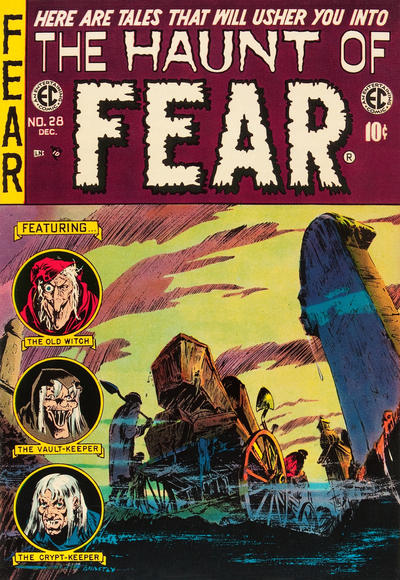
by Graham Ingels
This cover is from 1954.
The music video may be about a ghost (Philip Oakley) haunting a theater but Oakley has always said that this song is actually about Adam Ant.
Director Brian Duffy was best-known for his work as a fashion photographer.
Enjoy!
Suspense is a ten-minute blast from the past that comes to us all the way from 1913.
In this film, the Woman (played by Lois Weber) and her baby are menaced by the Tramp (Sam Kaufman), a sinister figure who cuts her phone lines and breaks into her home. While the Woman tries to protect herself, the Husband (Val Paul) rushes home to save his wife.
Suspense was one of the first thrillers and it introduced many elements that are still used to today, including the cut phone lines and the isolated location. This was also one of the first films to use the split screen as a narrative technique. There are many modern horror films that owe a debt to Suspense, whether the filmmakers realize it or not.
Suspense was written and directed by Lois Weber, who is widely acknowledged as being America’s first female filmmaker.
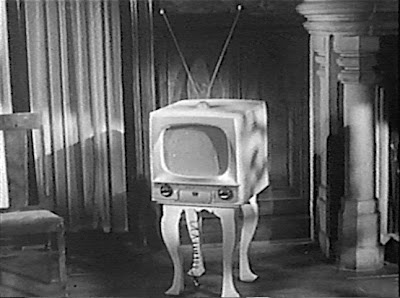
Tonight, we have the final episode of Hammer House of Horror and it is a macabre one indeed! A morgue attendant (Peter McEnery) becomes obsessed with both the number nine and a recently deceased neurosurgeon who died after trying to drill a hole in his own head in an attempt to let out all of his evil thoughts. McEnery finds himself becoming consumed by disturbing thoughts as well. Is he going mad or is he somehow seeing what no one else can see? This episode is effectively creepy and not for the squeamish.
It originally aired on December 6th, 1980.
Look at me/I’m Sandra Dee….
First released in the groovy and psychedelic year of 1970, The Dunwich Horror stars Sandra Dee as Nancy, an somewhat innocent grad student at Massachusetts’s Miskatonic University. When the mysterious Wilbur Wheatley (Dean Stockwell) comes to the university and asks to take a look at a very rare book called The Necronomicon, Nancy agrees. She does so even though there’s only one edition of The Necronomicon in existence and it’s supposed to be protected at all costs. Maybe it’s Wilbur’s hypnotic eyes that convince Nancy to allow him to see and manhandle the book. Prof. Henry Armitage (Ed Begley) is not happy to see Wilbur reading the book and he warns Nancy that the Wheatleys are no good.
Nancy still agrees to give Wilbur a ride back to his hometown of Dunwich. She finds herself enchanted by the mysterious Wilbur and she’s intrigued as to why so many people in the town seem to hate Wilbur and his father (Sam Jaffe). Soon, she is staying at Wilbur’s mansion and has apparently forgotten about actually returning to Miskatonic. She has fallen under Wilbur’s spell and it soon becomes clear that Wilbur has sinister plans of his own. It’s time to start chanting about the Old Ones and the eldritch powers while naked cultists run along the beach and Nancy writhes on an altar. We are in Lovecraft county!
Actually, it’s tempting to wonder just how exactly H.P. Lovecraft would have felt about this adaptation of his short story. On the one hand, it captures the chilly New England atmosphere of Lovecraft’s work and it features references to such Lovecraft mainstays as Miskatonic University, the Necronomicon, and the Old Ones. As was often the case with Lovecraft’s stories, the main characters are students and academics. At the same time, this is very much a film of the late 60s/early 70s. That means that there are random naked hippies, odd camera angles, and frequent use of the zoom lens. The film makes frequent use of solarization and other psychedelic effects that were all the rage in 1970. Lovecraft may have been an unconventional thinker but I’m still not sure he would have appreciated seeing his fearsome cult transformed into a bunch of body-painting hippies.
Really, the true pleasure of The Dunwich Horror is watching a very earnest Sandra Dee act opposite a very stoned Dean Stockwell. Stockwell was a charter member of the Hollywood counterculture, a friend of Dennis Hopper’s who had gone from being a top Hollywood child actor to playing hippie gurus in numerous AIP films. As for Sandra Dee, one gets the feeling that this film was an attempt to change her square image. When Wilbur tells Nancy that her nightmares sound like they’re sexual in origin and then explores her feelings about sex, Nancy replies, “I like sex,” and it’s obviously meant to be a moment that will make the audience say, “Hey, she’s one of us!” But Sandra Dee delivers the line so hesitantly that it actually has the opposite effect. Stockwell rather smoothely slips into the role of the eccentric Wilbur. Wilbur is meant to be an outsider and one gets the feeling that’s how Stockwell viewed himself in 1970. Sandra Dee, meanwhile, seems to be trying really hard to convince the viewer that she’s not the same actress who played Gidget and starred in A Summer Place, even though she clearly is. It creates an oddly fascinating chemistry between the two of them. Evil Wilbur actually comes across as being more honest than virtuous Nancy.
Executive produced by Roger Corman, The Dunwich Horror is an undeniably campy film but, if you’re a fan of the early 70s grindhouse and drive-in scene, it’s just silly enough to be entertaining. Even when the film itself descends into nonsense, Stockwell’s bizarre charisma keeps things watchable and there are a few memorable supporting performances. (Talia Shire has a small but memorable roll as a nurse.) It’s a film that stays true to the spirit of Lovecraft, despite all of the hippies.
 Through the Shattered Lens