
by Bob Larkin
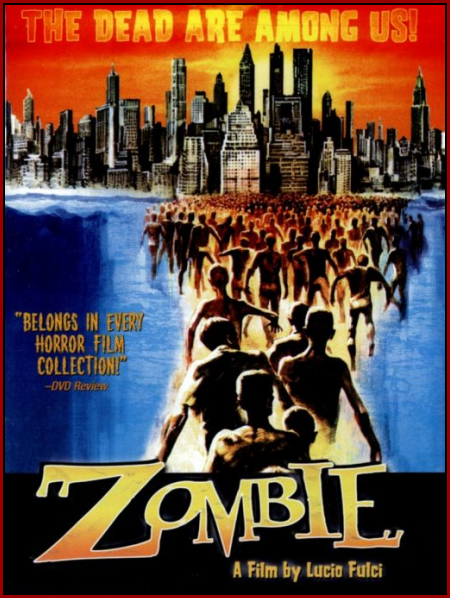
This film poster is from 1977. My sister made me watch this movie. The poster’s cool but the zombies are actually normal-sized.
by Bob Larkin
This film poster is from 1977. My sister made me watch this movie. The poster’s cool but the zombies are actually normal-sized.
Is that Danzig, encouraging listeners to call on the dark? That does sound like something that he would do.
Enjoy!
Tonight’s episode of Ghost Story stars Patricia Neal as a woman who wakes up one morning in a hotel and discovers that her husband is missing. She’s told that her husband checked out without her but no one will give her a straight answer as to where he went.
This episode was written by Jimmy Sangster, who also wrote several Hammer films. It originally aired on December 22nd, 1972.
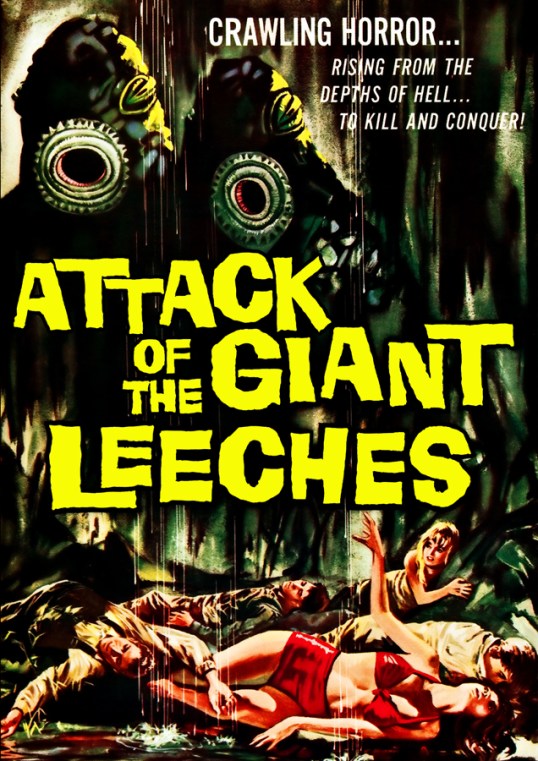
It’s time for nonstop drama in the bayous!
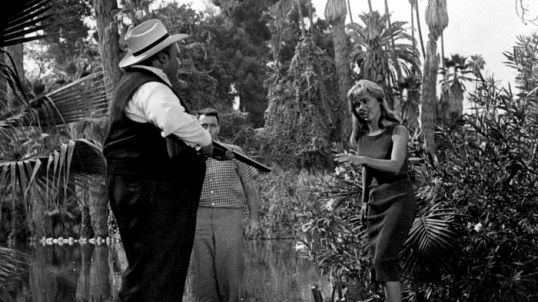
Shopkeeper Dave Walker (Bruno VeSota) knows that his wife, Liz (Yvette Vickers), is cheating on him with his best friend, Cal (Michael Emmett)! Dave is determined to catch them in the act and force them to walk out into the middle of the swamp at the end of his shotgun. That would be bad enough but what makes the swamp even more dangerous is the fact that there are two giant leeches living in the water, grabbing whoever they can get and dragging them back to their underground cave! Agck! While Dave plots to get revenge on his cheating wife, game warden Steve Benton (Ken Clark) tries to convince everyone that something really needs to be done about those giant leeches.
Filmed and released in 1959 and produced by Roger Corman, Attack of the Giant Leeches is not a particularly complicated film. The leeches live in the swamp. For various reasons, people keep wandering into the swamp. The leeches keep feeding until eventually, the authorities decide to do something about it. The simplicity of it all is why the film works. Why are there giant leeches in the swamp? How did the leeches become giants in the first place? Who cares? What’s important is that they’re there and they’re hungry for blood. At this point, why doesn’t matter. What matter is what is going to be done about them.
Clocking in at barely an hour and filmed by TV director Bernard L. Kowalski, Attack of the Giant Leeches is an enjoyably overhearted slice of Southern melodrama, full of humid atmosphere and sultry dialogue. The film does a wonderful job of capturing the overheated feeling of being stuck in the country and not having anything better to do than cause some trouble. I mean, it’s very easy for people to say what other should or shouldn’t do in their spare time. But, when you’re actually living in a swamp, you do what you have to do in order to pass the time. At its best, Attack of the Giant Leeches is like Roger Corman meets Tennessee Williams. It’s Southern Gothic, with even bigger leeches than usual. Flannery O’Connor would have been proud.
Yvette Vickers plays the role of Liz with a wonderfully defiant attitude. She’s going to do what she wants when she wants to and if that means running the risk of being forced to walk into the swamp, so be it. If she’s stuck in the bayous, she might as well have a good time. Liz may be frustrated but can you blame her? Meanwhile, VeSota turns Dave into a rather tragic buffoon. Even when he finally thinks that he’s about get his revenge, it turns out that the universe has other plans in store for him. In the end, Dave is fortune’s fool. No wonder stiff but earnest Ken Clark really can’t compete with either of them when it comes to capturing the audience’s attention.
Attack of the Giant Leeches is short but enjoyable and, because the copyright wasn’t renewed, it’s in the public domain and it’s very easy to watch for free. Watch it this Halloween and definitely stay out of the swamp!
There’s a house on a hill that everyone says in haunted. Your friends Ingram and Ryan have dared you to enter the house, even though you might get sick from something you find in there or you might even die. You can try to convince one of them to enter the house with you. You can enter the house alone. Or you can go home.
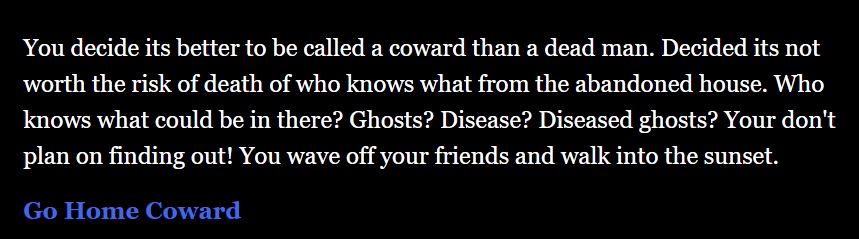
If there’s one thing that every good Interactive Fiction writer understands, it’s that you can get a player to do anything if you suggest that doing otherwise would make them a coward. Saying “Go Home Coward” is the equivalent of making chicken noises.
Once you enter the house, you can search the rooms and you get a chance to make a few simple decisions about whether or not to do certain things. Throughout it all, you are given the option to turn around leave. You’ll get called a coward but considering what does happen if you stay, sometimes it is worth being called a coward.
This is a simple Twine game and it shouldn’t take anyone longer than 10 minutes to play it. But there are enough different areas of the house to explore and enough possible outcomes that the game itself can be replayed several times.
In this scene from 1979’s Zombi 2, a group of humans try to destroy the zombies that are invading a small hospital on an isolated island. Director Lucio Fulci later pointed out, in many interviews, that he used the same clips of Al Cliver throwing a Molotov cocktail and firing a shotgun multiple times in the scene.
Two things to note about this scene:
First off, it captures what is truly scary about zombies. They are relentless. They do not stop coming. No matter how many you destroy, there’s always another one following behind it.
Secondly, Italian zombies actually looked like decaying walking corpses that are on the verge of falling apart. That was one huge difference between the Italian zombie films and many of the ones that were made in America.
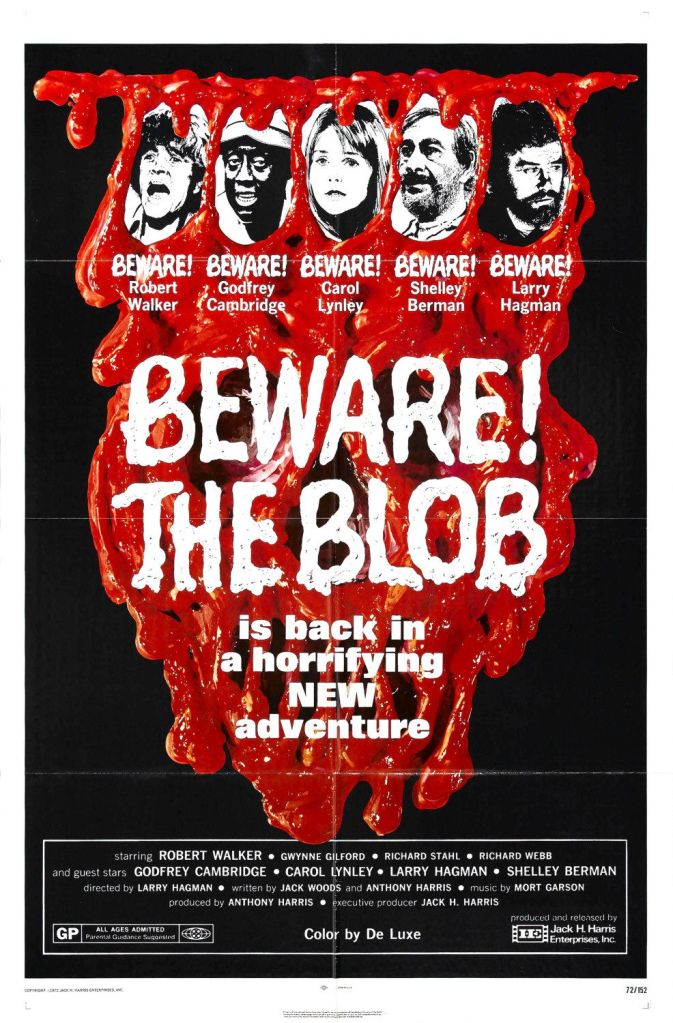
Everyone has one movie or two that hit them so hard it caused them to develop habits. It could be shaking your shoes to confirm no spiders are in them, counting the seconds after a lightning strike for the thunder, or checking the back seat of your car before you get into it, just in case. Some movies kind of imprint themselves on you in different ways.
Beware! The Blob (or Son of The Blob in some circles) was the most terrifying film I saw as a kid. I watched it in front of my grandmother’s living room tv that had a little alarm clock on the floor beneath it. Unlike Friday the 13th and Halloween, where I could rationalize my fears, Beware! The Blob had me fearing the summer and any open crevice we had. On any visits to our local video store (in the Pre-Blockbuster days), I’d pick out video games to rent and could see the box for the film in the horror section. I’d never walk over there, even in my early teenage years.
Most consider the 1958 original a Classic, and Chuck Russell’s 1988 update often goes toe to toe with John Carpenter’s The Thing on the Best Remakes list. Beware! The Blob will probably never make that list, but it’s not a total loss, given a recent rewatch. The film’s greatest strengths are in the casting and the special effects. From a cinema history/trivia standpoint, the film marks one of the earliest credits for Cinematographer Dean Cundey. Cundey worked as a 2nd Unit Cinematographer for the film, particularly with the animal shots in the opening and later on. That might not sound like much, but Cundey would go on to be picked by Debra Hill to help out on Halloween in 1978. From there, he had The Fog, Halloween II, The Thing, Romancing the Stone, Back to the Future, Big Trouble in Little China, Who Framed Roger Rabbit?, and Jurassic Park, to name a few.
With 14 years since the first film, there were some tech upgrades to how the blob was made. A large plastic balloon was used for some scenes (particularly the bowling alley sequences). Additionally, silicone was added to a drum to allow for the “blob pov” during the bowling alley sequences. In most sequences, a red dyed powder mixed with water was used. To make sure the audience was aware the Blob was close, a high whistle would sound, giving anyone with even the slightest bit of tinnitus some cause to look over their shoulder. Academy Award Winner Tim Baar (The Time Machine) and Conrad Rothmann worked on the effects, along with Cundey.
In his film directing debut, Larry Hagman (TV’s I Dream of Jeannie, Dallas) weaves a tale of horror lurking through a town peppered with parties, hobos, a boy scout team, an angry bowling alley owner, some dune buggy aficionados and a sheriff (Richard Webb, The Phantom Stagecoach) who’s a little confused about some of the events happening in town. To his credit, it’s amazing to see who Hagman assembled here, as he called in some friends to join in on the fun. Comedian Godfrey Cambridge. Cindy Williams, just a few years shy of American Graffiti. Gerrit Graham, about two years before Phantom of the Paradise. Sid Haig (The Devil’s Rejects) is here as well. You can even spot Hagman in the film as one of three hobos squaring off with the Blob. It should be noted that the other two hobos with him are Burgess Meredith (Clash of the Titans) and Del Close (Chuck Russell’s The Blob).
The film flows like it’s namesake, with some chapters having little do to with anything – Dick Van Patten’s boy scouts, while funny, could have had one of their scenes cut for speed. It’s not incredibly terrible, but it’s exactly great, either. Most of the script, written by Anthony Harris, was tossed with ad-libbing done on set. Despite all this, it does looks like the cast enjoyed themselves making the film. It has that going for it, at least.
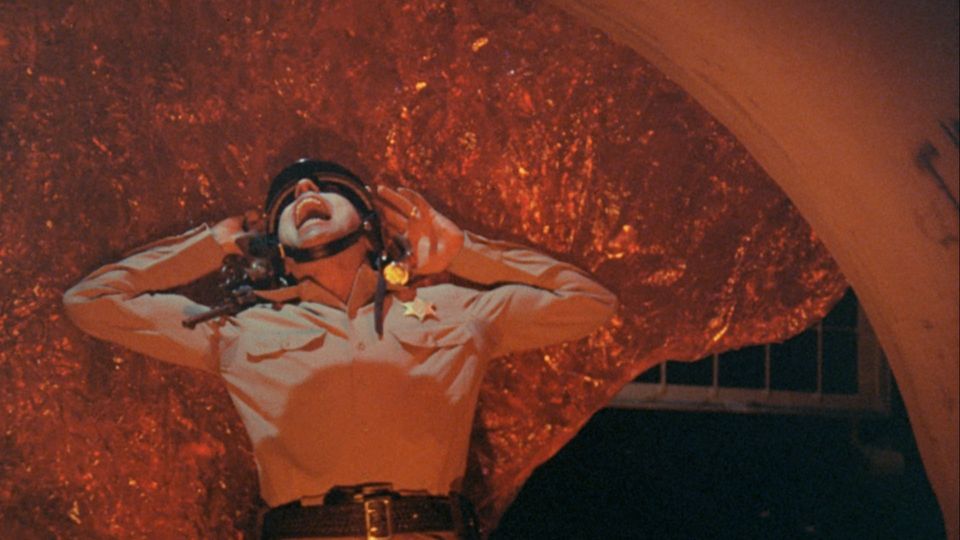
Chester, A construction worker from the Arctic (Cambridge) is getting his camping gear stowed away when his wife, Marlene (Marlene Clark, The Beast Must Die) discovers a thermos in their freezer. He explains he performed some work and brought home a piece of what the found in the Arctic. Setting it on a countertop, the couple forget about the thermos, which pops open. The newly released blob absorbs a fly and a kitten before moving on to larger prey. Before we know it, Chester is having problems with his TV – which happens to be playing the original 1958 movie – as it slithers into his favorite recliner. It’s a sequence that’s burned into my mind. I always check a chair before sitting in it. Some check for thumbtacks, I check for alien goo.
When Lisa (Gwynne Gilford, Masters of the Universe & actor Chris Pine’s Mom) discovers Chester with his new friend, she dashes out and heads to her boyfriend, Bobby (Robert Walker, Easy Rider). By the time the couple return to Chester’s place, they find the house empty. Can the couple convince the cops and the town of the danger ahead before it’s too late? Most of Beware! The Blob‘s scenes are set up in a way where people are completely oblivious of it until it’s touched them, causing said individual to slip and fall into the camera. The climax of the film takes place in a bowling alley, which is actually impressive for the techniques used, but even with the casting, you might spend more time laughing than anything else. Perhaps that’s my way of rationalizing the film years later.
At the time of this writing, Beware! The Blob is currently available to watch on the Plex streaming service. We’re also labeling this an Incident – out of respect to the kitten – and returning the timer to Zero.
4 Or More Shots From 4 Or More Films is just what it says it is, 4 shots from 4 of our favorite films. As opposed to the reviews and recaps that we usually post, 4 Shots From 4 Films lets the visuals do the talking!
This October, I’m going to be doing something a little bit different with my contribution to 4 (or more) Shots From 4 (or more) Films. I’m going to be taking a little chronological tour of the history of horror cinema, moving from decade to decade.
Today, we take a look at a very important year: 1979.
6 Shots From 6 Horror Films: 1979
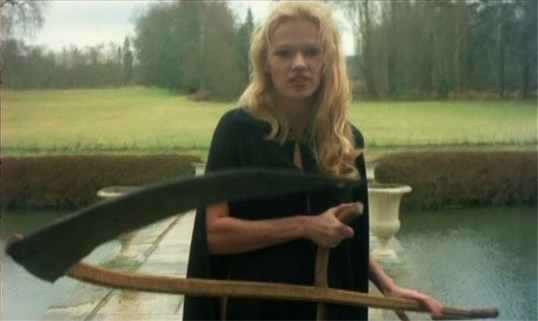
Fascination (1979, dir by Jean Rollin)
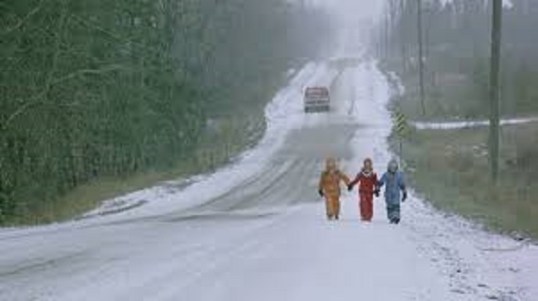
The Brood (1979, dir by David Cronenberg, DP: Mark Irwin)
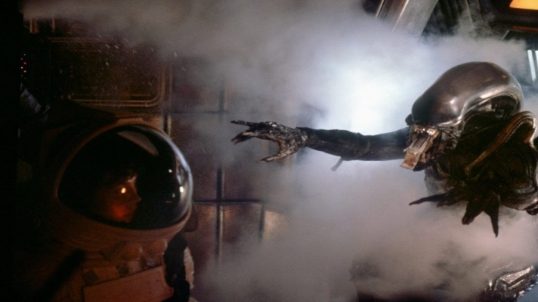
Alien (1979, dir by Ridley Scott, DP: Derek Vanlint)
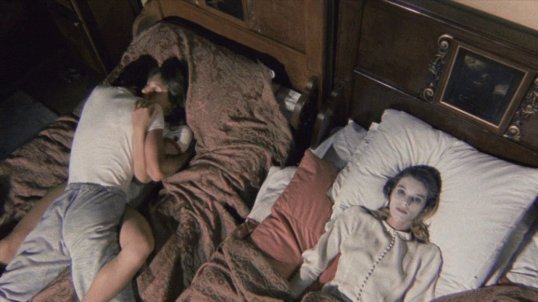
Beyond the Darkness (1979, dir by Joe D’Amato, DP: Joe D’Amato)

Nosferatu The Vampyre (1979, dir by Werner Herzog, DP: Jörg Schmidt-Reitwein)
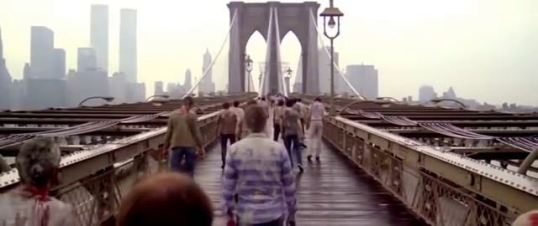
Zombi 2 (1979, dir. Lucio Fulci, DP: Sergio Salvati)
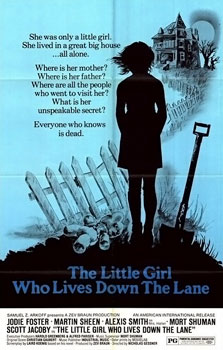
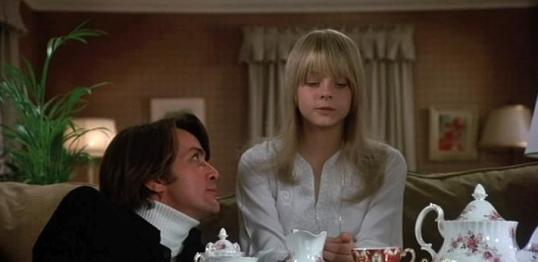
First released in 1976, The Little Girl Who Lives Down The Lane tells the story of Ryann Jacobs (played by Jodie Foster, who was thirteen years old when she made this film).
Rynn lives in a small New England town, in a house that her father has leased for three years. It’s been a while since anyone has seen Rynn’s father. Rynn always tells everyone that he’s either out of town or that he’s busy in his study and can’t be disturbed. When the friendly local policeman (Mort Schuman) expresses some doubt about Rynn’s claim that her father is working, Rynn says that her father is a drug addict, like all of the great poets.
Rynn’s main problem is with the Halletts. Cora Hallett (Alexis Smith) owns the house in which Rynn is living. Cora drops by regularly, haughtily demanding to see Rynn’s father. Her creepy son, Frank (Martin Sheen), also makes a habit of visiting. He’s not interested in Cora’s father. Instead, he’s interested in Cora. Everyone in the town knows that Frank is a perv but no one is willing to do anything about it. He’s protected by his mother’s money.
One day, when Cora drops by, she insists on going into the basement. She says she has something down there that she needs to retrieve. Rynn tells her not to go down there but Cora refuses to listen, which turns out to be a huge mistake. Cora screams at what she sees down there and then falls to her death. With the help of her only friend, Mario (Scott Jacoby) an aspiring magician who walks with a limp, Rynn covers up the murder.
Mario turns out to be a very good friend, indeed. Not only does he tell people that he’s seen Rynn’s father but he even stands up to Frank when he shows up at the house, searching for his mother. However, as it soon becomes clear, Frank isn’t one to give up so easily….
The Little Girl Who Lives Down The Lane is an interesting hybrid of a film. It definitely does have elements of horror. The running theme throughout the film is that Rynn might kill people but it’s all the adults in her life who are truly monstrous. Frank is truly a monster and Martin Sheen gives a remarkably intense and creepy performance in the role. Frank is the type who will say that worst things imaginable and then smirk afterward, confident that he’ll never have to face any sort of justice for his crimes.
At the same time, the film is also a coming-of-age-story and a teen romance. Rynn and Mario are two outsiders who find each other. You like both of them and you want things to work out for them, even though you spend almost the entire film worried that Rynn might end up poisoning Mario. Foster and Jacoby share some genuinely sweet scenes. Things would be just fine, the film seems to be saying, if all of these stupid adults would just mind their own business.
The Little Girl Who Lives Down The Lane is an effectively creepy and sometimes even sweet little film about a girl who occasionally has to kill people. Keep an eye out for it!
In the 1951 film, Bride of the Gorilla, Raymond Burr plays a plantation manager who commits a murder. Unfortunately, for him, the murder is observed by a witch who promptly puts a curse of Burr. Now, every time the sun goes down, Burr transforms into a gorilla and goes wild in the jungle.
Basically, it’s kind of like The Wolf Man, just with a less sympathetic protagonist and a gorilla instead of a werewolf. Just in case we missed the similarities, Lon Chaney, Jr. plays the film’s nominal hero, a police commissioner who suspects that something weird might be happening with Burr. Apparently, the plan was originally for Chaney to play the gorilla and for Burr to play the policeman but, because Chaney was dealing with a serious alcohol problem at the time, the roles were reversed.
Also in the cast, playing the role of Dina, is Barbara Payton, the tragic actress who is best known for being at the center of a love triangle involving actors Tom Neal and Franchot Tone. In 195000, Neal attacked Tone and beat him so severely that Tone spent 18 hours in a coma. Tone was notably shaky onscreen for the rest of his film career while Neal spent a few years in prison. After the incident between Tone and Neal, Payton could only get roles in B-movies like this one. Tragically, she would pass away, in 1967, of heart and live failure. She was only 39 years old.
 Through the Shattered Lens