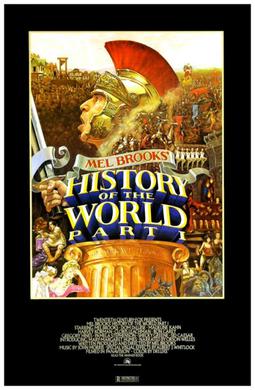
The History of the World, Part I (1981, directed by Mel Brooks)


Overlong, wildly uneven, gimmicky too a fault, and often laugh out loud funny with a mix of jokes that range from the crude to the sublimely clever to the surprisingly sentimental, The History of the World, Part I is the ultimate Mel Brooks films.

Narrated by Orson Welles and featuring five historical stories and a collection of coming attractions, The History of the World Part I follows man from his caveman origins to the French Revolution and the thread that ties it all together is that humanity always screws up but still finds a way to survive.  Moses (Mel Brooks) might drop and break one of the three tablets listing the 15 Commandments but he’s still able to present the other ten.  Stand-up philosopher Comicus (Mel Brooks) might make the mistake of poking fun at the weight of Emperor Nero (Dom DeLuise) but he still makes his escape with Josephus (Gregory Hines), Swiftus (Ron Carey), and Miriam the Vestal Virgin (Mary-Margaret Humes) and ends up serving as the waiter at the Last Supper.  (“Jesus!”)  The Spanish Inquisition may have been a catastrophe but it also gave Torquemada (Mel Brooks) a chance to show off his performance skills.  The French Revolution may have been a bloodbath but the future still held promise.  Ask for a miracle and he’ll show up as a white horse named Miracle, no matter what era of history you’re living in.

The humor is very Mel Brooks.  During the Roman Empire sequence, Madeline Kahn plays Empress Nympho.  Jackie Mason, Harvey Korman, Cloris Leachman, Spike Milligan, Jan Murray, Sammy Shores, Shecky Greene, Sid Caesar, Henny Youngman, and Hugh Hefner all make cameo appearances.  Carl Reiner is the voice of God.  John Hurt plays Jesus.  The film ends with the promise of a sequel that will feature “Jews in Space.”  Not every joke lands.  The entire caveman sequence feels forced.  But when the film works — like during The Inquisition production number — it’s hard not get caught up in its anything-goes style.  The entire Roman Empire sequence is probably more historically accurate than the typical Hollywood Roman epic.  That’s especially true of Dom DeLuise’s naughty performance as Emperor Nero.

Mel Brooks is 99 years old today and he says that he has at least one more film to give us, a sequel to Spaceballs.  I’m looking forward to it!  I’m also looking forward to rewatching and enjoying all of the films that he’s already given us.  The History of the World, Part I may not have initially enjoyed the critical acclaim of his earlier films but, in all of its anarchistic glory, it’s still pure Mel Brooks.

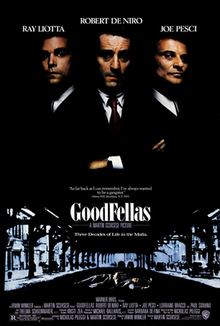
Lisa Marie Reviews An Oscar Nominee: Goodfellas (dir by Martin Scorsese)


First released in 1990 and continuously acclaimed ever since, Goodfellas did not win the Oscar for Best Picture.

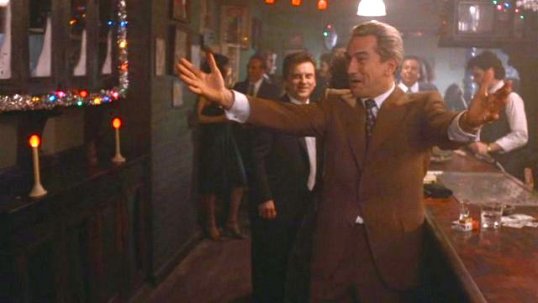
I’m always a bit surprised whenever I remember that.  Goodfellas didn’t win Best Picture?  That just doesn’t seem right.  It’s not the other films nominated that year were bad but Goodfellas was so brilliant that it’s hard to imagine someone actually voting for something else.  Seriously, it’s hard to think of a film that has been more influential than Goodfellas.  Every gangster film with a soundtrack of kitschy tunes from the 6os and 70s owes huge debt to Goodfellas.  Every actor who has ever been cast as a wild and out-of-control psycho gangster owes a debt to Joe Pesci’s performance as Tommy DeVito.  When Ray Liotta passed away two years ago, we all immediately heard him saying, “I always wanted to be a gangster.”  Robert De Niro’s Jimmy Conway remains the epitome of the ruthless gangster.  For many, Paul Sorvino’s neighborhood godfather redefined what it meant to be a crime boss.  Lorraine Bracco made such an impression as Karen Hill that it somehow seemed appropriate that she was one of the first people cast in The Sopranos, a show that itself would probably have not existed if not for Goodfellas.  Frank Sivero, Samuel L. Jackson, Tobin Bell, Debi Mazer, Vincent Gallo, Ileana Douglas, Frank Vincent, Tony Sirico, Michael Imperioli, Tony Darrow, Mike Starr, Chuck Low, all of them can be seen in Goodfellas.  It’s a film that many still consider to be the best of Martin Scorsese’s legendary career.  Who can forget Robert De Niro smoking that cigarette while Sunshine of Your Love blared on the soundtrack?  Who can forget “Maury’s wigs don’t come off!” or “Rossi, you are nothing but whore!?”  Who can forget the cheery Christmas music playing in the background while De Niro’s Jimmy Conway grows more and more paranoid after pulling off the biggest heist of his career?

Plus, it’s a Christmas movie!

And yet, it did not win Best Picture.

Myself, whenever I’m sitting behind a garbage truck in traffic, I immediately start to hear the piano coda from Layla.  For that matter, whenever I see a helicopter in the sky, I flash back to a coke-addled Henry Hill getting paranoid as he tries to pick up his brother from the hospital.  Whenever I see someone walking across the street in the suburbs, I remember the scene where Henry coolly pistol-whips the country club guy and then tells Karen to hide his gun.  I always remember Karen saying that she knows that many of her best friends would have run off as soon as their boyfriend gave them a gun to hide but “it turned me on.”  It would have turned me on as well.  Henry might be a gangster and his friends might be murderers but he doesn’t make any apologies for who he is, unlike everyone else in the world.

But it did not win Best Picture.

How many people have imitated Joe Pesci saying, “How am I funny?”  How many times did Pesci and Frank Vincent have to listen to people telling them to “go home and get your fucking shinebox?”  A lot of people remember the brutality of the scene where Pesci and De Niro team up to attack Vincent’s crude gangster but I always remember the sound of Donavon’s Atlantis playing on the soundtrack.

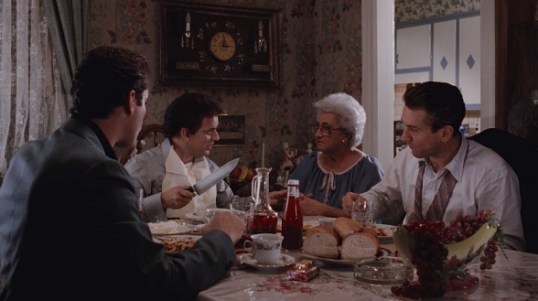
And then there’s Catherine Scorsese, showing up as Tommy’s mom and cooking for everyone while Vincent struggles to escape from the trunk of a car.  “He is content to be a jerk,” Tommy says about Henry Hill.  Just a few hours earlier, Tommy was apologizing to Henry for getting blood on his floor.

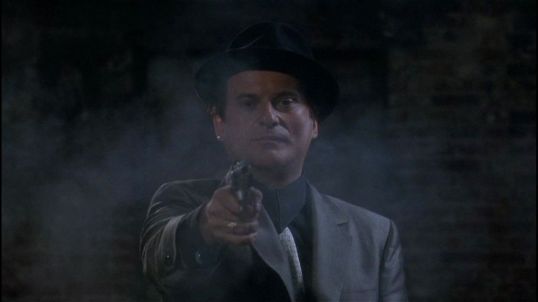
Goodfellas is a fast-paced look at organized crime, spanning from the 50s to the early 80s.  Ray Liotta plays Henry Hill, who goes from idolizing gangsters to being a gangster to ultimately fearing his associates after he gets busted for dealing drugs.  It’s a dizzying film, full of so many classic scenes and lines that it feels almost pointless to try to list them all here or to pretend like whoever is reading this review doesn’t remember the scene where the camera pans through the club and we meet the members of the crew.  (“And then there was Pete The Killer….”)  Goodfellas is a film that spend two hours showing us how much fun being a gangster can be and then thirty minutes showing us just how bad it can get when you’re high on coke, the police are after you, and you’ve recently learned that your associates are willing to kill even their oldest friends.  No matter how many times I watch Goodfellas, I always get very anxious towards the end of the film.  With the music pounding and the camera spinning, with Henry looking for helicopters, and with all of his plans going wrong over the course of one day, it’s almost a relief when Bo Dietl points that gun at Henry’s head and yells at him, revealing that Henry has been captured by the cops and not the Gambinos.  Karen desperately running through the house, flushing drugs and hiding a gun in her underwear, always leaves me unsettled.  It’s such a nice house but now, everything is crashing down.

There’s a tendency to compare Goodfellas to The Godfather, as their both films that re-imagine American history and culture through the lens of the gangster genre.  I think they’re both great but I also think that they are ultimately two very different films.  If The Godfather is sweeping and operatic, Goodfellas is the film that reminds us that gangsters also live in the suburbs and go to cookouts and that their wives take care of the kids and watch movies while the FBI searches their home.  If The Godfather is about the bosses, Goodfellas is about the blue collar soldiers.  The Godfather represents what we wish the Mafia was like while Goodfellas represents the reality.

Goodfellas is one of the greatest films ever made but it lost the Best Picture Oscar to Dances With Wolves, a film that left audiences feeling good as opposed to anxious.  To be honest, Martin Scorsese losing Best Director to Kevin Costner feels like an even bigger injustice than Goodfellas losing Best Picture.  One can understand the desire to reward Dances With Wolves, a film that attempts to correct a decades worth of negative stereotypes about Native Americans.  But Scorsese’s direction was so brilliant that it’s truly a shame that he didn’t win and that Lorraine Bracco didn’t win Best Supporting Actress.  It’s also a shame that Ray Liotta wasn’t nominated for playing Henry Hill.  At least Joe Pesci won an Oscar for redefining what it meant to be a gangster.

Goodfellas is proof that the best film doesn’t always win at the Oscars.  But it’s also proof that a great film doesn’t need an Oscar to be remembered.

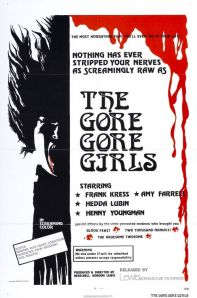
Grindhouse Classics : “The Gore Gore Girls”


Just when you thought the coast was clear, I’m back with more Herschell Gordon Lewis! Between this little haphazard Lewis retrospective Lisa Marie Bowman and I are indulging in, and her exhaustively thorough, and highly readable, Friday The 13th series of recent days, Through The Shattered Lens is really becoming a gore-hound’s delight these days, isn’t it? Hell, even the music reviews around here lately have a bombastic and violent theme to them — Bathory? Hell, I’m impressed — Quorthon’s “Viking trilogy” is my favorite period in Bathory history, truth be told, and Twilight Of The Gods my favorite Bathory album, even though my all-time favorite song of theirs, Blood, Fire, Death appears on the album — well, Blood, Fire, Death. But it’s waaaaaayyyy too early for me to be getting this hopelessly sidetracked, isn’t ? So let’s get back to our guy Herschell.
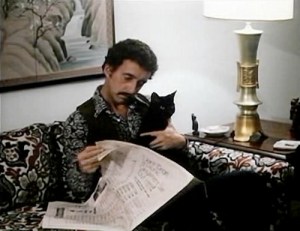
Having spent my last visit here examining the alpha of Lewis’ “gore cycle,” namely Blood Feast, I figure now would be as good a time as any to take a look at the omega (not just of his gore flicks but of his filmmaking career in general, at least until Blood Feast 2 came along about 30 years later, but we won’t pay any attention to that — nor should you), namely 1972’s The Gore Gore Girls. Somebody a whole lot wiser than I am (though I’m not sure exactly who — truth be told, it was probably several “somebodies”) once said “if you’re gonna go out, then go out with a bang,” and this movie certainly makes it clear that HGL took that advice to heart.
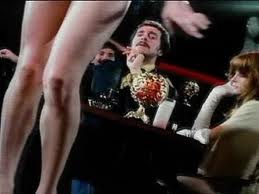
Even by Lewis “standards,” the plot for this one is pretty threadbare — go-go dancers at a local (in this case “local” being the Chicago area) strip joynt are being murdered in downright awesomely grotesque fashion — faces smashed to pulp in mirrors before their heads are dug into, buttocks beaten and — uhhhmmmm — tenderized with a meat mallet before having salt and pepper added to the impromptu (and quite rare, it must be said) “rump roast” for seasoning, nipples clipped off with scissors to reveal squirting biological fountains of both white and chocolate milk, heads shoved into deep-fat fryers — clearly, Herschell’s pulling out all the stops on his way out. And just as clearly, he’s well past the point of even pretending that he’s taking any of this shit seriously. Not that he ever put much effort into such  conceits in the first place, mind you,  but in the case of this film it’s especially fortunate that his tongue was so obviously placed firmly in his cheek, because it really does help to take the edge off what, on paper at least, seems like a truly OTT-in-the-misogyny-department series of murders ( a well-placed subplot involving a local feminist group helps to lessen the impact, as well — even though said group’s inclusion amounts to little more than a red herring plot-wise, the surprisingly level-headed portrayal of them by Lewis comes at least somewhat close to an admission on his part that feminist critics of his work were probably right ). Think of this as Herschell doing what he did best — giving gore-lovers more of what they wanted than they could possibly have hoped for, while not-so-tacitly admitting that it was all crap, anyway.

Anyway, back to the story — this was Lewis’ one and only attempt at injecting a bit of mystery into the proceedings, and doing their best to sleuth out the identity of the killer, without murdering each other first, are the truly odd couple of gungo-ho (but hopelessly incompetent) reporter Nancy Weston (Amy Farrell), and fancy-pants private eye Abraham gentry (Frank Kress, who absolutely sinks his teeth into the role of the — ahem! — sexually ambiguous version of Phillip Marlowe and is, in true Lewis fashion, playing the whole thing not just for laughs but for hearty, full-throttle belly laughs from start to finish). Throw in comedy legend Henny Youngman (who must have been broke or something) as the ridiculously fast-talking owner of the strip club the unfortunate victims worked at, and friends, you’ve got a recipe for a winner on your hands.
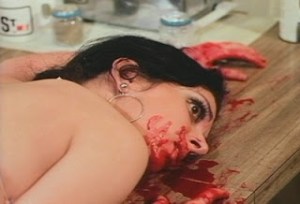
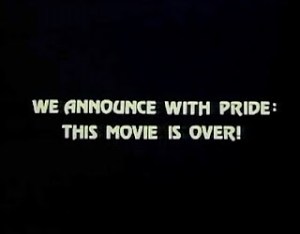
To be sure, you need a strong (hell, a cast-iron) stomach to make it through some of the death and dismemberment on display here (all of which looks pretty darn good on the Something Weird Video DVD release of this film — they did a very nice job remastering the full-frame picture, the mono sound is good, and extras include, of course, a commentary from Lewis and, doubly of course, the “Gallery of Herschell Gordon Lewis exploitation artwork”),  as the effects are, on the whole, somewhat-better-conceived than in the average HGL production, but there’s just no escaping the feeling of “the director’s not taking this whole thing too seriously, so why should I?” that permeates each and every frame of this film. It’s brutally honest in its intentions — “give the audience what they want one more time, rake up a bunch of money, and close the door behind me on the way out” is the best summation of Lewis’ aims here, and his willingness to have a few laughs as he says “thanks for the cash one more time, suckers” is just icing on the cake. Any movie that openly states that it’s proud that it’s over with (see the final screen cap below) is clearly imploring you to do anything other than take it seriously, and with that in mind, I gotta say, while The Gore Gore Girls falls absolutely flat in its attempt to wring anything like dramatic tension out of its poorly-thought-out (to be generous) murder-mystery premise, and while its absolutely appallingly brutal treatment of the female gender should be inexcusably offensive, and while it’s “fourth wall”-busting acting absolutely obliterates any chances the film might have had (not that it really wanted any) of being seen as anything other than a cash-in quickie, the fact is that it’s just about the most fun you can imagine having watching someone’s eyes being pulled out. And tits sliced off. And head deep-fried.
And that’s really the genius of Herschell Gordon Lewis in a nutshell, isn’t it? He could play you for a sucker, openly tell you that was exactly what he was doing, and make you chuckle at what a chump you were as you handed your money over to him anyway. God bless ya, Mr. Lewis — we could sure use more like you today. Thanks for this outrageous parting gift.