1993’s Murder So Sweet, also known a Poisoned By The Love: The Kern County Murders (seriously, try to say that ten times fast), tells the story of Steven David Catlin.
Steven David Catlin lived in Bakersfield, California. Catlin was a career criminal who was married six times and who found some personal redemption for himself as a member of the pit crew for a professional race car driver in Fresno. Trust me, I’ve lived in enough small, country towns to know that people will overlook a lot as long as someone knows how to work on a car.
One thing that people noticed about Catlin is that the people around him had a habit of dying of mysterious illnesses. Multiple wives, his adoptive parents, they all died with fluid in their lungs and they left behind not only a medical mystery but also quite a bit of money for Steven David Catlin. Catlin would always insist on holding a cremation just days after his loved ones passed away. Not only did that allow Catlin to move on but also kept anyone from being able to do a thorough autopsy.
Eventually, the police figured out that Catlin was just poisoning anyone who got on his nerves or threatened to divorce him. He wasn’t even a particularly clever poisoner. He used paraquet, a highly toxic herbicide and he kept the bottle sitting in plain view in his garage. He might as well have just labeled it his “Poisoning Thermos.” Catlin was convicted of multiple murders and he was sentenced to die in 1990. Of course, this being California, Catlin is sill alive and sitting in San Quentin. This really is a case of “If you lived in Texas, you’d be dead by now.”
In Murder My Sweet, Catlin is played Harry Hamlin, who steals the film as a dumb but charming redneck who walks with a confident swagger and has no fear of hitting on his ex-wife, even after he realizes that she’s trying to convince the police that he’s a murderer. Helen Shaver played Edie Bellew, the ex who knows better than to trust Catlin. Her current husband is played by Terence Knox and there’s plenty of scenes of him telling Edie that she needs to back off and that everyone knows that Steve Catlin isn’t a murderer. In many ways, this is the ultimate Lifetime film in that Edie Bellew not only gets to put her ex-husband in prison but she also proves that her current husband doesn’t know what he’s talking about.
Murder My Sweet takes place in rural California and, as a result, everyone in the film speaks with a shrill country accent and we spend a lot of time in a really tacky beauty parlor. Indeed, the film portrayal of country eccentricity is so over-the-top that I was tempted to say that it seemed as if the director was trying to rip-off David Lynch. However, Lynch may have made films about eccentric characters but he never portrayed them as being caricatures. Lynch loved his eccentrics while this film takes a bit of a condescending attitude towards them. Still, it’s worth watching for Harry Hamlin’s sleazy turn as Steve Catlin, a guy who enjoys fast cars and making ice cream.
If you grew up in the 80s or 90s, you probably had at least one friend whose father kept a pool table in the garage. This movie was probably the reason why.
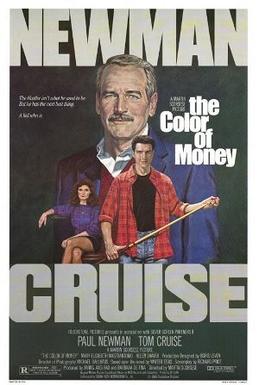
Fast Eddie Felson (Paul Newman) was once The Hustler, the legendary pool player who recovered from having his fingers broken with a bowling ball and went on to defeat the legendary Minnesota Fats. That was a long time ago. Now, Fast Eddie is a slick liquor salesman in Chicago. Eddie stills hangs out at the pool halls, despite his bad memories of the game. When he sees a cocky young player named Vincent (Tom Cruise) and his girlfriend Carmen (Mary Elizabeth Mastrantonio), he takes them under his wing and teaches them how to hustle. It’s not always easy because Vincent doesn’t like to lose, even if it means a chance to score an even bigger victory later on. Eddie finds himself being drawn back into the game, even as he starts to wonder who is hustling who.
I always forget that TheColorofMoney is a Martin Scorsese films. It’s a film that Scorsese made at a time when he had a reputation for only being able to make art films that critics loved but audiences stayed away from. After the box office failure of The King of Comedy and his abortive first attempt to make The Last Temptation of Christ, Scorsese took The Color of Money to prove that he could work with a studio. This is a Disney Scorsese film, with his signature camera moves but not much of his religious torment. Even if it’s not one of his personal films, Scorsese makes pool look exciting, a battle that is as much about psychology as physicality. Watching TheColorofMoney, you can smell the chalk on the tip of the pool cue.
Scorsese brings the seedy pool halls to life but it’s Paul Newman’s performance that dominates. TheColorofMoney won Newman his first and only Oscar and he deserved it. Newman had first played Fast Eddie Felson in 1961, in TheHustler. Returning to the role twenty-five years later allowed Newman to show what would eventually happen to the angry young men that he played in the 60s. Eddie has grown up and he’s got a comfortable life but he’s not content. He finally has stability but he misses the game. He needs the thrill of the hustle. Newman is at his best in TheColorofMoney, building on TheHustler but also revealing new sides of Eddie Felson.
Newman is so good that Tom Cruise often gets overlooked but both Cruise and Mastrantonio hold their own against Paul Newman. Cruise especially does a good job as Vincent, playing him as someone who is too cocky for his own good but also not as dumb as he looks. Just when you think you’ve got Vincent figured out, Cruise surprises you. TheColorof Money came out the same year as TopGun and Cruise’s Vincent feels like a commentary on the talented, troubled, but cocky characters that Cruise was playing at that time. Cruise, Scorsese, and Newman make a good team in this more-than-worthy sequel.
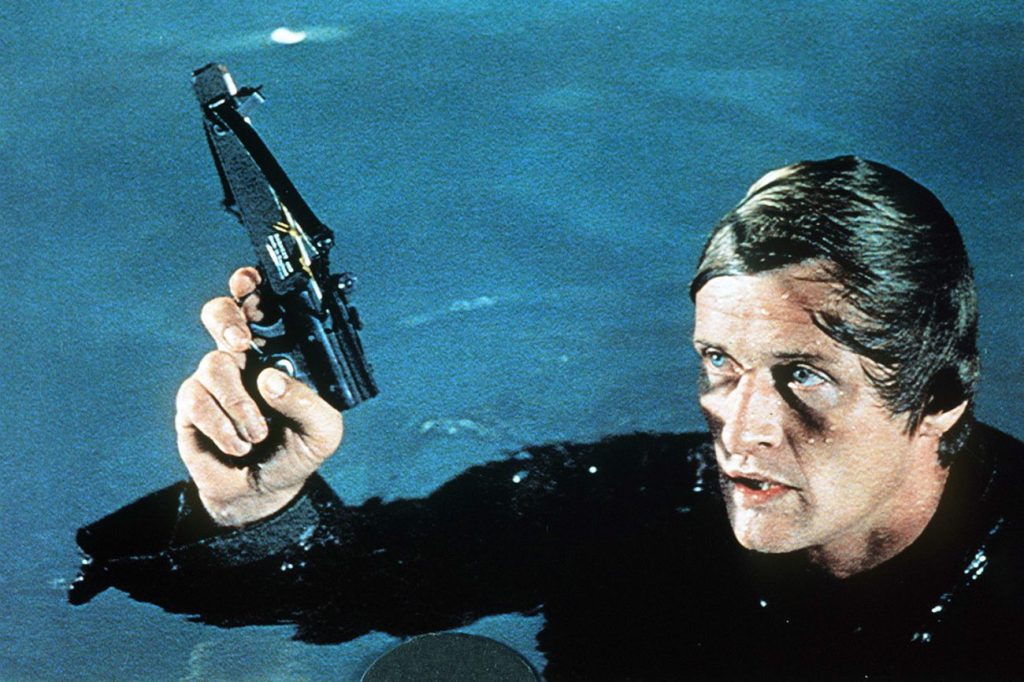
I’ve been having the best time reviewing Rutger Hauer films every Sunday. Today, I revisit THE OSTERMAN WEEKEND from 1983. Hauer made this film the year after BLADE RUNNER, so he was in the prime of his career. It also teams him up with an all-star supporting cast and master director Sam Peckinpah.
THE OSTERMAN WEEKEND opens with CIA Director Maxwell Danforth (Burt Lancaster) watching a recording of agent Laurence Fassett (John Hurt) making love to his wife. When Fassett hits the shower, two KGB assassins come in and kill her. Consumed by grief, Fassett hunts down the assassins and uncovers a Soviet spy network known as Omega. Fassett has identified three American men as top Omega agents… television producer Bernard Osterman (Craig T. Nelson with an awful, glued-on mustache), plastic surgeon Richard Tremayne (Dennis Hopper) and stock trader Joseph Cardone (Chris Sarandon). Rather than arrest the men and risk alarming the KGB, Fassett proposes to director Danforth that they try to turn one of the three men to the side of the West in hopes that this person will provide the information needed to bring down the Omega network.
Enter controversial television journalist John Tanner (Rutger Hauer). Fassett knows that Tanner has been close friends with Osterman, Tremayne, and Cardone since all four attended Berkeley together, and he believes that Tanner can successfully turn one of them. Although initially highly skeptical, the super patriotic Tanner begins to change his mind when Fassett shows him videotaped evidence of his old friends talking with a Russian agent in various capacities. Tanner reluctantly agrees to try turn one of his friends at their annual “Osterman Weekend” reunion which is coming up that week at Tanner’s house. He does have one condition… that Danforth, the CIA director will appear as a guest on his show. Danforth agrees to this condition. So that weekend, Tanner and his wife Ali (Meg Foster) welcome their old friends and their wives into their home, while Fassett has video camera equipment installed and hangs out in a van spying on the festivities. There’s no doubt it will turn out to be an awkward weekend, and you can’t help but wonder if Fassett may have more sinister motives than he’s letting on.
I’ll go ahead and say that I had a great time watching THE OSTERMAN WEEKEND for the first time in thirty-plus years. I’ve often read a criticism that the plot of this film is “incomprehensible.” Based on a book by Robert Ludlum, the story is purposely designed to keep you guessing up until its big reveal, but I didn’t have any trouble following it all. I’d say the biggest issue is that it doesn’t really stand up under close scrutiny. Some of the actions of the various characters don’t always make a lot of sense in light of the movie’s big twist near the end, but that didn’t take away from my personal enjoyment of the film. I just went along with the plot wherever it took me, and that was easy for me to do based on the cast that we have assembled. Any movie that includes Rutger Hauer, Burt Lancaster, John Hurt, Craig T. Nelson, Dennis Hopper, Chris Sarandon, Meg Foster, Helen Shaver, and Candy Yates will get a watch from me. Heck, Tim Thomerson even shows up as a motorcycle cop at one point. It’s a who’s who of excellent actors who always make their films watchable. In my opinion, it’s Hauer, Hurt, Foster and Nelson who do the most with their characters and take home the acting honors for their work here. Burt Lancaster is one of the all-time greats, and he does a good job, but it’s a one note character so there isn’t much he can do. Hopper and Sarandon are also fine, but their characters don’t really stand out. Their screen wives, Shaver and Yates, seem to be here mostly for eye candy because their tops are off for an abnormally large amount of their screen time! Speaking of eyes, the Hauer / Foster team up has to be on the list of the most striking combo pair of eyes in the history of cinema. Foster has the most noticeable eyes of any actress I’ve ever seen.
This is the great Sam Peckinpah’s final film, and I don’t agree with the people who complain that his career ended with a whimper. THE OSTERMAN WEEKEND is not in the same league as THE WILD BUNCH, RIDE THE HIGH COUNTRY, THE STRAW DOGS, or THE GETAWAY, but not many films are, including most of his own. And this movie is certainly visionary in one area, and that is found in its main theme about the damage that can be done with the manipulation of the media, including physical media, like videotape and audiotape. The primary driver of the film from the very beginning to the very end is the danger of false information that looks and sounds true. I can promise you that as I type this, and as you read it, there are people all over this world trying to make lies sound or appear true so they can share them on the news and on social media. I invite you to question everything you read, watch or hear on any outlet where you receive your news. Peckinpah’s final film beats this into our heads, just 40 years earlier.
Sam Peckinpah was known for his stylish and violent action sequences. THE OSTERMAN WEEKEND is more of a paranoid thriller, but it does feature some good action. There’s a chase sequence early in the film where Hauer’s wife and son are kidnapped, and he’s forced to commandeer the truck of honeymooners John Bryson (a Peckinpah regular) and Anne Haney (Greta from LIAR LIAR) to take off in hot pursuit. The scene features Peckinpah’s signature stunts, slow motion, and a myriad of cool tracking shots. There’s another fun scene where Hauer is using a baseball bat to defend himself against his pal Craig T. Nelson, who’s been shown to be a martial arts expert. It’s an exciting scene even if Hauer does get his ass kicked, in slow motion no less. And I always appreciate a movie with some good crossbow action, especially when it’s being wielded by a lady. The poster of the film prominently features a lady with a crossbow and we get to see Meg Foster step into that role in the actual film. She gets one especially gruesome, blood gurgling kill.
Overall, I think THE OSTERMAN WEEKEND is a good film. It is not nearly as bad as the critics of the time labeled it, and it’s not as good as Peckinpah’s best work, but you can certainly do a lot worse. It has a great cast, a timely message, a lot more sex and nudity than I remembered, and some cool action sequences. It’s definitely worth a watch!
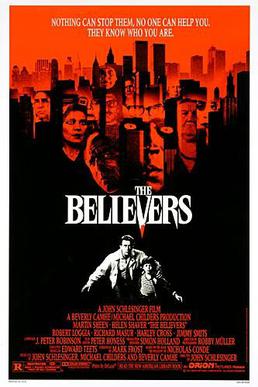
When it comes to unfortunate and dumb ways to die, getting electrocuted while standing in a puddle of spilled milk would seem to rank fairly high on the list. Unfortunately, it’s exactly what happens to the wife of Cal Jamison (Martin Sheen) during the first few minutes of 1987’s The Believers.
Traumatized by his wife’s death (and probably also by all of the people asking, “Wait a minute, she was standing in milk?”), Cal relocates from Minneapolis to New York City. Accompanying him is his young son, Chris (Harley Cross). Upon arriving in New York, Cal starts a tentative new relationship with artist Jessica Halliday (Helen Shaver) and he also gets a job working a psychologist for the NYPD.
And several members of the NYPD are going to need a good psychologist because they are investigating a series of brutal and ritualistic murders. All of the victims are children around Chris’s age and the murders are so grisly that even a hardened cop like Lt. Sean McTaggart (Robert Loggia) finds himself traumatized. When Detective Tom Lopez (Jimmy Smits, in one of his first roles) discovers one of the bodies, he has an apparent mental breakdown and starts to rant and rave about an all-powerful cult that Tom claims is committing the murders.
After Tom commits suicide, his ravings are dismissed as being the product of a mentally ill man. However, Cal is not so sure and starts to investigate on his own. What he discovers is a cult made up of a motely mix of wannabe gangsters and members of high society. While his friends and lovers either die or lose their minds around him, Cal discovers that the cult is actually closer to both him and his son than he ever realized.
An odd film, The Believers. On the one hand, there’s plenty of creepy scenes, including one in which Jessica gets a truly disturbing skin condition. The scenes in which Cal discovers that his friends have lost their minds as a result of the Cult are frequently sad and difficult to watch. Robert Loggia has scene that brought tears to my eyes. The mix of street witchery and upper class power lust is nicely handled and, as always, Harris Yulin makes for an effective villain. The Believers creates an ominous atmosphere of paranoia, one in which you really do come to feel that no one in the film is quite who they say they are.
And yet, it’s obvious that director John Schlesinger — whose previous films included Darlingand the Oscar-winning Midnight Cowboy — had more on his mind than just making an effective Omen-style horror film. He also tries to deal with Cal coming to terms with the death of his wife and Chris coming to terms with the idea of Cal dating someone new and all of those scenes of straight-forward domestic drama feel out-of-place in what should have been an energetic and grisly B-movie. In those ploddingly earnest scenes, Schlesinger seems to be trying almost too hard to remind us that he’s not really a horror filmmaker and they just feel out of place.
If there was ever a movie that called for the unapologetic and wickedly sardonic directorial vision of David Cronenberg, it was The Believers. As it is, The Believers is an intriguing but frustratingly uneven mix of paranoia, witchcraft, and domestic melodrama.
Once, during an interview, the distinguished British horror actor, Christopher Lee, was asked to name the worst film in which he had appeared.
Being a very busy actor who appeared in well-over 200 films, Lee paused for a minute to give it some thought and then eventually said that, in 1977, he had appeared in a Canadian science fiction film in which he played a mute alien who was using a suicide ray to conquer Earth. Though he wasn’t quite sure what the title had been, that was his pick for the worst movie in which he had ever appeared.
Now, considering some of the films in which Lee appeared, that’s a bold statement. Was Lee correct? Was that film — which was entitled Starship Invasions — the worst film in which he ever appeared?
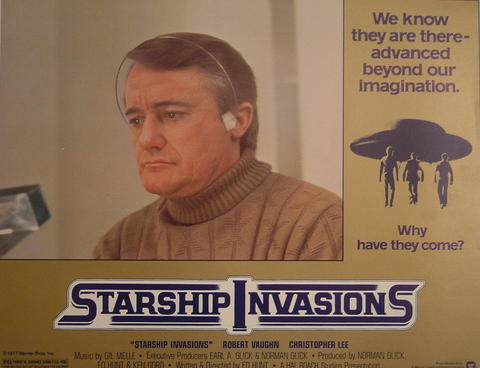
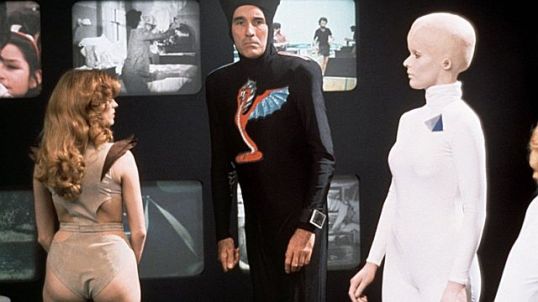
Well …. maybe. It’s certainly not one of his best. Lee plays Captain Ramses, who is the leader of the Legion of the Winged Serpents. The legion’s home planet is about to be destroyed by a supernova so he has taken it upon himself to find a new planet to colonize. Earth looks pretty good to him!
Christopher Lee remembered Ramses as being mute. Actually, he communicates through telepathy. We hear his words but his lips never move. The same is true of every alien that appears in the film. And yes, this could be an example of how different and more advanced the aliens are when compared to the humans but a more likely explanation is that it was cheaper to film the outer space scenes without sound and then just dub in the character’s “thoughts” later.
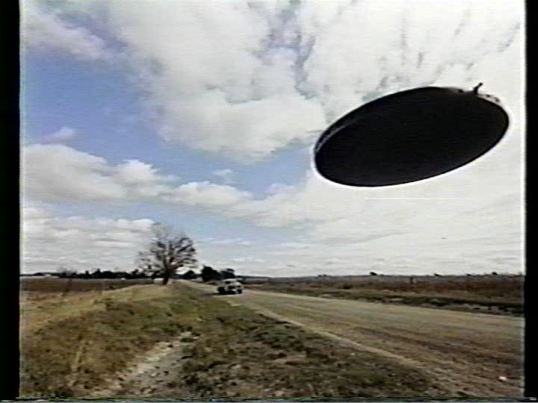
For reasons that are never quite clear, the Legion of the Winged Serpent abducts several Earthlings before then unleashing their suicide ray. Prof. Allan Duncan (Robert Vaughn) is the UFO expert who investigates the abductions before eventually getting abducted himself by a race of good, gray aliens. The gray aliens are determined to save the Earth from the Legion. It’s never really explained why.
Meanwhile, the suicide ray is causing chaos on Earth as people all over are driven to kill themselves and others. And the ray has just been aimed at Duncan’s wife (played by Helen Shaver) so Allan and the good aliens better hurry up and defeat Ramses and the bad aliens!
Is Starship Invasions really that bad? Well, it’s certainly not …. great. Christopher Lee is properly imposing as Ramses but even he occasionally has a “What have I gotten myself into?” look on his face. Most of all, Starship Invasions is very much a product of the 1970s. When Ramses visits a space station, it looks a lot like an incredibly tacky mix of a fitness center and a cocktail lounge. The fashion of both the Earthlings and the aliens is very much of the era. Robert Vaughn wears a turtleneck that just screams “community college history teacher.” The special effects are rather cheap and the plot never makes much sense. The scenes with the suicide ray, however, are surprisingly effective and the film does have a certain campy charm to it, especially if you’re into low-budget 70s sci-fi. Starship Invasions is probably not Christopher Lee’s worst film. It’s just one of his cheapest.
That, in a nutshell, is the main theme of the 1984 film, Countdown to Looking Glass. It’s a film that imagines the events leading up to an atomic war between the United States and Russia. It’s designed to look like a newscast. A distinguished anchorman named Dan Tobin (played by a real-life anchorman named Patrick Watson) gravely discusses the conflict between the two countries. Another reporter (played, somewhat jarringly given the film’s attempt to come across as authentic, by Scott Glenn) reports from an aircraft carrier. We see a lot of stock footage of planes taking off and world leaders meeting and people fleeing from cities.
There are a few scenes that take place outside of the newscast. They involve a reporter named Dorian Waldorf (Helen Shaver) and her boyfriend Bob Calhoun (Michael Muprhy). (If your name was Dorian Waldorf, you would kind of have to become a television news reporter, wouldn’t you?) Bob works for the government and has evidence that the world is a lot closer to ending than anyone realizes. Dorian tries to put the evidence on air but Dan tells her that they can’t run a story like that with just one source. It would be irresponsible…. when was this film made? I guess 1984 was a lot different from 2020 because I can guarantee you that CNN, Fox, and MSNBC would have had no problem running Dorian’s story and creating a mass panic.
(If Dan Tobin’s ethics didn’t already make this film seem dated, just watch the scene where Tobin announces that, because of the growing crisis, the networks will now be airing the news for 24 hours a day. From the way its announced, it’s obvious that this must have been a radical and new idea in 1984.)
Still, despite those dramatic asides, Countdown to Looking Glass is largely set up to look like a real newscast. We get stories about people naively singing up to serve in the army because they think war will be fun. We get interviews with a group of experts playing themselves. (The only one who I recognized was Newt Gingrich.) Everyone discusses the dangers of nuclear war and also whether or not humanity could survive an exchange of nuclear weapons. No one sounds particularly hopeful. Dan Tobin says that he always believed that nuclear war was inevitable but that the sight of all of the destruction would cause the combatants to come to their senses. That sounds a bit optimistic to me and the film suggests that Dan has no idea what he’s talking about.
In the end, Countdown to Looking Glass is a victim of its format. The newscast itself is rather dull, as most newscasts tend to be. Even the scenes that take place outside of the newscast tend to feel rather awkward, as if Murphy and Shaver were recruited for their roles at the last minute. In the end, Countdown to Looking Glass works best as a historical artifact. This is what a news report about the end of the world would have looked like in 1984. Watch it and compare it to how the news is covered in 2020.
Speaking of watching it …. well, it’s not easy. It’s never been released on video but you can watch it on YouTube. The upload’s not great but that’s pretty much your only option.
Breaker One-Nine, Breaker One-Nine, it’s time to put the hammer down with a pair of Trucksploitation flicks from the sensational 70’s! The CB/Trucker Craze came to be because of two things: the gas crisis of 1973 and the implementation of the new 55 MPH highway speed limit imposed by Big Brother your friendly Federal government. Long-haul truckers used Citizen’s Band radios to give each other updates on nearby fueling stations and speed traps set up by “Smokeys” (aka cops), and the rest of America followed suit.
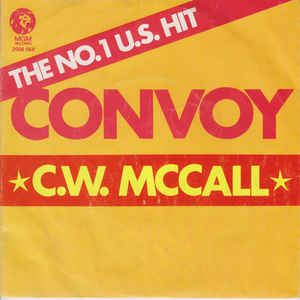
Country singer C.W. McCall had a massive #1 hit based on CB/trucker lingo with “Convoy”, and the trucker fad was in full swing. There had been trucker movies made before – THEY DRIVE BY NIGHT, THIEVES’ HIGHWAY, HELL DRIVERS, and THE WAGES OF FEAR come to mind – but Jonathan Kaplan’s 1975 WHITE LINE FEVER was the first to piggy-back on the new gearjammer…
The Snowman was the handle of Cledus Snow, the independent trucker who, along with his basset hound Flash, helped the Bandit escape Smokey in three different movies. Cledus was played by the country western singer, Jerry Reed. Interestingly, when Smokey and the Bandit was still in preproduction, the film’s producers envisioned a low-budget drive-in movie with Reed in the role of the Bandit. When Burt Reynolds signaled that he would be interested in playing the man in the black Trans Am, Reed was instead cast as Cledus.
The box office success of Smokey and the Bandit led to several road films being rushed into production and more than a few of them starred Jerry Reed. Several other of them starred Peter Fonda, who had already proven himself to be the king of the road with Easy Rider. However, High-Ballin’ is the only trucker film that can claim to have starred both Jerry Reed and Peter Fonda.
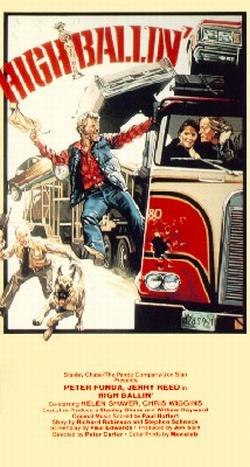
In High-Ballin’, Jerry Reed may be playing “Iron Duke” Boykin but he might as well just be Cledus Snow again. Once again, Reed is an independent trucker with a family at home and a love for the road. (Just as he did with Smokey and the Bandit, Reed even performed High-Ballin‘s theme song.) The local trucker’s union is putting pressure on the independent truckers and trying to intimidate them into joining. Iron Duke has no intention of doing that. Iron Duke has been hired to haul a load of liquor to an isolated lumber camp and he is not going to let the union or its thugs stop him. Helping him along the way is his friend Rane (Peter Fonda) and another independent, Pickup (Helen Shaver).
High-Ballin‘ was not as bad as I was expecting it to be. Reed, Fonda, and Shaver are likable in the lead roles and the action scenes are exciting. Fonda may have been a notoriously inexpressive actor but he was always believable whenever he was cast as a rebel or an outsider and the friendship between him and the more expressive Reed is as believable as the friendship between Cledus and the Bandit in Reed’s previous trucking film. Of course, the main reason you are going to watch a movie like High-Ballin’ is to see how many different ways that a car or a truck can be destroyed and this movie does not skimp on the vehicular destruction. It’s nothing great but, as far as 70s trucking films are concerned, High-Ballin’ is better than average.
One final note: keep an eye out for Michael Ironside in an early role.
The year is 1902. The old west is coming to an end. Almost all of the famous outlaws are either dead or imprisoned. Only a few, like Harry Tracy (Bruce Dern), continue to make a living by robbing banks and trains. Though he is often captured and even sentenced to death a few times, Harry is always able to escape. His latest escape, from a prison in Washington, has led to the largest manhunt in American history. Harry is being pursued by a trigger-happy army, led by U.S. Marshal Morrie Nathan (played by singer Gordon Lightfoot). Harry has been in this situation before but this time, things are different. Harry is traveling with Catherine Tuttle (Helen Shaver), the daughter of a local judge. Harry and Catherine are in love but that does not matter to the men with the guns.
Harry Tracy is a sadly overlooked and elegiac western from Canada. It is based on a true story. Outlaw Harry Tracy really did escape from several prisons and he eventually was the target of the largest manhunt in U.S. history. (His relationship with Catherine was apparently created for the film.) In real life, Harry was reportedly considered to be more ruthless than Jesse James and he killed not only members of law enforcement but also members of his own gang. The movie’s Harry is a much more gentle character. In the film, Harry only kills in self-defense and he robs banks not because he’s greedy but because it’s the only life that he has ever known. Harry is a relic of a time that it coming to a close. In one scene, he is shocked to come across a man driving a car. For an outlaw who usually makes his escape on horseback, the new century does not hold much promise.
In the tradition of Butch Cassidy and the Sundance Kid, Harry Tracy mixes comedy with tragedy. The film’s defining image is Harry fleeing from his latest robbery and dropping most of the money in the process. Harry often seems to be bewildered by all the fuss that people are making over him. Bruce Dern and Helen Shaver are great as Harry and Catherine. Even the casting of Gordon Lightfoot works. (Lightfoot also wrote the movie’s theme song.)
Harry Tracy is an overlooked classic about the end of the old west and the beginning of the modern era.
Tommy Lee Jones is Mitch, a troubled Vietnam veteran who has just lost his job and who can not convince his ex-wife to let him spend any time with his kids. One day, Mitch receives a letter from Mike, a friend who has recently committed suicide. In the letter, Mike explains that he has been stashing weapons and explosives in Central Park. Before he discovered that he had cancer, Mike had been planning to take over the park as a symbolic protest against government bureaucracy. Now that Mike is dead, it is now Mitch’s job to declare, “The park is mine!”
When Mitch takes over the park, he announces that he does not want to hurt anyone. Instead, he wants everyone in New York to spend some time to thinking about their lives. “There’s a lot of people like me, who don’t feel like they have any control over their lives,” he says, “Think about how you treat people and how you want to be treated.” Meanwhile, he will be camping out in the park for 72 hours and anyone who tries to come after him runs the risk of getting shot or blown up. Then he orders everyone to vote for Bernie Sanders and make America great again. Or at least he would if this film had been made today, instead of in 1985.
Deputy Mayor Dix (Peter Dvorsky) is so evil that he makes Ghostbusters‘s Walter Peck look reasonable. Dix is personally offended that Mitch has taken over Central Park. He is so offended that he is even willing to first call out the National Guard and then hire foreign mercenaries to sneak into the park and track Mitch down.
Reporter Valerie Weaver (Helen Shaver) also sneaks into the park so that she can interview Mitch. When Mitch captures her, he shouts at her, “GET NEKKID!” No, it’s not that type of movie. Mitch just wants to make sure that she’s not carrying any weapons on her. (The Park Is Mine was made for HBO. Even in the 80s, HBO understood the importance of getting nekkid.)
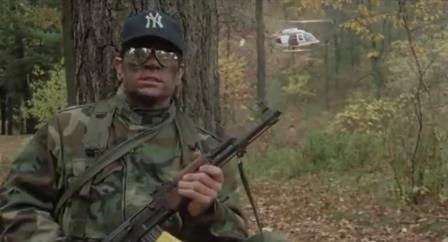
One of my favorite things about The Park Is Mine is that, after he goes to all the trouble to paint his face and dress up in camouflage, Mitch still spends the entire movie wearing a blue Yankees cap that would make him an easy target for anyone with a scope.
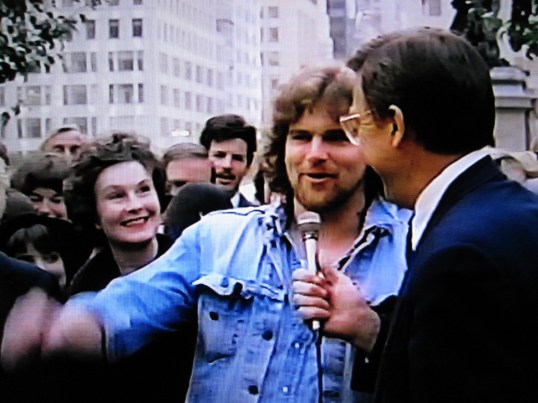
My other favorite thing is that, after Mitch asks everyone to think about how they treat people, a crowd of people gathers outside the park. When a reporter interviews them, a burly man with a hockey mullet and dressed in denim steps up and says, in a perfect Canadian accent, “My name is Elton Costanza. I’m from Queens!”
I’m not sure if Elton Costanza is meant to be related to George Costanza. He does look like he could be a distant cousin.
The rest of the film’s depiction of New York City is about as plausible as Elton’s accent. For a film taking place in New York in the 80s, the streets are too clean and the people are too friendly. Even when that crowd shows up to support Mitch, they are the most polite crowd that anyone could hope for. That may be because. though The Park Is Mine takes place in New York, it was filmed in Toronto.
The Park is Mine is both thoroughly implausible, totally heavy handed, and stupidly entertaining. Tommy Lee Jones is one of the few actors who can actually sell a line like, “The park is mine!” and Yaphet Kotto provides good support as a policeman who is sympathetic to Mitch. Peter Dvorsky is all too believable as the ultimate example of heartless bureaucracy. The most interesting thing about The Park Is Mine is that it comes down, without a hint of ambiguity, on the side of a domestic terrorist. That probably would not be allowed to happen today. In fact, the entire film feels like a relic of a past age, a celebration of an individualistic philosophy that America once embraced but, ever since the trauma of 911, has been in the process of abandoning. If Mitch was unhappy with America in the 80s, imagine how he would feel about the Patriot Act, NSA spying, too big to fail bailouts, and campus safe spaces.
Like Let’s Get Harry, The Park Is Mine is pure 80s hokum that deserves a nostalgic DVD release.
Hopefully, one with Tommy Lee Jones providing commentary.




 Hey, good buddy, remember the Snowman?
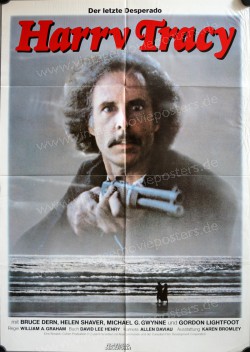 The year is 1902. The old west is coming to an end. Almost all of the famous outlaws are either dead or imprisoned. Only a few, like Harry Tracy (Bruce Dern), continue to make a living by robbing banks and trains. Though he is often captured and even sentenced to death a few times, Harry is always able to escape. His latest escape, from a prison in Washington, has led to the largest manhunt in American history. Harry is being pursued by a trigger-happy army, led by U.S. Marshal Morrie Nathan (played by singer Gordon Lightfoot). Harry has been in this situation before but this time, things are different. Harry is traveling with Catherine Tuttle (Helen Shaver), the daughter of a local judge. Harry and Catherine are in love but that does not matter to the men with the guns.
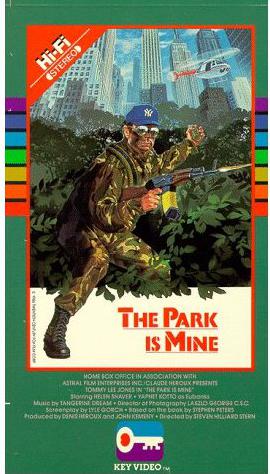 Tommy Lee Jones is Mitch, a troubled Vietnam veteran who has just lost his job and who can not convince his ex-wife to let him spend any time with his kids. One day, Mitch receives a letter from Mike, a friend who has recently committed suicide. In the letter, Mike explains that he has been stashing weapons and explosives in Central Park. Before he discovered that he had cancer, Mike had been planning to take over the park as a symbolic protest against government bureaucracy. Now that Mike is dead, it is now Mitch’s job to declare, “The park is mine!”
 Through the Shattered Lens