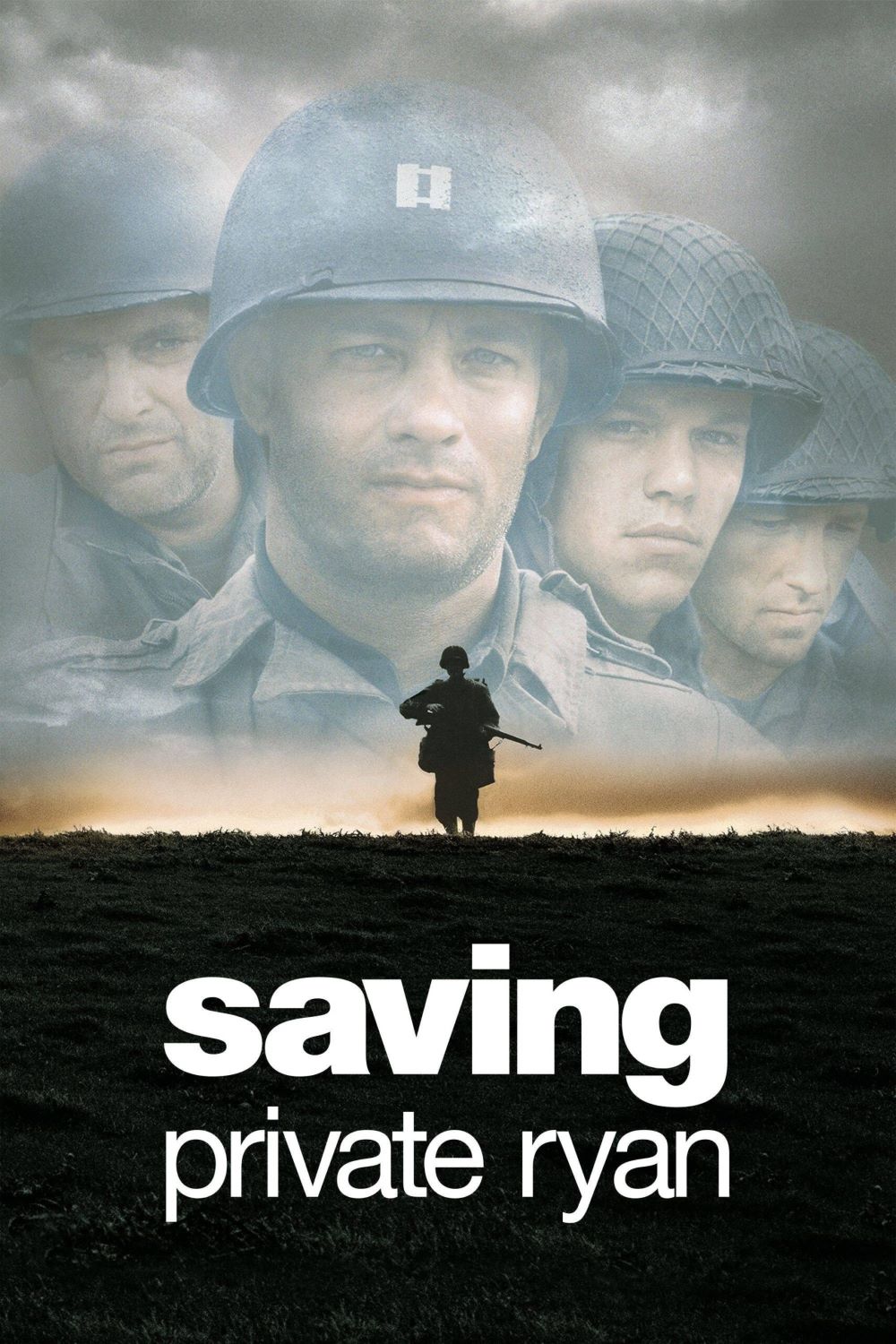
Review: Saving Private Ryan (dir. by Steven Spielberg)


“Someday we might look back on this and decide that Saving Private Ryan was the one decent thing we were able to pull out of this whole godawful, shitty mess.” — Sergeant Horvath

Saving Private Ryan stands as a landmark achievement in war cinema, intricately weaving immersive battle scenes, rich character dynamics, and profound moral themes into a nearly three-hour exploration of World War II’s human cost. One of its most remarkable features is the opening Omaha Beach landing sequence, a meticulously crafted, over 24-minute depiction of warfare’s brutal reality. Spielberg deploys a cinema verité style with handheld cameras capturing disorientation and chaos through the soldiers’ eyes. The sound design envelops the viewer in a sensory onslaught—gunfire, shouting, explosions—creating a visceral experience that immerses audiences directly in the terror and confusion of D-Day.

The filming process drew heavily on historical accuracy, with the production shot on the coast of County Wexford, Ireland, employing amputee actors and practical effects over computer graphics to simulate violent injuries and battlefield horrors. Muted tones evoke wartime photographs, and rapid, shaky editing conveys the disorganized, frantic environment soldiers endured. Consulting WWII veterans and historians, Spielberg created a sequence that reshaped cinematic portrayals of war, influencing how future films would approach the genre’s raw immediacy and emotional weight.

The film’s narrative follows a squad led by Captain Miller on a mission to locate and bring home Private James Ryan, whose three brothers have been killed in combat. The mission is steeped in the real-life tragedy of the five Sullivan brothers who died together aboard the USS Juneau in the Pacific, prompting military policies to prevent similar familial devastation. This historical context frames the story’s ethical heart: risking several men’s lives to save one, raising enduring questions about the value of individual sacrifice within the broader war.

In Saving Private Ryan, sacrifice is portrayed ambiguously—not as the sacrifice of a single hero but as the collective cost borne by the men tasked with rescuing one individual under perilous conditions. As the squad journeys through the war-torn French countryside, the deaths, injuries, and tensions they face underscore war’s randomness and the difficulty of weighing one life against many. The narrative refuses to romanticize or simplify, instead confronting the audience with the tragic truth that countless soldiers lose their lives without recognition or purpose, while some survive against staggering odds.

Duty and camaraderie thread throughout the film, portrayed through the soldiers’ evolving relationships and personal struggles. Each grapples with loyalty not only to their mission but to their fellow men and their own moral codes.

Integral to the film’s power is Tom Hanks’s layered performance as Captain John Miller. Hanks breathes life and emotional depth into Miller, portraying him as a man shaped by civilian life—revealed poignantly when he discloses his pre-war profession as a schoolteacher—now transformed by the relentless demands of war. He embodies an officer who is both composed and vulnerable, carrying the heavy burden of leadership with quiet dignity. Hanks’s portrayal reveals the internal struggles beneath Miller’s stoic exterior: moments of doubt, moral conflict, and fatigue subtly expressed through a trembling hand or a weary gaze. This humanity makes Miller relatable, as a man trying to maintain order and purpose amid chaos.

Hanks skillfully balances Miller’s authoritative presence with warmth and empathy, particularly evident in his paternal interactions with younger soldiers, reinforcing Miller’s role as both a leader and protector. His nuanced acting delivers the complexity of a man constantly negotiating duty and compassion. In scenes of high tension or moral quandaries, Hanks conveys the weight of command while allowing glimpses into Miller’s psychological strain, deepening the film’s emotional resonance.

Following Hanks’s Miller, a standout amongst the supporting cast is Tom Sizemore’s portrayal of Technical Sergeant Mike Horvath, Miller’s steady second-in-command. Sizemore embodies the pragmatic, battle-hardened soldier whose loyalty and experience provide emotional grounding for the squad. Sizemore portrays Horvath’s weariness and quiet commitment, adding layers of realism that deepen the exploration of how war reshapes individuals. The chemistry and shared history between Miller and Horvath are palpable, illustrating the bonds that sustain soldiers through hardship and lending emotional weight to the narrative.

The film wrestles with intense moral ambiguity throughout. The mission’s premise—to risk many lives to save one—compels both characters and viewers to confront complex questions about justice, value, and the cost of war. Scenes presenting difficult choices, such as the decision to spare or execute prisoners, dramatize these ethical dilemmas and highlight the emotional burdens borne by soldiers.

Technically, the film excels, with Janusz Kaminski’s dynamic cinematography capturing both the chaos of battle and intimate moments with evocative clarity. The immersive sound design reinforces the brutal reality, stripping warfare of glamor and confronting audiences with its daunting human costs.

Despite the overwhelming destruction and loss, Saving Private Ryan offers moments of humanity and hope. The rescue mission serves as a fragile symbol of compassion in the midst of devastation, while the film’s closing reflections on memory and legacy emphasize the lasting significance of sacrifice and survival.

Saving Private Ryan stands as a monumental achievement in the war genre, combining visceral combat realism, compelling characters, and moral complexity. Through Hanks’s deeply human Captain Miller and the nuanced supporting performances, especially Sizemore’s grounded Horvath, the film explores themes of sacrifice, duty, and brotherhood with unflinching honesty. Its enduring legacy lies in its unvarnished yet empathetic portrayal of war’s cost and the profound sacrifices made by those who lived it.

Lisa Marie Reviews An Oscar Nominee: Fargo (dir by the Coen Brothers)


Photograph by Erin Nicole

I am currently sitting in my bedroom, wrapped in several blankets and watching the snow fall on the other side of my window.  I love snow, mostly because I live in Texas and therefore, I don’t get to see it that often.  The most snow we’ve gotten down here, at least in my lifetime, was in 2021.  That was when we got hit by that blizzard and had to deal with rolling blackouts for a week straight.  That’s not a good memory but still, I love to watch the snow fall.  Even during that blizzard, I still loved the fact that I could use the snow as a nightlight as I read a Mickey Spillane book and waited for the power to come back on.

Down here in North Texas, snow is exotic.  In other parts of the country, it’s just a part of everyday life.

Like in the Dakotas for instance….

First released in 1996 and directed by the Coen Brothers, Fargo is a film that is full of arresting images.  As soon as you hear (or read) the title, those images and the sounds associated with them immediately pop into your head.  You immediately visualize the desperate car salesman Jerry Lundegaard (William H. Macy) trying to trick a customer into paying extra for the trucoat and insisting that “I’m not getting snippy here!”  You see the film’s two kidnappers, Carl Showalter (Steve Buscemi) and Gaear Grimsud (Peter Stomare), getting on each other’s nerves as they drive from one frozen location to another.  You remember heavily pregnant Marge Gunderson (Frances McDormand) investigating a snowy crime scene and gently correcting another officer’s “police work.”  You flash back to the moment when Mike Yanagita (Steve Park) suddenly breaks down in tears and tells Marge that she’s a super lady.  “And it’s a beautiful day,” Marge says at one point, wondering how so many terrible things could have happened on such a lovely day.  And she’s right.  It was a beautiful day.  It was far too beautiful a day to discover one man stuffing another into a woodchipper.

Myself, I always think of the scene where Carl attempts to find a place to hide a briefcase full of money.  It’s night.  Carl’s been shot in the face but he has the money that he’s gone through so much trouble to collect.  He runs into a field, looking for a place to hide it.  The field is covered in snow.  Every inch of the ground glows a bright white.  Everything looks the same.  But Carl still runs around desperately before picking a place to bury the suitcase.  It doesn’t seem to occur to Carl that there’s no visible landmarks or anything that would ever help him to find the money again.  He’s blinded, by the snow, by the pain of the bullet, and, like most of the characters in this movie, by his own greed.

Of course, Fargo is not a film about people behaving in intelligent ways.  Greed, loneliness, and desperation all lead to people doing some pretty stupid things.  Jerry thinks that the best way to pay off his debts and raise the money for a real estate deal is to arrange for his wife to be kidnapped so his wealthy father-in-law (Harve Presnell) will pay the ransom.  His father-in-law, who obviously despises Jerry and would be happy for him to just go away, is convinced that he’ll be able to both get back his daughter and recover his money.  (If Jerry had just spent a moment really thinking about his plan before going through with it, he would have realized his father-in-law would never just part with his money.)  Carl thinks that it’s a good idea to partner up with the obviously sociopathic Grimsud.  When a cop pulls over Carl and Grimsud’s car, Grimsud ignores the fact that Carl was talking his way out of the ticket and instead kills the policeman and then kills several eyewitnesses.  (“I told you not to stop.”)  Marge figures out what is going on but even she puts her life in danger by investigating a cabin without proper backup.  The characters in Fargo frequently behave in ludicrous ways and almost all of them speak with an exaggerated regional dialect (All together now: “Oh yeah,”) but they also feel incredibly real.  The sad truth of the matter is that there are people as greedy, dumb, and hapless in the world as Jerry.  There are people like Carl and Grimsud.  Even Jerry’s fearsome father-in-law is a very familiar type of character.  People do thing without thinking and inevitably, they make things worse the more overwhelmed they become.  Common sense (not to mention decency) is frequently the last thing that anyone considers.  Fortunately, Marge is believable too.  Marge at times almost seems so gentle and polite (“No, why don’t you sit over there?” she sweetly tells Mike when he attempts to get too close to her.) that the viewer worries about what’s going to happen to her when she gets closer and closer to figuring out what’s going on.  Fortunately, Marge turns out to be much stronger than anyone, even the viewer, expected.  The world of Fargo can be a terrible place but there’s moments of kindness and hope as well.

Fargo is both a comedy and a drama.  The opening title card says that the film is based on a true story, which is a typical Coen Brothers joke.  (The film was loosely inspired by several similar crimes but the story itself is fictional.)  Carter Burwell’s dramatic score is both appropriately grand and also gently satiric.  Jerry does some terrible things but William H. Macy plays him as being so naive and desperate and ultimately overwhelmed that it’s hard not to have a little sympathy for him.  Jerry truly thought it would be so simple to pull off a complicated crime.  (The poor guy can’t even get the ice off of his windshield.)  As played by Steve Buscemi, Carl Showalter talks nonstop and he makes you laugh despite yourself.  His shock at how poorly everything goes is one of the film’s highlights.  It’s a funny film but it’s also a sad one.  I always worry about what’s going to happen to Jerry’s son.  Ultimately, of course, the film belongs to Frances McDormand, who gives a wonderful performance as Marge.  She’s the heart of the film, the one who reminds the viewer that there are good people in the world.

Considering the film’s cultural impact, it’s always somewhat shocking to remember that Fargo did not win the Oscar for Best Picture.  It lost to The English Patient, a film about a homewrecker who helps the Nazis.  Personally, I prefer Fargo.

Fargo (1996, dir by the Coen Brothers, DP: Roger Deakins)

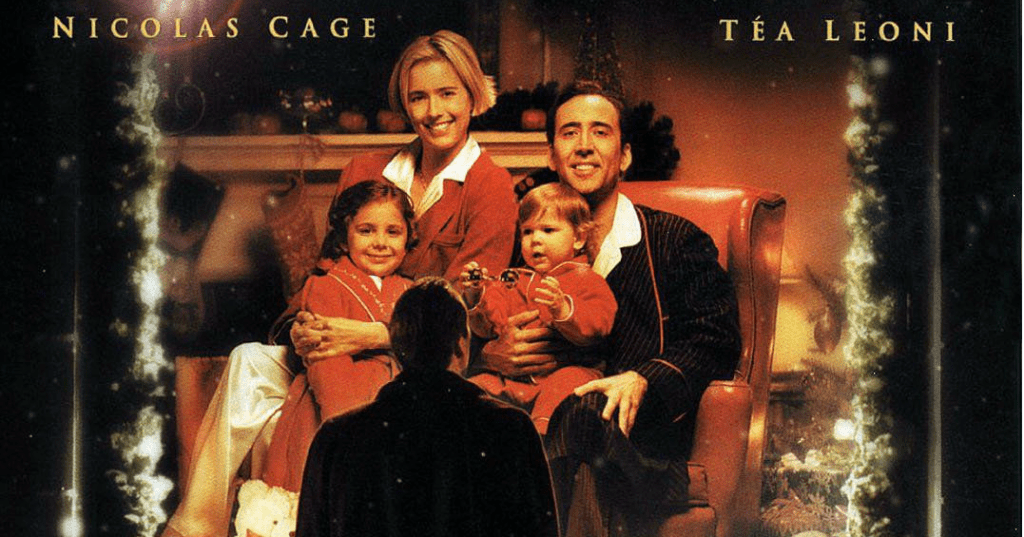
THE FAMILY MAN (2000) – Nicolas Cage gets a “glimpse” into a different life!


Nicolas Cage stars as Jack Campbell, a Wall Street hot shot, who puts his success in the business world above everything else in his life. We meet him on Christmas Eve as he’s trying to close a multi-billion dollar merger. He’s making everyone work late and even calls for a work session on Christmas Day. Jack’s administrative assistant gives him a phone message from his former girlfriend Kate (Tea Leoni), who he almost married about 15 years earlier. He’s surprised to hear from her, especially since he essentially chose his career over her all those years ago. That night as he stops at a grocery store on his way home, events transpire so that a desperate man named Cash (Dan Cheadle) pulls a gun on the clerk. Jack is able to use a calm demeanor and business sense to talk to Cash in a way that diffuses the situation and the two leave the store together. As they walk down the street, Jack tries to talk to Cash and help him. When Cash starts asking Jack about his life, Jack indicates that his life is great and he has everything he needs. Interestingly, this is where Cash mysteriously tells Jack that he’s going to do something for him, something he really needs…

The next morning, Christmas morning, Jack wakes up in a different home, he’s married to Kate, and they have two kids and a dog. He’s no longer an investment banker; now he’s a tire salesman. He no longer drives a Ferrari; now he’s drives a mini-van. In panic-mode, Jack runs out of the house as his in-laws arrive, fires up the mini-van, and drives to his office on Wall Street where nobody knows him, and they kick him out of the building. About that time, Cash pulls up in Jack’s Ferrari and tells him that he’s giving him the gift of a “glimpse” into what his life could have been if he had married Kate instead of focusing on himself and his career. So Jack heads back to try life in Jersey, wondering when the glimpse will come to an end. 

My wife and I are continuing to watch Christmas movies throughout the month of December to stay in the holiday spirit. THE FAMILY MAN is not necessarily a movie we watch every year, but I’m a fan of Nicolas Cage. I enjoy these types of films where a person sees what their lives could have been like if they had made different decisions at certain key points along the way. An easy comparison can be made to Frank Capra’s IT’S A WONDERFUL LIFE, which is my personal favorite Christmas movie, and it’s in my top 10 movies of all time. It’s not really an appropriate comparison though. These stories encounter their subjects in two very different places. In IT’S A WONDERFUL LIFE, George Bailey is at the end of his rope and thinking his family would have been better off if he had never been born. It takes Clarence to reveal just how important George has been to those he loves. In THE FAMILY MAN on the other hand, Jack Campbell is at the top of the world and standing at the precipice of his crowning achievement in his career. He believes his life is wonderful. Cash decides to teach him a lesson by offering a “glimpse” into a life that he could have had if he had chosen Kate and a family over his career. Would life with her be more fulfilling than all the money in the world? I think the sale is a lot easier for Clarence than Cash, and I also think that’s why I found the film to be less compelling. George Bailey’s decision was literally life with a family who dearly loves him, or death. Jack Campbell’s decision is if he wants a middle class life with a loving wife and two precious kids that he only just met, or if he wants to continue his prior life as the multi-millionaire mover and shaker with his pick of beautiful women.  It doesn’t help the film’s case either that Jack’s never really presented as being completely empty on the inside or unhappy, say, the way Bill Murray is in SCROOGED. While I personally enjoy the type of life that Jack is able to glimpse, his character’s specific choice is not as obvious, or earned, the way George Bailey’s is. 

Overall, as a man who wouldn’t trade my family for all the money in the world, I do appreciate what THE FAMILY MAN is going for. The execution doesn’t quite pull it off in a way that is completely satisfying, and ultimately explains why I don’t watch it every year as a holiday staple.