SHANE (The TV Series) – Episode 5: The Bitter, the Lonely (originally aired October 8th, 1966)


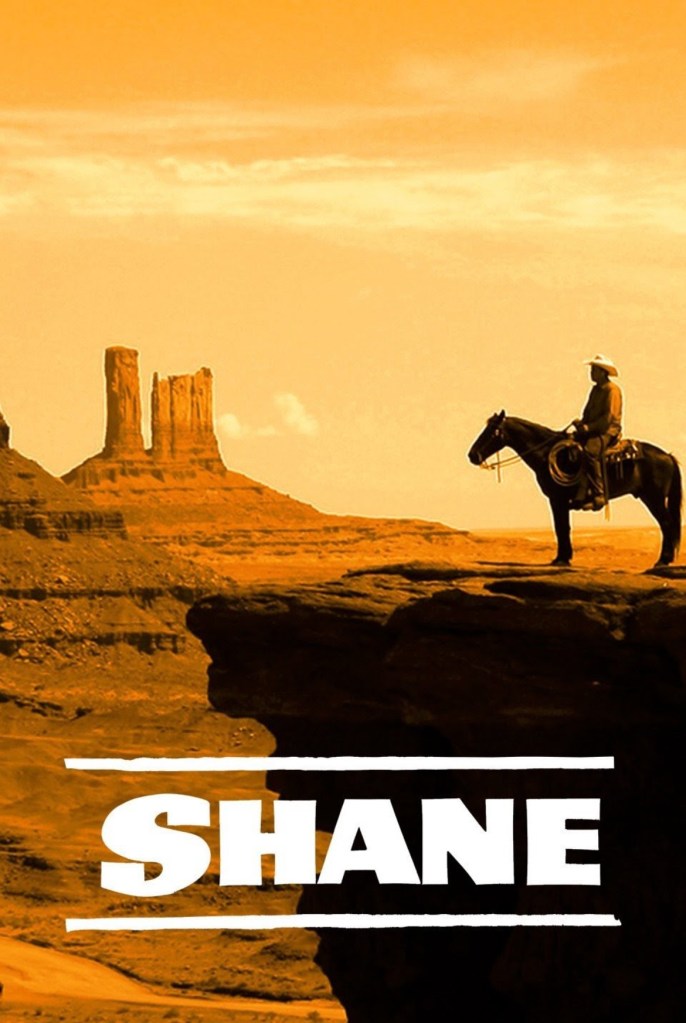
Episode 5 opens with a man riding his horse down the hill towards a sweaty Shane (David Carradine) who’s plowing a field on the Starett ranch. The man gets off his horse, walks up to Shane and punches him right in the face. He then turns around and heads back towards his horse. Not putting up with strangers punching him in the face on this day, Shane gets up and punches the guy back in the face. The guy then surprisingly proceeds to knock Shane on his ass again, this time telling him his name in the most Bond-ian of ways, “It’s Posey…RG Posey” (Steve Ihnat). Through a variety of circumstances, we learn that Posey hates “sodbusters” who put up fences and work the ground. He hates sodbusters so much that when he rode up on a person he thought was a sodbuster, he just decided to knock the crap out of him.

Hanging out at Sam Grafton’s saloon, Posey tells the local cowhands about kicking Shane’s ass, so local cattle rancher Rufe Ryker (Bert Freed) hires him on the spot. He thinks that any man who has gotten the best of Shane is someone he wants on his side. Over time though, Posey’s hateful and bullying actions towards Tom Starett (Tom Starett), his daughter Marian Starett (Jill Ireland), and Shane are too much, even for Ryker. Posey’s one of those guys who refer to farmers as “apple knockers,” “nesters” and “stump jumpers.” On multiple occasions, he even says they’re not human. Ryker makes it clear to Posey that while he’s working with the Ryker outfit, the Starett’s will be treated respectfully. Not content to leave well enough alone, Posey decides to dam up the stream that flows onto the Starett’s ranch just because he can. When Shane finds out, he rides out to confront Posey, and the two men fight it out with shovels. Ryker rides up on the two men and fires Posey on the spot, and even helps Shane break up the dam. Unable to accept that his own bitterness and hate cost him his job, Posey decides to blame Shane and sets out to kill him. 

Episode 5 is an enjoyable episode. First, it has a couple of exciting action sequences. The scene where Shane and Posey fight with shovels is the best action scene in the series so far. Grown men swinging shovels at each other is extremely dangerous and this episode certainly captures that feeling. I also enjoyed the scene at the very end where young Joey Starett (Christopher Shea) is running through the field with Shane’s gun, trying to warn him that Posey’s on his way to kill him. It’s a well executed scene that had me on the edge of my seat. Second, this episode tackles an important social issue. Posey hates sodbusters “just because they’re different.” As mentioned earlier, in his own mind he’s reduced them to being less than human. This is beaten into our heads in a pretty heavy handed approach, but that’s perfectly fine. The episode aired over 58 years ago and has a strong “message” that illustrates how Posey’s hate has turned him into an angry, bitter man who blames others for his own bad decisions and problems. For a good example of this these days, just open up any social media app and scroll for a bit, and you’ll see how anger and bitterness continue to steal our joy. Finally, I think Steve Ihnat is good as Posey, a man so full of hate that he doesn’t have the first clue about how to actually be happy. Ihnat had a solid television career, appearing in almost every good TV show in the 1960’s. He would even direct the James Coburn rodeo movie from 1972 called THE HONKERS. Sadly, Ihnat would pass away in 1972 at just 37 years of age. 

Overall, I found episode 5 to be very good. It tells an exciting story, while teaching an important lesson about how a person who allows hate to fester in their heart will ultimately end up as a bitter and lonely loser. Shane’s relationship with Marian Starett doesn’t advance much in Episode 5 but they do look at each other longingly at one point. Now that I think about it, with all the hate shown by Posey, it would have been nice to see a little more love in this episode. Oh well, there’s always episode 6 to look forward to! 

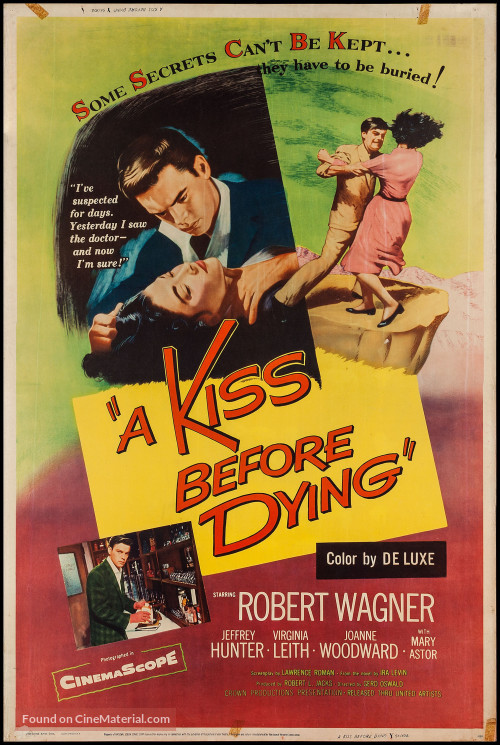
Soapy Noir: A KISS BEFORE DYING (United Artists 1956)


gary loggins's avatarcracked rear viewer

A KISS BEFORE DYING is part soap opera, part film noir, and 100% 50’s kitsch! Based on the best selling debut novel by Ira Levin (who went on to give us ROSEMARY’S BABY and THE STEPFORD WIVES), it’s also the debut of director Gerd Oswald (who went on to give us AGENT FOR HARM and BUNNY O’HARE !).  Lawrence Roman’s screenplay has some suspense, but his characters are all pretty dull and dumb, except for Robert Wagner’s turn as a charmingly sick sociopath.

Wagner is college student Bud Corliss, from the wrong side of the tracks, dating rich but naïve Dorie Kingship (Joanne Woodward) to get his hands on dad’s copper mine loot. And when I say naïve I’m not just whistling Dixie; this girl’s downright dense! Bud, after learning she’s pregnant, decides the best thing to do is not marry her, but bump her off. He whips up some poison…

View original post 563 more words

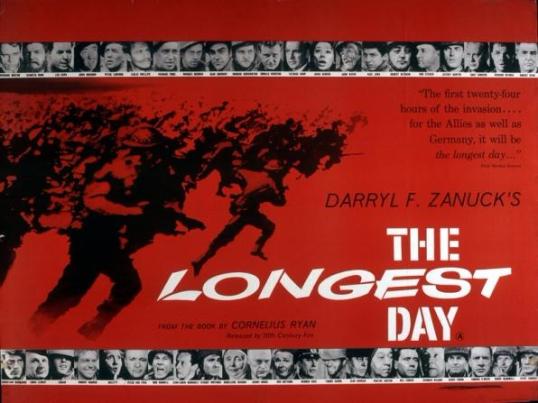
Lisa Reviews An Oscar Nominee: The Longest Day (dir by Ken Annakin, Andrew Marton, Bernhard Wicki, Gerd Oswald, and Darryl F. Zanuck)


As my sister has already pointed out, today is the 73rd anniversary of D-Day.  With that in mind, and as a part of my ongoing mission to see and review every single film ever nominated for best picture, I decided to watch the 1962 film, The Longest Day!

The Longest Day is a pain-staking and meticulous recreation of invasion of Normandy, much of it filmed on location.  It was reportedly something of a dream project for the head of the 20th Century Fox, Darryl F. Zanuck.  Zanuck set out to make both the ultimate tribute to the Allied forces and the greatest war movie ever.  Based on a best seller, The Longest Day has five credited screenwriters and three credited directors.  (Ken Annakin was credited with “British and French exteriors,” Andrew Marton did “American exteriors,” and the German scenes were credited to Bernhard Wicki.  Oddly, Gerd Oswald was not credited for his work on the parachuting scenes, even though those were some of the strongest scenes in the film.)  Even though he was not credited as either a screenwriter or a director, it is generally agreed that the film ultimately reflected the vision of Darryl F. Zanuck.  Zanuck not only rewrote the script but he also directed a few scenes as well.  The film had a budget of 7.75 million dollars, which was a huge amount in 1962.  (Until Steven Spielberg’s Schindler’s List, The Longest Day was the most expensive black-and-white film ever made.)  Not only did the film tell an epic story, but it also had an epic length.  Clocking in at 3 hours, The Longest Day was also one of the longest movies to ever be nominated for best picture.

The Longest Day also had an epic cast.  Zanuck assembled an all-star cast for his recreation of D-Day.  If you’re like me and you love watching old movies on TCM, you’ll see a lot of familiar faces go rushing by during the course of The Longest Day.  American generals were played by actors like Robert Mitchum, Robert Ryan, Henry Fonda, and John Wayne.  Peter Lawford, then the brother-in-law of the President of the United States, had a memorable role as the Scottish Lord Lovat, who marched through D-Day to the sounds of bagpipes.  When the Allied troops storm the beach, everyone from Roddy McDowall to Sal Mineo to Robert Wagner to singer Paul Anka can be seen dodging bullets.  Sean Connery pops up, speaking in his Scottish accent and providing comic relief.  When a group of paratroopers parachute into an occupied village, comedian Red Buttons ends up hanging from the steeple of a church.  When Richard Beymer (who is currently playing Ben Horne on Twin Peaks) gets separated from his squad, he stumbles across Richard Burton.  Among those representing the French are Arletty and Christian Marquand.  (Ironically, after World War II, Arletty was convicted of collaborating with the Germans and spent 18 months under house arrest.  Her crime was having a romantic relationship with a German soldier.  It is said that, in response to the charges, Arletty said, “My heart is French but my ass is international.”)  Meanwhile, among the Germans, one can find three future Bond villains: Gert Frobe, Curt Jurgens, and Walter Gotell.

It’s a big film and, to be honest, it’s too big.  It’s hard to keep track of everyone and, even though the battle scenes are probably about an intense as one could get away with in 1962 (though it’s nowhere near as effective as the famous opening of Saving Private Ryan, I still felt bad when Jeffrey Hunter and Eddie Albert were gunned down), their effectiveness is compromised by the film’s all-star approach.  Often times, the action threatens to come to a halt so that everyone can get their close-up.  Unfortunately, most of those famous faces don’t really get much of a chance to make an impression.  Even as the battle rages, you keep getting distracted by questions like, “Was that guy famous or was he just an extra?”

Among the big stars, most of them play to their personas.  John Wayne, for instance, may have been cast as General Benjamin Vandervoort but there’s never any doubt that he’s playing John Wayne.  When he tells his troops to “send them to Hell,” it’s not Vandervoort giving orders.  It’s John Wayne representing America.  Henry Fonda may be identified as being General Theodore Roosevelt II but, ultimately, you react to him because he’s Henry Fonda, a symbol of middle-American decency.  Neither Wayne nor Fonda gives a bad performance but you never forget that you’re watching Fonda and Wayne.

Throughout this huge film, there are bits and pieces that work so well that you wish the film had just concentrated on them as opposed to trying to tell every single story that occurred during D-Day.  I liked Robert Mitchum as a tough but caring general who, in the midst of battle, gives a speech that inspires his troops to keep fighting.  The scenes of Peter Lawford marching with a bagpiper at his side were nicely surreal.  Finally, there’s Richard Beymer, wandering around the French countryside and going through the entire day without firing his gun once.  Beymer gets the best line of the film when he says, “I wonder if we won.”  It’s such a modest line but it’s probably the most powerful line in the film.  I wish The Longest Day had more scenes like that.

The Longest Day was nominated for best picture of 1962 but it lost to an even longer film, Lawrence of Arabia.

4 Shots From 4 Films: Brainwashed, A Clockwork Orange, They Live, Body Snatchers


4 Shots From 4 Films is just what it says it is, 4 shots from 4 of our favorite films. As opposed to the reviews and recaps that we usually post, 4 Shots From 4 Films is all about letting the visuals do the talking.

4 Shots From 4 Films

Brainwashed (1960, dir by Gerd Oswlad)

Brainwashed (1960, dir by Gerd Oswald)

A Clockwork Orange (1971, dir by Stanley Kubrick)

A Clockwork Orange (1971, dir by Stanley Kubrick)

They Live (1988, dir by John Carpenter)

They Live (1988, dir by John Carpenter)

Body Snatchers (1993, dir by Abel Ferrara)

Body Snatchers (1993, dir by Abel Ferrara)

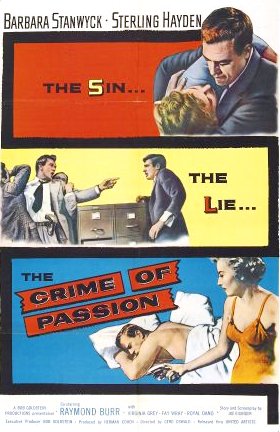
Netflix Noir #3: Crime of Passion (dir by Gerd Oswald)


CrimepassionPosterThe third Netflix Noir that I watched was 1957’s Crime of Passion.

In Crime of Passion, Barbara Stanwyck plays Kathy Ferguson, a San Francisco-based advice columnist.  She is approached by two homicide detectives who request her help tracking down a fugitive who they think might read her column.  Charlie (Royal Dano) is aggressive and outspoken.  When he first meets Kathy, he tells her, “You’re work should be raising a family and having dinner ready when your husband comes home from work.”  His far more passive partner is Detective Bill Doyle (Sterling Hayden).

Kathy writes a column that convinces the fugitive to turn herself in.  (The power of Kathy’s column is shown in an amusing montage where woman after woman is seen reading the column aloud.  Significantly, no men are seen to ever read anything that Kathy has written.)  The resulting fame leads to Kathy getting a job offer in New York.

However, before Kathy can leave, she gets a phone call from Bill.  He asks her out on a date and, one scene later, they’re getting married in the shabby office of a justice of the peace.  Kathy sacrifices her career to be a suburban housewife.

From the minute that Kathy first looks at the small and anonymous house and the boring neighborhood that she’ll be sharing with Bill, it’s obvious that things are not going to work out well.  Even though Kathy even tells Bill, “I hope all your socks have holes in them and I can sit for hours darning them,” the life of domestic servitude is not for her.

Every day, she stays home while Bill goes to work.  At night, she reluctantly plays hostess to the constant gatherings of Bill’s colleagues and their wives.  The women stay in one room while the man gather in another.  Kathy is quickly bored with the inane chattering of the other wives but whenever she tries to go into the other room, she finds herself treated like an unwanted intruder.

And worst of all is the fact that Bill has absolutely no ambition of his own.  He’s got his house.  He’s got his wife.  He’s got his friends.  And he doesn’t feel that he needs anything else.

Kathy takes it into her own hands to advance Bill’s career, first by having an affair with Bill’s boss (Raymond Burr) and finally by trying to find a spectacular crime that Bill can solve.  And, as the suburbs continue to drive her mad, Kathy is not above creating a few crimes on her own…

In many ways, Crime of Passion reminds of another 50s film, Nicholas Ray’s Bigger Than Life.  Both films use the conventions of melodrama to present a surprisingly subversive look at the horrors of suburban conformity.  Unfortunately, Crime of Passion never quite reaches the heights of Bigger Than Life, largely because Sterling Hayden gives such a dull performance as Bill that you never believe that Kathy would have married him in the first place.  (The film would have been far more impressive if Bill had started out as an apparently dynamic character whose dullness was then revealed after Kathy married him.)  However, Barbara Stanwyck is well-cast as Kathy and Raymond Burr plays up his character’s ambiguous morality.  If nothing else, Crime of Passion is one of those film to show anyone who is convinced that nothing subversive was produced in the 1950s.

Ghosts of Christmas Past #23: The Twilight Zone 1.31 “The Star”


Tonight’s ghost of Christmas Past was recommended to me by the TSL’s own editor-in-chief, Arleigh Sandoc.  This episode of the Twilight Zone originally aired on December 20th, 1985.  Based on a short story by Arthur C. Clarke, The Star features two men — one a scientist and one a priest — exploring the remains of a long dead alien civilization and discovering a connection to our own society.

And yes, it is a Christmas story.