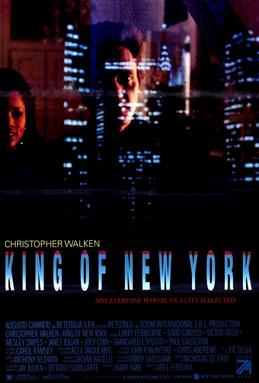
King of New York (1990, directed by Abel Ferrara)


Drug kingpin Frank White (Christopher Walken) has been released from prison and is again on the streets of New York City.  Frank might say that he’s gone straight but, as soon as he’s free, he’s  partying with his old crew (including Laurene Fishburne, Steve Buscemi, Giancarlo Esposito, and others).   While Frank’s agent (Paul Calderon) goes to all of the other city’s gangsters and explains that they can either get out of Frank’s way or die, three detectives (Victor Argo, David Caruso, and Wesley Snipes) make plans to take Frank out by any means necessary.  Meanwhile, Frank is donating money to politicians, building hospitals, and presenting himself as New York’s savior.

King of New York is the epitome of a cult film.  Directed by Abel Ferrara, the dark and violent King of New York was originally dismissed by critics and struggled to find an audience during its initial theatrical run.  (It was lumped in with and overshadowed by other 1990 gangster films like Goodfellas and Godfather Part III.)  But it was later rediscovered on both cable and home video and now it’s rightly considered to be a stone cold crime classic.  Walken gives one of his best performances as Frank White and that’s not a surprise.  The film was clearly made to give Walken a chance to show off what he could do with a lead role and Walken captures Frank’s charisma and humor without forgetting that he’s essentially a sociopath.  Walken gives a performance that feels like James Cagney updated for the end of the 80s.  What’s even more impressive is that all of the supporting characters are just as memorable as Walken’s Frank White.  From Laurence Fishburne’s flamboyant killer to David Caruso’s hotheaded cop to Paul Calderon’s slippery agent to Janet Julian’s morally compromised attorney, everyone gives a strong performance.  (I’m usually not a Caruso fan but he’s legitimately great here.)  They come together to bring the film’s world to life.  Everyone has their own reason for obsessing on Frank White and his return to power.  I’ve always especially appreciated Victor Argo as the weary, veteran detective who finds himself trapped by Caruso and Wesley Snipes’s impulsive plan to take down Frank White.  Frank White and the cops go to war and it’s sometimes hard to know whose side to be on.

Director Abel Ferrara has had a long and storied career, directing films about morally ambiguous people who are often pushed to extremes.  Personally, I think King of New York is his best film, a portrait of not just a criminal but also of a city that combines the best and the worst of human nature.  The action is exciting, the cast is superb, and Frank’s justifications for his behavior sometimes make a surprising amount of sense.  Thought there’s occasionally been speculation that it could happen, there’s never been a sequel to King of New York and it doesn’t need one.  King of New York is a film that tell you all that you need to know about Frank White and the city that he calls home.

 

Horror Film Review: Eyes of Laura Mars (dir by Irvin Kershner)


The Eyes of Laura Mars opens with Barbra Streisand singing the theme song, letting us know that we’re about to see one of the most 70s films ever made.

Laura Mars (played by a super intense Faye Dunaway) is a fashion photographer who is known for the way that her work mixes sex with violence.  Some people say that she’s a genius and those people have arranged for the publication of a book of her work.  (The book, naturally, is called The Eyes of Laura Mars.)  Some people think that Laura’s work is going to lead to the downfall of civilization.  And then one person thinks that anyone associated with Laura should die.

And that’s exactly what starts to happen.

Laura has visions of her friends being murdered.  Some people believe that makes her a suspect.  Some people think that she’s just going crazy from the pressure.  John Neville (Tommy Lee Jones), the detective assigned to her case, thinks that Laura is a damaged soul, just like him.  Neville and Laura soon find themselves falling in love, which would be more believable if Dunaway and Jones had even the least amount of chemistry.  Watching them kiss is like watching two bricks being smashed together.

There’s plenty of suspects, each one of them more a 70s cliché than the other.  There’s Donald (Rene Auberjonois), Laura’s flamboyant friend.  There’s Michael (Raul Julia), Laura’s sleazy ex-husband who is having an affair with the gallery of the manager that’s showing Laura’s photographs.  And then there’s Laura’s shift-eyed driver, Tommy.  Tommy has a criminal record and carries a switchblade and he always seem to be hiding something but, to be honest, the main reason Tommy might be the murderer is because he’s played by Brad Dourif.

If there’s one huge flaw with the film, it’s that the film never explains why Laura is suddenly having visions.  Obviously, the film is trying to suggest that Laura and the murderer share some sort of psychic connection but why?  (I was hoping the film would reveal that Dunaway had an evil twin or something like that but no.)  The other huge problem that I had is that one of the more likable characters in the film is murdered while dressed as Laura, specifically as a way to distract the killer.  So, that kind of makes that murder all Laura’s fault but no one ever points that out.

Personally, I think this film missed a huge opportunity by not having Andy Warhol play one of the suspects.  I mean, how can you make a movie about a pretentious fashion photographer in the 70s without arranging for a cameo from Andy Warhol?

The other missed opportunity is that the script was written by John Carpenter but he wasn’t invited to direct the movie.  I suppose that makes sense when you consider that Carpenter actually sold his script before he was hired to direct Halloween.  (Both Halloween and The Eyes of Laura Mars came out in the same year, 1978.)  That said, Carpenter would have directed with more of a sense of humor.  Director Irvin Kershner takes a plodding and humorless approach to the material.  When you’ve got a film featuring Faye Dunaway flaring her nostrils and Tommy Lee Jones talking about how sad his childhood was, you need a director who is going to fully embrace the insanity of it all.

With the glamorous background and the unseen killer, The Eyes of Laura Mars was obviously meant to be an American giallo.  Occasionally, it succeeds but again, it’s hard not to feel that an Italian director would have had a bit more fun with the material.  In the end The Eyes of Laura Mars is an interesting misfire but a misfire nonetheless.

Cleaning Out The DVR Yet Again #31: Black and White (dir by James Toback)


(Lisa recently discovered that she only has about 8 hours of space left on her DVR!  It turns out that she’s been recording movies from July and she just hasn’t gotten around to watching and reviewing them yet.  So, once again, Lisa is cleaning out her DVR!  She is going to try to watch and review 52 movies by the end of Wednesday, December 7th!  Will she make it?  Keep checking the site to find out!)

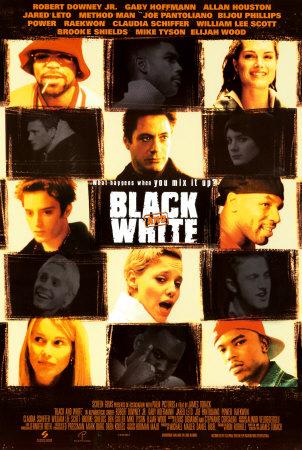
black_and_white_black_white-681253575-large

On November 15th, I recorded the 1999 melodrama, Black and White, off of Encore.

Black and White is a film that I’ve seen several times and I’ve always meant to review it.  It’s an attempt to explore the state of race, rap, crime, and sex in the late 20th century.  It’s also a James Toback film, which means that it contains all of the stuff that appears in every James Toback film: a threesome in the park, improvised dialogue, cameos from famous people playing themselves, an obsession with college basketball games, casual sexism, and a lot of talk about why you should never send “a little boy to do a man’s job.”  By his own admission, the white Toback is obsessed with the black experience but, when you watch a James Toback film, you get the feeling that his entire knowledge of African-American culture comes from watching other movies.

In short, Black and White is probably one of the silliest and most misjudged films that I’ve ever seen.  In fact, it’s so misjudged that it’s compulsively watchable.  Though I’m always hesitant to casually toss around the term “guilty pleasure,” that’s exactly what Black and White is.

Black and White tells several different stories, some of which are connected and some of which are not.  Sam Donager (Brooke Shields) is an independent filmmaker who is attempting to make a documentary about white people who try to act black.  Her husband, Terry (Robert Downey, Jr.), is gay and hits on every man (and boy) that he sees.  Sam and Terry start following around a group of privileged white kids who are obsessed with rap music.  Sam asks them if they want to be black.  They say that they’re going through a phase.

One of the kids is named Wren and he’s played by Elijah Wood.  He doesn’t really do much but every time he shows up in the film, you go, “It’s Elijah Wood!”  And then there’s Marty King (Eddie Kaye Thomas) who is the son of the Manhattan District Attorney (Joe Pantoliano).  Marty’s older brother is Will (William Lee Scott) ,who is some sort of low-level criminal.  And finally, the unofficial leader of the kids is Charlie (Bijou Phillips) and she gets to give a long monologue explaining the various uses of the n-word.

(Their teacher, incidentally, is played by Jared Leto.  If you’ve ever wanted to listen to Jared Leto lecture about the relationship between Othello and Iago, this is the film to see.  That said, the whole Othello and Iago lecture is just kinda randomly tossed in and doesn’t really pay off.)

Charlie is one of the many girlfriends of Rich Bower (Power), who is not only an up-and-coming rap producer but he’s also the head of a criminal organization.  (There’s a lengthy and kinda pointless scene where he and his associates demand money from a club manager played by Scott Caan.)  Rich is also friends with Mike Tyson.  Tyson plays himself and he gets to deliver an entire monologue about how Rich should never send a boy to do a man’s job.

But we’re not done!  Rich’s cousin is Dean Carter (Allan Houston), a college basketball player.  Dean is dating an anthropology graduate student (Claudia Schiffer, giving a hilariously terrible performance) who is obsessed with fertility symbols.  Dean is also being blackmailed by a corrupt cop named Mark Clear.  Guess who plays Mark Clear?

BEN FREAKING STILLER!

Needless to say, Ben Stiller is massively miscast.  He delivers he lines in his trademark comedic fashion, which makes it next to impossible to take him seriously as any sort of threat.  He also has a backstory that is needlessly complex but at least it allows him to say, “I’m Saul of Fucking Tarsus!”

Anyway, almost the entire film was improvised, which is one of those things that probably seemed like a good idea at the time.  A few of the actors do well with the improvisation.  Stiller may be miscast but at least he can come up with stuff to say.  Robert Downey, Jr.’s character may seem out-of-place but again, Downey knows how to keep things interesting.  But the rest of the cast seems to be a bit stranded so we end up with a lot of lengthy scenes of characters struggling to make some sort of sense of Toback’s storyline.

It’s obvious that James Toback felt that this film had something important to say but, instead of any insight, it can only offer up the occasionally strange-as-Hell scene.

Like this scene, for instance, in which Mike Tyson literally attempts to kill Robert Downey, Jr:

Or this weird little scene between Ben Stiller and Joe Pantoliano, which is dominated by Stiller’s odd delivery of his lines:

Or the closing montage, which is actually rather well-put together and makes great use of Michael Fredo’s Free:

Sadly, the video above ends before it gets to the part where we see Claudia Schiffer on a date with Mike Tyson, telling him about fertility symbols.

Anyway, Black and White is one of those films that wants to say something despite not being sure what.  Again, it may ultimately be rather silly but it’s still compulsively watchable.

(For the record, Marla Maples — who also appeared in Maximum Overdrive and was married to future President Donald Trump when this movie was made — has a cameo as a character named Muffy.  We live in a strange fucking world, don’t we?)