4 Or More Shots From 4 Or More Films is just what it says it is, 4 shots from 4 of our favorite films. As opposed to the reviews and recaps that we usually post, 4 Shots From 4 Films lets the visuals do the talking!
Today, the Shattered Lens wishes a happy birthday to Texas’s own Wes Anderson! It’s time for….
4 Shots From 4 Wes Anderson Films
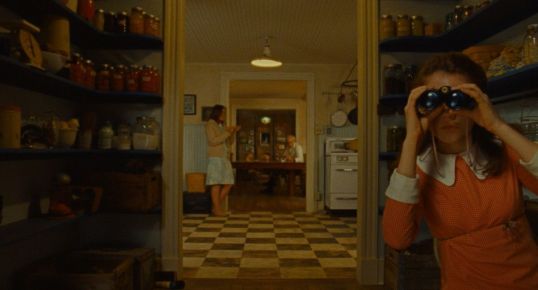
Moonrise Kingdom (2012, dir by Wes Anderson, DP: Robert Yeoman)
The Grand Budapest Hotel (2014, dir by Wes Anderson, DP: Robert Yeoman)
Isle of Dogs (2018, dir by Wes Anderson, DP: Tristan Oliver)
The French Dispatch (2021, dir by Wes Anderson, DP: Robert Yeoman)
At this point, the big news about the Oscar race is that there are a lot of contenders and there’s probably even more on the way. We’re still far away from being able to make any definite predictions, though Scorsese and Spielberg always seem like good bets. Everything Everywhere All At Once is also emerging as a possibility, despite it’s early release date. Could it be another Mad Max: Fury Road? It all probably depends on whether or not the precursors are willing to do their part.
Anyway, here are my predictions for April. Be sure to check out my predictions for February and March as well!
Best Picture
Babylon
Empire of Light
Everything Everywhere All at Once
The Fabelmans
I Want To Dance With Somebody
Killers of the Flower Moon
Next Goal Wins
Rustin
She Said
Till
Best Director
Damien Chazelle for Babylon
Chinoyne Chukwa for Till
Martin Scorsese for Killers of the Flower Moon
Steven Spielberg for The Fabelmans
Taika Watitti for Next Goal Wins
Best Actor
Colman Domingo in Rustin
Brendan Fraser in The Whale
Tom Hanks in A Man Called Otto
Joaquin Phoenix in Disappointment Blvd.
Brad Pitt in Babylon
Best Actress
Naomi Ackie in I Want To Dance With Somebody
Cate Blanchett in Tarr
Danielle Deadwyler in Till
Margot Robie in Babylon
Michelle Yeoh in Everything Everywhere All At Once
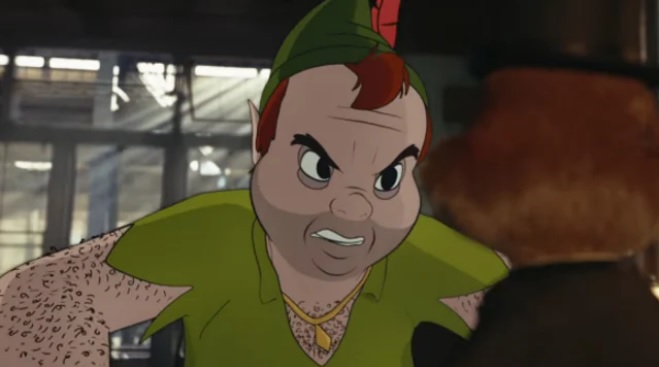
This screeenshot above is from the trailer for Chip n’ Dale: Rescue Rangers, which finds Chip and Dale estranged but forced to once again work together. It also features Peter Pan looking like he just spent a night drinking at Bada Bing.
This movie will be be streaming on Disney+, starting on May 20th!
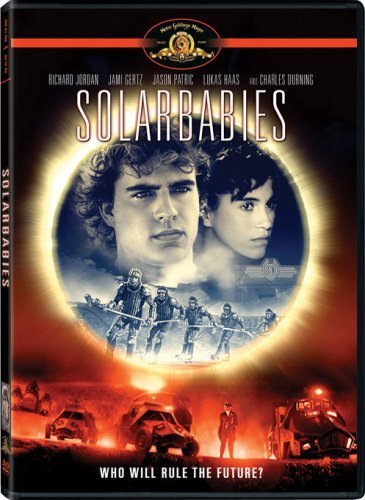
Solarbabies is a film that has a reputation. And it’s not a good one.
First released in 1986, Solarbabies is one of those post-Mad Max films that takes place in a post-apocalyptic desert society. There are no more trees. There is no more rain. Order is kept by force. The people are oppressed. Outsiders live in desert towns that have names like “Tiretown.” Children are forced to grow up in a combination of a prison and an orphanage. The orphanage’s Warden (played by Charles Durning) mourns for the way the world used to be, before it became a sun-drenched nightmare without plants or water. The fearsome Grock (Richard Jordan) makes sure that all of society’s rules are followed and the viewer knows he’s a bad guy because he wears a leather trench coat even when it’s over a 100 degrees outside. (Grock never sweats. If only the same could be said of the Warden.) The evil Professor Shandray (Sarah Douglas) experiments on living subjects. It’s a grim, grim world.
However, hope arrives in the form of a glowing orb! A ten year-old deaf boy named Daniel (Lukas Haas) finds the orb and, after regaining his ability to hear, he names it Bodhi. When Darstar (Adrian Pasdar) realizes that he can use Bodhi to protect the people of Tiretown, he steals the orb and runs off with it. Determined to retrieve Bodhi, Daniel chases after him
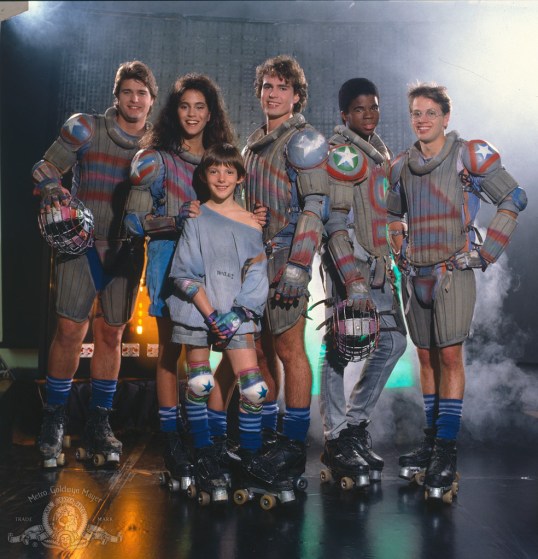
How will Daniel survive in the desert? Well, luckily, he’s not alone! Daniel was a member of the orphanage’s roller hockey team, the Solarbabies. Terra (Jami Gertz), Jason (Jason Patric), Metron (James LeGros), Rabbit (Claude Brooks), and Tug (Peter DeLuise) strap on their skates and roll out into the desert. Pursuing them is Grock and his stormtroopers.
Meanwhile, somewhere in the desert, an old man named Greentree (Frank Converse) hopes to help the world recover. Greentree looks like a thin version of Santa Claus and he hopes to bring rain and trees back to the Earth. Yes, his name is Greentree. There’s not really much room for subtlety in the world of Solarbabies.
Now, as I said at the beginning of this review, Solarbabies has a reputation. Today, it’s probably best known for being the film that nearly bankrupted Mel Brooks. Yes, that Mel Brooks. When Brooks originally signed on to produce Solarbabies, it was envisioned as being a low-budget sci-fi film that would not have any spectacular special effects. However, Brooks became convinced that Solarbabies had the potential to be a Star Wars-level hit so he increased the budget. He also brought in Alan Johnson to direct the film, despite the fact that Johnson was a choreographer who had only directed one other film and had no experience with science fiction. (Johnson’s previous film had been a remake of To Be Or Not To Be, which starred Brooks and featured Solarbabies’s Charles Durning in a supporting role). At Brooks’s insistence, the film was shot in Spain to save money. Unfortunately, no sooner had Johnson and the film’s cast arrived than Spain was hit by a series of unexpected storms that caused production to shut down. Even when the rain stopped, disagreements between Johnson and the cast delayed the film even further. The footage that was shot satisfied no one, leading to expensive reshoots. In the end, Mel Brooks invested close to $20 million dollars in the film, even taking a second mortgage out on his house. When the film was finally released, it was a critical and box office disaster, though Brooks later said that he did eventually break even after Solarbabies was released on DVD.
So, yes, Solarbabies has a bad reputation and it could be argued that it deserves it. Tonally, the film’s a mess. For a film that appears to have been made for a “family” audience, parts of the film are surprisingly violent Scenes of the Solarbabies playing LaCrosse and cheerfully crossing the desert are mixed with some surprisingly graphic scenes of Grock and Shandray torturing prisoners. Bodhi is a cute and glowing orb who gives Daniel back his hearing and then later brutally kills a lot of bad guys. Jason Patric, Jami Gertz, and Charles Durning all seem to be trying to take the film seriously while Richard Jordan and Sarah Douglas give performances that feel more appropriate for a Hammer horror film. Solarbabies is a bizarre mix of sincerity, sadism, and camp. Nothing about it makes much sense.
And yet….
Listen, I can’t help it. When I watched it last week, I enjoyed Solarbabies. For all of its many and obvious flaws, it’s a hard film not to like. It’s just so thoroughly ludicrous and messy that watching it becomes a rather fascinating viewing experience. It’s hard not to, at the very least, be entertained by the sight of the cast roller skating through the desert. A LaCrosse team battling futuristic Nazis for possession of a glowing orb that can cause rain to fall from a cloudless sky? As far as I’m concerned, it’s impossible not to enjoy that on some level.
Of course, I seem to be in the minority as far as that’s concerned. Alan Johnson never directed another movie after Solarbabies, though he did direct some of those really cool GAP commercials that aired in the early aughts. You know the ones that featured people enthusiastically dancing in khakis? That was him! Those commercials are kind of a guilty pleasure themselves. (Of course, because Mel Brooks nearly didn’t lose his house producing them, they’re not quite as infamous as Solarbabies.) But still, Johnson stared his directorial career by directing Charles Durning to an Oscar nomination in To Be Or Not To Be and he ended it by directing Durning in a box office flop. Well, no matter! I enjoyed Solarbabies and I don’t care who knows it.
Christina Ricci, whose performance was one of the highlights of the first season of Yellowjackets, plays a menaced mother in the upcoming supernatural thriller, Monstrous. The trailer below features Ricci’s character, her son, a rather ugly monster, and a really big car. Apparently, this film was produced by the Chicken Soup for the Soul people, which somehow just makes it all the more creepy.
(Seriously, whenever I see that anyone owns one of those “Chicken Soup” books …. well, I wouldn’t say that I silently judge them but the temptation is always there. Of course, you have to understand that I don’t really like soup to begin with. Someone once told me to have some chicken soup because I had a cold and I was like, “Yeah, I don’t have anything to do with soup so you’re advice is worthless and I’m still sick!”)
Anyway, the Chicken Soup brand is all about inspiring true stories so I guess maybe the monster is going to have a good life lesson to impart. We’ll find out on May 1st!
This is an intriguing trailer and really, how can you resist a film starring Sissy Spacek and J.K. Simmons? Night Sky will be available on Prime in May.
Obviously, making an origin story about a character who isn’t supposed to actually exist raises all sorts of existential issues but …. well, look. It’s PIXAR. And The LEGO Movie worked, didn’t it? And yes, I realize that the LEGO Movie was not a PIXAR film but I’m just saying that there’s all sorts of things that work in animation that wouldn’t necessarily work in live action.
If Liam Neeson ever retires, Gerard Butler will be there to take his place as the best actor to regularly appear in violent and somewhat formulaic thrillers about men doing what they have to do to save the members of their family from being abducted and sold to the highest bidder.
Here’s the trailer for Last Seen Alive, which is due to be released next month. In this one, Butler plays a man whose wife vanishes at a gas station. It was originally titled Chase, which was a bit of a generic title. I prefer Last Seen Alive. Butler not only stars but he also produced.
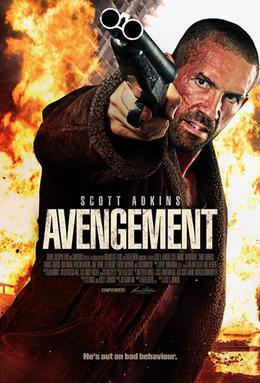
I’m not really sure if “Avengement” is actually a word but, regardless, that’s what Cain Burgess is determined to get. AVENGEMENT!
Martial artist Scott Adkins plays Cain in this 2019 British film. When we first meet Cain, he’s in prison but that quickly changes once he manages to escape. Cain heads to a pub, one that’s owned by his brother, Lincoln (Craig Faibrass). After he’s taken everyone in the pub hostage, we learn about how Cain not only came to be a prisoner but also how he ended up with some rather prominent facial scars. It turns out that Cain likes to tell a story and, for whatever reason, the gangsters are willing to sit around and listen. Through the use of flashbacks, we see how Cain went from being an innocent martial artist to being the most feared man in prison. We see how he learned to kill and how not even getting acid thrown in his face could slow him down. Cain’s a scary dude and he’s out for revenge! Or avengement!
Of course, we also can’t help but notice that a lot of Cain’s adventures feel as if they’ve been lifted from other British crime films. The talkative gangsters bring to mind the films of Guy Ritchie. A lengthy chase scene owes more than a little to the opening on Trainspotting. Even the fight in the pub owes a bit to the finale of Shaun of the Dead. It’s all a bit familiar but then again, that’s part of the appeal of the modern British crime thriller. We watch these films specifically for the posh villains and the pub fights and the often indecipherable dialogue. The familiarity is often exactly what the viewer is looking for. (That said, I was a little bit surprised by the lack of Russian mobsters wearing track suits. That was a missed opportunity.) I think the other reason why Americans, in particular, like British gangster films is the novelty of seeing that British gangsters can be just as unnecessarily violent as American gangsters. It’s nice to be reminded that America isn’t the only country that breeds violence.
Speaking of violence, Avengement is a very violent film and it’s also often a very bloody film. When you consider how much of the film takes place in prison, it’s not surprising that there’s a lot of stabbings. (What is somewhat surprising is that there are also a lot of stabbings outside of prison, even when there are guns nearby.) I’m usually not a fan of gratuitous violence but Avengement handles it all with a certain wit. The violence is so over-the-top that it’s hard not to suspect that the filmmakers are commenting on the excessive nature of other British gangster films. There’s a lengthy montage of Cain just fighting anyone who comes near him and it goes on for so long that it actually becomes somewhat humorous. It’s hard not to feel at least a little admiration for Cain’s determination to start a fight with every single person that he sees. He certainly doesn’t give up. Scott Adkins is a gymnast, along with being a martial artist, and there’s a grace to his movements that comes through even when the film is at its most brutal. Early on, I joked that the film would only work if its ultraviolent protagonist turned out to be likable and strangely enough, that’s exactly what happened. Scott Adkins, to my surprise, turned out to be not only an exciting fighter but also a pretty good actor. He shows enough screen presence in Avengement to make viewers hope that he’ll someday get a major action role.
Avengement is a ferocious but entertaining and unpretentious action film. Watch it. Experience it. Just don’t worry about trying to understand what everyone’s talking about. Just assume that everyone has a reason to want Cain dead and Cain has a reason to want the same for everyone else and there should not be any trouble at all.