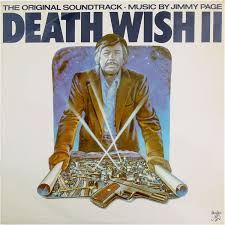
I’m a movie guy more than a music guy, but I still love Jimmy Page. His soundtrack for DEATH WISH II has been a part of my entire life. It’s such a strange, unique score, but it seems to work perfectly for the movie. I was only around 10 years old when I first saw an “edited for TV” version of the movie in ‘83 or ‘84. To be completely honest, the music kinda scared me. I laugh when I type that now, but it’s the truth! Parts of the soundtrack were rearranged again a few years later for DEATH WISH 3, the Charles Bronson movie I’ve watched more than any other.
Happy Birthday, Mr. Page!! Thanks so much for being Michael Winner’s neighbor and composing that soundtrack. This guy from Arkansas truly appreciates it!
I’ve attached a link to the soundtrack below for your listening pleasure!
In 1925, on this very date, Lee Van Cleef was born in Somervillve, New Jersey. In honor of what would have been Lee Van Cleef’s 100th birthday, here he is with Klaus Kinski and Clint Eastwood in For A Few Dollars More.
There’s not a lot of dialogue in this scene but when you had actors like Eastwood, Kinski, and Lee Van Cleef, you didn’t need a lot of dialogue to make an impression.
4 Or More Shots From 4 Or More Films is just what it says it is, 4 shots from 4 of our favorite films. As opposed to the reviews and recaps that we usually post, 4 Shots From 4 Films lets the visuals do the talking!
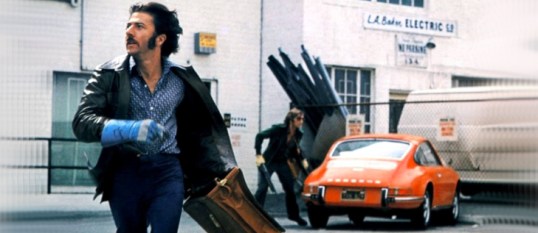
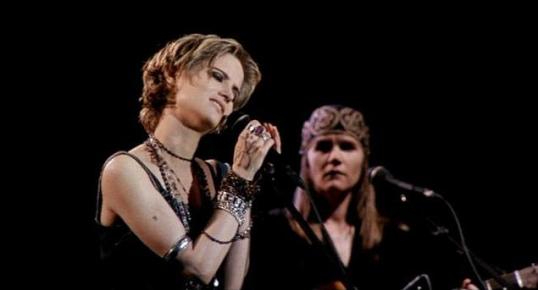
Today, on what would have been his 97 birthday, we pay tribute to director Ulu Grobsard with….
4 Shots From 4 Ulu Grosbard Films
The Subject Was Roses (1968, dir by Ulu Grosbard, DP: Jack Priestley)
Straight Time (1978, dir by Ulu Grosbard, DP: Owen Roizman)
True Confessions (1981, dir by Ulu Grosbard, DP: Owen Roizman)
Georgia (1995, dir by Ulu Grosbard, DP: Jan Kiesser)
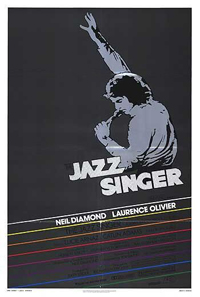
In the 1980 remake of The Jazz Singer, it only takes the film seven minutes to find an excuse to put Neil Diamond in blackface.
Of course, the film was a remake of the 1927 version of The Jazz Singer, which featured several scenes of Al Jolson performing in blackface. In fact, Al Jolson in blackface was such a key part of the film that it was even the image that was used to advertise the film when it was first released. Back in the 20s, Jolson said that wearing blackface was a way of honoring the black artists who created jazz. (As shocking as the image of Al Jolson wearing blackface is to modern sensibilities, Jolson was considered a strong advocate for civil rights and one of the few white singers to regularly appear on stage with black musicians.) Regardless of Jolson’s motives, less-progressively minded performers used blackface as a way to reinforce racial stereotypes and, to modern audiences, blackface is an abhorrent reminder of how black people were marginalized by a racist culture. You would think that, if there was any element of the original film that a remake would change, it would be the lead character performing in blackface.
But nope. Seven minutes into the remake, songwriter Jess Robin (Neil Diamond) puts on a fake afro and dons blackface so that he can perform on stage at a black club with the group that is performing his songs. The group’s name is the Four Brothers and, unfortunately, one of the Brothers was arrested the day of the performance. Jess performs with the group and the crowd loves it until they see his white hands. Ernie Hudson — yes, Ernie Hudson — stands up and yells, “That’s a white boy!” A riot breaks out. The police show up. Jess and the three remaining Brothers are arrested and taken to jail. Jess is eventually bailed out by his father, Cantor Rabinovitch (Laurence Olivier). The Cantor is shocked to discover that his son, Yussel Rabinovitch, has been performing under the name Jess Robin. He’s also stunned to learn that Yussel doesn’t want to be a cantor like his father. Instead, he wants to write and perform modern music. The Cantor tells Yussel that his voice is God’s instrument, not his own. Yussel returns home to his wife, Rivka (Caitlin Adams), and tries to put aside his dreams.
But when a recording artist named Keith Lennox (Paul Nicholas) wants to record one Yussel’s songs, Yussel flies out to Los Angeles. As Jess Robin, he is shocked to discover that Lennox wants to turn a ballad that he wrote into a hard rock number, Jess sings the song to show Lennox how it should sound. The arrogant Lennox is not impressed but his agent, Molly (Lucie Arnaz) is. Soon, Jess has a chance to become a star but what about the family he left behind in New York? “I have no son!” the Cantor wails when he learns about Jess’s new life in California.
I’ve often seen the 1980 version of The Jazz Singer referred to as being one of the worst films of all time. I watched it a few days ago and I wouldn’t go that far. It’s not really terrible as much as its just kind of bland. For someone who has had as long and successful a career as Neil Diamond, he gives a surprisingly charisma-free performance in the lead role. The most memorable thing about Diamond’s performance is that he refuses to maintain eye contact with any of the other performers, which makes Jess seem like kind of a sullen brat. It also doesn’t help that Diamond appears to be in his 40s in this film, playing a role that was clearly written for a much younger artist. Still, when it comes to bad acting, no one can beat a very miscast Laurence Olivier, delivering his lines with an overdone Yiddish accent and dramatically tearing at his clothes to indicate that Yussel is dead to him. Olivier was neither Jewish nor a New Yorker and that becomes very clear the more one watches this film. It takes a truly great actor to give a performance this bad. Diamond, at least, could point to the fact that he was a nonactor given a starring role in a major studio production. Olivier, on the other hand, really had no one to blame but himself.
Still, I have to admit that ending the film with a sparkly Neil Diamond performing America while Laurence Olivier nods in the audience was perhaps the best possible way to bring this film to a close. It’s a moment of beautiful kitsch. The Jazz Singer needed more of that.
Just for the hell of it, I went on a little Robert Duvall marathon for his birthday on January 5th. I started the marathon off with his superior western with Kevin Costner, OPEN RANGE (2003). Next up was Duvall’s excellent crime film with Joe Don Baker and Robert Ryan, THE OUTFIT (1973). Duvall was in badass mode in this one. Based on one of Richard Stark’s “Parker” books, this was my first time to watch the film and damn, it was excellent. After that, I watched the bleak THE ROAD (2009), starring Viggo Mortensen, where Duvall just had a small part. It was a downer. I finished off the marathon late in the evening with A FAMILY THING (1996). I remember when this movie came out in the 1990’s because it was co-written by Billy Bob Thornton. Thornton was still a year away from his massive success with the movie SLING BLADE, but I knew him from his writing and co-starring in the superior crime film ONE FALSE MOVE (1991), as well as his small role in TOMBSTONE (1993). As an Arkansan, I knew Thornton was from Arkansas so I had taken a particular interest in him. But I was only 22 years old when A FAMILY THING was released, and a movie about a couple of old guys resolving family issues didn’t seem that appealing to me. As a guy into his 50’s, the entire concept seems more interesting to me now, so I gave it a spin for the first time to close out the marathon.
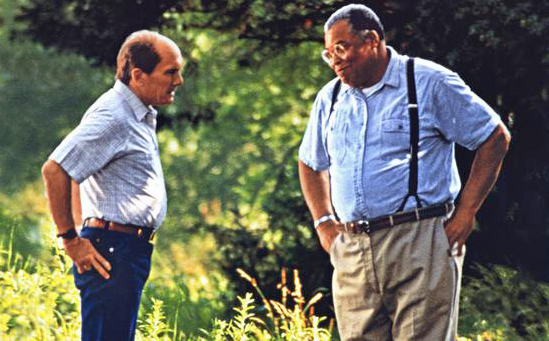
The story opens up in rural Arkansas with Earl Pilcher Jr. (Robert Duvall) getting the shock of his life when his beloved mother writes a final letter to him and instructs her local pastor to deliver it a few days after her death. The letter tells Earl that his biological mother was a black woman named Willa Mae who died in childbirth. It seems that Earl’s dad had gotten Willa Mae pregnant, and since he came out white, his “mother” was able to raise him as her own without having to tell him the truth. The letter also tells him that he has a half-brother named Ray Murdock (James Earl Jones) living in Chicago. It’s her dying wish that he meet Ray and get to know him as family. Pissed at his dad, and wanting to honor his mom, Earl heads to Chicago to meet Ray. Earl knows that Ray is a cop so he’s able to track him down. They immediately don’t like each other, but through a variety of circumstances, Earl ends up staying at Ray’s house for a couple of days. While there, he meets Ray’s wise, old Aunt T., Willa Mae’s sister (Irma P. Hall) and his sullen son Virgil (Michael Beach). Will the two men continue to push each other away, or will they eventually find the family connection that exists under all that messy past?
I was surprised how deeply I was affected by A FAMILY THING. I’d be lying if I said I didn’t get teary-eyed a couple of times. The movie may use issues of adultery and racism to get the ball rolling, but more than anything else, it seems to understand that life is messy and that people are messy. We’ll disappoint ourselves, we’ll disappoint other people, and other people will disappoint us. There’s a reason that many people find their love in dogs and cats instead of people, because real relationships can be tough. The truth about my own life is that I could not have appreciated this film in 1996 at only 22 years of age. I was too naive. That’s no longer the case in 2025, and I can now truly relate to this story of two men who share a painful history, find common ground, and decide it’s worth moving forward together because family really does matter.
A movie like A FAMILY THING has no chance of working without a great cast, and this movie is a thespian jackpot. Robert Duvall is spot on perfect as the good ole guy from Arkansas, with a little bit of a racism engrained down deep into his soul, who now has to deal with the fact that he is half black. The scene where he confronts his dad about the lies that had been told to him all his life is as good as it gets. James Earl Jones matches Duvall in the even trickier role as the man who has always known about his “white” half brother Earl. This man has buried his hatred away for Earl’s father for decades, who he blames for the death of his own mother, and now has to deal with those feelings being dredged back up to the surface when Earl shows up in Chicago. Jones perfectly balances his character’s desire to keep the past in the past, with his decency as a man who doesn’t want to just throw Earl out on the street. He eventually softens towards him no matter how much bitterness he has for Earl’s dad. And neither Duvall or Jones even give the best performance in the film. That honor goes to Irma P. Hall as the blind, but extremely perceptive Aunt T. She sees through all of their bullshit, as she states to each of them on different occasions, and encourages them to get to know each other because they’re family. As they play games of racism and bitterness, she reminds them they are brothers no matter the color of their skin. It’s the performance of a lifetime and was at least worthy of an Oscar nomination in my opinion.
Overall, A FAMILY THING may compress the amount of time and potential therapy it would take to resolve the type of family history presented here, but it does find a certain truth in the power of relationships. Earl and Ray don’t have to recognize the fact that they are brothers. As a matter of fact their lives are just fine without each other. But it’s their willingness to embrace the messy truth and find a way to connect with each other that makes the movie meaningful to me!
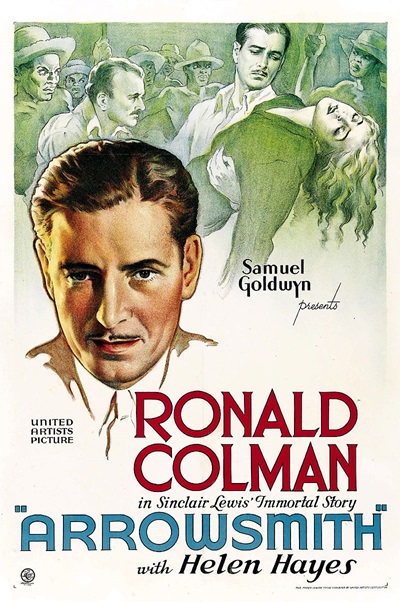
In the 1931 Best Picture nominee Arrowsmith, Ronald Colman stars as Martin Arrowsmith, a doctor who is trying to save lives without compromising his ethics.
Arrowsmith is mentored by the famed bacteriologist, Max Gottlieb (A.E. Anson) and married to a nurse named Leora (Helen Hayes). At first, Arrowsmith makes his living as the local doctor in Leora’s small hometown in South Dakota. However, Arrowsmith is ambitious and wants to do more with his life and career than just take care of a small town. He wants to cure the world of disease. When he’s offered a position at the prestigious McGurk Institute in New York, he enthusiastically accepts. Having just suffered a miscarriage, Leora supports Arrowsmith’s decision and travels to New York with him. No matter what happens, Leora is always there to support her husband, even when he doesn’t seem to appreciate it.
When Arrowsmith thinks that he’s discovered an antibiotic serum that appears to be capable of curing all sorts of diseases, he attempts to stay true to the methods taught to him by Dr. Gottlieb. He takes his time. He tests carefully. He doesn’t rush out and give the serum to everyone. However, Arrowsmith finds his methods continually sabotaged by his colleagues, who hope to raise money by telling the press about a miracle serum that can “cure all diseases!” When Arrowsmith later finds himself combatting an outbreak of the Bubonic Plague in the West Indies, he again tries to employ the scientific method but finds himself being pressured by government officials to give his untested serum to every single person on the island. Eventually, Arrowsmith’s ethics are pushed to their limits when even Leora falls ill.
Arrowsmith was based on a best-selling novel by Sinclair Lewis, though the plot was changed to make the story more palpable for film audiences. In the novel, Arrowsmith is a bit of cad who regularly cheats on his wife. In the film, Arrowsmith is passionate and driven but the exact nature of his relationship with wealthy Joyce Lanyon (Myrna Loy) is left so ambiguous that it actually leaves one wondering why the character is in the film at all. What both the film and the novel have in common is an emphasis on the importance of science and the scientific method. Arrowsmith’s idealism runs into the harsh reality of life during an epidemic. Government officials are more concerned with saying that they’ve done something as opposed to considering whether their actions have ultimately done more harm than good. In its way, Arrowsmith predicted the COVID era.
Arrowsmith was the first John Ford film to be nominated for Best Picture and its financial success allowed Ford the freedom to go on to become one of Hollywood’s most important directors. Seen today, Arrowsmith feels a bit creaky and self-important, with little of the visual flair that Ford brought to his later films. Ronald Colman’s performance as Arrowsmith seems a bit stiff, especially when compared to the much more lively (and sympathetic) performance of Helen Hayes. Arrowsmith is a big and serious film and, if we’re going to be honest, it’s a little bit boring. Still, it’s interesting to see the issues of today being debated 90 years in the past.
As for the Oscars, Arrowsmith was nominated for Best Picture, Adaptation, Cinematography, and Art Direction. It lost in all four of the categories in which it was nominated. That year, Best Picture was won by Grand Hotel, which curiously didn’t receive any other nominations at all.
The Director Guild has announced its nominees for the best of 2024. This is one of strongest of the precursors so A Complete Unknown getting mentioned both by the DGA and the SAG would seem to indicate that it’s going to get a Best Picture nod as well. We’ll find out next week!
FEATURE FILM
JACQUES AUDIARD, Emilia Pérez
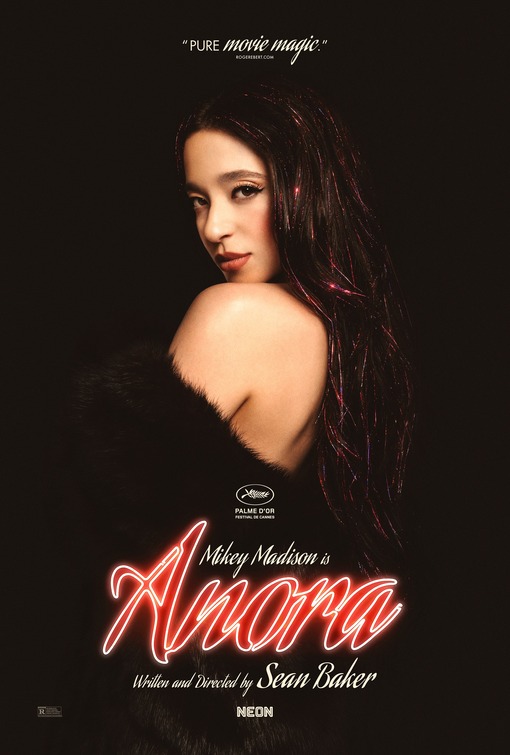
SEAN BAKER, Anora
EDWARD BERGER, Conclave
BRADY CORBET, The Brutalist
JAMES MANGOLD, A Complete Unknown
FIRST-TIME THEATRICAL FEATURE FILM
PAYAL KAPADIA, All We Imagine as Light
MEGAN PARK, My Old Ass
RAMELL ROSS, Nickel Boys
HALFDAN ULLMANN TØNDEL, Armand
SEAN WANG, Dìdi
For today’s song of the day, we have my favorite David Bowie song, Heroes. Heroes was also featured in one of my favorite downbeat movies, 1981’s Christiane F.
I, I will be king And you, you will be queen Though nothing will drive them away We can beat them, just for one day We can be heroes, just for one day
And you, you can be mean And I, I’ll drink all the time ‘Cause we’re lovers, and that is a fact Yes we’re lovers, and that is that Though nothing will keep us together We could steal time just for one day We can be heroes for ever and ever What d’you say?
I, I wish you could swim Like the dolphins, like dolphins can swim Though nothing, nothing will keep us together We can beat them, for ever and ever Oh we can be Heroes, just for one day
I, I will be king And you, you will be queen Though nothing will drive them away We can be Heroes, just for one day We can be us, just for one day
I, I can remember (I remember) Standing, by the wall (by the wall) And the guns, shot above our heads (over our heads) And we kissed, as though nothing could fall (nothing could fall) And the shame, was on the other side Oh we can beat them, for ever and ever Then we could be Heroes, just for one day
We can be Heroes We can be Heroes We can be Heroes Just for one day We can be Heroes
We’re nothing, and nothing will help us Maybe we’re lying, then you better not stay But we could be safer, just for one day
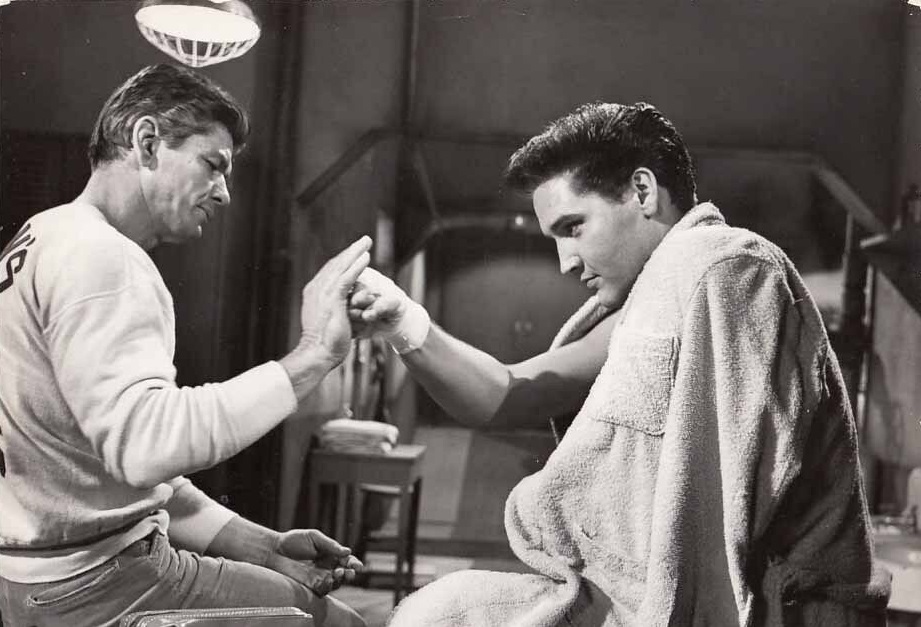
In celebration of the January 8th birthday of the great Elvis Presley, I decided to watch his 1962 film KID GALAHAD, the only film where he co-stars with my movie hero Charles Bronson. I’ve always been a fan of Elvis Presley and seeing him on-screen with Bronson is a real treat for me.
KID GALAHAD opens with Walter Gulick (Elvis Presley) returning to his hometown in upstate New York. Recently discharged from the army, and in the need of money, the aspiring mechanic finds his way to Willy Grogan’s (Gig Young) boxing camp and agrees to spar with one of his up-and-coming young boxers. Walter doesn’t have much boxing skill, but he ends up having one hell of a right hook and knocks the young boxer flat on his ass. Seeing this, Willy Grogan, who has all sorts of personal and financial problems, thinks Walter might be the answer to getting out of debt to his bookie. Willy asks his trainer Lew (Charles Bronson) to work with the young, strong Walter, who’s now been dubbed “Galahad” by Willy’s girlfriend Dolly (Lola Albright) after he had protected her honor from a “man who doesn’t know how to behave around a lady.” Pretty soon, Willy has fights arranged for Walter under the name of “Kid Galahad.” The first fight begins with Galahad getting his faced being punched repeatedly until he gets one opening and then knocks the other fighter out with one punch. After that, with Lew’s help, Galahad’s skills start showing definite improvement. When he’s not working with Lew at the gym, Galahad finds time to romance and propose to Willy’s sister, Rose (Joan Blackman). This causes problems with the troubled Willy who doesn’t want his sister married to some “meatball” or “grease monkey.” Even worse, smelling money, gangster Otto Danzig (David Lewis) and his henchmen start putting pressure on the financially troubled Willy to force Galahad to take a dive in his big fight with “Sugar Boy” Romero so they can clean up on the fix, going so far as breaking Lew’s hands. Will Willy get the balls to say no to the gangsters? Will Galahad be able to beat Sugar Boy Romero and then retire to open his garage with Rose by his side? You probably already know, but you’ll just have to watch and see!
1962’s KID GALAHAD is a remake of a 1937 movie of the same name directed by Michael Curtiz, and starring cinematic legends Edward G. Robinson, Bette Davis, and Humphrey Bogart. I’ve never seen the earlier version, so I will not compare the two in any way. And to be completely honest, I haven’t watched very many Elvis Presley movies either. As I type this, I can’t think of a single moment I remember in his filmography not included in KID GALAHAD, and I wouldn’t have watched this one without the presence of Charles Bronson. With that said, I think Elvis gives a good performance in KID GALAHAD. He’s very likable, with his character having an old-fashioned chivalry towards women, a friendly, open way with men, and an appreciation for a strong work ethic. I think Elvis handles each of these parts of his character in a way to that makes me want to root for him. As good as Elvis is as Kid Galahad, Gig Young does most of the heavy lifting as the story really revolves around his character’s troubles even more than it does around Galahad. I think he does a pretty good job of taking a character who’s a pretty sorry guy, and by the end of the movie we actually find ourselves starting to like him. Even though he’s in a true supporting role, Charles Bronson is excellent as the trainer who teaches Galahad how to box. Every scene Bronson’s in is elevated by his enormous screen presence and authority. With Bronson in his corner, you feel Galahad is capable of anything. The most powerful scene in the entire film is when the gangsters try to buy his character off under the threat of violence, and he refuses, leading to his hands being broken. After becoming one of the biggest stars on the planet a number of years later, it’s easy to look back at these moments and wonder how in the hell was he not already a huge star in 1962.
Of course, this being an Elvis Presley movie, there are several musical numbers spread throughout the movie. While I don’t remember too much about the songs themselves, they didn’t really take me out of the drama of the movie either. I actually enjoyed seeing Elvis perform, with the people around him clapping along and enjoying themselves. I do remember a specific scene where Elvis is singing as he’s driving down the road, and Bronson’s sitting in the back seat with a big smile on his face like he’s having a great time. That’s my favorite moment of all the songs.
Although I haven’t watched many of his movies, I’ve been an appreciative fan of Elvis Presley all my life. I can’t tell you how many times I heard his Christmas album in my younger years, as my mom would play it almost on repeat once we got to November. He was a talented, versatile singer whose charisma and stage presence have never been matched, and whose influence on music and entertainment is immeasurable. The fact that Elvis Presley and Charles Bronson made KID GALAHAD together means something to me, and I had a great time revisiting the film on his birthday!
Due to the catastrophic wildfires currently burning in California, Tte Screen Actors Guild dispensed with their usual big nominations announcement and instead sent out a simple press release their morning.
Here are the SAG’s film nominations. The SAG is a usually pretty good precursor so the folks who were celebrating the victory of the Brutalist on Sunday night have a bit less to celebrate today. That said, the 2,0000-person nominating committee appear to have really liked The Last Showgirl. Let’s keep Pamela Anderson’s Oscar hopes alive!
Outstanding Performance by a Male Actor in a Leading Role
ADRIEN BRODY / László Tóth – “THE BRUTALIST”
TIMOTHÉE CHALAMET / Bob Dylan – “A COMPLETE UNKNOWN”
DANIEL CRAIG / William Lee – “QUEER”
COLMAN DOMINGO / Divine G – “SING SING”
RALPH FIENNES / Lawrence – “CONCLAVE”
Outstanding Performance by a Female Actor in a Leading Role
PAMELA ANDERSON / Shelly – “THE LAST SHOWGIRL”
CYNTHIA ERIVO / Elphaba – “WICKED”
KARLA SOFÍA GASCÓN / Emilia/Manitas – “EMILIA PÉREZ”
MIKEY MADISON / Ani – “ANORA”
DEMI MOORE / Elisabeth – “THE SUBSTANCE”
Outstanding Performance by a Male Actor in a Supporting Role
JONATHAN BAILEY / Fiyero – “WICKED”
YURA BORISOV / Igor – “ANORA”
KIERAN CULKIN / Benji Kaplan – “A REAL PAIN”
EDWARD NORTON / Pete Seeger – “A COMPLETE UNKNOWN”
JEREMY STRONG / Roy Cohn – “THE APPRENTICE”
Outstanding Performance by a Female Actor in a Supporting Role
MONICA BARBARO / Joan Baez – “A COMPLETE UNKNOWN”
JAMIE LEE CURTIS / Annette – “THE LAST SHOWGIRL”
DANIELLE DEADWYLER / Berniece – “THE PIANO LESSON”
ARIANA GRANDE / Galinda/Glinda – “WICKED”
ZOE SALDAÑA / Rita – “EMILIA PÉREZ”
Outstanding Performance by a Cast in a Motion Picture A COMPLETE UNKNOWN
MONICA BARBARO / Joan Baez
NORBERT LEO BUTZ / Alan Lomax
TIMOTHÉE CHALAMET / Bob Dylan
ELLE FANNING / Sylvie Russo
DAN FOGLER / Albert Grossman
WILL HARRISON / Bobby Neuwirth
ERIKO HATSUNE / Toshi Seeger
BOYD HOLBROOK / Johnny Cash
SCOOT MCNAIRY / Woody Guthrie
BIG BILL MORGANFIELD / Jesse Moffette
EDWARD NORTON / Pete Seeger
ANORA
YURA BORISOV / Igor
MARK EYDELSHTEYN / Ivan
KARREN KARAGULIAN / Toros
MIKEY MADISON / Ani
ALEKSEY SEREBRYAKOV / Nikolai Zakharov
VACHE TOVMASYAN / Garnick
CONCLAVE
SERGIO CASTELLITTO / Tedesco
RALPH FIENNES / Lawrence
JOHN LITHGOW / Tremblay
LUCIAN MSAMATI / Adeyemi
ISABELLA ROSSELLINI / Sister Agnes
STANLEY TUCCI / Bellini
WICKED
JONATHAN BAILEY / Fiyero
MARISSA BODE / Nessarose
PETER DINKLAGE / Dr. Dillamond
CYNTHIA ERIVO / Elphaba
JEFF GOLDBLUM / The Wonderful Wizard of Oz
ARIANA GRANDE / Galinda/Glinda
ETHAN SLATER / Boq
BOWEN YANG / Pfannee
MICHELLE YEOH / Madame Morrible
Outstanding Action Performance by a Stunt Ensemble in a Motion Picture
DEADPOOL & WOLVERINE
DUNE: PART TWO
THE FALL GUY
GLADIATOR II
WICKED





 Through the Shattered Lens