Film Review: The Enforcer (dir. by James Fargo)


Today, we continue our look at the Dirty Harry film series by reviewing the third film in the series, 1976’s The Enforcer.

There’s a moment, towards the end of this film, where Harry (played as always by Clint Eastwood) is preparing to blow away one of the bad guys.  Before firing, Harry mutters something under his breath.  The first time I watched the film, I couldn’t make out what Harry was saying so I turned on the captioning and watched the scene again to discover just what exactly Harry had said before dispensing justice.

The line: “You fucking fruit.”

Yes, The Enforcer finds Harry at his most reactionary and it’s a good thing too.  Whereas Magnum Force found Harry fighting his fellow cops, The Enforcer could have just as easily been called Harry Vs. Occupy San Francisco.  This time around, the bad guys are members of something called The People’s Revolutionary Strike Force.  They’re led by a psychotic ex-pimp named Bobby Maxwell (played by an actor with the wonderful name of Deveren Bookwalter) and they’re fond of saying things like, “For the people!” before striking.  To be honest, The Enforcer’s villains are some of the most forgettable in the history of the franchise but that’s appropriate.  As opposed to the original Dirty Harry and Magnum Force, The Enforcer is less concerned with being a struggle between equals and more about Harry killing people.

The Enforcer opens with Harry preventing yet another armed robbery.  This time, he manages to destroy the entire store while doing so and ends up costing the city of San Francisco several million dollars.  Harry’s new superior, Capt. McKay (played by Bradford Dillman) isn’t amused and, as a punishment, temporarily transfers Harry over to the Personnel Department.  I have to say that McKay is a very brave man since Harry blew up the last superior who attempted to reprimand him.

Working Personnel, Harry has to sit in on interviews for promotions.  While doing so, he is informed that the Mayor has ordered them to find three women to promote to inspector.  “Women!?” Harry growls in shocked response.

While Harry is busy attempting to impede the march of progress, his old partner DiGiorgio (John Mitchum) stumbles upon Bobby and the revolutionaries stealing weapons.  As often happens with Harry’s partners, DiGiorgio is killed by the bad guys and Harry is transferred back to Homicide so he can investigate the death.  Helping Harry out is his new partner — Kate Moore (Tyne Daly), one of the three women who have recently been promoted to inspector.

While Harry and his new partner are busy tracking down Bobby, Capt. McKay tries to pin the crime on yet another revolutionary force, a group of black militants led by Big Ed Mustapha.

Big Ed is played by Albert Poppwell, who previously appeared in Dirty Harry as the “I’s got to know” robber.  When Harry first meets him, Harry says, “Haven’t I met you before?”  Though the film never explicitly says so, I like to think that the two characters are one in the same.

As for Bobby and the People’s Revolutionary Strike Force, they’re busy kidnapping the mayor and demanding $5,000,000 for his release.  Of course, it’s up to Harry and Moore to rescue the mayor and put all the “fucking fruits” back in their place….

Looking over other reviews of the Dirty Harry franchise, The Enforcer often seems to be dismissed as almost an afterthought.  Daly’s performance is usually praised (and quite rightfully so because she does give the film’s best performance) but the rest of the film is usually dismissed.  To a certain extent, that’s understandable.  As I mentioned before, Bobby Maxwell is not that interesting of a villain and Harry is at his most one dimensional here.

That said, I think The Enforcer is actually underrated.  There might not be much nuance to Eastwood’s performance here but he gets by on charisma alone and he has a likable chemistry with Daly.  As opposed to what we’ve been conditioned to expect from most other films, Harry and Moore’s relationship never turns romantic.  Instead, by the end of the film, they truly are equals.

The Enforcer was followed, nearly a decade later, by Sudden Impact.  We’ll take a look at that film tomorrow.

Film Review: Magnum Force (dir by Ted Post)


Today, we continue our look at the Dirty Harry film franchise by taking a look at the second film in the series, 1973’s Magnum Force.

Despite the fact that Dirty Harry famously ended with Harry Callahan throwing away his badge in disgust, Magnum Force reveals that Callahan (played again by Clint Eastwood) is still a member of the San Francisco Police Department.  He’s got a new partner (Felton Perry, a likable actor in a thankless role) but he’s still butting heads with his superiors at the department.  He’s also still got a way with the one-liners.  When Lt. Briggs (Hal Holbrook) brags that he never once had to draw his gun while he was in uniform, Callahan replies, “A man’s got to know his limitations.”

While Callahan is busying himself with doing things like gunning down robbers and preventing an attempt to hijack a plane, a group of motorcycle cops are gunning down the town’s criminals.  They begin by killing a mobster who has just beaten a murder charge on a technicality but soon, they’re gunning down anyone who has ever so much as been suspected of committing a crime.  Alone among the detectives investigating the murders, Callahan believes that the killers are cops and, even worse, he suspects that his old friend Charlie McCoy (played by Mitchell Ryan) might be a member of the group…

Though it suffers when compared to Dirty Harry, Magnum Force is still an exciting and effective action film that is clearly a product of the same period of time that gave us such classics of paranoid cinema as The Parallax View and Three Days of the Condor.  Whereas Dirty Harry took an almost documentary approach to capturing life and death in San Francisco, Magnum Force is a film that is full of dark shadows and expressionistic angles.

In Dirty Harry, the Scorpio Killer was both an obvious outsider and an obvious force of destruction.  The film’s dramatic tension came from the fact that he was so clearly guilty and yet nothing could be done to stop him.  The villains in Magnum Force are the exact opposite of Scorpio.  As chillingly played by David Soul, Robert Urich, Tim Matheson, and Kip Niven, the killer cops are distinguished not by their otherness but by their total lack of individuality.

In the film’s best scene, they confront Harry in a parking garage and basically tell him that he’s either with them or against him.  Sitting on their motorcycles, wearing their leather jackets, and with their grim faces hidden behind their aviator sunglasses, these cops are the ultimate representation of  faceless fascism.  After listening to their excuses, Harry asks if they consider themselves to be heroes.

“All of our heroes are dead,” one of them replies, delivering the film’s best line.

Obviously, Magnum Force was made to be an answer to those critics who claimed that Dirty Harry was a fascist film and it is a bit jarring, at first, to see Harry “defending” the system.  (“I hate the goddamn system but until something better comes along…”)  When Harry tells the killer cops, “I’m afraid you’ve misjudged me,” it’s not hard to see that this is the same message that Eastwood meant to give his critics.

However, what makes the killer cops in Magnum Force such interesting villains is that they are, ultimately, tools of the system that they’re attempting to destroy.  By killing off criminals as opposed to arresting them and putting them on trial, the killer cops are minimizing the risk of the flaws inherent in the system being exposed.  Hence, by defending the system, Harry is helping to expose and destroy it.

When I told Jeff that I was planning on watching and reviewing all of the Dirty Harry films, he suggested that I watch them in reverse-order.  His logic was that, since the films tended to get worse as the series progressed, watching them backwards would allow me to end my project on a happy note as opposed to a note of bitter disappointment.  I took his advice and I’m glad I did.  While I disagree with him about whether or not The Dead Pool is a better film than Sudden Impact, I do have to agree that the first two Dirty Harry films are dramatically better (and quite different in tone) from the ones that subsequently followed.

Tomorrow, we’ll look at the third film in the series, 1976’s The Enforcer.

Film Review: Dirty Harry (dir. by Don Siegel)


“Dirty Harry is obviously just a genre film but this action genre has always had fascist potential and it has finally surfaced…Dirty Harry is a deeply immoral movie.” — Pauline Kael

“It’s not about a man who stands for violence.  It’s about a man who can’t understand society tolerating violence.” — Clint Eastwood

I decided that I wanted to review the Dirty Harry film franchise about two seconds after Clint Eastwood finished giving his speech at the Republican National Convention last month. 

It had nothing to do with the politics of Eastwood’s speech because, quite frankly, I think a good film is a work of art and art is always more important than politics.  Instead, as I watched Eastwood give his speech, I was reminded that Clint Eastwood is about as close to a living icon as we have in America.  There aren’t many actors who could get away with giving a speech to an empty chair and, despite the predictable outraged tweets from Roger Ebert, Eastwood is one of them.  And, if Eastwood is an icon, Harry Callahan is perhaps the most iconic role of his career.

Now, I have to admit that, as I started this project, I knew more about Harry Callahan as a character than I did about the films he had actually appeared in.  I had seen both Dirty Harry and The Dead Pool because, for whatever reason, they both seem to turn up on AMC every other week.  I knew that Harry Callahan was a police inspector who was based in San Francisco.  I knew that he was willing to go to extremes when it came to fighting criminals.  I knew that, in his first film appearance, Harry had a really impressive head of hair that had pretty much vanished by the time that he reached his final appearance in The Dead Pool.  And, finally, I knew that, at some point in the film series, Harry growled the line, “Go ahead, make my day.”

So, for me, reviewing every film in the Dirty Harry franchise gave me a chance to discover why Harry has become such an iconic character and why people still ask Eastwood to repeat that “make my day” line.  When I started watching the films, Jeff warned me that the Dirty Harry films got worse as you went along and I discovered that, in many ways, he was right.  But I still enjoyed the experience and I hope that you enjoy reading my reviews over the next few days.

But, first things first.  Let’s take a look at the film that started the entire series, 1971’s Dirty Harry.

I have to admit that it’s a bit intimidating to try to review Dirty Harry because, quite frankly, what’s left to be said about this film?  It’s one of the most influential movies of all time. Any time you see a cop in a TV show or a movie getting yelled at by his superiors for not going “by the book,” it means that you’re watching a movie or an episode that is directly descended from Dirty Harry.  And yet, despite all the imitations, it’s a movie that remains as exciting and visceral today as when it was first released. 

Dirty Harry tells the story of two outsiders, two men who seem to exist solely to reveal the dark impulses of conventional society.  Both of these men are killers and both of these men are motivated by a rage against what they perceive society as being. 

One of these men calls himself Scorpio.  As played by Andy Robinson (who gives one of the definitive cinematic psycho performances here), Scorpio is a jittery mass of nerves, an unkempt man who wears a peace sign as a belt buckle but who also writes letters to the Mayor of San Francisco (played by John Vernon) in which he threatens to kill one innocent person a day unless he’s paid off.  When he first appears, he’s on a rooftop, aiming a rifle at an unaware woman in a swimming pool. At one point, the phallic barrel of rifle seems to be pointed directly at the camera (and by extension, at us in the audience).  When he fires the rifle, we see the mortally wounded woman silently sink under the water.  It’s a scene that still disturbs me every time I see it, one that establishes early on that we’re all potentially vulnerable to the Scorpios of the world.

In the next scene, we see San Francisco Police Inspector Harry Callahan (Clint Eastwood, of course) investigating the crime scene.  The difference between Harry and Scorpio is striking.  Whereas Scorpio is only calm while killing, Callahan inspects the crime scene (and goes through almost the entire film) without showing a hint of emotion.  While Scorpio looks like a madman, Callahan looks like a professional.  And yet, when Callahan foils a bank robbery (and delivers his famous “Do you feel lucky?” monologue to wounded bank robber played by Albert Popwell), it becomes obvious that he does have something in common with Scorpio.  They’re both willing to shoot to kill.  The only difference is that, as a police officer, Callahan is ostracized for his willingness to kill while Scorpio, as an American citizen, is protected by the U.S. Constitution.

It would be foolish to pretend that Dirty Harry isn’t a political film.  One need only watch the scene where a law professor explains to Harry why his pursuit and arrest of Scorpio violated Scorpio’s constitutional rights.  (The way that Eastwood snarls during this scene is priceless.)  As one can tell from the quote from Pauline Kael at the beginning of this review, Dirty Harry was a film that upset a lot of liberals when it was first released (much as Clint Eastwood’s empty chair speech managed to upset Roger Ebert).  However, as the years have passed, Dirty Harry has come to be acknowledged as a classic by critics on both sides of the political divide.

The success of Dirty Harry goes beyond politics.  I think any film students who aspires to direct an action film should be required to watch Dirty Harry a few dozen times before he graduates.  What makes the film work is not just what director Don Siegel does but what he doesn’t do.  As opposed to some of the later films in the franchise, Dirty Harry is a fast-paced film that tells its story with a minimum amount of padding.  It’s hard to think of a single scene that isn’t necessary to tell the story that the film wants to tell.  Even the oft-criticized scene where Harry, on a stake out, spies on some naked lesbians, works as a parallel to Scorpio’s own voyeurism at the start of the film.

Much as in a classic western, Harry and Scorpio are presented as two sides of the same coin.  Both of them are outsiders who refuse to follow the rules of society and the film’s violent and mournful climax is powerful precisely because, by this point, the audience understands that the Scorpios of the world can not exist without the Harrys and vice versa.

Along with generated a lot of controversy, Dirty Harry was a huge box office success.  Not surprisingly, a sequel would follow.

We’ll look at Magnum Force tomorrow.

Scenes That I Love: It’s Time To Change!


Since I previously shared two of my favorite scenes from The Brady Bunch Movie, I figured that today I would share one of my favorite scenes from 1996’s A Very Brady Sequel.  In this scene, the Brady kids abduct Tim Matheson and force him to take part in an elaborate musical number.

Enjoy!

The Daily Grindhouse: The Town That Dreaded Sundown (dir. by Charles B. Pierce)


Down here in Texas, we love our legends and the Phantom Killer is one of the most haunting.  In 1946, as American soldiers were returning from World War II and the country was looking forward to a future of peace and prosperity, an unknown killer stalked the moonlit streets of my former hometown of Texarkana, Texas.  (Technically, of course, Texarkana is located in both Texas and Arkansas.  In Texas, it’s usually assumed that the killer had to be from the Arkansas half of the town.)  From February until May, he attacked 8 people and killed 5 of them.  He stalked lovers who were parking at night and those that survived said that he hid his face underneath a white mask.  Despite the best efforts of both the Texas Rangers and the Texarkana police, the Phantom Killer was never captured and his reign of violence ended just as mysteriously as it began.

(My personal theory is that he ended up moving to California where he later became the Zodiac killer because, seriously, the two cases are so disturbingly similar.  Eventually, he left California and moved to Ohio and, living under a false name, he killed himself in 2002. )

When you read the facts of the Phantom Killer’s murder spree (not to mention all of the rumors and urban legends that have sprung up around the case), the main thing that jumps out at you is just how much it all truly does sound like a low-budget horror film.  Therefore, it’s not surprising to discover that, in 1976, the case served as the basis for just that.  What is surprising is just how effective The Town The Dreaded Sundown is.

The film was directed by Charles B. Pierce, an independent filmmaker who was based in Arkansas.  Pierce had previously directed The Legend of Boggy Creek, a “documentary” that was about the mysterious Bigfoot-like creature who is rumored to live in Fouke, Arkansas.  (Fouke, incidentally, is a town that my family briefly called home though none of us ever saw or heard any Bigfoots wandering about.)  Using the money that he made off of the Boggy Creek film, Pierce wrote, directed, and produced The Town The Dreaded Sundown.

Using the same technique that made The Legend of Boggy Creek such a success, Pierce filmed The Town That Dreaded Sundown on location in Texarkana and, along with established actors like Ben Johnson, Andrew Prine, and Tina Louise Dawn Welles, Pierce cast the film with local citizens.  When seen on screen, it’s obvious that these citizens are not professional actors.  However, what they may lack in talent they make up for authenticity.  (If nothing else, The Town That Dreaded Sundown is a rare Texas-set film in that it doesn’t feature any yankees butchering the dialect.)  The fact that the film is narrated by a grim-sounding narrator only adds to the film’s documentary-like feel.

Admittedly, the film does take some liberties with the story of the Phantom Killer but what’s important is that it’s accurate when it matters.  The film gets the basic facts correct and even the most outlandish of embellishments (such as a scene where the killer uses a trombone to kill one of his victims) don’t detract from the film’s power to frighten and disturb.  If nothing else, these feel like the type of details that one might spontaneously mention while telling an old ghost story.  Unlike a lot of “true crime” films, The Town The Dreaded Sundown never devotes too much time to trying to figure out the killer’s motives or drop hints as to his identity.  Instead, the film emphasizes the fact that the Phantom Killer could never be understood and was never stopped.  He simply existed, a malevolent force of evil.  This makes the film far more effective than it would have been if Pierce had spent the movie trying to explain that which can not be explained.

Unfortunately, The Town That Dreaded Sundown has never been released on DVD but it does show up occasionally on TCM.  Keep an eye out for it!

Film Review: Gabriel Over The White House (dir. by Gregory La Cava)


This is a strange one.

Released in 1933, Gabriel Over The White House is an unapologetic work of propaganda.  It tells the story of President Judson Hammond (Walter Huston), a likable but unimpressive political hack who seems to be blissfully unconcerned with the fact that, as the film begins, the country is mired in an economic depression, crime is out of control (largely as the result of the prohibition of alcohol), and the world is teetering on the edge of another world war. 

As the result of a suspicious car crash, Hammond spends several days in a coma.  When Hammond finally wakes up, he is a changed man.  Not only is he personally more aggressive but he now sometimes seems to be listening to a voice that only he can hear.  His secretaries even catch Hammond apparently talking to himself.  A lot of people would probably suggest that this indicates that Hammond may be going crazy but, in this film, they instead speculate that perhaps he’s talking to (and taking his orders from) the angel who is responsible for bringing him out his coma.  “Gabriel over the White House,” as one of them puts it.

Whether as a result of divine guidance or his own personal psychosis, Hammond quickly sets out to solve the country’s problems by setting himself up as a dictator.  He declares martial law, dissolves Congress, and announces that, from now on, all laws will be made by him.  Instead of legalizing alcohol, he announces that only the government will be allowed to sell it and he deals with poverty by redistributing everyone else’s money.  He also starts a new national police force  that arrests any and all dissenters.  These dissenters are charged with treason and tried by a military tribunal.  Those found guilty are immediately executed.  While delivering one guilty verdict, Judge Franchot Tone takes the time to praise President Hammond for suspending all legal rights.

Here’s the thing that makes this film so different and disturbing.  The movie is totally and completely on the side of President Hammond.  Walter Huston plays the role with a Lincolnesque sort of gravity and the film’s supporting cast spends most of their time assuring us that things have never been better than they are under Judson Hammond’s dictatorship.  In short, this is an American film that says that what the country needs is a dictator who will unite the country by blaming every problem on one group of scapegoats and execute anyone who shows the slightest hint of dissent.

(Even more interestingly, Gabriel Over The White House premiered the same year that Adolf Hitler came to power in Germany.)

This being an election year, it’s tempting to try to draw some sort of parallel between Gabriel Over The White House’s pro-dictatorship message and our own current political situation.  That’s especially true for someone, like me, who naturally distrusts any type of authority.  And I have to admit that, as I watched the film, I did find myself comparing the fictional President Hammond to both a certain real-life president and a certain presidential candidate who, like their cinematic counterpart, often seems to be rather smug in their belief in their own moral superiority. 

But, to be honest, it’s difficult for me to compare Gabriel Over The White House to our current situation because Gabriel Over The White House is so heavy-handed and just so weird that it’s difficult to take seriously.  It’s not so much the idea that a President would become a dictator as much as it’s the fact that, with the exception of a few millionaires and a few bootleggers, nobody else in the film seems to be too concerned about this.  This is a propaganda film.  There’s no room for ambiguity and that lack of ambiguity makes it difficult to take the film seriously as anything other than just wish-fulfillment on that part of elitists who are sick of having to deal with the opinions of those outside of their social circle.

Even while advocating the type dictatorship that would soon be epitomized by the likes of Hitler, Mussolini, and Stalin, Gabriel Over The White House was one of the many pacifist-themed films that were released between the two world wars.  We’ve grown so used to the idea of the world being perpetually at war that it’s easy to forget that, long ago, the world was actually so horrified by the first World War that a lot of very serious, powerful, and intelligent people dedicated themselves to trying to figure out a way to ensure that there would never be another one.  Just as films today are obsessed with environmentalism, the films of this earlier period were obsessed with world peace.  While some films advocated world government and many attempted to recreate the horrors of World War I as the ultimate deterrent, Gabriel Over The White House might be unique as one of the only American films to suggest that world peace could best be achieved by dictatorship.

(It’s interesting to compare these old pacifist films — even vaguely disturbing ones like Gabriel Over The White House — to the current political climate in the United States, where our leaders brag about personally choosing who to kill from week to week.) 

As I stated at the start of this review, Gabriel Over The White House is a strange film.  In fact, it’s one of the strangest films I’ve ever seen.  It’s also an invaluable resource for anyone who is fascinated with history.  It’s a true look into the psyche of a proud nation that’s confidence had been shaken by the twin calamities of war and economic depression.  Watching a film like this, which seems so desperate to try to convince us that not only can the world’s problems be solved but that they can be solved by following a set of very specific steps, it’s a little easier to understand how desperate and shaken people can give up their freedom to a dictator who seems to say all the right things.

Gabriel Over The White House is not the easiest film to see put it pops up on TCM occasionally.  (That’s how I saw it.)  It’s a film so strange that it simply has to be seen.

Scenes That I Love: Good Time Music!


For the past few days, I’ve been sharing some of my favorite scenes from two of my favorite movies from the 90s — The Brady Bunch Sequel (1995) and A Very Brady Sequel (1996).  I’m sure that some people would say that devoting that much time to two films that spoof a terrible show is a bit excessive.

But you know what?

Excess is underrated.

Before I close the book on this celebration of the Brady Bunch films, I wanted to share one more scene that I love.  In this scene from A Very Brady Sequel, the Bradys remind us that flying should be fun!

Enjoy some good time music!

The Daily Grindhouse: Chappaqua (dir. by Conrad Rooks)


At the risk of sounding like every other girl who has ever sat in a corner of Starbucks and spent a few hours writing emo poetry in her Hello Kitty notebook, I love the Beat Generation.  I’ve read all of Jack Kerouac’s novels, Allen Ginsberg’s poems, and William S. Burroughs’ cut-ups.  I’ve even tried to listen to the music of the Fugs and I just recently finished reading the very first Beat novel, John Clellon Holmes’ Go.  It was my interest in the Beats that led to me discovering Chappaqua.

Originally filmed in 1966 and released a year later, Chappaqua was produced, written, and directed by Conrad Rooks.  The son of the president of Avon, Rooks had a lot of money and a lot of addictions.  In 1962, Rooks checked into a European clinic where he detoxed and claimed to have been cured of his drug dependency through something called “sleep therapy.”  Chappaqua is based on his experiences both as a drug addict and a patient and, since Rooks was something of a hanger-on in the American underground art scene, the final film featured cameos from such counterculture figures as Allen Ginsberg and William S. Burroughs.

In the film, Rooks plays himself, a young man who is usually seen wandering aimlessly from one location to another.  The film is edited in such a way that you’re never quite sure where Rooks is going to be from one scene to another.  Most famously, the film’s opening features Rooks wandering across the countryside of Nebraska while images (and sounds) of New York’s 42nd Street are superimposed over his face.  Later on in the film, Rooks will just as abruptly turn up walking through the streets of India and meditating with a random guru.  Rooks, it quickly becomes apparent, is a man with no true home, a wanderer who seems to randomly alternate between being lost and being on a mission.

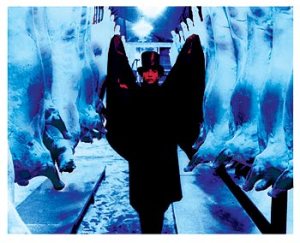
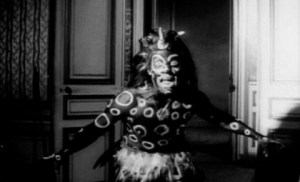
For most of the film, however, Rooks is in a small clinic outside of France.  Along with telling his doctor (played by Jean-Louis Barrault) about how he came to be addicted to drugs and alcohol, Rooks goes through withdrawal and has the surreal hallucinations that dominate the majority of the film.  During one hallucination, Rooks sees himself as a gangster gunning down a midget in a parking garage.  Then, suddenly, Rooks is no longer a gangster and instead, he’s a vampire speaking in an over-pronounced Transylvanian accent.   A druid appears and does a jig in the middle of the Stonehenge and a witch doctor shows up and starts to dance through the halls of the clinic.  Throughout it all, Rooks is haunted by the image of a stunningly beautiful woman (Paula Pritchett) in a white dress, kneeling by a placid lake.  Observing all of this is the menacing figure of Opium Jones (played by William S. Burroughs), who continually encourages Rooks to stay on drugs and who may, or may not, be a figment of Rooks’ imagination.

How to explain the odd (and occasionally frustrating) charm of Chappaqua.  This is truly a pretentious mess of a movie, full of symbolism that is both obvious and willfully obscure.  However, there’s a strange charm to the film’s pretension.  The film may not make much sense but it’s never incoherent.  Largely thanks to cinematographer Robert Frank, the visuals of the film are so strong and striking that they often provide the narrative drive that the film would otherwise lack.  Chappaqua is, ultimately, just a fascinating film to watch.

My main reason for enjoying and recommending Chappaqua, is that the film truly is a time capsule.  Both the film’s strengths and its flaws can be linked back to the fact that it was made in 1966.  It’s a true cultural artifact and, therefore, it is a must-see for anyone who is interested in either the Beats or the counter-culture that was indirectly descended from them.

A Very Late Film Review: Extremely Loud and Incredibly Close (dir. by Stephen Daldry)


Earlier this month, I finally found the time to see Extremely Loud and Incredibly Close, the critically reviled “prestige” picture that was the center of a minor scandal when it received an Academy Award nomination for best picture back in January.

That nomination, by the way, is the only reason that I made a point of DVRing the film when I saw that it was going to be on HBO.  I had already been turned off by the film’s trailer and the subject matter (a little kid trying to make sense of 9-11 by wandering around New York with a mute old man) seemed like the sort of thing that could only have been made effective by a Roberto Rossellini or a Vittorio De Sica.  Say what you will about director Stephen Daldry (and I think that both Billy Elliott and The Reader are excellent films), he’s not an Italian neorealist.  Extremely Loud and Incredibly Close seemed like just the film to bring out his worst instincts as a filmmaker.

Having now finally seen the film, I am sorry to say that my initial instincts were correct.  Extremely Loud and Incredibly Close is the type of film that gives a bad name to good intentions.  This is the type of film that you watch and you know that you should be touched by the subject matter but it just all feels so forced, heavy-handed, and ultimately quite empty.

The film tells the story of Oskar (played by Thomas Horn), a brilliant child who is also a bit abrasive and neurotic.  At one point, Oskar says that he’s been tested for Asperger syndrome but that the tests were “inconclusive.”  What’s interesting about this is that in the book that this film is based on, the possibility that Oskar might be autistic is never stated or even hinted at.  Instead, he’s just an abrasive kid and, to be honest, the film’s decision to make Oskar autistic feels less like characterization and more like narrative laziness.  It’s hard not to feel that the filmmakers introduced autism as a way to avoid dealing with the fact that Oskar (especially as played by Thomas Horn) is perhaps one of the most abrasive and annoying characters in film history.

Oskar’s life falls apart when his father, Thomas (Tom Hanks), is killed on 9-11.  He obsessively listens to the final 6 messages that his father left on the family’s answering machine, even while he hides those messages from his mother (Sandra Bullock).

A year later, Oskar is exploring his father’s closet and finds a vase that has an envelope in it.  Inside the envelope is a key and written on the envelope is the word “Black.”  Convinced that the key is a final message from his father, Oskar looks up the address of every single person in New York whose last name is Black and sets about tracking each one of them down and demanding to know if they knew his father.  Eventually, he’s joined in his quest by a sad-eyed mute (Max Von Sydow) who lives with Oskar’s grandmother.

Extremely Loud and Incredibly Close is based on a novel and the film’s central idea — that Oskar’s quest is his way of trying to make some sort of sense out of the September 11th terrorist attacks — is one that works better as a literary metaphor than as an actual story.  While Oskar’s quest might seem poignant on paper, it becomes narcissistic and rather insensitive when seen on film.  You find yourself wondering why so many New Yorkers are willing to let this obnoxious and rather annoying little brat into the homes, especially when he usually responds to their hospitality by being rude and condescending.

(In the film’s defense, it does try to address that very issue at the end of the movie but it does so in a way that just doesn’t seem that plausible.)

Ultimately, the film feels like a rather crass exploitation of a true-life tragedy and it’s made even more offensive by Daldry’s heavy-handed approach to the material.  This is the type of material that needed more than a hint of realism and instead, Daldry seems to feel that it’s necessary to manipulate us into thinking that 9-11 was a national trauma (as if we didn’t already know that).  The all-star approach that Daldry takes to casting his story also serves to undermine the film’s message.  At moments when you should be wrapped up in the unfolding melodrama, you find yourself saying, “Hey, it’s John Goodman!  There’s Viola Davis!  Oh look!  Jeffrey Wright!”  Extremely Loud and Incredibly Close ultimately feels less like a film about a national trauma and more like a slick Towering Inferno-style disaster flick.

The film’s one saving grace is Max Von Sydow, who dominates this entire film without saying a word or even having that much screen time.  One wishes that Daldry had told his 9-11 story through Von Sydow’s sad eyes and just left the kid at home.

Scenes I Love: Keep On Dancing All Through The Night!


Yesterday, I featured my favorite scene from 1996’s The Brady Bunch Movie.  Today, my scene that I love is my second favorite scene from that same film.  In this scene, the Brady kids save the day (and their house) with this exciting performance of Keep On.

I love the way that the song just fades out when the Bradys stop to take their final bow.