Retro Television Review: The Love Boat 5.19 “New York, A.C./Live It Up/All’s Fair in Love and War”


Welcome to Retro Television Reviews, a feature where we review some of our favorite and least favorite shows of the past!  On Wednesdays, I will be reviewing the original Love Boat, which aired on ABC from 1977 to 1986!  The series can be streamed on Paramount Plus!
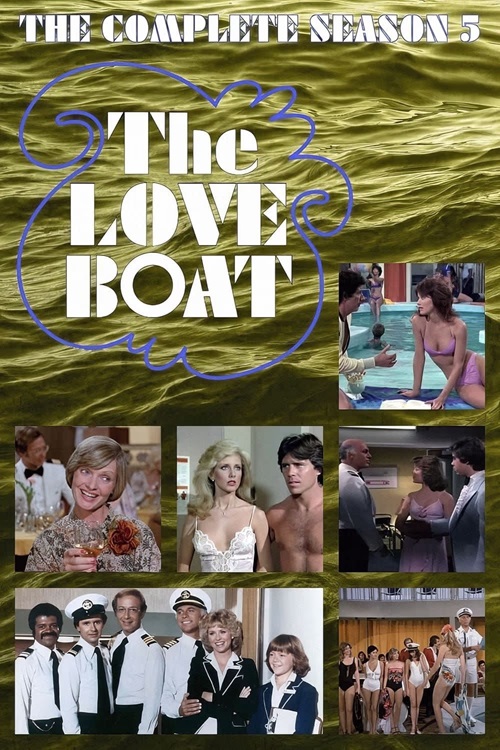
Come aboard, we’re expecting you!

Episode 5.19 “New York, A.C./Live It Up/All’s Fair in Love and War”

(Dir by Richard Kinon, originally aired on February 20th, 1982)

Poor Captain Stubing!  He’s just returned from burying an old friend named George and now, he’s thinking about his own mortality.  When he starts to feel unwell, Stubing goes to Dr. Bricker who tells Stubing that his problems are not physical.  The problem is that …. STUBING’S DEPRESSED!  Stubing decides to live each day to the fullest and good for him.  This was a simple storyline but I liked it.  I always appreciate the episodes that allow Stubing to be vulnerable without turning him into a hard-luck doofus.  In this episode, Stubing was dealing with something that almost everyone has either had to or will deal with at some point in their life.  It was also nice to see Doc Bricker giving good advice for once.  Bernie Kopell is so likable in the role that I always appreciate it when he gets to play Doc as being something other than a lech.

As for the other two stories …. agck!

Three New York friends (played by former teen idols Eddie Byrnes, Fabian, and Bobby Sherman) have boarded the cruise.  They are members of the Alimony Club.  They’re all divorced and they’ve all sworn that they’ll keep each other from marrying again.  They are a club that believes all marriages are doomed to failure.  But when Sherman’s ex-wife, Annette Funicello, boards the boat, it looks like the Alimony Club might lose a member.  And listen, I know that guys have their little rituals and their little clubs and that’s okay.  But the Alimony Club just feels weird.  It should be called the Misery Club because they seem to be more interested in keeping Bobby Sherman depressed than anything else.  I always find it odd when previously divorced couples get back together on The Love Boat.  I mean, did they forget why they got divorced in the first place?

Meanwhile, Jill St. John and Ron Ely have been having an affair for four years.  Every 12 months, they get together for a romantic getaway.  Ron says he can’t marry Jill because he’s married and has children back home.  (*cough* jerk *cough*)  Jill, who really could do better, insists that Ron leave his wife.  She even has her brother board the cruise and flirt with her (*cough*  Oh my Gosh, creepy! *cough*) to make Ron jealous.  Ron gets jealous, alright.  He beats up Jill’s brother and then reveals that he was lying about having a wife.  He’s not married …. he’s scared of commitment!  And now he’s ready to get married!  Uhmmm …. like seriously, WHAT THE HECK IS THAT!?  (I gave up cursing for Lent.)  Jill — you were a BOND GIRL!  You were TIFFANY FREAKING CASE!  YOU CAN DO BETTER!

Oy vey, this episode.

Retro Television Reviews: Fantasy Island 3.17 “Playgirl/Smith’s Valhalla”


Welcome to Retro Television Reviews, a feature where we review some of our favorite and least favorite shows of the past!  On Tuesdays, I will be reviewing the original Fantasy Island, which ran on ABC from 1977 to 1986.  Almost entire show is currently streaming is on Youtube!

This week, Leslie Nielsen returns to Fantasy Island!

Episode 3.17 “Playgirl/Smith’s Valhalla”

(Dir by Michael Vejar, originally aired on January 26th, 1980)

This week, Tattoo is super excited because one of the guests is Erica Clark (Barbie Benton), a famous centerfold for Rooster Magazine!  Erica, however, no longer models.  As she explains to Mr. Roarke, she grew tired of men treating her as just being a sex object.  Indeed, her fantasy is to be able to treat men the same way!  (Today, of course, Erica could save however much money she spent for the fantasy by simply watching clips of Magic Mike on YouTube.)

In perhaps the simplest fantasy that Mr. Roarke has ever put together, he sends Erica to the Island’s famed Jackrabbit Club, where men dance while women watch.  Again, to be clear, all Mr. Roarke had to do was send her to the island’s version of Chippendales.  I mean, Erica could have just done that on her own.  Anyway, Erica witnesses one of the dancers, Walter Wilde (Fabian Forte), getting fired for refusing to go along with being sexually harassed by one of the women in the audience.  Relating to Walter, his desire to go to medical school, and his life as a single father to Dinah (Heather McAdam), Erica agrees to come out of retirement and pose (in a bikini with a big rooster tail hooked on the back) for the club’s owner, Big Earl Sanderson (Denny Miller).  However, when Big Earl demands that Erica do more than just pose, Walter is there to punch him out.

Anyway, it turns out that Dinah’s fantasy was for Walter to fall in love and Roarke combined her fantasy with Erica’s, presumably to save some money.  So, Erica, Walter, and Dinah leave the island together and I guess Erica learns that …. well, I’m not sure anyone learned anything.  This was a pretty weak fantasy that claimed to be about treating men as sex objects but spent the majority of time looking for excuses to put Barbi Benton in a bikini.  Seriously, Jackrabbit was the tamest male strip club I’ve ever seen.

Meanwhile, the Island finds itself in what should be an international incident after a group of dirty commies hijack a plane and make it land at an abandoned Fantasy Island airport.  The communists say that they are doing this because they have to get people to pay attention to their cause but it’s hard not to notice that there’s next to no media coverage of the events, there are no soldiers or police surrounding the airport, and Mr. Roarke merely shrugs it off.

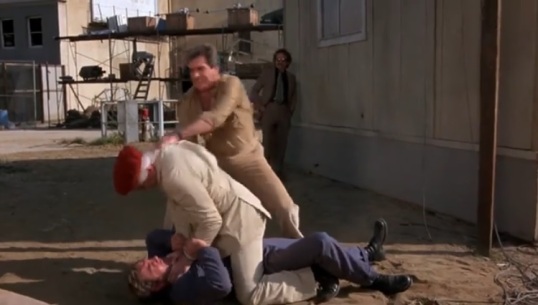
The only person who does care is Jason Smith (Hugh O’Brian), whose fantasy is to lead a combat mission.  The fantasy becomes personal for Jason when he discovers that his wife (Emily Banks) is one of the hostages!  Mr. Roarke arranges to Jason to work with three combat experts.

Buck Tanner (Sean Garrison) is an explosives expert who suffers from war flashbacks.

“Weasel” Forbes (Charlies Dierkop) is a wild sniper.

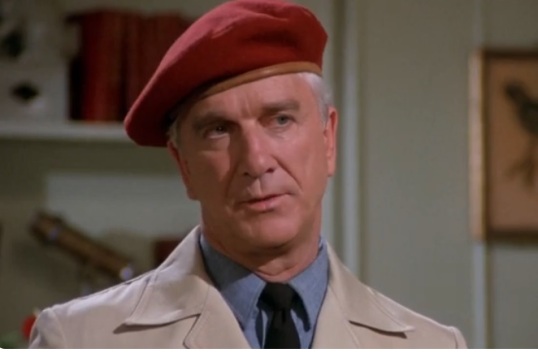
And French soldier of fortune Emile Bouvier is …. LESLIE NIELSEN!

Yes, this episode of Fantasy Island features Leslie Nielsen is one of the last of his “serious” roles, playing a French mercenary by wearing a red beret and not even attempting an accent.  Bouver is tough and no-nonsense, as we learn when he catches Buck drinking on the job.

Anyway, Jason is able to rescue his wife and the other hostages and the communists are all arrested and hopefully sacrificed to the Fantasy Island mermaid.  Bouvier sacrifices his life to save Jason’s but Mr. Roark explains that it was no big deal because Bouvier was dying anyways and his fantasy was to end his life doing something heroic.  Once again, it appears that Mr. Roarke saved some money by combining fantasies.  Was Fantasy Island feeling the effects of the Carter recession?  Perhaps.

Other than Leslie Nielsen playing a serious role, probably the most interesting thing about this episode is that Mr. Roarke and Tattoo barely spoke to each other over the course of it.  There was none of the usual comedic banter or anything like that.  Indeed, even in the scenes greeting and saying goodbye to their guests, Ricardo Montalban and Herve Villechaize refused to every look at each other.  Obviously, it wasn’t all happy days on Fantasy Island.

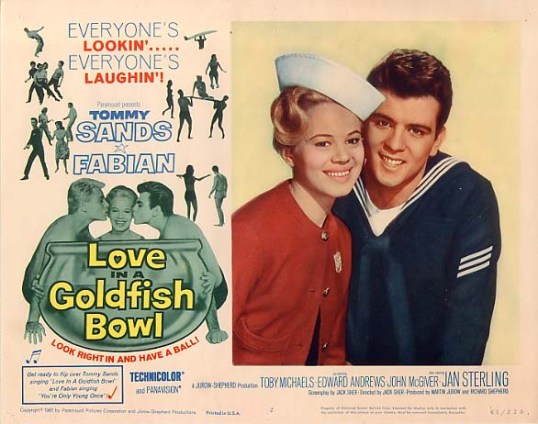
Spring Breakdown: Love In A Goldfish Bowl (dir by Jack Sher)


The 1961 film, Love in a Goldfish Bowl, tells the story of two college students.

Gordon Slide (Tommy Sands) and Blythe Holloway (Toby Michaels) are best friends.  Their relationship is strictly platonic, though everyone at the college assumes that they’re more than just friends.  Gordon and Blythe both share the common bond of coming from broken but wealthy families and they both want to do something more with their lives than just following the rules.  Blythe is a good student, the daughter of a senator.  Gordon is styles himself as being a cynic, or at least what was considered to be a cynic by the standards of 1961.  (James Dean would have probably called him a phony.)  The school’s headmaster (John McGiver) suspects that 1) Gordon and Blythe are more than just friends and 2) that Gordon is a bad influence on Blythe.  He even orders them to stop seeing each other, which I guess is something that headmasters could get away with in 1961.

Still, it’s going to take more than some stuffy authority figure to keep Gordon and Blythe for enjoying their Spring Break!  Especially when Gordon’s mother happens to own a beach house, which would be the perfect place for the two of them to hang out.  Despite knowing that each of their parent probably wouldn’t approve of them spending the break together, Gordon and Blythe decide to do just that.  Blythe even gets permission for her father, albeit by duplicitous means.  (Gordon imitates the headmaster on the phone.  Wow, that wild and crazy Gordon.)

At first, the beach house seems like the perfect place for Gordon and Blythe to unwind.  But when they meet Giuseppe La Barba (Fabian Forte), things start to change.  A member of the Coast Guard, Giuseppe plots to steal Blythe away from Gordon, with his schemes causing Gordon and Blythe to reconsider their feelings for each other.

Considering that this film is 60 years old, it’s perhaps not surprising that Love In A Goldfish Bowl often feels like it’s a rusty time capsule that someone buried in the sand on a California beach.  Everything from the intrusive headmaster to the scandal of divorce to the domestic routine that both Gordon and Blythe naturally slip into as soon as they arrive at the beach house makes this film feel almost as if it comes from another planet.  While the film is critical of adults who don’t understand what it’s like to be young and idealistic, it also ultimately ends with the suggestion that the adults might not be so clueless themselves.  It’s a bit of a wishy-washy approach to what little conflict the film has to offer up.

My point here is that Love In A Goldfish Bowl is an amazingly innocent little film, the type of Spring Break movie that would cause even your grandma to say, “Those kids really need to loosen up and live a little.”  Usually, I kind of like time capsule films like this, just because I’m a history nerd and I’m always interested in seeing how people used to live and communicate.  Unfortunately, Love In A Goldfish Bowl is a remarkably slow 88 minutes and neither Tommy Sands nor Toby Michaels have enough chemistry to be interesting as friends, let alone as a chaste couple waiting for their wedding night.  Fabian has a little bit more screen presence than Tommy Sands but overall, this is a pretty bland affair.

Ultimately, this film is mostly interesting as an example of what beach movies were like before AIP reinvented the genre with the Frankie and Annette beach party films.  Thank goodness people finally learned how to celebrate being young and on the beach.

Drive-In Saturday Night: DR. GOLDFOOT AND THE BIKINI MACHINE (AIP 1965) & DR. GOLDFOOT AND THE GIRL BOMBS (AIP 1966)


gary loggins's avatarcracked rear viewer

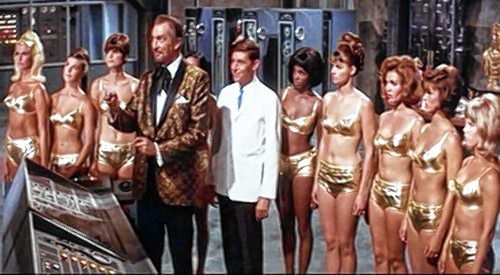
American-International Pictures, never ones to shy away from jumping on a trend, released a pair of secret agent spoofs starring the one and only Vincent Price as the evil supervillain Dr. Goldfoot. AIP president James H. Nicholson himself allegedly came up with the story, wanting to use the film as a showcase for wife Susan Hart, a beautiful woman of limited talent. The first was DR. GOLDFOOT AND THE BIKINI MACHINE, an endearingly goofy little movie co-starring SKI PARTY’s Frankie Avalon and Dwayne Hickman. The two even use the same character names from that previous film, Tod Armstrong and Craig Gamble – only reversed, with Frankie as Craig and Dwayne as Tod!

Mad scientist Goldfoot, an obvious cross between James Bond nemeses Dr. No and Goldfinger, is Price at his campy best, carving up large slices of ham as the malevolent meanie. His fiendish plot is creating an army of…

View original post 595 more words

Lisa Reviews An Oscar Nominee: The Longest Day (dir by Ken Annakin, Andrew Marton, Bernhard Wicki, Gerd Oswald, and Darryl F. Zanuck)


As my sister has already pointed out, today is the 73rd anniversary of D-Day.  With that in mind, and as a part of my ongoing mission to see and review every single film ever nominated for best picture, I decided to watch the 1962 film, The Longest Day!

The Longest Day is a pain-staking and meticulous recreation of invasion of Normandy, much of it filmed on location.  It was reportedly something of a dream project for the head of the 20th Century Fox, Darryl F. Zanuck.  Zanuck set out to make both the ultimate tribute to the Allied forces and the greatest war movie ever.  Based on a best seller, The Longest Day has five credited screenwriters and three credited directors.  (Ken Annakin was credited with “British and French exteriors,” Andrew Marton did “American exteriors,” and the German scenes were credited to Bernhard Wicki.  Oddly, Gerd Oswald was not credited for his work on the parachuting scenes, even though those were some of the strongest scenes in the film.)  Even though he was not credited as either a screenwriter or a director, it is generally agreed that the film ultimately reflected the vision of Darryl F. Zanuck.  Zanuck not only rewrote the script but he also directed a few scenes as well.  The film had a budget of 7.75 million dollars, which was a huge amount in 1962.  (Until Steven Spielberg’s Schindler’s List, The Longest Day was the most expensive black-and-white film ever made.)  Not only did the film tell an epic story, but it also had an epic length.  Clocking in at 3 hours, The Longest Day was also one of the longest movies to ever be nominated for best picture.

The Longest Day also had an epic cast.  Zanuck assembled an all-star cast for his recreation of D-Day.  If you’re like me and you love watching old movies on TCM, you’ll see a lot of familiar faces go rushing by during the course of The Longest Day.  American generals were played by actors like Robert Mitchum, Robert Ryan, Henry Fonda, and John Wayne.  Peter Lawford, then the brother-in-law of the President of the United States, had a memorable role as the Scottish Lord Lovat, who marched through D-Day to the sounds of bagpipes.  When the Allied troops storm the beach, everyone from Roddy McDowall to Sal Mineo to Robert Wagner to singer Paul Anka can be seen dodging bullets.  Sean Connery pops up, speaking in his Scottish accent and providing comic relief.  When a group of paratroopers parachute into an occupied village, comedian Red Buttons ends up hanging from the steeple of a church.  When Richard Beymer (who is currently playing Ben Horne on Twin Peaks) gets separated from his squad, he stumbles across Richard Burton.  Among those representing the French are Arletty and Christian Marquand.  (Ironically, after World War II, Arletty was convicted of collaborating with the Germans and spent 18 months under house arrest.  Her crime was having a romantic relationship with a German soldier.  It is said that, in response to the charges, Arletty said, “My heart is French but my ass is international.”)  Meanwhile, among the Germans, one can find three future Bond villains: Gert Frobe, Curt Jurgens, and Walter Gotell.

It’s a big film and, to be honest, it’s too big.  It’s hard to keep track of everyone and, even though the battle scenes are probably about an intense as one could get away with in 1962 (though it’s nowhere near as effective as the famous opening of Saving Private Ryan, I still felt bad when Jeffrey Hunter and Eddie Albert were gunned down), their effectiveness is compromised by the film’s all-star approach.  Often times, the action threatens to come to a halt so that everyone can get their close-up.  Unfortunately, most of those famous faces don’t really get much of a chance to make an impression.  Even as the battle rages, you keep getting distracted by questions like, “Was that guy famous or was he just an extra?”

Among the big stars, most of them play to their personas.  John Wayne, for instance, may have been cast as General Benjamin Vandervoort but there’s never any doubt that he’s playing John Wayne.  When he tells his troops to “send them to Hell,” it’s not Vandervoort giving orders.  It’s John Wayne representing America.  Henry Fonda may be identified as being General Theodore Roosevelt II but, ultimately, you react to him because he’s Henry Fonda, a symbol of middle-American decency.  Neither Wayne nor Fonda gives a bad performance but you never forget that you’re watching Fonda and Wayne.

Throughout this huge film, there are bits and pieces that work so well that you wish the film had just concentrated on them as opposed to trying to tell every single story that occurred during D-Day.  I liked Robert Mitchum as a tough but caring general who, in the midst of battle, gives a speech that inspires his troops to keep fighting.  The scenes of Peter Lawford marching with a bagpiper at his side were nicely surreal.  Finally, there’s Richard Beymer, wandering around the French countryside and going through the entire day without firing his gun once.  Beymer gets the best line of the film when he says, “I wonder if we won.”  It’s such a modest line but it’s probably the most powerful line in the film.  I wish The Longest Day had more scenes like that.

The Longest Day was nominated for best picture of 1962 but it lost to an even longer film, Lawrence of Arabia.