The TSL’s Horror Grindhouse: The Terminal Man (dir by Mike Hodges)


Check out the poster for 1974’s The Terminal Man.

Look at it carefully.  Examine it.  Try to ignore the fact that it’s weird that George Segal was once a film star.  Yes, on the poster, Segal has been drawn to have a somewhat strange look on his face.  Ignore that.  Instead, concentrate on the words in the top left corner of the poster.

“ADULT ENTERTAINMENT!” it reads.

That’s actually quite an accurate description.  The Terminal Man is definitely a film for adults.  No, it’s not pornographic or anything like that.  Instead, it’s a movie about “grown up” concerns.  It’s a mature film.  In some ways, that’s a good thing.  In some ways, that’s a bad thing.

Taking place in the near future (and based on a novel by Michael Crichton), The Terminal Man tells the story of Harry Benson (played, of course, by George Segal).  Harry is an extremely intelligent computer programmer and he’s losing his mind.  It might be because he was in a serious car accident.  It may have even started before that.  Harry has black outs and when he wakes up, he discovers that he’s done violent things.  Even when he’s not blacked out, Harry worries that computers are going to rise up against humans and take over the world.

However, a group of scientists think that they have a way to “fix” Harry.  It’ll require a lot of brain surgery, of course.  (And, this being a film from 1973, the film goes into excruciating details as it explains what’s going to be done to Harry.)  The plan is to implant an electrode in Harry’s brain.  Whenever Harry starts to have a seizure, the electrode will shock him out of it.  The theory is that, much like Alex in A Clockwork Orange 0r Gerard Malanga in Vinyl, Harry will be rendered incapable of violence.

Of course, some people are more enthusiastic about this plan than others.  Harry’s psychiatrist (Joan Hackett) fears that implanting an electrode in Harry’s brain will just make him even more paranoid about the rise of the computers.  Other scientists worry about the ethics of using technology to modify someone’s behavior.  Whatever happens, will it be worth the price of Harry’s free will?

But, regardless of the risks, Harry goes through with the operation.

Does it work?  Well, if it worked, it would be a pretty boring movie so, of course, it doesn’t work.  (Allowing Harry’s operation to work would have been like allowing King Kong to enjoy his trip to New York.)  Harry’s brain becomes addicted to the electrical shocks and, as he starts to have more and more seizures, Harry becomes even more dangerous than he was before…

The Terminal Man is a thought-provoking but rather somber film.  On the one hand, it’s a rather slow movie.  The movie does eventually get exciting after Harry comes out of surgery but it literally takes forever to get there.  The movie seems to be really determined to convince the audience that the story it’s telling is scientifically plausible.  On the other hand, The Terminal Man does deal with very real and very important issues.  Considering how threatened society is by people who cannot be controlled, issues of behavior modification and free thought will always be relevant.

Though the film may be slow, I actually really liked The Terminal Man.  Judging from some of the other reviews that I’ve read, I may be alone in that.  It appears to be a seriously underrated film.  As directed by Mike Hodges, the film is visually stunning, emphasizing the sterility of the white-walled hospital, the gray blandness of the doctors, and the colorful vibrancy of life outside of science.  Though he initially seems miscast, George Segal gives a good and menacing performance as Harry.

The Terminal Man requires some patience but it’s worth it.

The TSL’s Horror Grindhouse: Scream Blacula Scream (dir by Bob Kelljan)


Am I correct in assuming that everyone knows who Blacula was?

Blacula is often described as being the black Dracula but actually, it’s a little bit more complicated than that.  In life, he was an African prince named Mamuwalde who, in 1780, went to Dracula’s castle and asked for the count’s help in suppressing the slave trade.  Dracula turned him into a vampire instead and, after declaring that Mamuwalde would forever be known as Blacula, he proceeded to lock Mamuwalde in a coffin.  That’s where Mamuwalde remained for 290 years, until he managed to escape.  By that point, his coffin had been relocated from Transylvania to Los Angeles.

All of that was revealed in the 1972 film, BlaculaBlacula, which starred a distinguished Shakespearean actor named William Marshall in the lead role, was a surprise hit so, of course, Mamuwalde (played again by Marshall) returned the following year in a sequel.  It didn’t matter that the first Blacula ended with Mamuwalde deliberately ending his existence by walking out into the sunlight.  Blacula would return!

It also didn’t matter if anyone in the audience for Scream, Blacula, Scream had somehow missed seeing the first movie.  Scream, Blacula, Scream features lengthy flashbacks to the first film.  It makes sense, really.  Why waste money on all new footage when you can just pad the sequel with scenes from its predecessor?

I’m disappointed to say that Scream, Blacula, Scream did not feature any disco action.  When I saw that this movie would be airing on TCM Underground, I decided to watch it specifically because I figured there would be at least one scene of Blacula dancing underneath a spinning disco ball.  I mean, it was a movie from the 70s, right?  Honestly, I think that if Scream, Blacula, Scream had been made later in the decade, it would have featured at least one disco dance scene.

What the film did have was a lot of voodoo.  Judging from this movie, Live and Let Die, and the House on Skull Mountain, it would appear that people in the early 70s were really obsessed with voodoo.  When the movie opens, a voodoo priestess named Mama Loa is dying and she’s just named her apprentice, Lisa (Pam Grier), as the new head of the cult.  Mama Loa’s son, Willis (Richard Lawson), isn’t happy about this decision so, for some reason, he decides that it would be a good idea to bring Blacula back to life.

Willis apparently thought that the revived Blacula would be his servant but it doesn’t work out like that.  First off, Blacula was perfectly happy being dead.  Secondly, he is no one’s servant.  Blacula promptly bites Willis on the neck and then proceeds to vampirize nearly everyone that he comes across.  Soon, Blacula has an army of vampires but all he wants is to be human again.

And who can help him reach that goal?

How about the city’s newest voodoo priestess, Lisa?

Now, I will say this about Scream, Blacula, Blacula.  The main character is named Lisa and that automatically makes it an above average movie.  The entire movie features people saying, “Lisa” over and over again and you know I loved listening to that.

Other than that, though, the movie was kind of a mess.  It was obviously written and filmed in a hurry and, as a result, a lot of the action felt like padding.  For a subplot that wasn’t that interesting to begin with, the voodoo cult power struggle got way too much screen time.  On the plus side, William Marshall and Pam Grier were both a hundred times better than the material that they had to work with.  Regardless of how ludicrous the dialogue was, Marshall delivered it with dignity and just the right hint of ennui.

Scream, Blacula, Scream is not a particularly good film but it’s worth seeing for Marshall and Grier.


6 Trailers For October 15th, Inspired by TCM Underground!


It’s time, once again, for another October edition of Lisa Marie’s Favorite Grindhouse and Exploitation Film trailers!

This week’s edition was inspired by watching TCM Underground last night.  In fact, the last two trailers features are for the two films that I watched.

  1. Abby (1974)

This film was also released under the title Black Exorcist.  Warner Bros. actually brought suit against Abby, claiming that it was such an obvious rip-off of The Exorcist that it should not be allowed to play in theaters.  Warner Bros. actually won their suit but not before Abby made a lot of money.

2. Sugar Hill (1974)

Sugar Hill is a popular film here at the Shattered Lens.  Check out the reviews from both Arleigh and Gary!  And be sure to watch the trailer.

3. Blackenstein (1973)

Blackenstein is one of those titles that sounds like it has to be a parody but no, it’s a real movie.  There’s even a trailer to prove it.

4. Dr. Black, Mr. Hyde (1976)

Again, the title might sound like a parody but this is a very real film and, from what I’ve read, apparently a rather highly-regarded one as well.  This is on my list of films to see, though I have a feeling that Gary will probably beat me to it.

5. Blacula (1972)

From William Crain, the director of Dr. Black and My Hyde

And starring William Marshall, the star of Abby

It’s Blacula!  This is the first film that I watched on TCM Underground and it’s a legitimate classic.  Check out Gary’s review here!  And watch the trailer below:

6. Scream, Blacula, Scream (1973)

Of course, any successful film is going to get an inferior sequel.  This was also the second movie that I watched on TCM Underground last night.


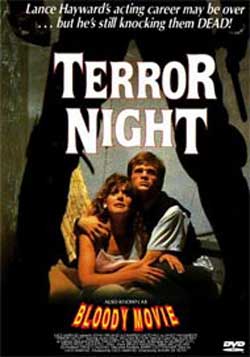
The TSL’s Horror Grindhouse: Terror Night, aka Bloody Movie (dir by Nick Marino)


Okay, so this is kind of a weird one.

The movie known as Bloody Movie was originally filmed in 1987, under the title Terror Night.  However, it was never released.  There are plenty of rumors about why it wasn’t released.  Some people say that it was because the film was produced with Mafia money.  Some people say it was because it used a lot of footage that was lifted from other movies and the producers apparently didn’t bother to clear the rights.  Of course, it’s also totally possible that the film wasn’t released because it wasn’t very good.  I mean, that does happen.

Regardless of why, the film apparently sat on the shelf for 20 years.  It was finally released by Fred Olen Ray’s Retromedia and retitled Bloody Movie.  That said, the DVD that I own (and watched for this review) was released by Legacy Entertainment and still had the Terror Night title.  The transfer on the Legacy DVD was notably bad.  From what I’ve been told, the Retromedia release looks a lot better.

Now, there’s a lot bad things that can be said about Terror Night.  It’s low-budget, which is one of those things that can be overcome by a clever director but, in this case, it just results in Terror Night looking cheap.  It’s poorly written, full of one-dimensional characters who were shallow even by the standards of a late 80s slasher.  This is also one of those movies where formerly respectable actors pop up for five minutes cameos.  Whenever one of those actors shows up, all the action stops so that they can earn their paycheck.  Aldo Ray is homeless and doomed.  Cameron Mitchell is a cynical cop and doomed.  Alan Hale, Jr. is an affable security guard and apparently not doomed.  There’s no real reason for any of them to be there but there they are!  There’s also a biker couple who show up for no particular reason, along with the typical collection of teenage victims.

But yet, there are moments when Terror Night goes from being bland to being almost transcendently odd..  There are moments of comedy mixed in with some surprisingly mean-spirited death scenes.  Necks are snapped.  Heads are chopped off.  Bodies are split in half.  It all gets rather messy and the presence of all those old time actors makes the sudden gore scenes feel all the more strange.

However, the main thing that distinguishes Terror Night from the other slashers of the era is the identity of the killer.  (And, before anyone yells at me, this is not a spoiler.  There is never any mystery about who the killer is.)  Lance Hayward is not a zombie like Jason Voorhees or a silent symbol of evil like Michael Myers.  He’s not seeking vengeance for some crime in the past.  Instead, he’s a former silent screen star.  (It seems like Hayward would have been close to 90 years old at the time of Terror Night.  He’s still surprisingly spry.)  Hayward commits his murders while wearing costumes from his old movies.  Adding to the strangeness of the whole scenario is that actual silent footage is spliced into the murder scenes.  Most of the footage comes from movies like The Thief of Baghdad, The Black Pirate, and the Gaucho.  You have to wonder if Douglas Fairbanks cheated the director’s father or something.

(Since Hayward spends most of the movie in costume, I’m assuming that he was mostly played by stuntmen.  When Hayward actually shows his face, he’s played by one-time Oscar nominee, John Ireland.  At the height of his career, Ireland co-starred in films like All The King’s Men.)

As to why a silent scream star would be murdering teenagers … well, your guess is as good as mine.  It’s a strange film, a mix of gore and nostalgia.  I wouldn’t necessarily recommend it but I still always appreciate anything this strange.

The TSL’s Horror Grindhouse: The Devil’s Nightmare (dir by Jean Brismée)


A 1971 Belgian-Italian co-production, The Devil’s Nightmare opens with a sepia-toned flashback to the closing days of World War II.  A child has been born to the Nazi general, Baron von Rohnberg (Jean Servais) but after the Baron learns that the baby is female, he orders that she be killed.  It’s a brutally effective little opening, all the more so because there is no greater evil than a Nazi with money and a title.  As with many European horror films, the crimes and sins of Hitler cast a shadow over every scene of The Devil’s Nightmare.

Years later, like many Nazi noblemen, the Baron remains free.  He lives in his isolated castle, occasionally letting tourists stay for the night while he practices his experiments in the basement.  A reporter comes by and pays a steep price for refusing the Baron’s orders not to take any pictures.  When her body is found, she has a hoof-shaped burn on her arm.  The sign of the devil, we are told.

Meanwhile, a bus takes a wrong turn and gets lost.  The tourists on the bus are a typical collection of Eurohorror types: the greedy woman, the bitter old businessman who loudly proclaims his atheism, the fighting husband and wife, and, of course, Alvin (Jacques Monseau), the seminarian.  The tourists meet a strange man (Daniel Emilfork) who directs them to the Baron’s castle, where they can stay until the ferry arrives the next day.

As the tourists explore the castle and get to know the Baron (who shares the story of how his family came to be cursed), a storm develops outside.  And, finally, one last guest arrives.  Her name is Lisa Muller (Erika Blanc) and, over the course of the night, everyone in the castle will be tempted.

The Devil’s Nightmare is a personal favorite of mine.  Now, I have to admit that, to a large extent, that’s because The Devil’s Nightmare is about a redhead named Lisa and I am a redhead named Lisa.  However, beyond that, The Devil’s Nightmare works surprisingly well.  What it may have lacked in a production budget, The Devil’s Nightmare makes up for atmosphere.  The castle is a wonderfully creepy location and, as played by Jean Servais, the Baron becomes a potent symbol of aristocratic decay.  Daniel Emilfork brings an eccentric flair to his role and, even if he is basically playing the movie’s most boring character, Jacques Monseau is sympathetic and believable as the upright seminarian.

That said, this film belongs to Erika Blanc, who basically grabs hold of the movie and then dares anyone to try to take it away from her.  Thoughout the film, Blanc shifts from elegant to evil and back again and she makes it all look not only easy but totally natural as well.

Finally, The Devil’s Nightmare ends with a twist that you’ll see coming from a mile away but that doesn’t make it any less satisfying.

The Devil’s Nightmare is one of those films that seems to have been included in almost every “Classics of Horror” box set that Mill Creek has ever released.  So, you probably have a copy even if you don’t realize it!  Track it down, turn off all the lights, and watch.


6 Trailer For October 8th, a Special Roger Corman edition!


Welcome to the latest edition of Lisa Marie’s Favorite Grindhouse and Exploitation Film Trailers!

Since today’s edition from 4 Shots From 4 Films was dedicated to Roger Corman, I figured why not do the same with this post.  The trailers below may be a varied bunch but they have at least one thing in common!  They’re all trailers for Corman films!

Enjoy!

  1. Bucket of Blood (1959)

In Bucket of Blood, Dick Miller plays, for the first time, a character named Walter Paisley.  Walter is an artist who discovers that the dead make the best models!

2. Little Shop of Horrors (1960)

Dick Miller returned to play a supporting role in Little Shop of Horrors, where his co-stars included a young Jack Nicholson.

3. The Terror (1963)

Both Jack Nicholson and Dick Miller returned for The Terror and they were joined by Boris Karloff.

4. The Raven (1963)

At around the same time, Karloff and Nicholson were co-starring with Vincent Price and Peter Lorre in The Raven.

5. The Masque of the Red Death (1964)

Price would return for The Masque of the Red Death.

6. The Tomb of Ligeia (1964)

To my knowledge, this film was the final time Corman directed Vincent Price, though he produced a few more films that featured him.

What do you think about all the trailers, random director with a tommy gun?

The TSL’s Horror Grindhouse: The House on Skull Mountain (dir by Ron Honthaner)


Before I say anything else about 1974’s The House on Skull Mountain, I just want to say how much I love the film’s poster.  Seriously, that poster is everything that you could hope for from an exploitation film print ad.  Everything about it, from the lightning to the giant skull to the mansion to the unfortunate person plunging to her doom is pure perfection.  I especially like the question at the bottom of the poster: “Which of these five will come down alive?”

And, to be honest, it’s actually a fairly honest poster.  The majority of the film really does take place in a house on a mountain that has features that look like a skull.  Of course, the skull in the movie is not quite as prominent as the one in the poster.  The house actually does look a lot like the one on the poster.  There’s also a lot of lightning in the movie.  It’s the same basic lightning stock footage that has appeared in almost every film ever produced by Roger Corman.  In The House on Skull Mountain, it’s used as a transitional device.  “Is that scene over?” you might find yourself wondering.  Well, don’t worry.  The lightning stock footage will let you know.

One reason that I’m focusing on the poster is because the film itself is kind of anemic.  In the movie, the house on top of Skull Mountains belongs to Pauline Christophe, a direct descendant of the first king of Haiti.  Upon her death, Pauline’s four great granchildren are invited to hear the reading of her will.  None of the four have ever met Pauline or each other.  Phillippe (Mike Evans) is an alcoholic who says stuff like, “Baby, what’s the scene?”  Harriet (Xernona Clayton) is fragile and nervous and it certainly doesn’t help her nerves when she briefly sees a hooded skeleton sitting a few rows in front of her on her flight to Atlanta.  Lorena (Janee Michelle) drives too fast but is otherwise responsible and mature.  And then there’s Dr. Andrew Cunningham (Victor French), who shows up late and turns out to be white.

“You’re the wrong color!” Phillippe snaps at him.

Andrew shrugs and says that he’ll explain it all later.  He does eventually tell a story about being abandoned on the front steps of an orphanage but the dialogue is so awkwardly-written and delivered that I’m not sure if he is being serious or if he is poking fun at Phillippe’s shock.

Because Andrew showed up late, the four of them have to stay in the house for a week until Pauline’s lawyer returns to read the will.  Keeping them company is the butler, Thomas (Jean Durand), and Loutte (Ella Woods) the maid.

And that’s not all!  It also appears that there is a robed skeleton wandering around the house as well!  Add to that, the relatives start having visions.  One falls down an elevator shaft.  Another has a heart attack after someone stabs doll with a pin.  Could all of this have something to do with the fact that Pauline and her servants were all dedicated practitioners of voodoo?

Sad to say but the House on Skull Mountain is pretty dull.  The film does provide a brief history lesson concerning how Haiti was the only nation to be formed as a result of a slave rebellion and how the real-life Henri Christophe went from being a slave to a king but the film doesn’t really do much with the information.  It’s tempting to look for some sort of subtext in the film’s plot but it’s really just not there.  Much like Andrew being the only white member of a historically important black family, the history of Haiti and the actual origins of Haitian voodoo are elements that are brought up and then quickly abandoned.   There is one good and lengthy voodoo ceremony but otherwise, the whole film is almost all filler.  When it’s not showing us the same lighting stock footage, it’s showing us Andrew and Lorena wandering around Atlanta.

But seriously, that movie poster is to die for.

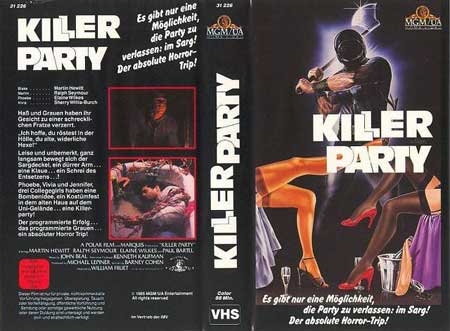
The TSL’s Horror Grindhouse: Killer Party (dir by William Fruet)


The 1986 film Killer Party is one of those late 80s slasher films that somehow has developed a cult following.  Up until recently, there was a fairly active fansite devoted to the history of Killer Party and Killer Party still regularly shows up on TCM Underground.

So, apparently, Killer Party has fans.

I’m just not sure why.

Some of it, I suppose, could have to do with the first ten minutes of the film, which are genuinely clever.  It starts out with a young woman being menaced at a drive-in theater and, just when you’ve gotten invested in her story and have started to wonder whether or not she’ll survive the entire movie, it is suddenly revealed that we’ve actually been watching a movie-within-a-movie.  And that movie-within-a-movie then turns out to be part of an incredibly silly music video, featuring a band that is so 80s that you find yourself expecting them to stop performing so they can do a line of coke and play the stock market.  At one point, the band even performs while standing on the drive-in’s concession stand.

It’s all marvelously silly and kind of clever.  The problem is that the rest of the film never lives up to those ten minutes.  In fact, you spend the rest of the movie wishing you were still watching that movie about the girl trapped at the drive-in.

I also suppose that some of the film’s cult reputation has to do with the fact that Paul Bartel has a small supporting role.  Bartel plays the same basic role that he played in almost every horror film in which he appeared.  He’s a pompous professor who says a few dismissive lines and is then promptly killed off.  Maybe it’s the Bartel factor that has led to this film developing a cult following.

Who knows?

Killer Party is essentially four movies in one.  The first movie is that part that I’ve already talked about.  The opening is clever but it only lasts for ten minutes.

After the opening, the film turns into a rather standard college comedy.  Three girls want to join the wildest sorority on campus but it won’t be easy!  Everyone on this campus is obsessed with playing pranks.  And by pranks, I mean stuff like locking a bunch of people outside while they’re naked in a hot tub and then dumping a bunch of bees on them.  Of course, that prank gets filmed and the footage is later shown at a meeting of stuffy old people.  That’ll teach those uptight members of the World War II generation!  You may have made the world safe for democracy but that was like a really, really long time ago!  So there!  It’s time for a new generation, one that will make the world safe for pranks!

During this part of the film, there are only a few hints that we’re watching a horror movie.  For instance, the sorority wants to have a party in an abandoned frat house.  Their housemother goes by the frat house and kneels in front of a grave.  She speaks to someone named Alan and tells him that it’s time to move on.  Then she promptly gets killed and no one ever seems to notice.

The comedy part of the movie segues into a remarkably bloodless slasher movie.  The cast assembles at the forbidden house.  They have a party.  Someone in a diving mask shows up and kills off the majority of the cast in 20 minutes.  Almost everyone dies off-screen so there’s really not even any suspense as far as that goes.

Then, during the last few minutes of the film, the slasher film suddenly turns into a demonic possession film and that seems like that should be brilliant turn of events but it just doesn’t work in Killer Party.  Usually, I love movies that are kind of messy but Killer Party is a rather bland and listless affair.  If you’re going to combine a campus comedy with a slasher film and a demonic possession film, you owe it to your audience to really go totally over the top and embrace the ludicrousness of it all.  Instead, Killer Party rolls out at a languid and rather dull pace.

I would not accept an invitation to Killer Party.


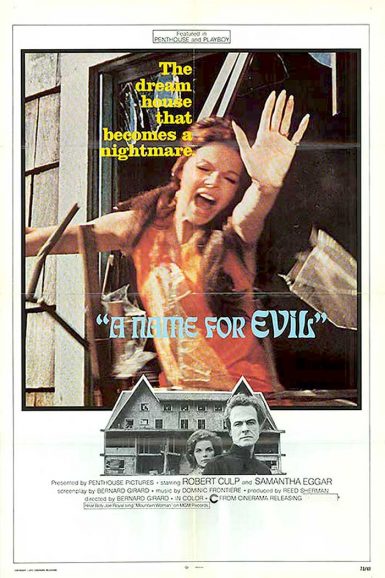
The TSL’s Horror Grindhouse: A Name For Evil (dir by Bernard Girard)


So, this is an odd one.

First released in 1973 but reportedly filmed several years before, A Name For Evil tells the story of John Blake (Robert Culp) and his wife, Joanna (Samantha Eggar).  John is a successful architect who lives in the big city.  He used to be a passionate rebel but now he’s just a boring corporate man.  Even his wife is bored with him.  John knows that he has to make some changes.  Since this movie was made in 1973, those changes start with throwing a TV out of a window.

(Trust me.  If you watch enough films from the early 70s, you will see so many TVs get tossed through so many windows that it will no longer surprise you.  Apparently, being a rebel in 1973 meant destroying a TV.  According to Wikipedia, the top five TV shows in 1973 were, in order, All In The Family, Sanford and Son, Hawaii 5-0, Maude, and the NBC Sunday Night Mystery Movie.  I choose to believe that the NBC Saturday Night Mystery Movie is what drove everyone over the edge.  Anyway…)

Anyway, John decides to quit his high-paying job and instead move up to New England and live in his grandfather’s mansion.  (His grandfather, by the way, was known as The Major.)  Joanna is reluctant to accompany him and she’s even more upset when it turns out that 1) the house is a total wreck and 2) the last tenant died under mysterious circumstances.

John, however, grows somewhat obsessed with the house.  This is despite the fact that John doesn’t seem to really like the house or the inhabitants of the nearby town that much.  For instance, there’s a scene — which might be a dream — in which John crashes the funeral of a local boy who died in Vietnam and he starts to laugh uncontrollably when the minister praises the boy for sacrificing himself for his country.  I think we’re supposed to like John during this scene but John laughs so long and so hard and he just keeps going and going that, by the end of it, I think even the most dedicated peace activist would look at him and say, “What an asshole.”

At the house, John keeps seeing strange shadows and hearing weird noises.  Occasionally, he sees someone who looks like the long-dead Major riding a white horse.  He hears voices coming from the walls and he accuses Joanna of being behind it.  Joanna tells him that he’s being paranoid.  Of course, Joanna herself is slowly coming to appreciate the house, especially after a ghost kisses her hand…

Suffering from ennui, John does what anyone in 1973 would do.  He tracks down the local hippies and he takes part in a down-with-the-establishment orgy.  Are the hippies real or are they figments of his imagination?  Is the house real or is it a figment of John’s imagination?  Is John real or is he just a figment of his imagination?  A Name For Evil does not seem to really know but you can be sure that we’ll get another shot of that TV falling out of that window before the movie ends.

On the one hand, A Name For Evil is a standard haunted house/spiritual possession type of film.  But, on the other hand, it’s obvious that A Name For Evil was trying to make some sort of grand statement about life in America in 1973.  How else do you explain the hippies, the funeral scene, and that TV flying out the window?  Robert Culp spends the entire movie so pissed off that there’s no way he wasn’t meant to be some sort of generational spokesman.  It makes for a very strange, only-in-the-70s hybrid type of film.

Now, I should mention that I actually did a little research before writing this review.  I discovered that A Name for Evil was originally produced by MGM but it spent years on the shelf until Penthouse (the magazine) bought the film and re-cut it for theatrical release.  Apparently, the first version was clear about being an attempt at social satire with a little horror and nudity thrown in.  The version that was actually released was edited to emphasize the horror and the nudity.  That probably explains why the film feels like such a strange mishmash of genres and attitudes.

If you ever get the chance, I’d recommend watching A Name For Evil.  It’s not that good but it’s just too strange not to watch.


The TSL’s Horror Grindhouse: The Autopsy of Jane Doe (dir by André Øvredal)


I have to admit that I’ve watched so many horror films that I’m sometimes tempted to get a little bit jaded about them.

Don’t get me wrong.  I love the genre.  I love watching horror movies.  I love analyzing horror movies.  I love writing about horror movies.  It’s just that, after you’ve watched a few hundred of them, it becomes easier to pick up on all the little tricks.  For instance, I now know not to worry whenever anyone hears a strange sound in the kitchen because it’s inevitably just going to be a cat in a cabinet.  Instead, it’s only after the cat has run by and caused everyone to jump that you have to start worrying about something terrible to happen.  I also know that there’s a good chance that the first chase scene is going to turn out to be an elaborate nightmare.  As such, I sometimes I get cynical about whether or not I can really be frightened anymore.

But then I watch something like The Autopsy of Jane Doe.

I watched The Autopsy of Jane Doe back in Decemeber.  It was two in the morning.  I was alone in the house.  It was raining outside.  I was having trouble sleeping so, of course, I decided why not sit in the dark in my underwear and watch a horror movie?  At the time, it didn’t occur to me that I was essentially putting myself in a classic horror movie situation.  It was only later, when I was lying in bed with all the lights on and freaking out about every little noise that I heard that I realized my mistake.

The Autopsy of Jane Doe takes place in a morgue in a small town.  The body of a woman has been brought in.  It is believed that she died in a house fire but there are no signs of trauma on her body.  Her finger prints are not on record.  No one knows who she is.  Over the course of the night, coroner Tommy Tilden (Brian Cox) and his son, Austin (Emile Hirsch), examine the body.  With each incision, the mystery of Jane Doe’s identity deepens.  The inside of her body is as damaged as the outside is perfect.

As the night continues, strange things start to happen inside the morgue.  It’s small things at first.  Strange sounds are heard.  Austin thinks that he sees something out of the corner of his eye.  A storm starts to rage outside.  Austin says that they should stop the autopsy but Tommy says that they have to finish what they’ve started…

And things only escalate from there.

The Autopsy of Jane Doe sneaks up on you.  It starts out as a collection of small scares and subtle hints that all is not right.  At first, you’re kind of like, “Yeah, it’s weird noises and shadows in the corner.  It’s a horror movie.  Of course, that’s going on…”  And then suddenly, about halfway through the film, you realize that you’re totally tense.  All of those small scares have added up, leaving you wondering when the big scares are going to start.  And when those big scares do arrive, they deliver.  By confining the movie to one location, director André Øvredal creates a palpable atmosphere of claustrophobia and impending doom.  It helps that Brian Cox is one of those older, paternal actors who you always expect to be in control of things so seeing him in a situation where he has no control carries an unexpectedly strong emotional impact.

If you doubt the power of horror, The Autopsy of Jane Doe will make you a believer.