For tonight’s Halloween on television, we have the story of four aliens who came to Earth on Halloween and search for candy for their planet. After an initial misunderstanding, two kids help the aliens in their search. It’s sweet!
This was directed by Savage Steve Holland of Better Off Dead fame and it originally aired on October 28th, 1991.
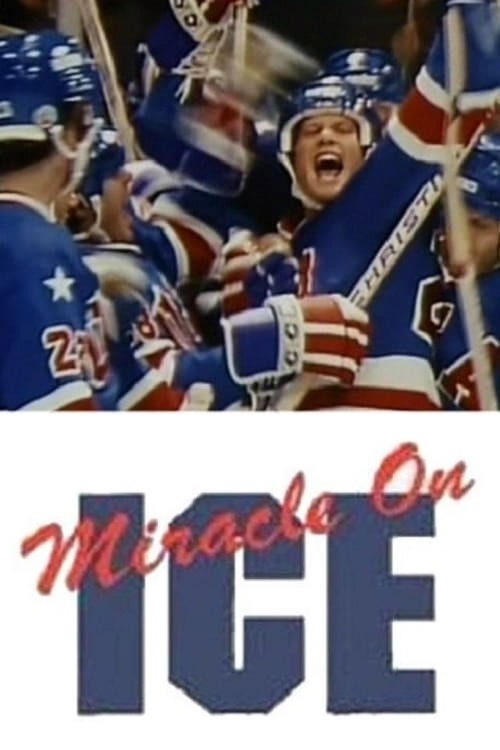
On February 22nd, 1980, the U.S. Olympic Hockey team pulled off one of the greatest upsets in sports history when they defeated the Soviet team during the Winter Olympics. At a time when America was struggling under Jimmy Carter and the Soviet Union appeared to be winning the propaganda war, a group of unheralded college students brought the U.S. together in celebration as they defeated the Soviets and then went on to defeat Finland for the gold medal.
Everyone knows that the Miracle On Ice, as it was called, served as the basis of the Disney film Miracle, with Kurt Russell playing coach Herb Brooks. What is now forgotten is that the story was first recreated in 1981, with a made-for-tv movie called Miracle On Ice. Who played Herb Brooks in that movie?
Karl Malden.
Keep in mind, Herb Brooks was 42 years-old when the U.S. team defeated the Soviets and he was a former player himself. Malden was 69 when he starred in Miracle On Ice and didn’t look like he had ever worn skates in his life. Malden is convincingly grumpy and hard-nosed as Brooks but he’s still very miscast and the movie misses the point that one of the reasons why Brooks could coach the young American team was because he was still relatively young himself. The actors playing the members of the team are better cast, with Andrew Stevens playing team leader Mike Eruzione and Steve Guttenberg cast as goalie Jim Craig. A lot of time is devoted to Craig’s financial difficulties and his fear that remaining an amateur for the Olympics, instead of going pro, will continue to make life difficult for his family. On the one hand, it is messed up that the U.S., at the time, did not allow its Olympians to turn professional. On the other hand, the fact all of the players were considered to be “amateurs’ made their victory over the Soviets all the more special.
It takes a while for MiracleonIce to get to the main event. There’s a lot of scenes of Brooks dealing with everyone’s skepticism and Eurozione trying to keep the players from giving up in the face of the Soviet Union’s previous domination of the game. Once the movie does finally reach the Winter Olympics, it relies on actual footage from the game, which is actually pretty cool. Watching the real footage, you can still feel the growing excitement in both the stadium and the broadcast booth as people started to realize that the American team was going to pull it off and defeat the Soviets. It’s impossible not to be inspired by the Soviet Union getting humiliated by a bunch of American college players. The Soviets may have had the performance enhancing drugs but the Americans had the spirit!
Of the two films about America’s victory, Miracle is definitely the one to see but Miracle On Ice still pays tribute to a great moment.
In 1996’s Executive Decision, terrorists hijack an airplane. Their leader, Nagi Hassan (David Suchet) demands that the U.S. government not only give him and his men safe passage but that they also release Hassan’s commander, Jaffa (Andreas Katsulas).
In Washington D.C., it is decide to use a stealth plane to transport Col. Austin Travis (Steven Seagal) and his men into the passenger plane. Accompanying them will be Dr. David Grant (Kurt Russell), a consultant for U.S. Intelligence. Dr. Grant is the world’s leading expert on Hassan, even though neither he nor anyone else is even sure what Hassan looks like. Travis distrusts Grant because he’s a civilian and also because he holds Grant responsible for a botched raid on a Russian safehouse in Italy. Dr. Grant is going to have to prove himself to Col. Travis because Travis doesn’t have any time for people who can’t get the job done. And Travis is determined to get on that plane and save all those passengers.
In other words, Travis is a typical Steven Seagal character and, for the first fourth of this movie, Seagal gives a typical Steven Seagal performance. He delivers his line in his trademark intimidating whisper, he glares at everyone else in the film, and essentially comes across as being a total douchebag who can still handle himself in a fight.. However, when it’s time to board the airplane through a docking tunnel, something goes wrong. Everyone — even nervous engineer Dennis Cahill (Oliver Platt) is able to slip through the stealth plane’s docking tunnel and get into the hijacked airplane cargo hold without being detected. But the two planes are hit by severe turbulence. Suddenly, it becomes apparent the one man is going to have to sacrifice his life and close the hatch before the docking tunnel decompresses.
David, already in the cargo hold, looks down at Austin in the tunnel. “We’re not going to make it!”
“You are!” Austin replies before slamming the hatch shut and getting sucked out of the tunnel. (There’s your Oscar Cheers Moment of 1996!) After all that build-up, Steven Seagal exits the film early and now, it’s up to Kurt Russell and what’s left of Austin Travis’s men to somehow stop the terrorists. Not only do they have to stop Hassan but they also have to do it before the Air Force — which has no way of knowing whether or not any of their men were able to get on the plane before the tunnel fell apart — shoots down the airliner.
(If the airplane looks familiar, that’s because Lost used the same stock footage whenever it flashed back to the plane crash that started the show.)
It’s actually a rather brilliant twist. When this film came out, Seagal was still a film star. He played characters who always got the job done and who were basically infallible. He wasn’t a very good actor but he did manage to perfect an intimidating stare and that stare carried him through a lot of movies. No one would have expected Seagal to die within the first 30 minutes of one of his movies and when Col. Travis, who the film has gone out of its way to portray as being the consummate warrior, is suddenly killed, there really is a moment where you find yourself wondering, “What are they going to do now?” In just a matter of minutes, Executive Decision goes from being a predictable Steven Seagal action film to a genuinely exciting and clever Kurt Russell thriller. For once, Russell is not playing a man of action. He’s an analyst, a thinker. And, to the film’s credit, he uses his mind more than his brawn to battle Hassan’s terrorists. With excellent support from Halle Berry (as a flight attendant who discreetly helps out David and the soldiers), Oliver Platt, B.D. Wong, Whip Hubley, David Suchet, Joe Morton, and even John Leguizamo (as Travis’s second-in-command), Executive Decision reveals itself to be an exciting and ultimately rewarding thrill ride.
And to think, all it took was sacrificing Steven Seagal.
Welcome to Late Night Retro Television Reviews, a feature where we review some of our favorite and least favorite shows of the past! On Thursdays, I will be reviewing Highway to Heaven, which aired on NBC from 1984 to 1989. The entire show is currently streaming on Freevee and several other services!
This week, Jonathan and Mark bring together a family.
Episode 3.4 “Another Kind of War, Another Kind of Peace”
(Dir by Dan Gordon, originally aired on October 15th, 1986)
Clancy (Eugene Roche) is an old man who has never gotten over the death of his son in Vietnam. He lives alone in an apartment in Los Angeles. His only friend is Guido Liggio (Ernest Borgnine), an Italian taxi driver who lives next door. Guido, who came to this country as a refugee during World War II, is the type of salt-of-the-Earth character who says stuff like, “Clancy, how come you no be a-nice to the people?” And Clancy is the type of bitter old man who says stuff like, “Don’t ask me for money, ya bum!”
Jonathan and Mark show up at Clancy’s apartment and inform him that they work for an agency that brings refugees to the United States. They explain that Clancy’s son had a child in Vietnam. Now, both Clancy’s grandchild and the grandchild’s mother are in the United States and they need somewhere to stay. Clancy is angered by the news, claiming that the mother is lying and just trying to get into the country. But eventually, he agrees to allow Lan Nguyen (Haunani Minn) and Michael Nguyen (Ernie Reyes, Jr.) to stay in his apartment. He even agrees to give Michael lunch money so that Michael won’t starve at school. Otherwise, Clancy says that he doesn’t want to have anything to do with either of them.
Guido, on the other hand, is more than willing to host Lan and Michael. He’s a refugee himself and, even more importantly, he’s everyone’s favorite character actor, Ernest Borgnine! But Jonathan and Mark understand that their assignment is to bring together Clancy and his grandson. Guido is a nice guy but he’s not Michael’s grandfather.
At school, a bully (Adam Gifford) is stealing Michael’s lunch money. When Michael says that he needs the money for food, the bully threatens to hurt Clancy. What a jerk! Seriously, check out this totally 80s bully:
When the principal tells Mark and Jonathan that Michael has been spending his lunchtime searching for food in the school dumpsters, Jonathan tells Clancy. Clancy, angered that his money is being wasted, heads down to the school and confronts the bully. Jonathan briefly gives Clancy and Michael “the stuff,” which allows them to beat up the bully and his entire gang. This experience brings grandson and grandfather together. So, I guess the message here is that violence is the answer. Forget about that turning the other cheek stuff. Instead, just throw your bully through a car window.
This episode was pretty much what most people picture when they think of a typical Highway to Heaven episode. It was unabashedly sentimental and a bit simplistic in its approach. It was earnest enough to be likable though a bit too heavy-handed for its own good. Any show that features Ernest Borgnine as a special guest star is not exactly going to deliver anything resembling a subtle story. While this episode was never quite as good as I wanted it to be, I was still glad that Michael and his mother found a home.
Welcome to Retro Television Reviews, a feature where we review some of our favorite and least favorite shows of the past! On Sundays, I will be reviewing the made-for-television movies that used to be a primetime mainstay. Today’s film is 1984’s Pigs vs. Freaks! It can be viewed on YouTube.
In the late 1960s, a small town is divided between the conservative older generation and their rebellious hippie children. Former high school football star Doug Zimmer (Patrick Swayze) has just returned from fighting in Vietnam and, unlike many of his former classmates, he is firmly on the side of the establishment. He wears his hair short. He has a job as a cop. He tries to keep his younger sister, Janice (Penny Peyser), from hanging out with hippies like his former best friend, Neal (Grant Goodeve).
Neal is also the son of the local police chief, Frank Brockmeyer (Eugene Roche). Though Frank and Neal have different political beliefs and Frank is always telling Neal to get a haircut, they still have a respectful relationship. When Neal complains that cops like Doug and his partner, Sgt. Cheever (Brian Dennehy), are always harassing the hippies who want to play football in park, Frank suggests a football game between the hippies and the police. When Neal agrees, the game becomes known as “Pigs vs. Freaks.”
While Frank coaches the Pigs and signs a few former athlete as police reservists, Neal recruits his former little league coach, a bearded guru who now goes by the name of Rambaba Organimus (Tony Randall) to serve as the Freak’s coach. He also places a call to a former football star named Mickey South (Adam Baldwin) and talks him into coming down from Canada to play in the game. Of course, Mickey is wanted by the FBI for dodging the draft so it might not seem like a great idea for him to risk federal prison for an exhibition football game but no matter! Who cares that there are now two federal agents watching the Freaks practice? There’s a game to be won!
Pigs vs. Freaks is an amiable mix of comedy and drama. Some of the comedy, like Tony Randall’s bearded guru and Stephen Furst’s perpetually frantic hippie linebacker, is a bit too broad but there’s enough moments of dramatic insight that it’s easy to overlook those flaws. I appreciated the fact that both the Freaks and the Pigs are treated fairly, with both sides getting a chance to make a case for themselves. When they first appear and start harassing the hippies for playing football in the park, it’s easy to dismiss both Doug and Cheever as fascists but a later scene, which is very well-played by both Brian Dennehy and Patrick Swayze, establishes them as just being two men who are confused by the direction of the world. Swayze, in particular, gives a strong performance that reveals the vulnerability underneath Doug’s tough exterior. As for the hippies, Mickey South is no self-righteous crusader but instead someone who feels the Vietnam War is wrong but who is also someone who both misses and loves his home country. Adam Baldwin does a wonderful playing him and is well-matched with Grant Goodeve, who plays the most reasonable hippie that one could hope to meet.
It’s a likable film and well-intentioned, a portrait of two opposing groups brought together by the love of one game. Some will cheer for the Pigs. Some will cheer for the Freaks. I cheered for both.
The 1978 film, Corvette Summer, tells the story of Kenny Dantley (Mark Hamill).
Kenny is a student at a high school in Southern California. He lives in a trailer park and he’s kind of dumb. He’s the type who rarely shows up to class and, when he does, it’s just to discover that he managed to score a D-minus on his last test. Kenny doesn’t think school’s important, though. All Kenny cares about is cars. He doesn’t date. He doesn’t have friends. But he can rebuild a corvette and spend hours talking about why it’s the greatest car in the world.
Yes, Kenny’s an idiot.
Kenny’s auto shop teacher, Mr. McGrath (Eugne Roche), warns Kenny that he’s spending too much obsessing on cars. Don’t fall in love with a car, Mr. McGrath says. A car is just a machine and a machine will always let you down. A machine is something that you build so you can sell it and move on to something else. To me, Mr. McGrath makes sense but Kenny’s like, “No, that’s totally squaresville. Real melvin, man.”
(Well, okay, Kenny doesn’t use those exact words but you can tell that he’s thinking them…..)
Anyway, Kenny and the shop class have just rebuilt a red corvette and Kenny’s convinced that it’s the greatest car ever. However, on the same night that the car makes its debut by cruising down the streets of Kenny’s hometown, it’s stolen! Maybe Kenny shouldn’t have given the keys to Danny Bonaduce. Kenny gets so angry that he smashes a cup of coke and attempts to beat up Bonaduce.
Mr. McGrath tells Kenny that these things happen and he suggests that Kenny instead look into enrolling at a community college after high school. Kenny, however, is too obsessed with finding his car to listen to Mr. McGrath. He even prints up flyers with a picture of the corvette. “Have you seen this car?” the flyers ask. Amazingly, it turns out that someone has. He tells Kenny that he saw the corvette in Las Vegas.
That’s all it takes for Kenny to head to Nevada. Of course, since Kenny doesn’t have a car, he has to hitchhiker. Despite the fact that Kenny looks like a killer hippie and tends to spend a lot of time yelling in a somewhat shrill manner, he’s picked up by Vanessa (Annie Potts). Vanessa is an “aspiring prostitute” who lives in a van. “Vanessa” is written on the side of the van, which means that it will be useless if anyone ever needs to use it as a getaway vehicle for a bank robbery. Way to go, Vanessa.
Once they arrives in Las Vegas, Kenny and Vanessa work a series of different jobs while looking for that corvette. Along the way, Kenny falls in love, discovers that there’s more to life than just cars, and also suffers a bit of disillusionment when one of his mentors turns out to be not as perfect as Kenny originally believed.
Corvette Summer is best known for being Mark Hamill’s first post-Star Wars role. He’s in almost every scene of the film and, to be honest, his performance kind of got on my nerves. Some of that is because, as written, Kenny is almost unbelievably stupid. But Hamill doesn’t help things by giving a rather shrill performance in the lead role. Though the film may be a coming-of-age comedy, Hamill is so intense in the role that he comes across as being less like a naive teenager and more like a mentally unbalanced time bomb. You find yourself hoping that he’ll get the car back before he’s forced to take hostages. Annie Potts is a bit more likable as Vanessa but her character is dreadfully inconsistent. One gets the feeling that she’s mostly just there so that Kenny can finally lose his virginity and be a little bit less of a loser by the end of the movie.
I will say that I did really like the performance of Kim Milford, who plays a superslick car thief named Wayne Lowry. As I watched the film, it took me a few minutes to realize where I recognized Milford from. He was the star of Laserblast, a film that featured Milford finding a laser gun and using it to blow up a sign advertising Star Wars. Milford only has a small role in Corvette Summer and we’re not supposed to like him but he’s so handsome and sure-of-himself that it’s hard not to prefer him to the rather histrionic character played by Mark Hamill.
Corvette Summer is such a film of the 70s that watching it is like stepping into a time machine. That’s not necessarily a bad thing, of course. Indeed, in 2020, the main appeal of a film like this is a chance to see how people lived in 1978. (It’s always a bit odd to watch a movie where no one carries a phone or has a twitter account.) Watching this film in 2020, it’s hard not cringe a little at the sight of not only Kenny hitchhiking but also people stopping to pick him up. Seriously, are they just trying to get killed?
When San Francisco-based private investigator Michael Brennen (O.J. Simpson) gives a ride to Joey Crawford (John Spencer) on Christmas Eve, he doesn’t know that it’s going to lead to the biggest case of his career. When Joey asks Michael to help him track down his ex-girlfriend, Michael assumes that Joey would never be able to pay for his investigative services. But one week later, Michael gets something in the mail from Joey. Inside the envelope, there’s a picture of both Joey’s ex and a thousand dollar bill. Ever after he discovers that Joey was mysteriously killed the night before, Michael decides to take on the case. His investigation will take him not only to Joey’s ex but it will also lead to him uncovering a drug ring that involves one of San Francisco’s most prominent families.
Simpson not only starred in this made-for-TV movie but he also served as executive producer. Watching the movie, it’s obvious that it was meant to serve as a pilot for a Michael Brennen TV series and it’s also just as obvious why that series never happened. O.J. Simpson was not a terrible actor but, ironically for someone who set records as an NFL player, there was nothing tough about him. Simpson may be playing a two-fisted, cash-strapped P.I. but, in every scene, he comes across like he can’t wait to hit the golf course. Simpson’s pleasant demeanor may have served him well in other areas of his life but it didn’t help him with this role. Whenever Simpson has to share a scene with John Spencer, Candy Clark, Cliff Gorman, or any of the other members of this film’s surprisingly talented supporting cast, Simpson’s bland screen presence and lack of gravitas becomes all the more apparent.
Of course, when seen today, the main problem with Cocaine and Blue Eyes is that it’s impossible to watch without thinking, “Hey, didn’t the star of this movie get away with killing his wife and an innocent bystander?” Even the most innocuous of lines take on a double meaning when they’re uttered by O.J. Simpson. It doesn’t help that the movie opens with Michael visiting his estranged wife and their children on Christmas Eve and getting chased around the neighborhood by a guard dog. When the movie was made, this scene was probably included so that O.J. could show off some of the moves that made him a star at UCLA and with the Bills. Seen today, the scene takes on a whole different meaning.
Without O.J. Simpson, Cocaine and Blue Eyes could easily pass for being an extended episode of Magnum P.I., Simon and Simon, or any other detective show from the 80s. With Simpson, it becomes a pop cultural relic. I don’t think it’s ever been released on DVD but it is available on YouTube, where it can be viewed by O.J. Simpson completists everywhere.
Eagle Lake, a mountain resort town in California, has a problem. It’s almost tourist season and there is a sniper stalking through the night, using his rifle to pick off citizens and painting messages like “The First” and “The Second” in the snow. It’s up to police chief Sam McNeill (Andy Griffith) to figure out the killer’s motives and capture him before the vacation season begins! To catch the killer, McNeill is going to have to investigate his friends and neighbors, all of whom have secrets that they don’t want to have revealed.
1974 was a busy year for Andy Griffith. Best-known for playing the folksy and reassuring Sheriff Taylor for over ten years on The Andy Griffith Show, Griffith tried to change his image by appearing in three unexpectedly dark made-to-TV movies. In Pray For The Wildcatsand Savages, Griffith played the villain. In Winter Kill, he’s back in a more familiar role. He is once again playing a lawman, though this one carries a gun and doesn’t have time to sit on his porch and play the guitar while Aunt Bea makes dinner. Instead, he’s getting pressure from all sides to capture a psycho sniper who, at the start of the movie, shoots an old woman after throwing pebbles at her bedroom window. Eventually, the sniper even ends up kidnapping Chief McNeill’s girlfriend! This never happened in Mayberry!
Winter Kill is a pretty good mystery. It’s not strictly a horror film but the sight of the masked sniper, making his way through the night and coldy gunning down unsuspecting victims is scary enough that it might as well be. Andy Griffith was surprisingly tough and gritty as Chief McNeill. He might be a good guy in this movie but you still know better than to mess with him. The rest of the cast is made up of television regulars but keep an eye out for a youngish Nick Notle playing a cocky ski instructor.
Winter Kill was actually meant to be a backdoor pilot for a show where Chief McNeill would battle crime on a weekly basis. Though that didn’t happen, the concept was later retooled and became a short-lived series called Adams of Eagle Lake.
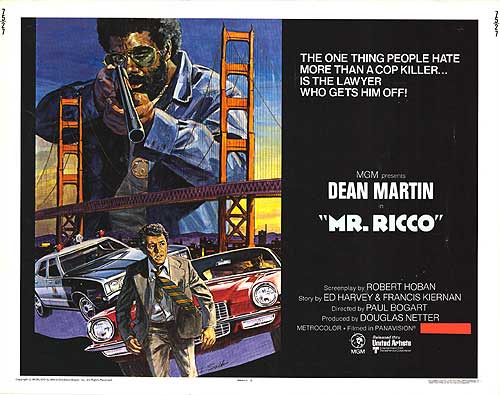
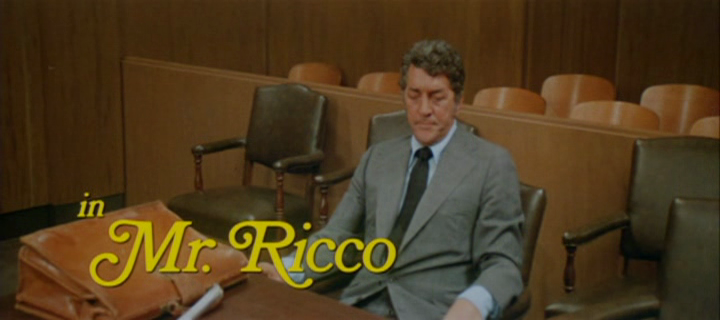
It’s an older, more world-weary Dean Martin we see in MR. RICCO, a fairly gritty but ultimately unfulfilling 70’s flick that would’ve made a decent pilot for a TV series (maybe in the NBC MYSTERY MOVIE rotation with Columbo and McCloud), but as a feature was best suited for the bottom half of a double bill. This was Dino’s last starring role, though he did appear in two more movies (THE CANNONBALL RUN and it’s sequel), and this attempt to change his image from footloose swinger to a more *gasp!* sober Martin doesn’t really cut it.
Dean’s a defense lawyer, a “lily white liberal” who gets black militant Frankie Steele (Thalmus Rasulala ) off a murder rap. When two cops are blown away in an ambush, the witness provides a description of Steele, causing friction between Ricco and the police, especially his friend Detective Captain Cronyn (Eugene Roche, an underrated character actor who’s really good here). The…
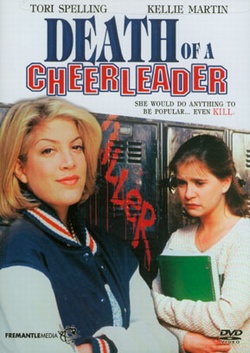
Over the past couple of year, I’ve had so much fun making fun of Tori Spelling’s performance in the original Mother, May I Sleep With Danger? that I almost feel like I have an obligation to review a movie in which she gave a halfway decent performance.
That film would be another 1994 made-for-TV-movie. It was apparently originally broadcast as A Friend To Die For but most of us know it better as Death of a Cheerleader. That’s the title that’s used whenever it shows up on Lifetime. There actually was a time when Death of a Cheerleader used to show up on almost a monthly basis but that was a while ago. Lifetime has since moved on to other movies about dead cheerleaders.
Technically, as my sister immediately pointed out when I made her watch the movie, the title isn’t quite correct. Though Stacy Lockwood (Tori Spelling) does try out for and is named to her school’s cheerleading squad, she never actually gets to cheer. Instead, shortly after the school assembly in which her selection is announced, Stacy is found stabbed to death. But really, Death of A Future Cheerleader doesn’t quite have the same ring to it.
As for who killed Stacy … well, it’s no secret. This is one of those true crime films where the murderer is not only portrayed sympathetically but is the main character as well. Angela Delvecchio (Kellie Martin) was a high school sophomore who was obsessed with trying to become popular. She looked up to Stacey and desperately wanted to be her best friend. (Why she didn’t just offer to bribe Stacey, I don’t know. Maybe she hadn’t seen Can’t Buy Me Love….) When Stacey got a job working in the school office, so did Angela. Of course, the school’s somewhat sleazy principal (Terry O’Quinn, coming across like John Locke’s worst nightmare) only made it a point to talk to Stacey and pretty much ignored Angela. When Stacey applied to work on the yearbook, so did Angela. When Stacey tried out for cheerleading, so did Angela.
In fact, the only time that Angela stood up to Stacey was when Angela was taunting the school’s token goth (played by Kathryn Morris). That turned out to be a mistake because Stacey never forgave her. When Angela invited Stacey to a party, Stacey was reluctant to go. When Stacey did finally accept the invitation, Angela stabbed her to death.
A Friend to Die For/Death of a Cheerleader is based on a true story and the film tries to lay the blame for Angela’s crime on the affluent neighborhood she was raised in. Just in case we missed the message, the film actually features a Priest (played by Eugene Roche) who says that the community put too much pressure on Angela to succeed.
Uhmmm….okay, if you say so.
Seriously, this is a pretty good little true crime film and both Tori Spelling and Kellie Martin give really good performances but this whole “It’s society’s fault” argument is typical, mushy, made-for-TV, bourgeois liberal BS. Angela picked up the knife, Angela committed the crime, end of story. That said, A Friend To Die For is pretty good as far as these movies go. I already mentioned the performances of Spelling and Martin but also keep an eye out for Marley Shelton, who gets a really good scene in which she explains that she never liked Stacey that much while she was alive.
You can watch A Friend To Die For/Death of a Cheerleader below!



 When San Francisco-based private investigator Michael Brennen (O.J. Simpson) gives a ride to Joey Crawford (John Spencer) on Christmas Eve, he doesn’t know that it’s going to lead to the biggest case of his career. When Joey asks Michael to help him track down his ex-girlfriend, Michael assumes that Joey would never be able to pay for his investigative services. But one week later, Michael gets something in the mail from Joey. Inside the envelope, there’s a picture of both Joey’s ex and a thousand dollar bill. Ever after he discovers that Joey was mysteriously killed the night before, Michael decides to take on the case. His investigation will take him not only to Joey’s ex but it will also lead to him uncovering a drug ring that involves one of San Francisco’s most prominent families.
 Eagle Lake, a mountain resort town in California, has a problem. It’s almost tourist season and there is a sniper stalking through the night, using his rifle to pick off citizens and painting messages like “The First” and “The Second” in the snow. It’s up to police chief Sam McNeill (Andy Griffith) to figure out the killer’s motives and capture him before the vacation season begins! To catch the killer, McNeill is going to have to investigate his friends and neighbors, all of whom have secrets that they don’t want to have revealed.
 Through the Shattered Lens