Embracing the Melodrama Part II #57: Saturday Night Fever (dir by John Badham)


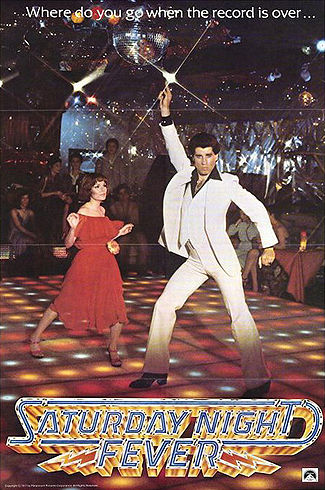
Saturday_night_fever_movie_posterHere’s a little bit of trivia about the iconic 1977 film Saturday Night Fever.

First off, according to the imdb, Saturday Night Fever was the first mainstream Hollywood film to ever use the term “blow job.”  That actually took me by surprise.  I mean, with all of the risks that the major studios took in the 70s, it still took them until 1977 to have someone say “blow job” in a movie?  But somehow, it seems appropriate that it would turn up in Saturday Night Fever.  We tend to think of Saturday Night Fever as being a movie where the soundtrack is nonstop disco and John Travolta dances in that iconic white suit.  But actually, Saturday Night Fever is a film about four guys who neither understand nor respect women.

When Tony (John Travolta), Joey (Joseph Cali), Double J (Paul Pape), and Bobby (Barry Miller) go down to that disco, it’s because they want to get laid.   Joey and Double J take turns having sex with insecure Annette (Donna Pescow) and, afterwards, Tony scornfully ask her if she‘s proud of herself.  When Bobby discovers that his girlfriend is pregnant, he is so terrified of having to be a father that he becomes suicidal.  As for Tony, he looks down on the women who are so eager to dance with him.  When he enters a dance contest with Stephanie (Karen Lynn Gorney), he can’t handle the fact that she wants more out of her life than just being his latest partner.

So, it makes sense that this would be the first mainstream movie to feature someone talking about a blow job because that’s what these boys are obsessed with.  Sexually primitive, hypocritically puritanical, and emotionally repressed, a blow job is all the intimacy that these boys can handle.

Another piece of trivia: while John Travolta was always the first choice for Tony Manero, several actors were seen for the roles of Joey and Double J.  At one point, both Ray Liotta and David Caruso were nearly cast in the role of Tony’s friends.  Imagine this: in some alternative universe, while white-suited John Travolta rules over the dance floor, Ray Liotta and David Caruso are standing in the background and cheering him on.

Of course, if Liotta and Caruso had been cast, it would be a totally different movie.  Whenever you watch Saturday Night Fever, you’re surprised by how much John Travolta totally dominates the film.  Even though the film devotes a good deal of time to Annette, Stephanie, Bobby and to Tony’s brother who has recently left the priesthood, Tony Manero is the only character that you remember.  That’s largely because Travolta is the only one of them who gives a truly memorable performance.

In theory, it’s easy to laugh at the thought of Travolta in that white suit, striking a dramatic pose on that cheap-looking dance floor.  But then you watch the film and you realize that Travolta truly did give a great performance.  And, to your surprise, you don’t laugh at Tony with his white suit because you know that the only time Tony has any control over his life is when he’s dancing.  He may work in a paint store.  He may regularly get slapped around by his family.  He may not be very smart or sensitive.  But when Tony’s dancing, he’s a king and you’re happy that he at least has one thing in his life that he can feel good about.

Even if he is kind of a jerk.

Of course, it helps that Tony is a really good dancer.  There’s actually a lot more going on in Saturday Night Fever than you might think but ultimately, it’s a dance movie and it’s one of the best.
Embracing the Melodrama Part II #56: Walking Tall: Final Chapter (dir by Jack Starrett)


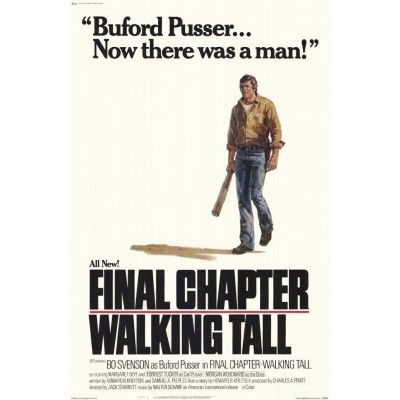
sq_final_chapter_walking_tallFor one last time, Buford Pusser is back!  The 1977 film Walking Tall: Final Chapter ends the story that was begun in Walking Tall and continued in Walking Tall Part II.  And it turns out that the final chapter is pretty much just like the previous two chapters.  In fact, I’m tempted to just tell you go reread my review of Walking Tall Part II because that review works just as well for most of the Final Chapter.

Final Chapter starts with footage from the first Walking Tall, with Bo Svenson awkwardly inserted in place of Joe Don Baker.  Once again, we watch as Elizabeth Hartman is shot in the back of the head and Svenson — in the role of Buford Pusser — is shot in the face.  Oh my God, we think, how many times can the exact same thing happen to the exact same character!?

Oh wait — it turns out that Buford is just remembering the death of his wife.  Buford is still haunted by that day and he’s still out for vengeance.  For the next hour or so, we follow Buford as he and his deputies blow up moonshiners across Tennessee.  After each arrest, an attorney shows up and yells at Buford for violating everyone’s civil rights.  In response, Buford smirks until the attorney gets so mad that he decides to run for sheriff himself.

Buford doesn’t give his opponent much of a chance.  As one of his deputies puts it, this guy is just a “bleeding heart liberal.”  (But if he’s so liberal, what’s he doing in Tennessee?  Off with you, sir — return to Vermont!)  Instead of campaigning, Buford spends his time hunting down more moonshiners.  When he discovers that one moonshiner is also an abusive father, he personally drives the man’s son down to the local orphanage.  Oddly enough, Buford does not offer to adopt the kid himself.

Anyway, to the shock of everyone, Buford is not reelected.  No longer sheriff, he struggles to find a full-time job and makes plans to run in the next election.  One of the moonshiners shows up and taunts Buford until Buford is forced to beat him up in the middle of the street.  The new sheriff show up and demands to know what happened.  None of the townspeople are willing to snitch on Buford.  Good for them!

After about an hour and a half of this, something interesting actually happens.  A film producer drives up to the Pusser Farm and tells Buford that he wants to make a movie out of his life.  “We’re going to tell the story exactly how it happened!” the producer assures him.  In the next scene, Buford is advising the director of Walking Tall on how to properly film a car chase.

And you know what?  These scenes of Buford watching his life story be filmed are actually rather charming.  For the only time in the series, Bo Svenson actually appears to be having fun in these scenes.  And, when Buford runs from a theater while watching the recreation of his wife’s murder, it’s actually a very effective moment.

Anyway, there’s not much running time left after all of that.  We see Buford sign a contract to play himself in the sequel and, by this point, we all know what happened afterward.  Buford was killed in a mysterious car accident.  But fear not!  The film opens with a heavenly choir and Svenson’s voice booming from the heavens so we all know that Buford Pusser is arresting moonshiners in Heaven.

And good for him!

Peace be with you, Buford Pusser.


Embracing the Melodrama Part II #55: The Tenth Level (dir by Charles S. Dubin)


10thlevelI first found out about the 1976 made-for-tv movie The Tenth Level while I was doing some research on the Milgram experiment.  The Milgram experiment was a psychological experiment that was conducted, under the direction of Prof. Stanley Milgram, in 1961.  Two test subjects were placed in two separate room.  One test subject was known as the “Learner” and he was hooked up to a machine that could deliver electric shocks.  The other subject was the “Teacher.”  His job was to ask the Lerner questions and, whenever the Learner gave an incorrect answer, the Teacher was supposed to correct the error by pushing a button and delivering the electric shock.  With each incorrect answer, the shock would get worse.

Of course, what the Teacher did not know was that the Lerner was an associate of Prof. Milgram’s and that pushing the button did not actually deliver a shock.  The Lerner would intentionally give wrong answers and, after the Teacher pushed each subsequent button, the Lerner would groan in pain and eventually beg the Teacher to stop.  The test was to see how long the Teacher would continue to push the buttons.

The study found that 65% of the Teachers, even when the Lerner stopped responding, continued to push the buttons until delivering the experiment’s final 450-volt shock.  It was a surprising result, one that is often cited as proof that ordinary people will do terrible things if they’re ordered to do so by an authority figure.

The Tenth Level is loosely based on the Milgram experiment.  Prof. Stephen Turner (William Shatner) is a psychology professor who conducts a similar experiment.  Turner claims that he’s looking for insight into the nature of blind obedience but some of his colleagues are skeptical.  His best friend (Ossie Davis) thinks that Turner is mostly trying to deal with the guilt of being a WASP who has never had to deal with discrimination.  His ex-wife, Barbara (Lynn Carlin), thinks that the experiment is cruel and could potentially traumatize anyone who takes part in it.  Turner, meanwhile, is fascinated by how random people react to being ordered to essentially murder someone.

Eventually, a good-natured carpenter/grad student, Dahlquist (Stephen Macht), volunteers.  At first, Turner refuses to allow Dahlquist to take part because he’s previously met Dahlquist and Dahlquist is a friend of one of Tuner’s assistants.  However, Dahlquist literally begs to be allowed to take part in the experiment and Turner relents.

Unfortunately, the pressure of administering shocks proves to be too much for Dahlquist and he has a 70s style freak-out, which essentially means that the screen changes colors and everything moves in slow motion as he smashes up the room.  As a result of Dalquist’s violent reaction, Turner is called before a disciplinary committee and basically put on trial.

The Tenth Level is an interesting film.  On the one hand, the subject matter is fascinating and, if nothing else, the film deserves some credit for trying to seriously explore the ethics of psychological experimentation.  On the other hand, this is a film from 1976 that features William Shatner giving numerous monologues about the nature of man.  And, let us not forget, this is William Shatner before he apparently developed a sense of humor about himself.  That means that, in this film, we get the Shatner that inspired a thousand impersonations.  We get the Shatner who speaks precisely and who enunciates every single syllable.  And let’s not forget that Shatner is paired up with Ossie Davis, an actor who was never exactly subtle himself.

The end result is a film that is both thought-provoking and undeniably silly.  This is a film that will make you think even while it inspires you to be totally snarky.

(Also of note, John Travolta supposedly makes his film debut in the Tenth Level.  Apparently, he plays a student.  I have yet to spot him.)

You can watch it below!

Embracing the Melodrama Part II #54: Mandingo (dir by Richard Fleischer)


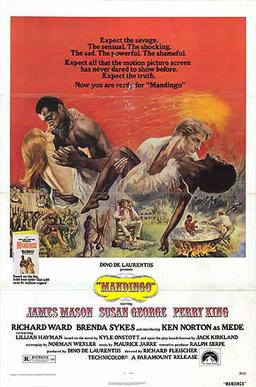
Mandingo_movie_posterUp until last night, I was under the impression that James Mason never gave a single bad performance over the course of his long career.  Oh sure, I knew that Mason had probably appeared in his share of bad films.  But I figured he was one of those actors who was always better than his material.  Just watch Lolita, The Verdict, Julius Caesar, Odd Man Out, Bigger Than Life, or Murder By Decree and you’ll see that James Mason was a great actor.

But then, last night, I finally got around to watching the 1975 film, Mandingo.

I’ve actually owned Mandingo on DVD for a few years.  I bought it on a whim, the result of having seen it listed as one of the worst films of all time in several different reference guides.  But I have to admit that I did not have any great desire to actually sit through the film.  Instead, it was one of those films that you buy just so your very ownership of it can be a conversation piece.

(“Oh my God, Lisa, what’s this?”  “Oh, that little old thing?  That’s my copy of Mandingo…”)

However, when I decided to do Embracing the Melodrama, Part II, I realized that this would be the perfect time to actually watch and review Mandingo.

Mandingo deals with life on a sordid plantation in pre-Civil War Alabama.  Warren Maxwell (James Mason) owns the plantation and he spends most of his time sweating and complaining about his rheumatism.  When a Satanic slave trader named Brownlee (Paul Benedict) suggests that Warren can cure his rheumatism by always resting his feet on the backs of two little slave children, Warren proceeds to do just that.  Seriously, this is a 127 minute film and, nearly every time that Mason appears on screen, he’s got his feet propped up on the children.

Warren’s got a son named Hammond (Perry King).  Hammond walks with a limp, the result of a childhood pony accident.  Warren expects Hammond to sire an heir to Maxwell family legacy but Hammond is only comfortable having sex with slaves.  Finally, during a business trip with his decadent friend Charles (Ben Masters), Hammond meets and marries Blanche (Susan George).  Blanche assures Hammond that she’s a virgin and, on their wedding night, she asks Hammond how to have sex.  “We take off our clothes…” Hammond begins.

However, the morning after, Hammond is convinced that Blanche lied about being virgin because she enjoyed having sex.  Once they return to the plantation, Hammond refuses to touch Blanche and instead ends up falling in love with a slave named Ellen (Brenda Sykes).  When Ellen gets pregnant, Blanche beats her until she miscarries.

And meanwhile, James Mason keeps popping up with two little kids resting underneath his feet…

But that’s not all!  Hammond has purchased a slave named Mede (Ken Norton).  Mede is a boxer and wins Hammond a lot of money.  In order to “toughen up” his skin, Mede is also forced to bathe in a cauldron of very hot water.  “Shuck down those pants!” Hammond shouts before Mede gets in the cauldron.

Blanche, who is now an alcoholic, gets her revenge on Hammond by having sex with the the legendarily endowed Mede.  Soon, Blanche is pregnant and Hammond and Warren are both excited.  Then the baby is born and all Hell breaks loose.

And, meanwhile, James Mason rests his feet on the back of two little kids…

Mandingo is one of those films that you watch in wide-eyed amazement, shocked that not only was this movie made but it was also apparently made by a major film studio and directed by a professional director.  (Before he directed Mandingo, Richard Fleischer directed everything from 20,000 Leagues Under The Sea to Doctor Dolittle to Soylent Green.)  I know that some would argue that Mandingo used the conventions of exploitation cinema to expose the sickening inhumanity of American slavery but let’s be honest here.  Mandingo is not Django Unchained.  Instead, it’s a slow-moving soap opera that is occasionally redeemed by some over-the-top dialogue and histrionic performances.

And it’s also proof that James Mason was capable of giving a bad performance.  According to the imdb, James Mason described Mandingo as a film that he did solely for the paycheck.  From his terrible Southern accent to the way that he always seems to be trying to hide his face from the camera, Mason gives perhaps one of the worst performances ever given by a legitimately great actor.

But really, can you blame him?

Embracing the Melodrama Part II #53: Someone I Touched (dir by Lou Antonio)


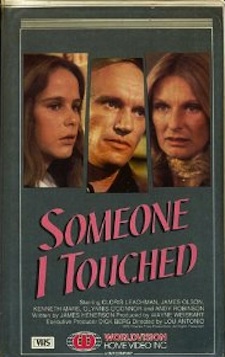
someoneitouch_225In the 1975 made-for-TV venereal disease epic Someone I Touched, there’s a scene of children’s author Cloris Leachman at work.  She’s sitting in her office, typing away on a manual typewriter.  Directly behind her is a crude drawing of a clown.  And to the right of her, there’s a statue of the same creepy clown.  Eventually, her husband (played by James Olson) comes into the office and, after a very long argument, finally forces himself to confess that, as the result of a one-night stand with a grocery store cashier (Glynnis O’Connor), he has syphilis.  And it’s possible that Cloris now has syphilis herself.  And, since Cloris is pregnant, it’s also possible that their baby may be born with syphilis.

And it’s all very serious and very dramatic and certainly, it’s nothing to laugh at.

But, I have to admit, that I could not stop thinking about that creepy clown.  And I have to admit that as Cloris was stumbling back in shock, I started to giggle because I just couldn’t stop thinking about what it must be like to work in an office surrounded by creepy clowns.  It made me think about The Sims and how, if your sims ended up getting depressed, the tragic clown would arrive and just makes things worse.

That’s the thing with Someone I Touched.  It’s a very serious film and yet it’s almost impossible to take that seriously.  Whenever a helpful health worker (Andy Robinson, the Scorpio Killer from Dirty Harry) shows up to dispense statistics or the cashier attempts to track down everyone that she’s ever had sex with or Cloris and Olson start to argue about the sad state of their marriage, you’re very aware that the film is dealing with some serious subject matter.  And yet, you can’t take it seriously because of all the little details.  You find yourself fixated on how ugly 70s interior design truly was.  You watch this tiny vein in Olson’s forehead and you worry if it’s going to explode during some of his more dramatic scenes.  You listen to dialogue like, “It (syphilis) can be a real drag if you don’t take care of it” and “Tramps get Syphilis!”  You realize that Leachman is supposed to be playing someone in her mid-30s, even though she was 49 when the film was made.  You listen as Olson explains his recent one night stand by saying, “I was looking down the barrel of my 40th birthday,” despite the fact that Olson looks like he’s in his mid-50s.  And let’s not forget those creepy clowns…

And you just can’t take the movie seriously.  You know that you should but you just can’t.  How could one well-intentioned film produce so many involuntary giggles?

Now, I know you’re probably thinking to yourself, “I would never watch a movie like that!”  But, if you change your mind, Someone I Touched is currently available on Netflix streaming.


Embracing the Melodrama Part II #52: Best Friends (dir by Noel Nosseck)


best-friends-lobby-3So, this is kind of a weird one.

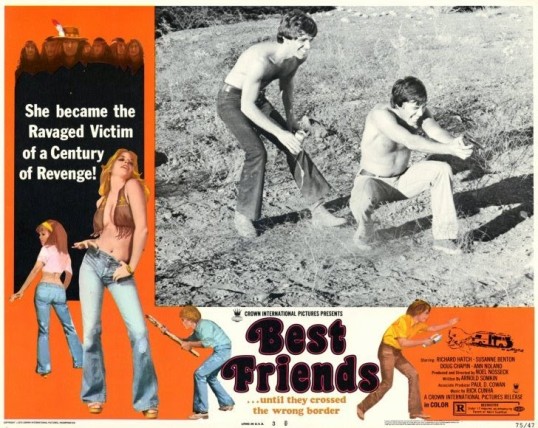
If the 1975 film Best Friends is known for anything, it’s probably the poster above.  As you can see, it features two women, being watched over by a shadowy group of Native Americans.  That tagline reads: “She became the ravaged victim of a century of revenge!”

Now, it’s often said that the above image has absolutely nothing to do with the actual film.  That’s actually not quite true.  There is a very brief scene where a woman and her boyfriend are at a bar and the boyfriend goads her into doing an impromptu striptease.  Sitting in the audience are some glowering American Indians.  There is a minor confrontation but otherwise, that’s it.  Nobody becomes “the ravaged victim of a century’s revenge.”  Instead, it was simply a marketing plot, used to draw audiences to a film that might otherwise have struggled to have been seen.

Perhaps not surprisingly, Best Friends is a Crown International Production.

CIP_LogoAs for what Best Friends actually is — well, it’s not easy to say.  It’s a very odd and very dark film, one that deals with characters who are ambiguous in more ways than one.  It’s one of those films that would be forgotten if it hadn’t, by chance, been included in a few dozen Mill Creek box sets and yet, from what I can tell, it has made an impression on just about everyone who has seen it.

In many ways, it’s a film that could only have been made in the 1970s.  Pat (Doug Chapin) and Jesse (Richard Hatch) served in Vietnam together and have remained close friends in America.  Jesse is serious and centered.  Pat is wild and impulsive.  Jesse has rented an RV and plans to drive across America with his fiancée, Kathy (Susanne Benton).  Pat suddenly announces that he’s engaged to and maybe he and Jo Ella (Ann Noland) could join Jesse and Kathy on their trip.  Even though Kathy would probably rather not have to share the RV with Pat’s old air force friend and his overly unstable girlfriend, Jesse readily agrees.

Now, I know this all sounds like the setup for a celebration of bromance but Best Friends actually has something else on its mind.  From the minute that Jesse and Pat get in that RV, it becomes obvious that they don’t have as much in common as they once did.  Jesse has matured.  He’s looking forward to the future and he wants to spend his time with Kathy.  Pat, however, is still obsessed with the past and wants to spend all of his time with Jesse.

As they drive across the country, Pat’s behavior starts to become more and more obsessive.  He cruelly breaks off his engagement with Jo Ella and then appears to be personally insulted when Jesse doesn’t do the same with Kathy.  He even buys a motorcycle so that he can ride behind, in front of, or next to the RV, as if the idea of even being inside of Jesse’s domesticated world would contaminate him.

And, since this is a Crown International Picture, Pat isn’t hesitant about using violence to try to keep Jesse and Kathy apart…

So, what is Pat’s problem?  A lot of reviewers have suggested that Pat is in love with Jesse and they’re probably right.  What’s interesting is that, consider that he’s the film’s nominal hero, Jesse isn’t that sympathetic of character.  If anything, he comes across as being a wimp, a guy who says he loves his fiancée but still won’t stand up for her.  As the film progresses, Jesse’s inherent impotence becomes both more obvious and more annoying.  By the end of the film, after all of the tragedy has played out, you can’t help but feel that Jesse and Pat don’t deserve any better than each other.

Best Friends is a deliberately paced and rather haunting little film.  It’s definitely one of the best of the many films to come out of Crown International Pictures.

Embracing the Melodrama Part II #51: Walking Tall Part 2 (dir by Earl Bellamy)


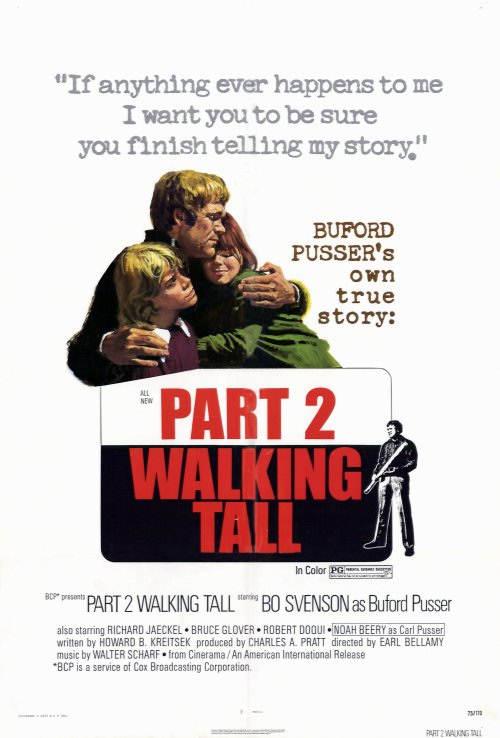
Film_Poster_for_Walking_Tall_Part_2The 1975 southern melodrama Walking Tall Part 2 opens with a voice over telling us that we’re about to see more of the true of story Sheriff Buford Pusser, the Tennessee lawman who carried a big stick, battled the Dixie Mafia, and whose wife was killed in an ambush.  Pusser, we learn, died under suspicious circumstances shortly after the release of the film Walking Tall.

Mere hours before he died, Pusser had signed a contract to play himself in Walking Tall Part 2.  As a result of Pusser’s car “accident,” the film’s producers were forced to cast an actor as the lawman.  Now, it would have made sense to, once again, give the role to Joe Don Baker.  After all, he played the role in Walking Tall and I imagine that to most audiences at that time, he was Buford Pusser.  However, for whatever reason, Baker was not given the role for a second time.  Instead, the role was given to Bo Svenson and, while Svenson does not necessarily do a bad job in the role, he’s still no Joe Don Baker.  The difference between Baker and Svenson is the difference between someone being a redneck and someone just pretending.

The film opens almost immediately where Walking Tall ended.  Terribly wounded in the ambush that took his wife’s life, Buford is in the hospital and his face is covered in bandages.  Townspeople gather outside both his room and his farm and they wonder whether he’ll run for reelection as sheriff.  Someone else mentions that Buford has had massive facial reconstructive surgery.

Finally, the bandages are removed and we discover that Buford has turned into Bo Svenson.  Now, Svenson and Baker do have enough facial similarities that you can force yourself to believe that surgery could lead to Baker having Svenson’s features.  I mean, this isn’t like Mark Ruffalo taking over the role of Bruce Banner from Edward Norton.  At the same time, it’s hard not to wonder how reconstructive surgery could have led to Buford Pusser becoming a blonde or, for that matter, apparently growing by 5 inches between Walking Tall and Walking Tall Part 2.

Anyway, Buford’s out of the hospital and, of course, he’s reelected as sheriff.  One thing that quickly becomes apparent is that everyone in the world totally loves Buford Pusser.  I lost track of how many characters specifically walked up to Buford to tell him that he was a great man and a great sheriff.  Nobody complains about Buford’s habit of ignoring civil liberties while enforcing the law.  Instead, everyone cheers for him.

(And, just in case the viewer is uncomfortable with the sight of the very white Buford taunting the mostly black moonshiners that he spends the film arresting, Buford’s black deputy constantly says stuff like, “Buford, you’re my kind of sheriff!”)

The only people who don’t like Buford are the local crime lords.  They still want Buford dead so they hire a race car driver (Richard Jaeckel) to kill him.  The race car driver’s girlfriend (Angel Tompkins) attempts to hit on Buford but Buford has no interest in her.  Buford’s about enforcing the law and avenging his wife…

Walking Tall Part 2 is a pretty standard film.  Whereas the original Walking Tall had a raw and unpredictable vibe to it, the sequel is predictable and boring.  On the plus side, the film was made on location in rural Tennesee and some of the countryside is nice to look at.

As for Buford Pusser, he died before Part Two was released but the character would return in Walking Tall — The Final Chapter.

Embracing the Melodrama Part II #50: Hustling (dir by Joseph Sargent)


hustling21I have to admit that I had ulterior motives for reviewing the film Hustle as a part of Embracing the Melodrama.  I was already planning on reviewing another 1975 film about prostitutes, one that I had recently watched on Netflix.  That name of that film was Hustling and, for whatever reason, it amused me to imagine being alive in 1975 and going to see Hustle at a movie theater and then coming home, turning on TV, and finding myself watching a film called Hustling.

So really, if I was going to review one of those films, I had to review the other, right?  It made perfect sense at the time!

Anyway, as for Hustling, it’s a film about prostitutes in New York and the wealthy magazine writer who decides to interview them for an article.  Watching the film, what I immediately noticed was that, even though the film had a properly gritty feel to it, none of the characters ever cursed and, for a film about sex workers, there was no nudity.  Though the characters continually talked about getting beaten up by their pimps, all of the violence occurred off-screen.  Even more importantly, whenever something dramatic happened, the scene would fade to black.  It was almost as if the movie was pausing for an unseen commercial.

Which, of course, it was.  Hustling was made for television and, as I watched it, it was easy for me to imagine that I was actually watching the latest Lifetime original film.  It certainly followed a pattern that should be familiar to anyone who has ever watched a movie on Lifetime.  Wanda (Jill Clayburgh, giving an excellent performance) is a veteran prostitute who, after being arrested for the hundredth time, is told that the charges against her will be dropped if she allows herself to be interviewed by magazine writer, Fran Morrison (Lee Remick).  At first Wanda refuses but, after her pimp refuses to pay her fine and suggests that she should just accept spending a few months in jail, Wanda reconsiders and accepts Fran’s offer.

The rest of the film charts Fran and Wanda’s unlikely friendship.  Wanda tells Fran what it’s like to be prostitute.  Fran encourages Wanda and the other prostitutes to stand up for their legal rights.  Wanda deals with a society that looks down on her.  Fran deals with a boyfriend (Monte Markham) who can’t understand why she’s so concerned about a bunch of prostitutes.  Wanda considers going back to her pimp.  Fran considers exposing all of the “respectable” men who use prostitutes.

So, Hustling is pretty predictable and, not surprisingly, rather dated but it’s also a fairly effective portrait of life on the margins of society.  Lee Remick is stuck playing a one-note character but Jill Clayburgh is great in the role of Wanda. If nothing else, Hustling was filmed on location in some of the sleaziest parts of 1970s New York City and therefore, the film serves as a bit of a historical document.

For those wishing to check it out, the film’s currently available on Netflix.

Embracing the Melodrama Part II #49: Hustle (dir by Robert Aldrich)


HustleContinuing our journey into the dark Hell of the 1970s, we now take a quick look at the 1975 cop film, Hustle.

Taking place in Los Angeles, Hustle tells the story of several different people who find their lives intertwined in the desperate dance of existence.  (Does that sound overdramatic?  Well, that’s the type of film that this is.)

There’s Leo Sellers (Eddie Albert), a lawyer with bright rosy cheeks and a friendly manner.  You look at Leo and you automatically assume that he must be a nice guy, the type of guy who puts on a fake beard and plays Santa Claus down at the local orphanage.  But actually, Leo is a lawyer for the mob.  He’s gotten rich through crime and his mansion hides all sorts of secrets.  He also has a weakness for violently abusing prostitutes.

Speaking of prostitutes, one of Leo’s favorite is Nicole (Catherine Deneuve), an icy French beauty who survives by holding the world at a distance.  Though Nicole doesn’t like Leo, she has to keep him happy because Leo could easily arrange for her to be deported back to France.

Nicole is also the girlfriend of Phil Gaines (Burt Reynolds), a cynical homicide detective who, like her, tries to keep the world at a distance.  Phil is obsessed with old films and frequently speaks of how much he wishes the real world could be like a movie.  Throughout the film, he talks about eventually moving to Rome.

Phil’s partner is Louis Belgrave (Paul Winfield), who is not quite as cynical as Phil but who is definitely getting there.  Whereas Phil is always talking about how much the world has disappointed him, Louis mostly accepts things without complaint.  He just wants to do his job and go home at the end of the day.

Phil and Louis’s boss is Santoro (Ernest Borgnine, giving a typical Ernest Borgnine performance).  Santoro is not a bad guy but, in order to hold onto his job, he has to keep powerful men like Leo Sellers happy.

Santoro also has to deal with the complaints of people like the Hollingers.  Marty Hollinger (Ben Johnson) is a veteran of the Korean War and handles the world in a gruff and suspicious manner.  Paula (Eileen Brennan) is Marty’s wife and, as a result of his emotional distance, has recently started having an affair.

And then there’s Gloria (Colleen Brennan), Marty and Paula’s daughter.  Gloria ran away from home a while ago and soon found herself working as a stripper, a porn actress, and eventually as a prostitute.  When Gloria is found dead, Phil and Louis get the case.  It’s obvious to them that Gloria committed suicide.  It’s not so obvious to Marty, who is convinced that his daughter was murdered and, disgusted by Phil’s cynical attitude, sets out to investigate the case on his own.

One of the more interesting things about Hustle is that really is no murder mystery.  Despite what Marty believes, Gloria really did commit suicide.  Marty’s insistence that she was murdered has more to do with his guilt over being a bad father than it does with any real evidence.  As Marty investigates his daughter’s life, he is exposed to a sordid world of strip clubs and prostitution.  He discovers that Gloria’s clients included many powerful men and he decides that the last client she saw must have murdered Gloria.

That client is Leo Sellers.  And while Leo may not have murdered Gloria, he is willing to kill Marty to keep his secret life from being exposed.  Phil and Louis are forced to choose between remaining detached or protecting Marty from himself.

And, since this film was made in the 70s, it all ends on a really dark note!

Hustle shows up on Encore occasionally.  It’s a strange film to watch, as it alternates between being a fairly predictable cop film and being a portrait of existential dread.  The movie doesn’t really work; it’s too long, it features some amazingly pretentious dialogue, and Reynolds, Winfield, and Deneuve all seem to be bored with their characters.  Probably the film’s best performance comes from Ben Johnson.  I imagine that has to do with the fact that Johnson is playing the only character who behaves in a fairly consistent way.

And yet, if you’re like me and you’re fascinated with the nonstop fatalism of 70s cinema, Hustle does have some historical value.  It’s one of those films that you watch and you wonder how anyone survived the 1970s!

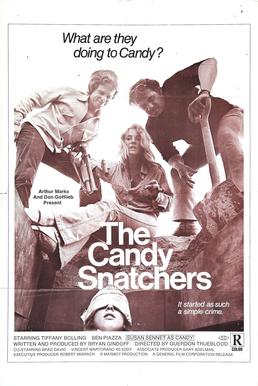
Embracing the Melodrama Part II #48: The Candy Snatchers (dir by Guerdon Trueblood)


The_Candy_Snatchers_Poster

(SPOILER ALERT)

Do you remember how, just last night, I described The Sister-in-Law as being one of the darkest films ever made?  Well, I stand by that description but, believe it or not, there was another low-budget thriller that was released in 1973 and which is even darker than The Sister-In-Law!  Compared to this film, The Sister-in-Law is a life affirming comedy.

The Candy Snatchers begins with Catholic school student Candy (Susan Sennet) walking home.  As a song called “Money Is The Root Of All Happiness” plays on the soundtrack, we watch Candy as she makes her way across the city.  However, we’re not the only ones watching Candy.  There are also three people in a van and they’re slowly following behind Candy.  They’re also wearing fake noses and glasses.

Despite the elaborate disguises, it’s not difficult to tell the three of them apart.  Jessie (Tiffany Bolling) is their leader, a high-strung woman who always seems to be on the verge of an emotional breakdown.  Alan (Brad David) is her brother and brags that he’s killed twelve people so far and he’s looking forward to adding more to the count.  Their partner is Eddy (Vince Martorano), an overly sensitive criminal who wants to make some money but who doesn’t want to hurt anybody.  Their plan is to kidnap Candy.

(Hence, the Candy Snatchers!)

See, they’re under the impression that Candy’s father, Avery (Ben Piazza) owns a jewelry store and, that by kidnapping Candy, they’ll be able to get him to pay them a ransom.  Pulling up beside her while she attempts to hitchhike home, the three kidnappers grab Candy, pull her into the van, and blindfold her.  They drive up to the mountains and bury Candy in a wooden box, leaving her with a breathing tube to make sure that she doesn’t suffocate.  They then call Avery and give him their demands.

The problem is that the kidnappers haven’t done as thorough a research job as they thought they had.  What they did not realize is that Avery doesn’t own the jewelry store.  Instead, he’s just the manager.  Even worse, it turns out that Avery is not Candy’s father.  Instead, he has just recently married Candy’s mother for her money.  As Avery cheerfully explains, with Candy out of the way, he now stands to inherit $2,000,000 when Candy’s mom dies.

In other words, the kidnappers are now stuck with Candy.

After retrieving her from her underground prison, Alan wants to rape Candy while Jessie wants to kill her.  Eddy, however, feels sorry for Candy.  After telling his two partners that he’s going to kill her, Eddy takes Candy back up to the mountains.  Again, he buries her alive but he promises her that he will return to dig her up as soon as he takes care of his partners.

What Alan, Jessie, and Eddy don’t realize is that all of this is being witnessed by Sean (played by Christophe, the actor’s son), an autistic child who apparently cannot speak.  Candy begs Sean to let someone know where she is but every time that Sean tries to get the attention of his loathsome parents, they either ignore him or they beat him.

By the end of the film, Jessie, Alan, and Candy’s mother are all dead.  When Eddy returns to Candy’s grave, he gets into a gunfight with Avery.  Eddy manages to kill Avery but, before he can dig up Candy, he’s shot in the back.  As he turns around, he sees that he’s been shot by Sean, who has picked up Avery’s gun.  Eddy tumbles down the mountain.  Sean goes back to his house and apparently shoots his abusive mother.  The movie ends with the sound of Candy struggling to breathe underground…

AGCK!

Seriously, I am totally claustrophobic so the end of The Candy Snatchers is pure nightmare fuel for me.  To be honest, the whole film is nightmare fuel.  There’s only two likable characters in the entire film and, as the end credits roll, Sean has just killed his mother and Candy is slowly suffocating underground.

As dark as The Candy Snatchers may be, it’s still strangely watchable and compelling.  It’s not a film that I would recommend to anyone getting over a serious bout of depression but still, it’s a well-acted, well-directed, and consistently surprising film.  In fact, I would say that it’s probably one of the best grindhouse films ever made.

That said, you do have to wonder just how depressing life was in 1973.  Between this film and The Sister-in-Law, I’m surprised humanity survived to see 1974.